TECHNOLOGY EXPLAINER
Topological Quantum Computing
— A qubit as hard to unpick as a knot: the idea, and what can be confirmed today
Qubits are spoiled by the slightest disturbance from their surroundings. So there is an idea: if information is stored in a form that small disturbances cannot change, qubits could be far more resistant to errors. That is topological quantum computing, and its leading candidate is the Majorana quasiparticle, a state expected at the two ends of a semiconductor nanowire combined with a superconductor. This article explains the idea with a knot analogy and diagrams, then covers the materials (InAs, InSb, Al, Pb and others) and the claims and disputes, setting official documents, papers and critical papers side by side. It does not settle on a conclusion: it separates what can be confirmed, what is disputed in interpretation, and what is not yet confirmed (checked 16 October 2026).
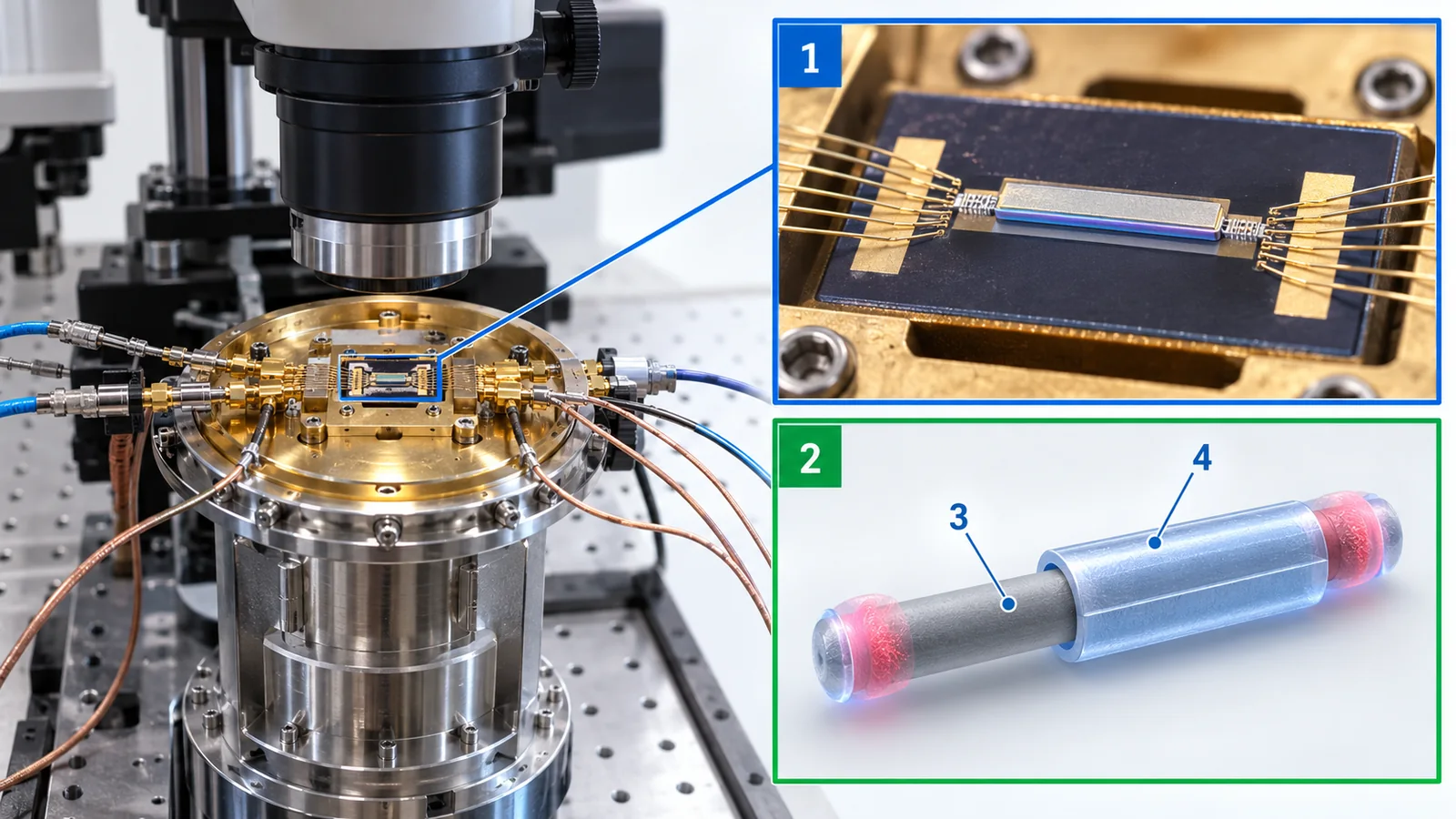
- What it does: store information in a “global property” (topology) that small local disturbances cannot change, to make an error-resistant qubit. The leading candidate is a pair of Majorana quasiparticles expected at the two ends of a nanowire, which keep information as whether the number of electrons is even or odd (parity)
- Where things stand: the theoretical appeal is large, but as of the check date the stage of “a topological qubit has been made, as confirmed by third parties” has not been reached. A company claims to have made one; the journal's editorial team noted that the results of the paper do not represent evidence for Majorana zero modes in the reported devices; critical papers have been published, and the company has replied
- The most important point: “a signal was measured” and “the signal may be interpreted as topological” are separate questions. If you keep track of which one is being discussed, many conflicts in news coverage become easier to sort out
It helps to know that a qubit can be drawn as an arrow from the centre of a sphere to its surface (north pole = 0, south pole = 1, tilted = superposition; if this is unfamiliar, the text explains what is needed). For superconductors, it is enough to know they are materials whose electrical resistance drops to zero.
Where this fits in the seriesRead this after our explainers on quantum computing fundamentals, quantum gates and circuits, and quantum error correction and the surface code. Comparing the usual way (protect a logical qubit with many qubits) with this article's way (protect it with a property of matter) shows how the two ideas differ. Superconductors and circuits are covered in our explainer on superconducting qubits, semiconductor quantum dots in our explainer on quantum dots, refrigerators in our explainer on cryogenics and control, and the overall materials and fabrication picture in our explainer on materials and fabrication for quantum computers.
Topological quantum computing is a subject on which claims and the state of papers and expert debate diverge. So this article does not settle on either conclusion. It writes in three categories.
1. What can be confirmed: what is written in papers and official documents (for example what was measured and what values were reported, or what a journal's editorial team wrote).
2. Points where interpretation is disputed: where other researchers interpret the same data differently. Both sides are placed next to each other, with sources.
3. Points not confirmed: things we could not confirm from primary sources within this survey. We do not fill them with guesses.
Company announcements are treated as “company claims” and plans as “not yet confirmed,” and we do not rate the standing or character of any company or researcher. The claims of critics and the replies of those criticized are both conveyed as they are, to the extent sources allow.
- Why “topological”? — the knot analogy
- Anyons and braiding — computing by exchanging particles
- Majorana quasiparticles and parity — storing information at the ends of a nanowire
- Materials — nanowires, superconductors and the interface
- Looking at the numbers — gaps, temperature and parity lifetime (our calculation)
- Claims and disputes — what is confirmed, what is disputed, what is not confirmed
- Other routes — chains built from quantum dots, and reproduction on quantum computers
- What we could not confirm, and a summary
- How to read evaluations and standards
- Glossary
- References (primary sources)
- Claim-to-source audit
Sourced = stated in a published source (with a link). It means a reported measurement exists and does not guarantee that its interpretation is correct
Our calculation = a value this article computed from stated assumptions
Not yet confirmed = plans, targets, items under review, matters still disputed and so on
Our reading of what this means for materials is marked as commentary. Inference is shown in bold. Company announcements are treated as “company claims” and do not imply independent confirmation.
The calculations in Chapter 5 are our calculations using numbers from the sources; assumptions such as temperature are examples. Device performance values (gap, parity lifetime and so on) include values from company preprints (not yet peer-reviewed) and are company claims. A laboratory best value, or the result of a single device, does not imply reproducibility or the performance of production devices. For any claim of “how many qubits,” always check whether it counts physical or logical qubits, and whether the qubits have been shown to operate as qubits (every number in this article is a number of physical devices or a design number, not logical qubits).
1. Why “topological”? — the knot analogy
First, qubits are fragile
A qubit's arrow gets blurred by the slightest disturbance from the surroundings (heat, fluctuating electric and magnetic fields, defects in the material). To prevent this, the mainstream approach today is error correction, in which many qubits together protect one logical qubit (see our explainer on quantum error correction and the surface code). It does, however, need a large number of qubits.
There is another idea: not “fix an error once it happens,” but store the information in a form that errors can hardly touch in the first place. Kitaev proposed that computing with excitations called “anyons” in a two-dimensional quantum system would be fault-tolerant by its physical nature Sourced [Ref. 1]. This is the starting point of topological quantum computing.
An everyday picture: a knot in a rope, and the hole in a donut
Suppose you tie a knot in a rope. Pinching a part of the rope and shaking it, or pulling it a little, does not remove the knot. To undo it, you must move the rope a lot and work on the whole. The knot is not about “one spot” in the rope; it is a property of the whole shape.
Another example is the hole in a donut. Make a donut out of clay and squash it into any shape; as long as you do not tear it or glue parts together, it keeps one hole. The number of holes is a property that does not change under continuous deformation. In mathematics, such properties are called topology.
Storing quantum information like a knot
The idea of topological quantum computing is to store the qubit's information in the “global property” of a material. A small surrounding disturbance is like “pinching one spot of the rope” and barely touches the global property (the information). This way of thinking is called “topological protection.” The review by Nayak and colleagues explains that the error resistance of this approach comes from encoding the quantum state non-locally, which makes it immune to errors caused by local perturbations Sourced [Ref. 3].
The knot analogy holds only as far as “the information lives in the whole rather than in a part, so local disturbances do not change it.” In real materials, there are disturbances that are protected against and disturbances that are not. If the rope itself is cut, or another rope tangles in, the knot is destroyed. For Majorana quasiparticles too, as we will see, the entry of extra particles from outside (quasiparticle poisoning) is treated as an error that topological protection cannot prevent (Chapter 5).
Wrong: “it is protected by a property of matter, so no error correction is needed.” In fact: what is protected is a particular kind of error. The company's own future plan (roadmap) also includes stages that demonstrate quantum error detection and error correction on arrays of topological qubits (a company plan, Not yet confirmed) [Ref. 24]. So topological qubits are the hope that “the number of qubits needed for error correction may be reduced,” not that “errors vanish.” Whether that hope comes true is still to be checked.
2. Anyons and braiding — computing by exchanging particles
An everyday sense: swapping two strands
If you set three strands side by side and keep swapping left and right as time passes, the strands become braided. Think of a braided plait of hair. Which strands you swap, and in what order, changes the braid you end up with.
Exchanging particles is similar. If you draw particle positions with place on the horizontal axis and time on the vertical axis, each particle's path becomes a “strand.” Exchanging particles makes the strands cross.
The difference between three and two dimensions
In the three-dimensional space we live in, if you swap two identical particles and then swap them again, you always return to the start (because the strands can be moved in space to undo the crossing). Electrons and photons behave this way. But in a world confined to a two-dimensional surface, the crossings of strands can stay tangled. The history of the order of exchanges remains as a “tangle.” Particle-like objects (quasiparticles) with this property are called anyons (our explanation; for reviews see [Refs. 3, 4]).
Inside a solid, a great many electrons influence one another. When an excitation (a slightly higher-energy state) of that crowd moves as if it were a single particle, we call it a quasiparticle. It resembles a wave on a pond moving as a lump, but unlike a wave, a quasiparticle can be counted as one, two and so on. The anyons and Majoranas discussed here are not new elementary particles; they are quasiparticles that exist only inside matter.
“Non-Abelian” means the order changes the result
Among anyons, non-Abelian anyons are those for which the order of exchanges changes the state of the whole system. As an analogy, “put on socks and then shoes” and “put on shoes and then socks” give different results. This property that order matters can be used for quantum gates.
Computing with braiding and measurement
The review by Nayak and colleagues explains that in topological quantum computing, quantum information is stored in the states of groups of several quasiparticles (topological degeneracy), and the unitary operations needed for quantum gates are carried out by braiding the quasiparticles and then measuring the group state Sourced [Ref. 3]. Kitaev also writes that a measurement can be made by bringing quasiparticles together in pairs (fusion) and observing the result [Ref. 1].
In actual devices, however, designs have been proposed (measurement-only computation) in which, instead of physically moving particles around each other, a sequence of measurements realizes the same operation. Microsoft's future plan (roadmap) also includes a stage that performs single-qubit operations by “measurement-based braiding” (a company plan) Not yet confirmed [Ref. 24].
Majorana quasiparticles at the ends of a thin one-dimensional wire are thought to allow braiding equivalent to exchanging particles if the wires are joined into a network. The overview by Das Sarma and colleagues says that well-separated Majorana zero modes (MZMs) should show non-Abelian braiding statistics suitable for unitary gate operations Sourced [Ref. 4]. It helps to think of “a network of wires standing in for a two-dimensional surface” (our explanation).
3. Majorana quasiparticles and parity — storing information at the ends of a nanowire
What a Majorana quasiparticle is
Electrons have “antiparticles” (partners with the opposite sign of electric charge). A Majorana particle is a special kind of particle for which the particle and the antiparticle are the same. The Majorana quasiparticle discussed here is not an elementary particle but a quasiparticle that exists only inside matter, an excitation that is its own antiparticle (as the opening of the paper by Mourik and colleagues puts it, Majorana fermions are particles identical to their own antiparticles, predicted to exist in topological superconductors [Ref. 7]).
In 2010, Lutchyn and colleagues and Oreg and colleagues proposed that if a superconductor is brought into contact with a semiconductor nanowire (with strong spin-orbit coupling) and a magnetic field is applied, the wire enters a topological superconducting state and Majorana quasiparticles appear at its two ends Sourced [Refs. 5, 6, 15]. The root of the idea is the model Kitaev presented in 2001, in which “unpaired Majoranas” appear at the ends of a one-dimensional chain [Ref. 2].
One qubit from two ends — the tally-stick analogy
Suppose there is one Majorana quasiparticle at each end of a wire. These two together form one ordinary electron state. That state has two possibilities, “one electron present” or “absent,” called parity (whether the number of electrons is even or odd). These two possibilities are used as the qubit's 0 and 1.
Think of a tally stick. Split one stick in two and put each half at opposite ends. Examining only one half tells you nothing about the content of the whole stick. You can only tell whether it is the original stick by putting the two halves together. For Majorana quasiparticles too, examining only one end does not reveal the parity (the information). The information spans the two ends, and a local disturbance can touch only one end. This is the source of the protection.
Limits of the analogy: halves of a tally stick become two separate objects once split. The two Majoranas are the two ends of a single quantum state that cannot be divided, not detachable parts. Also, if an electron from outside enters at one end, the parity changes (this is quasiparticle “poisoning”; Chapter 5).
View original SVG, values and sources
Original SVG reference: Conceptual diagram (vector drawing). Top: a sketch of a device in which a semiconductor nanowire covered by a superconductor is placed in a magnetic field, with Majorana quasiparticles (γ1, γ2) expected at the two ends. Bottom: the single state formed by the two ends becomes the qubit's 0 and 1 as the parity of the electron number. The layout and dimensions are illustrative and do not accurately depict the structure of any real device [Refs. 2, 5, 6].
Does a longer wire reduce errors exponentially? — our calculation
Kitaev wrote that a one-dimensional system of length L has two ground states of different parity whose energy difference becomes smaller in proportion to exp(−L/ℓ0) Sourced [Ref. 2] (ℓ0 is a length set by the material). The smaller the energy difference between these two states, the harder it is to tell them apart, so the parity information becomes more robust against disturbance. Kitaev adds that such a system can be used as a qubit and is intrinsically immune to decoherence [Ref. 2].
Let us check the meaning of this formula with numbers. The exponential e−L/ℓ0, where L/ℓ0 is how many times longer the wire is than the characteristic length, shrinks quickly as follows (the simplest estimate, ignoring the prefactor).
| L / ℓ0 | e−L/ℓ0 | How to read it |
|---|---|---|
| 5 | about 6.7 × 10⁻³ | about 1 in 150 |
| 10 | about 4.5 × 10⁻⁵ | about 1 in 22,000 |
| 20 | about 2.1 × 10⁻⁹ | about 1 in 500 million |
| 35 | about 6.3 × 10⁻¹⁶ | about 1 in 1,600 trillion |
Calculation: e−x (Our calculation). The “35” is an example using values from the company's preprint (wire length 3.5 µm; minimum coherence length expected for a clean system about 100 nm), the ratio 3.5 µm / 100 nm = 35 [Ref. 27]. In real devices, however, disorder and finite temperature mean this simple formula does not hold exactly.
Wrong: “it is an exponential, so lengthening the wire a little makes errors nearly vanish.” In fact: this formula protects only against errors in which “the states of the two ends leak and mix quantum-mechanically.” There is also parity flipping caused by quasiparticles entering from outside (quasiparticles produced when, for example, residual radiation breaks superconducting electron pairs), and that is set by the gap, materials and environment, not by wire length. The company's preprint also writes that a large topological gap suppresses thermally activated excitations but does not protect against quasiparticles far from equilibrium (a company claim) [Ref. 27].
How is parity read out?
Parity is whether the electron number is even or odd, and it is hard to learn by measuring the charge at one spot (the QuTech work confirms that the two parity states of a minimal chain are charge-neutral and cannot be told apart by a measurement that does not couple the two modes [Ref. 36]). So a semiconductor quantum dot is connected to the wire, and the fact that the quantum capacitance of the dot (the tiny electrical-capacitance response to electrons coming and going) changes slightly with parity is used for readout. Microsoft's 2025 Nature paper reported a single-shot interferometric measurement of parity using this method in an InAs and Al device. It writes that the capacitance change of the quantum dot is up to about 1 fF, the measurement's signal-to-noise ratio is 1 in 3.6 µs, and the dwell time in the two states exceeded 1 millisecond at an in-plane field of about 2 tesla Sourced [Ref. 18]. The same paper itself states that the measurements can be interpreted in terms of both topologically trivial and non-trivial origins [Ref. 18].
The basic unit of Microsoft's devices is called a “tetron,” an H-shaped island in which two parallel nanowires are joined by a backbone of ordinary superconductor. Each of the two wires is expected to have Majorana quasiparticles at both ends (four in total), and if the total parity is fixed, the remaining degree of freedom becomes the qubit. The design measures the Pauli operators X and Z with separate readout circuits (a company claim and design) Sourced (that the design is described) [Refs. 25, 27].
4. Materials — nanowires, superconductors and the interface
What this approach needs from materials
Translated into materials terms, what the proposals of Lutchyn and colleagues and Oreg and colleagues require is as follows Sourced [Refs. 5, 6, 15].
- Semiconductor: strong coupling between the direction of an electron's spin and its direction of motion (spin-orbit interaction), a large response to a magnetic field (a large g-factor), and low disorder (defects and impurities). InAs and InSb are used
- Superconductor: a large superconducting gap (the energy needed to break an electron pair) and tolerance of magnetic fields. Al, NbTiN, Pb and others are used
- Interface: the boundary between semiconductor and superconductor should be uniform at the atomic level and induce a “hard gap” (no extra states inside the gap) in the semiconductor
- Magnetic field: a field of several hundred millitesla up to about 2 tesla is applied (it depends on the device)
Why a “hard gap” is needed
Chang and colleagues write that earlier devices, in which a superconductor contacts a semiconductor, show a continuum of states inside the gap through which current flows (a soft gap), and that this nullifies topological protection Sourced [Ref. 8]. If there are many extra states inside the gap, the premise that “the gap protects it” fails. Chang and colleagues reported a hard gap in epitaxial (crystal-aligned) InAs and Al nanowires [Ref. 8]. Krogstrup and colleagues grew InAs/Al by molecular beam epitaxy, stated that an atomically uniform interface is the key to the quality of the induced gap, and wrote that the method “seems to solve the soft-gap problem” [Ref. 9]. The soft-gap problem itself is discussed in the paper of Takei and colleagues [Ref. 10].
Material combinations and reports so far
| Combination | Key points of the structure | Main reports (source) | Our reading |
|---|---|---|---|
| InSb nanowire + NbTiN contact | An ordinary metal contact and a superconducting contact on the nanowire | Mourik et al. (2012): observed states pinned at zero voltage in fields of about 100 mT; described as supporting the Majorana hypothesis [Ref. 7] Sourced | An early report. The quality of the gap (soft gap) remained an issue (commentary) |
| InAs/Al core-shell nanowire | Al grown as a single crystal on the InAs wire by molecular beam epitaxy | Krogstrup et al. (2015): atomically matched interface [Ref. 9]. Chang et al. (2015): hard gap [Ref. 8] Sourced | Interface uniformity decides the quality of the gap |
| InAs two-dimensional electron gas + Al (planar) | A thin wire defined by gate electrodes from a planar stack | Shabani et al. (2016): proposal that two-dimensional epitaxial superconductor-semiconductor heterostructures are a platform for topological superconducting networks (title) [Ref. 11]. Microsoft (2023): wires defined by gates in a high-mobility two-dimensional electron gas [Ref. 17] Sourced | The planar form makes it easier to connect devices in complex wiring patterns (design intent; commentary) |
| InAs (+InAsSb) well + Pb, GaSb substrate | About 10 nm of Pb on a stack of InAs and InAs0.8Sb0.2 wells, on a GaSb substrate | Microsoft preprint (June 2026, not peer-reviewed) [Ref. 27]. Numbers in Fig. 5 and Chapter 5 | A company claim (not peer-reviewed) Not yet confirmed |
| InSb/Al nanowire + quantum dots | Quantum dots linked by superconductors to build an artificial Kitaev chain | Dvir et al. (2023), Bordin et al. (2025) [Refs. 33, 35] Sourced | Another route (Chapter 7) |
The table is our own organization (Our calculation). It does not argue which combination is “right” or better.
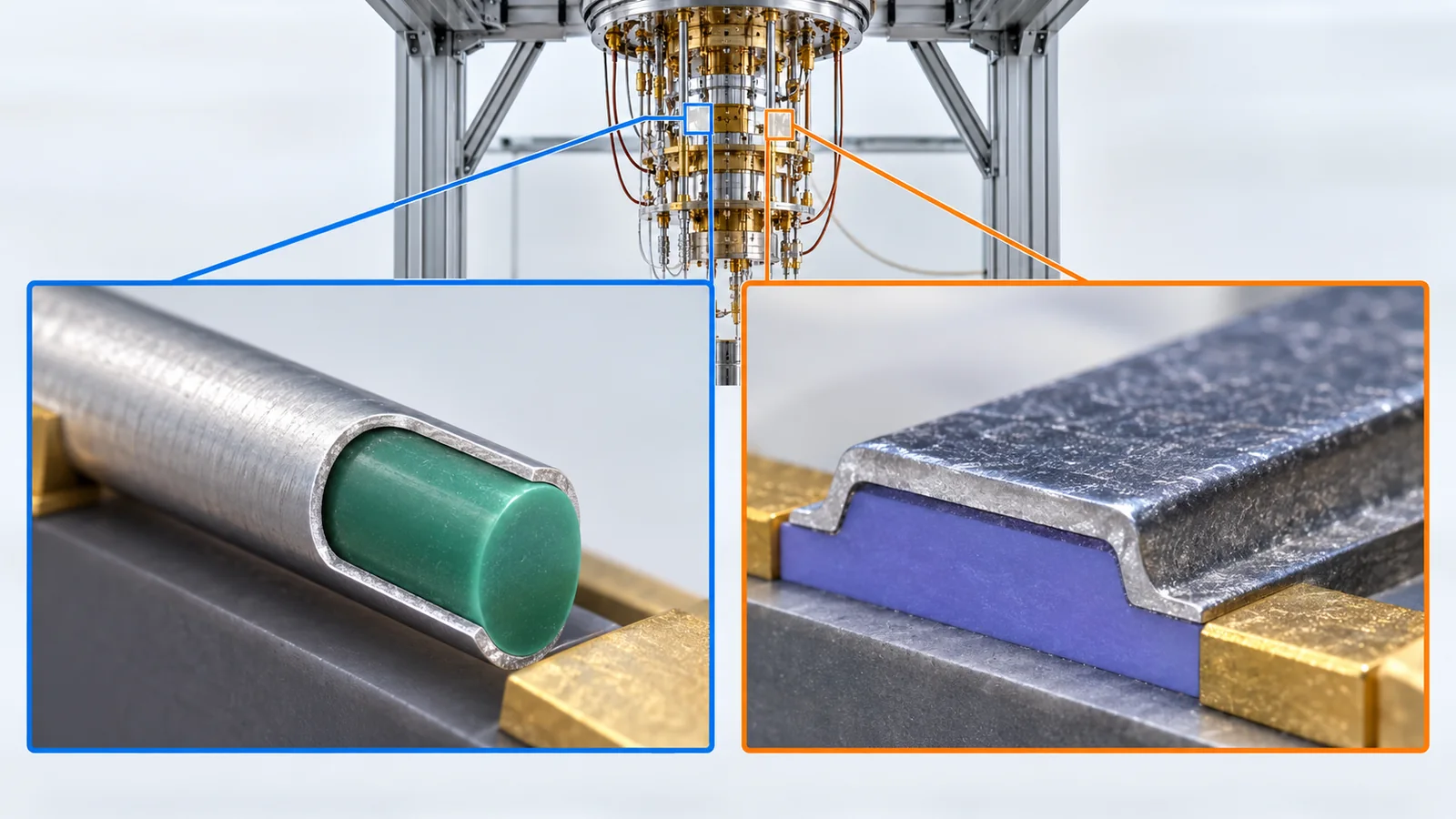
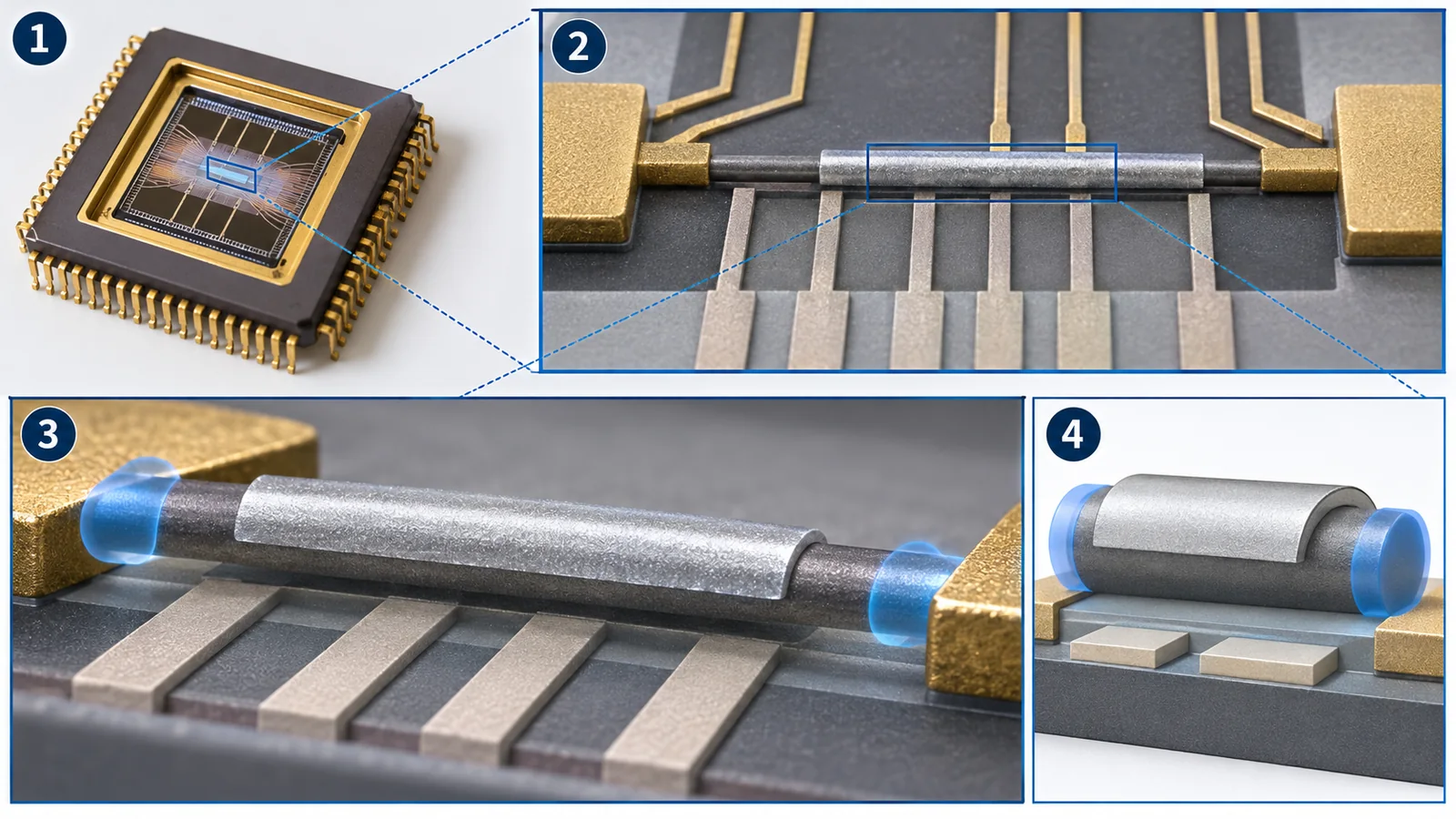
View original SVG, values and sources
Original SVG reference: Conceptual diagram (vector drawing). An example of superconductor and semiconductor stacks. The layer structure and numbers of (b) are as described in Microsoft's preprint (June 2026, not peer-reviewed) [Ref. 27] and are company claims. (a) is a generic sketch of a conventional Al-based stack and does not show layer thicknesses or compositions. It is not to scale.
In this approach, the interface between semiconductor and superconductor directly decides the device's performance (the quality of the induced gap). Krogstrup and colleagues state that atomic-scale uniformity is decisive [Ref. 9]. The perspective by Frolov and colleagues also names the quality of the superconductor-semiconductor interface as a very important factor for future progress, and discusses how far the materials science of these interfaces can take it Sourced [Ref. 15]. For example, the surface of freshly grown InAs changes its properties if it oxidizes or has defects. The paper by Pauka and colleagues deals with ways to “repair” the surface of InAs-based topological heterostructures (as given in the title) [Ref. 12]. For a materials engineer, this is a field where the order of deposition, whether the vacuum is broken (whether the superconductor goes on in situ), and surface treatment directly become the yield of quantum devices (our commentary).
According to Microsoft's preprint, the superconductor was changed from Al to Pb, and the semiconductor to an InAs/InAsSb well on a GaSb substrate. The parent gap of Pb is large, about 1.3 meV, and so the induced gap is also large. The GaSb substrate allows lattice-matched growth of the whole semiconductor stack (which reduces defects) and makes larger spin-orbit coupling easier to obtain than on InP substrates, the preprint explains (a company claim) [Ref. 27]. On the other hand, it also says that the thickness and composition of the upper barrier were tuned to avoid degrading the g-factor and spin-orbit coupling while keeping a large induced gap [Ref. 27]. So the choice of materials is a tuning of trade-offs, where raising one performance lowers another (our commentary). These numbers are company claims, not yet peer-reviewed, and reproduction has not been confirmed.
The same preprint expresses material quality in numbers such as mobility (above 350,000 cm2/Vs in a buried well), quantum lifetime (0.37 ± 0.14 ps) and localization length (above 1 µm in the lowest subband), and says that this localization length comfortably exceeds the minimum topological coherence length expected for a clean system (about 100 nm) (a company claim) [Ref. 27]. This is a typical way of quantifying electrically the claim that “the disorder is small enough.” From the materials side, whether other laboratories can reproduce the same values, and whether the data are published for checking, is a guide to trust (commentary; Chapter 6).
5. Looking at the numbers — gaps, temperature and parity lifetime (our calculation)
Is the gap large enough compared with temperature?
The “topological gap” of a topological superconductor (the energy wall that protects the information) must be sufficiently larger than the thermal jitter. How easily heat lifts an excitation over this wall is roughly proportional to exp(−Δ/kBT) (our explanation; a general estimate at thermal equilibrium). As in our explainer on silicon spin qubits, let us convert energy to temperature (1 µeV corresponds to about 11.6 mK).
| Gap Δ | Temperature equivalent Δ/kB | Δ/kBT at 20 mK | exp(−Δ/kBT) | Source of the gap |
|---|---|---|---|---|
| 20 µeV | about 0.23 K | about 11.6 | about 9.1 × 10⁻⁶ | Lower end of the range of 20 to 60 µeV reported as maximum for Al-based devices [Ref. 17] |
| 30 µeV | about 0.35 K | about 17.4 | about 2.8 × 10⁻⁸ | Top-quintile value of Al-based devices (as described in the preprint) [Ref. 27] |
| 60 µeV | about 0.70 K | about 34.8 | about 7.6 × 10⁻¹⁶ | Upper end of the range reported for Al-based devices [Ref. 17] |
| 70 µeV | about 0.81 K | about 40.6 | about 2.3 × 10⁻¹⁸ | Top-quintile value of Pb-based devices (as described in the preprint, not peer-reviewed) [Ref. 27] |
Calculation: Δ/kB (kB = 86.17 µeV/K) and exp(−Δ/kBT) (Our calculation). The temperature of 20 mK is an example of a refrigerator's operating temperature, not the actual temperature of each device. The gap values are those reported by the topological gap protocol (TGP), whose validity is disputed (Chapter 6).
The table estimates “quasiparticles excited naturally by heat.” In practice, however, separately from the thermal excitation estimated from the refrigerator temperature, quasiparticles out of thermal equilibrium can be produced, for example by residual radiation. The company's preprint gives the example of residual radiation passing through shielding and breaking electron pairs, and writes that a large gap suppresses thermal excitation but does not protect against quasiparticles far from equilibrium (a company claim) [Ref. 27]. That is why the time over which the parity actually flips (the parity lifetime) has to be measured and shown directly (next section).
Parity lifetime — longer is better, but what was measured?
The parity lifetime is the typical time until parity flips. To use parity as a qubit, this lifetime must be far longer than the operation time (about a microsecond). The figure below places reported values on a logarithmic scale.
Let us sort out what the numbers mean. The Z parity lifetime shows how long the parity itself is kept, and is reported as 12.4 ms for the Al-based tetron and about 20 s for the Pb-based preprint (company claims) Sourced [Refs. 25, 27]. 20 s / 12.4 ms is about 1,600 times, and 20 s / 1 µs (the operation-time guide) is about 2 × 10⁷ times Our calculation.
To work as a qubit, however, an X measurement (parity inside the wire) is also needed. In the X loop of the same Al-based tetron, the parity flips quickly, in 14.5 µs, and the estimated measurement assignment errors are reported as 16% for X and 0.5% for Z Sourced [Ref. 25]. The ratio of the Z and X lifetimes is 12.4 ms / 14.5 µs = about 855 Our calculation. What the 2026 preprint shows is a Z measurement; an X measurement could not be found in the preprint's text (our reading). So “the parity lifetime became 1000 times longer” is not the same as “the time a qubit can be used became 1000 times longer.”
Wrong: “it holds for 20 seconds, so it can be used as a qubit for 20 seconds.” In fact: a long-lived parity (Z) means one part of what destroys the qubit's information has become smaller. A qubit uses both Z and X information, so only after checking the lifetime in X and the results of actually operating it as a qubit (fidelity) can we speak of qubit performance. The company says it will examine the implications for the fidelity of operations and measurements later (the closing statement of the preprint) [Ref. 27].
6. Claims and disputes — what is confirmed, what is disputed, what is not confirmed
This chapter organizes the course of the experiments in topological quantum computing by setting official documents, papers, critical papers and replies side by side. It does not settle on either conclusion, and separates “what can be confirmed,” “points where interpretation is disputed” and “points not confirmed.” The check date is 16 October 2026.
Timeline
1. What can be confirmed
- Theoretical proposals: the proposals of Kitaev (2001, 2003) and of Lutchyn et al. and Oreg et al. (2010) exist as peer-reviewed papers Sourced [Refs. 1, 2, 5, 6].
- The 2012 observation: Mourik and colleagues observed states pinned at zero voltage in InSb nanowires in fields of about 100 mT, and wrote that this supports the Majorana hypothesis Sourced [Ref. 7].
- Retraction of the 2018 paper: Zhang and colleagues reported in 2018 a plateau of quantized conductance at 2e2/h [Ref. 13]. The retraction notice of March 2021 (by the authors) says that other researchers pointed out inconsistencies between the raw data made available to them and the published figures. When the authors re-analysed, they found that in some figures corrections for charge jumps had not been stated in the paper, that a figure axis was mislabelled, and that after recalibration the plateau values shifted by 8% (upward from 2e2/h), with points outside the two-sigma error bars. They wrote that they could no longer claim to have observed quantized Majorana conductance Sourced [Ref. 14].
- The 2023 paper (Microsoft): reported that devices passed the “topological gap protocol (TGP).” The paper writes that the results are consistent with the observation of topological superconductivity and Majorana zero modes, that the maximum topological gaps reported are 20 to 60 µeV, and that this is a prerequisite for experiments on fusion and braiding of Majorana zero modes Sourced [Ref. 17]. In other words, fusion and braiding were future experiments at the time of that paper.
- The February 2025 paper (Microsoft, Nature): reported a single-shot interferometric measurement of parity in an InAs and Al device. The paper states that the measurement can be interpreted in terms of both topological and non-topological origins, and that the device is compatible with future tests of fusion rules Sourced [Ref. 18].
- The Nature editorial note: at the start of the peer review file, the editorial team writes that after the second round of review it sought additional input from two reviewers to establish technical correctness, and then proceeded to publication. It specifically notes that the results of the paper do not represent evidence for the presence of Majorana zero modes in the reported devices, and that the paper was published for introducing a device architecture that might enable fusion experiments using future Majorana zero modes Sourced [Ref. 19].
- The company's announcement: in its announcement of 19 February 2025, Microsoft called Majorana 1 the “world's first quantum chip” built on a new “Topological Core” architecture, said eight topological qubits had been placed on the chip, and described the Nature paper as “peer-reviewed confirmation” that Majorana particles were created and measured with microwaves (company claims) [Ref. 28]. The strength of the wording differs from that of the editorial note for the same paper (above).
- DARPA's evaluation: on 6 February 2025, DARPA announced that it had selected Microsoft and PsiQuantum for the final phase (validation and co-design) of the US2QC program. It says its evaluation team had worked with both companies since early 2023 and that more than 50 experts examined their technical approaches, prototype plans and long-term plans. Microsoft's approach is described as a “compact superconducting topological qubit architecture” [Ref. 31]. The announcement of 7 October 2026 says Microsoft and PsiQuantum are already in the final stage (Stage C) [Ref. 32]. This is a stage that verifies whether a design can be built as designed and operated as intended; it is not a certification that topological qubits exist (our explanation; DARPA states that QBI is not a competition between companies and does not pick winners and losers [Ref. 32]).
- The July 2025 preprint (X and Z parity): in a tetron with two nanowires and four Majorana zero modes (when tuned into the topological phase), the time scales of the X and Z parity measurements were estimated at τX = 14.5 µs and τZ = 12.4 ms, with measurement assignment errors of 16% for X and 0.5% for Z. This paper was accepted by Physical Review A on 1 October 2026 (the version of record has not been confirmed) Sourced [Refs. 25, 26].
- The June 2026 preprint (Microsoft): in an InAs-Pb tetron whose superconductor was changed to Pb, a Z parity switching time of about 20 seconds was reported (not peer-reviewed). The paper gives the top-quintile gap reported by the TGP as about 70 µeV for the Pb-based devices (about 30 µeV for Al-based) (company claims) Sourced [Ref. 27]. Microsoft announced this as “Majorana 2” and stated an aim of a practical quantum computer by 2029 (a company target) Not yet confirmed [Ref. 29].
2. Points where interpretation is disputed (both sides side by side)
| Issue | The critics' claim (source) | Microsoft's explanation (source) | Our summary |
|---|---|---|---|
| Is the TGP (topological gap protocol) a reliable test? | Legg (February 2025, arXiv): the TGP lacks a consistent definition of “gap” and “topological,” and its outcome depends on the magnetic-field range, voltage range, data resolution and number of cutter-voltage pairs. The core claims of the 2023 paper rest on unexplained measurement choices and inconsistent definitions, not on intrinsic properties of the devices [Ref. 20] | The 2023 paper describes the TGP as a stringent test made of a sequence of local and non-local three-terminal conductance measurements, and says that passing it indicates a high probability of detecting a topological phase, as determined by large-scale disorder simulations [Refs. 16, 17]. We could not confirm a formal reply to this critique | The validity of the TGP is still disputed Not yet confirmed |
| Does the device of the 2025 parity measurement have a superconducting gap? | Legg (Nature Matters Arising, 24 June 2026): analysing the transport data underlying the work, which were not shown in the original paper, the regions where parity readout was done are considerably disordered and appear gapless. Without a gap, the premise of the original interpretation fails and the observed signals may come from trivial (non-topological) mechanisms [Ref. 22]. Legg also published a critique of this Nature paper on arXiv in March 2025 [Ref. 21] | Microsoft Quantum (reply, same day): the parity readout is an h/2e flux-periodic random telegraph signal in the quantum capacitance, and the analysis does not assume a gap. A gapless system would not show a stable h/2e-periodic bimodal signal; the measurement strongly indicates a topological origin and strongly constrains non-topological explanations. Corrected TGP maps were released [Ref. 23] | The interpretation of the same measurement data is split. Independent third-party judgment is not confirmed |
| Can it be said that “a topological qubit has been made”? | The Nature editorial note: the results of the paper are not evidence for the presence of Majorana zero modes [Ref. 19]. A report (APS Physics magazine) conveys that the paper itself does not claim a topological qubit, and that some researchers view the announcement as going beyond the paper [Ref. 39] | Microsoft's announcement: Majorana 1 is the world's first chip with a Topological Core, with eight qubits on it [Ref. 28]. In its reply to the Matters Arising too, it says the measurements strongly indicate a topological origin [Ref. 23] | The company's claim and the editorial note do not agree. We could not confirm a result that shows operation as a qubit |
| The 2026 Pb-based result | According to reports, a critical researcher says the preprint does not resolve the fundamental issues, and points out that it has only Z measurements and no X measurement (secondary information) [Refs. 40, 41] | The preprint reports that the parity lifetime became more than three orders of magnitude longer than for Al-based devices and that the TGP gap also grew (a company claim, not peer-reviewed) [Ref. 27]. Reports also convey an independent researcher praising the new measurement method (secondary information) [Ref. 40] | Not peer-reviewed; confirmation by third parties is pending |
The table is our own organization (Our calculation). Refs. 39 to 41 are news reports (used as pointers to primary information); the primary sources are Refs. 17 to 23 and 27. This article does not rule on which side is right.
“Trivial” here means ordinary, not topological. For example, a near-zero-energy state that happens to form at the end of a wire or in a quantum dot (an Andreev bound state) can produce signals similar to those of Majorana quasiparticles, such as a zero-bias peak. The perspective by Frolov and colleagues discusses the evidence accumulated so far, the remaining uncertainties and what further evidence is desirable Sourced [Ref. 15]. The paper by Liu and colleagues compares trivial and topological zero-bias conductance peaks in quantum dot-nanowire-superconductor structures (as given in the title) [Ref. 45]. That is why a single signal cannot establish “this is a Majorana,” and several independent tests are required together (Fig. 8).
Wrong: “there is a peak at zero voltage, so it is a Majorana quasiparticle.” In fact: a zero-bias peak is one of the signals expected for Majorana quasiparticles, but it is known that ordinary states can produce similar signals [Refs. 15, 45]. After the reports of zero-bias peaks and their splitting in Al-InAs nanowires by Das and colleagues in 2012 [Ref. 46], research moved toward stacking several tests: not just the peak, but the closing and reopening of the gap, simultaneous observation at both ends, and parity measurement (our explanation).
3. Points not confirmed
- Demonstration of braiding and fusion: the authors' own papers call this a “future experiment” [Refs. 17, 18]. Within this survey, we could not confirm a peer-reviewed paper that demonstrated braiding or fusion with topological qubits.
- Performance as a qubit: coherent operation and fidelity measured by benchmarking could not be confirmed. Microsoft's plan (roadmap) places this in future stages (a company plan; Not yet confirmed) [Ref. 24].
- Reproduction by third parties: within this survey, we could not confirm a paper in which a laboratory other than Microsoft's independently reproduced the results of Microsoft's devices.
- The results of DARPA's independent evaluation: we could not confirm that they have been published. Microsoft says that in September 2026 it handed a topological system to DARPA for independent testing (a company claim) [Ref. 30].
The retraction in 2018 began when other researchers compared the published raw data with the figures and found inconsistencies [Ref. 14]. What Legg analysed in the 2026 Matters Arising was transport data that were not in the original paper but were in the data repository (Zenodo) that Microsoft published [Ref. 22]. Microsoft's reply likewise releases corrected TGP maps in the same form [Ref. 23]. In materials and devices, publishing measurement data and analysis code lets third parties check a claim (our explanation). Conversely, how much of the data is published is a useful guide when reading news reports.
7. Other routes — chains built from quantum dots, and reproduction on quantum computers
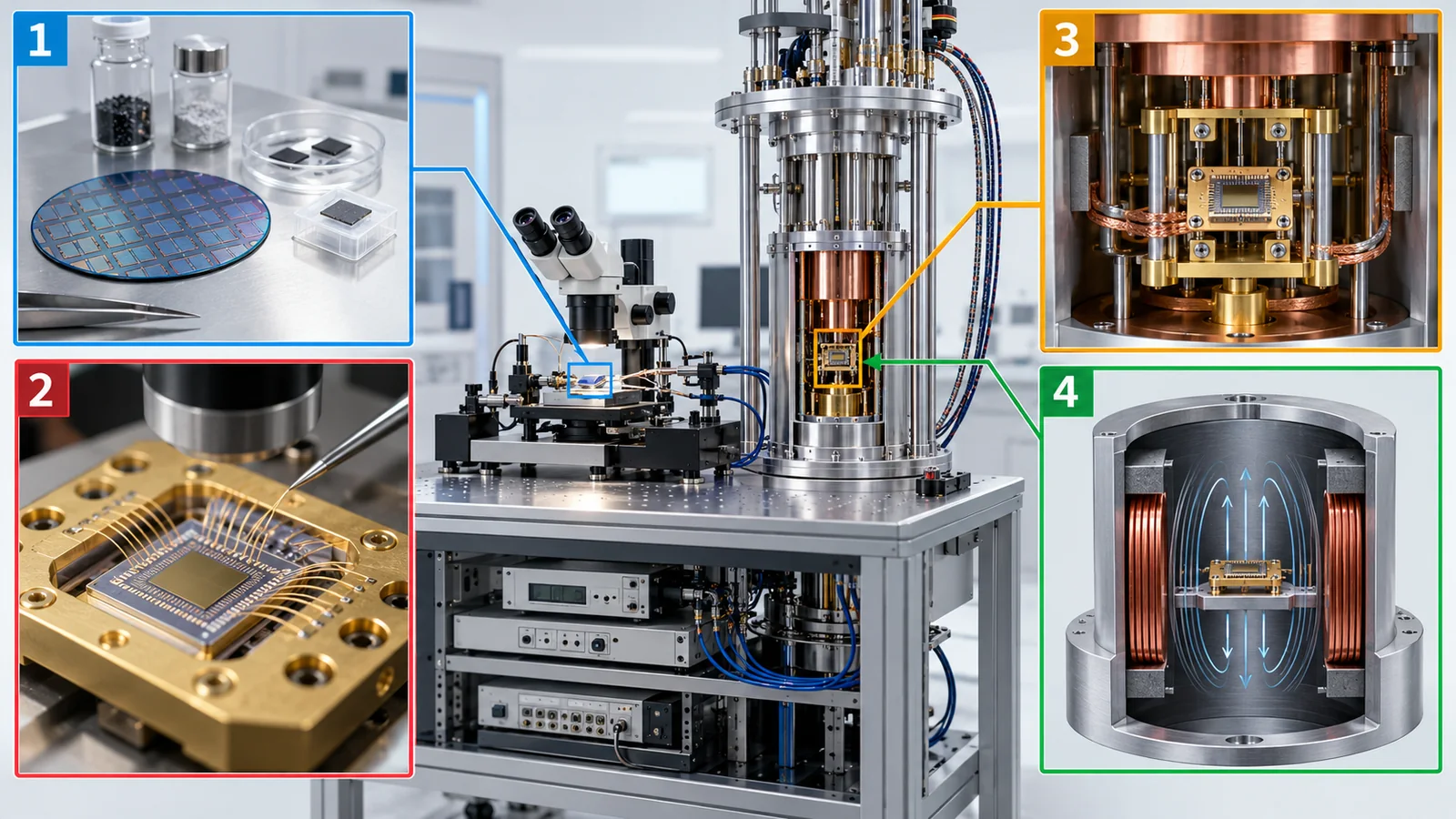
Microsoft's approach is not the only route in topological quantum computing. Here we look at three other routes.
| Route | What it does | Reports (source) | Protection and constraints |
|---|---|---|---|
| A Kitaev chain built from quantum dots | Semiconductor quantum dots are joined by superconductors into a chain, to build Kitaev's model artificially | Dvir et al. (2023): a minimal chain of two quantum dots; at a sweet spot where a pair of “poor man's Majorana” states is predicted, the transport characteristics satisfied the theoretical predictions (pair correlation, zero charge, stability against local perturbations) [Ref. 33]. Bordin et al. (2025): going to three sites makes the zero-energy modes more stable, but without superconducting phase control [Ref. 35]. ten Haaf et al. (2024): a two-site chain in a two-dimensional electron gas [Ref. 34]. van Loo et al. (2026, Nature): parity of a minimal chain measured in a single shot by quantum capacitance, with lifetimes above 1 ms [Ref. 36] Sourced | Each dot can be tuned individually (easier to control). On the other hand, the paper states plainly that a minimal chain offers limited protection compared with longer chains [Ref. 36] |
| Fractional quantum Hall states | Use candidates for non-Abelian anyons (the ν = 5/2 state) in a strong-field, extremely cold two-dimensional electron system | Review by Nayak et al. (2008): the only such topological states thought to have been found in nature are fractional quantum Hall states, most prominently ν = 5/2 [Ref. 3] Sourced | We did not check the current state of experiments |
| Creating the state on a quantum computer | Prepare the wavefunction of a non-Abelian topological order with qubits and gates, and move the anyons | Google (Andersen et al., 2023): on a superconducting processor, created and braided Ising anyons, verified their fusion rules and realized their statistics. The authors write that achieving topological protection would need future error correction [Ref. 37]. Quantinuum (Iqbal et al., 2024): created D4 topological order on 27 trapped-ion qubits with fidelity per site above 98.4%, and detected non-Abelian braiding by anyon interferometry [Ref. 38] Sourced | Not qubits protected by a property of matter but states prepared with gates (our explanation). Protection against errors is a problem for the circuit side, not the material |
The table is our own organization (Our calculation). It does not rank the routes.
A chain built from quantum dots lets each dot be tuned individually, so it is easy to control, but a short chain offers limited protection. A long continuous nanowire is expected to give greater protection, but building a long device without disorder and interpreting its signals are harder. Each has strengths and challenges, and this article does not judge which is better.
8. What we could not confirm, and a summary
What we could not confirm
- Microsoft's formal reply to Legg's February 2025 critique (of the 2023 PRB paper): we could not confirm one within this survey.
- The full text of the Matters Arising of 24 June 2026: on Nature's pages we could check the abstract of the critique (Legg) and the opening of the reply (Microsoft Quantum). The full texts require a subscription, so we did not check them.
- The additional data said to have been shown at the American Physical Society meeting in March 2025: the report (APS Physics magazine) says they would be presented there, but we could not confirm what they were [Ref. 39].
- The peer-review status of the June 2026 preprint, and the total number of qubits in Majorana 2: not confirmed (Microsoft's blog shows a figure of a four-qubit array, but we could not confirm a total chip count) [Ref. 29].
- Independent reproduction of the devices by laboratories other than Microsoft's: not confirmed.
- The results of DARPA's evaluation: we could not confirm published results.
- The present state of experiments on the fractional quantum Hall state (ν = 5/2): we stayed with the statement of a 2008 review and did not check the current state.
- Standards or specifications specific to topological quantum computing: not confirmed (Chapter 9).
- The idea: store information like a knot, in a property that local disturbances cannot change. A pair of Majorana quasiparticles at the ends of a nanowire carries one parity (whether the electron number is even or odd), in the proposed design. Sourced (the theoretical proposals)
- Materials: the interface between semiconductor (InAs, InSb) and superconductor (Al, Pb and others) being uniform at the atomic level, giving a hard gap, and low disorder are the keys. The Pb-based numbers (parent gap about 1.3 meV and so on) are claims in a company preprint Sourced / Not yet confirmed
- Numbers: the parity (Z) lifetime was reported as 12.4 ms for Al-based and about 20 s for Pb-based, but the X measurement was short at 14.5 µs, and the parity lifetime is not the same as the qubit lifetime. 20 s / 12.4 ms is about 1,600 times Sourced / Our calculation
- Where things stand: a company's claim that “a topological qubit has been made,” the Nature editorial note (the results of that paper are not evidence for the existence of Majorana zero modes), and a critical paper and a reply all stand side by side. Demonstrations of braiding and fusion, and an evaluation of performance as a qubit, are not confirmed. Independent reproduction is not confirmed either Sourced / Not yet confirmed
- How to read: separate “a signal that was measured” from “the interpretation that it is topological,” and line up company announcements, peer-reviewed papers, editorial notes and critiques, checking which stage is being discussed. Plans (2029 and so on) are not achieved facts
9. How to read evaluations and standards
The progress of topological quantum computing is measured with staged “yardsticks”: electrical tests that show a topological phase, quality of parity measurement, parity lifetime, operation and performance as a qubit, and demonstration of braiding and fusion (Fig. 8). The “gate fidelity” and “coherence time” used for ordinary qubits have not yet been measured for topological qubits. In addition, independent third-party evaluation, and the peer review, critique and retraction of papers, serve in practice as yardsticks. On the standards side, terminology standards are taking shape, but we could not confirm any evaluation standard specific to topological quantum computing (checked 16 October 2026).
| What is evaluated | Representative benchmark or method (name, source) | Standards and guidance (ISO/IEC, IEEE and others) | Cautions in reading |
|---|---|---|---|
| Judging a topological phase | Topological gap protocol (Pikulin et al., 2021; Aghaee et al., 2023) [16, 17] Sourced | Not confirmed | The validity of the method is disputed (Legg, 2025 and 2026) [20, 22] Not yet confirmed |
| Zero-bias peaks, quantized conductance | Mourik et al. (2012) [7]. The quantized conductance (Zhang et al., 2018) was retracted [13, 14] Sourced | Not confirmed | Ordinary states can give similar signals. Do not conclude from one signal [15, 45] |
| Quality of parity measurement | Signal-to-noise of the interferometric measurement, assignment error (Nature 2025: about 1%; tetron: 16% for X, 0.5% for Z) [18, 25] Sourced | Not confirmed | The paper itself states that the measurement can be interpreted in terms of both topologically trivial and non-trivial origins [18] |
| Parity lifetime, quasiparticle poisoning | Parity switching time τ (X: 14.5 µs, Z: 12.4 ms; Pb-based: about 20 s, not peer-reviewed) [25, 27] Sourced | Not confirmed | The Z lifetime is not the qubit lifetime. The X lifetime and fidelity after operations are also needed (Chapter 5) |
| Performance as a qubit | Not confirmed. Microsoft plans a measurement-based qubit evaluation procedure as a future stage [24] Not yet confirmed | Not confirmed | The procedure differs from, for example, randomized benchmarking of ordinary qubits (as described in the company's roadmap) |
| Third-party verification of the design | DARPA's US2QC and QBI: Microsoft is in the final stage (Stage C) [31, 32] Sourced | Not a standard but a government evaluation program | It verifies whether a design can be built and run as designed; it is not a certification that topological qubits exist (our explanation) |
| Terminology | — (a terminology standard, not an evaluation) | ISO/IEC 4879:2024 “Information technology — Quantum computing — Vocabulary” (published May 2024) [42] Sourced. IEEE P7130 (draft, Active PAR) [44] Not yet confirmed. ISO/IEC JTC 3 excludes fields such as semiconductors from its scope [43] | We did not check the text of the standards and do not describe their definitions |
| Reliability of papers | Retraction notice [14], Nature's Matters Arising (critique and reply) [22, 23], publication of measurement data and analysis code (Zenodo) Sourced | — | The more data are published, the more third parties can verify (Chapter 6) |
The table is our own organization (Our calculation). Numbers in brackets are reference numbers. ISO and IEEE numbers, titles and status were checked on the official pages (16 October 2026). Standards texts are paywalled, so we limit ourselves to titles and scope.
Cautions in reading (for materials engineers)
- What is “how many qubits” counting? Distinguish whether a claim such as “eight qubits were placed” is a design number or a number whose operation as qubits has been confirmed. The numbers in this article are all numbers of physical devices or design numbers, not logical qubits
- Separate the measured fact from the interpretation: “parity could be measured” and “it has a topological origin” are different claims. There are cases where a paper itself states both interpretations
- A company announcement, a peer-reviewed paper and an editorial note are different things: a press release can be stronger than the paper. Check the peer review file and editorial notes too. A preprint is not peer-reviewed
- Plans and achievements are different: targets such as a practical quantum computer by 2029 are Not yet confirmed. Progress through DARPA's stages is progress in design verification, not a certification that qubits exist
10. Glossary
- Topology
- A property that does not change under continuous deformation, such as the number of holes in a donut.
- Topological protection
- The idea of storing information in a global property so that local disturbances cannot change it.
- Quasiparticle
- An excitation of a crowd of many electrons that behaves like a single particle.
- Anyon
- A quasiparticle possible only in two dimensions, in which the history of exchanges remains in the state.
- Non-Abelian anyon
- An anyon for which the order of exchanges changes the quantum state of the whole system.
- Braiding
- Exchanging particles so that their paths form a braid like strands.
- Fusion
- Bringing quasiparticles together in pairs and observing the result.
- Majorana quasiparticle (MZM)
- A quasiparticle that is its own antiparticle. Also called a Majorana zero mode.
- Parity
- Whether the number of electrons is even or odd. The difference of the state made by two Majoranas.
- Spin-orbit coupling
- The link between the direction of an electron's spin and its direction of motion. Strong in InAs and InSb.
- Proximity effect
- Superconducting properties seeping into a semiconductor in contact with a superconductor.
- Induced gap
- The superconducting energy wall that appears in the semiconductor through the proximity effect.
- Hard gap / soft gap
- A gap with no extra states inside / with extra states inside. Hard is desirable.
- Topological gap
- The energy wall that protects information in the topological phase.
- Zero-bias peak
- Higher conductance at zero voltage. Expected for Majoranas, but other causes can produce it.
- Andreev bound state
- A state localized near a superconductor. It can give signals that resemble a Majorana's.
- Topological gap protocol (TGP)
- A procedure that judges a topological phase from a sequence of conductance measurements. Its validity is disputed.
- Quantum capacitance
- The tiny electrical-capacitance response of a quantum dot to electrons coming and going. Used to read out parity.
- Quasiparticle poisoning
- Quasiparticles entering from outside and flipping the parity.
- Tetron
- The basic unit of a qubit: two nanowires joined in an H shape, with four Majoranas.
- Kitaev chain
- A model of a chain of spinless electrons linked by p-wave superconductivity. It can be built artificially from quantum dots.
- Poor man's Majorana
- A Majorana-like state in a minimal Kitaev chain, with limited protection.
- Epitaxial growth
- Growing a layer with its crystal aligned to the crystal beneath.
- Matters Arising
- A format in which Nature publishes a critique of a paper it has published, with a reply.
- QBI / US2QC
- DARPA programs that verify whether utility-scale quantum computers can be realized.
11. References (primary sources)
- Kitaev A. Yu. "Fault-tolerant quantum computation by anyons", Annals of Physics 303, 2–30 (2003), DOI 10.1016/S0003-4916(02)00018-0 (arXiv:quant-ph/9707021) — doi.org/10.1016/S0003-4916(02)00018-0
- Kitaev A. "Unpaired Majorana fermions in quantum wires", Physics-Uspekhi 44, 131–136 (2001), DOI 10.1070/1063-7869/44/10S/S29 — doi.org/10.1070/1063-7869/44/10S/S29
- Nayak C., Simon S. H., Stern A., Freedman M., Das Sarma S. "Non-Abelian anyons and topological quantum computation", Rev. Mod. Phys. 80, 1083–1159 (2008), DOI 10.1103/RevModPhys.80.1083 — doi.org/10.1103/RevModPhys.80.1083
- Das Sarma S., Freedman M., Nayak C. "Majorana zero modes and topological quantum computation", npj Quantum Information 1, 15001 (2015), DOI 10.1038/npjqi.2015.1 — doi.org/10.1038/npjqi.2015.1
- Lutchyn R. M., Sau J. D., Das Sarma S. "Majorana Fermions and a Topological Phase Transition in Semiconductor-Superconductor Heterostructures", Phys. Rev. Lett. 105, 077001 (2010), DOI 10.1103/PhysRevLett.105.077001 — doi.org/10.1103/PhysRevLett.105.077001
- Oreg Y., Refael G., von Oppen F. "Helical Liquids and Majorana Bound States in Quantum Wires", Phys. Rev. Lett. 105, 177002 (2010), DOI 10.1103/PhysRevLett.105.177002 — doi.org/10.1103/PhysRevLett.105.177002
- Mourik V. et al. "Signatures of Majorana Fermions in Hybrid Superconductor-Semiconductor Nanowire Devices", Science 336, 1003–1007 (2012), DOI 10.1126/science.1222360 — doi.org/10.1126/science.1222360
- Chang W. et al. "Hard gap in epitaxial semiconductor–superconductor nanowires", Nature Nanotechnology 10, 232–236 (2015), DOI 10.1038/nnano.2014.306 — doi.org/10.1038/nnano.2014.306
- Krogstrup P. et al. "Epitaxy of semiconductor–superconductor nanowires", Nature Materials 14, 400–406 (2015), DOI 10.1038/nmat4176 — doi.org/10.1038/nmat4176
- Takei S., Fregoso B. M., Hui H.-Y., Lobos A. M., Das Sarma S. "Soft Superconducting Gap in Semiconductor Majorana Nanowires", Phys. Rev. Lett. 110, 186803 (2013), DOI 10.1103/PhysRevLett.110.186803 — doi.org/10.1103/PhysRevLett.110.186803
- Shabani J. et al. "Two-dimensional epitaxial superconductor-semiconductor heterostructures: A platform for topological superconducting networks", Phys. Rev. B 93, 155402 (2016), DOI 10.1103/PhysRevB.93.155402 — doi.org/10.1103/PhysRevB.93.155402
- Pauka S. J. et al. "Repairing the surface of InAs-based topological heterostructures", J. Appl. Phys. 128, 114301 (2020), DOI 10.1063/5.0014361 — doi.org/10.1063/5.0014361
- Zhang H. et al. "Quantized Majorana conductance", Nature 556, 74–79 (2018) (retracted), DOI 10.1038/nature26142 — doi.org/10.1038/nature26142
- Zhang H. et al. "Retraction Note: Quantized Majorana conductance", Nature 591, E30 (2021) (8 March 2021), DOI 10.1038/s41586-021-03373-x — doi.org/10.1038/s41586-021-03373-x
- Frolov S. M., Manfra M. J., Sau J. D. "Topological superconductivity in hybrid devices", Nature Physics 16, 718–724 (2020), DOI 10.1038/s41567-020-0925-6 — doi.org/10.1038/s41567-020-0925-6
- Pikulin D. I. et al. "Protocol to identify a topological superconducting phase in a three-terminal device", arXiv:2103.12217 (2021) — arxiv.org/abs/2103.12217
- Aghaee M. et al. (Microsoft Azure Quantum) "InAs-Al hybrid devices passing the topological gap protocol", Phys. Rev. B 107, 245423 (2023), DOI 10.1103/PhysRevB.107.245423 — doi.org/10.1103/PhysRevB.107.245423
- Microsoft Azure Quantum "Interferometric single-shot parity measurement in InAs–Al hybrid devices", Nature 638, 651–655 (2025) (19 February 2025), DOI 10.1038/s41586-024-08445-2 — doi.org/10.1038/s41586-024-08445-2
- Nature Peer Review File of the paper above (the editorial note is at its start) — media.springernature.com/…/41586_2024_8445_MOESM2_ESM.pdf
- Legg H. F. "Comment on 'InAs-Al hybrid devices passing the topological gap protocol', Microsoft Quantum, Phys. Rev. B 107, 245423 (2023)", arXiv:2502.19560 (February 2025) — arxiv.org/abs/2502.19560
- Legg H. F. "Comment on 'Interferometric single-shot parity measurement in InAs-Al hybrid devices', Microsoft Quantum, Nature 638, 651-655 (2025)", arXiv:2503.08944 (March 2025) — arxiv.org/abs/2503.08944
- Legg H. F. "On the robustness of topological gap detection via transport", Nature 654, E22–E26 (2026) (Matters Arising, 24 June 2026), DOI 10.1038/s41586-026-10567-8 — doi.org/10.1038/s41586-026-10567-8
- Microsoft Quantum "Reply to: On the robustness of topological gap detection via transport", Nature 654, E27–E28 (2026) (reply to the Matters Arising, 24 June 2026), DOI 10.1038/s41586-026-10568-7 — doi.org/10.1038/s41586-026-10568-7
- Aasen D. et al. (Microsoft Quantum) "Roadmap to fault tolerant quantum computation using topological qubit arrays", arXiv:2502.12252 (February 2025, a company plan) — arxiv.org/abs/2502.12252
- Aghaee M. et al. (Microsoft Quantum) "Distinct Lifetimes for X and Z Loop Measurements in a Majorana Tetron Device", arXiv:2507.08795 (July 2025) — arxiv.org/abs/2507.08795
- Physical Review A "Distinct lifetimes for X and Z loop measurements in a Majorana tetron device" (accepted paper, accepted 1 October 2026), DOI 10.1103/cx4w-lxx1 — journals.aps.org/pra/accepted/10.1103/cx4w-lxx1
- Microsoft Quantum "20 Second Parity Lifetime in an InAs–Pb Tetron Device", arXiv:2606.03884 (June 2026, preprint, not peer-reviewed) — arxiv.org/abs/2606.03884
- Microsoft "Microsoft's Majorana 1 chip carves new path for quantum computing" (19 February 2025, company announcement) — news.microsoft.com/source/features/innovation/microsofts-majorana-1-chip-carves-new-path-for-quantum-computing/
- Microsoft Quantum Blog on “Majorana 2” (June 2026, company announcement) — quantum.microsoft.com/en-us/insights/blogs/majorana-2-scalable-quantum-processor
- Microsoft Quantum Blog on the quantum research center in Maryland (22 September 2026, company announcement) — quantum.microsoft.com/en-us/insights/blogs/microsoft-quantum-research-center-maryland
- DARPA "DARPA selects two discrete utility-scale quantum computing approaches for evaluation" (6 February 2025) — darpa.mil/news/2025/quantum-computing-approaches
- DARPA "Four more teams enter Quantum Benchmarking Initiative's final stage" (7 October 2026) — darpa.mil/news/2026/four-more-teams-enter-quantum-benchmarking-initiative-final-stage
- Dvir T. et al. "Realization of a minimal Kitaev chain in coupled quantum dots", Nature 614, 445–450 (2023), DOI 10.1038/s41586-022-05585-1 — doi.org/10.1038/s41586-022-05585-1
- ten Haaf S. L. D. et al. "A two-site Kitaev chain in a two-dimensional electron gas", Nature 630, 329–334 (2024), DOI 10.1038/s41586-024-07434-9 — doi.org/10.1038/s41586-024-07434-9
- Bordin A. et al. "Enhanced Majorana stability in a three-site Kitaev chain", Nature Nanotechnology 20, 726–731 (2025), DOI 10.1038/s41565-025-01894-4 — doi.org/10.1038/s41565-025-01894-4
- van Loo N. et al. "Single-shot parity readout of a minimal Kitaev chain", Nature 650, 334–339 (2026) (11 February 2026), DOI 10.1038/s41586-025-09927-7 — doi.org/10.1038/s41586-025-09927-7
- Google Quantum AI and Collaborators (Andersen T. I. et al.) "Non-Abelian braiding of graph vertices in a superconducting processor", Nature 618, 264–269 (2023), DOI 10.1038/s41586-023-05954-4 — doi.org/10.1038/s41586-023-05954-4
- Iqbal M. et al. "Non-Abelian topological order and anyons on a trapped-ion processor", Nature 626, 505–511 (2024), DOI 10.1038/s41586-023-06934-4 — doi.org/10.1038/s41586-023-06934-4
- Ball P. "Experts Weigh in on Microsoft's Topological Qubit Claim", Physics 18, 57 (10 March 2025; an explanatory article by the APS; a news report) — physics.aps.org/articles/v18/57
- Science News "Microsoft's quantum chip got an upgrade. Critics are still skeptical" (June 2026; a news report) — sciencenews.org/article/microsoft-quantum-chip-upgrade-majorana
- Scientific American "Top quantum computer expert claims Microsoft's 'topological qubit' doesn't hold up" (24 June 2026; a news report) — scientificamerican.com/article/top-quantum-computer-expert-claims-microsofts-topological-qubit-doesnt-hold-up/
- ISO/IEC "ISO/IEC 4879:2024 Information technology — Quantum computing — Vocabulary" (ISO page) — committee.iso.org/standard/80432.html
- ISO/IEC "IEC/ISO JTC 3 Quantum technologies" (committee page) — committee.iso.org/committee/10138914.html
- IEEE SA "IEEE Draft Standard for Quantum Technologies Definitions" (P7130, Active PAR) — standards.ieee.org/ieee/7130/10680/
- Liu C.-X., Sau J. D., Stanescu T. D., Das Sarma S. "Andreev bound states versus Majorana bound states in quantum dot-nanowire-superconductor hybrid structures: Trivial versus topological zero-bias conductance peaks", Phys. Rev. B 96, 075161 (2017), DOI 10.1103/PhysRevB.96.075161 — doi.org/10.1103/PhysRevB.96.075161
- Das A. et al. "Zero-bias peaks and splitting in an Al–InAs nanowire topological superconductor as a signature of Majorana fermions", Nature Physics 8, 887–895 (2012), DOI 10.1038/nphys2479 — doi.org/10.1038/nphys2479
12. Claim-to-source audit
| Claim in the text | Basis | Category |
|---|---|---|
| The proposal that quantum computing with anyons in two dimensions is fault-tolerant by its physical nature. Measurement is done by fusing quasiparticles in pairs and observing the result | Abstract of Kitaev (2003) Reference 1 https://doi.org/10.1016/S0003-4916(02)00018-0 | Sourced |
| In a 1D system of length L, the energy difference between two ground states of different parity is proportional to exp(-L/ℓ0); it can serve as a qubit and is intrinsically immune to decoherence | Abstract of Kitaev (2001) Reference 2 https://doi.org/10.1070/1063-7869/44/10S/S29 | Sourced |
| Quantum information is stored in states of groups of quasiparticles and gates are performed by braiding and measurement. Error resistance comes from non-local encoding. The ν = 5/2 state was then the only topological state thought to have been found | Abstract of Nayak et al. (2008) Reference 3 https://doi.org/10.1103/RevModPhys.80.1083 | Sourced |
| Well-separated Majorana zero modes should show non-Abelian braiding statistics usable for unitary operations | Abstract of Das Sarma et al. (2015) Reference 4 https://doi.org/10.1038/npjqi.2015.1 | Sourced |
| The proposal (2010) that a semiconductor nanowire, a superconductor and a magnetic field give topological superconductivity and Majorana quasiparticles | Lutchyn et al. and Oreg et al. Reference 5 https://doi.org/10.1103/PhysRevLett.105.077001 Reference 6 https://doi.org/10.1103/PhysRevLett.105.177002 | Sourced |
| In InSb nanowires, states pinned at zero voltage in fields of about 100 mT, described as supporting the Majorana hypothesis. A Majorana particle is its own antiparticle | Abstract of Mourik et al. (2012) Reference 7 https://doi.org/10.1126/science.1222360 | Sourced |
| Earlier devices have a continuum of states inside the gap, nullifying topological protection. A hard gap was obtained in InAs/Al | Abstract of Chang et al. (2015) Reference 8 https://doi.org/10.1038/nnano.2014.306 | Sourced |
| InAs/Al grown by molecular beam epitaxy; an atomically uniform interface sets the quality of the gap; it seems to solve the soft-gap problem | Abstract of Krogstrup et al. (2015) Reference 9 https://doi.org/10.1038/nmat4176 | Sourced |
| A paper discussing the soft-gap problem. The proposal of two-dimensional epitaxial superconductor-semiconductor heterostructures (title). The repair of the surface of InAs-based heterostructures (title) | Titles of each paper Reference 10 https://doi.org/10.1103/PhysRevLett.110.186803 Reference 11 https://doi.org/10.1103/PhysRevB.93.155402 Reference 12 https://doi.org/10.1063/5.0014361 | Sourced |
| The 2018 Nature paper (quantized Majorana conductance) and its retraction by the authors in March 2021: pointed out by other researchers, unstated charge-jump corrections, a mislabelled axis, plateaus shifted by 8% after recalibration | The paper and the retraction notice Reference 13 https://doi.org/10.1038/nature26142 Reference 14 https://doi.org/10.1038/s41586-021-03373-x | Sourced |
| The importance of interface quality between superconductor and semiconductor. A summary of the evidence so far and the remaining uncertainties | Abstract of Frolov et al. (2020) Reference 15 https://doi.org/10.1038/s41567-020-0925-6 | Sourced |
| The proposal of the topological gap protocol (judging the presence and extent of a topological phase from local and non-local three-terminal conductance) | Abstract of Pikulin et al. (2021) Reference 16 https://arxiv.org/abs/2103.12217 | Sourced |
| Devices passed the TGP; the results are consistent with topological superconductivity. The maximum topological gaps reported were 20 to 60 µeV. A prerequisite for fusion and braiding experiments | Abstract of Microsoft (2023) Reference 17 https://doi.org/10.1103/PhysRevB.107.245423 | Sourced |
| The February 2025 Nature paper: single-shot interferometric parity measurement, capacitance change of about 1 fF, signal-to-noise of 1 in 3.6 µs, dwell time above 1 ms (about 2 T), assignment error of 1%, interpretable as both topological and non-topological, a device compatible with future tests of fusion rules | Abstract of the paper Reference 18 https://doi.org/10.1038/s41586-024-08445-2 | Sourced |
| The Nature editorial team obtained further input from two reviewers before publication, and noted that the results are not evidence for Majorana zero modes and that the paper was published for introducing a device architecture | Start of the Peer Review File Reference 19 https://media.springernature.com/original/springer-static/esm/art%3A10.1038%2Fs41586-024-08445-2/MediaObjects/41586_2024_8445_MOESM2_ESM.pdf | Sourced |
| Legg's critique: the TGP lacks a consistent definition and depends on data choices (2023 paper). The parity-readout regions of the 2025 device appear gapless | Legg (arXiv, Nature Matters Arising) Reference 20 https://arxiv.org/abs/2502.19560 Reference 21 https://arxiv.org/abs/2503.08944 Reference 22 https://doi.org/10.1038/s41586-026-10567-8 | Sourced (that the critique has been published) |
| Microsoft Quantum's reply: the analysis does not assume a gap; a gapless system would not show a stable h/2e-periodic bimodal signal; the measurement strongly indicates a topological origin. Corrected TGP maps released | Reply to the Matters Arising (24 June 2026) Reference 23 https://doi.org/10.1038/s41586-026-10568-7 | Sourced (that the reply has been published) |
| Microsoft's future plan: four generations of devices (measurement-based braiding, eight qubits, error detection and correction, lattice surgery) | Abstract of the roadmap (a company plan) Reference 24 https://arxiv.org/abs/2502.12252 | Not yet confirmed |
| X and Z parity measurements of a tetron: τX 14.5 µs, τZ 12.4 ms, assignment errors of 16% for X and 0.5% for Z. Accepted by PRA (1 October 2026; the version of record not confirmed) | The preprint and the page of the accepted paper Reference 25 https://arxiv.org/abs/2507.08795 Reference 26 https://journals.aps.org/pra/accepted/10.1103/cx4w-lxx1 | Sourced |
| The June 2026 preprint: InAs-Pb tetron, Z parity of about 20 s, Pb (about 10 nm, parent gap about 1.3 meV), a well of 6 nm InAs plus 2 nm InAs0.8Sb0.2, GaSb substrate, induced gap of about 570 µeV, Rashba coupling of 12 to 16 meV nm, mobility above 350,000 cm²/Vs, top-quintile TGP gap of about 70 µeV (about 30 µeV for Al-based), wire length 3.5 µm and width 35 nm, localization length above 1 µm | Preprint (company claim, not peer-reviewed) Reference 27 https://arxiv.org/abs/2606.03884 | Sourced (that the preprint states it) |
| The Majorana 1 announcement (Topological Core, eight topological qubits, a design goal of one million, the Nature paper presented as peer-reviewed confirmation) | Microsoft's announcement (company claim) Reference 28 https://news.microsoft.com/source/features/innovation/microsofts-majorana-1-chip-carves-new-path-for-quantum-computing/ | Sourced (that it was announced) |
| Majorana 2 (Pb, InAs/InAsSb, 1 to 12 ms for Al-based, above 20 s for Pb-based, a 2029 target). Handing a system to DARPA for independent testing (September 2026) | Microsoft's blogs (company claims and targets) Reference 29 https://quantum.microsoft.com/en-us/insights/blogs/majorana-2-scalable-quantum-processor Reference 30 https://quantum.microsoft.com/en-us/insights/blogs/microsoft-quantum-research-center-maryland | Not yet confirmed |
| DARPA selected Microsoft and PsiQuantum for the final phase of US2QC (6 February 2025). In the announcement of 7 October 2026, both are already in Stage C. QBI is not a competition | DARPA announcements Reference 31 https://www.darpa.mil/news/2025/quantum-computing-approaches Reference 32 https://www.darpa.mil/news/2026/four-more-teams-enter-quantum-benchmarking-initiative-final-stage | Sourced |
| Reports on Kitaev chains built from quantum dots (minimal chain, two sites, three sites, single-shot parity readout, lifetimes above 1 ms, minimal chains offer limited protection) | Abstracts of each paper Reference 33 https://doi.org/10.1038/s41586-022-05585-1 Reference 34 https://doi.org/10.1038/s41586-024-07434-9 Reference 35 https://doi.org/10.1038/s41565-025-01894-4 Reference 36 https://doi.org/10.1038/s41586-025-09927-7 | Sourced |
| Experiments creating non-Abelian topological order on quantum processors (Google: braiding of Ising anyons; Quantinuum: D4 order, 27 qubits, fidelity per site above 98.4%) | Abstracts of each paper Reference 37 https://doi.org/10.1038/s41586-023-05954-4 Reference 38 https://doi.org/10.1038/s41586-023-06934-4 | Sourced |
| News reports: APS Physics (10 March 2025), Science News (June 2026) and Scientific American (24 June 2026) conveying both appraisal and skepticism from experts | News reports (used as pointers to primary information; content is secondary) Reference 39 https://physics.aps.org/articles/v18/57 Reference 40 https://www.sciencenews.org/article/microsoft-quantum-chip-upgrade-majorana Reference 41 https://www.scientificamerican.com/article/top-quantum-computer-expert-claims-microsofts-topological-qubit-doesnt-hold-up/ | Sourced (that they were reported) |
| ISO/IEC 4879:2024 (quantum computing vocabulary, May 2024). The scope of ISO/IEC JTC 3 (semiconductors and others excluded). That IEEE P7130 is a draft (Active PAR) | ISO and IEEE SA pages (checked 16 October 2026) Reference 42 https://committee.iso.org/standard/80432.html Reference 43 https://committee.iso.org/committee/10138914.html Reference 44 https://standards.ieee.org/ieee/7130/10680/ | Sourced / Not yet confirmed |
| Zero-bias peaks can also appear in trivial states. The report of zero-bias peaks in Al-InAs nanowires (2012) | Titles and abstracts of each paper Reference 45 https://doi.org/10.1103/PhysRevB.96.075161 Reference 46 https://doi.org/10.1038/nphys2479 | Sourced |
| The table of e-L/ℓ0 (5, 10, 20, 35), the table of temperature equivalents of gaps and exp(-Δ/kBT) (20 mK is an example), 20 s / 12.4 ms = about 1,600, 20 s / 1 µs = about 2 × 10⁷, 12.4 ms / 14.5 µs = about 855 | Our own calculation (with numbers from sources; temperature and prefactor are illustrative or simplified) | Our calculation |
| The additional data from the March 2025 meeting of the American Physical Society, Microsoft's formal reply to Legg's February 2025 critique, the full text of the Matters Arising, the peer-review status of the June 2026 preprint, the total number of qubits in Majorana 2, independent reproduction, the results of DARPA's evaluation, the present state of ν = 5/2, standards specific to topological quantum computing | Could not be confirmed in the primary sources accessible within this survey, so not stated | commentary |
| The analogies of knot, donut hole, tally stick, and socks and shoes; the explanation of quasiparticles; why a hard gap is needed; trivial states; the trade-off between protection and control; materials readings (interface, choice of superconductor, publishing data); the staging and coloring of Fig. 8 | Our own organization and commentary based on published content. They are not views expressed by any researcher or company | commentary |
| That Figs. 2, 3, 4, 5, 6, 7 and 8 are explanatory drawings or drawings including our calculation, that Figs. 1 and 9 are ImageGen-generated conceptual illustrations, and that layer heights in Fig. 5 are not to scale | Notes by this article | commentary |
Last updated: 16 October 2026. Sources are mainly primary (original theory papers, peer-reviewed experimental papers, the retraction notice, the Nature editorial note and peer review file, critical papers and replies, and official DARPA, ISO and IEEE pages); company announcements and preprints are marked as company claims, and news reports are used only as pointers to primary information. This article does not rule on which company's or researcher's claim is right; it separates what can be confirmed, what is disputed in interpretation, and what is not confirmed. We could not confirm, and therefore do not state, Microsoft's formal reply to Legg's February 2025 critique, the full text of the Matters Arising, the peer-review status of the June 2026 preprint, independent reproduction, the results of DARPA's evaluation, or standards specific to topological quantum computing. All figures are explanatory concept drawings or drawings including our calculation; Figs. 1 and 9 are ImageGen-generated conceptual illustrations.