TECHNOLOGY EXPLAINER
National Quantum Strategies
— how to read "billions invested" (the US, the EU, Japan, China, the UK, and export controls)
Stories about quantum computers often say that "a country is investing billions" or "aims for practical use by such-and-such a year". But the meaning changes greatly depending on whether the sum is a promise, a statutory ceiling, a budget decided by the legislature or money actually spent. And even under the same name, "strategy", laws, policy documents, five-year plans and press releases are different in nature.
Assuming no familiarity with quantum technology, this article covers: (1) the stages of budget language, (2) what the US, the EU, Japan, China and the UK show in their official documents, (3) the fact that quantum computer parts and materials have become subject to export control and (4) why the numbers must not simply be set side by side. It ranks no countries. Sums are given in their original currency exactly as stated in the documents, with the checking date (16 October 2026).
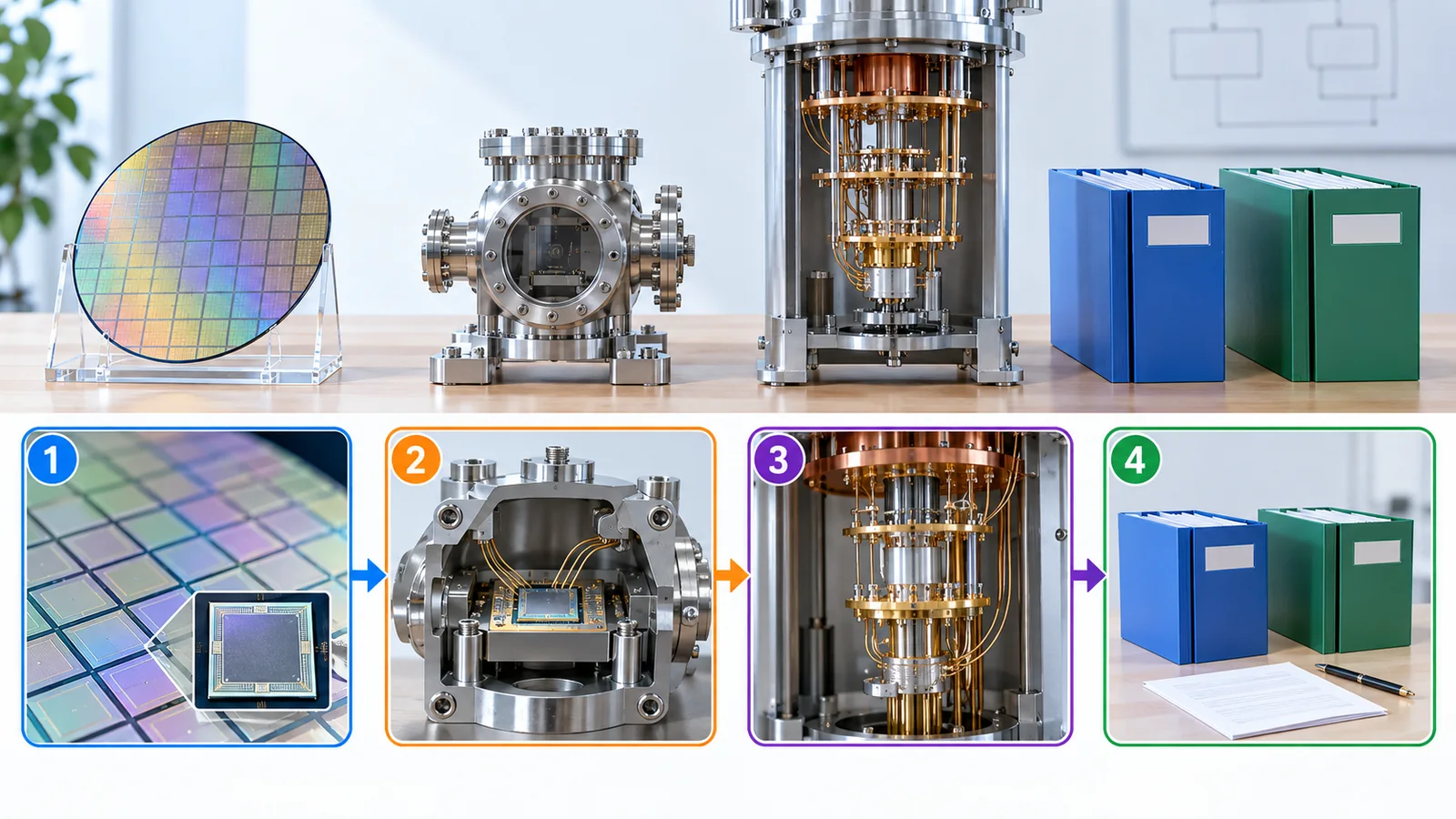
- The short version / before you read / where this fits in the series
- Reading the words "budget" and "strategy"
- The United States
- The EU (European Union)
- Japan
- China and the UK
- A timeline, and why the numbers cannot simply be compared
- Export controls: the "parts and materials" are now covered
- How to read evaluations and standards
- Glossary
- References (primary sources)
- Claim-to-source audit
Sourced = content stated in published material (with source links)
Our calculation = values we computed from stated assumptions (in this article, mainly the drawing of figures)
Not yet confirmed = plans, goals, bills, drafts and other matters not yet settled
Our own interpretation is labelled "Commentary". Inference is shown in bold.
Sums differ in currency, fiscal year, period and stage. They are not converted by exchange rate, and are written in the original currency with the words used in the document (request, enacted, ceiling, award and so on). Dates and status are as of the checking date (16 October 2026). This article ranks no countries, gives no investment or policy advice on any company or country, and does not treat laws that are not yet enacted (the US reauthorisation bills, the EU Quantum Act) as enacted. Japan's budget amounts, an official Chinese budget amount for quantum, and the confirmed US quantum-related budget figures for FY2026 onward could not be confirmed and are not stated.
1. The short version / before you read / where this fits in the series
- A "national quantum strategy" is not one kind of thing: the US has a law (the National Quantum Initiative Act) and annual budgets, the EU a policy document and joint programmes, Japan strategies and promotion measures of the Cabinet Office, China five-year plans, and the UK a ten-year strategy and individual announcements, so the nature of the documents differs by country[Ref. 3, 9, 14, 19, 17]
- Sums have "stages": request, authorisation (a statutory ceiling), appropriation (a budget decided by the legislature), award (assignment to a specific project) and expenditure mean different things. For example, DOE's $625 million is for "up to 5 years", with $125 million for FY2025 and the later years depending on congressional appropriations, as the announcement itself states[Ref. 5]
- For a materials engineer this is not a distant matter: the parts and materials of quantum computers, namely isotopically purified silicon and germanium, epitaxial materials and cryogenic equipment, became subject to export control in the US (2024) and the EU (2025)[Ref. 8, 13]. National strategy reaches directly into the sourcing and trading of materials
A quantum computer is a computer that uses "superpositions of 0 and 1". It helps to think of a qubit (the smallest unit of a quantum computer) as an arrow that can change direction. What this article needs, however, is not the details of the mechanism but the fact that a quantum computer is an assembly of physical things: cryogenic cooling equipment, special materials and control electronics. These things can become targets of national budgets and of export control. For the basics of the mechanism see the earlier articles in this series.
This article follows "Quantum Key Distribution and Quantum Communication", "Quantum Networks and Quantum Repeaters", "Post-Quantum Cryptography" and "Migrating to Post-Quantum Cryptography" and covers the national and policy side of the quantum-and-cryptography story. Cryptographic timelines were covered in Chapter 3 of the previous article. This article covers national frameworks for research and development, industry and export control.
2. Reading the words "budget" and "strategy"
(1) The words for money have five stages
To make sense of "billions invested" in the news you need to check which stage the number belongs to. The figure sets out five stages with US examples. (1) A request is the sum the government asks the legislature for; (2) an authorisation is a ceiling that a law sets on what may be spent (the actual money is a separate step); (3) an appropriation is the sum the legislature has decided as a budget; (4) an award is a sum assigned to a specific project or institution; and (5) expenditure is what was actually spent.
A concrete example is in the DOE announcement. It says that the total is $625 million for awards lasting up to 5 years, with $125 million in Fiscal Year 2025 dollars and outyear funding contingent on congressional appropriations, and goes on to say that selection for award negotiations is not a commitment by DOE to issue an award or provide funding: negotiations follow before funding is issued, and during that time DOE may cancel negotiations and rescind the selection for any reason[Ref. 5]. "Announced" and "available to use" are different stages.
(2) What can be decided differs by the kind of document
| Kind of document | Examples in this article | What it can settle | Caution in reading |
|---|---|---|---|
| Law | US: National Quantum Initiative Act (Public Law 115-368)[Ref. 3] | Institutional framework, agencies' roles, "authorisations" (ceilings) | An authorisation is not permission to spend; the annual budget (appropriation) is decided separatelySourced |
| Strategy (a policy document) | EU: Quantum Europe Strategy. UK: National Quantum Strategy. Japan: Quantum Future Industry Creation Strategy and others[Ref. 9, 17, 15] | Goals, priority areas and the direction of measures; sums are sometimes stated | A goal is not a guarantee of achievement. Check whether a stated sum is new money or the total of existing framesNot yet confirmed |
| Five-year plan | China: the outline of the 14th Five-Year Plan, and the 15th plan[Ref. 19, 20] | Priority fields and directions within the whole economy | A separate budget for quantum could not be read from what we checked |
| Regulation (export control and so on) | US: a Federal Register rule. EU: a delegated regulation[Ref. 8, 13] | What may be exported, to whom and on what conditions (legally binding) | The exact scope is in the text of the regulation; this article is not legal advice |
| Announcement (press release and so on) | US DOE's $625 million. The UK's £670 million[Ref. 5, 18] | The funding policy for specific projects | The period, stage and whether it is part of a larger sum are sometimes not statedNot yet confirmed |
| Bill | US: National Quantum Initiative Reauthorization bills[Ref. 7] | A proposal that becomes law if enacted | Not enacted at the checking dateNot yet confirmed |
Sourced / Not yet confirmed. The arrangement of the table is our commentary (a classification of the nature of documents).
The size of a budget is not a yardstick for how far development has progressed. Results depend not only on money but also on people, facilities, the sourcing of materials, the strength of companies and how time is used. Moreover, as Chapter 7 shows, the numbers of different countries differ in scope, period, stage and currency and cannot be set side by side as they are. This article ranks no countries.
3. The United States
(1) The law: the National Quantum Initiative Act (2018)
The foundation of US national quantum efforts is the National Quantum Initiative Act (Public Law 115-368, enacted 21 December 2018)[Ref. 3]. The law sets a framework in which several agencies (NIST of the Department of Commerce, the National Science Foundation (NSF), the Department of Energy (DOE) and others) advance quantum information science research and development, and provides for research centres. Its text states ceilings (authorisations) such as up to $80 million a year for NIST (fiscal years 2019 to 2023), up to $10 million a year per NSF research centre and up to $25 million a year per DOE research centre, but all of them are "subject to the availability of appropriations", and the actual sums are decided in the annual budgets[Ref. 3].
(2) The budget numbers: numbers of different kinds side by side
The yearly picture is gathered in the NQI annual report (the supplement to the FY2025 budget). The figure shows the amounts for federal quantum information science (QIS) R&D as given there. Note that the bars have different colours. FY2019 to FY2023 are amounts actually spent (expenditure), FY2024 is the budget authority enacted by Congress and FY2025 is the amount the President requested[Ref. 4].
What this figure shows is that federal QIS R&D amounts rose sharply from FY2019 to FY2022 and then hovered around one billion dollars (within the report's numbers). However, numbers for FY2026 and later could not be confirmed in an official supplement at the checking date[Ref. 4]. Whether the yearly numbers use the same definition of the agencies and fields counted should be checked in the report's notes (our commentary).
(3) DOE's $625 million for five research centres (4 November 2025)
On 4 November 2025 DOE announced a total of $625 million over up to 5 years to renew five National QIS Research Centers: C2QA (Brookhaven National Laboratory), SQMS (Fermi National Accelerator Laboratory), Q-NEXT (Argonne National Laboratory), QSA (Lawrence Berkeley National Laboratory) and QSC (Oak Ridge National Laboratory). The Fiscal Year 2025 portion is $125 million, and funding for later years is contingent on congressional appropriations[Ref. 5].
Reading the DOE announcement, materials are among the centres' tasks. C2QA lists improving the materials used in superconducting and plasma-grown, diamond-based quantum devices, and SQMS has "Superconducting Quantum Materials and Systems" in its very name and lists quantum devices based on superconducting microwave cavities and new methods of refrigeration[Ref. 5]. The performance of a quantum computer is often strongly affected by material quality such as thin-film defects, surface contamination and substrate purity (our commentary), which is why part of national budgets goes to materials research. From the materials side, what is needed are evaluation methods that let people discuss "which defects shorten a qubit's lifetime" in common terms.
(4) The defence side: DARPA's Quantum Benchmarking Initiative (QBI)
DARPA's QBI is a programme whose aim is to determine whether an industrially useful quantum computer can be built by 2033. It has three stages: Stage A, a concept (up to $1 million per organisation), Stage B, a research and development plan (up to $15 million) and Stage C, working with the government to verify that the machine can be built as designed and run as intended (up to $300 million). All the sums are ceilings of the form "can be awarded up to"[Ref. 6].
DARPA writes that QBI is not a competition between performers and that it is not designed to narrow the field to a few "winners" but to evaluate each company's approach on its own merits. It also notes that a company that has completed a stage's milestones is not listed until a contract for the next stage is awarded[Ref. 6]. So whether a company appears on the list and in which stage are not a ranking. This article does not reproduce the list of performers; see the official page (the list is current as of 8 October 2026).
(5) Renewing the law: the reauthorisation bills are not enacted at the checking date
Because the authorisation period of the NQI Act has passed (NIST's ran to fiscal year 2023), bills for reauthorisation, which would renew the law, have been introduced: S. 3597 in the Senate (introduced 8 January 2026; ordered to be reported by the Commerce Committee on 14 April) and H.R. 8462 in the House (introduced 23 April; ordered to be reported by the Science Committee on 29 April). In the congressional record at the checking date (16 October 2026) both are at the "introduced" stage and are not enacted[Ref. 7]Not yet confirmed. Because the contents of bills can change along the way, this article does not state the sums or provisions of the bills as settled institutions.
4. The EU (European Union)
The EU is a union of 27 Member States, and its quantum efforts are a layering of EU-wide programmes and the programmes of each Member State. The European Commission's quantum policy page lists the following pillars[Ref. 11].
- The Quantum Technologies Flagship: a long-term research and innovation initiative launched in 2018, with an EU-funded budget stated as EUR 1 billion[Ref. 11]Sourced
- EuroHPC quantum computers: in October 2022 six sites in Czechia, Germany, Spain, France, Italy and Poland were selected to host the first European quantum computers. The investment totals EUR 100 million, half from the EU and half from 17 participating countries. The first machine was inaugurated in Poznan, Poland, in June 2025 and the second in Ostrava, Czechia, in September 2025[Ref. 11]Sourced
- EuroQCI (European Quantum Communication Infrastructure): since June 2019 all 27 Member States have signed a declaration agreeing to work together, with the support of the European Space Agency, towards a quantum communication infrastructure covering the whole EU[Ref. 11, 1]Sourced
(1) The "Quantum Europe Strategy" of July 2025
On 2 July 2025 the European Commission adopted the Quantum Europe Strategy as Communication COM(2025) 363. The strategy lists five areas of action: (1) research and innovation, (2) quantum infrastructures, (3) strengthening the EU quantum ecosystem (securing supply chains and industrialisation through investment in startups and scaleups), (4) space and dual-use quantum technologies, and (5) quantum skills[Ref. 9, 10]Sourced.
The text of the strategy also contains sums, and here again we check the stage. (1) "Over the past five years, the EU and the Member States have invested more than EUR 11 billion in quantum technologies": the breakdown is nearly EUR 2 billion from the EU and more than EUR 9 billion in additional public funding from Member States. This is past performance, not a promise for the future. (2) "From today's EUR 2-3 billion, [the global market for quantum technologies] is forecasted to reach EUR 155 billion by 2040": this is a forecast[Ref. 10]SourcedNot yet confirmed.
In the text of the strategy, "more than EUR 11 billion" describes the sum the EU and Member States have already invested over the past five years, not a new budget decision. And the EU's nearly EUR 2 billion and the Member States' more than EUR 9 billion come from separate purses. When you see "the EU, billions of euros" in the news, check whether it is a past total or a future budget, and whether it is the EU's share or the Member States'.
(2) The "Quantum Act" has not yet been proposed at the checking date
The strategy says the proposal for an EU Quantum Act will be presented in 2026[Ref. 10]. The Commission's policy page also says the Quantum Act is "scheduled for adoption in 2026" and gives three objectives: (1) boosting research and innovation, (2) scaling up industrial capacity, including pilot lines and a design facility, and (3) reinforcing supply chain resilience and governance[Ref. 11]. But in the European Parliament's Legislative Train Schedule the status of the Quantum Act at the checking date is "Announced", with information as of 20 September 2026[Ref. 12]. So the proposal has not yet been presented and it is not lawNot yet confirmed. This article does not describe the contents of the Quantum Act as settled.
5. Japan
Japan's national quantum strategy documents are listed on the "Quantum Technology Innovation" page of the Cabinet Office[Ref. 14]. The figure arranges five of the main documents in date order.
The "Quantum Future Society Vision" of April 2022 set three goals for 2030: (1) ten million domestic users of quantum technology, (2) production value through quantum technology at the scale of 50 trillion yen, and (3) creation of quantum unicorn ventures that open up future markets[Ref. 14]SourcedNot yet confirmed. These are goals, not budget sums. Within what can be confirmed on the Cabinet Office page, Japan's quantum-related budget amounts could not be read in our check, so we do not state them.
As developments in 2026, the Cabinet Office page lists meetings of a quantum working group of the Japan Growth Strategy Council from January to March, and documents on quantum cooperation with Singapore (January), India (May, a statement of intent), Australia (July) and the Netherlands (September)[Ref. 14]Sourced (checked 16 October 2026; for details see each document).
The May 2025 promotion measures are organised as "people, things and money"
The "Measures for Building the Quantum Ecosystem" of 30 May 2025 organise efforts to create and grow the quantum industry from three viewpoints: people (widening the base of talent development and international reach), things (building strategic hubs that support the implementation base and international competitiveness) and money (a sustainable circulation of funds and market creation)[Ref. 16]Sourced. The "things" viewpoint includes enriching testbeds, domestic production of key parts and materials and strengthening of supply chains, technology development in hardware and software, and the formulation and support of a standardisation strategy.
The section "domestic production of key parts and materials and strengthening of supply chains" of the measures has many statements that concern materials[Ref. 16]Sourced. (1) The parts and materials differ by quantum computing approach, but leading suppliers are scattered across the world, and no country, even the US, has a supply chain that stands on one country alone. (2) Japanese suppliers hold a high share in some key parts and materials, while the document says refrigerators are monopolised by overseas makers. (3) Securing procurement from like-minded countries is called for for scarce raw materials (for example helium-3 as a refrigerant) and raw materials with geopolitical risk (for example gallium from China). (4) Artificial diamond as a material for quantum sensors is made in Japan too, but it depends on supply from the US, Russia and China for items such as high-purity seed crystals, and many low-noise lasers and single-photon detectors depend on imports from Germany and the US, it says. (5) It states that support will be focused on parts and materials where Japan has strengths. These are the document's own assessments of the situation; they are not an independent investigation of actual material supply by this article. For a materials maker, a practical starting point is to confirm with customers in which approach and in which component their products may be used (our commentary).
The same measures also state that "strategies and guidelines on economic security and related matters (the way of international cooperation, export control and clearance, parts, materials and related technologies to be supported or retained, and the assurance of research integrity) need to be made clear in an easy-to-understand form"[Ref. 16]Sourced. This is a statement of a task that "needs" doing, not the concrete rules on quantum export control themselves. We did not find an official Japanese rule on quantum-related export control in our check (Chapter 8).
6. China and the UK
(1) China: quantum within the five-year plans
China's national strategy is written within its five-year plans for national economic and social development. The outline of the 14th Five-Year Plan and the long-range objectives to 2035, published on the State Council's site on 13 March 2021, lists quantum information among the fields of national laboratories, frontier major projects and future industries, and quantum computing and quantum communication appear in the section on digital technology[Ref. 19]Sourced (from the Chinese original; the explanation is ours).
On the 15th Five-Year Plan, Xinhua (in English) reported in March 2026. The Government Work Report says it will nurture future industries such as future energy, quantum technology, embodied AI, brain-computer interfaces and 6G[Ref. 20]Sourced. The same coverage says the draft outline of the plan names quantum technology, biomanufacturing, hydrogen and fusion energy, brain-computer interfaces, embodied AI and 6G as new growth drivers[Ref. 20, 21]Sourced.
What we could not confirm: within our check, an official budget amount for China's quantum technology could not be confirmed from official documents. Various estimated sums appear in private surveys and press reports, but we do not state them because their sources and scope are not settled. Xinhua's report (10 March 2026) conveys remarks by the quantum scientist Pan Jianwei that touch on the blocking of exports of dilution refrigerators[Ref. 22]Sourced. It is an example of how export control can affect how research and development is actually carried out (our commentary).
(2) The UK: a ten-year strategy and individual announcements
The UK's National Quantum Strategy, published on 15 March 2023, states a commitment of GBP 2.5 billion over ten years (from 2024) and an aim of attracting GBP 1 billion of additional private investment[Ref. 17]SourcedNot yet confirmed. The same page carries five missions, published on 22 November 2023: (1) by 2035, UK-based quantum computers running a trillion operations, (2) by 2035, the most advanced quantum network at scale, (3) by 2030, quantum sensing for every NHS (National Health Service) Trust, (4) by 2030, quantum navigation on aircraft, and (5) by 2030, mobile networked sensors[Ref. 17]SourcedNot yet confirmed.
The government press release of 23 June 2025 says GBP 670 million will be dedicated to quantum computing, makes the National Quantum Computing Centre (NQCC) one of the first organisations to receive a 10-year funding settlement, and says that by 2035 the UK aims to develop quantum computers capable of outperforming conventional supercomputers[Ref. 18]SourcedNot yet confirmed. The release does not state the period of the GBP 670 million, and in our check we could not judge whether it is part of the GBP 2.5 billion.Not yet confirmed
7. A timeline, and why the numbers cannot simply be compared
Here are the documents and events so far on a timeline. The positions of the dots are approximate times.
| Country or region | Nature of main documents | Sums and goals stated (original currency, document's own words) | What could not be confirmed |
|---|---|---|---|
| US | A law (NQI Act), annual budgets, agency programmes[Ref. 3, 4, 5] | QIS R&D: $1,006 million for FY2024 (enacted), $998 million for FY2025 (request). DOE: $625 million (up to 5 years; $125 million for FY2025). QBI: ceilings of $1 million, $15 million and $300 million by stage[Ref. 4, 5, 6] | Confirmed quantum-related budgets for FY2026 onward. The reauthorisation bills are not enacted[Ref. 7] |
| EU | A policy document (Quantum Europe Strategy) and joint programmes (Flagship, EuroHPC, EuroQCI)[Ref. 9, 11] | Flagship: EUR 1 billion (EU). EuroHPC quantum: EUR 100 million (half EU, half 17 countries). Past five years: more than EUR 11 billion by the EU and Member States (EU nearly 2 billion, Member States more than 9 billion)[Ref. 11, 10] | The Quantum Act proposal (not yet presented at the checking date)[Ref. 12] |
| Japan | Strategies and promotion measures of the Cabinet Office[Ref. 14, 16] | Goals for 2030: ten million users, production value at the scale of 50 trillion yen, creation of quantum unicorn ventures[Ref. 14] | Quantum-related budget amounts. Official rules on quantum export control |
| China | Outlines of five-year plans[Ref. 19, 20] | No sum was found; quantum information and quantum technology are named as priority fields[Ref. 19, 20] | An official budget amount |
| UK | A ten-year strategy and individual announcements[Ref. 17, 18] | Strategy: GBP 2.5 billion (over ten years from 2024), aiming at GBP 1 billion of private money. June 2025 announcement: GBP 670 million[Ref. 17, 18] | The period of the GBP 670 million and its relation to the GBP 2.5 billion |
Sourced / Not yet confirmed. The arrangement of the table is our commentary. The sums in different rows differ in scope, period, stage and currency and cannot be compared or added.
Four things to check before comparing
"FY2025" is not necessarily the calendar year 2025. The US federal fiscal year starts in October of the previous year and ends in September of that year (for example FY2025 runs from October 2024 to September 2025). Japan's "fiscal 2026" runs from April 2026 to March 2027 (the way government documents are written; our commentary). Because fiscal years are divided differently by country, setting them out as "budgets for the same year" introduces a shift.
A strategy's "by such-and-such a year" is a goal. For example the UK mission of "UK-based quantum computers running a trillion operations by 2035", Japan's "ten million users in 2030" and DARPA's "determine whether an industrially useful quantum computer can be built by 2033" are all goals or evaluation purposes and not guarantees of achievement[Ref. 17, 14, 6]Not yet confirmed. DARPA writes that QBI estimates it is more likely than not that at least one company will be able to build one by 2033, but that too is the planner's own estimate. This article does not assert when quantum computers will become practical.
8. Export controls: the "parts and materials" are now covered
(1) What export control is
Export control is a system in which a state requires a permit (licence) when certain goods, technology or software are sent abroad (including being handed over or taught). It is carried out for security, and is mostly based on lists of items agreed through international arrangements (such as the Wassenaar Arrangement). Quantum computers are regarded as dual-use technology that may be used to break cryptography or for military computation, and in recent years not only quantum computers themselves but also the parts, materials and equipment used to make them have been added to the controls.
(2) The US: the rule of 6 September 2024
On 6 September 2024 the US Department of Commerce's Bureau of Industry and Security (BIS) published in the Federal Register (vol. 89, no. 173, from page 72926) a rule adding quantum-related items to the Commerce Control List (CCL)[Ref. 8]Sourced. Its title is "Implementation of Controls on Advanced Technologies Consistent With Controls Implemented by International Partners". The rule gave new Export Control Classification Numbers (ECCNs) to items such as the following.
| ECCN | What the rule says (summary) | What it means for a materials engineer (commentary) |
|---|---|---|
| 4A906 | Quantum computers and their electronic assemblies and components. The criteria are the number of physical qubits that are connected and fully controllable and the average error rate of the CNOT gate; the rule explains that the two combined are more indicative of the advance of the quantum computers of concern than either alone | About finished systems. But the fact that "qubit quality" is a criterion shows that material and process quality can bear on where the line is drawn (commentary) |
| 3A904 / 3B904 | Cryogenic cooling systems (as the rule states: systems rated to provide a cooling power of at least 600 microwatts at or below 0.1 K for more than 48 hours, and specified two-stage pulse tube cryocoolers) and cryogenic wafer probers (3B904) | Companies that handle refrigerator parts or equipment for measuring wafers at low temperature need to check whether their products' specifications fall under these (commentary) |
| 3A901 | Electronic components that work at cryogenic temperatures (for example cryogenic CMOS chips) and parametric signal amplifiers | May also concern the materials of semiconductors, wiring and packaging that operate at cryogenic temperatures (commentary) |
| 3C907 / 3C908 / 3C909 | Epitaxial materials (consisting of a substrate with at least one epitaxially grown layer), fluorides, hydrides and chlorides of silicon or germanium, and silicon, germanium and their oxides. In each case materials containing a specified percentage of isotopes. The rule explains that semiconducting qubits made of silicon or germanium isotopes with no nuclear spin are key materials for developing spin-based quantum computers | The materials themselves are covered. This bears directly on companies that make, sell or transport isotopically enriched feedstock or wafers with grown thin films (commentary) |
| 3D901 / 3E901 / 4D906 / 4E906 | Software and technology related to the items above | Providing "technology" such as drawings, recipes and growth conditions may be treated like exporting goods (commentary; the specifics are in the text of the rule) |
Sourced. ECCNs and descriptions are as stated in Federal Register vol. 89, no. 173 (6 September 2024)[Ref. 8]. The commentary column is our commentary and not legal advice.
The rule also states the following[Ref. 8]Sourced. (1) These items require a licence for all destinations, but a licence exception (License Exception IEC) is available for countries that have implemented equivalent controls. (2) These additional controls have not yet been adopted by the relevant multilateral regime (they are implemented in line with like-minded countries). (3) A 60-day grace period (until 5 November 2024) was given for exports and similar transactions to destinations in Country Group A:1. (4) Isotopically enriched silicon and germanium are, by commercial practice, exported with certificates indicating the isotopic distribution, and those documents help to check whether the item is above or below the control threshold.
(3) The EU: the update of 8 September 2025
On 8 September 2025 the European Commission adopted a Delegated Regulation updating the EU's dual-use export control list (Annex I of Regulation (EU) 2021/821). The update brings the list in line with decisions taken in multilateral regimes such as the Wassenaar Arrangement in 2024, and includes items that Member States, as members of those regimes, committed to control uniformly. On quantum technology, quantum computers, electronic components designed to work at cryogenic temperatures, parametric signal amplifiers, cryogenic cooling systems and cryogenic wafer probers are named as added items[Ref. 13]Sourced. The same update includes semiconductor manufacturing and testing equipment and materials (for example atomic layer deposition equipment, equipment and materials for epitaxial deposition, lithography equipment and so on)[Ref. 13]Sourced. The updated list enters into force after the usual two-month scrutiny period of the Council and the European Parliament. We have not confirmed the date of entry into force in the Official Journal.
The text of the EU's Quantum Europe Strategy also notes that the term "dual-use potential" in the strategy is used in a broader, forward-looking sense than the legal term "dual-use items" under the export control regulation[Ref. 10]Sourced. The words of a strategy and the words of a regulation are different things.
(4) Japan: no official rule could be confirmed
On Japan's export control for quantum items, this article could not confirm an official rule or publication by the Ministry of Economy, Trade and Industry or others. All that we could confirm is that the Cabinet Office's measures state, as a task, that guidelines on economic security including export control and clearance need to be made clear in an easy-to-understand form[Ref. 16]Sourced. A Japanese company that wants to know whether it is actually subject to export control should check the latest official information from the competent authority (this is not legal advice).
The core of export control is requiring a permit when specified items are sent under specified conditions. The US rule of 2024 required a licence for the new items for all destinations and then allowed a licence exception for countries that apply equivalent controls[Ref. 8]. So the conditions differ by country, item, use and counterpart (our commentary). Whether an individual transaction is covered must be determined from the text of the regulation and by confirmation with the competent authority.
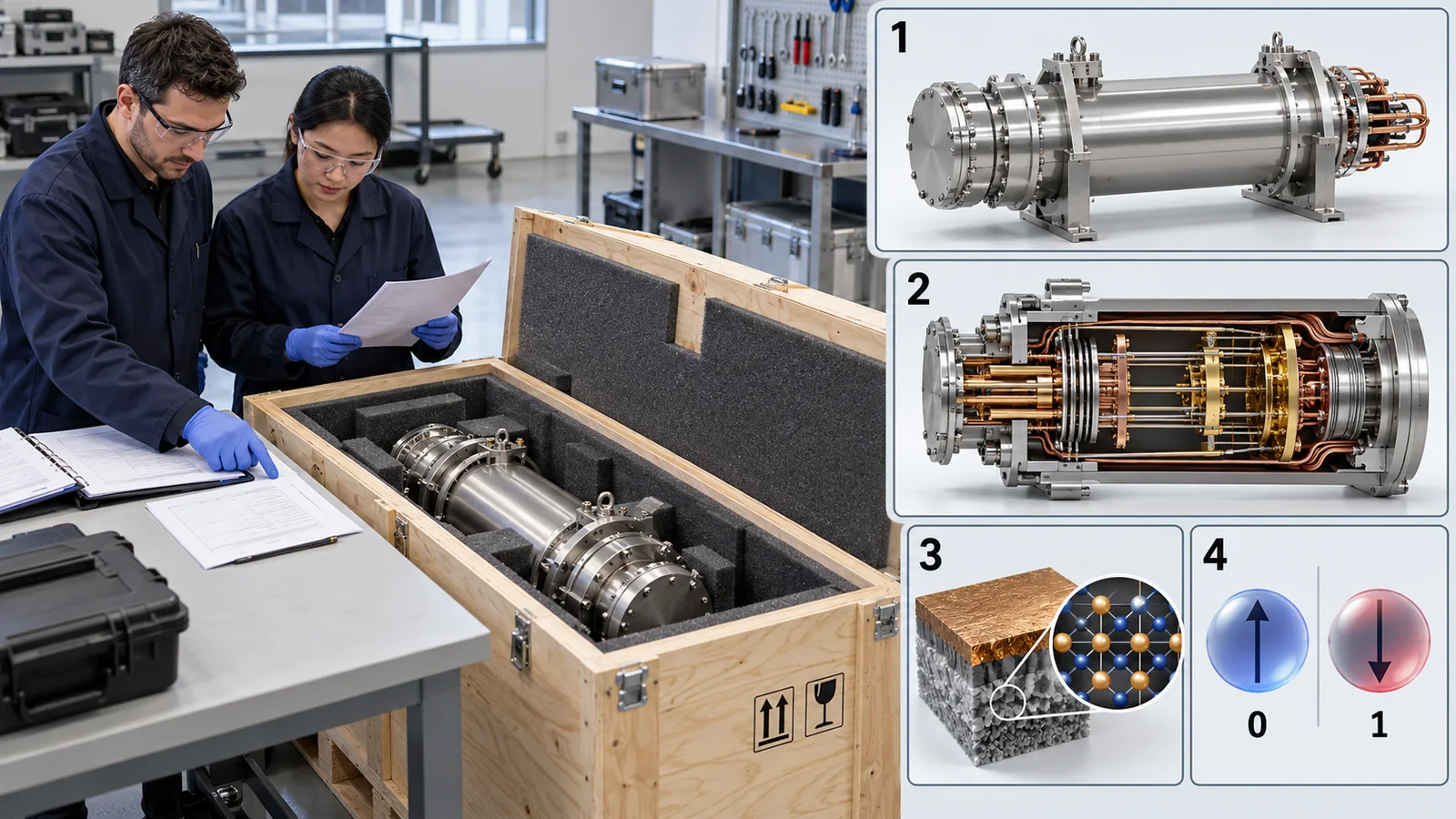
In quantum-related transactions a materials company may supply materials without knowing that the final product is a quantum computer (our commentary). As a practical starting point: (1) check your product's specifications (isotopic enrichment, thin-film structure, cooling performance and so on) against the rule's descriptions; (2) ask your customer about the use and the final product; (3) know that providing "technology" such as drawings and conditions can be treated like exporting goods; and (4) check the latest official information because lists and rules are revised. This is an example of a checking procedure and not legal advice. Decide whether something is covered from the text of the regulation and with the competent authority or an expert.
9. How to read evaluations and standards
Unlike yardsticks for technical performance, yardsticks for how far a national quantum strategy has progressed have few common standards. Here is what we could use in our check, arranged by kind. Checked 16 October 2026.
| What is assessed | Representative benchmark or method (name, source) | Standard, rule or guidance (name, version, material checked) | Caution in reading |
|---|---|---|---|
| Scale and stage of money | The NQI annual report (supplement to the FY2025 budget): lists expenditure, enacted and request separately[Ref. 4]Sourced | The authorisation provisions of the National Quantum Initiative Act (Public Law 115-368)[Ref. 3]Sourced. No common accounting standard across countries could be confirmed | Check the stage (request, authorisation, appropriation, award, expenditure). Do not convert by exchange rate |
| A mechanism for third-party verification of technical progress | DARPA's QBI (Quantum Benchmarking Initiative): Stages A, B and C. The aim is to determine whether an industrially useful quantum computer can be built by 2033. It provides third-party verification and validation[Ref. 6]SourcedNot yet confirmed | — (no performance indicator commonly used by national strategy documents could be confirmed) | A stage is not a ranking (as DARPA writes). Whether evaluation results are published depends on each programme |
| Where export control draws the line | US: the criteria for quantum computers are the number of physical qubits and the average CNOT gate error rate (ECCN 4A906); for cooling, the cooling power and duration at or below 0.1 K (3A904)[Ref. 8]Sourced | US: Federal Register vol. 89, no. 173 (6 September 2024). EU: the update of Annex I of Regulation (EU) 2021/821 (Delegated Regulation adopted 8 September 2025)[Ref. 8, 13]Sourced | Thresholds and scope are as in the text of the rules, and they are revised. No official Japanese rule could be confirmed |
| International standardisation | — | IEC/ISO JTC 3 "Quantum technologies" (committee page; working groups include WG 13 Quantum random number generators and WG 16 Quantum Communication)[Ref. 2]Sourced. Japan's measures list "formulating and supporting a standardisation strategy" among the efforts[Ref. 16]Sourced | That standardisation efforts exist is not the same as standards existing. Check the edition of each standard on its official page |
| Achievement of goals | The UK's five missions, Japan's three goals for 2030 and the EU strategy's action plan[Ref. 17, 14, 10]Not yet confirmed | — (at the checking date no criterion for measuring achievement by a common method could be confirmed) | A goal is not a guarantee. Check in each country's documents whether an official evaluation report on progress exists |
The arrangement of the table is Our calculation (arrangement). Names, dates and status were checked in each agency's official documents (checked 16 October 2026).
Cautions in reading (for materials engineers)
- Tell "announcement", "plan", "bill" and "rule" apart: the daily news reports them in the same tone. Only regulations (and enacted laws) have legal effect (our commentary).
- "Is it covered" is decided by specifications: in export control, coverage is decided by numbers in specifications, such as isotope percentages, cooling power values and qubit counts, not by the impression of the industry or use[Ref. 8].
- Dates and status get updated: the US reauthorisation bills, the EU Quantum Act and Japan's budgets and rules may change after the checking date. When quoting, add the checking date.
- Do not make a league table: this article ranks no countries. Treat with caution any article that sets out sums without the four checks of Chapter 7.
10. Glossary
- Qubit
- The smallest unit of a quantum computer; it helps to think of it as an arrow that can change direction.
- National Quantum Initiative Act (NQI Act)
- The US law of December 2018 setting the framework for quantum information science R&D (Public Law 115-368).
- Authorisation
- A ceiling on the amount that may be used, set by a law; actual spending is decided separately in the budget.
- Appropriation
- The sum the legislature decides as a budget to actually be used.
- Request
- The budget sum the government asks the legislature for.
- Award
- Assigning funds to a specific project or institution; it can be cancelled during negotiations.
- Expenditure
- The amount actually spent.
- Fiscal year (FY)
- The year used to divide budgets; October to September in the US, April to March in Japan.
- DOE National QIS Research Centers
- The five research centres supported by DOE (C2QA, SQMS, Q-NEXT, QSA and QSC).
- DARPA QBI
- The Quantum Benchmarking Initiative: a programme in which third parties verify and validate the prospects of an industrially useful quantum computer.
- Quantum Europe Strategy
- The quantum strategy adopted by the European Commission on 2 July 2025 (COM(2025) 363), with five areas of action.
- EuroHPC
- The European joint undertaking for supercomputing, which is also installing quantum computers.
- EuroQCI
- The effort to build a quantum communication infrastructure covering the whole EU.
- EU Quantum Act
- A law the EU is preparing; not yet proposed at the checking date.
- Five-year plan
- China's plan for national economic and social development, issued every five years.
- Quantum Future Society Vision
- Japan's April 2022 document, which set three goals for 2030.
- Testbed
- An environment where up-to-date equipment is shared for development and experiments.
- Epitaxial material
- A material in which a thin layer has been grown on a substrate with its crystal orientation aligned.
- Isotope
- Atoms of the same element with different numbers of neutrons; isotopes with no nuclear spin are used as materials for spin qubits.
- Dilution refrigerator
- A cooling apparatus that makes cryogenic temperatures close to absolute zero.
- ECCN (Export Control Classification Number)
- The control number given to an item in the US Commerce Control List (CCL).
- BIS (Bureau of Industry and Security)
- The part of the US Department of Commerce in charge of export control.
- Dual-use
- Technology or items usable for both civilian and military purposes.
- Wassenaar Arrangement
- An international arrangement on export controls for conventional arms and dual-use goods.
- Deemed export
- The idea of treating the provision of technology to foreign persons within a country as an export.
11. References (primary sources)
- European Commission "European Quantum Communication Infrastructure - EuroQCI" (Shaping Europe's digital future) — digital-strategy.ec.europa.eu/en/policies/european-quantum-communication-infrast
- IEC/ISO JTC 3 "Quantum technologies" committee page on iso.org (scope; working groups including WG 13 Quantum random number generators and WG 16 Quantum Communication; checked 16 October 2026) — iso.org/committee/10138914.html
- US Congress H.R. 6227, National Quantum Initiative Act, Public Law 115-368 (signed 21 December 2018): bill page on Congress.gov (text and actions) — congress.gov/bill/115th-congress/house-bill/6227
- White House OSTP (NQI Program) "National Quantum Initiative Supplement to the President's FY 2025 Budget" (NQI annual report, 2024) — bidenwhitehouse.archives.gov/wp-content/uploads/2025/01/NQI-Annual-Report-FY2025
- US Department of Energy "Energy Department Announces $625 Million to Advance the Next Phase of National Quantum Information Science Research Centers" (4 November 2025) — energy.gov/articles/energy-department-announces-625-million-advance-next-phase-n
- DARPA "Quantum Benchmarking Initiative (QBI)" program page (performer list current as of 8 October 2026; checked 16 October 2026) — darpa.mil/research/programs/quantum-benchmarking-initiative
- US Congress S. 3597, National Quantum Initiative Reauthorization Act of 2026 (introduced 8 January 2026; ordered to be reported by the Senate Commerce Committee 14 April 2026) and H.R. 8462, National Quantum Initiative Reauthorization Act (introduced 23 April 2026; ordered to be reported by the House Science Committee 29 April 2026): Congress.gov actions pages (checked 16 October 2026) — congress.gov/bill/119th-congress/senate-bill/3597/all-actions
- US Department of Commerce, BIS "Commerce Control List Additions and Revisions; Implementation of Controls on Advanced Technologies Consistent With Controls Implemented by International Partners", Federal Register 89 (173), 72926-72956 (6 September 2024), FR Doc. 2024-19633 — govinfo.gov/content/pkg/FR-2024-09-06/html/2024-19633.htm
- European Commission "Quantum Europe Strategy" library page (five areas of action; Communication COM(2025) 363, 2 July 2025; checked 16 October 2026) — digital-strategy.ec.europa.eu/en/library/quantum-europe-strategy
- European Commission Communication COM(2025) 363 "A Quantum Europe Strategy" (2 July 2025), full text (PDF, 25 pages) — ec.europa.eu/newsroom/dae/redirection/document/117890
- European Commission "Quantum" policy page, Shaping Europe's digital future (Quantum Technologies Flagship, EuroHPC quantum computers, EuroQCI, the planned EU Quantum Act; checked 16 October 2026) — digital-strategy.ec.europa.eu/en/policies/quantum
- European Parliament (Legislative Train Schedule) "Quantum Act" file page (status "Announced"; information updated as of 20 September 2026; checked 16 October 2026) — europarl.europa.eu/legislative-train/theme-a-new-plan-for-europe-s-sustainable-p
- European Commission (DG Trade) "2025 Update of the EU Control List of Dual-Use Items" (8 September 2025) — policy.trade.ec.europa.eu/news/2025-update-eu-control-list-dual-use-items-2025-0
- Cabinet Office, Japan Quantum technology innovation page (list of strategy documents and news up to 11 September 2026; checked 16 October 2026) (in Japanese) — www8.cao.go.jp/cstp/ryoshigijutsu/ryoshigijutsu.html
- Cabinet Office, Japan "Quantum Future Industry Creation Strategy" (decided 14 April 2023) (in Japanese) — www8.cao.go.jp/cstp/ryoshigijutsu/230414_mirai.pdf
- Quantum Technology Innovation Council (Cabinet Office, Japan) "Measures for Building the Quantum Ecosystem" (reported 30 May 2025) (in Japanese) — www8.cao.go.jp/cstp/ryoshigijutsu/250530_q_ecosys.pdf
- Department for Science, Innovation and Technology (UK) "National quantum strategy" (published 15 March 2023; accessible webpage; "National Quantum Strategy Missions" published 22 November 2023) — gov.uk/government/publications/national-quantum-strategy
- UK Government "Tech innovators backed to set up and scale up in Britain through Industrial Strategy" (press release, 23 June 2025) — gov.uk/government/news/tech-innovators-backed-to-set-up-and-scale-up-in-britain-
- State Council of the People's Republic of China (via gov.cn) Outline of the 14th Five-Year Plan for National Economic and Social Development and the Long-Range Objectives Through the Year 2035 (published 13 March 2021) (in Chinese) — gov.cn/xinwen/2021-03/13/content_5592681.htm
- Xinhua "China to nurture emerging, future industries" (5 March 2026) — english.news.cn/20260305/5b4f900c335e4176842b2e64283c4fa9/c.html
- Xinhua "China's five-year blueprint set to fast-track tech adoption on factory floor" (15 March 2026) — english.news.cn/20260315/f9bc0f36ebc240299d3b2d47a558da29/c.html
- Xinhua "Xinhua Headlines: China's five-year roadmap bets big on innovation in strategic leap" (10 March 2026) — english.news.cn/20260310/4221a813a22141b2859f01d65d0b3578/c.html
12. Claim-to-source audit
| Claim in the text | Basis | Category |
|---|---|---|
| The National Quantum Initiative Act (Public Law 115-368, enacted 21 December 2018): the institutional framework; ceilings (authorisations) of $80 million a year for NIST (fiscal years 2019 to 2023), $10 million a year per NSF research centre and $25 million a year per DOE research centre, all subject to the availability of appropriations | Congress.gov bill page Reference 3 https://www.congress.gov/bill/115th-congress/house-bill/6227 | Sourced |
| The amounts of federal QIS R&D (FY2019 $456 million, FY2020 $690 million, FY2021 $851 million, FY2022 $1,041 million, FY2023 $1,036 million (expenditure), FY2024 $1,006 million (enacted), FY2025 $998 million (request)) | NQI annual report (supplement to the FY2025 budget) Reference 4 https://bidenwhitehouse.archives.gov/wp-content/uploads/2025/01/NQI-Annual-Report-FY2025.pdf | Sourced |
| DOE's $625 million announcement (4 November 2025): five centres, up to 5 years, $125 million for FY2025, later years contingent on appropriations, selection not being a commitment to fund, and the statements on materials for C2QA and SQMS | DOE announcement Reference 5 https://www.energy.gov/articles/energy-department-announces-625-million-advance-next-phase-national-quantum-information | Sourced |
| DARPA QBI: the 2033 aim, ceilings for Stages A, B and C ($1 million, $15 million, $300 million), evaluation of each company rather than a competition, the list current as of 8 October 2026, and that a company that completes a stage is not listed until the next contract | DARPA programme page (checked 16 October 2026) Reference 6 https://www.darpa.mil/research/programs/quantum-benchmarking-initiative | SourcedNot yet confirmed |
| That the US reauthorisation bills S. 3597 (introduced 8 January 2026; ordered to be reported 14 April) and H.R. 8462 (introduced 23 April; ordered to be reported 29 April) were not enacted at the checking date | Congressional actions pages (checked 16 October 2026) Reference 7 https://www.congress.gov/bill/119th-congress/senate-bill/3597/all-actions | SourcedNot yet confirmed |
| The BIS rule (6 September 2024): ECCNs 3A901, 3A904, 3B904, 3C907-3C909, 3D901, 3E901, 4A906, 4D906 and 4E906; the 4A906 criteria (physical qubit count and CNOT error rate); the 3A904 description; the isotope descriptions; licences for all destinations and the IEC exception; not yet adopted by the multilateral regime; the 60-day grace period | Federal Register vol. 89, no. 173 Reference 8 https://www.govinfo.gov/content/pkg/FR-2024-09-06/html/2024-19633.htm | Sourced |
| The EU: the Quantum Technologies Flagship (2018, EUR 1 billion); six EuroHPC quantum computer sites (selected October 2022, EUR 100 million, half EU and half 17 countries); inaugurations in Poznan and Ostrava (June and September 2025); EuroQCI (27 Member States signed in June 2019); the objectives of the Quantum Act and "scheduled for adoption in 2026" | European Commission quantum policy page (checked 16 October 2026) Reference 11 https://digital-strategy.ec.europa.eu/en/policies/quantum Reference 1 https://digital-strategy.ec.europa.eu/en/policies/european-quantum-communication-infrastructure-euroqci | SourcedNot yet confirmed |
| Quantum Europe Strategy COM(2025) 363 (2 July 2025): five areas of action; EU and Member State investment of more than EUR 11 billion over the past five years (EU nearly 2 billion, Member States more than 9 billion); the market forecast (from EUR 2-3 billion today to EUR 155 billion by 2040); the statement that the Quantum Act proposal is to be presented in 2026; the caveat on the term "dual-use potential" | Commission library page and full text of the Communication Reference 9 https://digital-strategy.ec.europa.eu/en/library/quantum-europe-strategy Reference 10 https://ec.europa.eu/newsroom/dae/redirection/document/117890 | SourcedNot yet confirmed |
| That the status of the EU Quantum Act is "Announced", with information as of 20 September 2026 | European Parliament Legislative Train Schedule (checked 16 October 2026) Reference 12 https://www.europarl.europa.eu/legislative-train/theme-a-new-plan-for-europe-s-sustainable-prosperity-and-competitiveness/file-quantum-act | SourcedNot yet confirmed |
| The update of the EU dual-use list (Annex I) (adopted 8 September 2025): quantum computers, cryogenic electronic components, parametric signal amplifiers, cryogenic cooling systems, cryogenic wafer probers, semiconductor equipment and materials; entering into force after a two-month scrutiny period | Announcement of the European Commission (DG Trade) Reference 13 https://policy.trade.ec.europa.eu/news/2025-update-eu-control-list-dual-use-items-2025-09-08_en | Sourced |
| The titles and dates of Japan's strategy documents (21 January 2020, 22 April 2022, 14 April 2023, 9 April 2024, 30 May 2025), the three goals for 2030, and the 2026 working group and cooperation documents | Cabinet Office page (checked 16 October 2026) Reference 14 https://www8.cao.go.jp/cstp/ryoshigijutsu/ryoshigijutsu.html Reference 15 https://www8.cao.go.jp/cstp/ryoshigijutsu/230414_mirai.pdf | SourcedNot yet confirmed |
| Japan's promotion measures (30 May 2025): the people-things-money arrangement; the assessment of domestic production of key parts and materials and supply chain resilience; dependence on refrigerators, artificial diamond, lasers and detectors; the standardisation strategy; the need to clarify economic-security guidelines including export control | Text of the promotion measures Reference 16 https://www8.cao.go.jp/cstp/ryoshigijutsu/250530_q_ecosys.pdf | Sourced |
| China: the statements on quantum information, quantum computing and quantum communication in the outline of the 14th Five-Year Plan (13 March 2021); Xinhua coverage of the 15th plan (March 2026) and the report of remarks by Pan Jianwei touching on the export blockade of dilution refrigerators | State Council site (Chinese) and Xinhua (English) Reference 19 https://www.gov.cn/xinwen/2021-03/13/content_5592681.htm Reference 20 https://english.news.cn/20260305/5b4f900c335e4176842b2e64283c4fa9/c.html Reference 21 https://english.news.cn/20260315/f9bc0f36ebc240299d3b2d47a558da29/c.html Reference 22 https://english.news.cn/20260310/4221a813a22141b2859f01d65d0b3578/c.html | SourcedNot yet confirmed |
| The UK: the National Quantum Strategy (15 March 2023): GBP 2.5 billion (over ten years from 2024), the goal of GBP 1 billion of private money, and five missions (published 22 November 2023). The press release of 23 June 2025: GBP 670 million, the NQCC's 10-year funding settlement, and the 2035 aim | UK government pages Reference 17 https://www.gov.uk/government/publications/national-quantum-strategy Reference 18 https://www.gov.uk/government/news/tech-innovators-backed-to-set-up-and-scale-up-in-britain-through-industrial-strategy | SourcedNot yet confirmed |
| The IEC/ISO JTC 3 "Quantum technologies" committee page (working groups such as WG 13 and WG 16) | Committee page (checked 16 October 2026) Reference 2 https://www.iso.org/committee/10138914.html | Sourced |
| The drawings of Figures 2-7 (the stages of money, the bar chart of US budgets, the flow of Japan's strategies, the timeline, cautions for comparison, and the scope of export control) | Our drawings (arrangements of numbers, dates and statements in official documents; bar heights drawn from the report's numbers) | Our calculation |
| The classification table of kinds of documents, the materials engineer's viewpoints (the shared supply-chain cautions, the example checking procedure), the "cautions in reading" and the arrangement of the country overview | Our organisation and commentary based on published material; not views stated by the bodies concerned | Commentary |
| Japan's quantum-related budget amounts, an official Japanese rule on quantum export control, an official budget amount for China's quantum technology, confirmed US quantum-related budgets for FY2026 onward, the period of the UK's GBP 670 million and its relation to the GBP 2.5 billion, the date of entry into force of the EU's updated list in the Official Journal, any ranking of countries, any rating of companies, and legal or investment advice | This article does not state these (they could not be confirmed or are outside its scope) | Commentary |
| That Figures 1 and 8 are ImageGen-generated conceptual illustrations, and that Figures 2-7 are explanatory drawings, not observations of real data | Note by this article | Commentary |
Last updated: 16 October 2026. Sources are limited to primary material (official pages of the US Congress, DOE, DARPA and the Commerce Department's BIS; the European Commission and the European Parliament; the Cabinet Office of Japan; the State Council and Xinhua; the UK government; and IEC/ISO). Sums are given in their original currency and in the words of the documents (request, enacted, authorisation, award, ceiling and so on) and are not converted by exchange rate. We do not state Japan's quantum-related budget amounts, an official Japanese rule on quantum export control, an official budget amount for China's quantum technology, confirmed US figures for FY2026 onward or the period of the UK's GBP 670 million, because these could not be confirmed. The US reauthorisation bills and the EU Quantum Act were not enacted at the checking date. All figures are explanatory concept diagrams or drawings of numbers in published material; Figures 1 and 8 are ImageGen-generated conceptual illustrations. This article ranks no countries and is neither legal nor investment advice.