TECHNOLOGY EXPLAINER
Quantum Networks and Quantum Repeaters
— how entanglement is delivered over long distances, and why distance is such a wall
Light is gradually lost in an optical fibre, and a quantum state cannot be amplified and regenerated on the way (no-cloning). To deliver quantum information over long distances we therefore need a different tool that uses a property called entanglement. That tool is the quantum network, and its key parts are the quantum repeater and the quantum memory.
Assuming no knowledge of quantum mechanics, this article covers: (1) three kinds of quantum network, (2) what entanglement is (including the points people often get wrong), (3) how entanglement is delivered, and teleportation, (4) why distance is a wall (with our own calculation), (5) quantum repeaters and quantum memories, and (6) which experiments have been confirmed and what is still only a vision.
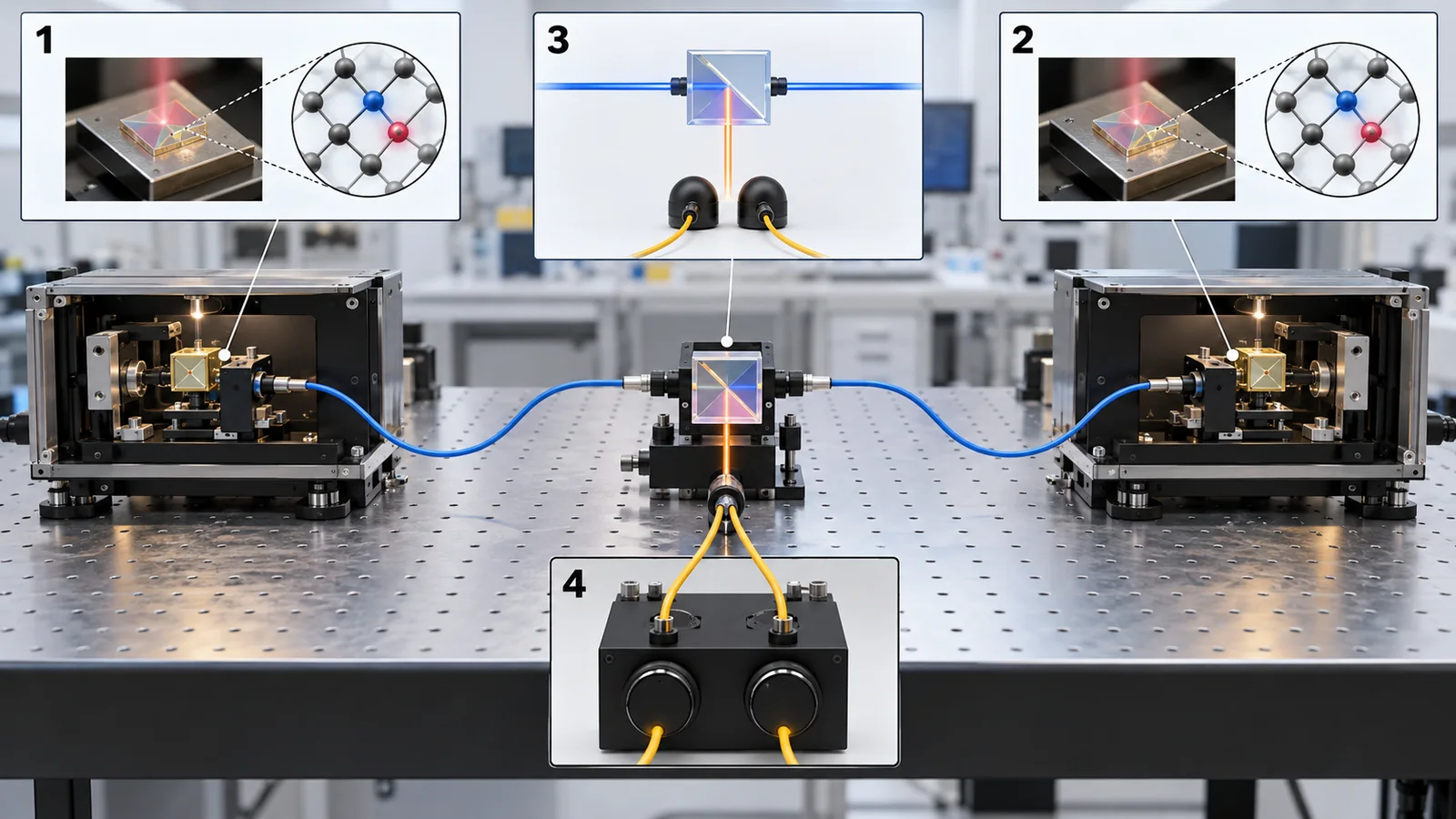
- The short version / before you read / where this fits in the series
- What a quantum network is: three kinds
- Entanglement, gently
- Delivering entanglement: heralded generation
- Quantum teleportation: moving a state
- Why distance is a wall
- The quantum repeater: swapping entanglement
- The quantum memory: the part that waits
- Experiments confirmed, and what is still a vision
- How to read evaluations and standards
- Glossary
- References (primary sources)
- Claim-to-source audit
Sourced = content stated in published material (with source links)
Our calculation = values we computed from stated assumptions
Not yet confirmed = drafts, plans, visions and other unsettled matters
Our own interpretation is labelled "Commentary". Inference is shown in bold.
Experimental numbers are those stated in the paper abstracts, given together with their conditions (distance, material, what the value measures). Because schemes and conditions differ, the size of a number cannot be used to rank experiments. The distance-and-loss calculation rests on idealised assumptions: a loss of 0.2 dB/km, memories that hold forever, and swaps that always succeed. It is an illustration of the mechanism, not the performance of real equipment. The 2026 papers (Chapter 9) are the latest reports as of the checking date and may be re-evaluated by replication and critique.
1. The short version / before you read / where this fits in the series
- A quantum network delivers "entanglement", not "data": if two distant places share a pair of entangled qubits, they can use it to move a quantum state or to make a key. The network's job is to make and deliver that entanglement[Ref. 35]
- Distance is a wall because light fades and cannot be amplified: beyond a few tens of kilometres in fibre, or about 1000 kilometres through a satellite, the rate of direct delivery becomes effectively zero[Ref. 35]. So the path is split into segments, the entanglement is kept in quantum memories, and quantum repeaters "swap" it onward
- As of October 2026, what has been confirmed is components and small-scale experiments: memory-to-memory entanglement has been reported over 10 km of fibre (trapped ions) and 420 km (atomic ensembles) and so on[Ref. 24, 25], but a continental-scale quantum internet is still a vision. We keep "what was done" and "what is planned" apart
No prior knowledge is needed. The "arrow analogy" (north = 0, south = 1, east and west are superpositions) and the fact that light cannot be copied were explained in our previous article on quantum key distribution. Both are briefly re-explained here.
This is best read after "Quantum Key Distribution and Quantum Communication". Distributed quantum computing, which links quantum computers, relates to our explainer on logical qubits and fault-tolerant computing; the materials of memories relate to our explainer on materials and fabrication for quantum computers, and to those on quantum dots and spintronic materials.
2. What a quantum network is: three kinds
The term "quantum network" is used in several senses. The UK NCSC divides it into three broad classes[Ref. 1].
This article centres on class 3. The Quantum Internet Research Group of the IRTF (the Internet's research body) states in RFC 9340 that the vision of a quantum internet is to enhance existing Internet technology by enabling quantum communication between any two points on Earth[Ref. 35]. It is not meant to "replace" today's Internet.
What is it for? Wehner et al. list (1) secure communication with distant parties (QKD and others), (2) distributed quantum computing that links several quantum computers, and (3) networks of highly sensitive sensors[Ref. 6, 36]. RFC 9583 organises examples of these applications.
An ordinary network carries the data itself. What a quantum network carries is a resource: entangled pairs. RFC 9340 contrasts them: a classical data plane carries user data, while a quantum data plane provides the resources for the user to transmit user data themselves[Ref. 35]. In postal terms, it does not carry the letter; it creates a state in which two people can hold "the same code book" (limit of the analogy: entanglement is not an object to carry but a relationship between two distant qubits).
3. Entanglement, gently
Let us think of entanglement using the arrow analogy. The state of one qubit was one arrow. Two entangled qubits are two arrows that behave as one unit. Neither arrow alone can be given a direction (looking at one alone, which way it points is completely undetermined). Only the pair can be described, by a relationship such as "the two always point the same way".
Concretely, suppose Alice and Bob each hold one arrow of an entangled pair. If they measure in the same way (for example "north or south?"), their results are random every time, yet always agree (for that kind of entanglement; RFC 9340 calls the most strongly entangled two-qubit states "Bell pairs" and lists four kinds[Ref. 35]).
This is wrong, for two reasons. (1) Each side's result is, alone, just random 0s and 1s, with no message in it. (2) That the results agree is learned only when the two compare them, and comparing needs an ordinary channel (no faster than light). RFC 9340 likewise says that, because the measurement results of teleportation must be sent over a classical channel, entanglement cannot be used to transmit information faster than light[Ref. 35]. Entanglement is a resource distributed in advance, not communication itself.
A popular analogy puts the left and right glove of a pair in two separate boxes and sends them far apart; open one, find a right-hand glove, and you know at once the other is a left-hand one. But that describes a situation that was fixed before the boxes were opened, and can be explained by "settled in advance", so it misses the essence of entanglement. Bell-inequality experiments have shown that for entangled pairs the agreement holds whichever way you choose to measure, which cannot be explained by a prior agreement. Hensen et al. performed a Bell test that closed the loopholes of distance and detection, using electron spins in diamond separated by 1.3 km, and reported rejecting local-realist hypotheses at two standard deviations[Ref. 14] (the Nature summary notes that the statistical significance was limited).
More detail: Bell pairs and entanglement as a resource
According to RFC 9340, the most strongly entangled two-qubit states (Bell pairs) come in four kinds and can be converted into one another by simple operations on just one of the qubits[Ref. 35]. A network needs to deliver only Bell pairs, not arbitrary quantum states, because once Bell pairs arrive, any state can be sent by teleportation (Chapter 5). Because the state of a Bell pair is known, errors are easier to handle: failures can be retried, and higher-quality pairs can be extracted from several (distillation)[Ref. 35].
4. Delivering entanglement: heralded generation
An entangled pair is first made somewhere, and one or both of its members are carried, for example through optical fibre. What is carried is a photon, which RFC 9340 calls a "flying qubit". Photons are fast, low-loss and little affected by surroundings, so they suit the job, but they are hard to store. So the photon's state is transferred into a qubit that can be stored (a "matter qubit": the memory)[Ref. 35].
This process often fails (because light is lost on the way). So a mechanism is used that signals whether it succeeded. Schemes that announce success are called "heralded" generation[Ref. 35]. On failure the attempt is discarded and tried again.
RFC 9340 lists three basic schemes: "at mid-point" (a source midway between the two nodes sends entangled photons to each), "at source" (one node sends a photon), and "at both end-points" (both nodes send photons and a detector in between measures them jointly, entangling the remote memories). The mid-point scheme is more robust to photon loss, while in the other schemes the nodes keep greater control over the generation[Ref. 35].
5. Quantum teleportation: moving a state
Once an entangled pair has been delivered, a quantum state can be moved to the other side. This is quantum teleportation, shown by Bennett et al. in 1993[Ref. 12]. Unlike teleportation in science fiction, no matter or information moves instantly.
Restated in the language of arrows, the RFC 9340 description runs as follows. (1) Alice measures, together, the unknown state she wants to send and her half of the entangled pair (a Bell measurement). (2) This measurement destroys the state to be sent and yields two classical bits. (3) She sends those two bits to Bob over an ordinary channel. (4) Bob applies one of four corrections, as the two bits indicate, to his half, and the state she wanted to send appears[Ref. 35]. The original state has been destroyed, so no-cloning is not violated.
What moves is only the quantum "state", not matter. And until the two bits of step 3 arrive, the state does not appear on Bob's side, so nothing goes faster than light. The value of teleportation is that the state itself need not be sent through a lossy channel (the entangled pair is made beforehand, retrying on failure). RFC 9340 summarises this as: the network need only deliver Bell pairs[Ref. 35].
Experiments have also been run between ground and satellite. Ren et al. reported teleportation of a single photon from a ground station to a satellite[Ref. 27], and Yin et al. reported an experiment that distributed entangled photons over 1200 km from a satellite to the ground[Ref. 26] (Chapter 9).
6. Why distance is a wall
In an optical fibre light is gradually lost by absorption and scattering. With a loss of 0.2 dB per km (an illustrative figure), only 1% arrives after 100 km, one part in ten thousand after 200 km and one in a million after 300 km (the same calculation as in the previous article). Ordinary links put "amplifiers" along the way to strengthen the signal, but a quantum state cannot be copied, so the same cannot be done. RFC 9340 states that beyond a few tens of kilometres in fibre, or about 1000 kilometres through a satellite, the rate of generating entanglement directly is effectively zero, and because of no-cloning the signal cannot simply be amplified[Ref. 35, 2].
If we try to deliver entanglement "directly", the chance of success per attempt is roughly "the fraction of light that arrives, η". On average 1/η attempts are needed before one succeeds. Here is how that number grows.
| Distance | Loss | Fraction arriving η | Average attempts per success, 1/η | If 10⁹ attempts per second |
|---|---|---|---|---|
| 100 km | 20 dB | 1e-02 | 1e+02 | 1e-07 s |
| 300 km | 60 dB | 1e-06 | 1e+06 | 1 ms |
| 500 km | 100 dB | 1e-10 | 1e+10 | 10 s |
| 700 km | 140 dB | 1e-14 | 1e+14 | 1.2 days |
| 1000 km | 200 dB | 1e-20 | 1e+20 | about 3,200 years |
Our calculation. Assumes a loss of 0.2 dB/km, 10⁹ attempts per second and an ideal detector (100% efficiency, zero noise): very generous assumptions. Real sources and detectors are neither this fast nor this efficient. The example shows that doubling the distance does not double the difficulty but changes it by orders of magnitude; it is not a prediction for real equipment.
Each attempt also costs time waiting for the success signal to arrive over a classical link. If light travels in fibre at about 200,000 km/s (our assumption), one way over 1000 km takes about 5 ms (1000 km ÷ 200,000 km/s; Our calculation).
Stronger light would mean more light arriving, but entanglement is a property of single photons in a pair. Strong light is no longer a single-quantum state but a classical signal and cannot carry entanglement. Being unable to make up for loss with more light is what makes quantum communication hard (our commentary).
7. The quantum repeater: swapping entanglement
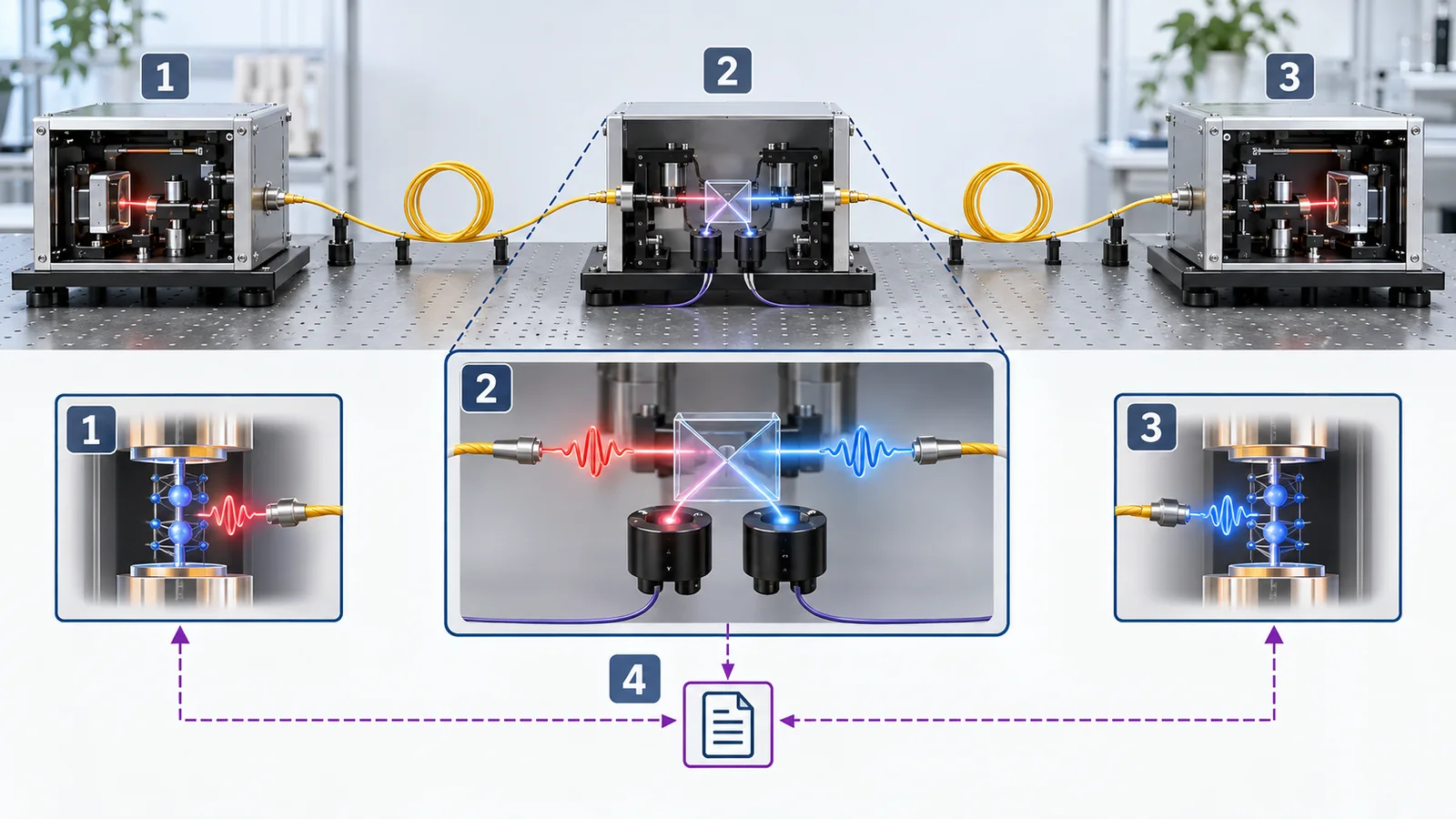
The idea for getting past the distance wall was put forward by Briegel et al. in 1998[Ref. 8]. Split the path into short segments, make entanglement on each segment and keep it in memory, then "swap" the entanglement of neighbouring segments so that it spans end to end. The swap is called entanglement swapping, proposed by Żukowski et al. in 1993[Ref. 13].
View original SVG, values and sources
Original SVG reference: Conceptual diagram (vector drawing). Extending entanglement with quantum repeaters by swapping. The green dashed lines are entanglement.
In the language of arrows, the RFC 9340 description runs as follows. Node B measures together its half of the pair shared with A (X2) and its half of the pair shared with C (Y1), a Bell measurement. The entanglement between the two qubits at B is destroyed, but a new entanglement appears between A and C. This is the same as "teleporting X2 to C using the entangled pair Y". The two bits of the measurement result are sent over a classical channel[Ref. 35].
It is not amplification. What a quantum repeater does is "swap" the entanglement made on each segment. It neither strengthens nor copies the quantum state of the light (it cannot). RFC 9340 notes that nodes which create long-distance entanglement through swapping are called quantum repeaters in the academic literature[Ref. 35].
What changes when the path is split: our calculation
Here is the average number of attempts when 1000 km is split into n segments. Each segment (length 1000/n km) succeeds with probability equal to its optical transmission. Memories are assumed to hold forever, so segments that succeed wait, and once all segments have succeeded the swaps are carried out together (swaps are assumed to always succeed).
The result is dramatic. Without splitting, 10²⁰ attempts are needed on average. With two segments (500 km each) about 1.5×10¹⁰, with four about 2×10⁵, and with 20 segments (50 km each) about 35. The scheme shown by Duan et al. in 2001 (using atomic ensembles and linear optics) likewise shows that "the communication efficiency scales polynomially with the channel length"[Ref. 9].
Our calculation (Python; computed as a sum of the expected number of attempts until all segments succeed). What this calculation ignores: failed swaps, degradation in the memories (finite storage time), the loss of entanglement quality (fidelity) at every segment and every swap, and the time spent waiting for success signals. RFC 9340 states that fidelity drops with each link and each swap, and that "distillation" to make up for it greatly increases the resource demand[Ref. 35].
We can also estimate how long the memory must hold on. For 50 km segments (the 20-segment example) the round trip for a success signal takes about 0.5 ms (50 km × 2 ÷ 200,000 km/s). Waiting for about 35 attempts gives about 17 ms (35 × 0.5 ms). So the memory has to hold entanglement for at least tens of milliseconds (Our calculation; an idealised example). As the next chapter shows, a key goal of real experiments, as a repeater component, is that memory-to-memory entanglement survives "longer than the time it takes to create it".
More detail: the "three generations" of quantum repeaters
Muralidharan et al. classify proposed repeater schemes into three categories (generations) according to how they compensate for photon loss and operation errors, and compare their costs in time and physical resources[Ref. 11]. Roughly, the first generation uses heralded entanglement generation and distillation, and later generations bring in quantum error correction to go farther and faster (this rough account is our commentary; see the paper for the definition of each generation). RFC 9340 also states that quantum error correction is not expected to be used until later generations of networks[Ref. 35]. Sangouard et al. review repeaters based on atomic ensembles and linear optics[Ref. 10].
8. The quantum memory: the part that waits
A quantum memory is a part that "keeps waiting" a quantum state without destroying it. Lvovsky et al. review the schemes and performance of optical quantum memory, noting that it matters both as a synchronisation tool in quantum computing and for quantum repeaters[Ref. 30]. In general a memory is judged by its efficiency (how much light it takes in and gives back), fidelity (how correctly it keeps the state), storage time, bandwidth (how fast a light pulse it can handle), multiplexing capacity (how many states it can hold at once) and wavelength (our commentary).
View original SVG, values and sources
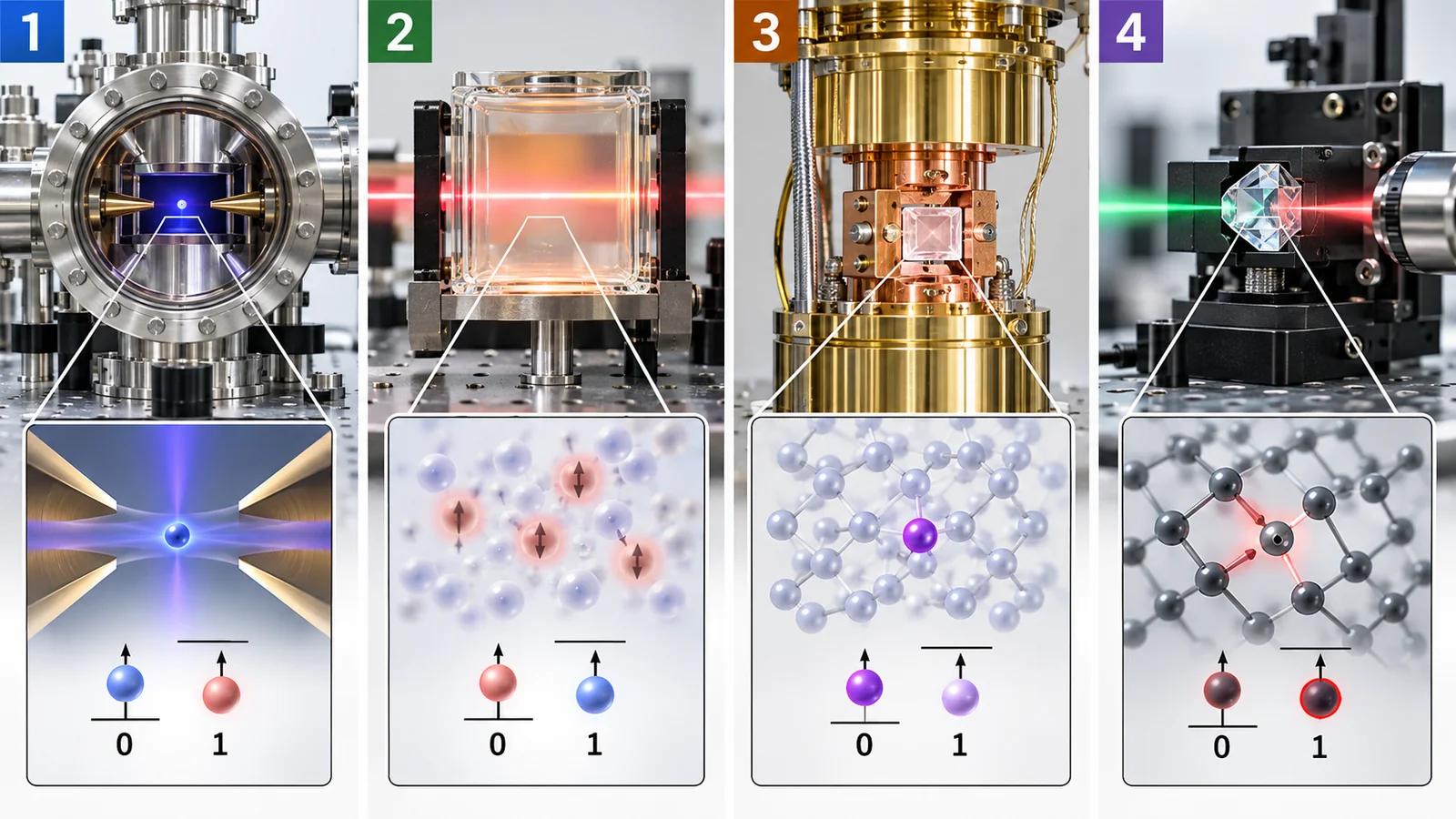
Original SVG reference: Conceptual diagram (vector drawing). Four systems for quantum memory. Not a ranking of materials.
There is no single material for quantum memory. Awschalom et al. and Atatüre et al. review spins in solids (diamond, silicon carbide, crystals doped with rare earths and so on)[Ref. 32, 31]. Atatüre et al. summarise that the material must give stable spin and optical properties and allow robust manufacturing of quantum photonic circuits; no system is yet perfect and different applications need different properties, so several are developed in parallel[Ref. 31].
| System (material) | Representative report (conditions, what the value is) | Caution in reading |
|---|---|---|
| Cooled atomic ensembles | Yu et al. (2020): two atomic ensembles in one laboratory entangled through field-deployed 22 km fibre and others[Ref. 17]. Liu et al. (2024): three nodes, up to 12.5 km, memory lifetime longer than the round-trip communication time[Ref. 18]. Luo et al. (2026): two atomic-ensemble memories entangled over 420 km of fibre[Ref. 25] | In Yu et al. the two ensembles sit in one laboratory and only the fibre is long. Distinguish what "distance" means |
| Rare-earth-doped crystals | Lago-Rivera et al. (2021): heralded entanglement stored in praseodymium (Pr)-doped crystals with telecom-wavelength photons; heralding rate up to 1.4 kHz, storage up to 25 μs, 62 temporal modes[Ref. 20]. Liu et al. (2021): two solid-state memories 3.5 m apart, bandwidth up to 1 GHz, fidelity 80.4 ± 2.2%[Ref. 21]. Zhong et al. (2015): nuclear spins in europium (Eu)-doped Y2SiO5 crystal with a coherence time of six hours[Ref. 28] | Six hours is the coherence time of nuclear spins in one memory, not entanglement storage time; 25 μs is the time entanglement was stored |
| Colour centres in diamond | Hensen et al. (2015): Bell test with electron spins of nitrogen-vacancy (NV) centres 1.3 km apart[Ref. 14]. Humphreys et al. (2018): NV nodes 2 m apart, entanglement generation up to 39 Hz, a decoherence rate of the remote entangled state of 5 Hz, and deterministic delivery at about every 100 ms with an average fidelity above 0.5[Ref. 15]. Knaut et al. (2024): nodes of silicon-vacancy (SiV) centres in nanophotonic cavities linked through 40 km spools of fibre and a 35 km deployed loop in the Boston area, with entanglement of nuclear-spin memories and second-long entanglement storage[Ref. 19] | A fidelity above 0.5 is only just beyond the usable threshold. Meanings differ between schemes |
| Trapped ions | Krutyanskiy et al. (2023): entanglement of ions 230 m apart[Ref. 22]. Main et al. (2025): two ion modules about 2 m apart; a teleported controlled-Z gate with 86% fidelity and a Grover search with 71% success rate[Ref. 23]. Liu et al. (2026): over 10 km of spooled fibre, memory-to-memory entanglement surviving beyond the average entanglement establishment time, with a device-independent QKD demonstration over 10 km and a positive asymptotic key rate over 101 km[Ref. 24]. Wang et al. (2021): a single 171Yb+ ion with a coherence time of about 5500 s (the time constant fitted to measurements up to 960 s)[Ref. 29] | The long coherence time of one ion is a different quantity from entanglement storage in a network; 2 m is between modules, not a long distance |
Sourced. All values are from the paper abstracts. Schemes, conditions and what is measured (coherence time, entanglement storage or success rate) differ, so rows and numbers cannot be ranked against each other.
The performance of a quantum memory is decided mostly by material quality. In colour centres in diamond, the environment around an atom-sized defect in the crystal (nearby nuclear spins, crystal strain, surface charge) governs the spin lifetime and the stability of the optical wavelength. In the experiment of Humphreys et al., control of the charge state and suppression of fluctuations of the optical wavelength (spectral diffusion) are named as keys to deterministic entanglement delivery[Ref. 15]. In rare-earth-doped crystals the combination of host crystal (Y2SiO5 and so on) and the rare-earth ion put in it (Pr, Eu and so on) sets storage length, bandwidth and wavelength[Ref. 20, 28]. Atatüre et al. compare three material platforms, diamond, silicon carbide and atomically thin semiconductors, and identify as the challenge manufacturing that makes defects stably, at chosen places, reproducibly[Ref. 31].
The wavelength of light that a memory emits is set by its material; for an NV centre it is 637 nm. That light suffers too much loss in telecom fibre. So elements are needed that convert the photon wavelength to a telecom wavelength where fibre loss is small. Dréau et al. converted NV photons from 637 nm to 1588 nm by difference-frequency generation, with an overall efficiency of 17%[Ref. 33] (a 2018 report; efficiencies have continued to improve). Wavelength conversion is also used in the atomic ensembles of Yu et al. (2020), the SiV nodes of Knaut et al. (1,350 nm, 2024) and the 420 km experiment of Luo et al. (telecom S band, 2026)[Ref. 17, 19, 25]. Such conversion uses nonlinear-optical crystals and waveguides, an area that overlaps with the materials of our thin-film lithium niobate explainer (our commentary).
In the 420 km experiment, Luo et al. state that, to keep the relative phase of the photons from the two memories, they combine full-time locking, which reduces high-frequency noise, with intermittent locking, which compensates slow drift[Ref. 25]. Changes in fibre length caused by temperature and vibration disturb the phase of light, so the fibre coating, the installation environment and the stability of the light sources bear directly on network performance (our commentary).
9. Experiments confirmed, and what is still a vision
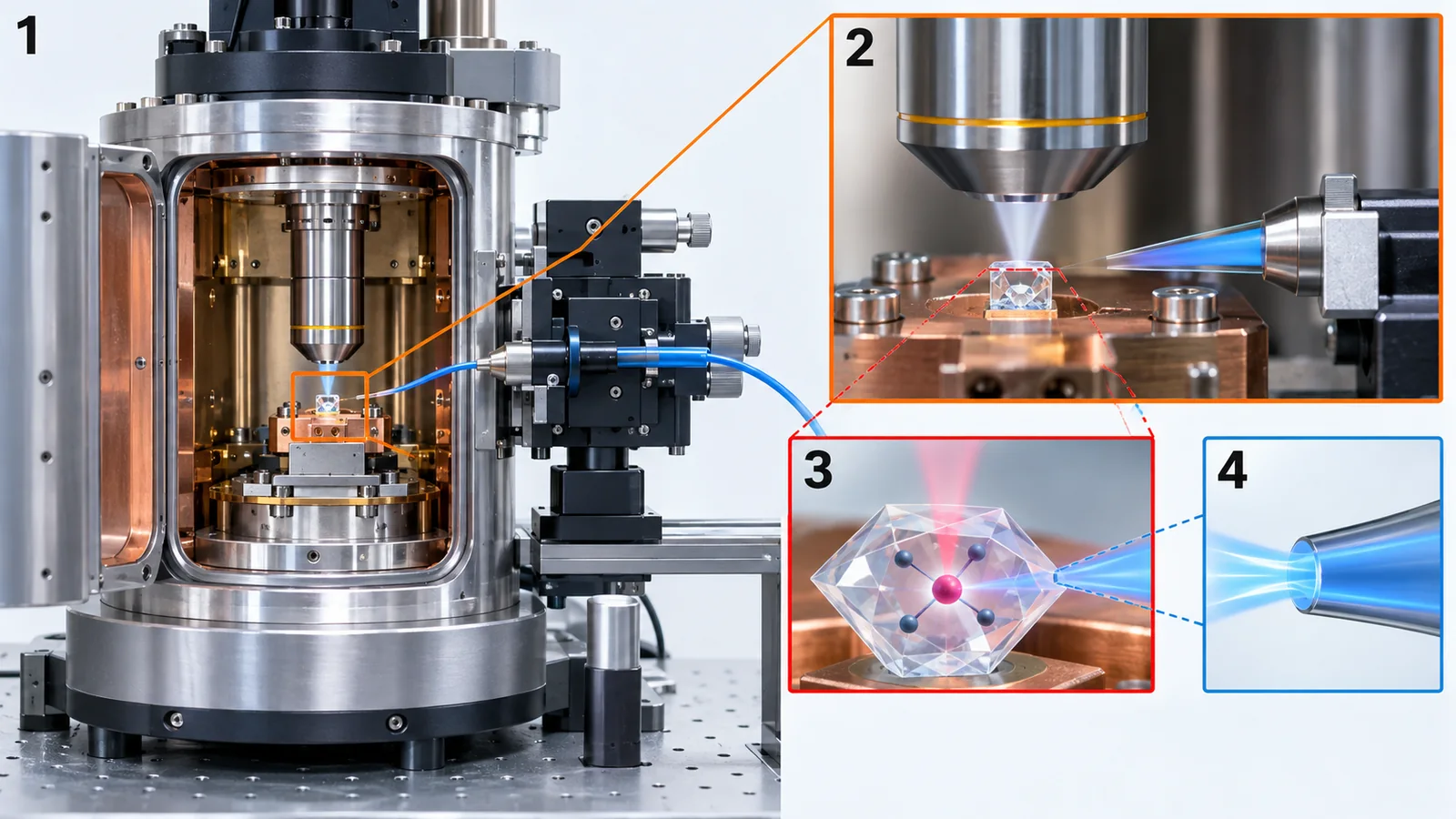
Talk of quantum networks tends to blend "what experiments have confirmed" with "visions for the future". Here we list the experiments confirmed in papers in order of year, and then set out the visions separately. Checked 16 October 2026.
(1) Confirmed experiments (by year)
| Year, report | What was shown | Scale and conditions | Caution |
|---|---|---|---|
| 2015 Hensen et al.[Ref. 14] | Bell test with electron spins in diamond, closing the loopholes | Two sites 1.3 km apart | A confirmation of the nature of entanglement; two nodes |
| 2017 Yin et al.[Ref. 26] | A satellite delivers entangled photons to two ground stations | Title: 1200 km | Photon delivery; no memories used |
| 2017 Ren et al.[Ref. 27] | Teleportation of a single photon from a ground station to a satellite | A low-orbit satellite | Transfer of a photon state |
| 2018 Humphreys et al.[Ref. 15] | Delivered entanglement deterministically in the regime where generation rate exceeds the decay rate | NV centres, 2 m; generation up to 39 Hz | A short distance; the point is meeting the condition |
| 2020 Yin et al.[Ref. 4] | A key between two ground stations from satellite entanglement, with no trusted relay | 1,120 km, 0.12 bit/s | The key amount is small (previous article) |
| 2020 Yu et al.[Ref. 17] | Entangled two atomic-ensemble memories through city-scale fibre | 22 km deployed / 50 km coiled; both memories in one laboratory | "Distance" is the fibre length |
| 2021 Pompili et al.[Ref. 16] | Entanglement distribution and swapping in a three-node network of NV centres | Three nodes; distances not confirmed here | A first small network example |
| 2021 Lago-Rivera et al. / Liu et al.[Ref. 20, 21] | Heralded entanglement with solid-state (rare-earth-doped crystal) memories | Different laboratories / 3.5 m | Storage up to 25 μs / fidelity 80.4% |
| 2023 Krutyanskiy et al.[Ref. 22] | Entanglement of trapped ions | 230 m | Only the title was checked |
| 2024 Liu et al. / Knaut et al.[Ref. 18, 19] | A three-node metropolitan network of atomic ensembles / entanglement of SiV nuclear-spin memories | Up to 12.5 km / 40 km spools and a 35 km deployed loop | The former is heralded, with memory lifetime longer than the round-trip time |
| 2025 Main et al.[Ref. 23] | A teleported controlled-Z gate and a distributed quantum algorithm between two ion modules | About 2 m; gate fidelity 86%, Grover success 71% | One of the first demonstrations of distributed quantum computing; a short distance |
| 2026 Liu et al.[Ref. 24] | Memory-to-memory entanglement survived beyond the average establishment time; also device-independent QKD | 10 km of spooled fibre; QKD over 10 km (finite) and 101 km (asymptotic) | Spooled = fibre wound in one place; a building block of repeaters |
| 2026 Luo et al.[Ref. 25] | Entangled two atomic-ensemble memories over 420 km of fibre; reported that the entangling probability beats the limit for direct delivery | 420 km (PRL, published 11 August 2026) | Only the abstract was checked; not a demonstration of a chain of repeaters |
Sourced. Content is based on titles and abstracts. Schemes, the meaning of "distance" and conditions differ, so rows cannot be ranked. The two 2026 reports are the latest as of the checking date, and their assessment may change.
This 2026 report entangled two atomic-ensemble memories over 420 km of fibre, and its abstract states that the memory-to-memory entangling probability beat the channel capacity for direct delivery without repeaters[Ref. 25]. It is a significant step for the elementary segment of a quantum repeater, but it is not a demonstration of a chain of repeaters swapping several segments onward (no such statement could be confirmed in the abstract). "One component works" and "a network is running" are different things.
(2) Visions: six stages toward a quantum internet
Wehner et al. divided the road to a quantum internet into six stages by how functionality grows[Ref. 6]. The classification is meant to measure experimental progress and to give researchers a common language.
| Stage | What becomes possible (our paraphrase of Wehner et al.) |
|---|---|
| 1. Trusted-repeater networks | End-to-end transmission of qubits is not possible. Neighbouring segments run QKD and keys are shared through trusted relay sites |
| 2. Prepare-and-measure networks | The first stage with end-to-end quantum functionality; QKD end to end without trusting intermediate repeater nodes |
| 3. Entanglement distribution networks | Entanglement can be created end to end, deterministically or heralded; the end nodes need no quantum memory |
| 4. Quantum memory networks | The end nodes have local memory and universal local control; more complex protocols that need temporary storage of quantum states become possible |
| 5. Few-qubit fault-tolerant networks | Local operations can be made fault-tolerant (a few logical qubits) |
| 6. Quantum computing networks | The final stage, in which quantum computers exchange quantum communication freely |
Not yet confirmed = a classification of future stages (a vision). Wehner et al. state that a network attains a stage only if the functionality is available to all nodes[Ref. 6]. We make no judgement as to which stage individual experiments have reached.
RFC 9340 sets out this vision as design principles for the network: "deliver only Bell pairs", "because states cannot be copied, repeat by entanglement swapping" and "set a fidelity threshold per application"[Ref. 35]. RFC 9583 collects example applications and a classification[Ref. 36]. Neither is an Internet standard; both are informational documents.
(1) A demonstration of a continental-scale quantum repeater network could not be confirmed (checked 16 October 2026). (2) A report that carried out several stages of swapping while holding entanglement in memories and delivered a key or entanglement end to end beyond the repeaterless limit could not be found in the abstracts we checked. (3) A judgement of which of Wehner et al.'s stages each experiment has reached. (4) The full texts of the two 2026 reports (only abstracts were checked).
10. How to read evaluations and standards
Progress in quantum networks is measured by (1) how fast entanglement is made, (2) the quality of the entanglement (fidelity), (3) how long memories keep the entanglement compared with how long it takes to make, (4) distance, compared with the repeaterless limit, and (5) the number of nodes and the stage of the network. Fidelity expresses, on a scale of 0 to 1, how close the entangled state made is to the intended state; RFC 9340 explains that below 0.5 the state is unusable and that each application sets its own threshold above which it operates[Ref. 35]. Checked 16 October 2026.
| What is assessed | Representative benchmark or method (name, source) | Standards and guidance (IETF, ISO/IEC, ITU-T and others) | Caution in reading |
|---|---|---|---|
| Entanglement generation rate | Generation rate (Hz) and whether heralded. Examples: up to 39 Hz (Humphreys et al.), heralding rate up to 1.4 kHz (Lago-Rivera et al.)[Ref. 15, 20]Sourced | Could not be confirmed (no standard setting a common pass level for the generation rate was found) | The rate is meaningful in comparison with the memory decay rate (the condition of Humphreys et al.) |
| Entanglement quality | Fidelity (0 to 1). Example: 80.4 ± 2.2% (Liu et al., 2021)[Ref. 21]Sourced | RFC 9340: the definition of fidelity and the idea of per-application thresholds (informational)[Ref. 35]Sourced | The required threshold differs by use; do not compare on "high fidelity" alone |
| Memory retention | Coherence time, entanglement storage time, and "can it be kept longer than it takes to establish". Examples: Liu et al. (2026)[Ref. 24], Zhong et al. (2015, six hours)[Ref. 28]Sourced | Could not be confirmed | Coherence time, entanglement storage time and establishment time are different quantities |
| Comparison with the distance limit | The repeaterless upper bound (Pirandola et al., 2017)[Ref. 3]. Luo et al. (2026): memory-to-memory entangling probability reported to beat the channel capacity for direct delivery[Ref. 25]Sourced | Could not be confirmed | For "beat the limit", check what was compared (key rate or entangling probability) |
| Stage of network development | Six stages and proposed tests to certify each stage (Wehner et al., 2018)[Ref. 6]Not yet confirmed | Not a standard; an organisation by researchers | Attaining a stage requires the functionality to be available at all nodes |
| Architecture and terminology | — | IETF (IRTF) RFC 9340 (March 2023) and RFC 9583 (June 2024). Both are informational, not Internet standards[Ref. 35, 36]Sourced | Despite the name, "RFC" here carries no binding force |
| International standards activity | — | IEC/ISO JTC 3 (quantum technologies): its scope includes quantum communications, and its working groups include WG 16 "Quantum Communication" and WG 13 "Quantum random number generators" (checked 16 October 2026)[Ref. 37]Sourced. Within what we checked, no international standard defining entanglement-distribution networks themselves was confirmed | The existence of a working group does not mean a standard exists |
| QKD network standards (for reference) | — | The ITU-T Y.3800 and X.1710 series. Examples: Y.3810 (framework for interworking of QKD networks, September 2024) and X.1711 (framework of QKD protocols in QKD networks, March 2026), both in force[Ref. 38]Sourced | These are for QKD; a recommendation targeting entanglement-distribution networks themselves could not be confirmed |
The organisation of the table is Our calculation (arrangement). Numbers and status checked on the official IETF, ISO and ITU-T pages (checked 16 October 2026).
Cautions in reading (for materials engineers)
- Check what the "N km" of "entanglement over N km" is the distance of: the length of fibre, or the real separation between the nodes. An experiment such as Yu et al. (2020), where the two memories sit in one laboratory and only the fibre is long, means something different from one with nodes in separate buildings[Ref. 17, 18].
- "Memory time" comes in three kinds: the coherence time of a single memory (Zhong et al.: six hours), the time for which entanglement could be stored (Lago-Rivera et al.: 25 μs), and the comparison with the time it takes to establish entanglement (Liu et al., 2026). For a repeater, the last comparison is the one that matters (our commentary).
- The latest reports are not yet assessed: the 2026 reports (Luo et al., Liu et al.) are new as of the checking date and replication and critique are still to come. Read them as claims in abstracts and do not write beyond what could be confirmed.
- An RFC is not a standard: RFCs 9340 and 9583 are informational documents recording the consensus of the Quantum Internet Research Group and are not candidates for Internet standards[Ref. 35, 36]. They help one learn the design thinking, but "follow this and you conform" is not what they offer.
11. Glossary
- Quantum network
- A network that exchanges quantum states or entanglement between distant nodes.
- Quantum internet
- The future vision of enabling quantum communication between any two points; it would enhance today's Internet.
- Entanglement
- Two or more qubits behaving as one unit, so that none alone can be described.
- Bell pair
- The most strongly entangled states of two qubits; there are four kinds.
- Bell inequality
- An inequality bounding the correlations that "prior agreement" can explain; its violation rules out simple prior agreement.
- Flying qubit
- A photon that carries entanglement.
- Matter qubit (memory)
- A qubit that can hold a state, such as an atom, an ion or a spin in a crystal.
- Herald
- A signal announcing that entanglement generation succeeded.
- Classical channel
- An ordinary communication channel, used for teleportation and success signals.
- Quantum teleportation
- A procedure that moves a quantum state to the other side using entanglement and two classical bits.
- Bell measurement
- A joint measurement of two qubits that tells which of the four Bell states they are in.
- Entanglement swapping
- An operation that joins two neighbouring entangled pairs by a Bell measurement into entanglement between the two ends.
- Quantum repeater
- A node that creates long-distance entanglement through swapping and similar steps; not a signal amplifier.
- Quantum memory
- A component that keeps a quantum state for a while without destroying it.
- Fidelity
- A measure from 0 to 1 of how close a made state is to the intended one.
- Coherence time
- The time for which a quantum state stays intact.
- Distillation (purification)
- Extracting one higher-quality pair from several lower-quality pairs; it costs many resources.
- DLCZ scheme
- A repeater scheme using atomic ensembles and linear optics (Duan, Lukin, Cirac, Zoller, 2001).
- Quantum frequency conversion
- Changing only the wavelength of a photon while preserving its state; used to shift to telecom wavelengths and reduce fibre loss.
- No-cloning
- The principle that an unknown quantum state cannot be copied without destroying the original; the reason amplification is impossible.
- Distributed quantum computing
- Linking several quantum computing modules through a network to run one computation.
- Trusted relay
- A scheme in which keys are handed on at relay sites; relay sites must be trusted.
- QKD (quantum key distribution)
- Making a shared secret key between two distant parties using the quantum properties of light.
12. References (primary sources)
- NCSC (UK National Cyber Security Centre) "Quantum networking technologies" (white paper, version 1.0, published 5 August 2025) — ncsc.gov.uk/whitepaper/quantum-security-technologies
- Wootters W. K., Zurek W. H. "A single quantum cannot be cloned", Nature 299, 802–803 (1982), DOI 10.1038/299802a0 — doi.org/10.1038/299802a0
- Pirandola S., Laurenza R., Ottaviani C., Banchi L. "Fundamental limits of repeaterless quantum communications", Nat. Commun. 8, 15043 (2017), DOI 10.1038/ncomms15043 — nature.com/articles/ncomms15043
- Yin J. et al. "Entanglement-based secure quantum cryptography over 1,120 kilometres", Nature 582, 501–505 (2020), DOI 10.1038/s41586-020-2401-y — nature.com/articles/s41586-020-2401-y
- Chen Y.-A. et al. "An integrated space-to-ground quantum communication network over 4,600 kilometres", Nature 589, 214–219 (2021), DOI 10.1038/s41586-020-03093-8 — nature.com/articles/s41586-020-03093-8
- Wehner S., Elkouss D., Hanson R. "Quantum internet: A vision for the road ahead", Science 362, eaam9288 (2018), DOI 10.1126/science.aam9288 (we read the accepted manuscript on the QuTech site) — doi.org/10.1126/science.aam9288
- Kimble H. J. "The quantum internet", Nature 453, 1023–1030 (2008), DOI 10.1038/nature07127 — doi.org/10.1038/nature07127
- Briegel H.-J., Dür W., Cirac J. I., Zoller P. "Quantum Repeaters: The Role of Imperfect Local Operations in Quantum Communication", Phys. Rev. Lett. 81, 5932–5935 (1998), DOI 10.1103/PhysRevLett.81.5932 — doi.org/10.1103/PhysRevLett.81.5932
- Duan L.-M., Lukin M. D., Cirac J. I., Zoller P. "Long-distance quantum communication with atomic ensembles and linear optics", Nature 414, 413–418 (2001), DOI 10.1038/35106500 — nature.com/articles/35106500
- Sangouard N., Simon C., de Riedmatten H., Gisin N. "Quantum repeaters based on atomic ensembles and linear optics", Rev. Mod. Phys. 83, 33–80 (2011), DOI 10.1103/RevModPhys.83.33 — doi.org/10.1103/RevModPhys.83.33
- Muralidharan S., Li L., Kim J., Lütkenhaus N., Lukin M. D., Jiang L. "Optimal architectures for long distance quantum communication", Sci. Rep. 6, 20463 (2016), DOI 10.1038/srep20463 — nature.com/articles/srep20463
- Bennett C. H., Brassard G., Crépeau C., Jozsa R., Peres A., Wootters W. K. "Teleporting an unknown quantum state via dual classical and Einstein-Podolsky-Rosen channels", Phys. Rev. Lett. 70, 1895–1899 (1993), DOI 10.1103/PhysRevLett.70.1895 — doi.org/10.1103/PhysRevLett.70.1895
- Żukowski M., Zeilinger A., Horne M. A., Ekert A. K. "Event-ready-detectors" Bell experiment via entanglement swapping", Phys. Rev. Lett. 71, 4287–4290 (1993), DOI 10.1103/PhysRevLett.71.4287 — doi.org/10.1103/PhysRevLett.71.4287
- Hensen B. et al. "Loophole-free Bell inequality violation using electron spins separated by 1.3 kilometres", Nature 526, 682–686 (2015), DOI 10.1038/nature15759 — nature.com/articles/nature15759
- Humphreys P. C. et al. "Deterministic delivery of remote entanglement on a quantum network", Nature 558, 268–273 (2018), DOI 10.1038/s41586-018-0200-5 — nature.com/articles/s41586-018-0200-5
- Pompili M. et al. "Realization of a multinode quantum network of remote solid-state qubits", Science 372, 259–264 (2021), DOI 10.1126/science.abg1919 — doi.org/10.1126/science.abg1919
- Yu Y. et al. "Entanglement of two quantum memories via fibres over dozens of kilometres", Nature 578, 240–245 (2020), DOI 10.1038/s41586-020-1976-7 — nature.com/articles/s41586-020-1976-7
- Liu J.-L. et al. "Creation of memory–memory entanglement in a metropolitan quantum network", Nature 629, 579–585 (2024), DOI 10.1038/s41586-024-07308-0 — nature.com/articles/s41586-024-07308-0
- Knaut C. M. et al. "Entanglement of nanophotonic quantum memory nodes in a telecom network", Nature 629, 573–578 (2024), DOI 10.1038/s41586-024-07252-z — nature.com/articles/s41586-024-07252-z
- Lago-Rivera D. et al. "Telecom-heralded entanglement between multimode solid-state quantum memories", Nature 594, 37–40 (2021), DOI 10.1038/s41586-021-03481-8 — nature.com/articles/s41586-021-03481-8
- Liu X. et al. "Heralded entanglement distribution between two absorptive quantum memories", Nature 594, 41–45 (2021), DOI 10.1038/s41586-021-03505-3 — nature.com/articles/s41586-021-03505-3
- Krutyanskiy V. et al. "Entanglement of Trapped-Ion Qubits Separated by 230 Meters", Phys. Rev. Lett. 130, 050803 (2023), DOI 10.1103/PhysRevLett.130.050803 — doi.org/10.1103/PhysRevLett.130.050803
- Main D. et al. "Distributed quantum computing across an optical network link", Nature 638, 383–388 (2025), DOI 10.1038/s41586-024-08404-x — nature.com/articles/s41586-024-08404-x
- Liu W.-Z. et al. "Long-lived remote ion–ion entanglement for scalable quantum repeaters", Nature 652, 51 (2026; published online 2 February 2026), DOI 10.1038/s41586-026-10177-4 — nature.com/articles/s41586-026-10177-4
- Luo X.-Y. et al. "Entangling Quantum Memories through a 420 km Long Fiber", Phys. Rev. Lett. 137, 070801 (published 11 August 2026), DOI 10.1103/ccd6-rf1s — journals.aps.org/prl/abstract/10.1103/ccd6-rf1s
- Yin J. et al. "Satellite-based entanglement distribution over 1200 kilometers", Science 356, 1140–1144 (2017), DOI 10.1126/science.aan3211 — doi.org/10.1126/science.aan3211
- Ren J.-G. et al. "Ground-to-satellite quantum teleportation", Nature 549, 70–73 (2017), DOI 10.1038/nature23675 — nature.com/articles/nature23675
- Zhong M. et al. "Optically addressable nuclear spins in a solid with a six-hour coherence time", Nature 517, 177–180 (2015), DOI 10.1038/nature14025 — nature.com/articles/nature14025
- Wang P. et al. "Single ion qubit with estimated coherence time exceeding one hour", Nat. Commun. 12, 233 (2021), DOI 10.1038/s41467-020-20330-w — doi.org/10.1038/s41467-020-20330-w
- Lvovsky A. I., Sanders B. C., Tittel W. "Optical quantum memory", Nat. Photon. 3, 706–714 (2009), DOI 10.1038/nphoton.2009.231 — nature.com/articles/nphoton.2009.231
- Atatüre M., Englund D., Vamivakas N., Lee S.-Y., Wrachtrup J. "Material platforms for spin-based photonic quantum technologies", Nat. Rev. Mater. 3, 38–51 (2018), DOI 10.1038/s41578-018-0008-9 — nature.com/articles/s41578-018-0008-9
- Awschalom D. D., Hanson R., Wrachtrup J., Zhou B. B. "Quantum technologies with optically interfaced solid-state spins", Nat. Photon. 12, 516–527 (2018), DOI 10.1038/s41566-018-0232-2 — nature.com/articles/s41566-018-0232-2
- Dréau A. et al. "Quantum Frequency Conversion of Single Photons from a Nitrogen-Vacancy Center in Diamond to Telecommunication Wavelengths", Phys. Rev. Applied 9, 064031 (2018), DOI 10.1103/PhysRevApplied.9.064031 — journals.aps.org/prapplied/abstract/10.1103/PhysRevApplied.9.064031
- Lauk N. et al. "Perspectives on quantum transduction", Quantum Sci. Technol. 5, 020501 (2020), DOI 10.1088/2058-9565/ab788a — doi.org/10.1088/2058-9565/ab788a
- Kozlowski W., Wehner S., Van Meter R. et al. (IRTF QIRG) RFC 9340 "Architectural Principles for a Quantum Internet" (Informational, March 2023) — rfc-editor.org/rfc/rfc9340.html
- Wang C., Rahman A., Li R. et al. (IRTF QIRG) RFC 9583 "Application Scenarios for the Quantum Internet" (Informational, June 2024) — rfc-editor.org/rfc/rfc9583.html
- IEC/ISO JTC 3 "Quantum technologies" committee page on iso.org (scope; working groups including WG 13 Quantum random number generators and WG 16 Quantum Communication; checked 16 October 2026) — iso.org/committee/10138914.html
- ITU-T Recommendations Y.3800 to Y.3820 and X.1710 to X.1715 on quantum key distribution networks (for example Y.3810 "Quantum key distribution network interworking - Framework", 09/2024, in force; X.1711 "Framework of quantum key distribution (QKD) protocols in QKD networks", 03/2026) (ITU-T pages, checked 16 October 2026) — itu.int/rec/T-REC-Y.3810/en
13. Claim-to-source audit
| Claim in the text | Basis | Category |
|---|---|---|
| The three classes of quantum networking (replacing classical functions / adding quantum functions to classical networks / networks distributing entanglement) and the need for memories and repeaters | UK NCSC white paper (5 August 2025) Reference 1 https://www.ncsc.gov.uk/whitepaper/quantum-security-technologies | Sourced |
| The quantum internet enhances the Internet; the classical data plane carries data while the quantum data plane provides resources (Bell pairs) for users to send; four Bell states; flying and matter qubits; the three schemes of heralded generation; the steps of teleportation (two classical bits, not faster than light); swapping and repeaters; the definition of fidelity and the 0.5 guide; the resource cost of distillation; amplification impossible because of no-cloning; beyond a few tens of km in fibre or about 1000 km via satellite the direct rate is effectively zero | RFC 9340 (IRTF QIRG, informational, March 2023) Reference 35 https://www.rfc-editor.org/rfc/rfc9340.html | Sourced |
| Example applications and classification for the quantum internet | RFC 9583 (IRTF QIRG, informational, June 2024) Reference 36 https://www.rfc-editor.org/rfc/rfc9583.html | Sourced |
| The six stages (trusted repeaters / prepare-and-measure / entanglement distribution / quantum memory / few-qubit fault-tolerant / quantum computing networks) and the criterion that a stage is attained only when functionality is available to all nodes | Accepted manuscript of Wehner et al. (2018) Reference 6 https://doi.org/10.1126/science.aam9288 | SourcedNot yet confirmed |
| Titles and bibliographic data of the quantum internet vision (Kimble, 2008), the quantum repeater proposal (Briegel et al., 1998), entanglement swapping (Żukowski et al., 1993), teleportation (Bennett et al., 1993) and no-cloning (Wootters and Zurek, 1982) | Bibliographic data of the papers (confirmed through Crossref) Reference 7 https://doi.org/10.1038/nature07127 Reference 8 https://doi.org/10.1103/PhysRevLett.81.5932 Reference 13 https://doi.org/10.1103/PhysRevLett.71.4287 Reference 12 https://doi.org/10.1103/PhysRevLett.70.1895 Reference 2 https://doi.org/10.1038/299802a0 | Sourced |
| The DLCZ scheme uses atomic ensembles and linear optics, and its communication efficiency scales polynomially with channel length | Abstract of Duan et al. (2001) Reference 9 https://www.nature.com/articles/35106500 | Sourced |
| Repeater schemes are classified into three categories (generations) by how they compensate for loss and operation errors, with their time and resource costs compared; a review of repeaters based on atomic ensembles and linear optics | Abstract of Muralidharan et al. (2016); bibliography of Sangouard et al. (2011) Reference 11 https://www.nature.com/articles/srep20463 Reference 10 https://doi.org/10.1103/RevModPhys.83.33 | Sourced |
| A Bell test closing the loopholes (1.3 km, electron spins in diamond); the Nature summary says the rejection of local realism was at two standard deviations only | Abstract and summary of Hensen et al. (2015) Reference 14 https://www.nature.com/articles/nature15759 | Sourced |
| NV centres 2 m apart: generation up to 39 Hz, decay rate 5 Hz, about every 100 ms, average fidelity above 0.5; control of charge state and mitigation of spectral diffusion | Abstract of Humphreys et al. (2018) Reference 15 https://www.nature.com/articles/s41586-018-0200-5 | Sourced |
| Entanglement distribution and swapping in a three-node network of NV centres | Abstract of Pompili et al. (2021) (via Crossref) Reference 16 https://doi.org/10.1126/science.abg1919 | Sourced |
| Two atomic-ensemble memories entangled through 22 km deployed and 50 km coiled fibre (both memories in one laboratory) | Abstract of Yu et al. (2020) Reference 17 https://www.nature.com/articles/s41586-020-1976-7 | Sourced |
| Three nodes, up to 12.5 km, memory lifetime longer than the round-trip communication time | Abstract of Liu et al. (2024) Reference 18 https://www.nature.com/articles/s41586-024-07308-0 | Sourced |
| Entanglement of SiV nuclear-spin memories (40 km spools, 35 km Boston loop, 1,350 nm, second-long storage) | Abstract of Knaut et al. (2024) Reference 19 https://www.nature.com/articles/s41586-024-07252-z | Sourced |
| Heralded entanglement in Pr-doped crystals (up to 1.4 kHz, up to 25 μs, 62 modes); another solid-state pair at 3.5 m with fidelity 80.4±2.2% and bandwidth 1 GHz | Abstracts of Lago-Rivera et al. and Liu et al. (2021) Reference 20 https://www.nature.com/articles/s41586-021-03481-8 Reference 21 https://www.nature.com/articles/s41586-021-03505-3 | Sourced |
| Entanglement of trapped ions (230 m); distributed quantum computing (about 2 m, CZ 86%, Grover 71%) | Title of Krutyanskiy et al. (2023) (via Crossref); abstract of Main et al. (2025) Reference 22 https://doi.org/10.1103/PhysRevLett.130.050803 Reference 23 https://www.nature.com/articles/s41586-024-08404-x | Sourced |
| Memory-to-memory entanglement surviving beyond the average establishment time over 10 km of spooled fibre; device-independent QKD over 10 km (finite) and 101 km (asymptotic) | Abstract of Liu et al. (2026) (Nature 652, 51) Reference 24 https://www.nature.com/articles/s41586-026-10177-4 | SourcedNot yet confirmed |
| Two atomic-ensemble memories entangled over 420 km, reported to beat the channel capacity for direct delivery; conversion to the S band and phase locking | Abstract of Luo et al. (2026) (PRL 137, 070801, 11 August 2026) Reference 25 https://journals.aps.org/prl/abstract/10.1103/ccd6-rf1s | SourcedNot yet confirmed |
| Entangled-photon delivery from a satellite (title: 1200 km), ground-to-satellite teleportation, a key from satellite entanglement (1,120 km, 0.12 bit/s) and an integrated space-to-ground network | Yin et al. (2017); Ren et al. (2017); Yin et al. (2020); Chen et al. (2021) Reference 26 https://doi.org/10.1126/science.aan3211 Reference 27 https://www.nature.com/articles/nature23675 Reference 4 https://www.nature.com/articles/s41586-020-2401-y Reference 5 https://www.nature.com/articles/s41586-020-03093-8 | Sourced |
| The repeaterless upper bound on key rate (about 1.44η at high loss) | Pirandola et al. (2017) Reference 3 https://www.nature.com/articles/ncomms15043 | Sourced |
| A six-hour coherence time for nuclear spins in Eu-doped Y2SiO5; about 5500 s for a single 171Yb+ ion | Abstracts of Zhong et al. (2015) and Wang et al. (2021) Reference 28 https://www.nature.com/articles/nature14025 Reference 29 https://doi.org/10.1038/s41467-020-20330-w | Sourced |
| Reviews of optical quantum memory and of quantum technologies with solid-state spins and material platforms (diamond, silicon carbide, atomically thin semiconductors) | Lvovsky et al.; Awschalom et al.; Atatüre et al. (abstracts) Reference 30 https://www.nature.com/articles/nphoton.2009.231 Reference 32 https://www.nature.com/articles/s41566-018-0232-2 Reference 31 https://www.nature.com/articles/s41578-018-0008-9 | Sourced |
| Conversion of NV 637 nm light to 1588 nm by difference-frequency generation, overall efficiency 17% | Abstract of Dréau et al. (2018) Reference 33 https://journals.aps.org/prapplied/abstract/10.1103/PhysRevApplied.9.064031 | Sourced |
| A review of quantum transduction (microwave-optical conversion) exists | Title and bibliography of Lauk et al. (2020) Reference 34 https://doi.org/10.1088/2058-9565/ab788a | Sourced |
| The scope of IEC/ISO JTC 3 (including quantum communications) and its list of working groups including WG 13 and WG 16 | ISO committee page (checked 16 October 2026) Reference 37 https://www.iso.org/committee/10138914.html | Sourced |
| The ITU-T QKD-network recommendations (Y.3810 September 2024; X.1711 March 2026; in force) | ITU-T recommendation pages Reference 38 https://www.itu.int/rec/T-REC-Y.3810/en | Sourced |
| The attempts table and Figure 6 (1/η, a sum of expectations), the distance-and-time table, the average attempts when 1000 km is split into 1 to 40 segments, the estimate of memory retention time (about 17 ms) and the one-way signalling time (about 5 ms) | Our calculation (Python; assumes 0.2 dB/km, memories that hold forever, swaps that always succeed, ideal detectors and light at about 200,000 km/s; not values of real equipment) | Our calculation |
| The arrow analogy for entanglement, the reason for not using the glove analogy, the criteria for judging memories (efficiency, fidelity, time, bandwidth, multiplexing, wavelength), the materials viewpoints, the link between wavelength-conversion elements and thin-film lithium niobate, the link between phase stability and environment, and the cautions on reading each experiment | Our organisation and commentary based on published material; not views stated by the bodies or authors concerned | Commentary |
| A continental-scale repeater network; an end-to-end demonstration beyond the repeaterless limit with several swap stages; a judgement of the stage reached by each experiment; and the contents of international standards for quantum communication | Not stated because they could not be confirmed within what we checked | Commentary |
| Figures 2-8 and 10 are explanatory diagrams, not observations of real data; Figures 1 and 9 are ImageGen-generated conceptual illustrations | Note by this article | Commentary |
Last updated: 16 October 2026. Sources are limited to primary material (peer-reviewed papers, IRTF RFCs, official pages of ISO and ITU-T, and a UK NCSC document). For the two 2026 reports (Liu et al., Luo et al.) only the abstracts were checked. Numerical examples are our own calculations that explain the mechanism under idealised assumptions. We could not confirm, and therefore do not state: a demonstration of a continental-scale repeater network, an end-to-end demonstration with several stages of swapping, a judgement of the stage each experiment has reached, or the contents of international standards for quantum communication. All figures are explanatory concept diagrams or charts including our calculation; Figures 1 and 9 are ImageGen-generated conceptual illustrations.