COMPANY PROFILE / QUANTUM COMPUTING
Alice & Bob
- A French company using "cat qubits" to cut the number of qubits that error correction needs
The biggest difficulty in quantum computing is that qubits make mistakes all the time. They go wrong in two main ways, and Alice & Bob builds only one kind of qubit, the "cat qubit," in which one of the two error types (the bit-flip) is suppressed by the physics of the device itself. Because only the other error type has to be corrected, fewer qubits are needed to build an error-corrected "logical qubit." That is the company's claim. This profile centres on Helium, the company's first complete system, unveiled in June 2026. It sets out what has actually been demonstrated and what is still a plan, using only what the company's official announcements and published papers let us confirm.
- Alice & Bob in 30 seconds, and its place in quantum computing
- Logo and the company name
- Where the company sits in the quantum computing landscape
- Company size
- Resources committed to quantum computing
- Track record so far
- Plans
- What the company seems to be aiming for in quantum computing
- Partnership map in quantum computing
- Technology, products and services
- Risks the company faces
- Glossary / References / Claim-to-source audit
1. Alice & Bob in 30 seconds, and its place in quantum computing
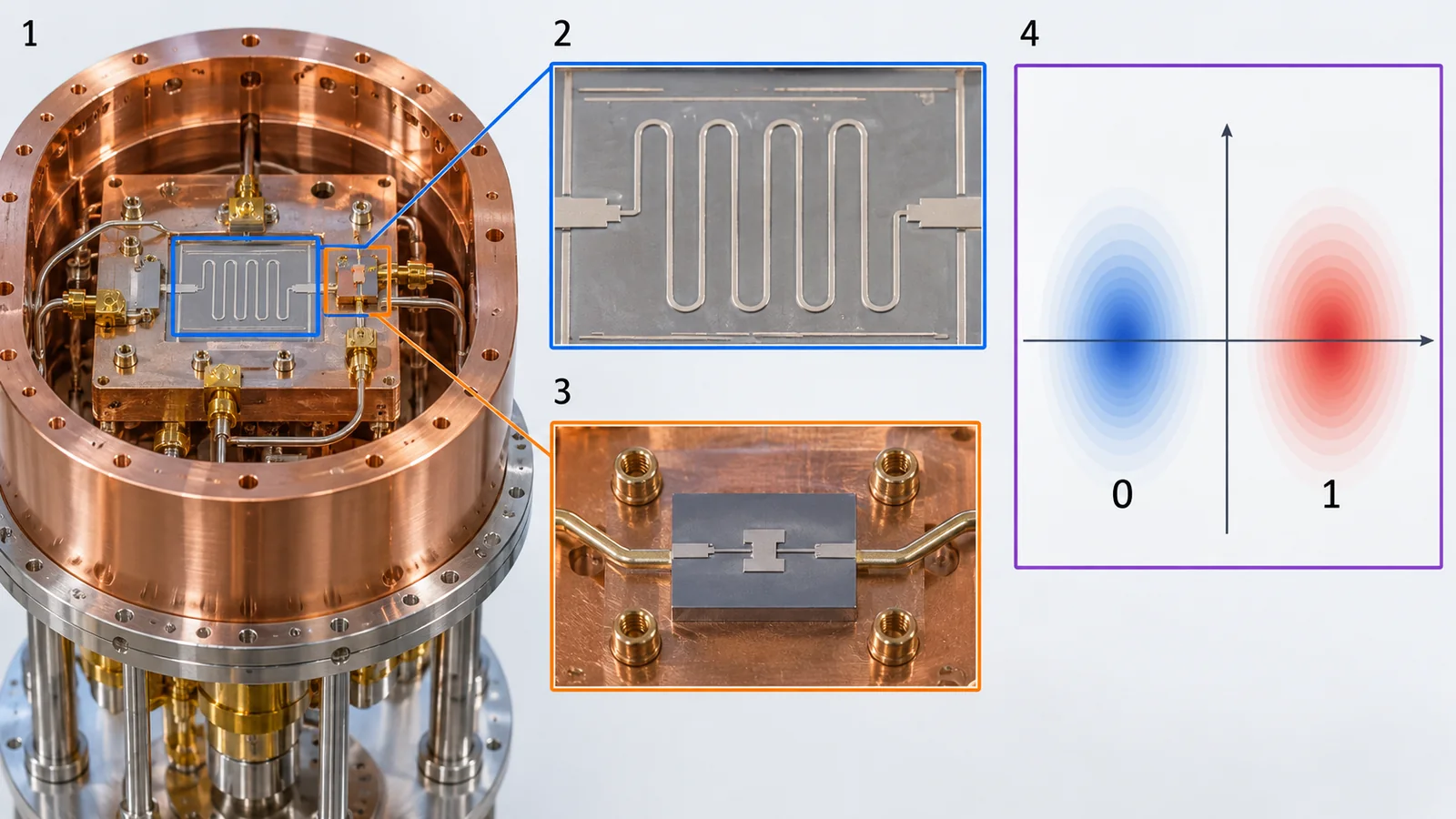
The qubit, the building block of a quantum computer, is not like the 0-or-1 bit of an ordinary computer. A small disturbance can easily make it go wrong. There are two main ways it goes wrong: the bit-flip (0 and 1 swap places) and the phase-flip (a quantum-specific "orientation" swaps; the figure below explains it). An ordinary qubit must be watched and corrected for both. Alice & Bob's cat qubit is designed so that bit-flips hardly happen in the first place. The company therefore says that a logical qubit (a qubit protected by error correction) might need as few as about 5 cat qubits Sourced. This is the company's claim. What has been confirmed in experiments is first that bit-flips are rare, and the logical qubit itself is still being built.
2. Logo and the company name

A note on the name: the company is called Alice & Bob (with the ampersand). They are not the founders' names. By the company's own account, physicists and cryptographers conventionally call the two parties in a communication scenario "Alice" and "Bob," and the company took its name from that scientific tradition (Reference 30). The "cat" refers to the famous quantum thought experiment, "Schrödinger's cat," and the cat in the logo alludes to it.
Official website: https://alice-bob.com/ Logo source: https://alice-bob.com/media-kit/3. Where the company sits in the quantum computing landscape
Quantum computing companies divide mainly by what the qubit is made of (the approach). Alice & Bob is superconducting: its qubits are tiny electrical circuits made of metal that has zero electrical resistance at extremely low temperatures. Within that approach, the company uses not an ordinary superconducting qubit but a cat qubit, which holds its quantum information in a "resonator" inside the circuit (a small box that stores microwaves) Sourced.
4. Company size
The company is privately held, so financial figures such as revenue and profit are not published. This is what the official announcements let us confirm (checked 16 October 2026) Sourced.
| Item | Detail | Reference |
|---|---|---|
| Founded | 2020 (Paris) | References 2, 25 |
| Employees | More than 250 (announcement of 13 October 2026). The announcement of 16 April 2026 gave 251, including 79 PhD holders (about one-third), from 31 nationalities | References 10, 13 |
| Sites | Paris (headquarters) and Boston. The company profile page says "4 offices" | Reference 2 |
| Funds raised (total) | Announcements up to April 2026 say €130 million; announcements from June 2026 say €180 million. The reason for the increase could not be confirmed | References 13, 8, 10 |
| Revenue, profit, valuation | Not published (we do not estimate them) | - |
"More than 250 employees" and "more than €180 million raised" are the company's own statements, not audited financial reports. The amount raised is also not necessarily the total available for developing quantum computers. For a private company, finances can only be confirmed within what the company announces, so this article does not discuss revenue or valuation.
5. Resources committed to quantum computing
Quantum computing is the company's main business, so people, money, outside relationships and public-sector ties all point at this field. For each of the four points, the table shows whether primary sources let us confirm it.
| Type of resource | Detail | Status |
|---|---|---|
| People | More than 250 employees; about one-third hold a PhD. The company says it hired specialists in quantum algorithms, error correction, cryogenic hardware, superconducting materials and nanofabrication (Reference 13) | Sourced |
| Money (funding raised) | Series A of €27 million (April 2022); Series B of €100 million (28 January 2025, led by Future French Champions, AVP and Bpifrance); investment from NVentures, NVIDIA's venture arm, extending the Series B (22 May 2026, amount not disclosed) | Sourced |
| Money (how it is used) | In January 2025 the company said nearly half of the Series B would go to building a new research and production facility in Paris (about 4,000 square metres). An October 2025 announcement described this new lab as a €50 million project | Sourced |
| Money (total R&D spending and capital expenditure) | There is no disclosure based on financial statements | Not published |
| Investments, acquisitions, joint ventures, divestments in other companies | No investment in, acquisition of, joint venture with or sale of another company was found in official announcements (the company is on the receiving end of investment) | Could not be confirmed |
| Universities and research institutes | Researchers from Inria, CEA, ENS Lyon and ENS (Paris) sit on the scientific board. A joint experiment with ENS Lyon (September 2026), a joint study of error correction with Inria (August 2025), and a research collaboration with CEA (17 September 2026) | Sourced |
| Public funding and public procurement | ULTRACAT, a deposition-tool development project funded by France's defence innovation agency (AID), 2022 to 2027; a $3.9 million award from the U.S. Department of Energy's ARPA-E (31 March 2026); the European Innovation Council (EIC) is among the investors; and a contract for GENCI, a French national high-performance computing centre, to buy an 18-cat-qubit machine (17 June 2026; the purchase is funded under France's national quantum strategy, France 2030) | Sourced |
Status of the main devices and products (as far as the company's official materials confirm)
| Device | Approach | Qubit count | Representative figures (company's stated values, with conditions) | Stage | Checked / reference |
|---|---|---|---|---|---|
| Boson | Superconducting, cat qubit | A research chip with a single cat qubit | Bit-flip time of 430 seconds (2024, company announcement) | Operating (in the fridge) | 16 October 2026 / References 4, 16, 5 |
| Hydrogen | Superconducting, cat qubit | Several | Error detection only (company description) | Operating (in the fridge) | 16 October 2026 / Reference 16 |
| Helium (system) | Superconducting, cat qubit | 18 physical qubits; being built to encode 1 logical qubit | Bit-flip time of 33 to 60 minutes (mean photon number 11, 95% confidence interval, lab experiment) / Z-gate fidelity 94.2% (26.5 ns). Both are preliminary results from September 2025, and we could not confirm that they hold for all 18 qubits | Unveiled 10 June 2026; offered to research partners | 16 October 2026 / References 3, 4, 5 |
| Next-generation chip | Superconducting, cat qubit | 48 physical qubits (expected to host several logical qubits) | No figures published | Planned (to fit into the Helium system) | 16 October 2026 / Reference 3 |
| Graphene (end goal) | Superconducting, cat qubit | 100 logical qubits | Described only as "high-fidelity"; 2030 is the target | Not yet confirmed | 16 October 2026 / References 13, 5 |
A physical qubit is a qubit actually built on the chip. A logical qubit bundles several physical qubits under error correction and treats them as "one qubit that is hard to get wrong." "Helium has 18" counts physical qubits, not logical ones. The company says it aims to build its first logical qubit from as few as 18 cat qubits on Helium Not yet confirmed. Fidelity is the fraction of operations carried out correctly; 94.2% means roughly 94 correct out of every 100. The bit-flip time (33 to 60 minutes) is how long a qubit left untouched takes to swap 0 and 1, and whether that holds while operations are running is a next step, as the company itself writes (Reference 5). Numbers from different approaches and measurement methods cannot be lined up to rank them.
6. Track record so far
| When | What happened | What it means |
|---|---|---|
| March 2020 | A paper by co-founder Lescanne on cat qubits appeared in Nature Physics (exponential suppression of bit-flips). The same month, Alice & Bob was founded | Taking a lab result to a company (References 2, 19) |
| November 2021 | Opened a headquarters in Paris and installed a cryostat. Preparing to test the first cat-qubit chip, "Boson 1" | Moving from a research lab to its own site (Reference 2) |
| April 2022 | €27 million Series A. The company announced a record of 100 seconds without a bit-flip | A lab record and fundraising at the same time (Reference 2) |
| February 2023 | The company announced a theoretical estimate that cat qubits would need about 60 times fewer qubits than other state-of-the-art approaches | The company's theoretical estimate (Reference 2) |
| October 2023 | Opened a site in Boston, USA | Expansion into the U.S. (Reference 2) |
| January 2024 | The company announced an estimate of about 200 times fewer qubits with a new error-correcting method (LDPC-cat codes). Published in Nature Communications in January 2025 | The company's theoretical estimate, not a demonstration on real hardware (References 2, 20) |
| May 2024 | An experiment with a cat qubit whose bit-flip time exceeds 10 seconds was published in Nature. The phase-flip time was above 490 nanoseconds | A peer-reviewed paper. Note that the phase-flip time is orders of magnitude shorter (Reference 18) |
| 28 January 2025 | Announced a €100 million Series B | Funding to expand facilities and staff (Reference 1) |
| 25 September 2025 | Announced a preliminary result of bit-flip times above one hour, and a Z-gate fidelity of 94.2% | Preliminary result; not yet confirmed in a paper (Reference 5) |
| October 2025 | Michel Devoret, described by the company as a co-inventor of the cat qubit, was one of three winners of the Nobel Prize in Physics (the company issued a congratulatory announcement). A deposition tool backed by AID was delivered | A prize for research on quantum phenomena in superconducting circuits. The link to the company's technology is the company's account (References 21, 31, 14) |
| 31 March 2026 | $3.9 million ARPA-E award (quantum algorithms to search for magnets that avoid rare-earth elements) | Publicly funded applied research (Reference 12) |
| 10 June 2026 | Unveiled the Helium system (18-cat-qubit chip, about 40 kilowatts, offered to research partners) | From a single chip to a "system" (Reference 3) |
| 17 June 2026 | GENCI signed a contract to buy an 18-cat-qubit machine. Users are expected from 2027 | Described by the company and GENCI as the first purchase of a cat-qubit machine (Reference 6) |
| September to October 2026 | A research collaboration with CEA (17 September), an experiment stabilising cat qubits with a DC voltage (30 September, preprint), and a demonstration of GPU-based error-correction decoding (13 October, synthetic data) | All at the stage of component technologies (References 9, 11, 10) |
7. Plans
Every number above is a target or plan set out by the company, not something already achieved Not yet confirmed. When we checked on 16 October 2026, the roadmap page on the company's website said it was being updated and would return soon, so we could not confirm the latest roadmap in full. Earlier it listed five generations (Boson, Helium, Lithium, Beryllium and Graphene) (References 24 and 16), so this article does not give per-generation qubit counts or error-rate targets.
The following could not be confirmed in official materials Not yet confirmed.
Whether the first logical qubit has actually been made on Helium / the release date of chips after Helium / the price of the GENCI machine / confirmation that the new Paris lab (cleanroom) is operating (an October 2025 announcement said completion was expected in March 2026) / revenue and customer numbers / the latest version of the roadmap.
8. What the company seems to be aiming for in quantum computing
This part includes things the company has not said directly. It sets out inferences from what the primary sources show, with the basis for each.
| What can be read from the sources | Primary-source basis | Status |
|---|---|---|
| The company is first trying to enter computing centres and research institutes as an error-correction research platform | It describes Helium as "a laboratory, not a product" and "an invitation" to joint research (References 3, 32). Its buyer is GENCI, and its partners include Bull, CEA and the Hartree Centre, all computing-centre players | Inference |
| It competes on error-correction efficiency, not on qubit count | It writes that the point is to do error correction seriously rather than boast a qubit count, and it has itself proposed five criteria for judging logical qubits (Reference 15) | Inference |
| The goal for around 2030 is practical use in limited applications such as materials science | The CEA research theme is many-body problems (such as new-materials search), and the ARPA-E theme is a search for magnets without rare earths (References 9, 12) | Inference |
| It assumes a hybrid with classical computing such as GPUs | A demonstration of error-correction decoding with NVIDIA NVQLink and CUDA-Q, and integration with the Slurm scheduler (References 10, 26) | Sourced |
The company's June 2026 blog post says of Helium, "This is not a product launch." It calls Helium "the first cat qubit laboratory open to third-party organizations," not a showcase of qubit count Sourced. It adds that Helium is not "infrastructure you rent to run your existing algorithms" and that the company is offering co-design: joint research and shared authorship of results. From this we read the company's near-term income as coming not from selling to a large customer base but from joint research and machine deliveries to research institutes and computing centres Not yet confirmed. Since the breakdown of income is not published, this cannot be verified.
9. Partnership map in quantum computing
10. Technology, products and services
| Name | What it does | Stage and conditions |
|---|---|---|
| Helium (system) | An on-premises machine that bundles an 18-cat-qubit chip, a fridge, control electronics and software, built for error-correction research. About 2.4 m wide, 3.3 m high and 9 m long (21 square metres); 10 millikelvin inside the cryostat; about 40 kilowatts to run | Unveiled 10 June 2026; for research partners. Figures are the company's stated values (References 3, 4) |
| Starboard | Helium's monitoring screen: individual qubit status, job scheduling and hardware metrics on one dashboard | Released with Helium (Reference 3) |
| Felis | Software with custom instructions for the Helium chip that stays compatible with the major quantum programming frameworks | Company description (Reference 3) |
| Slurm integration (QRMI) | An open-source library for calling a quantum computer from Slurm, the job scheduler used on supercomputers | Helium is described as compatible. Integration with the Hartree Centre announced in November 2025 (References 3, 26) |
| Dynamiqs | The company's own open-source library for simulating cat-qubit and other circuits on a computer; supports GPUs (NVIDIA CUDA-Q) | Company description (References 27, 7) |
| Chip line-up | Boson (a single cat qubit), Hydrogen (error detection), Helium (error correction) and Lithium (in design; the next generation on the roadmap) | As stated on the company's technology page. We could not confirm how Lithium relates to the "48-cat-qubit" chip that follows Helium (References 16, 3) |
What is inside Helium: three parts
Helium has three main parts (Reference 4). (1) The "chandelier": a cluster of metal cylinders hung from the top of the fridge, designed in Paris, with the quantum chip sitting in the "mixing chamber" at the bottom. (2) The cooling system: a dilution refrigerator (a machine that mixes helium isotopes to reach temperatures near absolute zero), which holds the inside at about 10 millikelvin (about minus 273.14 degrees Celsius). (3) The control electronics: precision instruments that send microwave pulses down into the fridge to operate and read out the qubits one by one. A superconducting quantum computer works only when all three, chip, cooling and wiring/control, are in place. For details, see our explainers on superconducting qubits and on cryogenics and qubit control.
A cat-qubit chip is made of thin superconducting metal films and Josephson junctions (two superconducting films separated by an extremely thin insulating layer, the "nonlinear component" a quantum circuit needs). The company says the chip is crafted "at a scale of just a few nanometers from superconducting materials," but which metals and substrate it uses could not be confirmed in official materials Not yet confirmed. What the October 2025 announcement does say is that PLASSYS-BESTEK's ultra-high-vacuum (UHV) deposition tool, the "SQUID-6 UHV," was delivered for the new Paris lab. It processes wafers up to 8 inches in diameter in several independent process chambers, one after another, to cut cross-contamination between steps (Reference 14) Sourced. Because small material defects (impurities, uneven films) directly affect a quantum chip's performance, a better deposition tool can plausibly help make performance more consistent Not yet confirmed.
11. Risks the company faces
| Risk | Detail | Status |
|---|---|---|
| Logical qubit not yet demonstrated | Helium's specifications read "1 logical qubit in the making." As of 16 October 2026 we found no official material showing a logical qubit has been achieved | Sourced |
| Unconfirmed whether bit-flips stay suppressed during operations | The September 2025 announcement itself attaches a condition ("assuming bit-flip protection holds during gate operations") and names evaluation under a two-qubit gate (CNOT) as the next step | Sourced |
| The level of gate fidelity | The Z-gate fidelity of 94.2% is a preliminary result (at a mean photon number of 11). Where it stands relative to error-correction thresholds could not be confirmed in official materials | Sourced |
| Roadmap being updated | The official roadmap page says it is being updated, so the latest targets cannot be confirmed | Sourced |
| Some key results are preprints | The September 2026 DC-bias experiment is based on a preprint from August 2026, and the October GPU decoding is a demonstration on synthetic data, not real-time decoding | Sourced |
| Differences in conditions behind the numbers | "About 60 times" and "about 200 times" fewer qubits are the company's theoretical estimates, not demonstrations on real hardware. Comparisons with other approaches depend on assumptions about noise bias and codes | Sourced |
| Concentration on one approach | The company describes itself as the only player developing quantum computers exclusively with this type of qubit. The official materials do not show what it would fall back on if the approach stalls | Inference |
| Finances cannot be checked | The company is private and does not publish revenue, profit or R&D spending. The €180 million-plus in funding can be broken down only in part | Sourced |
| Reliance on public procurement | The only large deployment contract we could confirm in 2026 is with GENCI, a public body, funded from France's national strategy budget. Shifts in public budgets could affect the company | Inference |
12. Glossary
- Qubit
- The basic unit of a quantum computer. It can hold a "superposition" of 0 and 1, but disturbances easily destroy it.
- Cat qubit
- A qubit that represents 0 and 1 with two stable states of a resonator (a box that stores microwaves). It can be made resistant to bit-flips.
- Bit-flip / phase-flip
- The two ways a qubit goes wrong. A bit-flip swaps 0 and 1; a phase-flip swaps the orientation (+ and -) of a superposition.
- Physical / logical qubit
- A physical qubit is the real device on the chip. A logical qubit bundles several physical ones under error correction into one that is hard to get wrong.
- Error correction
- Finding and fixing mistakes while a computation continues. It costs many extra qubits.
- Repetition code
- The simplest code: store the same information in several places and compare, like a majority vote. With cat qubits it is used to correct phase-flips.
- eFTQC
- Early fault-tolerant quantum computer. The company is aiming for around 2030.
- Resonator
- A small circuit "box" that can store microwaves of a particular frequency. A cat qubit keeps its information here.
- Josephson junction
- A device with a very thin insulating layer between superconductors. It provides the "nonlinear" behaviour quantum circuits need.
- Dilution refrigerator
- A machine that mixes helium isotopes to cool to about 10 millikelvin.
- QPU
- Quantum processing unit: the chip that does the quantum computation.
- HPC
- High-performance computing, such as supercomputers.
- Fidelity
- How closely an operation matches the ideal. 94.2% means about 94 out of 100 times correct.
13. References
- Alice & Bob Alice & Bob Closes €100M Series B (press release, 28 January 2025). Series B amount, lead investors and use of funds. https://alice-bob.com/newsroom/alice-bob-100m-series-b-fundraising-press-release/
- Alice & Bob That's us (company profile page). History, headcount and sites, scientific board, investors. https://alice-bob.com/thats-us/
- Alice & Bob Alice & Bob Unveils First Quantum System, Helium (10 June 2026). https://alice-bob.com/newsroom/alice-bob-unveils-first-quantum-system/
- Alice & Bob Platform (Helium product page). Chip and system specifications. https://alice-bob.com/platform/
- Alice & Bob Alice & Bob Shares Preliminary Results Vastly Surpassing Previous Bit-Flip Time Record (25 September 2025). https://alice-bob.com/newsroom/alice-bob-surpasses-bit-flip-stability-record/
- Alice & Bob France Acquires First Quantum Computer Based on Cat-Qubit Technology (contract with GENCI, 17 June 2026). https://alice-bob.com/newsroom/genci-acquisition/
- Alice & Bob Alice & Bob announces Series B Extension (NVentures, 22 May 2026). https://alice-bob.com/newsroom/alice-bob-announces-series-b-extension/
- Alice & Bob Bull and Alice & Bob partner to bring quantum computers into HPC (24 June 2026). https://alice-bob.com/newsroom/bull-and-alice-bob-partner-up-to-bring-quantum-computers-into-hpc/
- Alice & Bob Alice & Bob Partners with the CEA (17 September 2026). https://alice-bob.com/newsroom/alice-bob-cea-software-stack/
- Alice & Bob Alice & Bob decodes LDPC-cat codes on GPUs with NVIDIA NVQLink (13 October 2026). https://alice-bob.com/newsroom/alice-bob-decodes/
- Alice & Bob Alice & Bob Demonstrates New Approach to Stabilising Cat Qubits with DC Voltage Bias (30 September 2026). https://alice-bob.com/newsroom/alice-bob-new-approach-stabilising-cats/
- Alice & Bob Alice & Bob Secures $3.9M ARPA-E Award (31 March 2026). https://alice-bob.com/newsroom/alice-bob-secures-3-9m-arpa-e-award-to-use-quantum-computing-to-design-rare-earth-free-magnets/
- Alice & Bob Alice & Bob hires more than 100 employees in seven months (16 April 2026). Headcount and the Graphene target. https://alice-bob.com/newsroom/alice-bob-hires-more-than-100-employees-in-seven-months-even-as-overall-labour-market-slows/
- Alice & Bob French Government Backs New Technology for Industrial Quantum Chip Production (AID and PLASSYS-BESTEK, 23 October 2025). https://alice-bob.com/newsroom/aid-backs-new-technology-for-industrial-qpu-production/
- Alice & Bob Logical Qubits: Alice & Bob Publishes Report to Benchmark Claims (5 June 2026). https://alice-bob.com/newsroom/logical-qubits-alice-bob-publishes-report-for-industry-to-benchmark-claims/
- Alice & Bob Engineering (technology page). Chip line-up and description of building and operating. https://alice-bob.com/engineering/
- Alice & Bob Science (technology background page). https://alice-bob.com/science/
- Réglade et al. Quantum control of a cat qubit with bit-flip times exceeding ten seconds, Nature (2024). https://doi.org/10.1038/s41586-024-07294-3
- Lescanne et al. Exponential suppression of bit-flips in a qubit encoded in an oscillator, Nature Physics (2020). https://doi.org/10.1038/s41567-020-0824-x
- Ruiz et al. LDPC-cat codes for low-overhead quantum computing in 2D, Nature Communications (2025). https://doi.org/10.1038/s41467-025-56298-8
- Alice & Bob Technology Co-Inventor and Consultative Board Member Each Awarded Nobel Prize (7 October 2025). https://alice-bob.com/newsroom/nobel-prize-to-cat-qubit-co-inventor-and-consultative-board-member/
- Alice & Bob Alice & Bob Develops 'Elevator Codes' to Slash Error Rates (21 January 2026). https://alice-bob.com/newsroom/reducing-quantum-computing-errors-with-new-code/
- Alice & Bob Alice & Bob Partners on Europe's First Doctoral Network Dedicated to Quantum Error Correction (QuBriC, August 2026). https://alice-bob.com/newsroom/alice-bob-partners-on-europes-first-doctoral-network-dedicated-to-quantum-error-correction/
- Alice & Bob Roadmap (the roadmap page, showing an "updating" notice). https://alice-bob.com/roadmap/
- Alice & Bob Media kit (logo, company summary). https://alice-bob.com/media-kit/
- Alice & Bob Alice & Bob and STFC Hartree Centre integrate cat-qubit quantum computers into SLURM (November 2025). https://alice-bob.com/newsroom/hartree-centre-and-alice-bob-integrate-cat-qubits/
- Alice & Bob Alice & Bob Accelerates Fault-Tolerant Quantum Computing with NVIDIA NVQLink (28 October 2025). https://alice-bob.com/newsroom/alice-bob-accelerates-fault-tolerant-quantum-computing-with-nvidia-nvqlink/
- Alice & Bob Horizon Quantum Explores Faster Ways to Fault-Tolerant Quantum Computing with Alice & Bob (January 2026). https://alice-bob.com/newsroom/alice-bob-partners-with-horizon-quantum/
- Alice & Bob Alice & Bob and Inria Improve Efficiency of Magic State Preparation (6 August 2025). https://alice-bob.com/newsroom/alice-bob-and-inria-improve-efficiency-of-magic-state-preparation-to-enable-useful-quantum-computing/
- Alice & Bob Who are Alice and Bob? The Story Behind Our Name (origin of the company name). https://alice-bob.com/blog/who-are-alice-and-bob-the-story-behind-our-name/
- Nobel Prize Outreach Press release: Nobel Prize in Physics 2025. https://www.nobelprize.org/prizes/physics/2025/press-release/
- Alice & Bob This Is Not a Product Launch (company blog post on how it positions Helium, June 2026). https://alice-bob.com/blog/this-is-not-a-product-launch/
14. Claim-to-source audit
| Claim in the text | Status | Reference |
|---|---|---|
| Founded in 2020; headquarters in Paris and a Boston site; founders; make-up of the scientific board | Sourced | References 2, 25 https://alice-bob.com/thats-us/ |
| Cat qubits are designed to suppress bit-flips, and the company says it develops with this type of qubit only | Sourced | References 1, 17 https://alice-bob.com/newsroom/alice-bob-100m-series-b-fundraising-press-release/ |
| Bit-flip time above 10 seconds (Nature 2024) and phase-flip time above 490 nanoseconds | Sourced | Reference 18 https://doi.org/10.1038/s41586-024-07294-3 |
| First experiment showing exponential suppression of bit-flips (Nature Physics 2020) | Sourced | Reference 19 https://doi.org/10.1038/s41567-020-0824-x |
| Bit-flip time of 33 to 60 minutes (mean photon number 11, 95% confidence interval), Z-gate fidelity 94.2% (26.5 ns), next step is a CNOT evaluation | Sourced | Reference 5 https://alice-bob.com/newsroom/alice-bob-surpasses-bit-flip-stability-record/ |
| Helium unveiled (10 June 2026), 18 cat qubits, about 40 kilowatts, for research partners, next 48-cat-qubit chip | Sourced | References 3, 4 https://alice-bob.com/newsroom/alice-bob-unveils-first-quantum-system/ |
| Helium's dimensions and cryostat temperature, "1 logical qubit in the making" | Sourced | Reference 4 https://alice-bob.com/platform/ |
| GENCI's contract to buy an 18-cat-qubit machine, users from 2027 (planned), installed at the TGCC | Sourced | Reference 6 https://alice-bob.com/newsroom/genci-acquisition/ |
| NVentures investment (amount not disclosed) and cooperation on NVQLink and CUDA-Q | Sourced | References 7, 27 https://alice-bob.com/newsroom/alice-bob-announces-series-b-extension/ |
| MoU with Bull, research collaboration with CEA, integration with the Hartree Centre, collaboration with Horizon Quantum | Sourced | References 8, 9, 26, 28 https://alice-bob.com/newsroom/bull-and-alice-bob-partner-up-to-bring-quantum-computers-into-hpc/ |
| €100 million Series B (28 January 2025); nearly half of it planned for the new lab | Sourced | Reference 1 https://alice-bob.com/newsroom/alice-bob-100m-series-b-fundraising-press-release/ |
| The change in stated totals from €130 million (to April 2026) to more than €180 million (from June 2026) | Sourced | References 13, 10 https://alice-bob.com/newsroom/alice-bob-hires-more-than-100-employees-in-seven-months-even-as-overall-labour-market-slows/ |
| 251 employees and 79 PhD holders (April 2026); the Graphene target of 100 logical qubits | Sourced | Reference 13 https://alice-bob.com/newsroom/alice-bob-hires-more-than-100-employees-in-seven-months-even-as-overall-labour-market-slows/ |
| AID-backed SQUID-6 UHV deposition tool, the roughly €50 million new lab, ULTRACAT (2022 to 2027) | Sourced | Reference 14 https://alice-bob.com/newsroom/aid-backs-new-technology-for-industrial-qpu-production/ |
| $3.9 million ARPA-E award; research partners Los Alamos National Laboratory and GE Vernova | Sourced | Reference 12 https://alice-bob.com/newsroom/alice-bob-secures-3-9m-arpa-e-award-to-use-quantum-computing-to-design-rare-earth-free-magnets/ |
| CEA research theme (many-body problems), assuming early fault-tolerant machines around 2030 | Sourced | Reference 9 https://alice-bob.com/newsroom/alice-bob-cea-software-stack/ |
| Stabilising cat qubits with a DC voltage bias (preprint, with ENS Lyon) | Sourced | Reference 11 https://alice-bob.com/newsroom/alice-bob-new-approach-stabilising-cats/ |
| The LDPC-cat codes paper (2025) and the GPU decoding over NVQLink (synthetic data, not real time) | Sourced | References 20, 10 https://doi.org/10.1038/s41467-025-56298-8 |
| The Elevator Codes expectation (logical error rate 10,000 times lower with about 3 times more qubits) is the company's prediction from simulation | Sourced | Reference 22 https://alice-bob.com/newsroom/reducing-quantum-computing-errors-with-new-code/ |
| The five criteria for logical qubits are the company's proposal, not an industry standard | Sourced | Reference 15 https://alice-bob.com/newsroom/logical-qubits-alice-bob-publishes-report-for-industry-to-benchmark-claims/ |
| Devoret's Nobel Prize and the company's account of him as a co-inventor of the cat qubit | Sourced | References 21, 31 https://alice-bob.com/newsroom/nobel-prize-to-cat-qubit-co-inventor-and-consultative-board-member/ |
| Participation in QuBriC, a European doctoral network on error correction | Sourced | Reference 23 https://alice-bob.com/newsroom/alice-bob-partners-on-europes-first-doctoral-network-dedicated-to-quantum-error-correction/ |
| Joint magic-state study with Inria (August 2025) | Sourced | Reference 29 https://alice-bob.com/newsroom/alice-bob-and-inria-improve-efficiency-of-magic-state-preparation-to-enable-useful-quantum-computing/ |
| The roadmap page says it is being updated | Sourced | Reference 24 https://alice-bob.com/roadmap/ |
| Origin of the company name; Helium's positioning ("a laboratory, not a product") | Sourced | References 30, 32 https://alice-bob.com/blog/who-are-alice-and-bob-the-story-behind-our-name/ |
| The four-type classification of quantum computing companies | Our calculation | Our own grouping in this article; company names are examples from this series |
| Revenue, profit, R&D spending, valuation, and the price of the GENCI machine | Not yet confirmed | Not published or not stated. This article does not estimate them (our own policy) |
| A logical qubit on Helium, timing of the next chip, status of the new lab, the latest roadmap | Not yet confirmed | Not stated in official materials. These are company targets and plans; this article treats them as an outlook and keeps them apart from achieved facts |
| Whether the Z-gate fidelity and bit-flip time are values for all 18 qubits on Helium | Not yet confirmed | Could not be confirmed in official materials; this article does not assume it (our note) |
| The near-term income comes from joint research and deliveries to computing centres | Inference | Our reading of how Helium is positioned and who the buyer and partners are (our own interpretation) |
| It competes on error-correction efficiency rather than qubit count | Inference | Our reading of the company blog and its five-criteria proposal (our own interpretation) |
| Applications around 2030 will be limited to areas such as materials science | Inference | Our reading of the CEA and ARPA-E themes (our own interpretation) |
| The risks of concentrating on one approach and relying on public procurement | Inference | Our reading of the company's description and the contract counterparties (our own interpretation) |
Last updated: 16 October 2026 / Troy Technical
The figures in this article rest on Alice & Bob's official announcements and on papers in Nature, Nature Physics and Nature Communications. Device performance figures are the company's stated values, given with their measurement conditions. We do not use market-research estimates or press-only figures. Items marked "Inference" are our own readings of the primary sources, not statements by the company.