TECHNOLOGY EXPLAINER
Quantum Error Correction and the Surface Code
— How many fragile qubits can protect one
A qubit loses its state at the slightest disturbance. To finish a long computation, a quantum computer needs a way to find and fix its errors. That is quantum error correction. But a qubit cannot be copied, and measuring it disturbs it. So how can anything be fixed? This article assumes no quantum mechanics. It goes in the order everyday example, then words, then a figure, then a small number: from the classical "keep three copies and take a majority vote", through a tiny three-qubit code, to the surface code and its "threshold".
- The short version, what to know first, and where this fits in the series
- Why error correction is needed — error rates and the length of a computation
- Starting from classical error correction — a majority vote of three
- Why quantum is harder — three walls and how to get over them
- The three-qubit code, step by step
- Stabilizers and syndrome measurement — generalising the small example
- How the surface code works — lattice, checks and lit points
- Decoders — working out what happened from the lit points
- The threshold — "below the line, bigger is better"
- How far experiments have come (as of 16 October 2026)
- Remaining walls, and a materials engineer's view
- What could not be confirmed, and a summary
- How to read evaluations and standards
- Glossary
- References
- Claim-to-source audit
Sourced = stated in published material (source linked)
Our calculation = a value we computed from stated assumptions
Not yet confirmed = plans, targets and future estimates that are not settled
Our readings and explanations are marked as commentary. An Inference is shown in bold.
Curves labelled "our calculation" are estimates built on stated assumptions, not measurements. Experimental values (logical error rate, Λ and so on) are quoted from Google's paper [Ref. 12] together with their conditions. This field moves fast, so the state of devices, roadmaps and standards is as of the check date, 16 October 2026. Company announcements are treated as "company claims", and we do not rank companies or approaches.
1. The short version, what to know first, and where this fits in the series
- Why error correction is needed: even the best qubit operations fail about 0.1% of the time (10−3). A small number for one operation, but after 1,000 operations the chance of no error at all falls to about 37%. Long computations need a way to find and fix errors Sourced [Ref. 12] Our calculation
- Qubits can be corrected anyway: a qubit cannot be copied and measuring it disturbs it. But if we measure only a symptom (syndrome), such as "is this the same as its neighbour?", we can locate an error without disturbing the information. The information is not copied; it is spread over several qubits Sourced [Ref. 1, 2, 4]
- The surface code and its threshold: the surface code arranges this idea on a two-dimensional lattice. If the physical error rate is below the threshold, a bigger lattice suppresses logical errors exponentially. Google showed that each increase of the lattice size (code distance) from 3 to 5 to 7 cut errors by about 2.14 times Sourced [Ref. 12]
A qubit can be drawn as an arrow from the centre of a sphere to its surface (north pole = 0, south pole = 1, slanted = superposition). Measuring gives 0 or 1, and the original arrow cannot be recovered. That is all you need. The series explainer "Quantum Computing Fundamentals" covers this in detail; here we restate what is needed, when it is needed.
The easiest order is "Quantum Computing Fundamentals", "Quantum Gates and Quantum Circuits", then "Coherence and Fidelity", and then this article (it also stands alone). After this comes "Logical Qubits and Fault-Tolerant Quantum Computing", which puts computation on top of error correction (logical gates, magic states, newer codes), and "Cryogenics and Control", which covers the refrigerators and wiring that support all this.
2. Why error correction is needed — error rates and the length of a computation
(1) An everyday example: "10,000 steps without one mistake"
Suppose you add numbers on a calculator 10,000 times in a row, and each button press has a 0.1% chance of being wrong. Each step is 99.9% reliable, which sounds high. But the chance that all 10,000 steps succeed is 0.999 multiplied by itself 10,000 times, which is about 0.0045% (4.5×10⁻⁵) Our calculation. "Each step rarely fails" and "a long job finishes without failure" are different statements.
(2) A quantum computation has a great many operations
A quantum computation stacks up millions or hundreds of millions of quantum gates (single operations on qubits; see the series explainer "Quantum Gates and Quantum Circuits"). Google's paper says the best many-qubit machines have only recently reached 99.9% accuracy for two-qubit gates (0.1% error), while many applications need error rates below 10−10 Sourced [Ref. 12]. The gap between what is needed and what exists is seven orders of magnitude (0.1% = 10−3 versus 10−10; our calculation).
| Error rate per operation, p | 100 ops | 1,000 ops | 10,000 ops | 1 million ops | 1 billion ops |
|---|---|---|---|---|---|
| 10−3 (0.1%) | 90.5% | 36.8% | 0.0045% | about 0 | about 0 |
| 10−6 | 99.99% | 99.9% | 99.0% | 36.8% | about 0 |
| 10−9 | about 100% | about 100% | about 100% | 99.9% | 36.8% |
Our calculation. Probability of success = (1−p)N. A simple calculation assuming independent errors, not the success rate of any real computation. As a rule of thumb, after about 1/p operations, the chance that everything is correct is about 37% (1/e).
Not so. If the error rate stays high, adding qubits does not let a long computation finish correctly. Performance depends not only on how many qubits there are, but on the error rate and how many operations can be chained. The right statement is that you need both many qubits and a low error rate. That is why many qubits are spent on error correction (from the next sections on).
3. Starting from classical error correction — a majority vote of three
(1) An everyday example: saying a phone number three times
Suppose you must pass on a number over a bad phone line. Say it three times. Even if one repetition is misheard, the other two agree, and a majority vote gives the right number. This is the idea of a repetition code (the simplest error-correcting code: protect information by keeping it several times over). You protect information by adding more of it (redundancy).
(2) Checking with a small calculation
Let p be the probability that one bit flips. With a majority vote of three, the vote fails only when two or more bits flip together. That probability is 3p²(1−p) + p³ = 3p² − 2p³ (assuming independence; our calculation). For p = 10% (0.1) it is 2.8%; for p = 1% it is 0.0298%. The smaller p is, the faster the benefit of redundancy grows. Conversely, if p is near 0.5, no number of copies helps.
To merely detect one error, two copies are enough (you notice they disagree). To fix one, you need a majority vote that decides which is right, so at least three. For more strength, use five, seven and so on. The "distance" of the surface code that appears later generalises this idea of how many errors can be fixed.
4. Why quantum is harder — three walls and how to get over them
"Keep three copies and vote" cannot be used directly on qubits. There are three walls. We look at each one, and at how it is overcome.
| Wall | What the problem is | How it is overcome |
|---|---|---|
| 1. No copying | An unknown quantum state cannot be duplicated exactly (the no-cloning theorem) [Ref. 6, 7] Sourced. "Copy it three times and vote" is impossible | Do not copy; spread the information over several qubits. Move the information of one qubit into a "block" of several entangled qubits (Section 5) |
| 2. Measuring disturbs | Measuring a qubit's value directly forces a 0 or a 1 and destroys the superposition (the direction of the arrow) | Measure not the value itself but "is it the same as its neighbour?" (parity) only. The arrow's direction is not measured, so it is not destroyed (Sections 5 and 6) |
| 3. Many kinds of error | A classical bit only flips 0 to 1. A qubit's arrow can drift continuously. Besides bit flips there are phase flips (left and right of the arrow swap) | Measuring the symptom turns the drift into a discrete outcome: "error" or "no error". A code that can fix both bit flips and phase flips can fix any error on one qubit [Ref. 1, 2, 8] Sourced |
No-cloning is from Wootters and Zurek and from Dieks [Ref. 6, 7]; the general theory of error correction is from the textbook and reviews [Ref. 1, 2, 8]. The plain-language "how it is overcome" column is our commentary.
Let us check how to read the figure. A qubit's state is an arrow from the sphere's centre. A bit flip swaps north and south (an arrow leaning to 0 now leans to 1). A phase flip swaps left and right. After a phase flip, the odds of measuring 0 or 1 do not change. It is an error that measuring cannot reveal, yet it upsets the later "strengthening and cancelling of waves" (interference) in the computation. Quantum error correction has to handle both kinds.
Not so. What cannot be done is "making an exact copy of an unknown state". An error-correcting code does not copy; it uses entanglement to spread the information, so it does not run into the no-cloning limit. Say a qubit's state is α|0⟩ + β|1⟩ (α and β set the odds of 0 and 1). If it could be copied three times, the result would be three side-by-side copies of (α|0⟩ + β|1⟩), a mix of eight components: 000, 001, ..., 111. The encoded state α|000⟩ + β|111⟩ is different: it has only two components, "000" and "111". Read it as three qubits jointly holding "0 or 1" as one block (illustrated in Section 5).
Entanglement meant that "two or more qubits behave as one block, and one alone cannot be described". The state of an error-correcting code is exactly that. Looking at any single qubit tells you nothing about the protected information (α, β). That is why a small disturbance on one qubit does not easily destroy the information.
5. The three-qubit code, step by step
First, the smallest quantum error-correcting code, aimed at bit flips only. It is a standard textbook example [Ref. 1, 2, 3]. We use three qubits, q₁, q₂ and q₃. The information to protect starts in q₁.
Step 1: Encode — not copying, but "linking"
q₂ and q₃ start at 0. Using q₁ as the "control", apply a CNOT (controlled-NOT: flip the target only when the control is 1) to each of q₂ and q₃. If q₁ was α|0⟩ + β|1⟩, the result is α|000⟩ + β|111⟩: a state where the component "all three are 0" carries α and "all three are 1" carries β.
Let us use real numbers. Take α = 0.6 and β = 0.8 (the odds of 0 and 1 are 0.6² = 0.36 and 0.8² = 0.64; squares add up to 1 by convention). The encoded state is 0.6|000⟩ + 0.8|111⟩ (an example for Our calculation). Measure the three qubits separately and you always get "000" (probability 0.36) or "111" (probability 0.64), so the three always agree. That is what "three qubits behave as one block" means.
Step 2: An error occurs
Now suppose a bit flip hits q₂. The state becomes 0.6|010⟩ + 0.8|101⟩. Only q₂ disagrees with the other two.
Step 3: Check the symptom — measure "same as its neighbour?", not the value
We use helper qubits a₁ and a₂. a₁ checks only "do q₁ and q₂ have the same value?" and a₂ checks "do q₂ and q₃ have the same value?" (two CNOT gates each, then measure the helper). Each answer is "same (0)" or "different (1)". The pair of answers (a₁, a₂) is called the syndrome (the symptom).
In the example, q₁ differs from q₂, so a₁ = 1; q₂ differs from q₃, so a₂ = 1; the symptom is (1, 1). Here is the key point. The symptom is the same for the "000" component and the "111" component (after the error, "010" and "101" both give (1, 1)). So measuring the symptom reveals nothing about the ratio 0.6 : 0.8 (the protected information) and does not disturb it. We measured only "which neighbours disagree", not "is it 0 or 1 right now".
Step 4: Correct
The symptom fixes the location of the error (see the figure above). (1, 0) means q₁ flipped, (1, 1) means q₂, (0, 1) means q₃; (0, 0) means no error. We have found q₂, so flipping q₂ again restores 0.6|000⟩ + 0.8|111⟩. The information was never "measured" at any point.
What gets destroyed is the quantity that carries the information (0 or 1, and its odds). The measurement above is of a quantity that carries no information (whether neighbours agree). By analogy, it is like "checking an envelope for damage without looking at what is inside". In the arrow picture: you do not look at the tilt of the arrow, only whether the three arrows point the same way. The analogy has a limit, though. In a quantum measurement, a small continuous drift is also forced into the definite outcomes "damaged" or "not damaged" (Wall 3).
The limit of this code
The three-qubit code can fix bit flips only, and it actually makes phase flips worse. A phase flip on any one of q₁, q₂ or q₃ changes the protected information (the sign in α|000⟩ + β|111⟩). If a phase flip happens with probability q on each qubit, the chance that the protected information is spoiled by a phase flip is about 3q (three qubits at q each; an approximation for small q; Our calculation).
The remedy is a code of the same structure for phase flips (used in a changed basis), nested with the bit-flip code. That is the nine-qubit code Shor presented in 1995 [Ref. 4]. The next year Steane showed a code that does the same job with seven qubits [Ref. 5]. Both protect one logical qubit with several physical qubits and fix any single-qubit error Sourced [Ref. 4, 5].
In more detail: the three-qubit code in formulas (for readers comfortable with equations; feel free to skip)
Encoding: |ψ⟩ = α|0⟩ + β|1⟩ goes to α|000⟩ + β|111⟩. Error X₂ (a bit flip on q₂): goes to α|010⟩ + β|101⟩. The eigenvalues (+1 or −1) of the checks (stabilizers) Z₁Z₂ and Z₂Z₃ correspond to syndrome bits 0 and 1. Z₁Z₂ is +1 if q₁ and q₂ have the same value and −1 if they differ. The encoded state gives +1 for both checks (no error). After X₂, both checks give −1, read as (1, 1). Both components of the encoded state have the same eigenvalues, so the measurement extracts nothing about α or β.
6. Stabilizers and syndrome measurement — generalising the small example
The "same as its neighbour?" check of the last section is called, in general, a stabilizer. It means "a check that always gives the same answer (+1) on the protected state". When an error occurs, the answer becomes −1 and the error is noticed. Defining a code by a set of checks (stabilizer codes) was systematised by Gottesman [Ref. 8].
| Code | Physical qubits n | Protected information (logical qubits k) | Distance d | What the checks are |
|---|---|---|---|---|
| Three-qubit code | 3 | 1 | 3 against bit flips (does not handle phase flips) | Do neighbours agree (Z₁Z₂, Z₂Z₃) |
| Shor code [[9,1,3]] | 9 | 1 | 3 | Combines checks for bit flips and for phase flips [Ref. 4] |
| Steane code [[7,1,3]] | 7 | 1 | 3 | Seven-qubit checks [Ref. 5] |
| Surface code (rotated) | d² | 1 | d (3, 5, 7, ...) | X checks and Z checks on 4 neighbouring qubits (2 at the edge), d²−1 in all [Ref. 12, 18] |
[[n,k,d]] is the standard way to state a code's size (n physical qubits, k logical qubits, distance d). The Shor and Steane values are from the original papers [Ref. 4, 5]; the surface code from the descriptions in the Google and AlphaQubit papers [Ref. 12, 18]. The "what the checks are" column is our commentary.
What is "distance"?
The code distance d is a number telling how many errors must pile up before they become an undetectable error (a logical error). If d errors link up, the checks no longer see them. Fewer than d errors are always noticed. Up to (d−1)/2 errors can be fixed correctly (one for d = 3, two for d = 5, three for d = 7). The "majority vote of three" of Section 3 was a distance-3 example (it fixes up to one error).
7. How the surface code works — lattice, checks and lit points
(1) Arranging qubits on a lattice
The surface code is an error-correcting code that places qubits on a two-dimensional lattice. It descends from the toric code Kitaev devised in the late 1990s [Ref. 9]; Bravyi and Kitaev gave a planar version with edges [Ref. 10], and Dennis and colleagues analysed the recovery procedure and the "threshold" [Ref. 11]. The review by Fowler and colleagues tied it to the design of large computers [Ref. 14].
In the figure, the circles are data qubits (they hold the information) and the squares are measure qubits (qubits used only for the checks). For distance d there are d² data qubits and d²−1 measure qubits, 2d²−1 in all Sourced [Ref. 12]. That is 17 for d = 3, 49 for d = 5 and 97 for d = 7 Our calculation. The square at the centre of a blue tile (X check) checks whether the "phase" of the four surrounding data qubits agrees; the square at the centre of an orange tile (Z check) checks whether their "values" agree, every cycle.
(2) Where does the logical qubit's information live?
The protected information is not in any one data qubit; it is spread over the whole lattice. Look at any single qubit and you learn nothing (the "entanglement" point of Section 4). The "logical operations" that read and write the information correspond to chains of length d running from edge to edge (the dotted vertical and horizontal lines in the figure) [Ref. 18]. If d errors link up and reach edge to edge, it becomes an undetectable logical error. That is why distance is the "thickness of the protection".
(3) Errors "light up" neighbouring checks
When an error occurs, the answers of the neighbouring checks disagree. Such a disagreement is called a detection event (a check's answer differing from the previous cycle) [Ref. 18]. In the figure, disagreeing checks are drawn red as "lit". A single error lights up two neighbouring checks (or one at an edge). If several errors form a chain, only the checks at the two ends of the chain light up; those in between cancel each other.
What lights up is a "check", not the qubit that suffered the error. The checks only reveal the ends of a chain, so "which qubit went wrong" has to be inferred from the pattern of lit points. That is the job of the decoder in the next section. As in panel C above, if the inference differs from the real errors, you think you fixed it but a logical error remains. Increasing the distance makes such failures less likely. Also, the figure shows "bit flips only". In reality phase flips work the same way and light up the X (blue) checks.
(4) Why a two-dimensional lattice with neighbour-only checks?
In the surface code, each check looks at only four neighbouring qubits. No direct wiring between distant qubits is needed. You only have to lay qubits out on a flat chip and couple neighbours, so it is well suited to implementation in superconducting qubits and similar devices. Wang and colleagues showed a procedure that, with only nearest-neighbour interactions on a 2D square lattice, tolerates gate errors even above 1% Sourced [Ref. 15].
There is a cost. For each piece of protected information you need d² data qubits, and 2d²−1 qubits including measure qubits. New codes that reduce this size (the overhead) are covered in the next article, "Logical Qubits and Fault-Tolerant Quantum Computing".
8. Decoders — working out what happened from the lit points
A decoder is a classical computer (or the processing it performs) that takes the check results (the pattern of lit points), infers "which qubits suffered errors", and decides the correction. Because the answer is sometimes not unique, it picks "the most likely error". Fewer errors are more likely, so the basic principle is "the inference that uses the fewest errors".
(1) Minimum-weight perfect matching (MWPM)
Join the lit points in pairs (or to an edge) so that the total length of the paths (the number of errors) is shortest. Correct the qubits along the paths. In panel B (two errors) of the previous figure, joining the two lit points by the shortest path agrees with the real errors. This is the most widely used decoder for the surface code [Ref. 16].
(2) Measurements can be wrong too — look along time as well
The checks themselves can also err. So rather than a single measurement, you line up the results of several cycles and look at "what changed since the previous cycle" (detection events). This makes it a three-dimensional problem: the 2D lattice plus a time axis. Dennis and colleagues formulated this approach [Ref. 11].
| Method | Idea | What was confirmed | Caution |
|---|---|---|---|
| Minimum-weight perfect matching (MWPM) | Join lit points so the paths are shortest | Sparse Blossom: reported under one microsecond per round on a single core for distance-17 surface codes at 0.1% noise [Ref. 16] Sourced | This is the speed of the software implementation. Use on a real machine also needs the data transfer and latency to be counted |
| Union-Find | Grow regions from lit points and join them when they touch | Reported to run in almost linear time, n·α(n), even in the worst case [Ref. 17] Sourced | A design that is fast to compute. Accuracy depends on conditions |
| Neural network (AlphaQubit) | Inference learned from experimental data | Reported to beat other state-of-the-art decoders on Google's real-device data (distance 3 and 5); in simulation up to distance 11 [Ref. 18] Sourced | Needs training data. In Google's experiment the high-accuracy network took 24 microseconds per cycle, short of the real-time need (1.1 microseconds), and was used offline [Ref. 12] |
| Real-time decoder (Google's experiment) | A version of Sparse Blossom specialised for the surface code | Average latency 63 microseconds at distance 5, sustained up to a million cycles [Ref. 12] Sourced | A cycle is 1.1 microseconds. A latency longer than a cycle requires a design that keeps up by working in parallel |
| Relay-BP (IBM, for qLDPC codes) | A parallel, lightweight decoder based on improved belief propagation | Proposed as a method meant for real-time FPGA or ASIC implementation [Ref. 19]. IBM announced real-time decoding in under 480 nanoseconds for qLDPC codes (company claim) [Ref. 20] Sourced | A preprint (not peer reviewed) and a company announcement. Independent verification could not be confirmed here |
The kinds and performance of decoders depend on the code, the noise assumptions and the implementation (software or dedicated circuits). Do not line the numbers up to rank the methods.
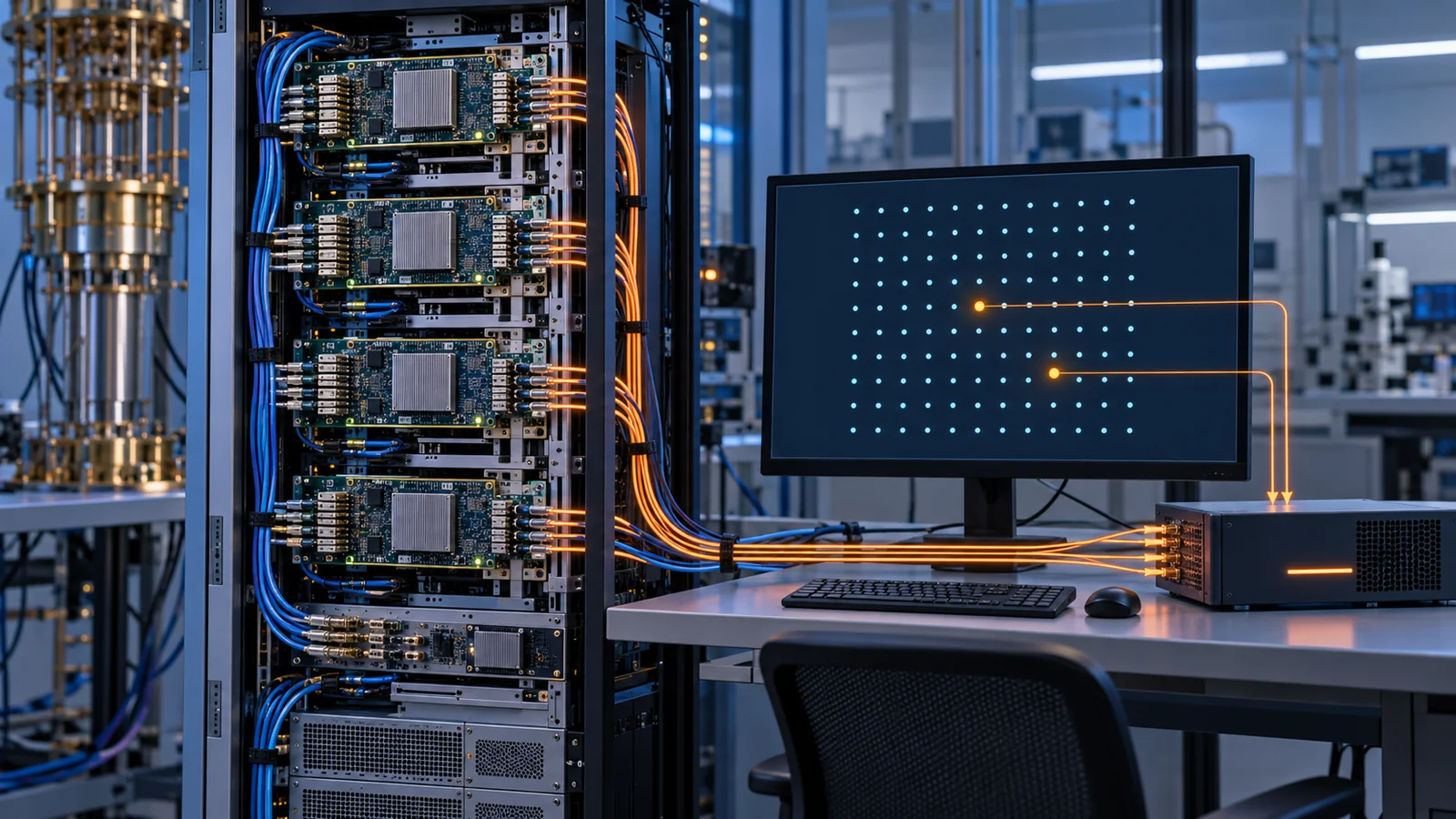
In Google's superconducting machine, measurement happens every 1.1 microseconds [Ref. 12]. If the decoder is slower than that, results keep piling up (our commentary). The amount of data also grows. At distance 27, 728 bits arrive on the classical side every cycle (d²−1; Our calculation). Error correction is a quantum mechanism, but it is equally a problem of fast classical computing and data transfer.
9. The threshold — "below the line, bigger is better"
(1) A thicker defence also adds things to defend
Enlarging the surface code lattice thickens the protection. But it also adds places where errors can happen (qubits and operations). Which wins? Google's paper puts the balance this way: if the physical error rate is below the threshold, adding qubits suppresses logical errors exponentially; above it, adding qubits makes things worse Sourced [Ref. 12]. In theory, Preskill explains that if the error rate per gate is below a critical value, an arbitrarily long computation can be carried out with reliable accuracy Sourced [Ref. 13].
(2) The formula, and a numerical example
Google's paper approximates the logical error rate εd of the surface code, using the physical error rate p and the threshold pth, as follows Sourced [Ref. 12].
εd ∝ (p / pth)(d+1)/2 The reduction per two steps of distance: Λ = εd / εd+2 ≈ pth / p
In words: "if p is half the threshold, each increase of distance by two cuts logical errors by about half". Λ (lambda) is the number telling by what factor logical errors fall when the distance goes up by two. As a numerical example, for p/pth = 0.5 (Λ = 2) and a proportionality constant of 1, you get 0.25 at distance 3, 0.125 at distance 5, 0.0625 at distance 7 and 0.03125 at distance 9 Our calculation. Each step of distance halves the error.
Λ = 2.14 means "each increase of distance by two (3 to 5, 5 to 7, ...) divides the logical error by 2.14". From Λ ≈ pth/p, you can read that the real machine's physical error rate is about 0.47 times the threshold (1/2.14; our calculation). It is "below the threshold", but only with about a factor of two to spare. If the physical error rate halves, Λ roughly doubles (Λ ∝ 1/p; an estimate assuming the same device and the same mix of errors).
(3) Numbers from Google's experiment (announced 2024, published in Nature 2025)
Google ran surface codes of distance 3, 5 and 7 on superconducting qubits (a 105-qubit chip) and measured the logical error rates. The table below uses values from the paper's supplementary table (neural-network decoder, offline) Sourced [Ref. 12].
| Code distance d | Physical qubits used (2d²−1) | Logical error rate (per cycle) | Ratio to the previous distance |
|---|---|---|---|
| 3 | 17 | 0.650% (6.50×10⁻³) | — |
| 5 | 49 | 0.303% (3.03×10⁻³) | about 2.15 times lower |
| 7 | 97 (101 in the experiment with helper qubits) | 0.143% (1.43×10⁻³) | about 2.12 times lower |
The "ratio to the previous distance" column is 6.50 ÷ 3.03 = 2.15 and 3.03 ÷ 1.43 = 2.12 (Our calculation). The paper averages several placements per distance and reports Λ = 2.14 ± 0.02 from a least-squares fit [Ref. 12]. Even with the same data, Λ depends on the decoder (an ensemble of matching decoders gives Λ = 2.04 ± 0.02 and ε₇ = 0.171%).
In this experiment, the lifetime of the distance-7 logical qubit was 291 ± 6 microseconds, 2.4 ± 0.3 times that of the best constituent physical qubit (119 ± 13 microseconds) [Ref. 12]. This is described as passing "break-even" (the point where a logical qubit outlasts the best physical qubit). But the paper itself notes that this measure does not include the cost of state preparation, measurement or gates [Ref. 12]. "Lasting a long time as memory" and "being able to compute" are different things.
What happens if we extend this result? Google's paper estimates by extrapolation that reaching a logical error rate of 10−6 would take distance 27 (1457 physical qubits) [Ref. 12]. Our simple calculation (assuming Λ = 2.14 stays unchanged as distance grows) gives 7.1×10⁻⁷ at distance 27, the same conclusion Our calculation. If the physical error rate halved and Λ roughly doubled (to 4.28), distance 17 (577 physical qubits) would reach 10−6 Our calculation. That is about 2.5 times fewer qubits (1457 ÷ 577), which leads into the materials discussion in Section 11.
Not so. Being below the threshold only means that "making it bigger makes errors shrink"; it does not make them zero. To reach a target error rate you must raise the distance, and in Google's estimate that is distance 27 and 1457 physical qubits (for 10−6). Moreover, when Google tested repetition codes up to distance 29, the logical error levelled off at 10−10. The cause is attributed to rare correlated errors that occur about once an hour (once in 3×10⁹ cycles) [Ref. 12]. The right way to put it: "below the threshold is the starting point; from there, scale, error quality and speed have to be improved."
In more detail: why the threshold has no single value
The threshold changes with the noise assumptions (the model of how errors occur), the check circuit and the decoder. Wang and colleagues calculated, for a procedure using only 2D nearest-neighbour coupling, that errors up to 1.1 to 1.4% can be tolerated, depending on the physically reasonable noise model [Ref. 15]. In Google's experiment too, behaviour near the threshold is discussed through the relation between detection probability and 1/Λ [Ref. 12]. In real machines, leakage (errors where a qubit leaves the 0 and 1 states) and correlated errors are added, so the "theoretical threshold" and the "Λ actually obtained on a real device" do not coincide.
10. How far experiments have come (as of 16 October 2026)
Experiments on the "memory" side of error correction (keeping qubit information alive), with the surface code and others, have advanced greatly in recent years. The table lists the main peer-reviewed papers we could confirm. The platforms, codes and ways of measuring differ, so do not line the numbers up to rank them.
| Year and group | Platform and code | What was confirmed | Caution in reading |
|---|---|---|---|
| 2023 (Nature) Google Quantum AI | Superconducting qubits. Surface code, distance 3 and distance 5 | The distance-5 logical qubit beat the average of distance-3 logical qubits "modestly". Logical error per cycle was 2.914% ± 0.016% (distance 5) and 3.028% ± 0.023% (distance 3) [Ref. 21] Sourced | The authors describe it as the first experiment where error correction starts to improve with qubit number. The improvement is small |
| 2025 (Nature; arXiv in August 2024) Google Quantum AI | Superconducting qubits. Surface code, distance 3, 5 and 7 (up to 101 qubits) | Λ = 2.14 ± 0.02. At distance 7 the logical error was 0.143% ± 0.003% per cycle. The logical qubit's lifetime was 2.4 ± 0.3 times that of the best physical qubit. Real-time decoding at distance 5 [Ref. 12] Sourced | A memory experiment, not logical gates or computation. It showed "below the threshold" experimentally |
| 2025 (Nature) Harvard, MIT, QuEra and others | Neutral atoms (up to 448 atoms). Surface codes and others | 2.14(13)-fold "below-threshold" performance in a four-round characterisation circuit, using atom-loss detection and machine-learning decoding [Ref. 22] Sourced | A check over few rounds. The conditions differ from Google's distance 3 to 7 experiment (the number is the same by coincidence) |
| 2025 (Nature) Google Quantum AI | Superconducting qubits. Colour code, distance 3 to 5 | Logical errors suppressed by a factor Λ(3/5) = 1.56(4) [Ref. 23] Sourced | The colour code is said to make logical operations more efficient. Whether it is below threshold is an estimate from simulation |
| 2025 (Nature) Amazon Web Services (AWS) | Superconducting circuits. Cat qubits (a bosonic code) plus an outer repetition code, distance 5 | Phase-flip correction improved from distance 3 to 5. Logical error per cycle averaged 1.75(2)% for the distance-3 sections and 1.65(3)% for distance 5 [Ref. 24] Sourced | A different design of code. The cat qubit suppresses bit flips itself, and the outer code fixes phase flips |
Each number is as stated in the abstract or text of the paper concerned (notation kept as in the original). Experiments we could not confirm (for example distance-7-or-larger experiments on other superconducting machines) are not included.
11. Remaining walls, and a materials engineer's view
(1) What remains
- Computation (logical gates): so far we have discussed "memory". To compute while keeping the code intact, more techniques (lattice surgery, magic states and so on) are needed. They are covered in "Logical Qubits and Fault-Tolerant Quantum Computing" in this series
- Leakage: errors where a qubit ends up outside the "0 and 1" states. Google's distance-7 experiment uses four extra qubits to remove leakage [Ref. 12] Sourced
- Correlated errors: errors that strike many nearby qubits at once. They break the assumption behind majority voting (that errors are independent). Google's paper says even a distance-29 repetition code levelled off at 10−10, with correlated errors about once an hour as the cause [Ref. 12] Sourced
- Scale: distance 27 for a logical error of 10−6 means 1457 physical qubits (above). Applications that need many logical qubits push this up by further orders of magnitude (next article)
- Speed and wiring: measurement every 1.1 microseconds, the decoder, and thousands of wires and their cooling ("Cryogenics and Control" in this series)
In the surface code, a lower physical error rate raises Λ and makes the distance needed for a given logical error rate smaller. In our estimate, if Λ goes from 2.14 to 4.28, the physical qubits needed for 10−6 fall from 1457 to 577, about 2.5 times fewer Our calculation (assuming Λ ∝ 1/p and an unchanged mix of errors). Qubit error rates rest on the quality of the superconducting films, the oxide of the Josephson junctions, the substrate and the interfaces. In other words, an improvement in materials cuts the number of qubits needed (chip area, wiring, cooling load) roughly with the square. Google attributes the improvement to a mean T1 (energy relaxation time) of 68 microseconds and a T2,CPMG of 89 microseconds to better fabrication, "participation ratio" engineering (designing how much of the electric field leaks into defect-rich regions) and circuit-parameter optimisation [Ref. 12] Sourced.
When a high-energy particle (a cosmic ray or radiation) hits the substrate, phonons (vibrations of the crystal) spread through the substrate and temporarily raise the number of "quasiparticles" in the superconductor. When these cross a Josephson junction, errors strike qubits over a wide area at the same time. McEwen and colleagues showed that making aluminium junctions with different superconducting gaps (the minimum energy needed to break a Cooper pair) side by side on one substrate suppresses these correlated errors [Ref. 25] Sourced. Google's paper says it attributes breaking past the earlier error floor (about 10−6, from high-energy impacts about once every 10 seconds) to gap-engineered junctions [Ref. 12] Sourced. Other work measured how radiation affects superconducting-qubit coherence [Ref. 26], and tests in a deep-underground facility to reduce radiation have also been reported [Ref. 27]. From the materials side, the substrate material and thickness, the junction material and (the material of) shielding are the variables that set the "floor of rare errors".
The surface code assumes that all qubits in the lattice are of about the same quality. Google's paper recorded how the frequencies of two-level systems (TLS; tiny defects in a material), which cause T1 fluctuations, drift in time, forecast their trajectories, and chose gate frequencies so as not to collide with them [Ref. 12] Sourced. In other words, since defects cannot be removed completely, they are avoided by how the device is used. Lower defect density in films and interfaces, better reproducibility and less wafer-to-wafer variation should connect directly to scaling error correction (our commentary; Inference). Materials and manufacturing behind qubits are covered in "Materials and Fabrication for Quantum Computers" in this series.
12. What could not be confirmed, and a summary
What could not be confirmed
- The text of ISO/IEC 4879:2024: it is paid, so we confirmed only the title, month of publication and status, and do not describe the definitions.
- The publication status of IEEE P7131: we checked the working group's site, but could not tell from that page whether the standard has been published.
- Below-threshold experiments at distance 7 or more on other superconducting machines: the peer-reviewed experiments we could confirm are limited to those in the table. Other work may be under way.
- Independent verification of IBM's "real-time decoding in under 480 nanoseconds": we checked IBM's announcement and the method's preprint [Ref. 19, 20] but could not confirm independent verification (company claim).
- A measured value of the theoretical threshold on real machines: experiments are reported through Λ (the change as distance grows); we did not confirm the threshold value itself.
- Long computations need error correction. If the error rate per operation is p, after about 1/p operations the chance that everything is correct falls to about 37% Our calculation
- Qubits can be protected without copying. Information is spread over entangled qubits, and only symptoms such as "same as the neighbour?" are measured to work backwards to the error Sourced
- The surface code is a code built from a 2D lattice and neighbour-to-neighbour checks. The thickness of protection is the distance d, and 2d²−1 physical qubits are needed Sourced
- Below the threshold, a bigger code means fewer logical errors. Google showed Λ = 2.14 for distances 3 to 5 to 7, with 0.143% per cycle at distance 7. Reaching 10−6 is estimated to need distance 27 and 1457 physical qubits Sourced
- What remains is logical gates, correlated errors, speed (the decoder), scale, and wiring and cooling. Better materials can cut the number of qubits needed roughly with the square
13. How to read evaluations and standards
The progress of quantum error correction is mainly measured by these "yardsticks": the logical error rate (how much the protected information is damaged per cycle), the error-suppression factor Λ (by what factor errors fall as distance grows), break-even (whether the protected information outlasts the best physical qubit), and decoder latency (whether it keeps up with the cycle). None of them has a meaning unless you state the kind of code, the distance, the number of cycles, the decoder and how the average was taken. As for standards, we could not confirm one that directly defines how to evaluate error correction; a terminology standard is the stage that has been published. Check date: 16 October 2026.
| Item evaluated | Representative benchmark or method (name and source) | Standards and guidance (ISO/IEC, IEEE and others) | Cautions in reading |
|---|---|---|---|
| Logical error rate (per cycle) | In logical-memory experiments, found by fitting the logical error against the number of cycles. Google: 0.143% ± 0.003% at distance 7 (101 qubits) [Ref. 12] Sourced | Could not be confirmed | Always give the code, distance, number of cycles, decoder and the average over X/Z bases. Memory (storage) and computation (gates) are different |
| Error-suppression factor Λ | The ratio of logical errors when distance grows by two. Google: 2.14 ± 0.02 [Ref. 12]. Harvard and others: 2.14(13) (four rounds) [Ref. 22]. Google colour code: Λ(3/5) = 1.56(4) [Ref. 23] Sourced | Could not be confirmed | A ratio for changing distance on the same device with the same code. Do not line up Λ values from different codes or platforms to rank them. The value changes with the decoder (Google 2.04 to 2.14) |
| Break-even gain | Effective logical lifetime divided by the lifetime of the best physical qubit. Google: 2.4 ± 0.3 [Ref. 12] Sourced | Could not be confirmed | It does not include the cost of state preparation, measurement or gates (the paper's own note) |
| Decoder performance | Logical error rate and latency. Google: average 63 microseconds at distance 5, cycle 1.1 microseconds [Ref. 12]. IBM: under 480 nanoseconds (company claim) [Ref. 20] Sourced | Could not be confirmed | Software speed and latency including data transfer on a real machine are different. The size of the problem differs by code (surface code or qLDPC) |
| Scale required | 2d²−1. Google's extrapolation: 10−6 needs distance 27 and 1457 physical qubits [Ref. 12] Sourced. Estimate with Λ = 4.28: 577 Our calculation | Could not be confirmed | The extrapolation assumes that Λ stays constant and no new errors appear |
| Terms and definitions | — (a terminology standard rather than an evaluation) | ISO/IEC 4879:2024 "Information technology — Quantum computing — Vocabulary" (ISO/IEC JTC 3; published May 2024; text is paid) [Ref. 28] Sourced | A standard for aligning definitions; it does not set how to measure error-correction performance. The text was not checked |
| Standard for performance metrics and benchmarking | — | IEEE P7131 (a draft standard for quantum computing performance metrics and benchmarking). The working group's site says its technical scope is defined by P7131 [Ref. 29] Not yet confirmed | At the draft stage. Whether it has been published could not be confirmed. Its content was not checked |
The arrangement of the table is Our calculation (organising). Numbers, titles and publication months of standards were checked on each body's page (check date 16 October 2026). Standards texts are paid, so only titles and scope are given.
Cautions in reading (for materials engineers)
- "Logical qubit" means different things for different codes, distances and ranges of measurement: read an announcement that "a logical qubit was made" together with which code, what distance, what logical error rate and how many cycles were measured. "Below threshold" and "error suppression" also need "compared with what, by what factor"
- Company announcements and peer review or independent verification are different: the experiments in the table are peer-reviewed papers. Items resting only on company announcements, such as decoder speed, are treated as "company claims"
- Memory and computation are different: most of the experiments in the table keep a logical qubit alive. The error rate of a computation including logical gates must be checked separately
- Standards are still at the terminology stage: ISO/IEC 4879 is a terminology standard and has no legal force or power to decide pass or fail on performance (in general a standard becomes binding when cited in law or a contract; our commentary). The benchmarking standard (IEEE P7131) was a draft as of the check date
14. Glossary
- Quantum error correction (QEC)
- Finding and fixing qubit errors without destroying the information.
- Physical qubit
- A qubit of the real device. Errors occur in it.
- Logical qubit
- A qubit with few errors, protected by many physical qubits.
- Redundancy
- Keeping extra information to prepare for errors.
- Repetition code
- The simplest code: keep the same information several times and fix by majority vote.
- No-cloning
- An unknown quantum state cannot be copied exactly.
- Bit flip
- An error that swaps 0 and 1. North and south of the arrow swap.
- Phase flip
- An error that swaps left and right of the arrow. The odds of measuring 0 or 1 do not change.
- CNOT
- A two-qubit operation that flips the target only when the control is 1.
- Syndrome
- The pattern of check answers. A clue for working back to the error location.
- Stabilizer
- A check that always gives +1 on the protected state and −1 after an error.
- Data qubit
- A qubit that holds the information.
- Measure qubit
- A helper qubit used only for the checks.
- [[n,k,d]]
- How a code's size is written: n physical, k logical, distance d.
- Code distance d
- The number of errors needed before an error becomes undetectable.
- Surface code
- A code that places qubits on a 2D lattice and checks neighbours.
- Detection event
- A check's answer changing from the previous cycle.
- Decoder
- The classical processing that infers the error from the check results.
- MWPM
- Minimum-weight perfect matching. A decoding method that pairs lit points by the shortest paths.
- Threshold
- The boundary below which a bigger code gives fewer logical errors.
- Λ (lambda)
- The factor by which logical errors fall when the distance rises by two.
- Break-even
- The point where a logical qubit outlasts the best physical qubit.
- Leakage
- An error where a qubit leaves the 0 and 1 states.
- TLS (two-level system)
- A tiny defect in a material. It drains a qubit's energy and shortens T1.
15. References
- Nielsen M. A., Chuang I. L. Quantum Computation and Quantum Information, 10th anniversary edition, Cambridge University Press (2010) (the standard textbook reference for error correction) — doi.org/10.1017/CBO9780511976667
- Roffe J. "Quantum error correction: an introductory guide", Contemporary Physics 60, 226–245 (2019), DOI 10.1080/00107514.2019.1667078 — arxiv.org/abs/1907.11157
- Devitt S. J., Munro W. J., Nemoto K. "Quantum error correction for beginners", Rep. Prog. Phys. 76, 076001 (2013), DOI 10.1088/0034-4885/76/7/076001 — arxiv.org/abs/0905.2794
- Shor P. W. "Scheme for reducing decoherence in quantum computer memory", Phys. Rev. A 52, R2493 (1995), DOI 10.1103/PhysRevA.52.R2493 — doi.org/10.1103/PhysRevA.52.R2493
- Steane A. M. "Error correcting codes in quantum theory", Phys. Rev. Lett. 77, 793 (1996), DOI 10.1103/PhysRevLett.77.793 — doi.org/10.1103/PhysRevLett.77.793
- Wootters W. K., Zurek W. H. "A single quantum cannot be cloned", Nature 299, 802–803 (1982), DOI 10.1038/299802a0 — doi.org/10.1038/299802a0
- Dieks D. "Communication by EPR devices", Phys. Lett. A 92, 271–272 (1982), DOI 10.1016/0375-9601(82)90084-6 — doi.org/10.1016/0375-9601(82)90084-6
- Gottesman D. "Stabilizer codes and quantum error correction", PhD thesis, arXiv:quant-ph/9705052 (1997) — arxiv.org/abs/quant-ph/9705052
- Kitaev A. Yu. "Fault-tolerant quantum computation by anyons", Ann. Phys. 303, 2–30 (2003), DOI 10.1016/S0003-4916(02)00018-0 — doi.org/10.1016/S0003-4916(02)00018-0
- Bravyi S. B., Kitaev A. Yu. "Quantum codes on a lattice with boundary", arXiv:quant-ph/9811052 (1998) — arxiv.org/abs/quant-ph/9811052
- Dennis E., Kitaev A., Landahl A., Preskill J. "Topological quantum memory", J. Math. Phys. 43, 4452–4505 (2002), DOI 10.1063/1.1499754 — doi.org/10.1063/1.1499754
- Google Quantum AI and Collaborators "Quantum error correction below the surface code threshold", Nature 638, 920–926 (2025), DOI 10.1038/s41586-024-08449-y (arXiv:2408.13687) — doi.org/10.1038/s41586-024-08449-y
- Preskill J. "Reliable quantum computers", Proc. R. Soc. Lond. A 454, 385–410 (1998), DOI 10.1098/rspa.1998.0167 — doi.org/10.1098/rspa.1998.0167
- Fowler A. G., Mariantoni M., Martinis J. M., Cleland A. N. "Surface codes: Towards practical large-scale quantum computation", Phys. Rev. A 86, 032324 (2012), DOI 10.1103/PhysRevA.86.032324 — doi.org/10.1103/PhysRevA.86.032324
- Wang D. S., Fowler A. G., Hollenberg L. C. L. "Surface code quantum computing with error rates over 1%", Phys. Rev. A 83, 020302(R) (2011), DOI 10.1103/PhysRevA.83.020302 — doi.org/10.1103/PhysRevA.83.020302
- Higgott O., Gidney C. "Sparse Blossom: correcting a million errors per core second with minimum-weight matching", Quantum 9, 1600 (2025), DOI 10.22331/q-2025-01-20-1600 — doi.org/10.22331/q-2025-01-20-1600
- Delfosse N., Nickerson N. H. "Almost-linear time decoding algorithm for topological codes", Quantum 5, 595 (2021), DOI 10.22331/q-2021-12-02-595 — doi.org/10.22331/q-2021-12-02-595
- Bausch J. et al. "Learning high-accuracy error decoding for quantum processors", Nature 635, 834–840 (2024), DOI 10.1038/s41586-024-08148-8 — doi.org/10.1038/s41586-024-08148-8
- Müller T. et al. (IBM) "Improved belief propagation is sufficient for real-time decoding of quantum memory", arXiv:2506.01779 (2025) (preprint) — arxiv.org/abs/2506.01779
- IBM "IBM Delivers New Quantum Processors, Software, and Algorithm Breakthroughs on Path to Advantage and Fault Tolerance", press release (12 November 2025) (company announcement) — newsroom.ibm.com (2025-11-12)
- Google Quantum AI "Suppressing quantum errors by scaling a surface code logical qubit", Nature 614, 676–681 (2023), DOI 10.1038/s41586-022-05434-1 — doi.org/10.1038/s41586-022-05434-1
- Bluvstein D. et al. "A fault-tolerant neutral-atom architecture for universal quantum computation", Nature 649, 39–46 (2025), DOI 10.1038/s41586-025-09848-5 — doi.org/10.1038/s41586-025-09848-5
- Lacroix N. et al. "Scaling and logic in the colour code on a superconducting quantum processor", Nature 645, 614–619 (2025), DOI 10.1038/s41586-025-09061-4 — doi.org/10.1038/s41586-025-09061-4
- Putterman H. et al. (AWS) "Hardware-efficient quantum error correction via concatenated bosonic qubits", Nature 638, 927–934 (2025), DOI 10.1038/s41586-025-08642-7 — doi.org/10.1038/s41586-025-08642-7
- McEwen M. et al. "Resisting high-energy impact events through gap engineering in superconducting qubit arrays", Phys. Rev. Lett. 133, 240601 (2024), DOI 10.1103/PhysRevLett.133.240601 — doi.org/10.1103/PhysRevLett.133.240601
- Vepsäläinen A. P. et al. "Impact of ionizing radiation on superconducting qubit coherence", Nature 584, 551–556 (2020), DOI 10.1038/s41586-020-2619-8 — doi.org/10.1038/s41586-020-2619-8
- Cardani L. et al. "Reducing the impact of radioactivity on quantum circuits in a deep-underground facility", Nat. Commun. 12, 2733 (2021), DOI 10.1038/s41467-021-23032-z — doi.org/10.1038/s41467-021-23032-z
- ISO/IEC 4879:2024 "Information technology — Quantum computing — Vocabulary" (published May 2024). Number, title, date and "Published" status were checked on the listing page of the Institute for Standardization of Serbia (ISS) — iss.rs/en/project/show/iso:proj:80432 (the official ISO page is https://www.iso.org/standard/80432.html; it could not be fetched automatically from our environment, and was confirmed through search-result listings)
- IEEE P7131 working group "Quantum Benchmarking Working Group P7131" (site of the working group on the draft standard for quantum computing performance metrics and benchmarking) — sagroups.ieee.org/7131
16. Claim-to-source audit
| Claim in the text | Basis | Label |
|---|---|---|
| The best many-qubit machines have only just reached 99.9% for two-qubit gates. The error rate needed for many applications is said to be below 10−10 | Introduction of Google (2025) Reference 12 https://doi.org/10.1038/s41586-024-08449-y | Sourced |
| An unknown quantum state cannot be duplicated (no-cloning) | Wootters and Zurek, Dieks (1982) Reference 6 https://doi.org/10.1038/299802a0 Reference 7 https://doi.org/10.1016/0375-9601(82)90084-6 | Sourced |
| The majority-vote repetition code is explained as the first example of error correction in textbooks and reviews. A code that can fix bit flips and phase flips can fix any error on one qubit | Textbook and reviews (Nielsen and Chuang, Roffe, Devitt et al., Gottesman) Reference 1 https://doi.org/10.1017/CBO9780511976667 Reference 2 https://arxiv.org/abs/1907.11157 Reference 3 https://arxiv.org/abs/0905.2794 Reference 8 https://arxiv.org/abs/quant-ph/9705052 | Sourced |
| Shor in 1995 presented a scheme (the nine-qubit code) for reducing decoherence in quantum computer memory. Steane in 1996 presented a quantum error-correcting code | Titles and bibliographic details of Shor (1995) and Steane (1996) Reference 4 https://doi.org/10.1103/PhysRevA.52.R2493 Reference 5 https://doi.org/10.1103/PhysRevLett.77.793 | Sourced |
| Systematisation of stabilizer codes (Gottesman) | Gottesman's thesis (abstract) Reference 8 https://arxiv.org/abs/quant-ph/9705052 | Sourced |
| The toric code (Kitaev), a planar code with boundaries (Bravyi and Kitaev), analysis of error recovery and the threshold (Dennis et al.), and a review tying the surface code to large-computer design (Fowler et al.) | Abstracts of each paper Reference 9 https://doi.org/10.1016/S0003-4916(02)00018-0 Reference 10 https://arxiv.org/abs/quant-ph/9811052 Reference 11 https://doi.org/10.1063/1.1499754 Reference 14 https://doi.org/10.1103/PhysRevA.86.032324 | Sourced |
| A procedure tolerating gate errors above 1% with only 2D nearest-neighbour interactions. Thresholds of 1.1 to 1.4% depending on the noise model | Abstract of Wang et al. (2011) Reference 15 https://doi.org/10.1103/PhysRevA.83.020302 | Sourced |
| If the error rate is below a critical value, an arbitrarily long computation can be done with reliable accuracy (explanation of the threshold theorem) | Abstract of Preskill (1998) Reference 13 https://doi.org/10.1098/rspa.1998.0167 | Sourced |
| Surface code: d×d data qubits, d²−1 checks, 2d²−1 physical qubits. Logical operations are chains from edge to edge. Definition of a detection event. Said to have the highest tolerance to errors among codes with planar connectivity | Introduction of Google (2025) and text of the AlphaQubit paper Reference 12 https://doi.org/10.1038/s41586-024-08449-y Reference 18 https://doi.org/10.1038/s41586-024-08148-8 | Sourced |
| Approximation of the logical error rate, εd ∝ (p/pth)(d+1)/2, and Λ = εd/εd+2 ≈ pth/p | Formula in the introduction of Google (2025) Reference 12 https://doi.org/10.1038/s41586-024-08449-y | Sourced |
| Google's experiment: Λ = 2.14 ± 0.02; 0.143% ± 0.003% at distance 7 (101 qubits); logical qubit lifetime of 291 ± 6 microseconds, 2.4 ± 0.3 times the best physical qubit's 119 ± 13 microseconds; cycle 1.1 microseconds; average latency 63 microseconds (distance 5). Supplementary table: distances 3, 5 and 7 give 6.50, 3.03 and 1.43 × 10⁻³; an ensemble decoder gives Λ = 2.04 | Abstract, text and supplementary table of Google (2025) Reference 12 https://doi.org/10.1038/s41586-024-08449-y | Sourced |
| The lifetime measure excludes the cost of gates, preparation and measurement. Extrapolation: 10−6 needs distance 27 and 1457 qubits. Repetition codes up to distance 29 level off at 10−10, with correlated errors about once an hour. The cause of the T1 improvement to 68 microseconds (fabrication, participation ratio, parameters). Avoiding frequency collisions with TLS | Text of Google (2025) Reference 12 https://doi.org/10.1038/s41586-024-08449-y | Sourced |
| 2023 Google experiment: distance 5 modestly beat the average of distance 3, with logical errors of 2.914% ± 0.016% (distance 5) and 3.028% ± 0.023% (distance 3) | Abstract of Google (2023) Reference 21 https://doi.org/10.1038/s41586-022-05434-1 | Sourced |
| Harvard and others: up to 448 atoms; 2.14(13)-fold below-threshold performance in a four-round characterisation circuit; atom-loss detection and machine-learning decoding | Abstract of Bluvstein et al. (2025) Reference 22 https://doi.org/10.1038/s41586-025-09848-5 | Sourced |
| Google colour code: Λ(3/5) = 1.56(4) from distance 3 to 5 | Abstract of Lacroix et al. (2025) Reference 23 https://doi.org/10.1038/s41586-025-09061-4 | Sourced |
| AWS: cat qubits with an outer repetition code (distance 5). Logical error of 1.75(2)% (distance-3 sections) and 1.65(3)% (distance 5) | Abstract of Putterman et al. (2025) Reference 24 https://doi.org/10.1038/s41586-025-08642-7 | Sourced |
| Sparse Blossom runs in under one microsecond per round on a single core for distance 17 at 0.1% noise. A Union-Find-type decoder runs in almost linear time even in the worst case. AlphaQubit beat other decoders on Google's real-device data (distance 3 and 5) and in simulation up to distance 11 | Abstracts of each paper Reference 16 https://doi.org/10.22331/q-2025-01-20-1600 Reference 17 https://doi.org/10.22331/q-2021-12-02-595 Reference 18 https://doi.org/10.1038/s41586-024-08148-8 | Sourced |
| Relay-BP was proposed as a parallel decoder meant for real-time FPGA or ASIC implementation. IBM announced real-time decoding in under 480 nanoseconds for qLDPC codes (company claim) | Abstract of the preprint by Müller et al. and IBM's press release (12 November 2025) Reference 19 https://arxiv.org/abs/2506.01779 Reference 20 https://newsroom.ibm.com/2025-11-12-ibm-delivers-new-quantum-processors,-software,-and-algorithm-breakthroughs-on-path-to-advantage-and-fault-tolerance | Sourced |
| High-energy impacts raise quasiparticle numbers and cause correlated errors. Aluminium junctions with different gaps suppress them. Measurement of radiation effects on coherence, and tests in a deep-underground facility | Abstracts of McEwen et al., Vepsäläinen et al. and Cardani et al. Reference 25 https://doi.org/10.1103/PhysRevLett.133.240601 Reference 26 https://doi.org/10.1038/s41586-020-2619-8 Reference 27 https://doi.org/10.1038/s41467-021-23032-z | Sourced |
| ISO/IEC 4879:2024 "Information technology — Quantum computing — Vocabulary" was published in May 2024 | Listing page of the Institute for Standardization of Serbia (ISS) Reference 28 https://iss.rs/en/project/show/iso:proj:80432 | Sourced |
| The IEEE P7131 working group has a draft standard for quantum computing performance metrics and benchmarking as its technical scope. Publication status could not be confirmed | The working group's site Reference 29 https://sagroups.ieee.org/7131 | Not yet confirmed |
| The success-probability table and figure ((1−p)N), the failure probability of a three-way majority vote (3p²−2p³), the 2d²−1 table, the ratios between distances (2.15, 2.12), the Λ = 2.14 extrapolation (7.1×10⁻⁷ at distance 27), the Λ = 4.28 estimate (distance 17, 577 qubits, about 2.5 times fewer), 728 bits and 0.66 Gbit/s, the three-qubit code example (α = 0.6, β = 0.8), the roughly threefold phase-flip risk, and the model curves by distance | Our calculation (Python; assumptions stated in the text and figure notes). Not results from a real machine | Our calculation |
| The text of ISO/IEC 4879, the publication status of IEEE P7131, experiments at distance 7 or more on other superconducting machines, independent verification of IBM's decoding speed, and a measured value of the threshold on real machines | Not described, because they could not be confirmed in the primary material available within the scope of this research | Commentary |
| The analogy of "inspecting an envelope for damage without opening it", the readings "distance is the thickness of protection" and "better materials cut the number of qubits needed roughly with the square", and the view that avoiding TLS is the present way of coping | Our organisation and commentary based on published content. Not views stated by the bodies concerned | Commentary |
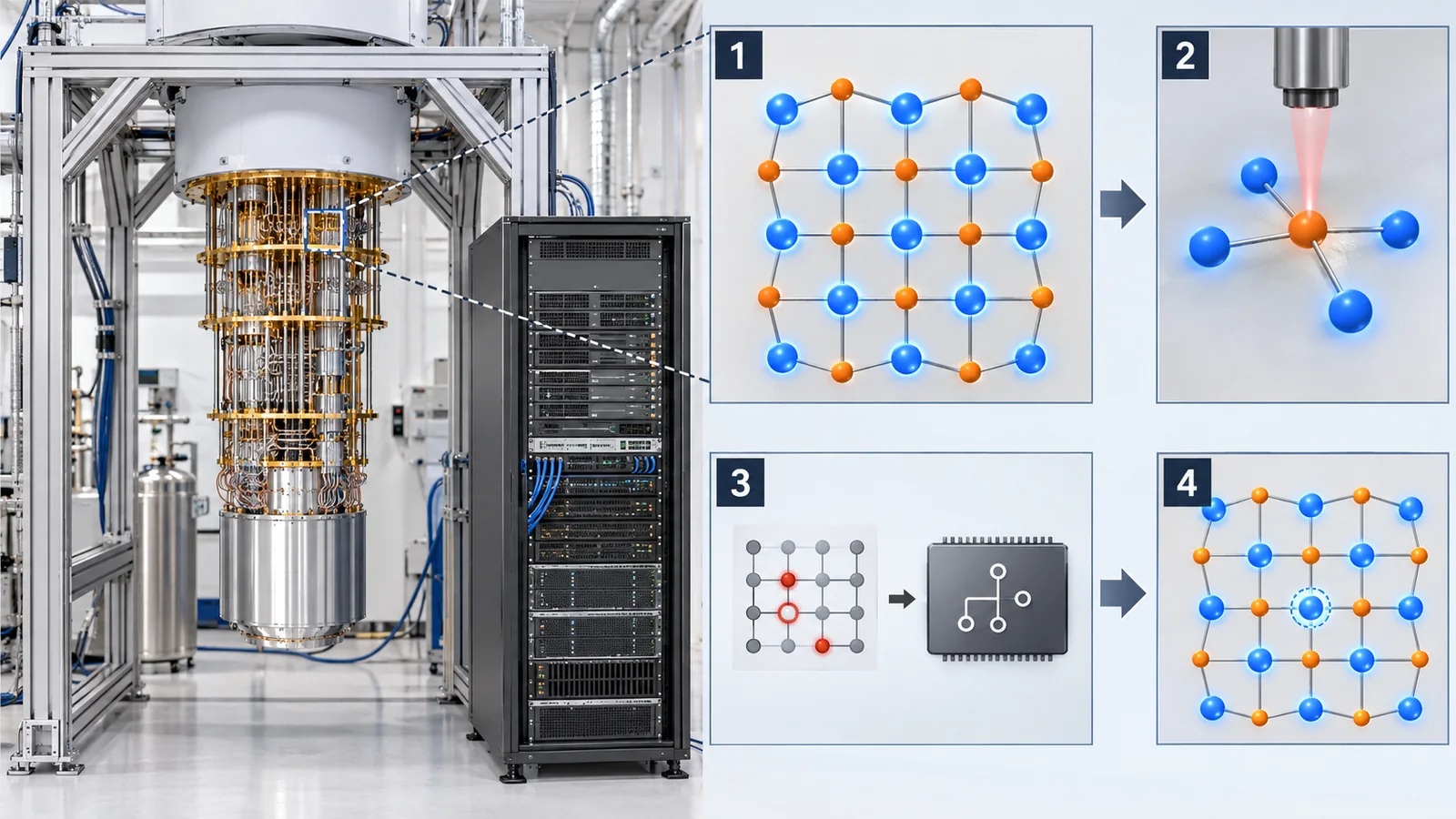
| Fig. 1 and Fig. 10 are ImageGen-generated conceptual illustrations. The other figures are explanatory drawings, not observations of real data | Note in this article | Commentary |
Last updated 16 October 2026. Sources are limited to primary material (peer-reviewed papers, arXiv papers, a textbook, company announcements and ISO standard listing pages). Company announcements are marked as company claims. Numerical estimates are our own calculations and not results from real machines. The text of ISO/IEC 4879, the publication status of IEEE P7131, independent verification of IBM's decoding speed, and a measured value of the threshold on real machines could not be confirmed and are not stated here. All figures are explanatory concept diagrams or drawings that include our calculations; Fig. 1 and Fig. 10 are ImageGen-generated conceptual illustrations.