COMPANY PROFILE / QUANTUM COMPUTING
Amazon Web Services
A company that rents out other firms' quantum computers through the cloud is also researching its own superconducting chip built for error correction
AWS lets customers use quantum computers built by other companies (IonQ, Rigetti, IQM, AQT and QuEra) through its cloud service, Amazon Braket. In parallel, at the AWS Center for Quantum Computing next to the California Institute of Technology (Caltech), it is researching its own superconducting chip, Ocelot. Ocelot is a prototype designed to build in error correction from the start; it is not a practical quantum computer. Amazon's annual report (Form 10-K) contains no discussion of quantum computing that we could find, and quantum revenue and spending are not disclosed. This profile covers only the quantum-related parts, to the extent official material allows.
- AWS in 30 seconds, and where it stands in quantum computing
- The logo and how the name is written
- Where the company sits in the quantum computing field
- Scale (limited to what touches quantum)
- Resources committed to quantum computing
- What it has done so far
- What comes next
- What the company is aiming for in quantum computing
- Map of quantum computing partnerships
- Products, technologies and services
- The risks this company carries
- Glossary, references and claim-to-source audit
1. AWS in 30 seconds, and where it stands in quantum computing
Seattle, WashingtonNASDAQ: AMZN (listed as Amazon)
Superconducting (secondary)Offers others' machines through the cloud while researching superconducting hardware itself
Quantum ComputingNext to Caltech (Pasadena, California)
on Braket by 2028 (target)Announced 15 June 2026. A company target
AWS has two roles in quantum. (1) A cloud front door: letting researchers try quantum computers of different types, built by others, with the same tools. (2) Its own chip research: building from basic research a superconducting chip with error correction built in. These are separate things. Every quantum computer available on Braket was built by another company, and AWS's own chip (Ocelot) is not offered on Braket (we found no statement in official material that it is) Sourced.
When this article gives a "qubit count" it always says whether it is physical qubits (the actual qubits on a chip) or logical qubits (sturdy qubits made by combining many physical ones through error correction).
Qubit: the smallest unit of information in a quantum computer. QPU stands for quantum processing unit, a quantum chip with qubits laid out on it.
Error correction: a mechanism that finds and fixes the mistakes of fragile qubits. It takes many qubits, so "how many extra qubits are needed" is a major challenge.
Cat qubit: named after Schrödinger's cat, a qubit that uses oscillations of light (microwaves). Of the two kinds of error, its design makes one kind much less likely.
Cloud: using a provider's computers over the internet instead of your own. Quantum machines are large installations, so using them through the cloud is the usual way.
2. The logo and how the name is written

A note on naming: Amazon Web Services (AWS) is a business unit of Amazon.com, Inc.; the listed company is Amazon.com, Inc. The financial figures here are the AWS segment figures in Amazon.com, Inc.'s Form 10-K. Amazon Braket is a cloud service for using quantum computers and the AWS Center for Quantum Computing is AWS's own quantum hardware research group; the names are similar but the roles differ.
Official site (Amazon Braket): https://aws.amazon.com/braket/3. Where the company sits in the quantum computing field
Companies involved in quantum computing are easiest to sort into four types according to how they build a qubit (the approach). This is our own classification Our calculation.
| Type (approach) | What serves as the qubit (plain-language explanation) |
|---|---|
| Superconducting | Tiny electrical circuits made of a metal that loses all electrical resistance at extremely low temperatures; two states of the circuit stand for 0 and 1. They can be made with methods close to chip manufacturing, but they need extreme cooling and a great deal of wiring. |
| Trapped ions & neutral atoms | Individual atoms, either electrically charged (ions) or neutral, held in a vacuum with electromagnetic fields or laser beams ("optical tweezers"); two internal states of each atom stand for 0 and 1. Atoms are all identical, which tends to give uniform qubits, but operations are slower and scaling up is hard. |
| Photonic, silicon & other approaches | Particles of light (photons), or the spin (the orientation of a tiny magnet) of an electron in silicon, and similar systems. They may be able to use existing semiconductor fabs and silicon photonics, but much of this work is still at the proof-of-concept stage. |
| Software, cloud & ecosystem | Companies that do not build qubits but help people use, run or connect quantum computers: cloud services, software, the classical computers that control them, and quantum communication. |
4. Scale (limited to what touches quantum)
AWS as a whole is very large, so we note only its scale. The figures are from Amazon.com, Inc.'s Form 10-K for calendar 2025 (1 January to 31 December 2025) Sourced.
| Measure (US$ million) | 2023 | 2024 | 2025 |
|---|---|---|---|
| Amazon total net sales | 574,785 | 637,959 | 716,924 |
| AWS segment net sales | 90,757 | 107,556 | 128,725 |
| AWS segment operating income | 24,631 | 39,834 | 45,606 |
| Item | Detail |
|---|---|
| Employees (all of Amazon, 31 December 2025) | About 1,576,000 full-time and part-time employees. The 10-K gives no headcount for the AWS segment alone |
| Headquarters | Seattle, Washington (410 Terry Avenue North) |
| Listing | NASDAQ Global Select Market (ticker AMZN) |
| AWS share of company net sales (2025) | About 18.0% (128,725 / 716,924) Our calculation |
The figures above are for AWS as a whole, not the size of its quantum computing business. Amazon discloses no quantum revenue, R&D expense, capital spending or dedicated headcount Not yet confirmed. The words "quantum" and "Braket" do not appear in the 10-K for 2025 or in the latest 10-Q (quarter ended 30 June 2026). Most AWS costs are booked under the "Technology and infrastructure" line, and the quantum portion is not separated out.
5. Resources committed to quantum computing
The table checks four kinds of resource (people, money, equity investments and acquisitions, and ties with universities and public bodies) against primary sources. "No mention" and "not disclosed" are findings too.
| Type of resource | What primary sources confirm | Category |
|---|---|---|
| People | The research site is the AWS Center for Quantum Computing (next to Caltech; its formation was announced in December 2019). Headcount is not disclosed. Official material names Oskar Painter as AWS director of Quantum Hardware and Eric Kessler as General Manager of Amazon Braket | Sourced / headcount not disclosed |
| Money | Quantum R&D and capital spending are not disclosed (nothing in the 10-K) | Not disclosed |
| Equity investments, acquisitions, joint ventures, disposals | In the official material we checked, no equity investment in, or acquisition, joint venture or disposal of, a quantum company could be confirmed. QuEra's announcement mentions its "long-standing collaborations with AWS", but that is not a statement of investment | Not confirmed |
| Universities, research institutions, public funding | Its site sits next to Caltech (the Nature paper also thanks Caltech researchers). AWS Cloud Credits for Research for researchers (credits to use Braket). A joint research program with JPMorganChase. Government grants or public funding could not be confirmed | Sourced / public funding not confirmed |
Status of the main devices and products
The only quantum chip AWS built itself is Ocelot (a prototype). The machines on Braket are other companies' products, and the numbers below are what AWS's own pages state, not the makers' full specifications. We do not rank machines of different types against each other (checked 16 October 2026).
| Device | Approach | Qubits (physical; as confirmed on AWS pages) | Representative error rate | Stage and date | Reference |
|---|---|---|---|---|---|
| Ocelot (AWS's own) | Superconducting (cat qubits) | 14 components: 5 data cat qubits, 5 stabilizing buffer circuits and 4 error-detection qubits. Logical qubits: one "logical memory" (an error-correction experiment, see below) | Nature paper: minimum logical error per cycle 1.65(3)% (distance-5 repetition code) and 1.75(2)% (distance-3). A value for a "memory" that corrects only phase flips | Prototype (announced February 2025). No statement that it is offered on Braket | Refs. 5, 6 |
| IBEX Q1 (AQT) | Trapped ion (fully connected) | 12 | Not stated on the relevant AWS page | On Braket (20 November 2025) | Ref. 11 |
| Cepheus-1-108Q (Rigetti) | Superconducting (twelve 9-qubit chiplets joined) | 108 | Not stated on the relevant AWS page | On Braket (7 April 2026) | Ref. 10 |
| Aquila (QuEra) | Neutral atom (analog mode) | 256 | Not stated on the relevant AWS page | On Braket (launched jointly in 2022) | Ref. 14 |
| Forte-1 / Forte-Enterprise-1 (IonQ), Garnet / Emerald (IQM), Ankaa-3 (Rigetti) | Ion / superconducting / superconducting | Not confirmed (no count on the AWS pages we read) | Not confirmed | Listed among the devices Braket supports | Ref. 8 |
| Libra (QuEra's fault-tolerant machine) | Neutral atom | Hundreds of logical qubits (target); about one million quantum operations (Megaquop) | No logical error rate on the AWS pages we read | Plan (to reach Braket by 2028; a company target) | Ref. 14 |
Ocelot's "logical error rate" is not an error rate for practical computation. The Ocelot paper builds a "logical memory", one that merely stores data, using a repetition code of five cat qubits and measures the logical error per cycle (an error-correction cycle of about 2.8 microseconds). A repetition code corrects only one of the two kinds of error (phase flips); the other kind (bit flips) is suppressed by the cat qubits themselves. The paper itself states that this code has no "proper asymptotic threshold" (the point beyond which making the code larger reduces errors) Sourced.
6. What it has done so far
| When | What happened | Why it matters |
|---|---|---|
| 2 December 2019 | Announced Amazon Braket (as a preview) and the formation of the AWS Center for Quantum Computing next to Caltech | It started a window for renting others' machines and its own basic research at the same time |
| 2020 | Braket entered service (an AWS blog post says it launched "in 2020") | An entry point for using quantum computers through the cloud |
| 2022 | With QuEra, offered Aquila, a 256-qubit analog neutral-atom machine | The start of putting machines of different types on Braket |
| February 2025 | Announced its own quantum chip, Ocelot. The Nature paper was published on 26 February 2025. AWS estimated it could cut the cost of error correction by up to 90% (AWS's own estimate) | A design with error correction built in, but a prototype |
| November 2025 | CUDA-Q made natively available in Braket notebooks (10 November). AQT's IBEX Q1 added (20 November) | NVIDIA software and a new trapped-ion machine added |
| 10 December 2025 | Braket gained support for Qiskit 2.0 | Stronger link with a leading quantum programming framework |
| 7 April 2026 | Added Rigetti's Cepheus-1-108Q (108 qubits) to Braket | The first superconducting machine with over 100 qubits on Braket |
| 15 June 2026 | Expanded its collaboration with QuEra and announced a target of bringing the fault-tolerant machine Libra to Braket by 2028 | States outright that quantum should become "one more item on the AWS compute menu" |
| 5 August 2026 | Published results of joint research with JPMorganChase (a finance optimization problem) | The figures in the results are the two firms' own (no independent verification found) |
7. What comes next
by 2028 (target)About 1 million operations, hundreds of logical qubits. Limited capacity at first
in official materialAWS says it has "several more stages of scaling to go through"
None of the following appears in the official material we checked Not yet confirmed.
The timing and qubit count of Ocelot's successor; any plan to offer Ocelot on Braket; quantum revenue, spending and headcount; the pricing and terms for Libra on Braket. Libra's "2028", "hundreds of logical qubits" and "about one million quantum operations" are targets of AWS and QuEra, not performance already achieved.
8. What the company is aiming for in quantum computing
We separate what the company itself says from what this article infers.
| What can be read | Primary evidence behind it | Category |
|---|---|---|
| It wants quantum processors to become, in time, one item on the AWS compute menu alongside CPUs and GPUs | AWS's blog says it envisions quantum processors becoming "a natural part of the AWS compute portfolio" (Ref. 14) | Sourced |
| It does not stake everything on one approach | The same blog says quantum computing is not winner-take-all and explains the different strengths and limits of ion, superconducting and Rydberg-atom qubits (Ref. 14) | Sourced |
| It sees its own superconducting work (Ocelot) and others' neutral atoms as complementary | The same blog calls Ocelot "deeply complementary to Rydberg atoms" (Ref. 14) | Sourced |
| For now the revenue core is use of Braket, not its own chip | No plan to offer its own chip is stated, and Braket offers others' machines. But quantum revenue is not disclosed, so this cannot be verified (Refs. 1, 3, 5) | Inference |
| Early customers are co-development partners in finance, chemistry and similar fields | AWS says there is "no off-the-shelf path" and that early adopters must work hand in hand with hardware and software experts, and it published joint research with JPMorganChase (Refs. 14, 15) | Sourced (the picture of customers is an Inference) |
| The own chip is a "seed of differentiation" to be grown over the long term | Painter says AWS will "continue investing in basic research", and AWS states plainly that Ocelot is a prototype (Ref. 5) | Inference |
AWS has run a window for renting others' machines (Braket) since 2019 and set up its own chip research site the same year. AWS itself likens this approach to the path of another business: it compares Ocelot to its own CPU, Graviton, which grew from long experience running x86 servers Sourced.
From this, our reading is that AWS learns demand from customers at the window while keeping a route to own what is inside later, through its own chip Inference. Whether the own chip will join the machines offered on Braket is not stated in official material and cannot be known at present Not yet confirmed.
9. Map of quantum computing partnerships
10. Products, technologies and services
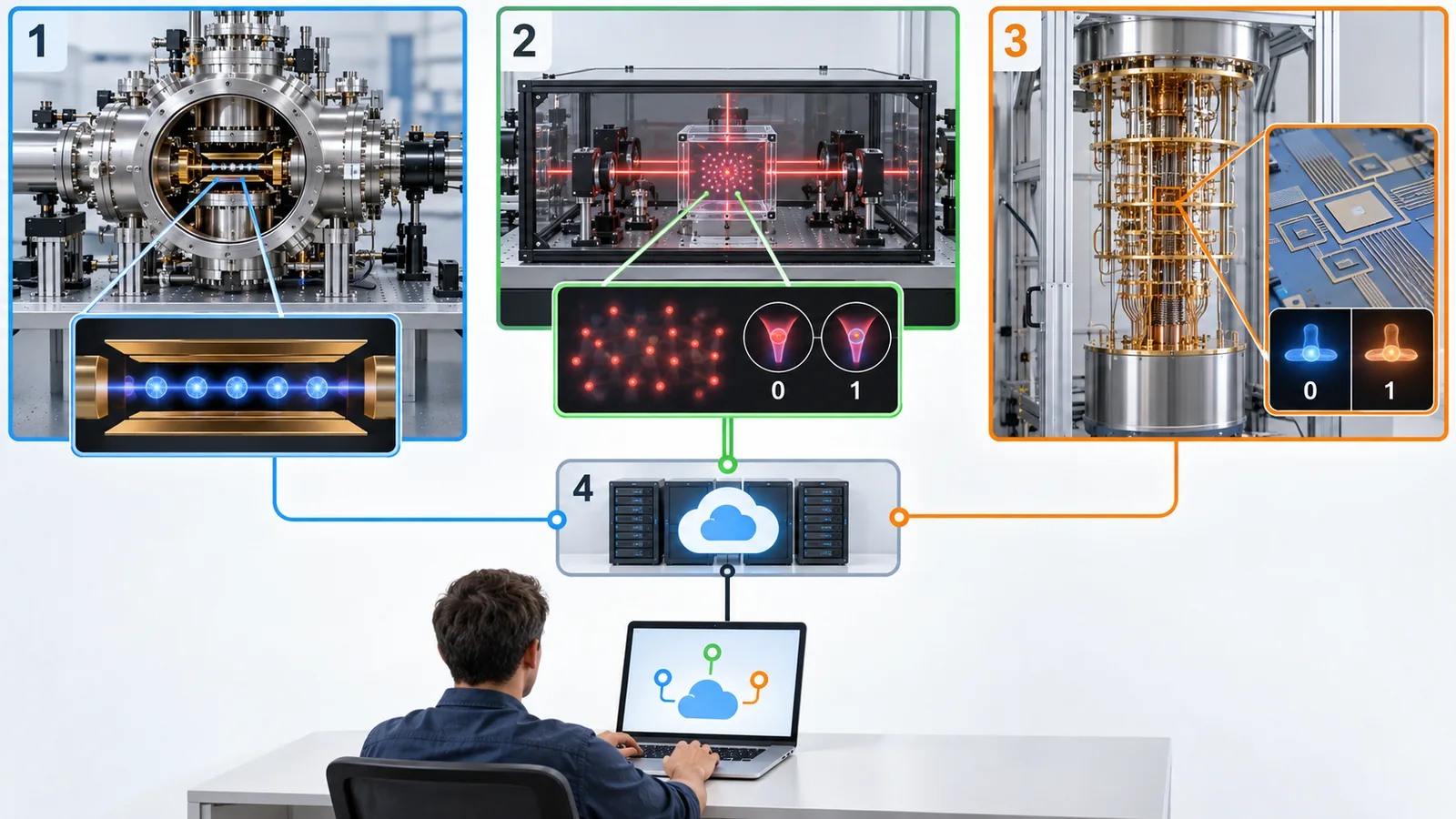
AWS's quantum offering has two parts: Braket (a window for using others' machines) and Ocelot (its own research). The first illustration shows how Braket works and the second shows how Ocelot is built.
In AWS's description, Ocelot is built from two silicon microchips of about 1 cm² each, bonded one on top of the other and electrically connected. On the surface of each chip sit thin layers of superconducting material that form the quantum circuit Sourced.
The heart of a cat qubit is an oscillator (a small circuit that vibrates at a set frequency). The oscillators are made from a thin film of tantalum, and AWS says its materials scientists developed "a specific way of processing tantalum on the silicon chip" to improve performance Sourced. From a materials standpoint, how long a qubit keeps its information (its lifetime) depends on losses in and on the surface of the film (defects, oxides and so on). The Nature paper reports that the oscillators that hold the data have an average energy-relaxation time of more than about 60 microseconds and a phase-coherence time of more than about 80 microseconds Sourced.
The chip is also said to be manufacturable "in a scalable fashion using processes borrowed from the microelectronics industry". But there is no statement that it has been mass-produced; at present it is a research prototype chip. How such films are made and how substrates lose energy are covered in our explainers on superconducting qubits and on the materials and manufacturing of quantum computers.
11. The risks this company carries
| Risk | Substance | Category |
|---|---|---|
| The size of the quantum business cannot be checked from outside | Revenue, spending and headcount are not disclosed, and nothing appears in the 10-K. Progress can be followed only through AWS's official blogs and What's New notices | Sourced |
| Braket depends on other companies' machines | Every machine on Braket is built by someone else. Additions, updates and the regions where each is offered depend on each company (AQT is in Stockholm and Rigetti in the western United States, for example) | Sourced |
| Ocelot is a prototype, and what was shown is a "logical memory" | The paper's result is a logical memory using a repetition code that corrects only phase flips. It does not demonstrate the logical gates needed for computation. The paper itself says the code has no "proper threshold" | Sourced |
| AWS's estimate (up to 90% less) is a pre-demonstration figure | That a resource of one-tenth of usual methods may suffice is AWS's estimate. It has not been confirmed on a large machine | Not yet confirmed |
| QuEra's Libra (2028) is a target of AWS and QuEra | Hundreds of logical qubits and about one million quantum operations are targets, and the first devices are stated to have "limited capacity". It depends on QuEra's technical success | Not yet confirmed |
| Joint research results are the firms' own numbers | The "about 80% reduction" and "about 89% success rate" in the JPMorganChase research were shown by the two firms' researchers themselves; no independent verification was found | Sourced |
12. Glossary
- Qubit
- The smallest unit of information in a quantum computer. It can be in a state of being 0 and 1 at once.
- Physical qubit / logical qubit
- A physical qubit is an actual qubit on the chip. A logical qubit is a sturdy "virtual" qubit built from many physical qubits through error correction.
- Cat qubit
- A qubit made from a superposition of two states of light (microwaves) in a resonator. It can be designed so that bit flips are unlikely.
- Repetition code
- The simplest error-correcting code: it stores the same information in several places and fixes mistakes by something like a majority vote.
- Bit flip / phase flip
- Two kinds of qubit error. A bit flip swaps 0 and 1; a phase flip shifts the sign of a superposition.
- QPU
- Quantum processing unit: a quantum chip with qubits laid out on it.
- Amazon Braket
- AWS's service for using quantum computers and simulators through the cloud.
- Analog (Analog Hamiltonian Simulation)
- A mode that does not combine quantum gates but runs the machine according to a set physical model and reads the result.
- Megaquop
- A scale of about one million (mega) quantum operations.
- Form 10-K / 10-Q
- The annual and quarterly reports that U.S. listed companies file with the SEC.
13. References
- Amazon.com, Inc. Form 10-K for the fiscal year ended 31 December 2025 (filed with the U.S. SEC on 6 February 2026). Net sales and operating income for the company and the AWS segment, headcount, headquarters. The words "quantum" and "Braket" do not appear. https://www.sec.gov/Archives/edgar/data/1018724/000101872426000004/amzn-20251231.htm
- Amazon.com, Inc. Form 10-Q for the quarterly period ended 30 June 2026 (filed with the U.S. SEC on 31 July 2026). The latest quarterly report contains no discussion of quantum computing that we could find. https://www.sec.gov/Archives/edgar/data/1018724/000101872426000026/amzn-20260630.htm
- AWS Amazon Braket – Get Started with Quantum Computing (AWS News Blog, 2 December 2019). Announcement of Braket and the AWS Center for Quantum Computing. https://aws.amazon.com/blogs/aws/amazon-braket-get-started-with-quantum-computing/
- AWS Introducing Amazon Braket, a service for exploring and evaluating quantum computing (What's New, 2 December 2019). Launched as a preview. https://aws.amazon.com/about-aws/whats-new/2019/12/introducing-amazon-braket/
- Amazon Amazon's new Ocelot chip brings us closer to building a practical quantum computer (Amazon news, February 2025). Overview and make-up of Ocelot, AWS's estimate, and its description as a prototype. https://www.aboutamazon.com/news/aws/quantum-computing-aws-ocelot-chip
- Putterman et al. (AWS Center for Quantum Computing) Hardware-efficient quantum error correction via concatenated bosonic qubits, Nature 638, 927–934 (published 26 February 2025). DOI 10.1038/s41586-025-08642-7. https://www.nature.com/articles/s41586-025-08642-7
- AWS Amazon Braket (product page). The approaches offered (superconducting, trapped ion, neutral atom) and research credits. Checked 16 October 2026. https://aws.amazon.com/braket/
- AWS Amazon Braket supported regions and devices (developer guide). The list of quantum computers available. Checked 16 October 2026. https://docs.aws.amazon.com/braket/latest/developerguide/braket-devices.html
- AWS Amazon Braket Quantum Computers (product page). Descriptions of each provider's approach. Checked 16 October 2026. https://aws.amazon.com/braket/quantum-computers/
- AWS Amazon Braket adds support for Rigetti's 108-qubit Cepheus QPU (What's New, 7 April 2026). https://aws.amazon.com/about-aws/whats-new/2026/04/amazon-braket-rigetti-cepheus
- AWS Amazon Braket adds a new quantum processor from Alpine Quantum Technologies (What's New, 20 November 2025). IBEX Q1 (12 qubits, trapped ion). https://aws.amazon.com/about-aws/whats-new/2025/11/amazon-braket-alpine-quantum-technologies/
- AWS Amazon Braket notebook instances now support CUDA-Q natively (What's New, 10 November 2025). https://aws.amazon.com/about-aws/whats-new/2025/11/amazon-braket-notebook-instances-cuda-q-natively
- AWS Amazon Braket now supports Qiskit 2.0 (What's New, 10 December 2025). https://aws.amazon.com/about-aws/whats-new/2025/12/amazon-braket-qiskit-2-0
- AWS Quantum Technologies Blog AWS Deepens Strategic Collaboration with QuEra to Bring Fault-Tolerant Quantum Computing to Amazon Braket (Eric Kessler, 15 June 2026). https://aws.amazon.com/blogs/quantum-computing/aws-deepens-strategic-collaboration-with-quera-to-bring-fault-tolerant-quantum-computing-to-amazon-braket/
- AWS Quantum Technologies Blog AWS and JPMorganChase collaborate to advance quantum computing R&D (5 August 2026). https://aws.amazon.com/blogs/quantum-computing/aws-and-jpmorganchase-collaborate-to-advance-quantum-computing-rd/
- QuEra Computing QuEra Expands $230 Million Financing Round (press release, 9 September 2025). A reference to its long-standing collaboration with AWS. https://www.quera.com/press-releases/quera-expands-230-million-financing-round-advancing-quantum-accelerated-supercomputing
- NVIDIA NVIDIA CUDA-Q (developer page). A statement that CUDA-Q is available on clouds such as Braket. Checked 16 October 2026. https://developer.nvidia.com/cuda-q
14. Claim-to-source audit
| Claim in the article | Category | Source |
|---|---|---|
| Net sales and operating income of Amazon and the AWS segment (2023 to 2025), about 1,576,000 employees, headquarters, listing | Sourced | Reference 1 https://www.sec.gov/Archives/edgar/data/1018724/000101872426000004/amzn-20251231.htm |
| AWS is about 18.0% of company net sales (128,725 / 716,924) | Our calculation | Our calculation (from the figures in Reference 1) |
| The words "quantum" and "Braket" do not appear in the 10-K or 10-Q | Sourced | This article's own text search / References 1 and 2 https://www.sec.gov/Archives/edgar/data/1018724/000101872426000004/amzn-20251231.htm https://www.sec.gov/Archives/edgar/data/1018724/000101872426000026/amzn-20260630.htm |
| Quantum revenue, R&D expense, capital spending and dedicated headcount are not disclosed | Not yet confirmed | None is disclosed, and this article makes no estimate |
| Announcement of Braket (2 December 2019, preview) and of the AWS Center for Quantum Computing next to Caltech | Sourced | References 3 and 4 https://aws.amazon.com/blogs/aws/amazon-braket-get-started-with-quantum-computing/ https://aws.amazon.com/about-aws/whats-new/2019/12/introducing-amazon-braket/ |
| Braket entered service in 2020; Aquila was offered jointly with QuEra in 2022 | Sourced | Reference 14 https://aws.amazon.com/blogs/quantum-computing/aws-deepens-strategic-collaboration-with-quera-to-bring-fault-tolerant-quantum-computing-to-amazon-braket/ |
| Ocelot's announcement, 14 components (5 cat qubits, 5 buffers, 4 detection qubits), two silicon chips, tantalum film, described as a "prototype" | Sourced | Reference 5 https://www.aboutamazon.com/news/aws/quantum-computing-aws-ocelot-chip |
| AWS's estimate that Ocelot can cut the cost of error correction by up to 90% (a pre-demonstration estimate) | Not yet confirmed | AWS's estimate / Reference 5 https://www.aboutamazon.com/news/aws/quantum-computing-aws-ocelot-chip |
| Nature paper: distance-5 repetition code, logical error per cycle 1.65(3)% and 1.75(2)%, phase flips only, no proper threshold, oscillator lifetimes | Sourced | Reference 6 https://www.nature.com/articles/s41586-025-08642-7 |
| Approaches offered on Braket (superconducting, trapped ion, neutral atom) and research credits | Sourced | Reference 7 https://aws.amazon.com/braket/ |
| List of devices Braket supports (AQT, IonQ, IQM, QuEra, Rigetti) and their regions | Sourced | References 8 and 9 https://docs.aws.amazon.com/braket/latest/developerguide/braket-devices.html https://aws.amazon.com/braket/quantum-computers/ |
| Cepheus-1-108Q (108 qubits, 7 April 2026) and AQT IBEX Q1 (12 qubits, 20 November 2025) | Sourced | References 10 and 11 https://aws.amazon.com/about-aws/whats-new/2026/04/amazon-braket-rigetti-cepheus https://aws.amazon.com/about-aws/whats-new/2025/11/amazon-braket-alpine-quantum-technologies/ |
| Braket's CUDA-Q support (10 November 2025), Qiskit 2.0 support (10 December 2025), and NVIDIA's CUDA-Q page statement | Sourced | References 12, 13 and 17 https://aws.amazon.com/about-aws/whats-new/2025/11/amazon-braket-notebook-instances-cuda-q-natively https://aws.amazon.com/about-aws/whats-new/2025/12/amazon-braket-qiskit-2-0 https://developer.nvidia.com/cuda-q |
| The expanded collaboration with QuEra and Libra (a target of 2028, hundreds of logical qubits, about one million operations, limited capacity at first) | Not yet confirmed | A target of AWS and QuEra / Reference 14 https://aws.amazon.com/blogs/quantum-computing/aws-deepens-strategic-collaboration-with-quera-to-bring-fault-tolerant-quantum-computing-to-amazon-braket/ |
| Joint research with JPMorganChase (5 August 2026) and the "about 80%" and "about 89%" figures | Sourced | The two firms' own figures / Reference 15 https://aws.amazon.com/blogs/quantum-computing/aws-and-jpmorganchase-collaborate-to-advance-quantum-computing-rd/ |
| QuEra's announcement mentions its collaboration with AWS (not a statement of investment) | Sourced | Reference 16 https://www.quera.com/press-releases/quera-expands-230-million-financing-round-advancing-quantum-accelerated-supercomputing |
| The division of quantum companies into four types | Our calculation | This article's own classification. Company names are examples from this series |
| No equity investment, acquisition, joint venture, disposal or public funding could be confirmed | Not yet confirmed | Not in the official material checked. This article does not assert that none exists |
| Ocelot's successor, any plan to offer Ocelot on Braket, and quantum business plans | Not yet confirmed | Not confirmed. This article makes no estimate |
| The reading that the revenue core for now is use of Braket, not the own chip | Inference | This article's interpretation / References 1, 3 and 5 https://www.sec.gov/Archives/edgar/data/1018724/000101872426000004/amzn-20251231.htm https://aws.amazon.com/blogs/aws/amazon-braket-get-started-with-quantum-computing/ https://www.aboutamazon.com/news/aws/quantum-computing-aws-ocelot-chip |
| The picture of early customers as co-development partners in finance and chemistry | Inference | This article's interpretation / References 14 and 15 https://aws.amazon.com/blogs/quantum-computing/aws-deepens-strategic-collaboration-with-quera-to-bring-fault-tolerant-quantum-computing-to-amazon-braket/ https://aws.amazon.com/blogs/quantum-computing/aws-and-jpmorganchase-collaborate-to-advance-quantum-computing-rd/ |
| The reading that the own chip is a seed of differentiation to be grown over the long term | Inference | This article's interpretation / Reference 5 https://www.aboutamazon.com/news/aws/quantum-computing-aws-ocelot-chip |
| The reading that AWS learns demand at the window while keeping a route to own what is inside later | Inference | This article's interpretation / References 3 and 5 https://aws.amazon.com/blogs/aws/amazon-braket-get-started-with-quantum-computing/ https://www.aboutamazon.com/news/aws/quantum-computing-aws-ocelot-chip |
Last updated 16 October 2026 / Troy Technical
All figures in this article rest on statutory filings that Amazon.com, Inc. made with the U.S. Securities and Exchange Commission, and on AWS's official material and a peer-reviewed paper. No research-firm estimates or press-based figures have been used. Passages marked "Inference" are this article's interpretation of primary sources, not statements made by the company. Device figures are the makers' stated values or AWS's statements and do not rank machines of different types. Checked 16 October 2026.