COMPANY PROFILE / QUANTUM COMPUTING
Atom Computing
- A U.S. company that arranges atoms with light, turns them into qubits, and sells machines built around "logical qubits"
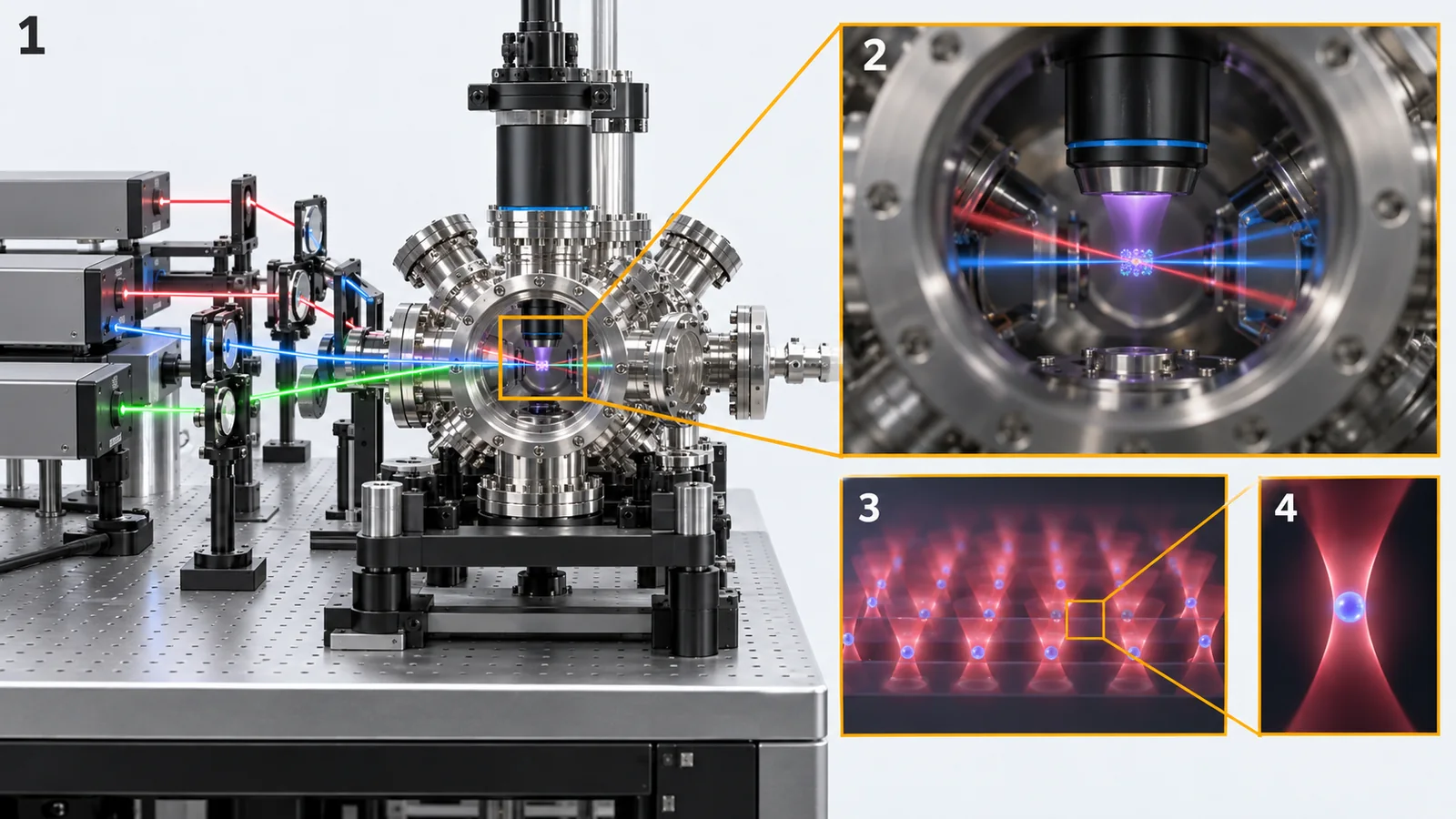
Atom Computing is a privately held U.S. company that catches individual atoms with laser light, arranges them in a grid, and uses them as the parts (qubits) of a quantum computer. The atom it uses is ytterbium-171, one kind of electrically neutral atom. In 2023 it built an array holding more than 1,000 qubit sites, and in 2024 it reported, together with Microsoft, an experiment that entangled 24 "logical qubits" (qubits made more robust against errors). In July 2025, QuNorth, a company funded by a Danish public fund and a Danish foundation, announced that it would buy a machine called Magne from Atom Computing and Microsoft. In October 2026 the company moved into the final stage (Stage C) of an evaluation program run by the U.S. Defense Advanced Research Projects Agency (DARPA). This profile sorts out what kind of company this is and where it is heading, using only company announcements, papers and DARPA's official page. Qubit counts and error rates are given with their method and measurement conditions, and phrases such as "world first" or "largest" are treated as the company's own claims. Information checked on 16 October 2026.
- Atom Computing at a glance, and where it sits in quantum computing
- Logo and naming
- Where the company sits in the quantum-computing landscape
- Company size (published information only, as a private company)
- Resources committed to quantum computing
- What the company has done so far
- Plans
- What the company is aiming for in quantum computing
- Partnership map for quantum computing
- Technology, products and services
- Risks the company faces
- Glossary / References / Claim-to-source audit
1. Atom Computing at a glance, and where it sits in quantum computing
ytterbium-171 atomsAtoms arranged with optical tweezers and operated with lasers (company description)
entangled (November 2024)24 logical qubits from 48 atoms, on a 256-atom processor (paper's value)
Stage CListed on DARPA's official page (as of 8 October 2026)
The "parts" of a quantum computer (qubits) can be built in several ways: superconducting circuits, trapped ions, light, and atoms, among others. Atom Computing uses identical atoms found in nature, as they are, as qubits. No one has to fabricate the qubits, and because atoms of one kind are all the same, the company says unit-to-unit variation is small Sourced. What the company is pushing hardest is not only more qubits but combining several physical qubits into a "logical qubit" that resists errors. In 2024 it published a paper with Microsoft and others reporting 24 logical qubits entangled from 48 atoms Sourced. What has not yet been shown is that this machine beats a classical computer on a practical calculation; the company itself treats that as a future goal. This profile keeps "what has been demonstrated in experiments" and "what is a future target" apart.
2. Logo and naming

A note on names: the company is Atom Computing (registered as Atom Computing, Inc.). AC1000 is its flagship quantum computer and Magne is the machine for Denmark described below (the buyer is QuNorth); neither is a company name. QuNorth is a separate company owned 50/50 by EIFO (Denmark's export and investment fund) and the Novo Nordisk Foundation. It is not a subsidiary of Atom Computing.
Official site: https://atom-computing.com/3. Where the company sits in the quantum-computing landscape
First, a word on "qubits" and "approaches". A qubit is the smallest unit that carries information in a quantum computer. An ordinary computer bit is either 0 or 1, but a qubit can be in a "superposition" of 0 and 1. The "approach" is simply what the qubit is made of.
4. Company size (published information only, as a private company)
Atom Computing is private and does not publish financial statements. The table lists what could be confirmed from the company website, press releases and SEC Form D filings Sourced.
| Item | What could be confirmed | Source |
|---|---|---|
| Founding | January 2018. First atom trapped in August 2019; first nuclear-spin qubits in an atom array in May 2020; the 100-qubit system "Phoenix" unveiled in July 2021 | Reference 18 https://atom-computing.com/about-us/ |
| Leadership | Dr. Ben Bloom (CEO and founder) and Dr. Jonathan King (chief scientist and co-founder). Rob Hays joined from outside as CEO in July 2021; the company announced Dr. Bloom's return as CEO in July 2024. Kevin Messerle became CFO on 31 August 2026 | References 18, 19, 20, 30 https://atom-computing.com/about-us/ https://atom-computing.com/atom-computing-appoints-kevin-messerle-as-chief-financial-officer/ https://atom-computing.com/atom-computing-unveils-first-generation-quantum-computing-system-appoints-new-ceo-after-closing-15-million-in-series-a-funding/ https://atom-computing.com/dr-ben-bloom-resuming-ceo-role/ |
| Sites | The website lists Berkeley, California. Press releases are mostly datelined Boulder, Colorado. European headquarters in Copenhagen, Denmark (announced June 2024) | References 17, 18 https://atom-computing.com/quantum-denmark/ https://atom-computing.com/about-us/ |
| Employees | No figure found on the website or in press releases | Could not be confirmed |
| Revenue and profit | Not disclosed (could not be confirmed) | Could not be confirmed |
| Valuation | Not stated in the June 2026 funding announcement | Reference 2 https://atom-computing.com/atom-computing-raises-more-than-300-million-to-accelerate-deployment-of-fault-tolerant-neutral-atom-quantum-computers/ |
For a private company, funding amounts are the figures in the company's own announcements. Because valuation, revenue and headcount are unknown, it is not possible to judge the company's size or financial stability from the outside. This profile does not use valuations or investment amounts that appear only in press reports.
5. Resources committed to quantum computing
The table shows whether four items (people, money, outside investments and acquisitions, and ties to universities and public bodies) could be confirmed.
| Type of resource | Details | Status |
|---|---|---|
| People | Headcount not disclosed. The November 2024 paper lists more than 70 authors from Atom Computing and Microsoft combined (a joint paper). A new CFO joined in August 2026 | Sourced (headcount not confirmed) |
| Money: funding rounds | Series A about US$16 million (July 2021, Form D); Series B US$60 million (January 2022, led by Third Point Ventures); Series C US$100 million (June 2026, led by Third Point Ventures with DCVC, Cisco Investments and others). The company states a total of "more than US$300 million" | Sourced |
| Money: public funding | A letter of intent (LOI) with the U.S. Department of Commerce for US$100 million (May 2026). The company calls the support "intended" and gives no terms or form of funding. Eligible for DARPA QBI Stage C (up to US$300 million possible, not a fixed amount) | Sourced (final agreement not confirmed) |
| Outside investments, acquisitions, joint ventures | No investment in, acquisition of, or joint venture with another company was found in company announcements. Microsoft, NVIDIA, Cisco, Nu Quantum and Phasecraft are linked through MOUs or joint development, with no capital relationship found (Cisco took part as an investor in Series C) | Not confirmed |
| Universities, research bodies, public funding | DARPA (US2QC; QBI Stages A to C), investment by Denmark's EIFO (2024), U.S. National Science Foundation grants (mentioned in the 2021 Series A release), and a study of power-grid optimization with the U.S. National Renewable Energy Laboratory (NREL) (July 2023, press release), and DARPA's US2QC program (January 2023) | Sourced |
Breakdown of funding: adding the individual published amounts (about US$16 million + US$60 million + US$100 million + US$100 million) gives about US$276 million; the breakdown of the gap to the company's "more than US$300 million" could not be confirmed Our calculation.
Here are the main machines and experiments, as far as company materials and papers allow (checked 16 October 2026). The numbers are the company's stated values or values reported in papers. Because the methods and measurement conditions differ, they are not lined up against other companies to rank them.
| Machine / experiment | Scale and content (approach: neutral atoms, ytterbium-171) | Stage | Date | Source |
|---|---|---|---|---|
| Phoenix (first generation) | A quantum computer holding 100 atoms in vacuum. The company describes a coherence time of more than 40 seconds (the company points to a 2022 Nature Communications paper; the paper itself was not checked here) | Operating (unveiled) | July 2021 | References 18, 20, 27 https://atom-computing.com/about-us/ https://atom-computing.com/atom-computing-unveils-first-generation-quantum-computing-system-appoints-new-ceo-after-closing-15-million-in-series-a-funding/ https://atom-computing.com/atom-computing-raises-60m-series-b-to-build-second-generation-quantum-computing-systems/ |
| Array with 1,225 sites | 1,180 atoms placed in 1,225 sites, a second-generation array. The company describes this as the first gate-based system to pass 1,000 | Experiment (array built) | October 2023 | Reference 10 https://atom-computing.com/quantum-startup-atom-computing-first-to-exceed-1000-qubits/ |
| Fault-tolerance experiments (256-atom processor) | 24 logical qubits entangled from 48 atoms, with an average of 1.8 lost atoms corrected. The Bernstein-Vazirani algorithm run on 28 logical qubits made from 112 atoms, reported with "better-than-physical error rates" (a paper co-authored with Microsoft and others) | Experiment (paper) | November 2024 (revised June 2025) | Reference 8 https://arxiv.org/abs/2411.11822 |
| Single- and two-qubit gates | Reported 99.963(2)% for single-qubit gates and 99.56(5)% for two-qubit gates on qubits in an optical-tweezer array (published in PRX Quantum). See the paper for the measurement method (not checked here) | Experiment (paper) | November 2024 (published May 2025) | References 21, 22 https://atom-computing.com/high-fidelity-gates-and-the-worlds-largest-entangled-logical-qubit-state/ https://doi.org/10.1103/PRXQuantum.6.020334 |
| Error correction with the toric code | Reported repeating the error-checking step (syndrome extraction) for up to 90 cycles, including reloading lost atoms. Two code sizes (distances) were compared over up to 8 cycles, and the larger one showed a lower logical error rate (preprint) | Experiment (preprint) | June 2026 | References 4, 5 https://atom-computing.com/atom-computing-reveals-quantum-error-correction-with-toric-code/ https://arxiv.org/abs/2606.04079 |
| AC1000 | More than 1,200 physical qubits; all-to-all connectivity (any two can be linked); single-qubit gate fidelity above 99.9%; two-qubit gate fidelity above 99.6%; state preparation and measurement (SPAM) above 99.8%; atom movement above 99.9% (all company's stated values; measurement conditions are not given on the product page). Footprint about 56 square meters | Available (sold for on-premises installation) | Checked 16 October 2026 | Reference 7 https://atom-computing.com/ac1000/ |
| Magne (for QuNorth) | Designed for about 50 logical qubits and more than 1,200 physical qubits. To be installed in Copenhagen. The building was completed in September 2026 and installation is the next step. Full operation is given as "early 2027" (QuNorth website) or "spring 2027" (Ramboll announcement), so sources differ | Before installation Not yet confirmed | Announced July 2025, updated September 2026 | References 6, 13, 14 https://atom-computing.com/eifo-and-the-novo-nordisk-foundation-acquire-the-worlds-most-powerful-quantum-computer/ https://thequantuminsider.com/2026/09/02/qunorth-clears-facility-milestone-for-magne-quantum-computer/ https://www.qunorth.dk/ |
Stages such as "before installation" or "plan" do not mean the outcome is certain. Magne's "about 50 logical qubits" is a design target, not a measured value after commissioning.
"1,200 qubits" means physical qubits (the number of atoms actually trapped). "24 logical qubits" means several atoms combined and treated as one error-resistant qubit. How many atoms one logical qubit needs depends heavily on the method. The illustration below divides figures from the company's paper and announcements as "number of atoms / number of logical qubits".
6. What the company has done so far
| When | What happened | Meaning |
|---|---|---|
| January 2018 to July 2021 | Company founded. First atom trapped in August 2019. The 100-qubit "Phoenix" unveiled in July 2021, the same month as a Series A of about US$16 million (Form D) | The first machine of the atom-array approach |
| January 2022 | Series B of US$60 million (the Form D shows about US$58.85 million sold) | Funding for a second-generation machine |
| January and October 2023 | Selected for DARPA's US2QC, the predecessor of QBI (January). 1,180 atoms placed in a 1,225-site array (October) | Showed it could scale the number sharply |
| June 2024 | Announced its European headquarters in Denmark; EIFO invested | The company describes it as the first U.S. quantum-computing company to place a European headquarters there |
| September to November 2024 | Announced joint development with Microsoft (September). Reported 24 logical qubits entangled and computation on 28 logical qubits (November) | Evidence of entering the "logical qubit" stage |
| April to November 2025 | Selected for DARPA QBI Stage A (April) and advanced to Stage B (November) | The stage at which the plan is evaluated |
| July 2025 | EIFO and the Novo Nordisk Foundation set up QuNorth (EUR 80 million in total) and announced the purchase of the Magne machine from Microsoft and Atom Computing | The company describes it as the first commercial sale of a logical-qubit machine |
| March 2026 | Integrated NVIDIA's NVQLink into its control system (16 March). Memorandum of understanding (MOU) with Cisco on quantum networking (25 March) | Faster control, and research on linking several machines |
| May to June 2026 | US$100 million letter of intent with the U.S. Department of Commerce (21 May). Toric-code error-correction experiment (3 June). MOU with Phasecraft (15 June). US$100 million Series C (16 June). MOU with Nu Quantum (17 June) | Funding, technology and partnerships landed within a short span |
| September 2026 | The Copenhagen building for Magne was completed (Ramboll announcement, 2 September) | Installation is the next step |
| October 2026 | Selected for DARPA QBI Stage C, the final stage (7 October). The CEO described the speed challenge and a roadmap to 2029 (6 October) | The final stage of a public evaluation program |
7. Plans
over 1,200 physicalA design target, not a measured value after commissioning
logical qubitsThe CEO's statement (6 October 2026): a company target to deliver a fault-tolerant quantum supercomputer by 2029
per generationCompany target (6 October 2026)
possibleDARPA's page says "up to US$300 million". The actual amount is not fixed
(letter of intent only)No final agreement found
nanosecondsA company development policy. Readout time is said to be cut "by orders of magnitude"
Nu QuantumBoth are at the memorandum (MOU) stage
The company describes these as "targets", "roadmaps" and "plans", and they are not accomplished facts Not yet confirmed. The timing for Magne is "early 2027" or "spring 2027" depending on the source, later than the "2026/27 new year" in the original July 2025 announcement. The reason for the shift is not given in the announcements and could not be confirmed.
None of the following could be confirmed from company materials, papers or official pages Not yet confirmed: the name and specifications of the successor to AC1000; the location and price of the 2029 machine; Magne's actual logical error rate once running; headcount, revenue and valuation; whether Microsoft holds equity in Atom Computing (joint development and software are documented, but no capital relationship was mentioned); and the terms of the final Commerce agreement. Phrases such as "world's most powerful" or "largest number of logical qubits" are claims by the company or its co-announcers, and this profile has not confirmed any independent comparison.
8. What the company is aiming for in quantum computing
This chapter includes points the company does not state directly. They are given as inferences, within what the primary sources support, together with the evidence.
| What can be read from the sources | Primary evidence | Status |
|---|---|---|
| The goal is a "utility-scale fault-tolerant quantum computer", and the way in is to sell logical-qubit machines first | The AC1000 page sells "everything you need to build your own logical qubits", Magne is designed for about 50 logical qubits, and the target for 2029 is over 1,000 logical qubits | Inference |
| The error-correction codes and software are shared with Microsoft | The QuNorth announcement says Microsoft supplies its own software and error-correction technology. The company's DARPA QBI notices say Microsoft provides "algorithmic support and error correction codes" | Sourced |
| It leans toward installing machines at customer sites (on-premises) rather than renting them over a cloud | AC1000 is described as installed and operated on-premises, and QuNorth is buying a machine. No cloud service of the company's own was found in the materials checked | Inference |
| The funding pillars are private venture money plus governments and public funds | Series C (led by Third Point Ventures), plus EIFO and the Novo Nordisk Foundation (via QuNorth), DARPA, and the Commerce letter of intent | Inference |
| It sees "speed", often cited as a weakness of the atom approach, as its own challenge | The CEO's post of 6 October 2026 calls speed the "remaining" challenge and describes four levers: gate time, readout, control systems and atom movement | Sourced |
The atom approach is easy to scale and lets any atom talk to any other, but each operation is said to take a long time. In his post of 6 October 2026, the CEO acknowledges the view that gate operations take microseconds rather than nanoseconds, says users care about "overall time-to-solution", and says he told a conference keynote that time-to-solution is now on par with superconducting machines Sourced. The post gives no measurements or comparison conditions behind the claim, and no independent check was found. From this we read that "Atom Computing sees bringing computation time closer to other approaches as its next battleground, alongside the number and quality of logical qubits". This is a reading that takes the company's claim as given; whether it has been achieved is something later papers and customer deployments will show Not yet confirmed.
9. Partnership map for quantum computing
10. Technology, products and services
| Layer | Main product | What official materials say |
|---|---|---|
| Qubit | Nuclear spin of ytterbium-171 atoms | Electrically neutral atoms are trapped with light, and the direction (spin) of the atomic nucleus is used as the qubit. The closed outer electron shell makes the qubit resistant to environmental disturbance, which the company says gives long coherence times |
| Machine | AC1000 | More than 1,200 physical qubits, all-to-all connectivity, mid-circuit measurement with reset and reuse, and real-time conditional branching. APIs (OpenQASM, QIR) and a 20-qubit emulator. Footprint about 56 square meters, said to fit in an ordinary office building |
| Software and control | In-house control system; Microsoft software | The control system is developed in-house, with NVIDIA's NVQLink among the options for speeding it up. Error correction uses Microsoft's codes |
| Service | On-premises installation and technical support | Installed at the customer's site with nearby technical support. A partner program offers early access |
Qubit = atom: in this approach nobody fabricates the qubit; natural atoms (ytterbium-171) are used. The company says neutral atoms are "intrinsically identical" Sourced. So instead of the thin films and junctions of superconducting devices, performance depends on the environment that holds the atoms (ultra-high vacuum) and the light aimed at exactly the right atoms (lasers and optical components).
Optics and vacuum: the "optical tweezers" that arrange atoms are made by focusing laser light finely. The company says it developed its own "optical display technology" that moves many atoms to arbitrary positions at once, which enables all-to-all connectivity and parallel operation Sourced. The loss and laser-damage resistance of lenses and coatings, and the choice of materials that release little gas into the vacuum, are not described in any detail in the materials checked here; they are areas that generally matter for this approach Not yet confirmed.
In-house components: the announcement of the May 2026 Commerce letter of intent lists "in-house development of critical components", "parallelized testbeds" and "enhanced collaboration with supply-chain partners" as uses of the funds Sourced. Which components, specifically, could not be confirmed from the materials checked.
11. Risks the company faces
| Risk | Details | Status |
|---|---|---|
| Slippage in Magne's timing | First tasks, originally given as the 2026/27 new year, are now given as early to spring 2027. No reason is stated | Sourced |
| Gap between logical-qubit counts and usefulness | The 24- and 28-logical-qubit experiments are at the stage of detecting errors with small codes, and no statement that they beat classical computers on a useful calculation was found. The company itself treats "utility scale" as a future goal | Sourced |
| The speed challenge | The atom approach is said to have slow gate operations, and the company calls speed a remaining challenge. The measurement conditions behind its claim of having closed the gap could not be confirmed | Sourced |
| Dependence on government funding and letters of intent | The Commerce US$100 million is at the letter-of-intent stage, and DARPA Stage C is "up to US$300 million" as a possibility. Terms and actual amounts could change | Not yet confirmed |
| Finances are not visible from outside | Revenue, headcount and valuation are not disclosed, so progress cannot be checked on the financial side | Sourced |
| Competition | Pasqal, Infleqtion, QuEra Computing and others also work on neutral atoms, and superconducting, ion and photonic approaches also aim for logical qubits. The company's claims of "first" or "only" are its own, and no ranking against others is made here | Sourced |
12. Glossary
- Qubit
- The smallest part of a quantum computer. It can be in a superposition of 0 and 1.
- Neutral atom
- An atom with no electric charge. It is trapped and arranged with laser light and used as a qubit.
- Optical tweezers
- Finely focused laser light that holds and moves atoms one at a time.
- Nuclear-spin qubit
- A qubit that uses the "direction" of the atomic nucleus as 0 and 1. It is little affected by the environment and is said to last a long time.
- Logical qubit
- Several physical qubits combined into one qubit that is more robust against errors.
- Quantum error correction (QEC)
- A way to find and fix qubit errors. It is essential for large-scale calculations.
- Fidelity
- The "accuracy" of an operation. At 99.5%, roughly 0.5% of operations go wrong, as a rule of thumb.
- Coherence time
- How long a qubit keeps its quantum properties.
- All-to-all connectivity
- Any two qubits can be linked directly. Here it is achieved by moving atoms.
- DARPA QBI
- A U.S. defense research agency program that evaluates whether a utility-scale quantum computer can be built by 2033, in three stages (A, B, C).
- Level 2
- A grouping used by Microsoft and others for machines that use logical qubits (Level 1 uses physical qubits and Level 3 is fault-tolerant).
- Form D
- A notice that a private U.S. company files with the SEC when it raises money in certain ways.
13. References
- Atom Computing "Atom Computing Selected by DARPA for Final Stage of Quantum Benchmarking Initiative" (7 October 2026). Stage C selection, Microsoft's support, possible funding of up to US$300 million. https://atom-computing.com/atom-computing-selected-by-darpa-for-final-stage-of-quantum-benchmarking-initiative/
- Atom Computing "Atom Computing Raises More Than $300 Million..." (16 June 2026). Series C of US$100 million, investors, use of funds, total of more than US$300 million. https://atom-computing.com/atom-computing-raises-more-than-300-million-to-accelerate-deployment-of-fault-tolerant-neutral-atom-quantum-computers/
- Atom Computing "Atom Computing Announces Letter of Intent with U.S. Department of Commerce for $100 Million..." (21 May 2026). The letter of intent and its uses. https://atom-computing.com/atom-computing-announces-letter-of-intent-with-u-s-department-of-commerce-for-100-million-to-accelerate-path-to-fault-tolerant-utility-scale-quantum-computing/
- Atom Computing "Atom Computing Reveals Quantum Error Correction with Toric Code" (3 June 2026). https://atom-computing.com/atom-computing-reveals-quantum-error-correction-with-toric-code/
- arXiv Atom Computing and Collaborators, "Quantum error correction with the toric code", arXiv:2606.04079 (submitted 2 June 2026). Up to 90 cycles; comparison of two distances. https://arxiv.org/abs/2606.04079
- Atom Computing "EIFO and the Novo Nordisk Foundation Acquire the World's Most Powerful Quantum Computer" (17 July 2025). QuNorth, Magne's design, funding amounts, the explanation of levels. https://atom-computing.com/eifo-and-the-novo-nordisk-foundation-acquire-the-worlds-most-powerful-quantum-computer/
- Atom Computing Product page "AC1000" (checked 16 October 2026). Specification table. https://atom-computing.com/ac1000/
- arXiv Reichardt et al., "Fault-tolerant quantum computation with a neutral atom processor", arXiv:2411.11822 (v3, June 2025). 24 and 28 logical qubits. https://arxiv.org/abs/2411.11822
- Atom Computing "Building Quantum Supercomputers with Microsoft" (10 September 2024). Announcement of the joint development. https://atom-computing.com/building-quantum-supercomputers-with-microsoft/
- Atom Computing "Quantum startup Atom Computing first to exceed 1,000 qubits" (24 October 2023). 1,225 sites, 1,180 atoms, 40 seconds. https://atom-computing.com/quantum-startup-atom-computing-first-to-exceed-1000-qubits/
- Atom Computing "Atom Computing selected by DARPA to explore near-term utility-scale quantum computing with neutral atoms" (3 April 2025). Stage A. https://atom-computing.com/atom-computing-selected-by-darpa-to-explore-near-term-utility-scale-quantum-computing-with-neutral-atoms/
- Atom Computing "Atom Computing selected by DARPA for the next stage..." (7 November 2025). Stage B. https://atom-computing.com/atom-computing-selected-by-darpa-for-the-next-stage-of-exploring-near-term-utility-scale-quantum-computing-with-neutral-atoms/
- The Quantum Insider "QuNorth Clears Facility Milestone for MAGNE Quantum Computer" (2 September 2026; reprints the Ramboll announcement). Building completed; full operation in spring 2027. https://thequantuminsider.com/2026/09/02/qunorth-clears-facility-milestone-for-magne-quantum-computer/
- QuNorth Official website. Magne to be fully operational in early 2027; about 50 logical and over 1,200 physical qubits (checked 16 October 2026). https://www.qunorth.dk/
- DARPA Quantum Benchmarking Initiative (QBI) official page (as of 8 October 2026). Description of the stages; listed among Stage C performers. https://www.darpa.mil/research/programs/quantum-benchmarking-initiative
- Atom Computing "Atom Computing Integrates NVIDIA NVQLink..." (16 March 2026). https://atom-computing.com/atom-computing-integrates-nvidia-nvqlink-to-accelerate-scaling-of-its-quantum-computers/
- Atom Computing "Empowering Innovation: Expanding to Denmark for Quantum Advancement" (June 2024). European headquarters. https://atom-computing.com/quantum-denmark/
- Atom Computing About page. Founded January 2018; timeline; leadership. https://atom-computing.com/about-us/
- Atom Computing "Atom Computing Appoints Kevin Messerle as Chief Financial Officer" (31 August 2026). https://atom-computing.com/atom-computing-appoints-kevin-messerle-as-chief-financial-officer/
- Atom Computing "Atom Computing Unveils First-Generation Quantum Computing System... Series A" (21 July 2021). Phoenix, Series A, Rob Hays's appointment, NSF grants. https://atom-computing.com/atom-computing-unveils-first-generation-quantum-computing-system-appoints-new-ceo-after-closing-15-million-in-series-a-funding/
- Atom Computing Tech Perspectives "Demonstrating high-fidelity gates and the world's largest entangled logical qubit state..." (19 November 2024). Announcement of the gate fidelities. https://atom-computing.com/high-fidelity-gates-and-the-worlds-largest-entangled-logical-qubit-state/
- APS (PRX Quantum) "High-Fidelity Universal Gates in the 171Yb Ground-State Nuclear-Spin Qubit", PRX Quantum 6, 020334 (May 2025). The DOI was checked through the Crossref API. https://doi.org/10.1103/PRXQuantum.6.020334
- Atom Computing "Atom Computing and Cisco... Strategic Collaboration" (25 March 2026). MOU. https://atom-computing.com/atom-computing-announces-strategic-collaboration-with-cisco-to-advance-scalable-networked-and-distributed-quantum-computing/
- Atom Computing "Atom Computing and Nu Quantum Partner..." (17 June 2026). MoU. https://atom-computing.com/atom-computing-and-nu-quantum-partner-to-unlock-utility-scale-quantum-computing/
- Atom Computing "Atom Computing and Phasecraft Announce Strategic Collaboration..." (15 June 2026). MOU. https://atom-computing.com/atom-computing-and-phasecraft-announce-strategic-collaboration-to-accelerate-development-of-next-generation-materials/
- Atom Computing Tech Perspectives "Closing the Speed Gap" (6 October 2026, Ben Bloom). The speed challenge and the roadmap to 2029. https://atom-computing.com/closing-the-speed-gap/
- Atom Computing "Atom Computing Raises $60M Series B..." (20 January 2022). Series B. https://atom-computing.com/atom-computing-raises-60m-series-b-to-build-second-generation-quantum-computing-systems/
- U.S. SEC Atom Computing Inc. Form D (filed 20 July 2021). Amount offered and sold. https://www.sec.gov/Archives/edgar/data/1798861/000179886121000001/xslFormDX01/primary_doc.xml
- U.S. SEC Atom Computing Inc. Form D (filed 13 January 2022). Amount offered and sold. https://www.sec.gov/Archives/edgar/data/1798861/000179886122000001/xslFormDX01/primary_doc.xml
- Atom Computing "Dr. Ben Bloom resuming CEO role" (2 July 2024). https://atom-computing.com/dr-ben-bloom-resuming-ceo-role/
- Atom Computing "Atom Computing and National Renewable Energy Laboratory exploring electric grid optimizations using quantum computing" (20 July 2023). https://atom-computing.com/atom-computing-and-national-renewable-energy-laboratory-exploring-electric-grid-optimizations-using-quantum-computing/
- Atom Computing "Atom Computing selected by DARPA to accelerate scalable quantum computing with atomic arrays of neutral atoms" (31 January 2023). US2QC. https://atom-computing.com/atom-computing-selected-by-darpa-to-accelerate-scalable-quantum-computing-with-atomic-arrays-of-neutral-atoms/
14. Claim-to-source audit
Last updated: 16 October 2026 / Troy Technical
The figures in this profile are based on Atom Computing's official announcements, papers (arXiv and PRX Quantum), DARPA's official page, announcements by QuNorth and Ramboll, and SEC Form D filings. No market-research estimates or press-only figures are used. Passages marked "Inference" are our reading of the primary sources, not statements by the company. Performance figures are the company's stated values or values reported in papers, and they are not lined up against other companies' figures that use different methods or conditions.