COMPANY PROFILE / QUANTUM COMPUTING
Diraq
An Australian company turning silicon transistors into qubits, in the same fabs that make PC chips
Quantum computers are often assumed to need special circuits and exotic equipment. Diraq takes the opposite view. It uses the equipment and processes of the semiconductor factories that make smartphone and PC chips, and treats the direction of a single electron, trapped in a tiny piece of silicon, as a qubit (the basic unit of quantum computation). On 7 October 2026 it was named by the U.S. Defense Advanced Research Projects Agency (DARPA) as one of the companies moving to Stage C, the final stage of DARPA’s evaluation program. Yet the largest chip it has shown working has only eight qubits, a long way from its targets of hundreds of thousands to millions. This profile explains what it builds, who it works with and what it is aiming for, using only primary sources we could check, and in terms a reader new to quantum computing can follow.
- Diraq in 30 seconds, and where it stands in quantum computing
- The logo and how the name is written
- Where the company sits in quantum computing
- Scale
- Resources committed to quantum computing
- What it has done so far
- What comes next
- What the company is aiming for in quantum computing
- Map of quantum computing partnerships
- Technologies, products and services
- Risks this company carries
- Glossary, references and claim-to-source audit
1. Diraq in 30 seconds, and where it stands in quantum computing
Palo Alto, U.S.Australian head office has manufacturing and cryogenic test facilities; U.S. head office in Palo Alto
& otherQubits made from the spin of electrons in silicon
in a silicon transistorMade with standard semiconductor (CMOS) processes
1,000 logical qubits (2029)A company target, not an achievement
Quantum computing companies differ mainly in what they use to make a qubit. Diraq chose silicon: the same material as the CPUs in PCs, which factories around the world already machine with extreme precision. Diraq’s main claim is that its qubits can be made as they are in existing semiconductor fabs Sourced. The current gap is quantity, by orders of magnitude. The largest array disclosed is eight qubits, and the company’s 2029 target of 150,000 physical qubits is about 19,000 times larger Our calculation (150,000 / 8 = 18,750).
Qubit (quantum bit): the basic unit of a quantum computer, which uses a superposition of 0 and 1. In Diraq’s design, a qubit is the “spin” of one electron trapped in silicon (a compass-needle-like orientation, up or down), with up and down standing for 0 and 1.
Physical and logical qubits: a physical qubit is one piece of hardware and is sensitive to noise; a logical qubit bundles many physical qubits so that errors can be found and fixed. When you read a number, always check which one it counts.
Fidelity: how accurate an operation is, as a percentage. At 99%, about one operation in a hundred goes wrong. What was measured (a single-qubit operation, a two-qubit operation or readout) changes the meaning, so this article always states the conditions. For more, see our explainer on coherence and fidelity.
2. The logo and how the name is written

A note on names: the company is Diraq (written in lower case, “diraq”, in its logo). The primary sources we checked do not explain where the name comes from, and we could not confirm the company’s full registered legal name.
Official site: https://diraq.com/ (the logo was taken from the image used in the site header)3. Where the company sits in quantum computing
Quantum computing companies have different strengths and challenges depending on what they use to make a qubit. The figure below sorts the companies in this series into four types. Diraq falls in the third type, “photonic, silicon and other approaches”, as a silicon company.
Here is each type in a sentence or two.
| Type | What the qubit is | Strength | Difficulty |
|---|---|---|---|
| Superconducting | An electrical circuit cooled to extremely low temperature | Circuits can be made with semiconductor-style processes | Needs refrigerators and a great deal of wiring |
| Trapped ions and neutral atoms | Atoms held in place with electric fields or light | Each one is identical, so precision is high | Increasing the number, and operating speed |
| Photonic, silicon and other | A particle of light (photon), the spin of an electron in silicon, and so on | May be made in semiconductor factories; photons can be linked by optical fiber | The approach is still unproven |
| Software, cloud and ecosystem | No qubits of its own | Supports the whole field through cloud, software and communications | No hardware advantage of its own |
4. Scale
Diraq is private and there are no official filings of revenue or profit. These are the figures on the company’s own website (company statements) Sourced.
| Item | Detail (company statements) |
|---|---|
| Incorporation | Incorporated on 6 May 2022 (a company blog post of 6 May 2026 says “exactly four years”) |
| Employees | More than 130 (company overview on the website, checked 16 October 2026). A blog post of May 2026 says the R&D team exceeds 100, including more than 60 quantum physicists |
| Locations | Australia: Sydney (head office, manufacturing and cryogenic test facilities) and Melbourne (technology hub). United States: Palo Alto (U.S. head office), Los Angeles (cryogenic test facility), Chicago (technology hub). A laboratory in Albuquerque, New Mexico, is planned |
| Patents and papers | More than 60 patents; more than 200 papers (more than 40 in Nature and Science journals) |
| Total funding raised | The website’s company overview says more than $140 million; a May 2026 blog post says more than $100 million. The currency and the breakdown are not stated, and we could not confirm them |
| Revenue and profit | Not disclosed |
All of these figures are the company’s own statements, not audited statements or filings with a regulator. A full-text search of the U.S. SEC’s EDGAR system found no filings by Diraq (such as Form D) within the scope of our check Not yet confirmed. The funding total is described as “more than $100 million” at one time and “more than $140 million” at another, and the currency is not stated, so we cannot tell what makes up the difference. Revenue is not disclosed, and this article does not estimate it.
5. Resources committed to quantum computing
| Type of resource | Detail | Status |
|---|---|---|
| People | More than 130 employees, including a R&D team with more than 60 quantum physicists. The founder and CEO, Andrew Dzurak, is a quantum physicist who researched at UNSW for decades. The chairman is Scott McGregor, a former CEO of Broadcom | Sourced (company statement) |
| Money | Total raised as above (currency and breakdown not disclosed). In February 2026 Australia’s National Reconstruction Fund Corporation (NRFC) announced an equity investment of “$20 million” (the release gives no currency). In May 2026 Diraq said it had signed a letter of intent (LOI) with the U.S. Department of Commerce for up to $38 million of proposed support (not a final award). On reaching DARPA QBI Stage C, the company says an initial US$51 million tranche will fund the next year | Sourced (company statement) |
| Outside investments, acquisitions, joint ventures | No investments in, acquisitions of or joint ventures with other companies appear in the materials we checked. Named investors include ICM, Quantonation and Australian pension funds (Hostplus, NGS Super, UniSuper) (company statement) | Not found |
| Universities, research institutions, public funding | UNSW (the origin of the founder’s research; a joint research fellowship) / imec (the Belgian semiconductor research institute, which makes the devices on its 300 mm CMOS-compatible line) / DARPA QBI / the U.S. Department of Commerce CHIPS R&D Office (LOI) / NRFC (equity) / the State of New Mexico (a memorandum of understanding to locate in the Roadrunner Quantum Lab) / Australian government grants (CTCP, ARC) | Sourced (company statement) |
| Investment in manufacturing | The policy is to use external semiconductor foundries (imec, GlobalFoundries) rather than its own fab. The Sydney head office has manufacturing and cryogenic test facilities (company statement). U.S. production capacity is planned under the LOI | Sourced (company statement) |
Status of the main devices and products
| Name | Approach and scale | Typical performance or content (papers and company releases) | Stage | Date and source |
|---|---|---|---|---|
| Two-qubit devices (four) | Silicon MOS spin qubits (physical), made in imec’s 300 mm foundry | Single- and two-qubit control fidelities above 99% for all four devices; state preparation and measurement fidelity up to 99.9% (evaluated by gate set tomography); T1 up to 9.5 s, T2* of 40.6 microseconds, T2 (Hahn) of 1.9 ms | Experimental demonstration | Nature paper, 24 September 2025 |
| Operation above 1 K | Silicon spin qubits (physical) | Operated above 1 kelvin. Single-qubit Clifford gate fidelity up to 99.85%, two-qubit gate fidelity 98.92%, initialization and readout up to 99.34% | Experimental demonstration | Nature paper, March 2024 |
| Eight-qubit array | Eight silicon MOS spin qubits in a linear array (physical), made on imec’s 300 mm line | Coherent operation and readout of all eight confirmed, with no loss of coherence according to the release (numerical values not checked in the release) | Experimental demonstration | 13 July 2026 (announced with a Nature Communications paper) |
| Quantum computer in an Equinix data center | An 8-qubit chip; cooling and control electronics self-contained; under 20 kW (company statement) | Installation at an Equinix data center in Sydney is due to be completed in October 2026, and operation is planned within 2026 | In development (installation under way) | Announcement of 1 September 2026 |
| Next-generation systems | Silicon; 150,000 physical and up to 1,000 logical qubits (2029); more than 2 million physical and more than 10,000 logical qubits (2031) | Company targets. The company also says its first product, in 2029, will be a quantum computer capable of genuine quantum advantage | Not yet confirmed | White paper of 27 August 2026 and release of 3 February 2026. No achievement as of 16 October 2026 |
What decides how good a silicon qubit is, is how quiet the place where the electron sits is. Natural silicon contains a small amount of an isotope (silicon-29) that has a nuclear spin (a tiny magnet in the nucleus), and it disturbs the electron’s spin and causes errors. The 2025 Nature paper states that residual nuclear-spin-carrying isotopes contribute substantially to operational errors, and that further isotopic purification is a clear pathway to higher performance Sourced. The other factor is disorder at the interface between silicon and the oxide (insulating) layer, which causes charge noise and so errors. Diraq’s strength is in showing that these can be reproduced with standard semiconductor processes (300 mm wafers, existing transistor machining). The 2025 Nature paper reports fidelities above 99% in all four devices and answers the question of whether performance seen in academic labs carries over to a foundry Sourced. Seen through materials, the contest is whether material purity (isotopes) and interface quality can be kept uniform at factory yields.
6. What it has done so far
| When | Event | Meaning |
|---|---|---|
| 6 May 2022 | Diraq incorporated (company statement) | Commercialization of UNSW research |
| March 2024 | Nature paper on spin qubit operation above 1 kelvin | Showed a way to ease the burden on refrigerators |
| April 2025 | Selected for DARPA QBI Stage A (company statement) | Entry to a U.S. government evaluation framework |
| 24 September 2025 | Nature paper on two-qubit devices made in imec’s 300 mm foundry | Experimental support that qubits made in a factory can reach high fidelity |
| 6 November 2025 | Selected for QBI Stage B, one of the Stage A teams (17 were selected) to move on (company statement) | The stage that reviews plans for utility scale |
| 3 February 2026 | NRFC announced an equity investment of “$20 million” | Investment from an Australian public fund |
| 18 March 2026 | Described its use of NVIDIA’s NVQLink at NVIDIA’s GTC 2026 conference | Support for the technology that links quantum hardware and GPUs |
| 21 May 2026 | Announced a letter of intent with the U.S. Department of Commerce CHIPS R&D Office for up to $38 million | An LOI, not a final award |
| 13 July 2026 | Announced, with imec, the operation of an eight-qubit array | A step from two-qubit devices to larger arrays |
| 27 August 2026 | Published the white paper “The Case for Silicon” | States the targets for 2029 and 2031 |
| 1 September 2026 | Announced a plan to install a machine at an Equinix data center in Sydney | Aims to run inside a commercial data center |
| 30 September 2026 | Announced a memorandum of understanding for an R&D laboratory in New Mexico | Expansion of its U.S. base |
| 7 and 8 October 2026 | DARPA announced the companies moving to Stage C (7th). Diraq issued its own release (8th) | The stage in which the government’s verification team evaluates design and performance for utility scale |
7. What comes next
Equinix (Sydney)The company's plan (installation due in October)
up to 1,000 logical qubitsA company target (white paper)
more than 10,000 logicalA company target; the claimed arrival of utility scale
All of these are company targets and plans, not achievements Not yet confirmed. The roadmap on the company’s website describes a first phase (2022-2025, 10 qubits), a second phase (2025-2029, 1,000 or more) and a third phase (2029 onward, 1 million or more), which is worded differently from the numbers in the white paper and the October 2026 release (lower bounds of each phase versus specific targets).
None of the following appears in the primary sources we checked Not yet confirmed.
The price, delivery date and customers for its own quantum computers / specific performance numbers for arrays larger than eight qubits / whether the LOI will lead to a final award / the full legal name / revenue and profit / the currency and breakdown of funding raised. The white paper’s “under $1 per qubit” is a company target, not a measured value.
8. What the company is aiming for in quantum computing
This section includes points the company does not state directly. They are inferences from what the primary sources show, given with their basis.
| What we read from the sources | Primary-source basis | Type |
|---|---|---|
| The goal is a quantum computer that fits in one rack in a data center | The website says the processing unit is the size of one server rack and compatible with standard data centers; an 8-qubit machine is planned for an Equinix data center | Sourced (company statement) |
| The decisive ground is manufacturing cost and volume, more than raw performance | Chairman McGregor says winners will be decided by manufacturing economics, and the website sets a target of under $1 per qubit | Inference |
| It will keep dividing labor with external foundries rather than build its own fab | Partnerships with imec and GlobalFoundries are central, and we found no plan to build its own volume fab (U.S. production is at LOI stage) | Inference |
| It aims to achieve error correction with external code design (Iceberg Quantum) using fewer physical qubits | The release of 14 September 2026 describes fitting Iceberg Quantum’s “Pinnacle” design, which uses qLDPC codes, onto Diraq’s hardware (1,000 logical qubits from 150,000 physical) | Sourced (company statement) |
| Reaching the targets requires growth by orders of magnitude | The largest disclosed array is eight qubits; the 2029 target is 150,000 physical qubits | Inference |
The white paper’s targets are 150,000 physical and up to 1,000 logical qubits in 2029, and more than 2 million physical and more than 10,000 logical qubits in 2031. Dividing gives about 150 physical qubits per logical qubit in 2029 (150,000 / 1,000) and about 200 in 2031 (2,000,000 / 10,000) Our calculation. In other words, the company expects the overhead for error correction to be 150- to 200-fold. This ratio rests on Iceberg Quantum’s code design, which the company says needs fewer physical qubits than the standard approach, the surface code Sourced. We could not confirm, however, that this code design has been run on real Diraq hardware. Demonstrating error correction on real hardware is still ahead Not yet confirmed.
9. Map of quantum computing partnerships
The figure below shows only relationships stated on the website and in press releases, with lines colored by type.
10. Technologies, products and services
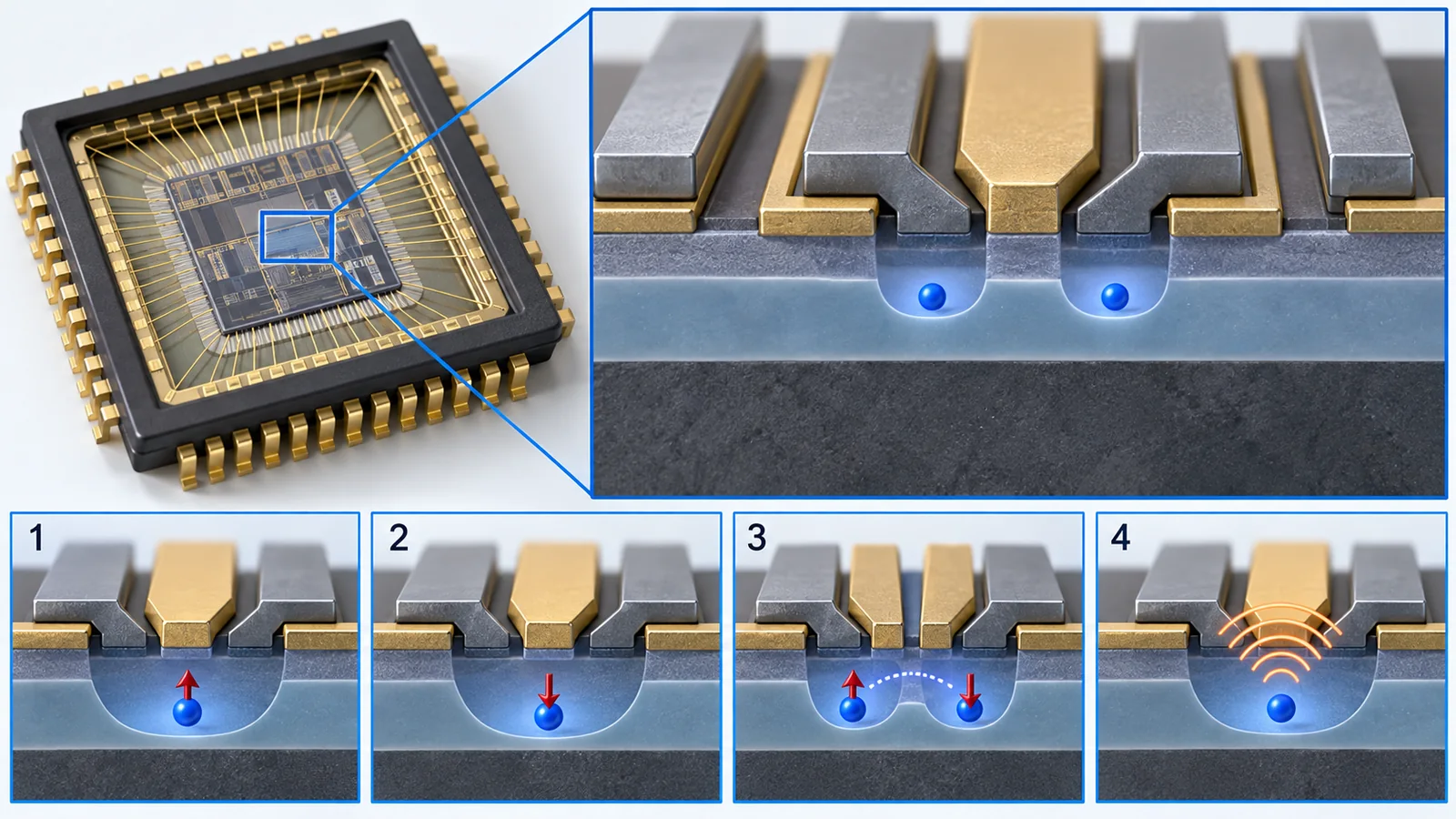
Diraq’s technology begins with modifying a transistor so that it traps a single electron. The next figure splits the flow into three steps.
What does it mean to make a qubit from silicon?
- Trap a single electron: a transistor is a part that switches an electric current on and off. Diraq applies that structure to trap exactly one electron in silicon (called a quantum dot).
- Make the electron’s direction (spin) the qubit: an electron behaves like a tiny magnet that points “up” or “down”. Up and down correspond to 0 and 1, and a superposition of the two is used for computation. Spin is relatively insensitive to electrical noise, which is said to help the state last longer.
- Mass-produce it in a semiconductor factory: the devices are made on the same 300 mm wafer processes as PC chips, so many qubits can be placed on one chip, the company says (made at imec’s fab).
- Cool it to operate: qubits run at very low temperature. The company describes putting control circuits (CMOS) that also work at cryogenic temperature next to the quantum chip, with room-temperature electronics connected outside. A paper has also shown operation above 1 kelvin.
Cooling and cabling are heavy burdens for a quantum computer. Diraq points toward making the control electronics themselves a CMOS chip that works at cryogenic temperature and sits next to the quantum chip Sourced. In the announcement of the Commerce LOI, GlobalFoundries describes cryo-CMOS capabilities for quantum as its own. The fact that the factory making the qubits and the factory making the control circuits belong to the same semiconductor industry is the foundation of Diraq’s case. The same announcement describes a plan for an end-to-end U.S. supply chain covering chips, cryostats and packaging, which is a future plan. Seen through materials and process, the remaining challenges are keeping qubit-to-qubit variation small over large areas and wiring density at cryogenic temperature Not yet confirmed.
Linking quantum with AI and supercomputers
Diraq works with Dell and NVIDIA on running a quantum chip and classical computers (GPUs and so on) close together. Dell is described as having placed a small HPC cluster in Diraq’s Sydney laboratory so that it can run next to a quantum processor. NVIDIA’s NVQLink is a link technology that lowers communication delay between quantum hardware and GPUs; Diraq says it uses it to achieve round trips to a GPU of about 3.3 microseconds, and to automate qubit calibration with AI models (NVIDIA Ising) (company statements) Sourced.
The facts: DARPA’s Quantum Benchmarking Initiative (QBI) tests whether a utility-scale quantum computer, one whose computational value exceeds its cost, can be built by 2033. Stage A is a concept description (up to US$1 million), Stage B an evaluation of the research and development plan (up to US$15 million), and Stage C a check with a government team that the machine can be built as designed and operated as intended (up to US$300 million). On 7 October 2026 DARPA announced that Diraq, Atom Computing, IBM and IonQ had moved to Stage C (Microsoft and PsiQuantum had moved to Stage C from US2QC, the pilot program that preceded QBI) Sourced.
What to keep in mind: DARPA states that QBI is not a competition and not meant to pick winners. Reaching Stage C means being a subject of detailed verification, not a ranking of technologies or a guarantee of success. The Stage C funding is a ceiling of up to US$300 million, and Diraq’s release says US$51 million for the first year (company statement). Read it as the official page states it, without ranking the companies.
11. Risks this company carries
| Risk | Detail | Type |
|---|---|---|
| A gap in scale | The largest array running is eight qubits. The 2029 target is 150,000 physical qubits, about 19,000 times more | Sourced / Our calculation |
| Error correction not yet shown on hardware | Two-qubit devices above 99% fidelity are reported, but we could not confirm a result showing error correction (logical qubits) on real hardware | Not yet confirmed |
| Finances not visible | Not disclosed. Funding is “more than $100 million” at one time and “more than $140 million” at another, with no currency. It is hard to judge the funding runway from outside | Sourced |
| Reliance on outside foundries | Qubits are made by imec and GlobalFoundries, so their processes and capacity may constrain Diraq’s plans | Inference |
| Conditions and timing of public support | The Commerce support is at LOI stage and we could not confirm a final award. DARPA Stage C is verification, not a guarantee of results | Sourced |
| Competition among approaches | Superconducting, ion, neutral-atom, photonic and other approaches are also advancing. Which will reach utility scale first is not settled | Inference |
| Range of target wording | The roadmap page (lower bounds of each phase, millions, tens of millions) and the white paper (150,000, more than 2 million) are worded differently, so definitions must be checked when comparing | Sourced |
| Character of company claims | Phrases such as “decisive advantage” and “most economical” are company claims, and this article does not rank companies against each other | Sourced |
12. Glossary
- Qubit
- The basic unit of quantum computation. It uses a superposition of 0 and 1.
- Physical / logical qubit
- A physical qubit is one piece of hardware and is sensitive to noise. A logical qubit bundles many physical qubits so that errors can be corrected.
- Spin
- A property of an electron like a tiny magnet. Up or down stands for 0 or 1.
- Silicon spin qubit
- A qubit made from the spin of a single electron trapped in silicon.
- Quantum dot
- A very small region that can trap a single electron.
- CMOS
- The standard semiconductor manufacturing approach used for PC and smartphone chips.
- MOS
- The basic metal-oxide-semiconductor layered structure of a transistor.
- Fidelity
- How accurate an operation is, as a percentage. Check what was measured.
- Gate set tomography
- A method for measuring the errors in a qubit’s operations in detail.
- T1 / T2 / T2*
- Times that express how long a qubit’s state lasts (relaxation and coherence times).
- Isotopic purification
- Removing isotopes that carry nuclear spin to make a quieter material.
- qLDPC code
- A family of error-correcting codes that may correct errors with little redundancy.
- Utility scale
- The level at which a quantum computer’s computational value exceeds the cost of building and running it (DARPA’s definition).
- DARPA QBI
- The Quantum Benchmarking Initiative of the U.S. Defense Advanced Research Projects Agency, which tests whether utility-scale quantum computers are feasible.
- LOI (letter of intent)
- A document stating intent before a formal contract. It does not mean a final award.
13. References
- Diraq Website, “Technology” page. Description of the approach, roadmap (phases) and company claims (under $1 per qubit, one rack, and so on). https://diraq.com/technology
- Diraq Website, “About” page. Locations, headcount, funding raised, patent and paper counts, partners, leadership and board, mention of DARPA QBI participation (checked 16 October 2026). https://diraq.com/about
- Defense Advanced Research Projects Agency (DARPA) Quantum Benchmarking Initiative (QBI) public page. Content and funding ceiling of each stage, and the list of participants (current as of 8 October 2026). https://www.darpa.mil/research/programs/quantum-benchmarking-initiative
- Defense Advanced Research Projects Agency (DARPA) News item “Four more teams enter Quantum Benchmarking Initiative’s final stage” (7 October 2026). The companies moving to Stage C. https://www.darpa.mil/news/2026/four-more-teams-enter-quantum-benchmarking-initiative-final-stage
- Diraq Press release “Diraq Advances to Final Stage of DARPA’s Quantum Benchmarking Initiative” (8 October 2026). Stage C, the initial US$51 million for the first year, targets for 2029 and 2031. https://diraq.com/newsdesk/diraq-advances-to-final-stage-of-darpas-quantum-benchmarking-initiativenbsp
- Steinacker et al. (Diraq, imec) “Industry-compatible silicon spin-qubit unit cells exceeding 99% fidelity”, Nature 646, 81-87 (24 September 2025). https://doi.org/10.1038/s41586-025-09531-9
- Huang et al. (Diraq, UNSW) “High-fidelity spin qubit operation and algorithmic initialization above 1 K”, Nature 627, 772-777 (27 March 2024). https://doi.org/10.1038/s41586-024-07160-2
- imec, Diraq Press release “Imec and Diraq demonstrate first coherent operation of eight silicon MOS spin qubits fabricated in a 300mm CMOS-compatible foundry process” (13 July 2026). https://diraq.com/newsdesk/diraq-demonstrates-scaled-silicon-based-qubit-array-produced-with-industry-standard-manufacturing-techniquesnbsp
- imec, Diraq Press release “Imec technology lights the path to utility scale for Diraq’s quantum chips” (dated 24 September 2025; posted on Diraq’s site on 25 September). https://diraq.com/newsdesk/imec-technology-lights-the-path-to-utility-scale-for-diraqs-quantum-chips
- Diraq Press release “Diraq charts course to utility-scale quantum computing with millions of spin qubits on a single silicon chip” (27 August 2026). Key points of the white paper “The Case for Silicon”. https://diraq.com/newsdesk/diraq-sets-roadmap-for-utility-scale-quantum-computing-with-millions-of-qubits-on-a-single-silicon-chip
- Diraq, Equinix Press release “Diraq to Deploy a Quantum Computer Inside an Equinix Data Center” (1 September 2026). https://diraq.com/newsdesk/diraq-to-deploy-a-quantum-computer-inside-an-australian-equinix-data-centernbsp
- Diraq Press release “NRFC backs Diraq to lead global race to utility-scale quantum computing” (3 February 2026). Investment by the National Reconstruction Fund Corporation (NRFC), names of investors, locations. https://diraq.com/newsdesk/nrfc-backs-diraq-to-lead-global-race-to-utility-scale-quantum-computing
- Diraq Press release “Diraq Signs $38M Letter of Intent with the U.S. Department of Commerce under CHIPS Act” (21 May 2026). https://diraq.com/newsdesk/diraq-signs-38m-letter-of-intent-with-the-us-department-of-commerce-under-chips-act-to-scale-domestic-quantum-computing-processors-using-silicon-spin-technology
- Diraq Press release “Diraq to establish quantum R&D laboratory in New Mexico” (30 September 2026). https://diraq.com/newsdesk/diraq-to-establish-quantum-rampd-laboratory-in-new-mexico
- Diraq Press release “Diraq Collaborates with NVIDIA on Hybrid Quantum-HPC for Utility Scale” (18 March 2026) and case study “Diraq is Accelerating its Path to Utility-Scale Quantum Computing with NVIDIA Ising and NVQLink” (22 June 2026). https://diraq.com/newsdesk/diraq-is-accelerating-its-path-to-utility-scale-quantum-computing-with-nvidia-ising-and-nvqlinknbsp
- Diraq Article “Diraq and Dell Technologies are Building a Bridge Between Quantum and Classical Computing” (18 September 2026). https://diraq.com/newsdesk/diraq-and-dell-technologies-are-building-a-bridge-between-quantum-and-classical-computing
- Iceberg Quantum, Diraq Press release “Iceberg Quantum and Diraq Confirm Pinnacle’s Logical Advantage for Spin Qubits Using NVIDIA CUDA-Q Logical” (14 September 2026). https://diraq.com/newsdesk/iceberg-quantum-and-diraq-confirm-pinnacles-logical-advantage-for-spin-qubits-using-nvidia-cuda-q-logical
- Diraq Blog post “4 Years of Diraq” (6 May 2026). Four years since incorporation, more than 60 patents, more than $100 million raised. https://diraq.com/newsdesk/4-years-of-diraq-scaling-quantum-for-the-global-marketnbsp
- Diraq Press release “Diraq Advances to Next Phase of DARPA’s Utility-Scale Quantum Computing Initiative” (6 November 2025). Stage B. https://diraq.com/newsdesk/diraq-advances-to-next-phase-of-darpas-utility-scale-quantum-computing-initiative
- Diraq Official website (source of the logo; company overview). https://diraq.com/
14. Claim-to-source audit
| Claim in the text | Type | Source |
|---|---|---|
| Incorporation (6 May 2022, company statement) | Sourced | Reference 18 https://diraq.com/newsdesk/4-years-of-diraq-scaling-quantum-for-the-global-marketnbsp |
| More than 130 employees, locations (Sydney, Melbourne, Palo Alto, Los Angeles, Chicago), more than 60 patents, more than 200 papers, partners, board (chairman McGregor), funding raised (more than $140 million) | Sourced | Reference 2 https://diraq.com/about |
| Funding raised as of May 2026 (more than $100 million), R&D team of more than 100, more than 60 quantum physicists | Sourced | Reference 18 https://diraq.com/newsdesk/4-years-of-diraq-scaling-quantum-for-the-global-marketnbsp |
| Revenue, profit, full legal name, currency and breakdown of funding | Not yet confirmed | Not stated in the primary sources we checked (not disclosed). This article does not estimate them |
| No Diraq filings found in a full-text search of the U.S. SEC’s EDGAR | Not yet confirmed | A result within the scope of this article’s check (16 October 2026); we do not claim none exist |
| NRFC equity investment of “$20 million” (3 February 2026, no currency stated) and the named investors (ICM, Quantonation, Hostplus, NGS Super, UniSuper and others) | Sourced | Reference 12 https://diraq.com/newsdesk/nrfc-backs-diraq-to-lead-global-race-to-utility-scale-quantum-computing |
| Letter of intent with the U.S. Department of Commerce CHIPS R&D Office for up to $38 million (21 May 2026; not a final award) | Sourced | Reference 13 https://diraq.com/newsdesk/diraq-signs-38m-letter-of-intent-with-the-us-department-of-commerce-under-chips-act-to-scale-domestic-quantum-computing-processors-using-silicon-spin-technology |
| Content and funding ceilings of DARPA QBI stages (Stage A up to US$1 million, B up to US$15 million, C up to US$300 million), the 2033 target, and the statement that it is not a competition | Sourced | Reference 3 https://www.darpa.mil/research/programs/quantum-benchmarking-initiative |
| On 7 October 2026 Diraq, Atom Computing, IBM and IonQ moved to Stage C; Microsoft and PsiQuantum moved to Stage C from the predecessor pilot | Sourced | Reference 4, 3 https://www.darpa.mil/news/2026/four-more-teams-enter-quantum-benchmarking-initiative-final-stage https://www.darpa.mil/research/programs/quantum-benchmarking-initiative |
| Stage C, initial US$51 million for the first year, 150,000 qubits in 2029, more than 2 million physical qubits in 2031 (company statements) | Sourced | Reference 5 https://diraq.com/newsdesk/diraq-advances-to-final-stage-of-darpas-quantum-benchmarking-initiativenbsp |
| Selection for Stage A (April 2025) and Stage B (6 November 2025), and the 17 Stage A teams | Sourced | Reference 19 https://diraq.com/newsdesk/diraq-advances-to-next-phase-of-darpas-utility-scale-quantum-computing-initiative |
| 2025 Nature paper: single- and two-qubit fidelity above 99% in four devices, state preparation and measurement fidelity up to 99.9%, T1 9.5 s, T2* 40.6 microseconds, T2 (Hahn) 1.9 ms, contribution of residual nuclear-spin isotopes | Sourced | Reference 6 https://doi.org/10.1038/s41586-025-09531-9 |
| 2024 Nature paper: operation above 1 kelvin, readout and initialization fidelity up to 99.34%, single-qubit Clifford gate fidelity up to 99.85%, two-qubit gate 98.92% | Sourced | Reference 7 https://doi.org/10.1038/s41586-024-07160-2 |
| Coherent operation and readout of an eight-qubit array made on imec’s 300 mm line (13 July 2026, announced with a Nature Communications paper) | Sourced | Reference 8 https://diraq.com/newsdesk/diraq-demonstrates-scaled-silicon-based-qubit-array-produced-with-industry-standard-manufacturing-techniquesnbsp |
| The 2025 imec announcement (qubits made with standard semiconductor processes exceeding the fidelity needed for error correction) | Sourced | Reference 9 https://diraq.com/newsdesk/imec-technology-lights-the-path-to-utility-scale-for-diraqs-quantum-chips |
| White paper: 150,000 physical and up to 1,000 logical qubits in 2029, more than 2 million physical and more than 10,000 logical in 2031, under $1 per qubit, one rack, one million error-corrected operations per minute | Sourced | Reference 10 https://diraq.com/newsdesk/diraq-sets-roadmap-for-utility-scale-quantum-computing-with-millions-of-qubits-on-a-single-silicon-chip |
| Roadmap on the website (phase 1: 10 qubits, phase 2: 1,000 or more, phase 3: 1 million or more), “millions by 2031, tens of millions by 2033” | Sourced | Reference 1 https://diraq.com/technology |
| Plan to install an 8-qubit chip at Equinix (Sydney), under 20 kW, installation due to be completed in October 2026 | Sourced | Reference 11 https://diraq.com/newsdesk/diraq-to-deploy-a-quantum-computer-inside-an-australian-equinix-data-centernbsp |
| Memorandum of understanding for the Roadrunner Quantum Lab in New Mexico and the planned Albuquerque laboratory | Sourced | Reference 14 https://diraq.com/newsdesk/diraq-to-establish-quantum-rampd-laboratory-in-new-mexico |
| Use of NVIDIA NVQLink, about 3.3 microsecond round trips to a GH200, calibration with NVIDIA Ising, first commercial product in 2029 | Sourced | Reference 15 https://diraq.com/newsdesk/diraq-is-accelerating-its-path-to-utility-scale-quantum-computing-with-nvidia-ising-and-nvqlinknbsp |
| Dell placed a small HPC cluster in the Sydney laboratory | Sourced | Reference 16 https://diraq.com/newsdesk/diraq-and-dell-technologies-are-building-a-bridge-between-quantum-and-classical-computing |
| Fitting Iceberg Quantum’s “Pinnacle” design onto Diraq hardware (target of 1,000 logical qubits from 150,000 physical) | Sourced | Reference 17 https://diraq.com/newsdesk/iceberg-quantum-and-diraq-confirm-pinnacles-logical-advantage-for-spin-qubits-using-nvidia-cuda-q-logical |
| GlobalFoundries’ mention of cryo-CMOS capabilities for quantum, and the plan for an end-to-end U.S. supply chain | Sourced | Reference 13 https://diraq.com/newsdesk/diraq-signs-38m-letter-of-intent-with-the-us-department-of-commerce-under-chips-act-to-scale-domestic-quantum-computing-processors-using-silicon-spin-technology |
| Targets: 150,000 physical and up to 1,000 logical qubits (2029), more than 2 million physical and more than 10,000 logical (2031), first product in 2029 | Not yet confirmed | Plans, not confirmed. The statement of the targets is in Reference 10 https://diraq.com/newsdesk/diraq-sets-roadmap-for-utility-scale-quantum-computing-with-millions-of-qubits-on-a-single-silicon-chip |
| Ratio of the largest current array of 8 qubits to the 2029 target of 150,000 (about 19,000-fold, 150,000 / 8) | Our calculation | Our calculation. The inputs are in References 8 and 10 |
| Physical qubits per logical qubit (about 150 in 2029 = 150,000 / 1,000; about 200 in 2031 = 2,000,000 / 10,000) | Our calculation | Our calculation. The inputs are in Reference 10 |
| Classification of companies into four types | Our calculation | Our own classification; company names are examples from this series |
| Price, delivery date and customers for its own quantum computers; performance beyond eight qubits; whether the LOI becomes a final award | Not yet confirmed | Not stated in the primary sources we checked; this article does not guess |
| Investments in, acquisitions of, joint ventures with or divestments of other companies | Not yet confirmed | Not in the materials we checked; this article does not claim they do not exist |
| Reading that the decisive ground is manufacturing cost and volume | Inference | Our own reading of the chairman’s remark and the under-$1 target |
| Reading that it will keep dividing labor with external foundries | Inference | Our own reading of the central role of the imec and GlobalFoundries partnerships |
| Reading that reaching the targets requires growth by orders of magnitude | Inference | Our own reading, comparing the current array size with the targets |
| Risks from reliance on outside foundries and from competing approaches | Inference | Our own reading of the partnership structure and the progress of other approaches |
Last updated: 16 October 2026 (date checked) / Troy Technical
Figures in this article are based on Diraq’s website and press releases, papers in Nature and DARPA’s public pages. Diraq is private, so revenue, profit and valuation are not disclosed, and this article does not estimate them. Market-research estimates and press figures are not used. Device names, roadmaps, contracts and corporate structure reflect what had been published as of 16 October 2026; because this field moves fast, check the company’s announcements for the latest. Passages marked “Inference” are our reading of primary sources and are not statements by the company.