COMPANY PROFILE / QUANTUM COMPUTING
Fujitsu
A Japanese company building a superconducting quantum computer with RIKEN, and planning to install a "1,000-qubit-class" machine in fiscal 2026
Fujitsu is building superconducting quantum computers together with RIKEN, Japan's national research institute. It announced a 64-qubit machine in October 2023 and a 256-qubit machine in April 2025, and has offered the 256-qubit machine to companies and research institutions since the first quarter of fiscal 2025. It plans (a company plan) to install a machine of about 1,000 qubits in fiscal 2026, and targets completing a machine with more than 10,000 physical qubits and 250 logical qubits in fiscal 2030. But a rising qubit count and being able to do useful calculations are different things. This profile covers only the quantum-related parts, to the extent that statutory filings and official announcements allow.
- Fujitsu in 30 seconds, and where it stands in quantum computing
- The logo and how the name is written
- Where the company sits in the quantum computing field
- Scale (limited to what touches quantum)
- Resources committed to quantum computing
- What it has done so far
- What comes next
- What the company is aiming for in quantum computing
- Map of quantum computing partnerships
- Products, technologies and services
- The risks this company carries
- Glossary, references and claim-to-source audit
1. Fujitsu in 30 seconds, and where it stands in quantum computing
Software, cloud & ecosystem (secondary)Diamond spin is a separate approach at the research stage
superconductingAnnounced April 2025. Offered from Q1 of fiscal 2025
to be installed in fiscal 2026A company plan. No completion announcement found
250 logical qubitsA company target. 1,000 logical qubits aimed for in fiscal 2035
University of Osaka, NTTJoint development, supply and architecture design
year to March 20261 April to 31 March. "Fiscal year" here means this
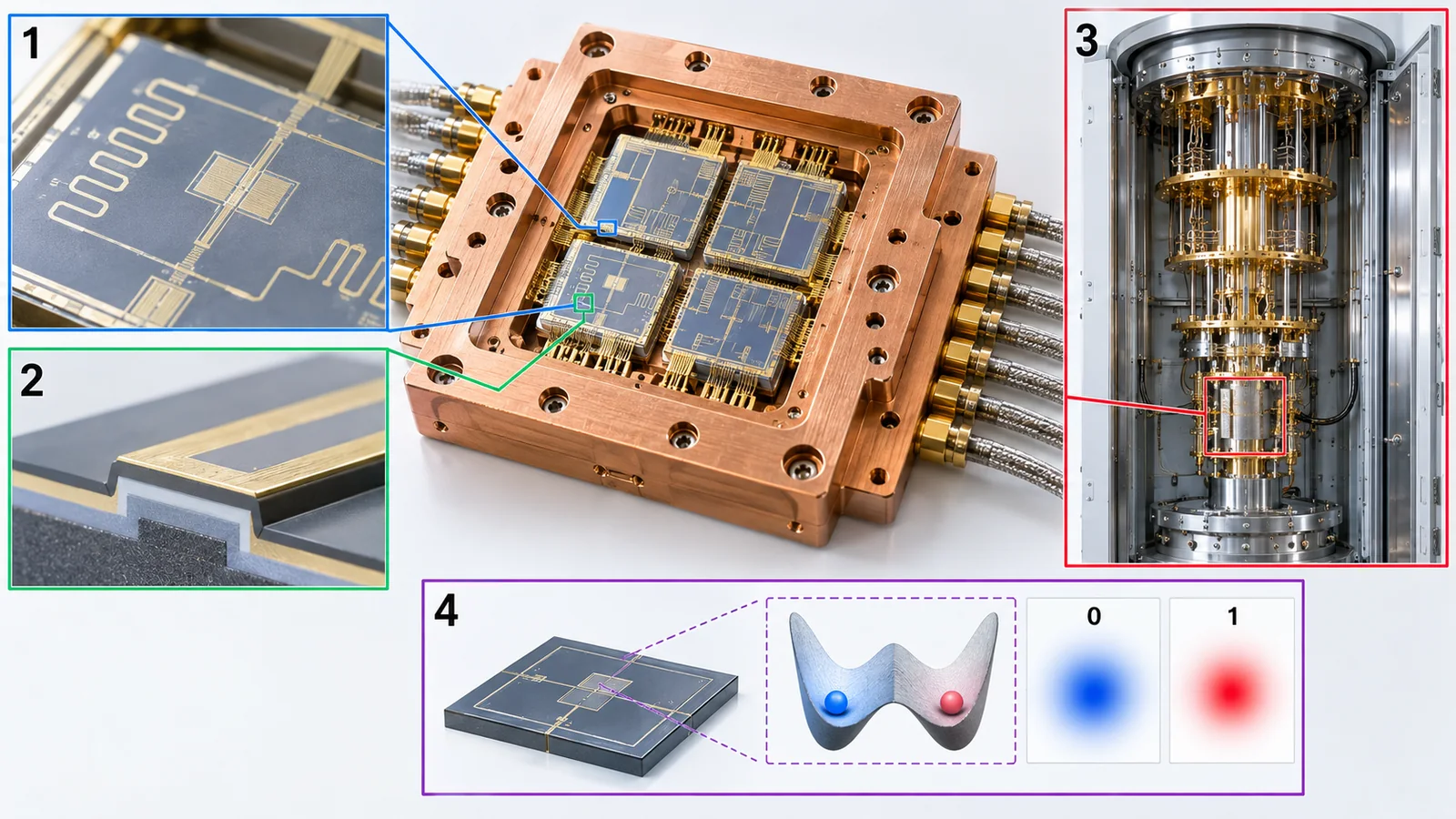
Fujitsu's qubits are superconducting (tiny circuits of a metal that loses its electrical resistance at very low temperatures serve as the qubits). With this approach, the more qubits you add, the bigger the walls become in heat inside the refrigerator and crowding of wiring. Fujitsu and RIKEN say that by stacking small units of four qubits into a three-dimensional structure and quadrupling the packing density inside the refrigerator, they grew from 64 to 256 qubits in the same cooling unit Sourced.
Another point matters just as much: there is a big gap between "number of qubits" and "useful calculation". Fujitsu itself says that to outperform conventional computers while correcting errors, even its own method (the STAR architecture) needs about 60,000 qubits (August 2025 announcement; this reads as physical qubits, but the release does not say so explicitly). 256 qubits is about 0.4% of that Our calculation.
Physical qubit / logical qubit: a physical qubit is an actual qubit on the chip. A logical qubit is a sturdy qubit made by combining many physical qubits through error correction. When this article gives a count, it always says which.
Dilution refrigerator: a special refrigerator that cools to just above absolute zero (-273 degrees C). The heart of a superconducting quantum computer goes inside it.
Early fault-tolerant quantum computer (early-FTQC): a machine that can use error correction but is still small, one step short of a full fault-tolerant machine. This is what Fujitsu's STAR architecture aims at.
Quantum simulator: a tool that imitates the behavior of a quantum computer on an ordinary computer. It makes no errors, but it cannot give the speedups that are special to quantum (Fujitsu's explanation).
2. The logo and how the name is written

A note on naming: the legal name is Fujitsu Limited. RIKEN, its joint-development partner, is a national research institute and a separate organization. The joint research site is called the "RIKEN RQC-Fujitsu Collaboration Center" and sits inside RIKEN's Center for Quantum Computing (RQC). For the next machine, the company page says "1,000 qubits" and the securities report says "1,024-qubit class". They read as the same fiscal 2026 machine, but we found no document that spells out the relation, so this article shows both wordings.
Official site (quantum computing): https://global.fujitsu/en-global/technology/research/quantum3. Where the company sits in the quantum computing field
Companies involved in quantum computing are easiest to sort into four types according to how they build a qubit (the approach). This is our own classification Our calculation.
| Type (approach) | What serves as the qubit (plain-language explanation) |
|---|---|
| Superconducting | Tiny electrical circuits made of a metal that loses all electrical resistance at extremely low temperatures; two states of the circuit stand for 0 and 1. They can be made with methods close to chip manufacturing, but they need extreme cooling and a great deal of wiring. |
| Trapped ions & neutral atoms | Individual atoms, either electrically charged (ions) or neutral, held in a vacuum with electromagnetic fields or laser beams ("optical tweezers"); two internal states of each atom stand for 0 and 1. Atoms are all identical, which tends to give uniform qubits, but operations are slower and scaling up is hard. |
| Photonic, silicon & other approaches | Particles of light (photons), or the spin (the orientation of a tiny magnet) of an electron in silicon, and similar systems. They may be able to use existing semiconductor fabs and silicon photonics, but much of this work is still at the proof-of-concept stage. |
| Software, cloud & ecosystem | Companies that do not build qubits but help people use, run or connect quantum computers: cloud services, software, the classical computers that control them, and quantum communication. |
4. Scale (limited to what touches quantum)
The table gives Fujitsu's overall scale briefly. Figures are consolidated figures from the securities report for the year to March 2026. Fujitsu's "fiscal 2025" is April 2025 to March 2026 Sourced.
| Measure (consolidated, yen million) | Fiscal 2023 | Fiscal 2024 | Fiscal 2025 |
|---|---|---|---|
| Revenue | 3,476,985 | 3,550,116 | 3,502,971 |
| Operating profit | 149,326 | 265,089 | 348,329 |
| Item | Detail |
|---|---|
| Employees (consolidated, 31 March 2026) | 99,203 (down 13,540 from the previous year-end; the securities report attributes this to the sale of subsidiaries and restructuring) |
| R&D expense (continuing operations, fiscal 2025) | Yen 137.3 billion (Service Solutions 26.4 billion, Hardware Solutions 58.6 billion, corporate 52.2 billion). No breakdown for quantum |
| Head office | 4-1-1 Kamikodanaka, Nakahara-ku, Kawasaki (Fujitsu Technology Park) |
| Listing | Tokyo Stock Exchange and Nagoya Stock Exchange (named as places where the report is available). Securities code 6702 |
The figures above are for the whole company, not the size of its quantum computing business. The securities report says investment in advanced research such as quantum computers is booked under "Eliminations and corporate" (research carried at the head-office level). Fujitsu discloses no quantum-only revenue, R&D expense, capital spending or dedicated headcount Not yet confirmed.
5. Resources committed to quantum computing
The table checks four kinds of resource (people, money, equity investments and acquisitions, and ties with universities and public bodies) against primary sources. "No mention" and "not disclosed" are findings too.
| Type of resource | What primary sources confirm | Category |
|---|---|---|
| People | Dedicated quantum headcount is not disclosed. The joint research site is the RIKEN RQC-Fujitsu Collaboration Center (opened April 2021), whose term was extended to March 2029 (announced April 2025), on RIKEN's Wako campus. A dedicated quantum building was completed in September 2025 at the head-office site in Kawasaki (securities report) | Sourced / headcount not disclosed |
| Money | Quantum R&D and capital spending are not disclosed. The securities report gives only company-wide R&D of yen 137.3 billion and says investment in advanced research including quantum is booked under "Eliminations and corporate" | Not disclosed |
| Equity investments, acquisitions, joint ventures, disposals | No investment in, or acquisition, joint venture or disposal of, a quantum company could be confirmed in the official material we checked | Not confirmed |
| Universities, research institutions, public funding | RIKEN (the joint research site; Q-LEAP grant from the Ministry of Education, Culture, Sports, Science and Technology) / National Institute of Advanced Industrial Science and Technology (AIST) (a superconducting machine ordered in June 2024; a quantum-technology partnership agreement in September 2025) / NEDO (selected in August 2025 as an implementing party of a public call, the post-5G information and communication systems infrastructure project, which runs to fiscal 2027) / The University of Osaka (joint work on the STAR architecture) / NTT (control software for the 64-qubit machine) / QuTech (Delft University of Technology) (diamond spin) | Sourced |
Status of the main devices and products
All qubit counts are physical qubits. The numbers and the phrase "world-leading" are Fujitsu's own statements (as of April 2025, among superconducting machines available to outside users, according to Fujitsu) and do not rank Fujitsu against other companies (checked 16 October 2026).
| Device | Approach | Qubits | Representative error rate | Stage | Date | Reference |
|---|---|---|---|---|---|---|
| 64-qubit machine | Superconducting | 64 (physical) | Not confirmed | In service (offered to joint-research partners) | 5 October 2023 | Ref. 9 |
| 256-qubit machine | Superconducting (four-qubit units arranged in 3D) | 256 (physical) | Not confirmed | In service (from Q1 of fiscal 2025) | Announced 22 April 2025 | Refs. 2, 8 |
| Superconducting machine for AIST | Superconducting | Designed to extend to hundreds of qubits | Not confirmed | Ordered (announced as due to run in early 2025; start of operation not confirmed) | Announced 18 June 2024 | Ref. 5 |
| 1,000-qubit-class machine | Superconducting | 1,000-class (company page) / 1,024-class (securities report), physical | - | Plan (to be installed in the quantum building in fiscal 2026) | Checked 16 October 2026 | Refs. 1, 8 |
| Machine with over 10,000 qubits | Superconducting | Over 10,000 (physical), 250 (logical) | - | Target (completion in fiscal 2030) | Announced 1 August 2025 | Ref. 4 |
| Two-qubit diamond-spin system | NV centers in diamond | 2 (one electron spin, one nitrogen nuclear spin) | Error probability under 0.1% (fidelity above 99.9%) for both one- and two-qubit gates, measured by gate set tomography; Fujitsu's stated value | Research result (paper published) | Announced 24 March 2025 | Ref. 6 |
| 40-qubit quantum simulator | Imitation on a classical computer | 40 (simulated) | No errors (because it is simulated) | In service | Since October 2023 | Refs. 8, 9 |
6. What it has done so far
| When | What happened | Why it matters |
|---|---|---|
| 1 April 2021 | Opened the RIKEN RQC-Fujitsu Collaboration Center with RIKEN, aiming to develop technology for a quantum computer of about 1,000 qubits | 1,000 qubits has been a goal for five years |
| March 2023 | RIKEN unveiled Japan's first domestically built superconducting quantum computer (with a joint research group that includes Fujitsu) | The first step for a home-grown machine |
| 23 March 2023 | Fujitsu and the University of Osaka announced STAR architecture ver. 1 (ver. 2 followed on 28 August 2024) | The start of its own method for making error correction more efficient |
| 5 October 2023 | Launched a hybrid platform that combines a 64-qubit superconducting machine with a 40-qubit simulator. Uses NTT control software | A real machine and an error-free imitation can be compared side by side |
| February to June 2024 | Received orders from AIST's G-QuAT for ABCI-Q (a quantum and AI cloud with 2,020 NVIDIA GPUs; February 2024) and for a superconducting quantum computer (15 May; announced 18 June) | Described as the first order for a commercial quantum computer by a Japanese vendor |
| 24 March 2025 | With QuTech, announced a quantum gate with error probability under 0.1% on diamond spin | Exploring an approach other than superconducting |
| 22 April 2025 | With RIKEN, announced the 256-qubit superconducting machine. Extended the collaboration center's term to March 2029 | Four times the qubits in the same refrigerator |
| 1 August 2025 | Announced it had begun developing a machine with over 10,000 qubits. Selected as an implementing party of a NEDO call | Published a roadmap to a scale useful for practical work |
| September 2025 | Completed a quantum building at its Kawasaki head office. Signed a quantum-technology partnership with AIST (securities report) | A building now exists for the next machine |
| 25 March 2026 | With the University of Osaka, announced STAR architecture ver. 3 (the qubits needed for chemistry calculations cut to 1/15 to 1/80 of conventional) | Aiming at drug and catalyst calculations in the early error-corrected stage |
7. What comes next
installed in the quantum building (planned)The securities report says "1,024-qubit class"
250 logical qubitsA company target. Uses the STAR architecture
and diamond spinA company plan. Aims at expansion by optical links
None of the following appears in the official material we checked Not yet confirmed.
A completion or start-of-operation announcement for the 1,000-qubit-class machine (as of 16 October 2026); the error rates and coherence times of the 256- and 64-qubit machines; quantum revenue and spending; an announcement that the machine for AIST has started operating. Fiscal 2026, 2030 and 2035 in the table above are all Fujitsu's plans and targets, not facts already achieved.
8. What the company is aiming for in quantum computing
We separate what the company itself says from what this article infers.
| What can be read | Primary evidence behind it | Category |
|---|---|---|
| It wants to put an early fault-tolerant quantum computer (early-FTQC) to practical use ahead of a full fault-tolerant machine | Fujitsu says its STAR method aims at an early machine of about 60,000 qubits and sets 250 logical qubits for fiscal 2030 (Refs. 4, 7) | Sourced |
| It wants to provide quantum computers together with supercomputers (HPC) | Fujitsu's CTO says the company will "integrate platforms for high-performance and quantum computing" and is developing the next-generation FUJITSU-MONAKA processor (Ref. 4) | Sourced (the reading of the aim is an Inference) |
| It concentrates on superconducting while hedging with diamond spin as the next candidate | The company page says it is exploring "optional alternatives" to superconducting, and it states research on integrating the two from fiscal 2030 (Refs. 4, 8) | Inference |
| Working with national projects and research institutions, it may be covering part of development cost with public money | Selected as a NEDO implementing party and working with RIKEN and AIST. The amount and share of public funds are not disclosed (Refs. 1, 4) | Inference |
| It expects quantum to become a business pillar around 2030 | The company page says "leading the business with quantum computers in 2030". For now it invests as advanced research under a head-office cost line (Refs. 1, 8) | Sourced (the timing is an Inference) |
Fujitsu says a machine with over 10,000 physical qubits will run 250 logical qubits. Simple division gives about 40 physical qubits per logical qubit Our calculation (10,000 / 250; since it says "over", the real figure is at least this).
Fujitsu's explanation for the small ratio is that the STAR architecture reduces the effort of error correction with its own "phase-rotation gate" Sourced. But the method works only if the physical qubits' errors are small enough (in the ver. 3 announcement, the estimates are about 35 days of computation at an error probability of 0.10% and about 10 days at 0.01%). Whether the current machines are at that level is not stated in the material we checked. From this, we read that the key to the plan is the quality of each qubit as much as the number of qubits Inference.
9. Map of quantum computing partnerships
10. Products, technologies and services
Fujitsu's quantum offering is a combination of real superconducting machines, a 40-qubit simulator, a hybrid platform that can use both, and open-source software for running quantum machines in the cloud (as the company page describes it). The first illustration shows the qubit counts achieved so far and planned, and the second shows how it went from 64 to 256.
The heart of a superconducting qubit is the Josephson junction (a very thin insulating film sandwiched between two superconductors). If the size or film thickness of the junction drifts a little, the frequencies of individual qubits scatter and control becomes harder. In its August 2025 announcement, Fujitsu named among its development priorities "improving the manufacturing precision of Josephson junctions" to minimize frequency variation Sourced. This is a place where materials and process control matter more the more qubits there are.
The second is wiring and heat. In the same announcement, Fujitsu lists wiring and packaging technology to connect several qubit chips (chip-to-chip interconnect), and technology to reduce component count and heat dissipation inside the refrigerator (high-density packaging and low-cost control) Sourced. For the 256-qubit machine, it is described as having designed "the balance between heat from the control circuits and the refrigerator's cooling capacity" to fit the same refrigerator Sourced.
In diamond spin, a different approach, using high-purity diamond with the carbon-13 isotope (which carries spin) cut from 1% to 0.01% reduced environmental noise and gave a gate with an error probability under 0.1% Sourced (the diamond with NV centers was developed jointly by Element Six and TU Delft). How superconducting films are made, how substrates lose energy and what refrigerators are made of are covered in our explainers on superconducting qubits, on cryogenics and control, and on the materials and manufacturing of quantum computers.
11. The risks this company carries
| Risk | Substance | Category |
|---|---|---|
| The next machine is at the "plan" stage | No announcement that the 1,000-qubit-class machine is complete could be found as of 16 October 2026. It is a fiscal 2026 plan, and timing and scale could change | Not yet confirmed |
| The distance between qubit count and useful calculation | Fujitsu itself says outperforming conventional computers needs about 60,000 qubits. 256 qubits is 0.4% of that (our calculation), and even 10,000 may not be enough | Sourced |
| The substance of performance (error rates) cannot be confirmed | The error rates and coherence times of the 64- and 256-qubit machines are not given in the material we checked. The number of qubits alone does not show a machine's quality | Sourced |
| The STAR architecture's estimates are design estimates | "1/15 to 1/80 of the qubits" and "about 35 days (at an error probability of 0.10%)" are design estimates made with the University of Osaka, not confirmed on a real machine. They assume the physical error rate reaches that level | Sourced |
| Diamond spin is still two qubits | The error probability under 0.1% is a result for a two-qubit NV-center system. It is not at the stage of lining up many. The company says it will next work on more qubits and on optical interconnects and control circuits | Sourced |
| Reliance on national programs and partners | Part of development proceeds under a NEDO program (to fiscal 2027) and jointly with RIKEN and AIST. The share of public money is not disclosed | Inference |
| "World-leading" is the company's wording | Calling the 256-qubit machine one of the world's largest superconducting machines available to outside users is Fujitsu's statement as of April 2025. It does not rank it against other companies' machines | Sourced |
12. Glossary
- Qubit
- The smallest unit of information in a quantum computer. It can be in a state of being 0 and 1 at once.
- Physical qubit / logical qubit
- A physical qubit is an actual qubit on the chip. A logical qubit is a sturdy "virtual" qubit built from many physical qubits through error correction.
- Superconducting qubit
- A qubit made from a small circuit of a metal that loses electrical resistance at extremely low temperatures.
- Dilution refrigerator
- A refrigerator that cools to just above absolute zero. Superconducting quantum computers sit inside it.
- Josephson junction
- A device with a thin insulating film between two superconductors. The key part of a superconducting qubit.
- STAR architecture
- A quantum computing method developed by Fujitsu and the University of Osaka. It uses phase-rotation gates to reduce the effort of error correction. Ver. 1 (March 2023), ver. 2 (August 2024), ver. 3 (March 2026).
- Early-FTQC (early fault-tolerant quantum computer)
- A machine that can use error correction but is still small.
- Diamond spin (NV center)
- An approach that uses the electron and nuclear spins of a nitrogen-vacancy pair (an NV center) in a diamond crystal as qubits.
- Quantum simulator
- A tool that imitates the operation of a quantum computer on an ordinary computer. It makes no errors but gives no quantum speedup.
- Hybrid platform
- An environment that lets you use a real quantum machine, a quantum simulator and ordinary computers together.
- Securities report
- The annual statutory disclosure document that listed Japanese companies file (the Japanese counterpart of a Form 10-K).
13. References
- Fujitsu Limited Securities Report for the 126th fiscal period (1 April 2025 to 31 March 2026; filed with the Kanto Local Finance Bureau on 26 June 2026; EDINET document S100YM3K; in Japanese). Revenue, headcount, R&D expense and the passages on quantum computing (pages 11, 13, 21, 59 and 66). https://disclosure2dl.edinet-fsa.go.jp/searchdocument/pdf/S100YM3K.pdf
- Fujitsu and RIKEN Fujitsu and RIKEN develop world-leading 256-qubit superconducting quantum computer (press release, 22 April 2025). https://info.archives.global.fujitsu/global/about/resources/news/press-releases/2025/0422-01.html
- RIKEN RIKEN and Fujitsu unveil world-leading 256-qubit quantum computer (RIKEN news, 22 April 2025). https://www.riken.jp/en/news_pubs/news/2025/20250422_1/index.html
- Fujitsu Fujitsu starts official development of plus-10,000 qubit superconducting quantum computer targeting completion in 2030 (press release, 1 August 2025). https://global.fujitsu/en-global/pr/news/2025/08/01-01-en
- Fujitsu Fujitsu to introduce superconducting quantum computer system at National Institute of Advanced Industrial Science and Technology (press release, 18 June 2024). https://info.archives.global.fujitsu/global/about/resources/news/press-releases/2024/0618-01.html
- Fujitsu Fujitsu and QuTech realize high-precision quantum gates (press release, 24 March 2025). Diamond-spin qubits. https://info.archives.global.fujitsu/global/about/resources/news/press-releases/2025/0324-02.html
- Fujitsu and The University of Osaka Fujitsu and The University of Osaka develop new technologies for chemical material energy calculations on early-FTQC quantum computers (press release, 25 March 2026). STAR architecture ver. 3. https://global.fujitsu/en-global/pr/news/2026/03/25-01
- Fujitsu Quantum Computing by Fujitsu (official quantum computing page). Provision of the 256-qubit machine, the planned 1,000-qubit machine, the NEDO national project, the roadmap. A copy saved on 25 June 2026 and a retrieval checked 16 October 2026. https://global.fujitsu/en-global/technology/research/quantum
- Fujitsu and RIKEN Fujitsu and RIKEN develop superconducting quantum computer at the RIKEN RQC-Fujitsu Collaboration Center (press release, 5 October 2023). The 64-qubit machine and the hybrid platform. https://info.archives.global.fujitsu/global/about/resources/news/press-releases/2023/1005-01.html
- RIKEN and Fujitsu RIKEN, Fujitsu Launch Collaborative R&D Center in Japan (press release, 1 April 2021). https://info.archives.global.fujitsu/global/about/resources/news/press-releases/2021/0401-01.html
- NVIDIA NVIDIA Powers Japan's ABCI-Q Supercomputer for Quantum Research (press release, 18 March 2024). Built by Fujitsu. https://nvidianews.nvidia.com/news/nvidia-powers-japans-abci-q-supercomputer-for-quantum-research
14. Claim-to-source audit
| Claim in the article | Category | Source |
|---|---|---|
| Legal name, head office, listing, revenue and operating profit (fiscal 2023 to 2025), 99,203 employees, R&D expense of yen 137.3 billion and its breakdown | Sourced | Reference 1 https://disclosure2dl.edinet-fsa.go.jp/searchdocument/pdf/S100YM3K.pdf |
| Quantum revenue, R&D expense, capital spending and dedicated headcount are not disclosed | Not yet confirmed | None is disclosed, and this article makes no estimate |
| Advanced-research investment is booked under "Eliminations and corporate"; the 256-qubit machine in service; the quantum building completed in September 2025; a 1,024-qubit-class machine to be installed in fiscal 2026; the AIST partnership (September 2025); NEDO selection | Sourced | Reference 1 https://disclosure2dl.edinet-fsa.go.jp/searchdocument/pdf/S100YM3K.pdf |
| The 256-qubit machine (announced 22 April 2025): four-qubit unit cells in 3D, four times the packing density, the same cooling unit, offered from Q1 of fiscal 2025, the 1,000-qubit machine plan, the center extended to March 2029 | Sourced | References 2 and 3 https://info.archives.global.fujitsu/global/about/resources/news/press-releases/2025/0422-01.html https://www.riken.jp/en/news_pubs/news/2025/20250422_1/index.html |
| The 64-qubit machine and the hybrid platform with a 40-qubit simulator (5 October 2023), and NTT's control software | Sourced | Reference 9 https://info.archives.global.fujitsu/global/about/resources/news/press-releases/2023/1005-01.html |
| The RIKEN RQC-Fujitsu Collaboration Center opened (1 April 2021) with a goal of about 1,000 qubits | Sourced | Reference 10 https://info.archives.global.fujitsu/global/about/resources/news/press-releases/2021/0401-01.html |
| Over 10,000 qubits and 250 logical qubits (fiscal 2030), 1,000 logical qubits (fiscal 2035), the STAR architecture, the NEDO program, the explanation of an early machine of about 60,000 qubits, the priority technologies (Josephson junction precision and others) | Not yet confirmed | Fujitsu's target and plan / Reference 4 https://global.fujitsu/en-global/pr/news/2025/08/01-01-en |
| The order from AIST for a superconducting quantum computer (15 May 2024, announced 18 June) and ABCI-Q | Sourced | Reference 5 https://info.archives.global.fujitsu/global/about/resources/news/press-releases/2024/0618-01.html |
| ABCI-Q's configuration (2,020 H100 GPUs) and its construction by Fujitsu | Sourced | Reference 11 https://nvidianews.nvidia.com/news/nvidia-powers-japans-abci-q-supercomputer-for-quantum-research |
| Diamond spin: a complete quantum gate set with error probability under 0.1%, the carbon-13 concentration, a two-qubit system (24 March 2025) | Sourced | Fujitsu's stated value / Reference 6 https://info.archives.global.fujitsu/global/about/resources/news/press-releases/2025/0324-02.html |
| STAR architecture ver. 3: 1/15 to 1/80, about 35 days at an error probability of 0.10% and about 10 days at 0.01%, ver. 1 (23 March 2023) and ver. 2 (28 August 2024) | Sourced | Estimates by Fujitsu and the University of Osaka / Reference 7 https://global.fujitsu/en-global/pr/news/2026/03/25-01 |
| The company page: the 256-qubit machine in service, the planned 1,000-qubit machine, the NEDO program to fiscal 2027, the roadmap, "leading the business with quantum computers in 2030" | Sourced | Reference 8 https://global.fujitsu/en-global/technology/research/quantum |
| The division of quantum companies into four types | Our calculation | This article's own classification. Company names are examples from this series |
| 256 qubits is about 0.4% of 60,000 qubits (256 / 60,000) | Our calculation | Our calculation (from the figure in Reference 4) |
| About 40 physical qubits per logical qubit (10,000 / 250) | Our calculation | Our calculation (from the figures in Reference 4) |
| Unit-cell counts (16 and 64) | Our calculation | Our calculation (qubit count divided by 4) |
| No investment in, acquisition of, joint venture with or disposal of a quantum company could be confirmed | Not yet confirmed | Not in the official material checked. This article does not assert that none exists |
| A completion announcement for the 1,000-qubit-class machine, the error rates of the 64- and 256-qubit machines, the start of operation of the machine for AIST | Not yet confirmed | Not confirmed. This article makes no estimate |
| The reading that it wants to provide quantum together with HPC | Inference | This article's interpretation / Reference 4 https://global.fujitsu/en-global/pr/news/2025/08/01-01-en |
| The reading that it hedges with diamond spin as the next candidate | Inference | This article's interpretation / References 4 and 8 https://global.fujitsu/en-global/pr/news/2025/08/01-01-en https://global.fujitsu/en-global/technology/research/quantum |
| The reading that part of development may be covered by public money | Inference | This article's interpretation / References 1 and 4 https://disclosure2dl.edinet-fsa.go.jp/searchdocument/pdf/S100YM3K.pdf https://global.fujitsu/en-global/pr/news/2025/08/01-01-en |
| The reading of timing that quantum becomes a business pillar around 2030 | Inference | This article's interpretation / References 1 and 8 https://disclosure2dl.edinet-fsa.go.jp/searchdocument/pdf/S100YM3K.pdf https://global.fujitsu/en-global/technology/research/quantum |
| The reading that the key to the plan is the quality of each qubit | Inference | This article's interpretation / Reference 7 https://global.fujitsu/en-global/pr/news/2026/03/25-01 |
Last updated 16 October 2026 / Troy Technical
All figures in this article rest on the securities report Fujitsu filed with the Kanto Local Finance Bureau and on official announcements by Fujitsu, RIKEN, the University of Osaka, AIST and NVIDIA. No research-firm estimates or press-based figures have been used. Passages marked "Inference" are this article's interpretation of primary sources, not statements made by the company. Performance figures are Fujitsu's stated values and do not rank Fujitsu against other companies. Checked 16 October 2026.