COMPANY PROFILE / QUANTUM COMPUTING
Google Quantum AI
A research team that fabricates its own superconducting chips and builds up papers on how to cut errors while scaling up
Google Quantum AI is the team inside Alphabet (Google's parent) that researches and develops quantum computers. It was founded in 2012, according to its founder. Centred on qubits (the basic units of quantum computation) built from superconducting circuits, it announced in 2019 that it had run a calculation that classical computers could not reproduce in a realistic time, and in December 2024 it published in Nature an error-correction experiment on its new Willow chip (105 qubits) in which "adding qubits reduces errors". In October 2025 it published a paper claiming "verifiable quantum advantage", and in March 2026 it announced that it is starting research on neutral atoms as well. Google does not, however, sell quantum computers to the general public; Willow is offered only to selected researchers. This profile concentrates on Google Quantum AI and sets out what it claims and what rebuttals or checks exist, as far as papers and official announcements allow.
- Google Quantum AI in 30 seconds, and where it stands in quantum computing
- The logo and how the name is written
- Where the team sits in the quantum computing field
- Scale (kept brief, Google Quantum AI only)
- Resources committed to quantum computing
- What it has done so far
- What comes next (all of it plans)
- What the team is aiming for in quantum computing
- Map of quantum computing partnerships
- Technology, products and services
- The risks this team carries
- Glossary, references and claim-to-source audit
1. Google Quantum AI in 30 seconds, and where it stands in quantum computing
(part of Google Research)Parent company Alphabet Inc. Founded in 2012 by Hartmut Neven, by his own account
Trapped ions & neutral atoms (secondary, research stage)Neutral-atom research announced in March 2026. The classification is our own
105 physical qubitsAnnounced December 2024. Updated performance published in an October 2025 blog
0.143% error per cycleNature, December 2024. A memory experiment, not a logical-qubit computation
foundWillow is offered only through an early-access programme for selected researchers. The Cirq software is public
Google Quantum AI is less a company that "sells" quantum computers than a team doing research towards a large error-corrected quantum computer, down to making the chips itself. Most of its results appear as peer-reviewed papers, in Nature and elsewhere Sourced. That makes it easier than with many companies to check "what exactly was shown, under what conditions". On the other hand, comparisons such as "a classical computer would need this many years" are Google's estimates, not measurements. There is also a precedent (2019) in which classical researchers answered "we reproduced it by another method", so this profile treats "quantum advantage" as a company claim and sets any rebuttals beside it Not yet confirmed.
Qubit: the smallest unit of quantum computation, the counterpart of the ordinary "bit" (0 or 1). It can hold a blend of 0 and 1 at once, but it is fragile: a little heat or electrical noise makes it err.
Physical and logical qubits: the qubits actually on the device are "physical". A sturdier virtual "logical" qubit is made by bundling many physical qubits so errors can be fixed. The two are counted very differently, so this profile always says which one it means.
Threshold: in error correction, adding qubits reduces errors only if each physical qubit's error rate is below a certain level (below threshold). The Willow experiment claims to have shown this "below threshold" behaviour experimentally.
Quantum advantage: a quantum computer producing, for some task, a better result than the best known method on a classical computer. One side announces "we did it", the other answers "we matched it classically", and this has repeated many times.
2. The logo and how the name is written
A note on naming: the team is Google Quantum AI, part of Google Research. The parent is Alphabet Inc., which is the company that files the 10-K (annual report). The "Scale" chapter shows Alphabet's whole-company figures briefly and then treats what relates to Google Quantum AI separately.
Easily confused: Cirq is the open-source software library Google publishes for quantum circuits, Willow is the quantum chip announced in December 2024, and Sycamore is the name of the 53-qubit chip of 2019. None of this is about Google DeepMind or the Gemini AI models.
Official site: https://quantumai.google/3. Where the team sits in the quantum computing field
Quantum computing companies are easiest to sort by how they build a qubit, which gives four groups. Superconducting means "cool an electrical circuit until it behaves as a qubit". Trapped ions and neutral atoms means "use individual atoms themselves as qubits". Photonic, silicon and other approaches means "use particles of light, or the spin of electrons in silicon". Software, cloud and ecosystem companies do not build qubits; they make quantum computers easier to use.
Some metals, cooled far enough, lose all electrical resistance. This is called superconductivity. Google uses small electrical circuits made from such metals as qubits (a type called the transmon; the 2019 Nature paper describes them as resonant circuits at 5 to 7 GHz) and drives them with microwaves. The inside of its cooling units, Google's campus article says, reaches about 10 millikelvin (about -273.14 °C) Sourced. The advantage is that the same "draw the circuit on a wafer" methods used for semiconductors can be applied, so designs can change and numbers can grow. The difficulties are the size of the refrigerators that reach such temperatures, the number of wires, and the complicated way errors arise among qubits. See also our explainers on superconducting qubits and on cryogenics and control in this series.
4. Scale (kept brief, Google Quantum AI only)
Alphabet is one of the world's largest IT companies, and quantum is a very small part of it. The company as a whole fits in one table Sourced.
| Measure (Alphabet as a whole) | Year to Dec 2023 | Year to Dec 2024 | Year to Dec 2025 |
|---|---|---|---|
| Revenue (US$ million) | 307,394 | 350,018 | 402,836 |
| Research and development expense (US$ million) | 45,427 | 49,326 | 61,087 |
| Capital expenditure (purchases of property and equipment, US$ million) | 32,251 | 52,535 | 91,447 |
| Employees (31 December 2025) | 190,820 (headquarters: Mountain View, California, U.S.; listed on Nasdaq as GOOGL and GOOG) | ||
The figures above cover Alphabet as a whole. Quantum revenue, R&D, capital spending and headcount are not broken out in the 10-K or the 10-Q Not yet confirmed. In the 10-K for the year to December 2025, "quantum computing" appears in only one place, in a sentence to the effect that the company will keep investing for the long term in AI and in other frontier technologies such as quantum computing. We found no quantum reference in the 10-Q for the quarter to 30 June 2026. This profile does not estimate quantum spending. The official numbers about Google Quantum AI's scale are limited to individual official announcements, such as the Atlantic Quantum team joining and the contribution of up to US$50 million over ten years to the university partnership, described below.
5. Resources committed to quantum computing
Google Quantum AI discloses little about money or headcount. The table sorts the four points into what could and could not be confirmed.
| Type of resource | What was confirmed (checked 16 October 2026) | Status |
|---|---|---|
| People | Team size is not disclosed. Confirmed: (1) the Willow paper in Nature has an author list of about 250; (2) the team of Atlantic Quantum, a start-up that came out of MIT, joined in October 2025; (3) Adam Kaufman joined in March 2026 to lead a neutral-atom hardware team (Boulder, Colorado; he remains on the faculty of CU Boulder and a JILA Fellow) | Sourced (headcount not confirmed) |
| Money (spending) | Quantum R&D and capital spending are not broken out in the 10-K or 10-Q. Amounts confirmed in Google's own announcements: (1) up to US$50 million from Google within a ten-year partnership with the University of Chicago and the University of Tokyo (up to US$100 million across the three, May 2023); (2) US$10 million from Google.org to five universities under REPLIQA, a life-sciences and quantum research programme (11 May 2026); (3) the XPRIZE Quantum Applications (US$5 million in total, backed by Google Quantum AI, Google.org and GESDA; each backer's share is not stated) | Sourced (actual spending not confirmed) |
| Outside investments and acquisitions | (1) Atlantic Quantum: on 2 October 2025 Google announced that the team "is joining Google" (a company putting superconducting control electronics on the cold stage with the qubits; no price stated); (2) QuEra Computing: Google's March 2026 blog calls it "our portfolio company" (no amount or stake stated) | Sourced (amounts not confirmed) |
| Public funding and government ties | Takes part in Stage A of DARPA's Quantum Benchmarking Initiative (QBI), added to DARPA's announcement on 9 September 2025. In DARPA's list of participants as of 8 October 2026, Google Quantum AI is listed under Stage A and does not appear in the Stage B or Stage C lists. Any government funding Google received was not confirmed | Sourced / amount not confirmed |
| Universities and research institutes | The University of California, Berkeley (Quantum Echoes molecule experiment); the University of Chicago and the University of Tokyo (a ten-year partnership in which Google said in 2023 that it would provide access to processors of up to 72 qubits); CU Boulder, JILA and NIST (the neutral-atom base in Boulder); the five REPLIQA universities | Sourced |
| Manufacturing and facilities | A campus in Santa Barbara, California, with a quantum data center, labs and its own chip fabrication facilities (announced May 2021). The December 2024 blog says Willow was fabricated there | Sourced |
Status of the main devices and experiments (checked 16 October 2026; all from Google's papers and announcements)
Qubit counts are split into "physical" and "logical". Error rates and fidelities (the probability that an operation is performed correctly) are values Google gave under stated conditions and cannot be lined up against other approaches or companies to rank them.
| Device or experiment | Approach | Qubits | Typical error rate or performance (company's stated value, with conditions) | Stage | Date and source |
|---|---|---|---|---|---|
| Sycamore | Superconducting | 53 physical (one of 54 did not work) | On random circuit sampling (RCS), claimed that a task taking about 200 seconds would take a state-of-the-art classical supercomputer about 10,000 years (a 2019 estimate) | Experiment (paper) | Nature 574 (October 2019) |
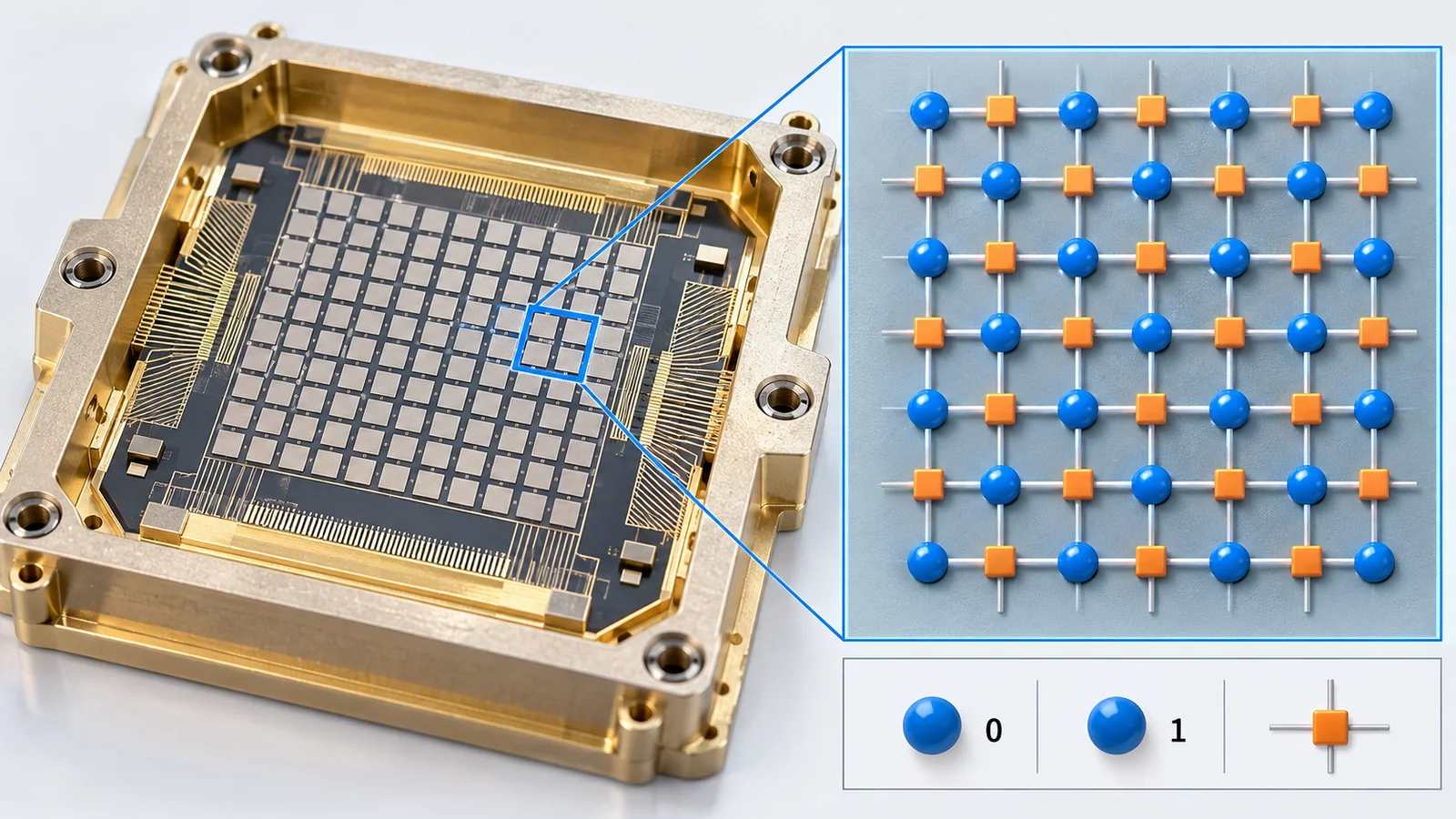
| Willow (error-correction experiment) | Superconducting (surface-code memory) | 105-qubit chip; the distance-7 code uses 101 qubits | Each increase of the code distance by two suppressed the logical error by a factor of Lambda = 2.14 +/- 0.02, reaching 0.143% +/- 0.003% error per cycle at distance 7. Lifetime 2.4 +/- 0.3 times that of the best physical qubit (beyond break-even). Real-time decoding averaged 63 microseconds at distance 5, with a 1.1-microsecond cycle | Experiment (paper). Not a logical-gate experiment | Nature 638 (2025); blog of 9 December 2024 |
| Willow (RCS) | Superconducting | 105 physical | A computation finished in under five minutes that Google estimated would take a classical supercomputer 1025 years (Google's estimate, not a measurement) | Experiment (announcement) | Blog of 9 December 2024 |
| Willow (Quantum Echoes) | Superconducting | Physical (the paper uses 103 qubits; the blog describes a 105-qubit array) | Google claims a measurement of the OTOC(2) quantity about 13,000 times faster than the best classical algorithm; one trillion measurements were taken | Experiment (paper). A company claim | Nature 646 (October 2025); blog |
| Willow (updated performance) | Superconducting | 105 physical | Across the 105-qubit array, single-qubit gate fidelity of 99.97%, entangling-gate fidelity of 99.88% and readout of 99.5% (company figures; whether average or best is not stated) | In operation (research) | Blog of 22 October 2025 |
| A long-lived logical qubit | Superconducting | Not disclosed | Stated by Google as its "next milestone". No announcement of achievement found | Planned | Blog of 22 October 2025 |
| Neutral-atom chip | Neutral atoms | Not disclosed | Research start announced in March 2026. No device specification or qubit count given | Development begun | Blog of 24 March 2026 |
6. What it has done so far
Google publishes its path as a roadmap and says it has completed "milestone 1: beyond-classical computation (2019)" and "milestone 2: an error-correction prototype (2023)", and is heading, via Willow's "below threshold" result, towards "milestone 3: a long-lived logical qubit" Sourced.
| When | What happened | Why it matters |
|---|---|---|
| 2012 | Google Quantum AI founded (per founder Hartmut Neven) | Has done its research inside Google Research since |
| October 2019 | Published in Nature a paper claiming "quantum supremacy" on Sycamore (53 qubits): a task of about 200 seconds, estimated at about 10,000 years classically | That same October, IBM researchers posted a paper saying secondary storage would let it be simulated in days. In 2022 Pan et al. reproduced it in about 15 hours on 512 GPUs (see the box below) |
| May 2021 | Announced the Quantum AI campus in Santa Barbara (quantum data center, labs, its own chip fabrication) | A set-up that runs design through manufacturing in-house. It stated an aim of an error-corrected quantum computer within the decade |
| February 2023 | Published in Nature an error-correction prototype (what Google describes as the first experiment showing logical error falls when the code is made larger) | Google describes this as achieving "milestone 2" |
| May 2023 | Ten-year partnership with the University of Chicago and the University of Tokyo (up to US$100 million across the three; Google's contribution up to US$50 million) | Announced to coincide with a U.S.-Japan joint commitment on quantum |
| 9 December 2024 | Announced Willow (105 qubits) and published a Nature paper showing error correction "below threshold" | Google says logical error roughly halved each time the code was enlarged (distance 3, 5, 7) |
| 2 October 2025 | Announced that the Atlantic Quantum team is joining | Brings in a design that puts superconducting control circuits on the cold stage (Google's description) |
| 22 October 2025 | Published the "Quantum Echoes" paper in Nature, claiming "verifiable quantum advantage" | Comparison with classical algorithms is in chapter 7 |
| 13 November 2025 | Published a five-stage framework for quantum applications | Sorts the road from discovery to real use into five stages |
| 10 December 2025 | Named seven finalists in the XPRIZE Quantum Applications competition | US$5 million in total, with the remainder to be awarded in March 2027 |
| February and March 2026 | Issued a call to prepare for post-quantum cryptography (PQC) and set Google's own migration target of 2029 | A move to prepare for the threat quantum computers pose to cryptography (this profile does not cover how cryptography is broken) |
| 24 March 2026 | Announced it is starting research on neutral atoms in addition to superconducting qubits | A broadening of approach, discussed in chapter 8 |
| 11 May 2026 | Announced REPLIQA, a life-sciences and quantum research programme (US$10 million from Google.org to five universities) | Research on quantum sensors and molecular simulation |
Error correction is the quantum version of "write the same thing three times and take a majority vote". But with qubits, the more you have, the more "sources of mistakes" there are too. Only when each qubit's error is small enough does bundling more of them make the whole more accurate. That boundary is the "threshold". Google reported that each time it enlarged the grid of bundled qubits, from 3x3 to 5x5 to 7x7, the logical error roughly halved (Lambda of about 2). The core of Google's claim is that it showed "the more you bundle, the better it gets" on superconducting qubits for the first time. But this is an experiment in "storing information (a memory)", not one in which logical qubits compute together. See our explainer on quantum error correction and the surface code in this series.
7. What comes next (all of it plans)
Everything below is a plan or target stated in Google's official materials. None had been achieved as of the check date (16 October 2026) Not yet confirmed.
hardware developmentThree pillars: quantum error correction, modelling and simulation, experimental hardware. No dates given
Google has made three advantage claims, and each has had an exchange with the classical side.
(1) Sycamore, 2019: Google estimated that a task of about 200 seconds on 53 qubits would take a classical supercomputer about 10,000 years (Nature, 2019). IBM researchers then posted a paper saying that with secondary storage it could be simulated on the Summit supercomputer in a matter of days (October 2019). Later, Pan et al. reported producing one million samples from the same circuit by a tensor-network method on 512 GPUs in about 15 hours (Physical Review Letters, 2022; fidelity about 0.0037). This is an example of the "about 10,000 years" estimate dropping sharply as classical algorithms improved.
(2) Willow RCS, 2024: a computation of under five minutes was estimated at 1025 years classically. This is Google's estimate, not a measurement. We found no peer-reviewed paper in the primary sources that overturns the estimate. But given the 2019 history, such numbers can change as classical algorithms advance Not yet confirmed.
(3) Quantum Echoes, October 2025: Google claimed "verifiable quantum advantage", about 13,000 times the best classical algorithm. Here "verifiable" means the result can be reproduced on another quantum computer of comparable quality, not that a classical computer can check the answer. In April 2026 a preprint (not yet peer reviewed) appeared arguing that a classical method combining tensor networks with belief propagation cannot reproduce this experiment. That is not a rebuttal; it supports Google's claim. We found no paper in the primary sources, as of 16 October 2026, in which classical researchers reproduced this experiment. But the absence of a rebuttal does not mean the claim is right. This profile treats it as a company claim Not yet confirmed. See also our explainer on how to read quantum advantage claims.
8. What the team is aiming for in quantum computing
This part includes things the team has not said directly. They are written as inferences from what the primary sources allow, with the evidence alongside.
| What can be read from the record | Primary evidence | Status |
|---|---|---|
| The goal is less to "sell quantum computers" than to realise a large error-corrected machine and discover its applications | No general-purpose sale is described; the roadmap, the five-stage applications framework and the researcher early-access programme are the centre. The 10-K does not treat quantum as a separate business | Inference |
| It has widened from superconducting alone to two approaches, including neutral atoms | The March 2026 blog says it will exploit the "complementary strengths of two modalities". It says superconducting is fast (about 1 microsecond per cycle) and neutral atoms scale larger (arrays of about ten thousand qubits) with any-to-any connections | Sourced (the policy was announced); the reason for widening is an inference |
| On the superconducting side it aims to scale up with a design that places control circuits in the cold section | The Atlantic Quantum announcement says a modular chip stack combining qubits and superconducting control electronics within the cold stage will help scale superconducting hardware | Inference |
| It places weight on publishing its numbers in papers and accepting outside checks | Its main results are published as peer-reviewed papers in Nature, and it takes part in DARPA's Stage A | Inference |
In the March 2026 blog Google wrote that superconducting qubits can do "millions of gate and measurement cycles, each taking about one microsecond", while neutral atoms "have scaled to arrays of about ten thousand qubits but are slow, with cycle times in milliseconds", setting out the strengths and weaknesses of both Sourced. It also said the next task for superconducting qubits is to demonstrate computing architectures with tens of thousands of qubits, and the outstanding challenge for neutral atoms is to demonstrate deep circuits with many cycles (Google itself explains that superconducting is easier to scale in time, meaning circuit depth, and neutral atoms in space, meaning qubit count). Our reading is that by having both the fast approach and the large approach in one company, Google both prepares for one approach stalling and can reuse its error-correction designs across the two. The same article also calls QuEra (a neutral-atom company) a "portfolio company", which shows Google had earlier ties to neutral-atom technology Not yet confirmed.
9. Map of quantum computing partnerships
10. Technology, products and services
Google Quantum AI's "products" are not a cloud quantum computer like some rivals' but research results, papers, software and access for researchers.
| Layer | What it is (checked 16 October 2026) | Status |
|---|---|---|
| Quantum chip | Willow (105 physical qubits), fabricated at its own Santa Barbara facility. Performance as in the table in chapter 5 (company's stated values, with conditions) | In operation (research) |
| Access for researchers | Willow Early Access Program. Selected research partners may use Willow, which is not publicly available. Applicants need a proposal for an experiment designed for Willow and a dedicated researcher to run it | Open call (selective) |
| Software | Cirq, an open-source Python library for writing and optimising quantum circuits and running them on quantum computers and simulators. It also works with the qsim simulator and a "quantum virtual machine" that imitates real hardware | Public |
| Applications research | In November 2025 it published a "five-stage framework for quantum applications" (discovery, finding the right problem instances, establishing real-world advantage, engineering for use, deployment). It presented a molecular-distance measurement combined with NMR using Quantum Echoes as a proof of concept | Research |
| General-purpose quantum cloud or commercial machine sales | Not found in Google's official materials | Not confirmed |
| Post-quantum cryptography (PQC) | Not a quantum computing business but Google's own migration of its cryptography (Chrome key exchange, Android 17 signatures and so on). The target is 2029 (announced March 2026) | Stated (target) |
Google says it fabricates its quantum chips at its own facility in Santa Barbara Sourced. The Willow blog explains that every part of the chip (qubit operations, reset and readout) must work well at the same time or overall performance falls, so it optimises design, fabrication, operation and calibration together. A superconducting qubit is made by drawing a circuit in superconducting thin films on a wafer, so film quality and interface contamination feed straight into the qubit's lifetime (T1). On Willow the time a qubit holds an excitation (T1) is said to be approaching 100 microseconds, about five times the previous generation (Google's statement).
The 2025 error-correction paper names, as one factor limiting performance, rare "correlated error events" (several qubits erring at once), occurring about once an hour (about once in 3 billion cycles). The paper alone does not pin down the cause of such events, and this profile does not guess whether it lies in materials, equipment or environment Not yet confirmed. The design said to be the point of the Atlantic Quantum team joining, which places the superconducting circuits that control the qubits in the same very cold section as the qubits, can be read as a way to cut the wiring run from room-temperature control equipment down to the cold stage (this is our inference; DARPA's description is "fluxonium qubits with co-located cryogenic controls"). The specific superconducting materials and substrates used for the qubits are not stated in the official materials we checked, and this profile does not specify them.
11. The risks this team carries
What follows is fact drawn from official materials and papers, plus this profile's own reading. It is not an assessment of any company and not an input for investment decisions.
| Risk | Detail | Status |
|---|---|---|
| Milestone timing is unknown | The date for the next goal, "a long-lived logical qubit", is not in the official materials we checked. The outlook that "a commercially relevant superconducting machine will exist by the end of the 2020s" is also the company's outlook | Not yet confirmed |
| Advantage claims could be overturned | The 2019 claim has a precedent of its estimate falling sharply as classical algorithms improved. The 2024 RCS figure of 1025 years is an estimate, not a measurement. For the 2025 Quantum Echoes, we found no primary source showing a reproduction as of 16 October 2026, but verification will continue | Sourced (past history); the future is Not yet confirmed |
| The scale gap | The current Willow has 105 physical qubits. That is orders of magnitude away from the 1,000,000 physical qubits named in the 2021 article, or from a target of about 1,000 physical qubits per logical qubit. The error-correction experiment is at the memory stage, not logical gates | Sourced (current state); targets are Not yet confirmed |
| Spreading across approaches | It added neutral atoms in March 2026. No device specification, qubit count or timeline is given, and how resources are split with superconducting is unknown. This profile does not rank approaches against each other | Sourced (start); the effect is an inference |
| Outside verification | In DARPA's QBI, Google Quantum AI is listed under Stage A as of 8 October 2026, and is not in the Stage B or C lists. DARPA says QBI is not a competition between companies, so whether a company is listed cannot be used to judge its technology | Sourced |
| Limited disclosure | Quantum spending, headcount, acquisition prices and investment amounts are not broken out in the 10-K or in announcements. That limits the ways to check from outside the scale or changes in resources | Sourced (state of disclosure) |
| Risks the company names itself | The 10-K mentions quantum computing only as one example of a frontier technology for long-term investment, and lists no risk factor specific to quantum | Sourced |
12. Glossary
- Qubit
- The smallest unit of quantum computation. It can hold a blend of 0 and 1, but is fragile.
- Physical and logical qubits
- Physical qubits are those actually on the device. A logical qubit is a sturdier virtual qubit made by bundling many physical qubits for error correction.
- Transmon
- A common type of superconducting qubit. A small resonant circuit made of superconductors serves as the qubit.
- Surface code
- The standard error-correcting code. Qubits sit on a grid and errors are detected by neighbours only. The larger the code "distance", the more errors it can fix.
- Threshold
- The boundary below which physical-qubit errors must lie for a bigger code to give lower logical error.
- Break-even
- When an error-corrected qubit lasts longer than the best unprotected physical qubit.
- Random circuit sampling (RCS)
- A task of drawing many outputs from a randomly built quantum circuit. It is hard to reproduce classically, so it is used to test for quantum advantage.
- OTOC (out-of-time-order correlator)
- A quantity that measures how disturbance spreads in a quantum system. Quantum Echoes traces the operations backwards and measures an "echo".
- Quantum advantage
- A quantum computer giving a better result on some task than the best classical method. Claims and rebuttals keep alternating.
- Tensor network
- A classical method that approximates a quantum state as a network of small pieces. It is often used in rebuttals of advantage claims.
- Neutral atom
- An approach that holds uncharged atoms in place with optical tweezers and uses them as qubits.
- DARPA QBI
- The Quantum Benchmarking Initiative of the U.S. Defense Advanced Research Projects Agency. It tests in stages whether a useful fault-tolerant quantum computer can be built by 2033.
- Cirq
- Google's open-source software for quantum circuits.
- Millikelvin (mK)
- A unit of temperature close to absolute zero. 10 mK is about -273.14 °C. It is reached with a machine called a dilution refrigerator.
13. References
- Alphabet Form 10-K for the fiscal year ended 31 December 2025 (filed with the U.S. SEC on 5 February 2026). Business description, employee numbers, the mention of quantum computing. https://www.sec.gov/Archives/edgar/data/1652044/000165204426000018/goog-20251231.htm
- Alphabet Form 10-Q for the quarter ended 30 June 2026 (filed 23 July 2026). Used to confirm that no quantum reference was found. https://www.sec.gov/Archives/edgar/data/1652044/000165204426000071/goog-20260630.htm
- U.S. SEC EDGAR XBRL company facts API (CIK 0001652044). Annual revenue, R&D and capital expenditure. https://data.sec.gov/api/xbrl/companyfacts/CIK0001652044.json
- Google Meet Willow, our state-of-the-art quantum chip (official blog, 9 December 2024). Willow, RCS, T1, fabrication in Santa Barbara. https://blog.google/innovation-and-ai/technology/research/google-willow-quantum-chip/
- Google Quantum AI Quantum error correction below the surface code threshold. Nature 638, 920-926 (2025). DOI 10.1038/s41586-024-08449-y. arXiv:2408.13687. https://doi.org/10.1038/s41586-024-08449-y
- Google Our Quantum Echoes algorithm is a big step toward real-world applications for quantum computing (official blog, 22 October 2025). https://blog.google/innovation-and-ai/technology/research/quantum-echoes-willow-verifiable-quantum-advantage/
- Google Our quantum hardware: the engine for verifiable quantum advantage (official blog, 22 October 2025). Updated Willow performance and the current state of the roadmap. https://blog.google/innovation-and-ai/technology/research/quantum-hardware-verifiable-advantage/
- Google Quantum AI Observation of constructive interference at the edge of quantum ergodicity. Nature 646, 825-830 (2025). DOI 10.1038/s41586-025-09526-6. https://doi.org/10.1038/s41586-025-09526-6
- Google Building superconducting and neutral atom quantum computers (official blog, 24 March 2026). https://blog.google/innovation-and-ai/technology/research/neutral-atom-quantum-computers/
- Google We're scaling quantum computing even faster with Atlantic Quantum (official blog, 2 October 2025). https://blog.google/innovation-and-ai/technology/research/scaling-quantum-computing-even-faster-with-atlantic-quantum/
- Google Our new initiative to apply quantum science and AI to the life sciences (REPLIQA, official blog, 11 May 2026). https://blog.google/innovation-and-ai/models-and-research/quantum-computing/repliqa-quantum-computing-life-sciences/
- Google A quantum computing partnership with the University of Chicago and the University of Tokyo (official blog, May 2023). https://blog.google/innovation-and-ai/products/quantum-computing-partnership-chicago-tokyo-universities/
- Google Unveiling our new Quantum AI campus (official blog, 18 May 2021). The Santa Barbara campus and long-term goals. https://blog.google/innovation-and-ai/products/unveiling-our-new-quantum-ai-campus/
- Google Quantum AI Quantum supremacy using a programmable superconducting processor. Nature 574, 505-510 (2019). DOI 10.1038/s41586-019-1666-5. https://www.nature.com/articles/s41586-019-1666-5
- Pednault et al. (IBM) Leveraging Secondary Storage to Simulate Deep 54-qubit Sycamore Circuits (arXiv:1910.09534, October 2019). https://arxiv.org/abs/1910.09534
- Pan et al. Solving the Sampling Problem of the Sycamore Quantum Circuits. Physical Review Letters 129, 090502 (2022). DOI 10.1103/PhysRevLett.129.090502. arXiv:2111.03011. https://doi.org/10.1103/PhysRevLett.129.090502
- Bermejo et al. Tensor Networks with Belief Propagation Cannot Feasibly Simulate Google's Quantum Echoes Experiment (arXiv:2604.15427, April 2026, a preprint not yet peer reviewed). https://arxiv.org/abs/2604.15427
- Google Quantum AI Suppressing quantum errors by scaling a surface code logical qubit. Nature 614, 676-681 (2023). DOI 10.1038/s41586-022-05434-1. https://doi.org/10.1038/s41586-022-05434-1
- DARPA Quantum Benchmarking Initiative (QBI) official page. List of participants as of 8 October 2026. https://www.darpa.mil/research/programs/quantum-benchmarking-initiative
- DARPA DARPA eyes companies targeting industrially useful quantum computers (3 April 2025; Google Quantum AI added on 9 September 2025). https://www.darpa.mil/news/2025/companies-targeting-quantum-computers
- DARPA Four more teams enter Quantum Benchmarking Initiative's final stage (7 October 2026). https://www.darpa.mil/news/2026/four-more-teams-enter-quantum-benchmarking-initiative-final-stage
- Google Quantum frontiers may be closer than they appear (Google's 2029 PQC migration target, official blog, 25 March 2026). https://blog.google/innovation-and-ai/technology/safety-security/cryptography-migration-timeline/
- Google Quantum AI Cirq official page (open-source software for quantum circuits). https://quantumai.google/cirq
- Google Quantum AI Willow Early Access Program (early access for researchers). https://quantumai.google/willowearlyaccess
- Google Google's framework for developing quantum applications (official blog, 13 November 2025). https://blog.google/innovation-and-ai/technology/research/useful-quantum-computing-applications/
- Google The 7 finalists in the XPRIZE Quantum Applications competition (official blog, 10 December 2025). https://blog.google/innovation-and-ai/technology/research/google-gesda-xprize-quantum-applications-finalists/
- Google Quantum AI Google Quantum AI official website (source of the logo). https://quantumai.google/
14. Claim-to-source audit
| Claim in the text | Status | Source |
|---|---|---|
| Name of the parent (Alphabet Inc.), head office (Mountain View) and Nasdaq listing | Sourced | Reference 1 https://www.sec.gov/Archives/edgar/data/1652044/000165204426000018/goog-20251231.htm |
| Alphabet's revenue, R&D and capital expenditure (years to December 2023 to 2025) | Sourced | Values in the SEC XBRL data for the 10-K. References 3 and 1 https://data.sec.gov/api/xbrl/companyfacts/CIK0001652044.json https://www.sec.gov/Archives/edgar/data/1652044/000165204426000018/goog-20251231.htm |
| Alphabet's 190,820 employees (31 December 2025) | Sourced | Reference 1 https://www.sec.gov/Archives/edgar/data/1652044/000165204426000018/goog-20251231.htm |
| The 10-K mentions quantum computing in one sentence only; no quantum reference found in the 10-Q | Sourced | References 1 and 2 https://www.sec.gov/Archives/edgar/data/1652044/000165204426000018/goog-20251231.htm https://www.sec.gov/Archives/edgar/data/1652044/000165204426000071/goog-20260630.htm |
| Quantum revenue, R&D, capital spending and headcount are not broken out | Not yet confirmed | No such line items. This article does not estimate them. References 1 and 2 https://www.sec.gov/Archives/edgar/data/1652044/000165204426000018/goog-20251231.htm https://www.sec.gov/Archives/edgar/data/1652044/000165204426000071/goog-20260630.htm |
| Google Quantum AI founded in 2012 (per its founder) and part of Google Research | Sourced | Reference 4 https://blog.google/innovation-and-ai/technology/research/google-willow-quantum-chip/ |
| The Santa Barbara campus (quantum data center, labs, own chip fabrication), about 10 millikelvin, and the 1,000,000-physical-qubit long-term goal (2021 statement) | Sourced | The goal is the company's goal as of 2021. Reference 13 https://blog.google/innovation-and-ai/products/unveiling-our-new-quantum-ai-campus/ |
| Willow: 105 physical qubits, T1 approaching 100 microseconds (about 5 times), fabricated in Santa Barbara | Sourced | The company's description. Reference 4 https://blog.google/innovation-and-ai/technology/research/google-willow-quantum-chip/ |
| Distance-7 surface code: Lambda = 2.14 +/- 0.02, 0.143% +/- 0.003% error per cycle, break-even of 2.4 +/- 0.3, real-time decoding latency averaging 63 microseconds, 1.1-microsecond cycle, correlated errors about once an hour | Sourced | Values from the paper (Nature 638). Reference 5 https://doi.org/10.1038/s41586-024-08449-y |
| Willow RCS: under five minutes versus 1025 years classically (estimate) | Sourced | Google's estimate, not a measurement. Reference 4 https://blog.google/innovation-and-ai/technology/research/google-willow-quantum-chip/ |
| Quantum Echoes: 13,000 times, one trillion measurements, 103 or 105 qubits, the meaning of verifiable | Sourced | A company claim. The paper's abstract says the results exceed the simulation capacity of known classical algorithms. References 6, 7 and 8 https://blog.google/innovation-and-ai/technology/research/quantum-echoes-willow-verifiable-quantum-advantage/ https://blog.google/innovation-and-ai/technology/research/quantum-hardware-verifiable-advantage/ https://doi.org/10.1038/s41586-025-09526-6 |
| Updated Willow performance (99.97%, 99.88%, 99.5%) | Sourced | Company figures; whether average or best is not stated. Reference 7 https://blog.google/innovation-and-ai/technology/research/quantum-hardware-verifiable-advantage/ |
| The next milestone is a long-lived logical qubit | Sourced | No achievement date found. References 6 and 7 https://blog.google/innovation-and-ai/technology/research/quantum-echoes-willow-verifiable-quantum-advantage/ https://blog.google/innovation-and-ai/technology/research/quantum-hardware-verifiable-advantage/ |
| Sycamore, 2019: 53 qubits, about 200 seconds, about 10,000 years classically (estimate) | Sourced | The company's estimate at the time. Reference 14 https://www.nature.com/articles/s41586-019-1666-5 |
| The October 2019 IBM-researcher re-simulation paper, and Pan et al.'s 512 GPUs and about 15 hours (fidelity about 0.0037) | Sourced | References 15 and 16 https://arxiv.org/abs/1910.09534 https://doi.org/10.1103/PhysRevLett.129.090502 |
| The 2023 error-correction prototype (Nature 614), described by Google as milestone 2 | Sourced | The positioning is Google's description. References 18 and 7 https://doi.org/10.1038/s41586-022-05434-1 https://blog.google/innovation-and-ai/technology/research/quantum-hardware-verifiable-advantage/ |
| The April 2026 preprint (tensor networks with belief propagation cannot reproduce Quantum Echoes) | Sourced | Not peer reviewed. No primary source showing a classical reproduction was found. Reference 17 https://arxiv.org/abs/2604.15427 |
| 24 March 2026: start of neutral-atom research, Adam Kaufman's appointment (Boulder), the superconducting outlook, QuEra called a portfolio company | Sourced | The outlook is the company's outlook. Reference 9 https://blog.google/innovation-and-ai/technology/research/neutral-atom-quantum-computers/ |
| 2 October 2025: the Atlantic Quantum team joined (no price stated) | Sourced | Reference 10 https://blog.google/innovation-and-ai/technology/research/scaling-quantum-computing-even-faster-with-atlantic-quantum/ |
| REPLIQA (US$10 million from Google.org to five universities) | Sourced | Reference 11 https://blog.google/innovation-and-ai/models-and-research/quantum-computing/repliqa-quantum-computing-life-sciences/ |
| The ten-year partnership with the University of Chicago and the University of Tokyo (up to US$100 million in total, Google up to US$50 million, access to processors of up to 72 qubits) | Sourced | Reference 12 https://blog.google/innovation-and-ai/products/quantum-computing-partnership-chicago-tokyo-universities/ |
| XPRIZE Quantum Applications (US$5 million in total, remainder awarded March 2027) | Sourced | Reference 26 https://blog.google/innovation-and-ai/technology/research/google-gesda-xprize-quantum-applications-finalists/ |
| DARPA QBI: takes part in Stage A (added 9 September 2025) and is listed under Stage A as of 8 October 2026. Not in the Stage B or C lists. DARPA says QBI is not a competition | Sourced | References 19, 20 and 21 https://www.darpa.mil/research/programs/quantum-benchmarking-initiative https://www.darpa.mil/news/2025/companies-targeting-quantum-computers https://www.darpa.mil/news/2026/four-more-teams-enter-quantum-benchmarking-initiative-final-stage |
| Google's PQC migration target (2029) | Sourced | The company's target. Reference 22 https://blog.google/innovation-and-ai/technology/safety-security/cryptography-migration-timeline/ |
| Cirq (open source) and the Willow Early Access Program (selective) | Sourced | References 23 and 24 https://quantumai.google/cirq https://quantumai.google/willowearlyaccess |
| The five-stage framework for quantum applications (13 November 2025) | Sourced | Reference 25 https://blog.google/innovation-and-ai/technology/research/useful-quantum-computing-applications/ |
| Whether a general-purpose quantum cloud or commercial machine is sold | Not yet confirmed | Not in the official materials we checked. Not confirmed. Reference 24 https://quantumai.google/willowearlyaccess |
| The classification of Google Quantum AI (superconducting primary, trapped ions and neutral atoms secondary, research stage) and the four types in Fig. 1 | Our calculation | Our own classification. Companies shown are examples from this series |
| Description of the superconducting approach (very low temperature, transmons, microwave control) and the error-correction and threshold analogies | Sourced | General explanation is this article's own; the transmon description is from the 2019 Nature paper. References 14 and 13 https://www.nature.com/articles/s41586-019-1666-5 https://blog.google/innovation-and-ai/products/unveiling-our-new-quantum-ai-campus/ |
| The reading that the goal is a large error-corrected machine and its applications rather than sales | Inference | Our interpretation of the absence of sales material and the focus on researcher access and the five-stage framework. References 24, 25 and 1 https://quantumai.google/willowearlyaccess https://blog.google/innovation-and-ai/technology/research/useful-quantum-computing-applications/ https://www.sec.gov/Archives/edgar/data/1652044/000165204426000018/goog-20251231.htm |
| The reading of why it widened from superconducting alone to two approaches (hedging, reusing designs) | Inference | Our interpretation of the March 2026 blog. Reference 9 https://blog.google/innovation-and-ai/technology/research/neutral-atom-quantum-computers/ |
| The reading that it aims to scale by adopting the Atlantic Quantum design and reducing wiring | Inference | Our interpretation. Reference 10 https://blog.google/innovation-and-ai/technology/research/scaling-quantum-computing-even-faster-with-atlantic-quantum/ |
| The reading that it values publishing in papers and accepting outside checks | Inference | Our interpretation. References 5, 8 and 19 https://doi.org/10.1038/s41586-024-08449-y https://doi.org/10.1038/s41586-025-09526-6 https://www.darpa.mil/research/programs/quantum-benchmarking-initiative |
| The superconducting materials and substrates of the qubits, and the cause of correlated errors | Not yet confirmed | Not in the official materials or paper checked. This article does not specify them or guess. Reference 5 https://doi.org/10.1038/s41586-024-08449-y |
| Atlantic Quantum's price, QuEra's investment amount and stake, dedicated quantum headcount, and any government funding | Not yet confirmed | Not in the official announcements. Not confirmed. References 10 and 9 https://blog.google/innovation-and-ai/technology/research/scaling-quantum-computing-even-faster-with-atlantic-quantum/ https://blog.google/innovation-and-ai/technology/research/neutral-atom-quantum-computers/ |
Last updated 16 October 2026 / Troy Technical
Figures in this article come from Alphabet's statutory filings with the U.S. Securities and Exchange Commission, Google's official blog, peer-reviewed papers such as those in Nature, and DARPA's official pages. Quantum advantage claims, roadmaps and performance figures are company claims or plans, not third-party confirmation, and comparisons such as "years on a classical computer" are Google's estimates. No research-firm estimates or press-based figures have been used. Passages marked "Inference" are this article's interpretation of primary sources, not statements by the company. The check date is 16 October 2026.