COMPANY PROFILE / QUANTUM COMPUTING
Pasqal
- A French company that builds neutral-atom quantum computers for European computing centers, and listed on Nasdaq in August 2026
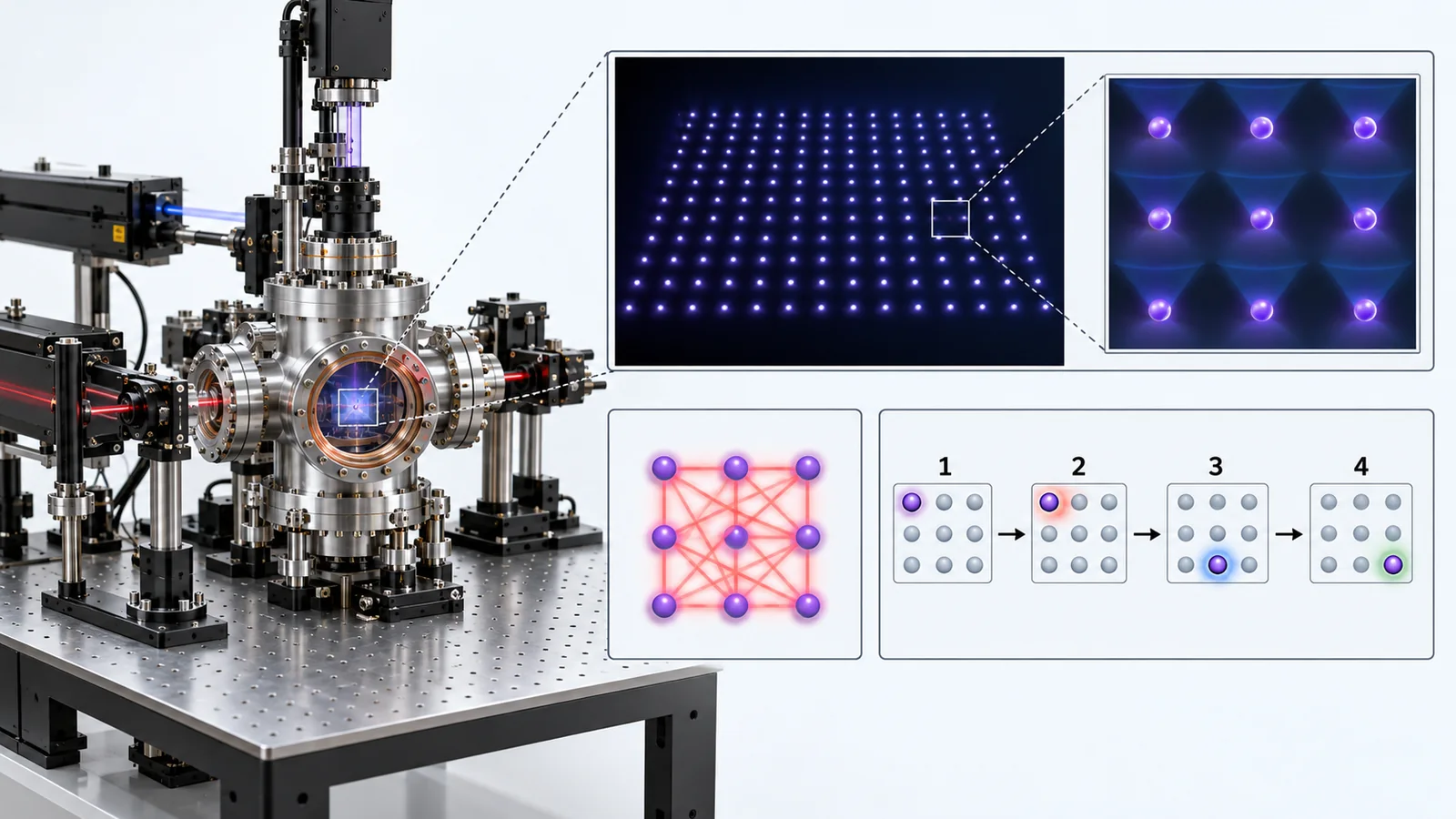
Pasqal is a French company that uses atoms, caught one at a time with laser light and arranged in a grid, as the parts (qubits) of a quantum computer. It was founded in 2019 on research by Alain Aspect, winner of the 2022 Nobel Prize in Physics, and his colleagues. The company says that today it leads with an "analog" mode (the layout of the atoms encodes a problem, and the atoms' natural interactions do the computing), and that the same machine is meant to move toward a "digital" mode (stacking instructions one by one) with error correction. On 27 August 2026 it completed its merger with a special purpose acquisition company (SPAC), Bleichroeder Acquisition Corp. II, and began trading on Nasdaq (PSQL) on 28 August. Revenue was about EUR 16.5 million in 2025, still small, and losses are widening. This profile sets out the route to listing (from SEC filings), the machines delivered, revenue and funding, and the roadmap, using only the company's filings and announcements. Claims such as "quantum advantage" are treated as the company's own. Information checked on 16 October 2026.
- Pasqal at a glance, and where it sits in quantum computing
- Logo and naming
- Where the company sits in the quantum-computing landscape
- Company size
- Resources committed to quantum computing
- What the company has done so far
- Plans
- What the company is aiming for in quantum computing
- Partnership map for quantum computing
- Technology, products and services
- Risks the company faces
- Glossary / References / Claim-to-source audit
1. Pasqal at a glance, and where it sits in quantum computing
(from 28 August 2026)Merger with the SPAC Bleichroeder Acquisition Corp. II completed on 27 August 2026
with optical tweezersIts photonic-chip experiment used rubidium atoms (company announcement). Analog mode is the main use; digital mode is a goal
140 to 200 qubitsPhysical qubits. About 4 kW of power (company's description). Seven installed, three in production
in 2029A company plan. Results in experiments so far are small in scale (see the text)
Pasqal is trying to sell quantum computers in a form that can be used now. Its main product today is the analog mode: the layout of the atoms represents the problem to be solved (optimization, simulation of materials and so on), and the atoms' natural forces do the calculation. The "digital mode", which stacks instructions called gates one by one, and "error correction", which fixes mistakes, are future goals Sourced. Revenue is still small (about EUR 4.9 million in the first half of 2026), and customers are public computing centers in Europe (GENCI/CEA in France, the Jülich research center in Germany, CINECA in Italy) as well as Saudi Aramco. In 2026 the company said it can "deliver quantum advantage on meaningful applications today". This profile treats that as the company's claim; an independent check could not be found.
2. Logo and naming

A note on names: the company is Pasqal. As legal entities, the listed company after the merger is Pasqal Holding SA, and the operating company Pasqal SAS is its subsidiary. The name honors the 17th-century French scientist Blaise Pascal. Orion is a machine name and Pulser is a software name; neither is a company name.
Official site: https://www.pasqal.com/3. Where the company sits in the quantum-computing landscape
First, qubits and approaches. A qubit is the smallest part of a quantum computer. Unlike an ordinary bit, it can be in a "superposition" of 0 and 1. What the qubit is made of is the "approach", and Pasqal uses electrically neutral atoms.
A distinctive feature of Pasqal's machines is that the same atom array can be used in two ways. The illustration below shows the difference in simple terms.
4. Company size
Pasqal listed only in August 2026, and no annual report (Form 20-F) has been filed yet. Figures up to 2025 come from the prospectus; figures for the first half of 2026 come from the management's discussion and analysis (MD&A) attached to Form 6-K. Units are millions of euros, rounded from thousands Sourced.
| Item (EUR million) | 2024 | 2025 | H1 2026 |
|---|---|---|---|
| Revenue | 3.5 | 16.5 | 4.9 (4.3 a year earlier) |
| of which QPU (machine) sales | 0 | 7.5 | 0 |
| of which QPU-related services | 2.1 | 6.5 | 3.9 |
| of which cryostat sales | 1.4 | 2.6 | 0.9 |
| Operating loss | (46.8) | (50.5) | (59.2) (includes 37.5 of share-based pay and one-off items) |
| Net loss | (48.5) | (92.4) | (53.2) |
| Cash and cash equivalents | - | 73.8 (end of December) | 110.8 (end of June) to about 312.9 (27 August 2026) |
The 2025 revenue is 16,468 thousand in the table, while the text says "EUR 16.4 million". The 2025 net loss of EUR 92.4 million includes a loss of about EUR 34.9 million from the change in fair value of redeemable bonds (ORA bonds).
| Other measures of size | Details | Source |
|---|---|---|
| Employees | About 300 (more than 70 hold PhDs). At the Palaiseau headquarters, 14 specialized laboratories and 10 rooms for QPUs | Reference 1 https://www.sec.gov/Archives/edgar/data/2119292/000121390026085694/ea0282861-11.htm |
| Patents | About 92 patent families (issued and pending combined) | Reference 1 https://www.sec.gov/Archives/edgar/data/2119292/000121390026085694/ea0282861-11.htm |
| Booked and awarded business | EUR 70.4 million (30 June 2026). It includes grants, tax credits and multi-year customer contracts, so it is not revenue | Reference 4 https://www.pasqal.com/newsroom/pasqal-reports-first-half-2026-financial-results/ |
| Shares outstanding | 212,293,691 as of 27 August 2026 | Reference 2 https://www.sec.gov/Archives/edgar/data/2119292/000121390026096761/ea0303765-20f_pasqal.htm |
The 14% rise in first-half 2026 revenue came from the timing of revenue recognition (an upgrade of the QPU at the Jülich research center), and the company itself writes that revenue may fluctuate between periods. The Saudi Aramco machine was commissioned in 2026, but the related service revenue is expected to be recognized in future periods as the services are performed Sourced. And "booked and awarded business" includes grants and tax credits, so it is not an outlook for revenue.
5. Resources committed to quantum computing
The table shows whether four items (people, money, outside investments and acquisitions, and ties to universities and public bodies) could be confirmed.
| Type of resource | Details | Status |
|---|---|---|
| People | About 300, with more than 70 PhDs. Staff costs were about EUR 38.7 million in 2025 (about EUR 27.9 million in 2024). Most staff work in research and development | Sourced |
| Money: funding | More than US$300 million raised since founding (prospectus). From April to December 2025, EUR 68.3 million of redeemable bonds (ORA bonds, 12% a year); from December 2025 to February 2026, about EUR 101 million of Series C shares (EUR 139.54 per share); in March 2026, US$312.5 million of convertible bonds (US$250 million paid). About US$27.7 million remained in the SPAC's trust account after redemptions of about US$266 million | Sourced |
| Money: cash | EUR 110.8 million at the end of June 2026, and about EUR 312.9 million on 27 August after the merger (half-year results). The merger-completion announcement says "approximately US$360 million of cash available at closing" (currency, date and definition differ) | Sourced |
| Money: public funding and loans | Government grant income of about EUR 7.2 million in 2025 (about EUR 10.8 million in 2024). A loan from Investissement Québec (up to CAD 15 million), a loan from the Illinois Finance Authority (up to US$15 million, 3.55% a year), and Bpifrance loans | Sourced |
| Outside investments, acquisitions, joint ventures | Qu&Co Solutions (acquired in 2021, wound down in June 2025 with the closure of the Dutch entity), MyCryoFirm (acquired in 2022; cryostats), and Aeponyx Enterprises (Canada, acquired in 2024; photonic integrated circuits). Shareholders include Quantonation (11.5%), Bpifrance-affiliated entities (11.4%), Runa Capital (8.9%), EIC Fund (6.8%) and Temasek-affiliated entities (5.6%) (as of 1 September 2026, from the Form 20-F table) | Sourced |
| Universities, research bodies, public bodies | Institut d'Optique; machines delivered to GENCI/CEA, the Jülich research center and CINECA; the EU's Q-PLANET (EUR 50 million in total, 28 bodies, with Pasqal as coordinator); and the French defense procurement agency's (DGA) defense program, which Pasqal left in September 2026 after its first phase | Sourced |
Here are the main machines and experiments, as far as the company's materials allow (checked 16 October 2026). The numbers are the company's stated values or statements in its announcements. Because the methods and conditions differ, they are not lined up against other companies to rank them.
| Machine / experiment | Scale and content (approach: neutral atoms, mainly analog) | Stage | Date | Source |
|---|---|---|---|---|
| Orion | 140 to 200 physical qubits, about 4 kW of power (company's description; the same prospectus compares this with more than 1,400 kW for a classical supercomputer). Seven installed and four delivered to third parties (GENCI/CEA, Jülich, Saudi Arabia, CINECA) | Available / delivered | August 2026 (prospectus) | Reference 1 https://www.sec.gov/Archives/edgar/data/2119292/000121390026085694/ea0282861-11.htm |
| Machine in Saudi Arabia | A two-dimensional array that can control 200 qubits, installed in Saudi Aramco's data center in Dhahran | Installed / operating | 24 November 2025 (announcement) | References 6, 4 https://www.pasqal.com/newsroom/aramco-and-pasqal-make-history-with-saudi-arabia-first-quantum-computer/ https://www.pasqal.com/newsroom/pasqal-reports-first-half-2026-financial-results/ |
| Machine for Italy | 140 qubits, designed to connect to the Leonardo supercomputer. Full operation at CINECA is planned within 2026 | Delivered / being commissioned | 2026 | References 4, 1 https://www.pasqal.com/newsroom/pasqal-reports-first-half-2026-financial-results/ https://www.sec.gov/Archives/edgar/data/2119292/000121390026085694/ea0282861-11.htm |
| 324-qubit QPU | Developed for analog-mode materials-science applications. First demonstrations carried out (company's description) | Development / demonstration | August 2026 (prospectus) | Reference 1 https://www.sec.gov/Archives/edgar/data/2119292/000121390026085694/ea0282861-11.htm |
| 1,024-atom array | A defect-free array of 1,024 atoms (previously 506). Atom lifetime extended about 40-fold (redesigned cooling system) | Experiment (company announcement) | First half of 2026 | Reference 4 https://www.pasqal.com/newsroom/pasqal-reports-first-half-2026-financial-results/ |
| Building blocks of a logical qubit | Demonstrated "an initial capability to construct and operate the key building blocks of a logical qubit" at a review under the French government's PROQCIMA program. An experiment comparing logical and physical qubits on a machine-learning differential-equation task (the company calls it the first such comparison on a full application) | Experiment (small scale) | Early 2026 to May 2026 | References 1, 4 https://www.sec.gov/Archives/edgar/data/2119292/000121390026085694/ea0282861-11.htm https://www.pasqal.com/newsroom/pasqal-reports-first-half-2026-financial-results/ |
| Trapping atoms with a photonic integrated circuit (PIC) | From one photonic chip, four rubidium atoms held in four optical tweezers. Lifetime about 27.5 seconds, matching bulk-optics systems (company announcement). Optical footprint reduced by up to a factor of 50 | Experiment (company announcement) | 2026 (half-year results) | Reference 4 https://www.pasqal.com/newsroom/pasqal-reports-first-half-2026-financial-results/ |
| Vela / Centaurus / Lyra | Vela: over 200 qubits (2027). Centaurus: early fault tolerance (2028). Lyra: impactful fault tolerance (2029). All planned | Plan Not yet confirmed | August 2026 (prospectus) | Reference 1 https://www.sec.gov/Archives/edgar/data/2119292/000121390026085694/ea0282861-11.htm |
The prospectus and announcements checked here do not give figures for gate fidelity or qubit coherence time, so the table omits them. The stage "plan" does not mean the outcome is certain.
6. What the company has done so far
| When | What happened | Meaning |
|---|---|---|
| 2019 | Founded in France by Georges-Olivier Reymond, Christophe Jurczak, Alain Aspect, Antoine Browaeys and Thierry Lahaye | Researchers of neutral atoms are the founders |
| 2021 to 2022 | Acquired Qu&Co Solutions (2021) and MyCryoFirm (2022). Series A (2021) and Series B (2022) | Took in software and cooling technology |
| January 2023 | Wa'ed Ventures, the venture arm of Saudi Aramco, invested | A step toward the later Saudi presence, according to the company |
| 2024 | An array of more than 1,000 atoms (June). Acquired Aeponyx (Canada; photonic integrated circuits). Contract with Saudi Aramco | Took in optical parts for mass production and miniaturization |
| 2025 | Opened a second factory in Sherbrooke, Canada. Loïc Henriet became chair in April; Wasiq Bokhari was appointed Managing Director on 29 October. ORA bonds (April to December), Series C (from December). Qu&Co wound down (June) | Reshaped management and funding |
| November 2025 | Installed a 200-qubit machine in Saudi Aramco's Dhahran data center (24 November) | The company describes it as the Middle East's first quantum computer for industrial use |
| February to March 2026 | Signed the merger agreement with the SPAC (28 February). Convertible-bond agreement (4 March) | The path to listing |
| May to July 2026 | Reached the finals of XPRIZE Quantum Applications (May). Experiment comparing logical and physical qubits (May). Opened a photonic-chip packaging center in Quebec (2 July) | Announcements on both applications and components |
| August 2026 | SPAC shareholders approved the merger (25th), the merger closed (27th) and trading began on Nasdaq (28th). About US$266 million was redeemed from the trust account | Became a listed company |
| September to October 2026 | Shell company report (20-F, 2 September), half-year results (24 September), exit from the French defense program PROQCIMA (28 September), announced as coordinator of the EU's Q-PLANET (6 October) | The center of gravity shifted from defense to civil and European industrial policy |
7. Plans
First, an illustration of the "machine generations" the company set out in its prospectus. All of it is company plan, not accomplished fact.
The company describes these as "targets", "plans" and "expectations", and they are not accomplished facts Not yet confirmed. The roadmap page set a goal of "demonstrating quantum advantage by the end of Q1 2026". The September 2026 half-year announcement says the company can "deliver quantum advantage on meaningful applications today", but the conditions behind that statement and any comparison with classical computers are not given in the announcement, and we could not confirm them.
None of the following could be confirmed from the company's filings and announcements Not yet confirmed: gate fidelity (single- and two-qubit) and coherence-time figures; Vela orders and customers; error-rate figures for the logical-qubit experiments; whether classical-computing researchers have disputed the quantum-advantage claims (we did not look into this); and the amount of the new French public support. Phrases such as "the second largest fleet of complex quantum computers in the world" (company statement) are the company's claims, and we have not confirmed any third-party comparison.
8. What the company is aiming for in quantum computing
This chapter includes points the company does not state directly. They are given as inferences, within what the primary sources support, together with the evidence.
| What can be read from the sources | Primary evidence | Status |
|---|---|---|
| For now, revenue centers on delivering analog machines and services, with digital (fault-tolerant) to follow | The prospectus says it "leads with" analog in the near term; revenue came from machine sales (2025) and QPU-related services (first half of 2026). Digital is planned for 2028 to 2029 | Inference |
| It builds a track record by delivering to public computing centers in Europe and is widening sales to the Middle East and Asia | Deliveries to GENCI/CEA, Jülich and CINECA, the Saudi Aramco machine, MOUs with Eleven Ventures and KACST, and offices in South Korea, the U.S. and Canada | Inference |
| It is trying to solve the bottleneck of mass production and miniaturization with photonic integrated circuits (PICs) | It acquired Aeponyx and held four atoms for about 27.5 seconds from a PIC, saying the optical footprint can shrink by up to a factor of 50. In Q-PLANET it leads chip-based lasers at 1013 nm | Inference |
| It has shifted its main public funding from defense (PROQCIMA) to civil and European industrial policy | The announcement of 28 September 2026 describes leaving PROQCIMA and a "focus on commercial applications", and says Pasqal was asked to submit a civil fault-tolerance R&D plan. On 6 October it was announced as coordinator of Q-PLANET | Sourced (the reason is an inference) |
| The cash from the SPAC listing was limited by large redemptions by public shareholders | About US$266 million was redeemed, and about US$27.7 million remained in the trust account. With the convertible bonds (US$250 million paid) and other items, the company says about US$360 million was available | Sourced |
The half-year announcement says that, using a photonic-chip laser, four rubidium atoms were held in four optical tweezers for about 27.5 seconds. The company says this matches systems with conventional optics and reduces the optical footprint by up to a factor of 50 Sourced. In a neutral-atom machine, the more atoms there are, the larger and more complex the optics that deliver laser light to the chosen positions become. From this we read that "Pasqal sees putting the optics onto a chip, to cut the size and assembly effort when scaling to the 10,000-qubit range, as a key to mass production". But the experiment held four atoms, and no run of an array of thousands of atoms on a PIC is described. This reading takes the company's statement as given, and whether it helps mass production will be shown by later demonstrations Not yet confirmed.
9. Partnership map for quantum computing
10. Technology, products and services
| Layer | Main product | What the filings and official materials say |
|---|---|---|
| Qubit | Neutral atoms arranged with optical tweezers | Atoms cooled and caught with lasers are arranged in a grid, their states are operated on with other lasers, and they are read out through fluorescence. Qubits do not have to be fabricated, so nature's uniformity can be used. The qubits themselves do not need cryogenic cooling (company's description) |
| Machine | Orion (140 to 200 qubits) | Installed at the customer's site (on-premises) and able to sit in a data center. Designed to run both analog and digital modes on the same machine |
| Software | Pulser, Pulser Studio, hybrid libraries | Tools for designing analog-mode programs. Links with IBM's Qiskit and NVIDIA's CUDA-Q |
| Cloud | Pasqal Cloud, Microsoft Azure Quantum, Google Cloud Marketplace | Remote access to analog-mode QPUs, with pay-as-you-go use |
| Other | Cryostats (cryogenic equipment) | Revenue has a "cryostat sales" line, about EUR 2.6 million in 2025, tracing to MyCryoFirm (acquired in 2022). The company says qubits need no cryogenics, but the role of this equipment inside the machine is not described in detail in the materials |
Atoms are "identical"; what matters is light and vacuum: in a neutral-atom machine the qubit material is a natural atom. The company says it "does not need to manufacture qubits" Sourced. Performance depends on the quality of the vacuum that holds the atoms and the optics that deliver light accurately to the chosen atoms.
Photonic integrated circuits (PICs): the company says PICs can provide high-speed modulators, low-noise lasers, amplifiers and filters, and are compatible with scaling to tens of thousands of qubits Sourced. In the EU's Q-PLANET, lasers at four wavelengths (461 nm, 698 nm, 795 nm and 1013 nm), atom chips and microfabricated vapor cells for atomic clocks are to be developed, and Pasqal leads the chip-based 1013 nm laser Sourced. The direction is to apply silicon and photonics manufacturing processes to light sources and parts that control atoms.
What could not be confirmed: the specific materials or processes of the PICs (for example silicon nitride, silicon or thin-film lithium niobate) are not described in the materials checked here Not yet confirmed. Our explainers "silicon photonics", "silicon nitride waveguides", "thin-film lithium niobate" and "semiconductor lasers" cover the background of such parts.
11. Risks the company faces
| Risk | Details | Status |
|---|---|---|
| Small revenue, large losses | 2025 revenue of about EUR 16.5 million against a net loss of EUR 92.4 million; first-half 2026 revenue of about EUR 4.9 million against a net loss of EUR 53.2 million | Sourced |
| Debt and dilution | The US$312.5 million of convertible bonds (US$250 million paid) is measured at fair value as a financial liability. Conversion (about 26.0 million shares) and exercise of investor warrants (about 32.6 million shares) could increase the share count | Sourced |
| Government involvement in company decisions | Bpifrance is a shareholder, and the operating company's strategic committee needs its vote on matters such as moving intellectual property out of France, selling key assets outside the EU, and appointing key executives. The company says this could limit decision-making | Sourced |
| Changes in public programs | Participation in the French defense program (PROQCIMA) ended after the first phase. Civil public support is still being designed; content and amount are not set | Not yet confirmed |
| Commitments to the Canadian government | In connection with the Aeponyx acquisition, the company has undertakings and compliance duties (on employment, limits on technology collaboration and so on) that it says could limit operational flexibility | Sourced |
| Checking the "quantum advantage" claim | The company says it can deliver quantum advantage on applications today, but the conditions and comparisons are not set out in the announcement, and no independent check was found | Not yet confirmed |
| Limits on production capacity | The expansion to 13 machines a year is expected "if staffing, preparation and parts are in place" | Not yet confirmed |
| Regulatory change | QPUs are currently not classed as dual-use items and are outside sensitive export controls, but that could change with the law. The EU Quantum Act is at the proposal stage | Sourced |
| Competition | Atom Computing, QuEra Computing, Infleqtion and other neutral-atom companies, and superconducting, ion and photonic approaches that also aim for logical qubits. The company's "second largest fleet" is its own claim, and no ranking against others is made here | Sourced |
12. Glossary
- Qubit
- The smallest part of a quantum computer. It can be in a superposition of 0 and 1.
- Neutral atom
- An atom with no electric charge. It is trapped and arranged with laser light and used as a qubit.
- Optical tweezers
- Finely focused laser light that holds and moves atoms one at a time.
- Analog quantum computing
- A mode in which the atom layout encodes a problem and the atoms' natural interactions do the computing. No gates are stacked.
- Digital (gate-based) mode
- A mode that computes by stacking instructions called gates. It combines well with error correction.
- Logical qubit
- Several physical qubits combined into one qubit that is more robust against errors.
- Fault-tolerant quantum computing (FTQC)
- A quantum computer that fixes mistakes automatically while it runs.
- QPU
- Quantum processing unit, the core device that does a quantum computer's calculation.
- Photonic integrated circuit (PIC)
- Light-handling parts put together on a single chip.
- SPAC
- A special purpose acquisition company. It lists first and then merges with an operating company, which thereby becomes listed.
- Form 20-F / 6-K
- The annual report (20-F) and ad hoc report (6-K) that foreign companies listed in the U.S. file.
- ORA bonds
- Bonds redeemable in shares. Pasqal issued them in 2025, and they were later converted into Series B or Series C shares.
13. References
- Pasqal Holding SA (U.S. SEC) Proxy statement/prospectus (Form 424B3, 5 August 2026). Company information, technology, products, customers, regulation, financials (MD&A), risks, and the plan for machine generations. https://www.sec.gov/Archives/edgar/data/2119292/000121390026085694/ea0282861-11.htm
- Pasqal Holding SA (U.S. SEC) Shell Company Report on Form 20-F (filed 2 September 2026; event date 27 August 2026). Completion of the merger, redemptions, convertible bonds, shareholdings. https://www.sec.gov/Archives/edgar/data/2119292/000121390026096761/ea0303765-20f_pasqal.htm
- Pasqal "Pasqal and Bleichroeder Acquisition Corp. II Complete Business Combination" (27 August 2026). https://www.pasqal.com/newsroom/pasqal-and-bleichroeder-acquisition-corp-ii-complete-business-combination/
- Pasqal "Pasqal Reports First Half 2026 Financial Results" (24 September 2026). Half-year revenue, cash and technical highlights. https://www.pasqal.com/newsroom/pasqal-reports-first-half-2026-financial-results/
- Pasqal Holding SA (U.S. SEC) Form 6-K Exhibit 99.2, MD&A (half-year to 30 June 2026, filed 24 September 2026). Revenue breakdown, net loss, cash. https://www.sec.gov/Archives/edgar/data/2119292/000121390026102831/ea030634601ex99-2.htm
- Pasqal "Aramco and Pasqal make history with Saudi Arabia's first quantum computer" (24 November 2025). https://www.pasqal.com/newsroom/aramco-and-pasqal-make-history-with-saudi-arabia-first-quantum-computer/
- Pasqal Official website "Our Roadmap" (checked 16 October 2026). Roadmap goals. https://www.pasqal.com/technology/roadmap/
- Pasqal "Pasqal Announces an Evolution of Its Collaboration Framework with the French Public Authorities" (28 September 2026). Exit from PROQCIMA. https://www.pasqal.com/newsroom/pasqal-announces-an-evolution-of-its-collaboration-framework-with-the-frenchpublic-authorities/
- Pasqal "Pasqal Reaffirms its Commitment to the EU's Quantum Ambitions as It Leads Q-PLANET..." (6 October 2026). https://www.pasqal.com/newsroom/pasqal-reaffirms-its-commitment-to-the-eus-quantum-ambitions-as-it-leads-q-planet-for-neutral-atom-technologies/
- U.S. SEC EDGAR list of filings by Pasqal Holding SA (checked 16 October 2026). https://www.sec.gov/cgi-bin/browse-edgar?action=getcompany&CIK=0002119292&type=&dateb=&owner=include&count=40
14. Claim-to-source audit
| Claim in the text | Status | Source |
|---|---|---|
| Founded in 2019, co-founders, about 300 employees, about 92 patent families, sites | Sourced | Reference 1 https://www.sec.gov/Archives/edgar/data/2119292/000121390026085694/ea0282861-11.htm |
| Completion of the merger (27 August 2026), start of Nasdaq (PSQL) trading (28 August), headquarters address | Sourced | References 2, 3 https://www.sec.gov/Archives/edgar/data/2119292/000121390026096761/ea0303765-20f_pasqal.htm https://www.pasqal.com/newsroom/pasqal-and-bleichroeder-acquisition-corp-ii-complete-business-combination/ |
| Redemptions of about US$266 million, about US$27.7 million left in the trust account, US$312.5 million of convertible bonds (US$250 million paid), 212,293,691 shares outstanding | Sourced | Reference 2 https://www.sec.gov/Archives/edgar/data/2119292/000121390026096761/ea0303765-20f_pasqal.htm |
| Shareholdings (Quantonation 11.5%, Bpifrance-affiliated 11.4%, Runa Capital 8.9%, EIC Fund 6.8%, Temasek-affiliated 5.6%) | Sourced | Reference 2 https://www.sec.gov/Archives/edgar/data/2119292/000121390026096761/ea0303765-20f_pasqal.htm |
| Revenue (EUR 3.5 million in 2024, EUR 16.5 million in 2025), its breakdown, net loss, staff costs, government grant income, ORA bonds, Series C | Sourced | Reference 1 https://www.sec.gov/Archives/edgar/data/2119292/000121390026085694/ea0282861-11.htm |
| First-half 2026 revenue of EUR 4.9 million, breakdown, net loss of EUR 53.2 million, cash of EUR 110.8 million, 1,024 atoms, atoms held with a PIC, EUR 70.4 million of booked and awarded business | Sourced | References 4, 5 https://www.pasqal.com/newsroom/pasqal-reports-first-half-2026-financial-results/ https://www.sec.gov/Archives/edgar/data/2119292/000121390026102831/ea030634601ex99-2.htm |
| Orion (140 to 200 qubits, about 4 kW), seven installed and four delivered, 324-qubit QPU, plans for Vela, Centaurus and Lyra, capacity of 13 machines a year | Not yet confirmed | Reference 1 https://www.sec.gov/Archives/edgar/data/2119292/000121390026085694/ea0282861-11.htm |
| The Saudi Aramco machine (200 qubits) and the Wa'ed Ventures investment (January 2023) | Sourced | Reference 6 https://www.pasqal.com/newsroom/aramco-and-pasqal-make-history-with-saudi-arabia-first-quantum-computer/ |
| Roadmap (quantum-advantage target, over 200 logical qubits) | Not yet confirmed | Reference 7 https://www.pasqal.com/technology/roadmap/ |
| Exit from PROQCIMA; request to submit a civil fault-tolerance R&D plan | Sourced | Reference 8 https://www.pasqal.com/newsroom/pasqal-announces-an-evolution-of-its-collaboration-framework-with-the-frenchpublic-authorities/ |
| Q-PLANET (EUR 50 million, 28 bodies in 11 countries, a chip-based laser at 1013 nm) | Sourced | Reference 9 https://www.pasqal.com/newsroom/pasqal-reaffirms-its-commitment-to-the-eus-quantum-ambitions-as-it-leads-q-planet-for-neutral-atom-technologies/ |
| The 2026 claim that it can "deliver quantum advantage today" | Not yet confirmed | Reference 4 https://www.pasqal.com/newsroom/pasqal-reports-first-half-2026-financial-results/ |
| Grouping of the company as "trapped ions & neutral atoms" | Our calculation | Our own grouping; company names are examples from this series |
| Gate fidelity, coherence time, Vela orders, whether classical researchers have disputed the claims, amount of new French support | Not yet confirmed | None could be confirmed; we do not estimate them. Within the statements in References 1 and 4 https://www.sec.gov/Archives/edgar/data/2119292/000121390026085694/ea0282861-11.htm https://www.pasqal.com/newsroom/pasqal-reports-first-half-2026-financial-results/ |
| Analog-led revenue, wider sales to the Middle East and Asia, PICs to ease mass production, and a shift from defense to civil funding | Inference | Our own interpretation of the prospectus, the half-year results and the announcement of 28 September |
| The list of filings (20-F, F-4, 6-K and others) | Sourced | Reference 10 https://www.sec.gov/cgi-bin/browse-edgar?action=getcompany&CIK=0002119292&type=&dateb=&owner=include&count=40 |
Last updated: 16 October 2026 / Troy Technical
The figures in this profile are based on filings that Pasqal Holding SA made with the U.S. Securities and Exchange Commission (Form 424B3, 20-F, 6-K) and on company announcements. No market-research estimates or press-only figures are used. Passages marked "Inference" are our reading of the primary sources, not statements by the company. Performance figures are the company's stated values or statements in its announcements, and they are not lined up against other companies' figures that use different methods or conditions. Share prices and valuations are not discussed.