COMPANY PROFILE / QUANTUM COMPUTING
QuEra Computing
- A privately held "neutral-atom" company that rearranges atoms with optical tweezers, runs logical-qubit experiments and aims for a fault-tolerant machine in 2028
QuEra Computing is a Boston company that grew out of research at Harvard University and the Massachusetts Institute of Technology (MIT). It grabs individual electrically neutral atoms with laser "optical tweezers," arranges them, and rearranges them as it computes, using them as qubits. It is known for Aquila, a 256-qubit machine put on the cloud in 2022, and in 2025 it installed a "Gemini-class" machine that can run logical-qubit experiments at Japan's National Institute of Advanced Industrial Science and Technology (AIST). In June 2026 it announced a plan to offer a fault-tolerant quantum computer, "Libra," on Amazon Braket in 2028. Because the company is privately held, most financial figures such as revenue are not published. Using only what the company's official announcements and peer-reviewed papers let us confirm, this profile separates what has been achieved from what is still a plan.
- QuEra in 30 seconds, and its place in quantum computing
- Logo and the company name
- Where the company sits in the quantum computing landscape
- Company size
- Resources committed to quantum computing
- Track record so far
- Plans
- What the company seems to be aiming for in quantum computing
- Partnership map in quantum computing
- Technology, products and services
- Risks the company faces
- Glossary / References / Claim-to-source audit
1. QuEra in 30 seconds, and its place in quantum computing
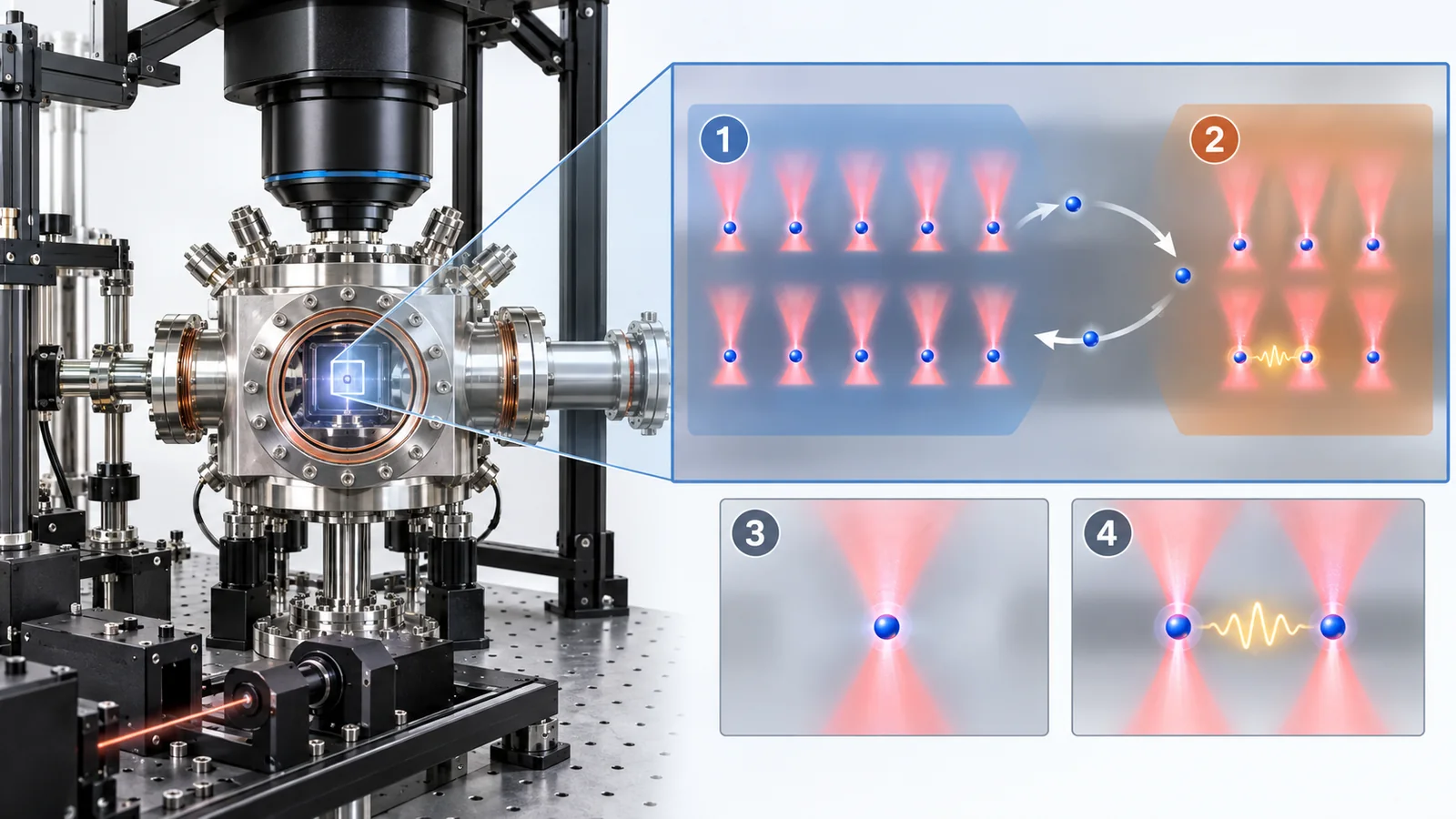
QuEra's qubits are individual atoms. Atoms are made by nature, so every one behaves identically, and the company says the machine runs at room temperature (only the atoms inside a vacuum chamber are laser-cooled) Sourced. The strength of this approach is that optical tweezers can move atoms freely: the atoms that need to work together are brought close and "entangled," so the way qubits are connected can be changed at will. The weakness is that atoms sometimes escape (atom loss). In 2025 QuEra and Harvard-MIT reported keeping an array of 3,000 atoms running for over two hours while topping up missing atoms. Figures such as "48 logical qubits," however, come with conditions. Chapter 5 sets them out from the papers.
2. Logo and the company name
A note on the name: the company is QuEra Computing Inc., usually just QuEra, with mixed upper and lower case. QuEra's scientific founders are Mikhail Lukin and Markus Greiner of Harvard University and Vladan Vuletic of MIT (company announcements). QuEra is a company separate from those university labs, and the joint research continues.
Official website: https://www.quera.com/ Logo source: https://www.quera.com/media-kit3. Where the company sits in the quantum computing landscape
Quantum computing companies divide mainly by what the qubit is made of (the approach). QuEra uses neutral atoms. Where trapped ions float electrically charged atoms in electric fields, neutral atoms are caught by optical tweezers, focused laser light. Every atom of a kind is identical, and it is easy to line up many of them, which is the approach's hallmark. On the other hand, atoms can escape, and the accuracy of two-qubit operations differs by approach and by how it is measured Our calculation (a generally known tendency).
4. Company size
The company is privately held, so figures such as revenue, profit and headcount can be confirmed only within what the company announces (checked 16 October 2026) Sourced.
| Item | Detail | Reference |
|---|---|---|
| Public launch of the business | On 17 November 2021 it announced US$17 million in funding, a completed 256-qubit device and US$11 million in revenue, and came out of stealth | Reference 16 |
| Sites | Boston (headquarters), Tokyo and the U.K. (the company's media kit) | Reference 14 |
| Management | The CEO is Andy Ory. In July 2024 the then-CEO, Alex Keesling, moved to a role leading higher-volume production and technology enhancements, and Ory became acting CEO. By December 2025 he was announced as CEO | References 15, 5 |
| Headcount | The company said it doubled its global workforce in 2025. The number is not published | Reference 5 |
| Revenue and profit | It announced "record revenues and cash collections" for 2025. The amounts are not published (we do not estimate them) | Reference 5 |
| Funding | More than US$230 million in February 2025 (of which US$60 million was conditional). NVIDIA's venture arm NVentures added to it in September 2025. Google Quantum AI invested in October 2024 (amount not disclosed) | References 2, 3, 4 |
"More than US$230 million" is the company's announcement, not an audited financial report. Revenue and customer numbers, each investor's amount and the company's valuation have not been announced. For a private company, finances can only be confirmed within what it announces, so this article does not discuss revenue or valuation.
5. Resources committed to quantum computing
Quantum computing is the main business, so the table shows, for each of the four points (people, money, outside relationships, public-sector ties), whether primary sources let us confirm it.
| Type of resource | Detail | Status |
|---|---|---|
| People | Doubled its headcount in 2025 and plans significant growth in 2026. Headcount and the number of researchers are not published (Reference 5) | Sourced / Not published |
| Money (funding) | A Series B of more than US$230 million (Google Quantum AI, SoftBank Vision Fund 2, Valor Equity Partners, QVT, Safar Partners and others, with NVentures added). The company says the funds go to developing fault-tolerant machines, expanding staff and strengthening build-and-test capacity (References 2, 3) | Sourced |
| Money (orders) | A ¥6.5 billion (about US$41 million) contract from AIST for a machine (April 2024). In DARPA's Quantum Benchmarking Initiative (QBI) Stage B, up to US$15 million over 12 months (November 2025) | Sourced |
| Investments, acquisitions, joint ventures, divestments in other companies | No investment in, acquisition of, joint venture with or sale of another company was found in official announcements (the company is on the receiving end of investment) | Could not be confirmed |
| Universities and research institutes | Joint research with Harvard and MIT labs (the papers are co-authored with them). The 2023 logical-qubit experiment was also joint with the U.S. National Institute of Standards and Technology (NIST) and the University of Maryland (Reference 23). Research on low-overhead fault tolerance was with Harvard and Yale | Sourced |
| Public funding and public bodies | DARPA QBI Stage B; the U.S. Department of Energy's ARPA-E Quantum Computing for Computational Chemistry (QC3) program (US$37 million across all performers, with QuEra on 3 of 9 teams, announced 15 October 2026); Japan's NEDO "Post-5G" project to build a supply chain for quantum components; and a testbed machine for the U.K.'s National Quantum Computing Centre (NQCC) (a contract won in 2024; a delivery photo is in the company media kit) | Sourced |
| Manufacturing and equipment | It says it is strengthening capacity to assemble and test machines for volume production, and building a supply chain for optical and vacuum components through the NEDO project (Reference 5) | Sourced / Not yet confirmed |
Status of the main devices and products (as far as the company's official materials confirm)
| Device | Approach | Qubit count | Representative figures (company's stated values, with conditions) | Stage | Checked / reference |
|---|---|---|---|---|---|
| Aquila | Neutral atoms (analog) | 256 physical | An analog machine that uses atom interactions directly rather than building gate circuits. Available more than 100 hours a week on Amazon Braket | Operating (since November 2022) | 16 October 2026 / Reference 13 |
| Gemini-class | Neutral atoms (gate-based, rubidium-87) | 260 physical. As a logical-qubit testbed, fewer than 100 | Single-qubit gates 99.9% / two-qubit gates 99.2% / state preparation, readout and atom shuttling 99.7% (company product page) | Operating (since 2025). Installed at AIST | 16 October 2026 / References 12, 11, 5 |
| Libra | Neutral atoms (gate-based, fault-tolerant) | 256 or more logical / more than 10,000 physical (roadmap page) | Target logical error rate of 10-6 (one in a million). "Megaquop class" (about a million logical operations) | Not yet confirmed (planned for Amazon Braket in 2028) | 16 October 2026 / References 1, 11 |
| Next generation | Neutral atoms (gate-based, fault-tolerant) | 1,000 or more logical / more than 20,000 physical | Target logical fidelity of 99.9999999%. "Gigaquop class" | Not yet confirmed (listed on the roadmap as 2028 to 2029) | 16 October 2026 / References 11, 10 |
48 logical qubits (2023): the paper (Bluvstein et al., Nature) reports a "logical processor" operating with up to 280 physical qubits, and says that using blocks of a three-dimensional [[8,3,2]] code it ran circuits with up to 48 logical qubits entangled. The code's "distance" is 2, so it detects errors rather than correcting them, and the paper says explicitly that performance improved "with error detection." It means the logical encoding beat the physical qubits on some measures. The title of the company's announcement about this result speaks of "error-corrected" algorithms, which differs from the paper's wording (detection) (References 17, 23) Sourced.
99.5% two-qubit gates (2023): this is the value reported in another paper (Evered et al., Nature) for parallel two-qubit gates on up to 60 neutral atoms (Reference 22). It was measured on a different device and under different conditions from the 99.2% on the Gemini product page.
"96 logical qubits" and "2.14 times below threshold" (2025): the paper (Bluvstein et al., Nature, November 2025) reports, in surface-code experiments on arrays of up to 448 neutral atoms, "below-threshold" performance, with errors shrinking as repeated error-correction rounds are added (2.14 times in a four-round circuit). The company's announcement speaks of algorithms with "up to 96 logical qubits," while the paper's abstract speaks of "dozens of logical qubits" and of the [[7,1,3]] and high-rate [[16,6,4]] codes, so the numbers differ with the code and the conditions (Reference 18). Numbers from different approaches and measurement methods cannot be lined up to rank them.
Continuous operation: the paper (Chiu et al., Nature, September 2025) uses two optical-lattice "conveyor belts" to carry atoms from reservoirs and reports assembling and maintaining an array of over 3,000 atoms for more than two hours while initialising over 30,000 qubits per second (Reference 19). Logical magic state distillation: the paper (Sales Rodriguez et al., Nature, July 2025) reports an experiment that distils magic states at the logical-qubit level. A magic state is a special state needed for universal quantum computation. The company says it ran this on Gemini, using distance-3 and distance-5 colour codes and a 5-to-1 distillation protocol, and obtained magic states of higher fidelity than the inputs (References 20, 12) Sourced.
6. Track record so far
| When | What happened | What it means |
|---|---|---|
| November 2021 | Launched the business: US$17 million in funding, a completed 256-qubit device, US$11 million in revenue | From research lab to company (Reference 16) |
| November 2022 | Made Aquila publicly available, as the first neutral-atom machine to be so (Amazon Braket) | A 256-qubit analog machine (Reference 13) |
| October 2023 | Two-qubit gate fidelity of 99.5% on up to 60 neutral atoms (paper) | Joint with Harvard and MIT (Reference 22) |
| December 2023 | Ran circuits with up to 48 logical qubits (paper; centred on error detection) | The first big result in logical-qubit experiments (Reference 17) |
| April 2024 | Won a ¥6.5 billion (about US$41 million) order for a machine from AIST | Deployment at a Japanese public institution (Reference 7) |
| July 2024 | CEO changed from Keesling to Ory (acting) | A focus on volume production and technology (Reference 15) |
| October 2024 | Google Quantum AI invested | Amount not disclosed (Reference 4) |
| February 2025 | Announced funding of more than US$230 million | SoftBank, Valor and others joined as new investors (Reference 2) |
| March 2025 | Became a founding member of NVIDIA's quantum research centre (NVAQC) | Link-up with GPUs (Reference 8) |
| July to November 2025 | Published in Nature: logical magic state distillation (July), continuous operation of over 3,000 atoms (September), low-overhead fault tolerance (September), and experiments on elements of a fault-tolerant architecture (November) | Peer-reviewed papers (References 20, 19, 21, 18) |
| September 2025 | NVentures (NVIDIA) invested more | An extension of the Series B (Reference 3) |
| November 2025 | Selected for DARPA QBI Stage B (up to US$15 million over 12 months) | Toward independent verification (Reference 6) |
| December 2025 | Completed the first on-premises installation at AIST. Announced record revenue and cash collections | Amounts not disclosed (Reference 5) |
| 15 June 2026 | Announced a plan to offer the fault-tolerant Libra on Amazon Braket in 2028, and widened the multi-year partnership with AWS | A future plan (Reference 1) |
| 17 September 2026 | Announced a collaboration with HPE to integrate fault-tolerant quantum computers into HPE supercomputers | For on-premises HPC (Reference 9) |
| 15 October 2026 | Joined 3 of the 9 teams in ARPA-E's QC3 program as co-researchers | Publicly funded chemistry research (Reference 10) |
7. Plans
Every number above is a target or plan set out by the company, not something already achieved Not yet confirmed. The company describes its roadmap as one that "doesn't project systems still under development" and lists what is scientifically viable based on peer-reviewed research, but whether a fault-tolerant machine arrives in 2028 to specification is yet to be seen. DARPA's Stage B is a one-year planning phase before independent verification (Stage C), and as of 16 October 2026 we could not confirm selection for Stage C.
The following could not be confirmed in official materials Not yet confirmed.
Headcount, revenue and customer numbers / each investor's amount and the company's valuation / whether DARPA QBI Stage C selection has happened / the price of Libra and its terms of use once available / details of the operating status of the AIST machine / any announced integrated experiment running logical qubits on a whole Libra-type system (there are papers on each element, but we found no demonstration of the assembled system).
8. What the company seems to be aiming for in quantum computing
This part includes things the company has not said directly. It sets out inferences from what the primary sources show, with the basis for each.
| What can be read from the sources | Primary-source basis | Status |
|---|---|---|
| It makes peer review a pillar of its credibility, with the message "confirm in papers, then make it a product" | The Libra announcement stresses that "every building block is validated in peer-reviewed research" and "eight Nature and PRL papers." The roadmap too is described as based on peer-reviewed research (References 1, 11) | Inference |
| It is trying to get into computing centres and national programmes through both the cloud and on-premises routes | AWS (cloud); AIST, HPE, NVIDIA and the U.K. NQCC (on-premises and testbeds); DARPA, ARPA-E and NEDO (public programmes) (References 1, 5, 9, 10) | Inference |
| It uses "atoms that can be moved" as its difference from other approaches | The December 2025 announcement stresses the contrast with fixed qubits, and room-temperature, low-power operation (Reference 5) | Inference |
| It assumes use together with classical computing such as GPUs | Founding member of NVAQC, NVIDIA's investment, co-location with ABCI-Q, and the collaboration with HPE (References 8, 3, 5, 9) | Sourced |
In its June 2026 Libra announcement the company says eight peer-reviewed papers demonstrate the foundational capabilities behind the system, and lists logical qubits, below-threshold error correction, transversal logical operations, fast decoding, continuous operation of thousands of qubits and codes that need fewer qubits Sourced. From this we read the company as using the framework "each element is shown in a paper; what remains is to assemble and deliver it" as the pillar of its credibility with customers and public bodies Not yet confirmed. But there is a gap between experiments on each element and building everything into one running machine, and we found no confirmation of the latter as of 16 October 2026.
9. Partnership map in quantum computing
10. Technology, products and services
| Name | What it does | Stage and conditions |
|---|---|---|
| Aquila | An analog quantum processor with 256 neutral atoms. You set the layout of the atoms and use their interactions directly to tackle physics and optimisation problems. Available through Amazon Braket or the company's Premium Access (priority booking) | In operation since November 2022 (Reference 13) |
| Gemini-class | The first gate-based processor, with 260 neutral atoms. It moves atoms between two zones (storage and gate) and can run logical-qubit experiments. Operates at room temperature | Since 2025. Installed at AIST (References 12, 5) |
| Libra | The machine in the plan the company calls its "first fault-tolerant quantum computer." Targets 256 or more logical qubits and a logical error rate of 10-6, a "megaquop class" machine able to run about a million logical operations | Not yet confirmed (planned for Amazon Braket in 2028) (Reference 1) |
| On-premises and cloud | Offered both on-premises (the machine sits at the customer's site) and in the cloud (Amazon Braket, Premium Access) | As categorised on the company's product pages (References 5, 13) |
| Algorithm co-design | A service in which the company designs algorithms suited to the machine together with the customer | Company service description (company website) |
| Bloqade (software and emulators) | Software for building quantum programs and for simulating the machine's behaviour on a computer | Listed on the company's product page (Reference 12) |
| QuEra Quantum Alliance | A company-led partnership framework of software firms, enterprises and research institutions. Classiq, Horizon Quantum, Algorithmiq and others have announced they joined | Announcements by each company (company press releases) |
Rydberg gates: briefly "puffing up" atoms to link them
Neutral atoms barely affect each other normally. So a particular laser lifts an atom's electron to a high-energy state (a Rydberg state), briefly "puffing up" the atom so that it interacts strongly with nearby atoms. This is used to perform the operation between two qubits (a two-qubit gate). It is a common way of operating neutral-atom devices and is used in QuEra's two-qubit gate paper as well (Reference 22) Our calculation (this is our own explanation). For more, see our explainer on neutral-atom quantum computing.
QuEra's qubits are rubidium-87 atoms, not defects on a chip (Gemini product page). The materials and manufacturing difficulty gathers in the ultra-high-vacuum chamber, the laser optics, the optics that arrange the atoms and the atom sources. In 2025 the company was selected for Japan's NEDO "Post-5G" project and says it will put in place a supply chain to mass-produce optical and vacuum components (Reference 5) Sourced. The 2025 "continuous operation" paper uses a device that carries atoms on optical-lattice conveyor belts (Reference 19). Because it runs at room temperature, the cryogenic cooling equipment that superconducting machines need is not required, the company says (References 5, 11). Still, it needs optics that keep lasers stable, a chamber with vacuum pumping, and equipment to catch atoms in the array. The official materials do not give the specific materials or specifications of these parts, or yields in volume production Not yet confirmed.
11. Risks the company faces
| Risk | Detail | Status |
|---|---|---|
| The planned machines are not yet available | Libra (2028) and the next generation (2028 to 2029) are plans, and as of 16 October 2026 we found no demonstration of the assembled system. There are papers on each element, but integrating them into one machine is a separate challenge | Sourced |
| "48 logical qubits" centred on error detection | The code in the 2023 paper has distance 2 and improved performance through error detection. The company's announcement ("error-corrected") and the paper ("detection") word it differently | Sourced |
| Atom loss and continuous operation | In answer to the problem of escaping atoms, a 3,000-atom array was kept going for over two hours in 2025. But we could not confirm that continuous operation has been shown while running logical operations on a large number of logical qubits | Sourced |
| Finances cannot be checked | The company is private and does not publish revenue, profit, headcount or customer numbers. Part of the more than US$230 million (US$60 million) was conditional | Sourced |
| Reliance on public and large contracts | The ¥6.5 billion AIST contract is large among the contracts that have been announced. Its share of total revenue is not published | Inference |
| Key results are joint with university labs | Many of the foundational papers are co-authored with the Harvard and MIT labs, so whether the company can reproduce and mass-produce them on its own is yet to be seen | Inference |
| A change of management | The CEO changed in 2024 (acting, then permanent). The company explained the change as being for volume production and technology | Sourced |
| Competition from other approaches | It competes with superconducting, trapped-ion, photonic and other approaches. Progress in error-correction experiments and the accuracy of two-qubit gates differ by approach and conditions, and do not settle which is better | Inference |
12. Glossary
- Neutral atom
- An atom with no electric charge, used here as a qubit.
- Optical tweezers
- A technique that uses focused laser light to hold atoms one by one.
- Analog / gate-based
- Analog machines use atom interactions directly. Gate-based machines build "circuits" of operations to compute.
- Rydberg state
- A state in which an atom's electron is lifted to a high energy and the atom swells. It lets atoms interact strongly.
- Atom loss
- Atoms in the array being lost during operation. One of the challenges of neutral atoms.
- Physical / logical qubit
- A physical qubit is the real device. A logical qubit bundles several under error correction into one that is hard to get wrong.
- Error detection / correction
- Detection only notices an error and discards the run. Correction notices and fixes it while the computation continues.
- Below threshold
- The state in which adding more qubits reduces errors. The condition under which error correction works.
- Magic state distillation
- Refining the "magic states" needed for universal quantum computation from noisy ones into higher-quality ones.
- Megaquop / gigaquop
- A scale of about a million / a billion logical operations.
- On-premises
- The machine is installed at the customer's own site.
- QBI
- DARPA's Quantum Benchmarking Initiative, which checks whether an approach can reach utility scale by 2033.
13. References
- QuEra Computing QuEra Announces 2028 Fault-Tolerant Quantum Computer and Expanded Multi-Year Strategic Collaboration with AWS (15 June 2026). https://www.quera.com/press-releases/quera-announces-2028-fault-tolerant-quantum-computer-and-expanded-multi-year-strategic-collaboration-with-aws
- QuEra Computing QuEra Computing Completes $230M Financing (11 February 2025). https://www.quera.com/press-releases/quera-computing-completes-230m-financing-to-accelerate-development-of-large-scale-fault-tolerant-quantum-computers
- QuEra Computing QuEra Expands $230 Million Financing Round (NVentures, 9 September 2025). https://www.quera.com/press-releases/quera-expands-230-million-financing-round-advancing-quantum-accelerated-supercomputing
- QuEra Computing QuEra Computing announces investment from key strategic partner (Google Quantum AI, 15 October 2024). https://www.quera.com/press-releases/quera-computing-announces-investment-from-key-strategic-partner-to-accelerate-development-of-large-scale-fault-tolerant-quantum-computers0
- QuEra Computing QuEra Computing Marks Record 2025 as the Year of Fault Tolerance (9 December 2025). https://www.quera.com/press-releases/quera-computing-marks-record-2025-as-the-year-of-fault-tolerance-and-over-230m-of-new-capital-to-accelerate-industrial-deployment
- QuEra Computing DARPA Selects QuEra for Stage B of Quantum Benchmarking Initiative (6 November 2025). https://www.quera.com/press-releases/darpa-selects-quera-for-stage-b-of-quantum-benchmarking-initiative-qbi
- QuEra Computing AIST Selects QuEra's Neutral-Atom Quantum Computer (30 April 2024). https://www.quera.com/press-releases/aist-selects-quera0
- QuEra Computing QuEra Joins NVIDIA Accelerated Quantum Research Center (NVAQC) as Founding Member (18 March 2025). https://www.quera.com/press-releases/quera-joins-nvidia-accelerated-quantum-research-center-nvaqc-as-founding-member
- QuEra Computing QuEra Computing Collaborates with HPE (September 2026). https://www.quera.com/press-releases/quera-computing-collaborates-with-hpe-to-bring-fault-tolerant-quantum-computing-to-on-premises-hpc-environments
- QuEra Computing QuEra Scientists Named Co-Principal Investigators on Three of Nine Teams in DOE's Quantum Chemistry Program (15 October 2026). https://www.quera.com/press-releases/quera-scientists-named-co-principal-investigators-on-three-of-nine-teams-in-department-of-energys-quantum-chemistry-program-now-underway
- QuEra Computing Our Quantum Roadmap (the roadmap page). https://www.quera.com/our-quantum-roadmap
- QuEra Computing Gemini-Class Gate-Model Quantum Computer (product page). https://www.quera.com/gemini
- QuEra Computing Aquila (product page). https://www.quera.com/aquila
- QuEra Computing Media Kit (company overview and logo). https://www.quera.com/media-kit
- QuEra Computing QuEra Announces Leadership Transition (15 July 2024). https://www.quera.com/press-releases/quera-announces-leadership-transition-as-ceo-alex-keesling-to-focus-on-high-volume-production-and-technology-enhancements
- QuEra Computing Harvard and MIT Scientists Launch QuEra Computing Inc. (17 November 2021). https://www.quera.com/press-releases/harvard-and-mit-scientists-launch-quera-computing-inc-to-build-quantum-computers-for-todays-impossible-problems
- Bluvstein et al. Logical quantum processor based on reconfigurable atom arrays, Nature (December 2023). https://doi.org/10.1038/s41586-023-06927-3
- Bluvstein et al. A fault-tolerant neutral-atom architecture for universal quantum computation, Nature (November 2025). https://doi.org/10.1038/s41586-025-09848-5
- Chiu et al. Continuous operation of a coherent 3,000-qubit system, Nature (September 2025). https://doi.org/10.1038/s41586-025-09596-6
- Sales Rodriguez et al. Experimental demonstration of logical magic state distillation, Nature (July 2025). https://doi.org/10.1038/s41586-025-09367-3
- Zhou et al. Low-overhead transversal fault tolerance for universal quantum computation, Nature (September 2025). https://doi.org/10.1038/s41586-025-09543-5
- Evered et al. High-fidelity parallel entangling gates on a neutral-atom quantum computer, Nature (October 2023). https://doi.org/10.1038/s41586-023-06481-y
- QuEra Computing Harvard, QuEra, MIT, and the NIST/University of Maryland Usher in New Era of Quantum Computing (48 logical qubits, December 2023). https://www.quera.com/press-releases/harvard-quera-mit-and-the-nist-university-of-maryland-usher-in-new-era-of-quantum-computing-by-performing-complex-error-corrected-quantum-algorithms-on-48-logical-qubits0
14. Claim-to-source audit
| Claim in the text | Status | Reference |
|---|---|---|
| Launch of the business (November 2021, US$17 million, 256 qubits, US$11 million in revenue) | Sourced | Reference 16 https://www.quera.com/press-releases/harvard-and-mit-scientists-launch-quera-computing-inc-to-build-quantum-computers-for-todays-impossible-problems |
| Sites (Boston, Tokyo, U.K.) and the company overview | Sourced | Reference 14 https://www.quera.com/media-kit |
| The CEO change (July 2024) | Sourced | Reference 15 https://www.quera.com/press-releases/quera-announces-leadership-transition-as-ceo-alex-keesling-to-focus-on-high-volume-production-and-technology-enhancements |
| Funding of more than US$230 million (investors, the US$60 million condition) | Sourced | Reference 2 https://www.quera.com/press-releases/quera-computing-completes-230m-financing-to-accelerate-development-of-large-scale-fault-tolerant-quantum-computers |
| Investments by NVentures (September 2025) and Google Quantum AI (October 2024) | Sourced | References 3, 4 https://www.quera.com/press-releases/quera-expands-230-million-financing-round-advancing-quantum-accelerated-supercomputing |
| Record 2025 revenue and cash collections, doubled headcount, the AIST installation, selection for the NEDO project | Sourced | Reference 5 https://www.quera.com/press-releases/quera-computing-marks-record-2025-as-the-year-of-fault-tolerance-and-over-230m-of-new-capital-to-accelerate-industrial-deployment |
| The ¥6.5 billion contract with AIST (April 2024) | Sourced | Reference 7 https://www.quera.com/press-releases/aist-selects-quera0 |
| DARPA QBI Stage B (12 months, up to US$15 million) | Sourced | Reference 6 https://www.quera.com/press-releases/darpa-selects-quera-for-stage-b-of-quantum-benchmarking-initiative-qbi |
| Founding membership of NVAQC, and the collaboration with HPE | Sourced | References 8, 9 https://www.quera.com/press-releases/quera-joins-nvidia-accelerated-quantum-research-center-nvaqc-as-founding-member |
| Participation in ARPA-E QC3 (3 of 9 teams, US$37 million in total) and the updated roadmap (1,000 logical qubits in 2029) | Sourced | Reference 10 https://www.quera.com/press-releases/quera-scientists-named-co-principal-investigators-on-three-of-nine-teams-in-department-of-energys-quantum-chemistry-program-now-underway |
| Libra (2028, 256 or more logical qubits, logical error rate 10-6), the AWS partnership, the eight papers | Sourced | Reference 1 https://www.quera.com/press-releases/quera-announces-2028-fault-tolerant-quantum-computer-and-expanded-multi-year-strategic-collaboration-with-aws |
| The figures in the roadmap table (Aquila, Gemini, Libra, next generation) | Sourced | Reference 11 https://www.quera.com/our-quantum-roadmap |
| Gemini-class: 260 qubits, rubidium-87, 99.9% single-qubit, 99.2% two-qubit, 99.7%, magic state distillation | Sourced | Reference 12 https://www.quera.com/gemini |
| Aquila: a 256-qubit analog machine, November 2022, more than 100 hours a week | Sourced | Reference 13 https://www.quera.com/aquila |
| 48 logical qubits ([[8,3,2]] code, error detection, up to 280 physical qubits) | Sourced | References 17, 23 https://doi.org/10.1038/s41586-023-06927-3 |
| Up to 448 atoms, 2.14 times below threshold, the [[7,1,3]] and [[16,6,4]] codes | Sourced | Reference 18 https://doi.org/10.1038/s41586-025-09848-5 |
| An array of over 3,000 atoms maintained for more than two hours | Sourced | Reference 19 https://doi.org/10.1038/s41586-025-09596-6 |
| Logical magic state distillation | Sourced | Reference 20 https://doi.org/10.1038/s41586-025-09367-3 |
| Low-overhead transversal fault tolerance | Sourced | Reference 21 https://doi.org/10.1038/s41586-025-09543-5 |
| Two-qubit gate fidelity of 99.5% on up to 60 atoms | Sourced | Reference 22 https://doi.org/10.1038/s41586-023-06481-y |
| The four-type classification of quantum computing companies | Our calculation | Our own grouping in this article; company names are examples from this series |
| The explanation of Rydberg gates and of general tendencies of the neutral-atom approach | Our calculation | Our own explanation (generally known content) |
| Headcount, revenue, customer numbers, each investor's amount, valuation, and the price of Libra | Not yet confirmed | Not published or not stated. This article does not estimate them (our own policy) |
| Targets for Libra (2028) and the next generation (2028 to 2029) | Not yet confirmed | Company plans; this article treats them as an outlook and keeps them apart from achieved facts |
| Selection for DARPA QBI Stage C, and an integrated demonstration of Libra | Not yet confirmed | Could not be confirmed on 16 October 2026; this article does not assert that none exists (our note) |
| It makes peer review a pillar of its credibility | Inference | Our reading of the Libra announcement and the roadmap's description (our own interpretation) |
| It is trying to enter computing centres and national programmes by both cloud and on-premises routes | Inference | Our reading of the roster of AWS, AIST, HPE and others (our own interpretation) |
| It uses movable atoms as its difference from other approaches | Inference | Our reading of what the December 2025 announcement stresses (our own interpretation) |
| The risks of reliance on large contracts and on university labs | Inference | Our reading of the announced contracts and co-authored papers (our own interpretation) |
Last updated: 16 October 2026 / Troy Technical
The figures in this article rest on QuEra Computing's official announcements and product pages and on papers published in Nature. Device performance figures are the company's stated values, given with their measurement conditions. The company is privately held and does not publish revenue, headcount or valuation, and we do not estimate them. We do not use market-research estimates or press-only figures. Items marked "Inference" are our own readings of the primary sources, not statements by the company.