COMPANY PROFILE / QUANTUM COMPUTING
Quantinuum
- A trapped-ion company, listed in June 2026, that wants to grow the number of error-corrected logical qubits
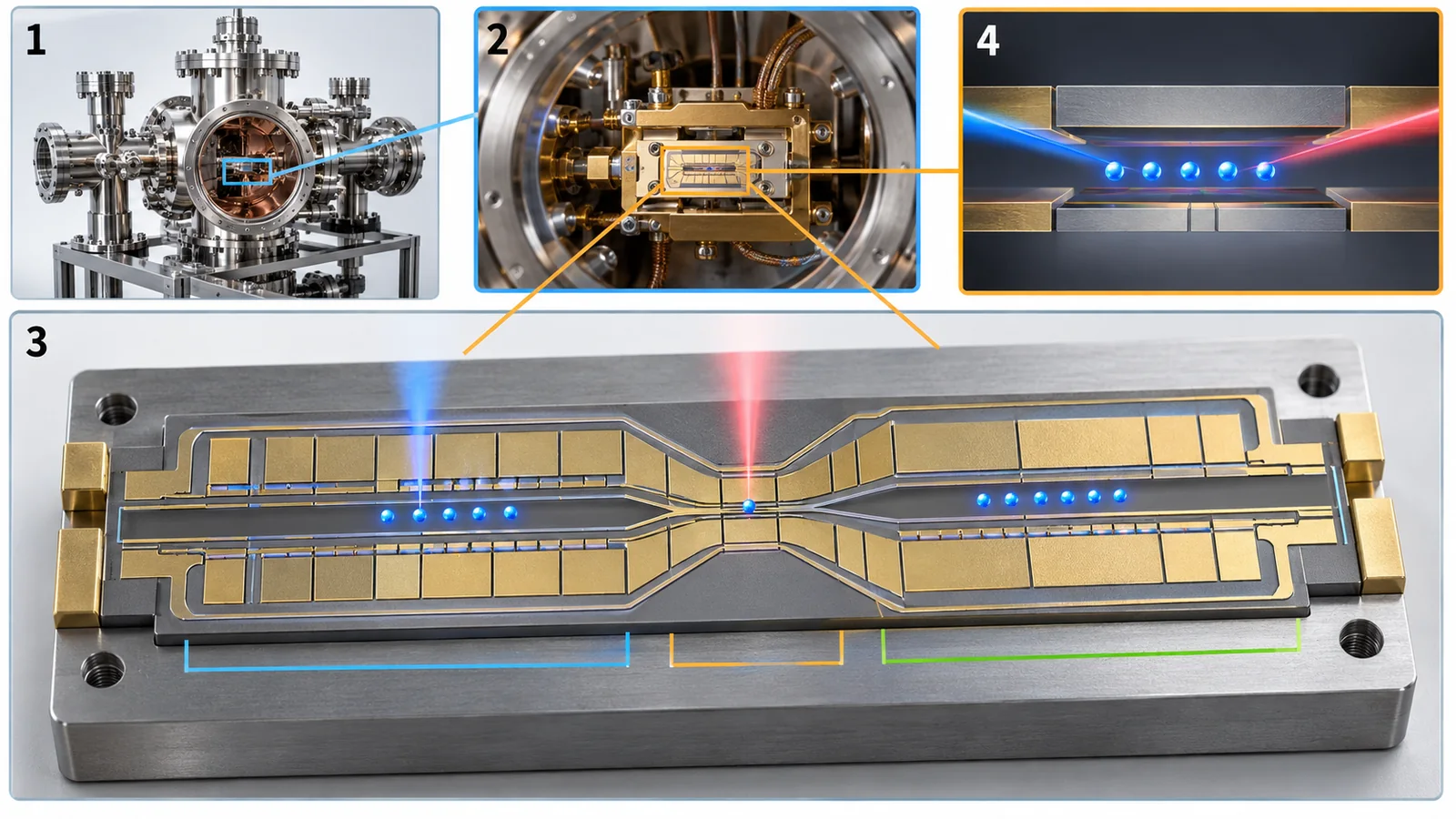
Quantinuum builds quantum computers on the trapped-ion approach: atoms are turned into electrically charged particles (ions), held floating in a vacuum, and operated with lasers. The company was formed in 2021 when Honeywell's quantum unit and Cambridge Quantum combined, and it listed on Nasdaq in June 2026 (ticker QNT). Because the listing produced a prospectus and a quarterly report, the company's business figures, plans and risks can be checked against its own statutory filings. This profile centres on Helios, announced in November 2025, and on the next generations planned for 2027 and 2029. It separates what has been achieved from what is still a plan. Device performance figures are the company's stated values, given with their conditions. We do not comment on the share price or on investment decisions.
- Quantinuum in 30 seconds, and its place in quantum computing
- Logo and the company name
- Where the company sits in the quantum computing landscape
- Company size
- Resources committed to quantum computing
- Track record so far
- Plans
- What the company seems to be aiming for in quantum computing
- Partnership map in quantum computing
- Technology, products and services
- Risks the company faces
- Glossary / References / Claim-to-source audit
1. Quantinuum in 30 seconds, and its place in quantum computing
Quantinuum's qubits are real atoms made into electrically charged "ions" (Helios uses barium-137 ions; Reference 5). Atoms are made by nature, so every atom of a given kind behaves identically. This is a big difference from approaches that build qubits as artificial circuits. What sets the company apart is that it moves the ions around the chip to bring the ones it wants to work together close to each other, a method called "QCCD." The company says that this makes it easier to connect distant qubits directly and to arrange error-correcting codes Sourced (this is the company's claim). Figures such as "48 logical qubits," however, come with conditions. Chapter 5 sets them out.
2. Logo and the company name

A note on names: the filings use several company names. Quantinuum Inc. was incorporated in Delaware on 20 January 2026 and is the listed holding company. The actual business is run by its subsidiary Quantinuum Holdings, LLC and the operating companies below it (such as Quantinuum LLC). The pre-IPO group of operating companies is called Quantinuum (Cayman), and the past financial figures in the filings belong to that group. The company's predecessors were Honeywell's quantum unit (Honeywell Quantum Solutions) and Cambridge Quantum of the United Kingdom, combined in 2021 (Reference 1). Note that Honeywell is not Quantinuum's parent company but its largest shareholder (Chapter 4).
Official website: https://www.quantinuum.com/ (the logo is the image shown in the site header)3. Where the company sits in the quantum computing landscape
Quantum computing companies divide mainly by what the qubit is made of (the approach). Quantinuum is an ion company. In the trapped-ion approach every qubit is an atom of the same kind, so qubit-to-qubit variation is small. On the other hand, the machinery for moving ions and aiming lasers tends to be complex, and each operation tends to take longer than on superconducting devices Our calculation (a generally known tendency; each company's figures are given separately in Chapter 5).
4. Company size
Because the company is listed, its financial figures can be checked in statutory filings. The figures below include those of Quantinuum (Cayman), the pre-IPO operating group (US$ millions) Sourced.
| Metric | 2024 | 2025 | January to June 2026 (six months) |
|---|---|---|---|
| Revenue (net) | 23.0 | 30.9 | 13.2 (Q1: 5.2, Q2: 8.0) |
| R&D expenses (net of the U.K. tax credit) | 122.2 | 165.4 | 422.0 (including 294.9 of one-time stock-based compensation tied to the IPO) |
| Net loss | 144.1 | 192.6 | - |
| Cash and cash equivalents (end of period) | - | 762.6 | 2,106.7 (30 June 2026) |
| Bookings (value of signed contracts) | - | 79.3 | Q1: 1.3 |
| Item | Detail | Reference |
|---|---|---|
| Employees | About 700 (11 March 2026). More than 450 hold a PhD or master's degree and over 40% hold a PhD. About 410 are hardware specialists and about 105 are software specialists | Reference 1 |
| Sites | Besides the Broomfield, Colorado headquarters: Minnesota, Virginia and New Mexico in the U.S.; Cambridge, Oxford and London in the U.K.; Munich in Germany; Tokyo, Wako and Tsukuba in Japan; Doha in Qatar; and Singapore. All are leased, and the company owns no real estate | Reference 1 |
| Commercial systems in operation | Four (three on the Colorado campus and one on the campus of RIKEN, Japan's national research institute). A fifth is expected in Singapore in the second half of 2026 | Reference 1 |
| Listing structure | An "Up-C structure." The listed Quantinuum Inc. holds part of Quantinuum Holdings (12.6% right after the IPO). The rest is held as "Common Units" by Honeywell, Cambridge Quantum-related holders and others, who can exchange them for shares. There is also an agreement to pay part of certain tax benefits to existing holders (the TRA) | References 1, 2 |
| Main shareholders | Honeywell-related holders have about 47.4% of the voting power (30 June 2026, Form 10-Q; the prospectus projected 47.8% right after the IPO). Cambridge Quantum-related holders have about 31.8% (the prospectus's projection right after the IPO) | References 1, 2 |
R&D spending looks large in the second quarter of 2026 because it includes about US$294.9 million of stock-based compensation recorded in one lump at the IPO (no cash left the company). Research did not grow nearly tenfold in a quarter (the explanation in the Form 10-Q). Revenue is also concentrated in a few customers. RIKEN accounted for 60% of 2025 revenue, and the U.S. government for 29% of revenue in January to June 2026 (References 1, 2). This article does not discuss the share price, valuation or investment decisions.
5. Resources committed to quantum computing
Quantum computing is the company's main business, so all four points, people, money, outside relationships and public-sector ties, point at quantum. The table shows whether primary sources let us confirm each one.
| Type of resource | Detail | Status |
|---|---|---|
| People | About 700 (March 2026): about 410 in hardware, about 105 in software, and over 40% with a PhD (Reference 1) | Sourced |
| Money (R&D) | The company says it has put more than US$2 billion into R&D over the last decade. US$122 million in 2024 and US$165 million in 2025 (Reference 1) | Sourced |
| Money (funding raised) | US$838.8 million of Series B preferred stock between August and December 2025 (of which US$350.0 million came from Honeywell). In the IPO of 5 June 2026 it issued 28,500,000 shares, for net proceeds of about US$1,628.8 million after underwriting costs | Sourced |
| Investments, acquisitions, joint ventures, divestments in other companies | The company's origin is the 2021 combination (a joint venture, "NewCo," of Honeywell and Cambridge Quantum acquired all the interests in Honeywell's quantum unit and in Cambridge Quantum Computing Limited in the U.K.). After the IPO, no investment in, acquisition of or sale of another company was found in the filings | Sourced / Could not be confirmed |
| Public funding and public bodies | Up to US$100 million from the U.S. Department of Commerce under the CHIPS Act (agreed 4 September 2026; the company issued 2,369,528 shares to the department in return; paid in milestone-based tranches, with conditions on domestic IP and production and a clawback right). The company says it was selected for Stage B (one year) of DARPA's Quantum Benchmarking Initiative, which is about planning a utility-scale fault-tolerant quantum computer by 2033. A partnership with Invest Qatar (2025) | Sourced |
| Universities and research institutes | A commercial system sits on the campus of RIKEN (Japan). There are many joint studies with universities and institutes, but the filings do not give a full picture | Sourced / Could not be confirmed |
| Manufacturing | Ion-trap chips are made at Honeywell's facilities (a ten-year supply agreement from 2021). For machines, the company plans to assemble and validate early units itself and then outsource manufacturing to partners such as Quanta (References 1, 2) | Sourced / Not yet confirmed |
Status of the main devices and products (as far as the company's official materials confirm)
| Device | Approach | Qubit count | Representative figures (company's stated values, with conditions) | Stage | Checked / reference |
|---|---|---|---|---|---|
| H1 | Trapped ion (linear layout) | 20 physical | Quantum volume 220; two-qubit gate fidelity above 99.9% (all pairs) | Operating (since 2020) | 16 October 2026 / References 9, 1 |
| H2 | Trapped ion (racetrack layout) | 56 physical (upgraded from 32) | Quantum volume 225; two-qubit gate fidelity above 99.9% | Operating (since 2023) | 16 October 2026 / References 10, 12 |
| Helios | Trapped ion (barium-137 ions, two operation regions linked by a junction) | 98 physical; logical 48 to 94 under conditions (see the note below) | Average two-qubit gate error 7.9×10⁻⁴ (fidelity 99.921%) / single-qubit 2.5×10⁻⁵ / state preparation and measurement 4.8×10⁻⁴ (averages over all operation zones, November 2025 paper) | Available (cloud and on-premises). Announced November 2025 | 16 October 2026 / References 5, 8, 1 |
| Sol | Trapped ion | Up to about 100 logical as a target | Target of logical fidelity "approaching 99.999%" | Not yet confirmed (introduction planned for 2027) | 16 October 2026 / Reference 1 |
| Apollo | Trapped ion | Hundreds of logical as a target | "Up to 99.99999999%" logical fidelity is an expected value from analysis based on the literature | Not yet confirmed (introduction planned for 2029) | 16 October 2026 / References 1, 11 |
The company says in its prospectus that Helios built 48 logical qubits (error-correcting code) from 98 physical qubits. The paper behind this (February 2026, Dasu et al.) gives these conditions Sourced.
- Errors can be corrected with a two-level concatenated code (distance 4) for 48 qubits. With a method that only detects errors (distance 2, the "iceberg code"), up to 94 qubits.
- The results involve discarding runs in which an error was detected (post-selection). The paper says performance beat the physical qubits ("beyond break-even") "with reasonable postselection rates."
- The 64 qubits used in the magnetism simulation are error-detected only logical qubits (the company's blog).
- The official product page says "50 logical qubits," which differs from the "48" in the prospectus and the paper (References 8, 1, 6).
So "48" means "under an error-correcting code, performance beat physical qubits under conditions." It does not mean a complete fault-tolerant quantum computer, one that can correct errors automatically and keep computing for any length of time, has been achieved. The company itself sets "about 100" for Sol and "hundreds" for Apollo as the next goals Not yet confirmed.
The company claims that on a task called "random circuit sampling," Helios has reached a regime beyond what classical computers can simulate (Reference 5). This is the company's claim, and this article does not judge it. For context:
- A search on 16 October 2026 found no classical rebuttal aimed at this Helios claim.
- In a different case, the claim of heuristic quantum advantage using "peaked circuits" on Quantinuum's 56-qubit H2 (Gharibyan et al., October 2025) was answered by another research group's paper (April 2026) arguing that those circuits can be efficiently simulated on a classical computer (References 14, 15).
- More generally, there are earlier cases in which a claimed quantum advantage was later reproduced classically with improved algorithms. For how to weigh such claims, see our explainer on how to read claims of quantum advantage.
6. Track record so far
| When | What happened | What it means |
|---|---|---|
| 2020 | The first commercial system, H1, was announced (by Honeywell's quantum unit): 20 physical qubits | The first generation of commercial trapped-ion machines (References 9, 1) |
| 2021 | Quantinuum was formed from Honeywell's quantum unit and Cambridge Quantum. A notice was also filed with the Committee on Foreign Investment in the United States (CFIUS) | A combination of hardware and software companies (Reference 1) |
| December 2021 | An experiment on real-time error correction (Ryan-Anderson et al., Physical Review X). The company says it was first to realize logical qubits more accurate than physical ones | A peer-reviewed paper (References 16, 1) |
| 2023 | The second generation, H2, was announced and later upgraded from 32 to 56 qubits | Quantum volume 225 (References 10, 12) |
| September 2024 | 12 "highly reliable logical qubits" on H2 in work with Microsoft; a roadmap aiming at a fully fault-tolerant computer by the end of the decade | Company announcement; the roadmap is a future plan (References 12, 11) |
| November 2025 | Helios was announced: 98 physical qubits and an average two-qubit gate fidelity of 99.921% | The third generation, offered in the cloud and on-premises (References 5, 8) |
| August to December 2025 | US$838.8 million raised in Series B preferred stock | The last large raise before the IPO (Reference 1) |
| February 2026 | On Helios, 48 to 94 logical qubits outperformed physical qubits (paper) | With conditions (see the note above) (Reference 6) |
| May 2026 | A non-binding letter of intent with the U.S. Department of Commerce for a CHIPS Act award. The multi-year partnership with BMW was extended (5 May) | Public funding and a long-term industry contract (References 1, 13) |
| 5 June 2026 | Listed on Nasdaq (QNT). Issued 28,500,000 shares | Became a publicly traded company (References 1, 2, 4) |
| July 2026 | A multi-year statement of work with Oracle, including installation of a quantum computer | Installation at a large cloud company (Form 10-Q; amount not disclosed) (Reference 2) |
| 4 September 2026 | Signed an award of up to US$100 million with the U.S. Department of Commerce. Shares were issued to the department | For R&D to scale up, including 422 nm integrated photonics (Reference 3) |
7. Plans
Every number above is a target or plan set out by the company, not something already achieved Not yet confirmed. The company itself lists the roadmap as a risk in its prospectus: its plans "involve technology that is not yet available for customers and may never become available or meet desired technical specifications" (Reference 1). DARPA's Stage B is a one-year phase of planning for a utility-scale fault-tolerant machine by 2033; it does not mean such a machine has been built.
The following could not be confirmed in official materials Not yet confirmed.
The physical qubit counts and physical error-rate targets for Sol and Apollo (a 2024 technical blog gave "thousands" and 10-4 for Apollo, but the latest prospectus does not) / whether there is a classical rebuttal to Helios's random circuit sampling claim / the price of Helios and the number of on-premises machines sold / the contract values for Qatar, Singapore and Oracle / the date of the official announcement of DARPA QBI's Stage B result.
8. What the company seems to be aiming for in quantum computing
This part includes things the company has not said directly. It sets out inferences from what the primary sources show, with the basis for each.
| What can be read from the sources | Primary-source basis | Status |
|---|---|---|
| It wants to compete on accuracy and the number of logical qubits, not on raw qubit count or speed | The prospectus says it judges performance by fidelity, logical qubit count and time to solution, "rather than early stage and traditional metrics, such as raw qubit count or gate speed" (Reference 1) | Inference |
| It plans to grow revenue through software and applications, not just machines | It lists four revenue sources (infrastructure access, software licences, research and development services, outcome-based IP) and says its software is built to work on other approaches' machines too (Reference 1) | Inference |
| It is trying to lock in large companies and governments as long-term research partners | A multi-year partnership with BMW (May 2026); JPMorgan Chase, Amgen and Mitsui & Co. described as "both a customer and an innovation partner" (References 1, 13) | Inference |
| It assumes use together with classical computing such as GPUs | NVIDIA GPUs built into Helios's control system and stated compatibility with CUDA-Q (References 8, 1) | Sourced |
On how it evaluates its machines, the prospectus says that raw qubit count and gate speed are "early stage" metrics and that the company evaluates by metrics closer to customer outcomes Sourced. From this we read that the company wants to avoid being compared on the figures competitors can show easily (qubit count, gate speed) and to be compared on the metrics where it is strong (fidelity, logical qubit count, all-to-all connectivity) Not yet confirmed. Which metric matters in real use depends on the application, however, and none of them settles which approach is better.
9. Partnership map in quantum computing
10. Technology, products and services
| Name | What it does | Stage and conditions |
|---|---|---|
| Helios | The latest trapped-ion machine, with 98 physical qubits, offered in the cloud and on-premises (installed at a customer's site). The base unit draws under 40 kilowatts, and GPUs are built into its control system | Announced November 2025. Figures are the company's stated values and apply to the base unit only (Reference 8) |
| H2 / H1 | Earlier-generation trapped-ion machines (56 and 20 qubits) | In operation (References 9, 10) |
| Guppy | A programming language that lets you write quantum programs in a Python-like style, including "dynamic circuits" that change course based on mid-computation results. Open source | Released with Helios (Reference 1) |
| TKET | A compiler that optimises quantum circuits for the hardware and also works on other companies' machines. Open source | Company description (Reference 1) |
| InQuanto | Software for quantum chemistry (calculating the properties of molecules) | Company description; also integrated with Azure Quantum Elements (References 1, 12) |
| Nexus | A cloud environment for running and managing jobs that combine quantum and classical computing. More than 150 organisations and over 750 users (9 March 2026) | Company figures (Reference 1) |
| Q-Net | A user community, with over 200 members (8 May 2026) | Company figures (Reference 1) |
| Quantum Origin | A service that generates random numbers using quantum properties (for strengthening encryption) | Described on the company's product page (Reference 17) |
What QCCD means: moving the ions as you use them
QCCD stands for "quantum charge-coupled device." It is an approach proposed in 2002 by David Wineland of the U.S. National Institute of Standards and Technology (NIST) (Reference 1). By changing the voltages on the chip's electrodes, the ions are gently moved between a "storage zone," a "gate zone" and a "measurement zone." Because they can be moved without losing their quantum state, the company says any qubit can be connected directly to any other ("all-to-all connectivity"). For more, see our explainers on trapped-ion quantum computing and on quantum error correction and the surface code.
Quantinuum's qubits are atoms, so the qubit itself has no "material defects". Instead, the materials and manufacturing difficulty gathers in the chip that holds the ions, the optics and the vacuum. (1) The ion-trap chip: its electrodes create electric fields that float the ions a few microns above it (prospectus). The company has this chip made at Honeywell's facility (Form 10-Q). (2) Lasers and optics: every qubit operation uses lasers. The company writes that the future Apollo chip will be made with a standard CMOS (semiconductor) process (Reference 11). The 2026 U.S. Department of Commerce award targets low-loss integrated photonics at 422 nanometres, control ASICs that run at cryogenic temperatures and reliable optical components at the wavelengths ions need, which shows that materials, optics and packaging are bottlenecks for scaling the machines (Reference 3) Sourced. (3) Cooling: ions are cooled with lasers, so the helium-3 dilution refrigerators used by superconducting machines are not needed, the company says (Reference 1). Vacuum systems, magnetic shielding and lasers are still required.
11. Risks the company faces
| Risk | Detail | Status |
|---|---|---|
| Planned technology not yet available | The prospectus's risk factors state that the roadmap and commercialisation plans include technology customers cannot yet use and which may never become available | Sourced |
| Technical barriers to fault tolerance | It states as a risk that significant technical barriers remain to building large-scale, fully fault-tolerant quantum computers | Sourced |
| Revenue concentrated in a few customers | RIKEN was 60% of 2025 revenue and the U.S. government 29% of revenue in January to June 2026 | Sourced |
| Continuing losses | The 2025 net loss was US$192.6 million against revenue of US$30.9 million. The company writes that its revenue is limited | Sourced |
| Conditions of the CHIPS Act award | Conditions include no transfer of intellectual property to foreign parties, domestic production and research security, and funds already paid can be clawed back if they are breached or not met. Shares were also issued in return | Sourced |
| Dependence on cloud providers | The company says it depends partly on offering access through providers such as Microsoft Azure, and that these providers also run services that compete directly with it | Sourced |
| Limited suppliers of components | It states that suppliers of important components are limited, and a disruption would delay expansion and repairs | Sourced |
| Competition from other approaches | It competes with superconducting, neutral-atom, photonic and other approaches. The company itself writes that trapped ions may not prove the most successful | Sourced |
| Effect of the shareholder structure | Honeywell-related holders (about 47.4%) and Cambridge Quantum-related holders (about 31.8%) hold most of the voting power and could influence important decisions. There is also an agreement to pay part of certain tax benefits to existing holders | Inference |
| Verifying performance claims | "Most accurate" and "beyond the reach of classical computers" are the company's claims. Quantum-advantage claims by other groups' systems have drawn classical rebuttals before | Sourced |
12. Glossary
- Ion
- An atom with an electron removed, so it carries an electric charge. Electric fields can hold it floating in space.
- Ion trap
- A device that uses electric fields to hold ions in a vacuum. The trapped ions serve as the qubits.
- QCCD
- An approach in which ions are moved around the chip as they are used, with separate storage, gate and measurement zones.
- Fidelity
- How closely an operation matches the ideal. 99.921% means about one error in 1,266 operations.
- Physical / logical qubit
- A physical qubit is the real device on the chip. A logical qubit bundles several under error correction into one that is hard to get wrong.
- Error detection / correction
- Detection only notices an error and discards the run. Correction notices and fixes it while the computation continues.
- Iceberg code
- A code that detects errors using few qubits, needing only about one physical qubit per logical one.
- Post-selection
- Throwing away runs in which an error was detected and keeping only the successful ones.
- Break-even
- The point where an error-corrected qubit performs better than an unprotected one.
- Quantum volume
- A single number for a quantum computer's overall capability. Comparisons need the conditions checked.
- Up-C structure
- A setup in which a listed company owns only part of the operating company, and existing holders own the rest.
- Form 10-Q / 424B4
- A 10-Q is a U.S. listed company's quarterly report; a 424B4 is the final prospectus for a new offering. Both carry legal responsibility.
13. References
- Quantinuum Inc. Prospectus, Form 424B4 (filed with the U.S. SEC, 5 June 2026). Business description, Helios and roadmap, financials, shareholders, risk factors, the CHIPS Act letter of intent. https://www.sec.gov/Archives/edgar/data/2110105/000162828026041003/quantinuum-424b4.htm
- Quantinuum Inc. Form 10-Q for the quarter ended June 30, 2026 (13 August 2026). Completion of the IPO, January to June 2026 financials, Honeywell's voting power, the Oracle contract, major customers. https://www.sec.gov/Archives/edgar/data/2110105/000162828026056743/qnt-20260630.htm
- Quantinuum Inc. Form 8-K (8 September 2026). The Other Transaction Agreement with the U.S. Department of Commerce and the securities issuance agreement. https://www.sec.gov/Archives/edgar/data/2110105/000162828026060934/qnt-20260908.htm
- U.S. SEC EDGAR filing list for Quantinuum Inc. (CIK 0002110105). Nasdaq listing, the registration taking effect on 3 June 2026, and the listing registration (Form 8-A12B) of 4 June. https://data.sec.gov/submissions/CIK0002110105.json
- Ransford et al. Helios: A 98-qubit trapped-ion quantum computer (arXiv:2511.05465, November 2025). https://arxiv.org/abs/2511.05465
- Dasu et al. Computing with many encoded logical qubits beyond break-even (arXiv:2602.22211, February 2026). https://arxiv.org/abs/2602.22211
- Quantinuum Skinny Logic: Quantum Codes Go on a Diet (company blog, 4 March 2026). https://www.quantinuum.com/blog/skinny-logic-quantum-codes-go-on-a-diet
- Quantinuum Helios (product page). 98 qubits, fidelities, how it is offered. https://www.quantinuum.com/products-solutions/quantinuum-systems/helios
- Quantinuum System Model H1 (product page). https://www.quantinuum.com/products-solutions/quantinuum-systems/system-model-h1
- Quantinuum System Model H2 (product page). https://www.quantinuum.com/products-solutions/quantinuum-systems/system-model-h2
- Quantinuum Technical perspective: By the end of the decade, we will deliver universal, fully fault-tolerant quantum computing (company blog, 17 September 2024). The Apollo concept. https://www.quantinuum.com/blog/technical-perspective-by-the-end-of-the-decade-we-will-deliver-universal-fault-tolerant-quantum-computing
- Quantinuum Quantinuum accelerates the path to Universal Fully Fault-Tolerant Quantum Computing (company blog, 10 September 2024). The H2 upgrade and 12 logical qubits with Microsoft. https://www.quantinuum.com/blog/quantinuum-accelerates-the-path-to-universal-fault-tolerant-quantum-computing-supports-microsofts-ai-and-quantum-powered-compute-platform-and-the-path-to-a-quantum-supercomputer
- Quantinuum Quantinuum and BMW Group Expand Landmark Quantum Computing Collaboration with New Multi-Year Partnership (5 May 2026). https://www.quantinuum.com/press-releases/quantinuum-and-bmw-group-expand-landmark-quantum-computing-collaboration-with-new-multi-year-partnership
- Gharibyan et al. Heuristic Quantum Advantage with Peaked Circuits (arXiv:2510.25838, October 2025). https://arxiv.org/abs/2510.25838
- Kremer and Dupuis Efficient Classical Simulation of Heuristic Peaked Quantum Circuits (arXiv:2604.21908, April 2026). https://arxiv.org/abs/2604.21908
- Ryan-Anderson et al. Realization of Real-Time Fault-Tolerant Quantum Error Correction, Physical Review X 11, 041058 (2021). https://doi.org/10.1103/PhysRevX.11.041058
- Quantinuum Company website (home and product pages; logo, Quantum Origin, Nexus, Guppy and TKET descriptions). https://www.quantinuum.com/
14. Claim-to-source audit
| Claim in the text | Status | Reference |
|---|---|---|
| Incorporation of Quantinuum Inc. (20 January 2026), headquarters, Up-C structure, 12.6% interest right after the IPO, voting-power make-up | Sourced | Reference 1 https://www.sec.gov/Archives/edgar/data/2110105/000162828026041003/quantinuum-424b4.htm |
| Listed on Nasdaq (QNT); IPO completed (5 June 2026), 28,500,000 shares, net proceeds of about US$1,628.8 million | Sourced | References 2, 4 https://www.sec.gov/Archives/edgar/data/2110105/000162828026056743/qnt-20260630.htm |
| Honeywell-related voting power of about 47.4% (30 June 2026); chips made at Honeywell's facility | Sourced | Reference 2 https://www.sec.gov/Archives/edgar/data/2110105/000162828026056743/qnt-20260630.htm |
| 2024 and 2025 revenue, R&D and net loss; about 700 employees; sites; four systems in operation | Sourced | Reference 1 https://www.sec.gov/Archives/edgar/data/2110105/000162828026041003/quantinuum-424b4.htm |
| January to June 2026 revenue of US$13.2 million, R&D, cash of US$2,106.7 million, and customer concentration | Sourced | Reference 2 https://www.sec.gov/Archives/edgar/data/2110105/000162828026056743/qnt-20260630.htm |
| Series B preferred stock of US$838.8 million (US$350.0 million from Honeywell) | Sourced | Reference 1 https://www.sec.gov/Archives/edgar/data/2110105/000162828026041003/quantinuum-424b4.htm |
| Award agreement with the U.S. Department of Commerce (up to US$100 million, 2,369,528 shares, conditions, clawback) | Sourced | Reference 3 https://www.sec.gov/Archives/edgar/data/2110105/000162828026060934/qnt-20260908.htm |
| Helios: 98 qubits, barium-137, two-qubit gate error of 7.9×10⁻⁴ and other figures | Sourced | Reference 5 https://arxiv.org/abs/2511.05465 |
| 48 to 94 logical qubits, the codes (distance 4 and distance 2), post-selection, the magnetism simulation | Sourced | References 6, 7 https://arxiv.org/abs/2602.22211 |
| The Helios product page's figures ("50 logical qubits," power use) and how it is offered | Sourced | Reference 8 https://www.quantinuum.com/products-solutions/quantinuum-systems/helios |
| Qubit counts and figures for H1 and H2 | Sourced | References 9, 10 https://www.quantinuum.com/products-solutions/quantinuum-systems/system-model-h1 |
| H2's upgrade from 32 to 56 qubits; 12 logical qubits with Microsoft (September 2024) | Sourced | Reference 12 https://www.quantinuum.com/blog/quantinuum-accelerates-the-path-to-universal-fault-tolerant-quantum-computing-supports-microsofts-ai-and-quantum-powered-compute-platform-and-the-path-to-a-quantum-supercomputer |
| The Apollo concept (thousands of physical qubits, physical error rate of 10-4 and so on) | Sourced | Reference 11 https://www.quantinuum.com/blog/technical-perspective-by-the-end-of-the-decade-we-will-deliver-universal-fault-tolerant-quantum-computing |
| Targets for Sol (2027) and Apollo (2029), DARPA QBI Stage B, the plan to outsource manufacturing to Quanta | Sourced | Reference 1 https://www.sec.gov/Archives/edgar/data/2110105/000162828026041003/quantinuum-424b4.htm |
| Multi-year partnership with BMW (5 May 2026) | Sourced | Reference 13 https://www.quantinuum.com/press-releases/quantinuum-and-bmw-group-expand-landmark-quantum-computing-collaboration-with-new-multi-year-partnership |
| Contract with Oracle (July 2026) | Sourced | Reference 2 https://www.sec.gov/Archives/edgar/data/2110105/000162828026056743/qnt-20260630.htm |
| The quantum-advantage claim on H2 and the classical rebuttal | Sourced | References 14, 15 https://arxiv.org/abs/2510.25838 |
| The December 2021 experiment on real-time error correction | Sourced | Reference 16 https://doi.org/10.1103/PhysRevX.11.041058 |
| Descriptions of Guppy, TKET, InQuanto, Nexus, Q-Net and Quantum Origin | Sourced | References 1, 17 https://www.quantinuum.com/ |
| The four-type classification of quantum computing companies | Our calculation | Our own grouping in this article; company names are examples from this series |
| The general tendency of trapped ions toward slower operations | Our calculation | Our commentary (a generally known tendency; each company's figures given separately) |
| Prices, units sold, and contract values for Helios, Sol, Apollo, Qatar, Singapore and Oracle | Not yet confirmed | Not stated in the filings. This article does not estimate them (our own policy) |
| Targets for Sol and Apollo (about 100 and hundreds of logical qubits, fidelity) | Not yet confirmed | Company targets and plans; this article treats them as an outlook and keeps them apart from achieved facts |
| A classical rebuttal to Helios's random circuit sampling claim | Not yet confirmed | Not found in a search on 16 October 2026; this article does not assert that none exists (our note) |
| It competes on accuracy and logical qubit count rather than qubit count or speed | Inference | Our reading of how the prospectus describes its metrics (our own interpretation) |
| It plans to grow revenue through software and applications | Inference | Our reading of the four revenue sources (our own interpretation) |
| It is trying to lock in large companies and governments as long-term research partners | Inference | Our reading of the BMW partnership and similar ties (our own interpretation) |
| The shareholder structure may influence important decisions | Inference | Our reading of the voting-power make-up (our own interpretation) |
Last updated: 16 October 2026 / Troy Technical
The figures in this article rest on statutory filings submitted by Quantinuum Inc. to the U.S. Securities and Exchange Commission, and on the company's papers and official materials. Device performance figures are the company's stated values, given with their measurement conditions. Market-research estimates are not used, even where they appear in filings. Items marked "Inference" are our own readings of the primary sources, not statements by the company. This article is not investment advice.