COMPANY PROFILE / QUANTUM COMPUTING
Rigetti Computing
A listed company that makes its own superconducting chips and sells quantum computers built by tiling small chips, the "chiplet" approach
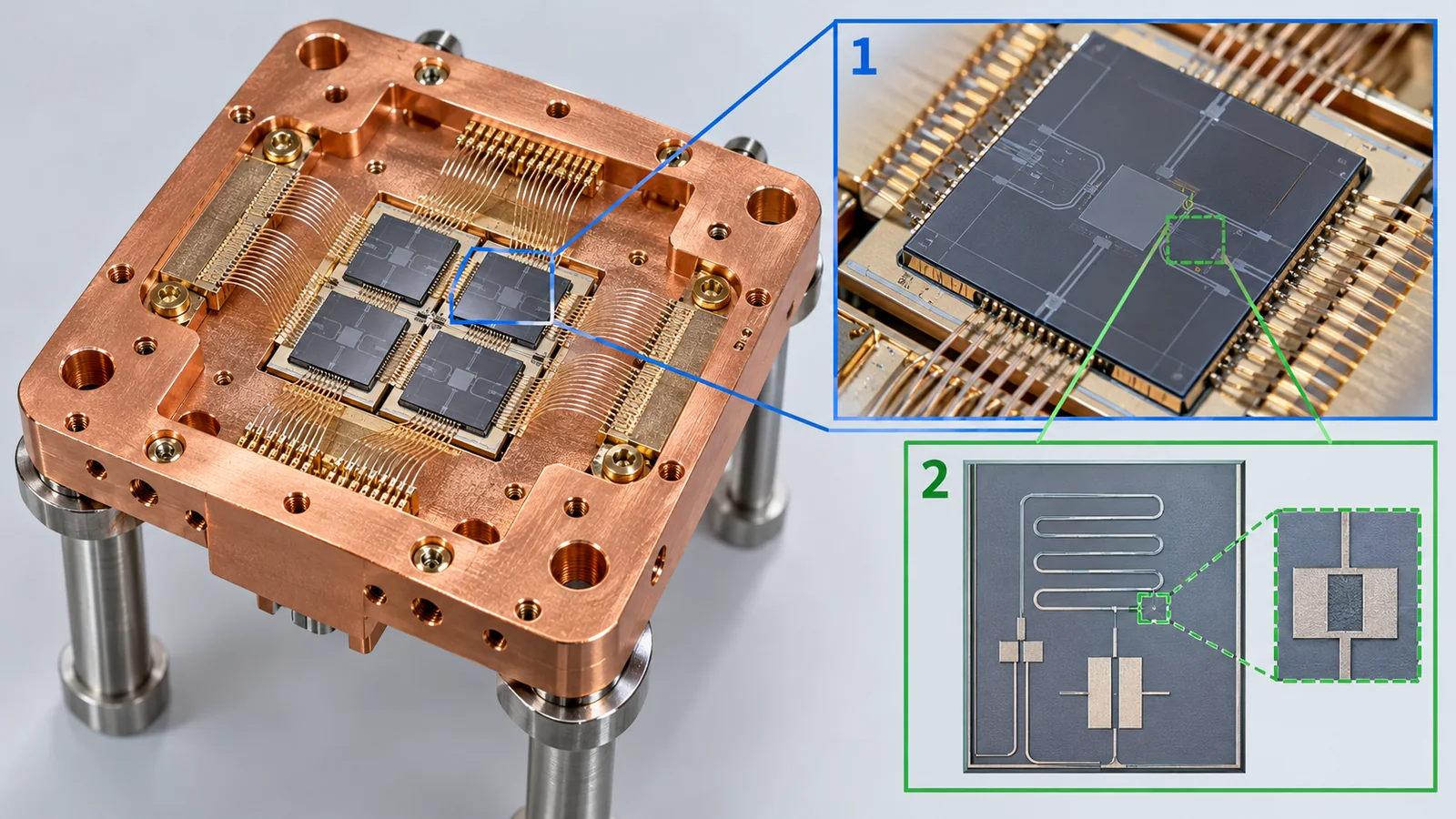
Rigetti Computing is a U.S. listed company (Nasdaq: RGTI) that builds its qubits, the basic units of quantum computation, from superconducting circuits. Its signature feature is joining several small 9-qubit chips (chiplets) into one quantum processor. In April 2026 it announced general availability of Cepheus-1-108Q, a 108-qubit system made from twelve chiplets. It makes its quantum chips in its own fabrication plant (Fab-1) and offers its quantum computers both through the cloud and as on-site installations. But the business is still small: revenue for the year to December 2025 was about US$7.09 million and the net loss was about US$216.2 million, and 48.0% of revenue came from U.S. government entities. In September 2026 it finalised with the U.S. Department of Commerce an award of up to US$100 million for research and development under the CHIPS Act (in return it issued shares to the Department). This profile sets out these facts as far as its filings with the U.S. SEC (10-K, 10-Q, 8-K) allow.
- Rigetti in 30 seconds, and where it stands in quantum computing
- The logo and how the name is written
- Where the company sits in the quantum computing field
- Scale
- Resources committed to quantum computing
- What it has done so far
- What comes next (all of it plans)
- What the company is aiming for in quantum computing
- Map of quantum computing partnerships
- Technology, products and services
- The risks this company carries
- Glossary, references and claim-to-source audit
1. Rigetti in 30 seconds, and where it stands in quantum computing
Nasdaq: RGTIIts fabrication plant, Fab-1, is in Fremont, California
108 physical qubitsTwelve 9-qubit chiplets. General availability announced 7 April 2026
(108-qubit system)Company's in-house test value, announced April 2026. It differs by system (table in chapter 5)
Rigetti is a company that makes "joining small chips into a big one" the pillar of its business, even among quantum computing firms. The idea is that a single large chip suffers more defects and a lower yield (the share of good parts), so one picks good 9-qubit chips and tiles them Sourced. But the company is small: revenue is in the millions of US dollars and the loss is far larger. On "quantum advantage" and a "large fault-tolerant machine", the company itself writes in its 10-K that the start of the large-scale fault-tolerant phase is "roughly a decade away", so the timing is the company's outlook Not yet confirmed. This profile keeps that distinction to the end.
Qubit: the smallest unit of quantum computation. It can hold a blend of 0 and 1 at once, but it is fragile: a little heat or electrical noise makes it err.
Gate accuracy (fidelity): the probability that an operation on qubits is performed correctly. "Two-qubit gate accuracy of 99%" means it goes wrong about once in 100 tries, an error rate of 1% (= 100% minus 99%). The value changes with how it is measured (in-house or third party, median or best).
Chiplet: joining several small chips so they act as one large chip (here, small 9-qubit chips). The idea is also used in ordinary computer chips.
Quantum advantage: a quantum computer producing, for some task, a better result than the best known method on a classical computer. One side announces "we did it" and the other rebuts, many times over. Rigetti has not yet made this claim.
2. The logo and how the name is written
A note on naming: the company is Rigetti Computing, Inc. (Rigetti for short). In its 10-K it calls its quantum chip fabrication plant Fab-1 and its cloud service Rigetti Quantum Cloud Services (QCS).
Easily confused: Novera is the product name of the 9-qubit quantum processing unit (QPU), Cepheus is the product name of systems that link several chiplets, and Ankaa is the generation name of a single-chip design. The logo is the one shown on Rigetti's official website.
Official site: https://www.rigetti.com/3. Where the company sits in the quantum computing field
Quantum computing companies are easiest to sort by how they build a qubit, which gives four groups. Superconducting means "cool an electrical circuit until it behaves as a qubit". Trapped ions and neutral atoms means "use individual atoms themselves as qubits". Photonic, silicon and other approaches means "use particles of light, or the spin of electrons in silicon". Software, cloud and ecosystem companies do not build qubits; they make quantum computers easier to use.
Some metals, cooled far enough, lose all electrical resistance. This is called superconductivity. Rigetti builds small electrical circuits from such metals (a type called the transmon) on silicon chips, cools them with commercially available dilution refrigerators to about 0.02 kelvin (about -273.13 °C), and drives them with microwave electrical signals Sourced. The 10-K lists as advantages that superconducting qubits have much in common with silicon semiconductors, so the skills and workforce of chip fabrication can be reused, and that gates are fast (the 10-K says 50 to 70 nanoseconds) (the company's view). The difficulties are the size of the cooling equipment, the number of wires into the chip, and the way accuracy is hard to hold as qubit counts grow. See also our explainers on superconducting qubits and on cryogenics and control in this series.
4. Scale
Rigetti is a small company of about 160 people. The table gives figures from its 10-K, 10-Q and earnings release Sourced.
| Measure (US$ thousand) | Year to Dec 2023 | Year to Dec 2024 | Year to Dec 2025 |
|---|---|---|---|
| Revenue | 12,008 | 10,790 | 7,088 |
| Research and development expense | 52,768 | 49,750 | 61,345 |
| Capital expenditure (purchases of property and equipment) | 9,059 | 11,098 | 18,676 |
| Net loss (note: includes changes in the fair value of warrants) | 75,107 | 200,988 | 216,210 |
| Employees (1 March 2026) | 164, of whom 162 are full-time. Mostly in the U.S., with sites in the U.K., Australia and Canada | ||
| Cash, cash equivalents and available-for-sale investments (30 June 2026) | US$541.3 million (company announcement as of 30 June 2026; the company says it has no debt) | ||
The net loss above includes a loss from changes in the fair value of warrants (rights to buy new shares) (a loss of US$150.6 million in 2025, an accounting item that is not a cash outflow). It is separate from the loss on operations itself, so do not read the size of the operating loss from net loss alone. For the three months to 30 June 2026 the company reported revenue of US$5.138 million (US$1.801 million a year earlier), an operating loss of US$28.1 million and a GAAP net loss of US$52.6 million. In 2025, 48.0% of revenue came from U.S. government entities (54.2% in 2024), and most revenue was from development contracts (10-K). The 10-K also says that the company "has in the past failed to meet publicly announced milestones" and "has in the past changed its technology roadmap".
5. Resources committed to quantum computing
Rigetti is a quantum specialist, so its company-wide figures are its quantum figures. The table sorts the four points by whether they could be confirmed.
| Type of resource | What was confirmed (checked 16 October 2026) | Status |
|---|---|---|
| People | 164 employees (1 March 2026; mainly researchers, chip and hardware engineers and software developers). 121 patents issued and 160 pending (31 December 2025). A chief operating officer (COO) and a chief technology officer (CTO) were newly appointed in August 2026 | Sourced |
| Money (spending) | R&D expense was US$61.35 million in 2025 and capital expenditure US$18.68 million. The 10-K says R&D is expected to rise and that upgrading its fab or building a new one could need large amounts of cash | Sourced |
| Money (funding) | In the first half of 2025 it raised net US$346.7 million through at-the-market (ATM) share sales and US$35 million from a private placement to Quanta Computer (3,020,412 shares at about US$11.59). Cash and investments of US$541.3 million at the end of June 2026 (company announcement) | Sourced |
| Outside investments, acquisitions and joint ventures | No investment in or acquisition of another company by Rigetti was found in the 10-K or 10-Q. Investments received from outside: (1) Quanta Computer (Taiwan); (2) the U.S. Department of Commerce (it took 7,739,938 Rigetti shares in September 2026 in return for the award). The company describes a plan to invest "up to US$100 million in the U.K. over the next several years" (a plan) | Sourced / Not yet confirmed (U.K. investment) |
| Public funding and government ties | (1) A CHIPS Act award of up to US$100 million from the U.S. Department of Commerce (finalised on 4 September 2026 as an Other Transaction Agreement); (2) contracts with DARPA, the U.S. Department of Energy (Fermilab and SQMS) and the Air Force Research Laboratory (AFRL); (3) grants from Innovate UK; (4) an order from India's C-DAC (a research organisation of the Ministry of Electronics and Information Technology) for a 108-qubit computer (US$8.4 million). In DARPA's Quantum Benchmarking Initiative (QBI), it appeared on the list of Stage A companies in April 2025. It was not among the 11 Stage B companies of November 2025 and is not on DARPA's list of participants as of 8 October 2026 | Sourced |
| Universities and research institutes | Montana State University (supplied a Novera), the University of Edinburgh and Imperial College London (joined Innovate UK consortia), the U.K.'s National Quantum Computing Centre (NQCC, hosting a 36-qubit system), and the Pittsburgh Supercomputing Center (plan to supply a 9-qubit Novera) | Sourced |
| Manufacturing and facilities | Headquarters in Berkeley, California, and the Fab-1 plant in Fremont (about 53,800 square feet). The company says it built "the first dedicated quantum processor fab" in 2017 and that it has wafer capacity to supply its chip needs for at least the next three years | Sourced (company's description) |
Status of the main devices (checked 16 October 2026; all from Rigetti's 10-K, 10-Q and 8-Ks)
All qubit counts are "physical" qubits (Rigetti does not offer a logical-qubit device). Gate accuracies are the company's in-house test medians, and with their measurement conditions they cannot be lined up against other approaches or companies to rank them.
| Device | Approach | Qubits | Typical accuracy or performance (company's stated value, in-house tests) | Stage | Date and source |
|---|---|---|---|---|---|
| Novera QPU | Superconducting | 9 physical (plus a 5-qubit chip for single-qubit testing) | Median two-qubit gate accuracy of 99.7% (announced January 2026) and 99.8% (August 2026). Orders for two systems totalling about US$5.7 million were received in 2025 | On sale (on-site) | Launched December 2023. 10-K |
| Ankaa-3 | Superconducting (single chip) | 84 physical | Median two-qubit gate accuracy of 99.0% (error rate halved in 2024) | Available on the cloud | Fourth quarter of 2024. 10-K |
| Cepheus-1-36Q | Superconducting (four chiplets) | 36 physical | Median two-qubit gate accuracy of 99.6% (January 2026; error rate halved from Ankaa-3), median gate time of 76 nanoseconds | Available on the cloud | Announced second quarter of 2025. 10-K |
| Cepheus-1-108Q | Superconducting (twelve chiplets) | 108 physical | Median two-qubit gate accuracy of about 99.1%, single-qubit gates about 99.9%, gate speed about 60 nanoseconds (August 2026 announcement). It was 99.0% in January 2026 | General availability (cloud, Amazon Braket, Azure Quantum and others) | 7 April 2026. 10-Q, earnings release |
| 108-qubit system (for India) | Superconducting | 108 physical | On-site installation at C-DAC (Bengaluru). Order value US$8.4 million | Preparing delivery (installation planned for the second half of 2026) | January 2026 announcement. 10-Q |
| High-accuracy gate prototype | Superconducting (prototype platform) | - | Two-qubit gate accuracy as high as 99.9% (gate time 28 nanoseconds) using a proprietary "adiabatic CZ" scheme. A prototype value, not a product figure | Development (prototype) | 10-K |
| About-1,000-qubit machine | Superconducting | About 1,000 (plan) | The company says it aims at about 99.9% two-qubit gate accuracy and gate speeds below 50 nanoseconds over roughly three years | Planned | Earnings release of 6 August 2026 |
6. What it has done so far
Rigetti's history is easiest to follow as four threads: "make it usable on the cloud", "make it in our own fab", "scale up with chiplets" and "raise accuracy".
| When | What happened | Why it matters |
|---|---|---|
| 2013 and 2017 | Founded in 2013. In 2017 it built a fab dedicated to quantum processors (Fab-1) and began offering access on the cloud (company's description) | The starting point of running design, fabrication and cloud together |
| 2021 | Began selling full-scale systems to national laboratories and quantum computing centres (10-K) | Moved from the cloud alone to on-site installations |
| 2 March 2022 | Completed a merger with the special purpose acquisition company (SPAC) Supernova Partners Acquisition Company II and became listed | Has raised funds as a Nasdaq-listed company ever since |
| December 2023 | Launched Novera, a 9-qubit QPU | Few qubits, but a product universities and laboratories can install on site |
| Fourth quarter of 2024 | Made the 84-qubit Ankaa-3 public. Median two-qubit gate accuracy of 99.0% (error rate halved) | The high point of the single-chip approach |
| 27 February 2025 | Collaboration agreement with Quanta Computer of Taiwan. Each side agreed to invest at least US$250 million in quantum over five years, and in April Quanta bought US$35 million of shares | A division of labour in which Quanta develops control systems, dilution refrigerators, cables and other parts |
| April 2025 | Named among the Stage A companies in DARPA's Quantum Benchmarking Initiative (announced by DARPA on 3 April 2025). In the same month it was also named a winner of the U.K.'s Innovate UK "Quantum Missions" competition | QBI is a public programme testing whether a fault-tolerant quantum computer can be built by 2033 |
| Second quarter of 2025 | Made the 36-qubit Cepheus-1-36Q public (four 9-qubit chiplets) | The first product of the chiplet approach |
| 6 November 2025 | DARPA announced 11 companies for QBI Stage B. Rigetti was not among them | DARPA says QBI is "not a competition". What happened next could not be confirmed from primary sources |
| 9 January 2026 | Revised its roadmap and moved general availability of the 108-qubit system to around the end of March 2026. At the same time it announced accuracies of 99.7% (9 qubits), 99.6% (36 qubits) and 99.0% (108 qubits) | The company says in its 10-K that it has missed milestones and changed its roadmap before |
| January 2026 | Received an order from India's C-DAC for a 108-qubit system (US$8.4 million) | A large on-site order. Delivery is planned for the second half of 2026 |
| 7 April 2026 | Announced general availability of Cepheus-1-108Q. Median accuracy of 99.1%, gate speed of about 60 nanoseconds | Its largest system. Available on the cloud, on Amazon Braket and later on Azure Quantum |
| 20 and 21 May 2026 | Signed and announced a letter of intent (LOI) with the U.S. Department of Commerce for a CHIPS Act award of up to US$100 million | The terms include issuing shares to the Department in return |
| August 2026 | Appointed a COO and a chief technology officer (CTO). Reported second-quarter 2026 results | Strengthening of the management team (revenue in the quarter was US$5.138 million) |
| 4 and 8 September 2026 | Finalised an award of up to US$100 million with the Department of Commerce through an Other Transaction Agreement (4 September). Issued 7,739,938 shares to the Department at US$12.92 a share on 8 September | The award is paid in three tranches, and the Department can demand repayment if milestones are not met |
Bake one big cake in a single tin and one burnt corner ruins all of it. Bake small cupcakes and line them up, and you can pick only the good ones. Rigetti's 10-K likewise explains that instead of making one large 1,000-qubit chip, making ten 100-qubit chips and combining them raises yield and is more predictable (the company's view). Joining chips takes superconducting wiring that passes through the silicon (through-silicon vias), a technique for stacking and bonding chips, and a coupling that allows high-accuracy gates between chips; the 10-K describes these as Fab-1 technologies. But the more chips there are, the more the errors at the joins and the number of wires inside the refrigerator become the challenges.
7. What comes next (all of it plans)
Everything below is a plan or outlook stated in Rigetti's filings and earnings release. None had been achieved as of the check date (16 October 2026) Not yet confirmed.
Two-qubit accuracy of about 99.9%
Gates under 50 nanosecondsThe "path" the company set out. Not a guarantee of timing
In its filings and announcements Rigetti uses statements that compare superconducting gate speed with other approaches. The 10-K says about 1,000 times faster than trapped ions or neutral atoms; the August 2026 earnings release says about 10,000 times faster than trapped ions and about 100 times faster than neutral atoms. The multiples differ between documents. They are company claims, and the basis of comparison (which gate-time value is compared) is not given. This profile does not rank approaches against each other, so it does not adopt these multiples.
On "quantum advantage", Rigetti itself has not yet claimed to have achieved it. The 10-K defines advantage as "solving a practical problem that would be physically impossible to solve on a classical computer" and gives the performance conditions it believes are needed, only as the company's own view Not yet confirmed. See also our explainer on how to read quantum advantage claims.
8. What the company is aiming for in quantum computing
This part includes things the company has not said directly. They are written as inferences from what the primary sources allow, with the evidence alongside.
| What can be read from the record | Primary evidence | Status |
|---|---|---|
| It wants to move its revenue pillar from development contracts to selling quantum computers and cloud access | The 10-K says most current revenue is from development contracts and that the longer-term model will be weighted towards QPU sales and recurring cloud revenue (QCaaS, QCS). The first-half 2026 revenue increase was mainly from sales of the 9-qubit Novera (10-Q) | Sourced (the company's outlook); the shift is an inference |
| It pursues the route of adding qubits (chiplets) and the route of raising accuracy (improving a single chip) separately | The 10-K says that with the chiplet approach accuracy gains can be developed on a single core chip, separately from scaling, and integrated later | Sourced (company policy) |
| It is heading towards a U.S. domestic-manufacturing, government-supported footing | The Commerce award includes U.S. ownership and manufacturing requirements, limits on dealings, investments and partnerships with foreign entities, and security requirements, and shares are issued in return. U.S. government entities were 48.0% of revenue (10-K) | Inference |
| It uses combination with HPC (supercomputers) as a foothold for sales | The August 2026 announcement describes the collaboration with HPE and the Pittsburgh Supercomputing Center (supply of a 9-qubit Novera) as evidence of growing demand | Inference |
| Improving accuracy (coherence time) is the top near-term challenge | The August 2026 announcement names coherence time as the key to raising fidelity further and says the company is working on chip design, fabrication, materials and process improvements | Sourced (company's description) |
In January 2026 Rigetti postponed general availability of its 108-qubit system and at the same time gave accuracies of "99.7% for 9 qubits, 99.6% for 36 qubits and 99.0% for 108 qubits". The 108-qubit system stood at 99.1% at general availability in April, so the company's own figures show accuracy falling as the qubit count rises Sourced. This tendency is common in many approaches, not only superconducting, and it shows that holding accuracy while adding qubits is the challenge for the chiplet approach. Our reading is that the company's naming of "improving coherence time" as its top priority in August 2026 is a response to this challenge Not yet confirmed.
9. Map of quantum computing partnerships
10. Technology, products and services
Rigetti's offering falls into five lines: "selling quantum processing units (QPUs)", "selling whole quantum computers (systems)", "use on the cloud", "contract manufacture of chips (foundry)" and "development contracts".
| Layer | What it is (checked 16 October 2026) | Status |
|---|---|---|
| QPU sales | Novera (a 9-qubit chip plus a 5-qubit chip for single-qubit testing). The customer connects it to its own refrigerator and control system. Orders for two systems, about US$5.7 million in total, were received in 2025 | On sale |
| System sales (on-site) | The Cepheus series (36 and 108 qubits), including control electronics. An order for a 108-qubit system for India's C-DAC has been received. Sold to national laboratories and quantum computing centres since 2021 | On sale / preparing delivery |
| Cloud | Rigetti Quantum Cloud Services (QCS), and offerings through Amazon Braket, Microsoft Azure Quantum, qBraid and others. Ankaa-3, Cepheus-1-36Q and Cepheus-1-108Q are available | Available |
| Contract chip manufacture | Rigetti Foundry Services. It makes superconducting quantum chips in Fab-1 for universities, defence laboratories and national laboratories | Offered (amount not disclosed) |
| Development contracts and professional services | Development contracts with DARPA, DOE, AFRL, Innovate UK and others. Fee-based services in algorithm development, benchmarking and software development | Most of revenue (10-K) |
Rigetti's qubits are made by drawing circuits in superconducting thin films on silicon chips Sourced. The 10-K names three technologies behind the chiplet approach: a technology for bonding chips together in the superconducting state (3D chip integration), superconducting wiring that passes through the silicon (through-silicon vias), and an inter-chip coupling that allows high-accuracy gates between qubits on different chips. These are close in spirit to advanced packaging in an ordinary semiconductor fab (stacking chips and joining them with through-silicon vias), and the company says its strength is the ability to run design, fabrication and test quickly in Fab-1.
As a factor that decides qubit accuracy, the August 2026 announcement names coherence time (how long a qubit can hold its quantum state) and says the company is working on chip design, fabrication, materials and process improvements. In superconducting qubits, film quality and interface contamination bear directly on how long the state can be held (a general explanation). The specific superconducting materials and substrates used for Rigetti's qubits are not stated in the filings and announcements we checked, and this profile does not specify them Not yet confirmed. Two of the three challenges named in the Commerce award, "developing fabrication capability for high-connectivity chips" and "expanding cryogenic capacity by orders of magnitude with a new cryostat architecture", are exactly challenges of thin films, bonding and cooling.
11. The risks this company carries
What follows is fact drawn from its filings, plus this profile's own reading. It is not an assessment of any company and not an input for investment decisions.
| Risk | Detail | Status |
|---|---|---|
| Roadmap slippage or change | The 10-K states that the company has "failed to meet publicly announced milestones" and "changed its technology roadmap" in the past. In January 2026 it postponed general availability of the 108-qubit system and delivered it in April. The targets of about 1,000 qubits and 99.9% are the company's outlook | Sourced (past history); targets are Not yet confirmed |
| Business scale and funding | Revenue was US$7.088 million in 2025 (down from the previous year) and the net loss was US$216.2 million (including fair-value changes). The company says it had US$541.3 million of cash and investments and no debt at the end of June 2026, but the 10-K says losses are expected to continue and that further funding may be needed | Sourced |
| Customer concentration | In 2025, 48.0% of revenue (54.2% the year before) came from U.S. government entities. The 10-K says expiry of the National Quantum Initiative Act and delay in its reauthorisation affected revenue | Sourced |
| Holding accuracy as scale grows | In the company's own numbers, the more qubits, the lower the two-qubit gate accuracy (9 qubits 99.8%, 36 qubits 99.6%, 108 qubits about 99.1%). There is a gap from the conditions the company itself says advantage needs (over 1,000 qubits, over 99.9%) | Sourced (current state); achievement is Not yet confirmed |
| Conditions of the government award | The Commerce award includes suspension of payments if milestones are missed, a right to demand repayment of money already paid, U.S. ownership and manufacturing requirements, limits on dealings, investments and partnerships with foreign entities, and government licence rights (including march-in rights). The shares issued to the Department dilute existing shareholders | Sourced (contract terms) |
| Internal control over financial reporting | The 10-K says the company has in the past identified material weaknesses in internal control, which led to a restatement of prior financial statements | Sourced (past history) |
| Other approaches and competitors | Companies using other approaches (ions, neutral atoms, photons and others), and large companies such as IBM and Google, are also advancing error-correction experiments. This profile does not rank approaches or companies against each other | Inference |
| Outside verification | In DARPA's QBI, it was named a Stage A company in April 2025, but was not among the 11 Stage B companies in November 2025 and is not on DARPA's list of participants as of 8 October 2026. DARPA says QBI is not a competition between companies, so whether a company is listed cannot be used to judge its technology. We found no reference to this in Rigetti's 10-K or 10-Q | Sourced |
12. Glossary
- Qubit
- The smallest unit of quantum computation. It can hold a blend of 0 and 1, but is fragile.
- Physical and logical qubits
- Physical qubits are those actually on the device. A logical qubit is a sturdier virtual qubit made by bundling many physical qubits for error correction.
- Superconducting qubit
- A qubit made from a circuit of metal that has zero electrical resistance at very low temperatures. IBM and Google also use it.
- Chiplet
- A way of joining several small chips so they act as one larger chip. Rigetti uses small 9-qubit chips.
- Gate accuracy (fidelity)
- The probability that an operation on qubits is performed correctly. 99% means it goes wrong about once in 100 tries. The value changes with median or best, in-house or third-party measurement.
- QPU
- Quantum processing unit. The chip carrying the qubits, or the device that contains it.
- Coherence time
- How long a qubit can hold its quantum state. The longer, the easier it is to raise accuracy.
- Error correction / fault tolerance
- A scheme that detects and fixes errors with many qubits. A fault-tolerant computer can run long calculations using it.
- Quantum advantage
- A quantum computer giving a better result on some task than the best classical method. Rigetti does not claim to have achieved it.
- Dilution refrigerator
- A machine that cools to near absolute zero (about 0.02 K in Rigetti's case). The quantum chip sits inside it.
- CHIPS Act
- The U.S. law (CHIPS and Science Act) that funds semiconductor manufacturing and research. Rigetti's award is made under it.
- Other Transaction Agreement
- A contract the U.S. government makes outside its ordinary procurement rules. Rigetti's award from the Department of Commerce takes this form.
- DARPA QBI
- The Quantum Benchmarking Initiative of the U.S. Defense Advanced Research Projects Agency. It tests in stages whether a useful fault-tolerant quantum computer can be built by 2033.
- Form 10-K / 10-Q / 8-K
- The annual report, quarterly report and current report on important events that U.S. listed companies file with the SEC.
13. References
- Rigetti Computing Form 10-K for the fiscal year ended 31 December 2025 (filed with the U.S. SEC on 4 March 2026). Business description, devices, finances, employees, patents and risk factors. https://www.sec.gov/Archives/edgar/data/1838359/000110465926023454/rgti-20251231x10k.htm
- Rigetti Computing Form 10-Q for the quarter ended 30 June 2026 (filed 6 August 2026). Cepheus-1-108Q, C-DAC, Quanta, the Commerce award, second-quarter 2026 finances. https://www.sec.gov/Archives/edgar/data/1838359/000110465926091993/rgti-20260630x10q.htm
- Rigetti Computing Form 8-K (filed 8 September 2026). The Other Transaction Agreement with the Department of Commerce (4 September 2026) and the share issuance (8 September 2026). https://www.sec.gov/Archives/edgar/data/1838359/000110465926105662/tm2624940d1_8k.htm
- Rigetti Computing Form 8-K (filed 21 May 2026). The letter of intent (LOI) with the Department of Commerce (20 May 2026). https://www.sec.gov/Archives/edgar/data/1838359/000110465926064861/tm2615300d1_8k.htm
- Rigetti Computing Form 8-K (filed 7 April 2026). General availability and performance of Cepheus-1-108Q. https://www.sec.gov/Archives/edgar/data/1838359/000110465926040377/tm2611278d1_8k.htm
- Rigetti Computing Form 8-K (filed 9 January 2026). The roadmap revision, the change in the 108-qubit general-availability timing, and the accuracy announcement. https://www.sec.gov/Archives/edgar/data/1838359/000110465926002328/tm262713d1_8k.htm
- Rigetti Computing Form 8-K (filed 20 January 2026). The order from India's C-DAC for a 108-qubit system (US$8.4 million). https://www.sec.gov/Archives/edgar/data/1838359/000110465926004828/tm263499d1_8k.htm
- Rigetti Computing Rigetti Computing Reports Second Quarter 2026 Financial Results (Exhibit 99.1 to Form 8-K, 6 August 2026). Second-quarter finances, roadmap, collaboration with HPE and PSC, U.K. investment. https://www.sec.gov/Archives/edgar/data/1838359/000110465926091979/rgti-20260806xex99d1.htm
- Rigetti Computing Form 8-K (filed 20 August 2026). Appointment of the COO and CTO. https://www.sec.gov/Archives/edgar/data/1838359/000110465926098877/tm2623611d1_8k.htm
- U.S. SEC EDGAR XBRL company facts API (CIK 0001838359). Annual revenue, R&D expense, net loss and capital expenditure. https://data.sec.gov/api/xbrl/companyfacts/CIK0001838359.json
- DARPA DARPA eyes companies targeting industrially useful quantum computers (3 April 2025; list of QBI Stage A companies). https://www.darpa.mil/news/2025/companies-targeting-quantum-computers
- DARPA Stage B selection (the 11 companies as of 6 November 2025). https://www.darpa.mil/research/programs/quantum-benchmarking-initiative/stage-b-selection
- DARPA Quantum Benchmarking Initiative (QBI) official page. List of participants as of 8 October 2026. https://www.darpa.mil/research/programs/quantum-benchmarking-initiative
- Rigetti Computing Rigetti official website (source of the logo). https://www.rigetti.com/
14. Claim-to-source audit
| Claim in the text | Status | Source |
|---|---|---|
| Legal name, founding (2013), the 2 March 2022 SPAC merger and listing, head office (Berkeley), Nasdaq: RGTI | Sourced | References 1 and 8 https://www.sec.gov/Archives/edgar/data/1838359/000110465926023454/rgti-20251231x10k.htm https://www.sec.gov/Archives/edgar/data/1838359/000110465926091979/rgti-20260806xex99d1.htm |
| 164 employees (162 full-time, 1 March 2026), 121 patents issued and 160 pending | Sourced | Reference 1 https://www.sec.gov/Archives/edgar/data/1838359/000110465926023454/rgti-20251231x10k.htm |
| Revenue (years to December 2023 to 2025), R&D expense, net loss and capital expenditure | Sourced | Values in the SEC XBRL data for the 10-K. References 10 and 1 https://data.sec.gov/api/xbrl/companyfacts/CIK0001838359.json https://www.sec.gov/Archives/edgar/data/1838359/000110465926023454/rgti-20251231x10k.htm |
| Revenue of US$7.088 million (US$10.790 million the year before), a net loss of US$216.2 million, and a loss of US$150.6 million from changes in warrant fair value (2025) | Sourced | Reference 1 https://www.sec.gov/Archives/edgar/data/1838359/000110465926023454/rgti-20251231x10k.htm |
| U.S. government entities were 48.0% of revenue in 2025 and 54.2% in 2024 | Sourced | Reference 1 https://www.sec.gov/Archives/edgar/data/1838359/000110465926023454/rgti-20251231x10k.htm |
| Second-quarter 2026 revenue of US$5.138 million, an operating loss of US$28.1 million, a GAAP net loss of US$52.6 million, US$541.3 million of cash and investments, and no debt | Sourced | The company's announcement. References 8 and 2 https://www.sec.gov/Archives/edgar/data/1838359/000110465926091979/rgti-20260806xex99d1.htm https://www.sec.gov/Archives/edgar/data/1838359/000110465926091993/rgti-20260630x10q.htm |
| Fab-1 (Fremont, about 53,800 square feet), the first dedicated fab in 2017 (company's description), three years of wafer capacity | Sourced | The company's description. Reference 1 https://www.sec.gov/Archives/edgar/data/1838359/000110465926023454/rgti-20251231x10k.htm |
| The collaboration agreement with Quanta Computer (27 February 2025; at least US$250 million each over five years) and the US$35 million share purchase (3,020,412 shares) | Sourced | References 1 and 2 https://www.sec.gov/Archives/edgar/data/1838359/000110465926023454/rgti-20251231x10k.htm https://www.sec.gov/Archives/edgar/data/1838359/000110465926091993/rgti-20260630x10q.htm |
| Net US$346.7 million raised through ATM share sales in the first half of 2025 | Sourced | Reference 2 https://www.sec.gov/Archives/edgar/data/1838359/000110465926091993/rgti-20260630x10q.htm |
| The Commerce letter of intent (20 May 2026): up to US$100 million, with shares to be issued | Sourced | Reference 4 https://www.sec.gov/Archives/edgar/data/1838359/000110465926064861/tm2615300d1_8k.htm |
| The Other Transaction Agreement with Commerce (4 September 2026): up to US$100 million, three projects, three payments (US$43.9, 29.9 and 26.2 million), repayment demands and U.S. ownership and manufacturing requirements | Sourced | Reference 3 https://www.sec.gov/Archives/edgar/data/1838359/000110465926105662/tm2624940d1_8k.htm |
| Issue of 7,739,938 shares to Commerce at US$12.92 a share (8 September 2026) | Sourced | Reference 3 https://www.sec.gov/Archives/edgar/data/1838359/000110465926105662/tm2624940d1_8k.htm |
| Sales of Novera (9 qubits) and orders for two systems of about US$5.7 million in 2025 | Sourced | Reference 1 https://www.sec.gov/Archives/edgar/data/1838359/000110465926023454/rgti-20251231x10k.htm |
| Ankaa-3 (84 qubits, 99.0%) and Cepheus-1-36Q (36 qubits, 99.6%, 76 nanoseconds) | Sourced | The company's in-house test values. Reference 1 https://www.sec.gov/Archives/edgar/data/1838359/000110465926023454/rgti-20251231x10k.htm |
| General availability of Cepheus-1-108Q (7 April 2026): 99.1%, about 60 nanoseconds, single-qubit 99.9% | Sourced | The company's in-house test values. References 5, 2 and 8 https://www.sec.gov/Archives/edgar/data/1838359/000110465926040377/tm2611278d1_8k.htm https://www.sec.gov/Archives/edgar/data/1838359/000110465926091993/rgti-20260630x10q.htm https://www.sec.gov/Archives/edgar/data/1838359/000110465926091979/rgti-20260806xex99d1.htm |
| The 9 January 2026 roadmap revision (108-qubit general availability moved to around the end of March 2026) and the announced accuracies of 99.7%, 99.6% and 99.0% | Sourced | The company's announcement. The original planned timing is not in the filings we checked. Reference 6 https://www.sec.gov/Archives/edgar/data/1838359/000110465926002328/tm262713d1_8k.htm |
| The order from India's C-DAC for a 108-qubit system (US$8.4 million, installation planned for the second half of 2026) | Sourced | References 7, 1 and 2 https://www.sec.gov/Archives/edgar/data/1838359/000110465926004828/tm263499d1_8k.htm https://www.sec.gov/Archives/edgar/data/1838359/000110465926023454/rgti-20251231x10k.htm https://www.sec.gov/Archives/edgar/data/1838359/000110465926091993/rgti-20260630x10q.htm |
| The path to about 1,000 qubits, about 99.9% and under 50 nanoseconds in about three years, and the improvement of coherence time | Not yet confirmed | The company's outlook and targets. Reference 8 https://www.sec.gov/Archives/edgar/data/1838359/000110465926091979/rgti-20260806xex99d1.htm |
| The conditions for quantum advantage (over 1,000 qubits, over 99.9%, under 50 ns) and the outlook that large-scale fault tolerance is about ten years away | Not yet confirmed | The company's definition and outlook. It does not claim to have achieved advantage. Reference 1 https://www.sec.gov/Archives/edgar/data/1838359/000110465926023454/rgti-20251231x10k.htm |
| The multiples for gate speed against other approaches differ between documents (about 1,000 times; about 10,000 and 100 times) | Sourced | Company claims. This article does not adopt them. References 1 and 8 https://www.sec.gov/Archives/edgar/data/1838359/000110465926023454/rgti-20251231x10k.htm https://www.sec.gov/Archives/edgar/data/1838359/000110465926091979/rgti-20260806xex99d1.htm |
| The plan to invest up to US$100 million in the U.K. over several years, and the collaboration with HPE and the Pittsburgh Supercomputing Center (supply of a 9-qubit Novera) | Not yet confirmed | The company's plan. Reference 8 https://www.sec.gov/Archives/edgar/data/1838359/000110465926091979/rgti-20260806xex99d1.htm |
| DARPA QBI: on the Stage A list in April 2025, not among the 11 Stage B companies in November 2025, and not on the list of participants as of 8 October 2026. DARPA says QBI is not a competition | Sourced | No QBI reference was found in Rigetti's own 10-K or 10-Q. References 11, 12 and 13 https://www.darpa.mil/news/2025/companies-targeting-quantum-computers https://www.darpa.mil/research/programs/quantum-benchmarking-initiative/stage-b-selection https://www.darpa.mil/research/programs/quantum-benchmarking-initiative |
| Contracts with DARPA, DOE (Fermilab and SQMS), AFRL and Innovate UK, joint work with NQCC and Riverlane, and availability on AWS, Azure and others | Sourced | References 1 and 2 https://www.sec.gov/Archives/edgar/data/1838359/000110465926023454/rgti-20251231x10k.htm https://www.sec.gov/Archives/edgar/data/1838359/000110465926091993/rgti-20260630x10q.htm |
| Appointment of the COO and CTO (August 2026) | Sourced | Reference 9 https://www.sec.gov/Archives/edgar/data/1838359/000110465926098877/tm2623611d1_8k.htm |
| The 10-K risk factors: past missed milestones and roadmap changes, and past material weaknesses in internal control with a restatement | Sourced | Reference 1 https://www.sec.gov/Archives/edgar/data/1838359/000110465926023454/rgti-20251231x10k.htm |
| The classification of Rigetti (superconducting) and the four types in Fig. 1 | Our calculation | Our own classification. Companies shown are examples from this series |
| Description of the superconducting approach (about 0.02 K, transmon type, commonality with semiconductors) and the chiplet analogy | Sourced | General explanation is this article's own; temperature and design statements are from the 10-K. Reference 1 https://www.sec.gov/Archives/edgar/data/1838359/000110465926023454/rgti-20251231x10k.htm |
| The reading that it wants to move its revenue pillar from development contracts to sales and cloud | Inference | Our interpretation of the 10-K's description of its business model and of the cause of the first-half 2026 revenue increase. References 1 and 2 https://www.sec.gov/Archives/edgar/data/1838359/000110465926023454/rgti-20251231x10k.htm https://www.sec.gov/Archives/edgar/data/1838359/000110465926091993/rgti-20260630x10q.htm |
| The reading that it is heading towards a U.S. domestic-manufacturing, government-supported footing | Inference | Our interpretation of the terms of the Commerce award and the share of government revenue. References 3 and 1 https://www.sec.gov/Archives/edgar/data/1838359/000110465926105662/tm2624940d1_8k.htm https://www.sec.gov/Archives/edgar/data/1838359/000110465926023454/rgti-20251231x10k.htm |
| The reading that it uses combination with HPC as a foothold for sales | Inference | Our interpretation. Reference 8 https://www.sec.gov/Archives/edgar/data/1838359/000110465926091979/rgti-20260806xex99d1.htm |
| The reading that accuracy falls as qubit count rises, and that improving coherence time is the top priority | Inference | Our interpretation of the company's figures and announcements. References 6, 5 and 8 https://www.sec.gov/Archives/edgar/data/1838359/000110465926002328/tm262713d1_8k.htm https://www.sec.gov/Archives/edgar/data/1838359/000110465926040377/tm2611278d1_8k.htm https://www.sec.gov/Archives/edgar/data/1838359/000110465926091979/rgti-20260806xex99d1.htm |
| Risk from other approaches and competitors (other approaches, IBM and Google) | Inference | Our interpretation. This article does not rank approaches or companies. Reference 1 https://www.sec.gov/Archives/edgar/data/1838359/000110465926023454/rgti-20251231x10k.htm |
| The specific superconducting materials and substrates for the qubits, and the detailed specification of the chiplet bonding | Not yet confirmed | Not in the filings or announcements checked. This article does not specify them or guess. Reference 1 https://www.sec.gov/Archives/edgar/data/1838359/000110465926023454/rgti-20251231x10k.htm |
| Any investment or acquisition by Rigetti in another company, the revenue of the foundry services, and what happened next in DARPA QBI | Not yet confirmed | Not in the 10-K or 10-Q. Not confirmed. References 1 and 2 https://www.sec.gov/Archives/edgar/data/1838359/000110465926023454/rgti-20251231x10k.htm https://www.sec.gov/Archives/edgar/data/1838359/000110465926091993/rgti-20260630x10q.htm |
Last updated 16 October 2026 / Troy Technical
Figures in this article come from Rigetti Computing's statutory filings with the U.S. Securities and Exchange Commission (10-K, 10-Q and 8-K), its earnings release, and DARPA's official pages. Gate accuracies, roadmaps and performance comparisons are the company's in-house test results, claims or plans, not third-party confirmation. No research-firm estimates or press-based figures have been used. Passages marked "Inference" are this article's interpretation of primary sources, not statements by the company. The check date is 16 October 2026.