INSTITUTION PROFILE / QUANTUM COMPUTING
National Institute of Advanced Industrial Science and Technology (AIST)
The research institute under METI that evaluates, prototypes and shares quantum computing
The National Institute of Advanced Industrial Science and Technology (AIST) is a national research and development agency supervised by the Ministry of Economy, Trade and Industry (METI). It is not a government body that sets policy or hands out subsidies. It is a research institute that hosts real quantum computers, opens a quantum-chip prototyping facility to outside users, and takes part in international standards discussions. Its quantum hub is the Global Research and Development Center for Business by Quantum-AI Technology (G-QuAT), where machines from Fujitsu, QuEra and OptQC sit side by side and companies and universities can use them. This profile sets out how far AIST's influence goes and what it cannot decide, keeping what is running apart from what is still being prepared or planned. Everything here was checked on 16 October 2026.
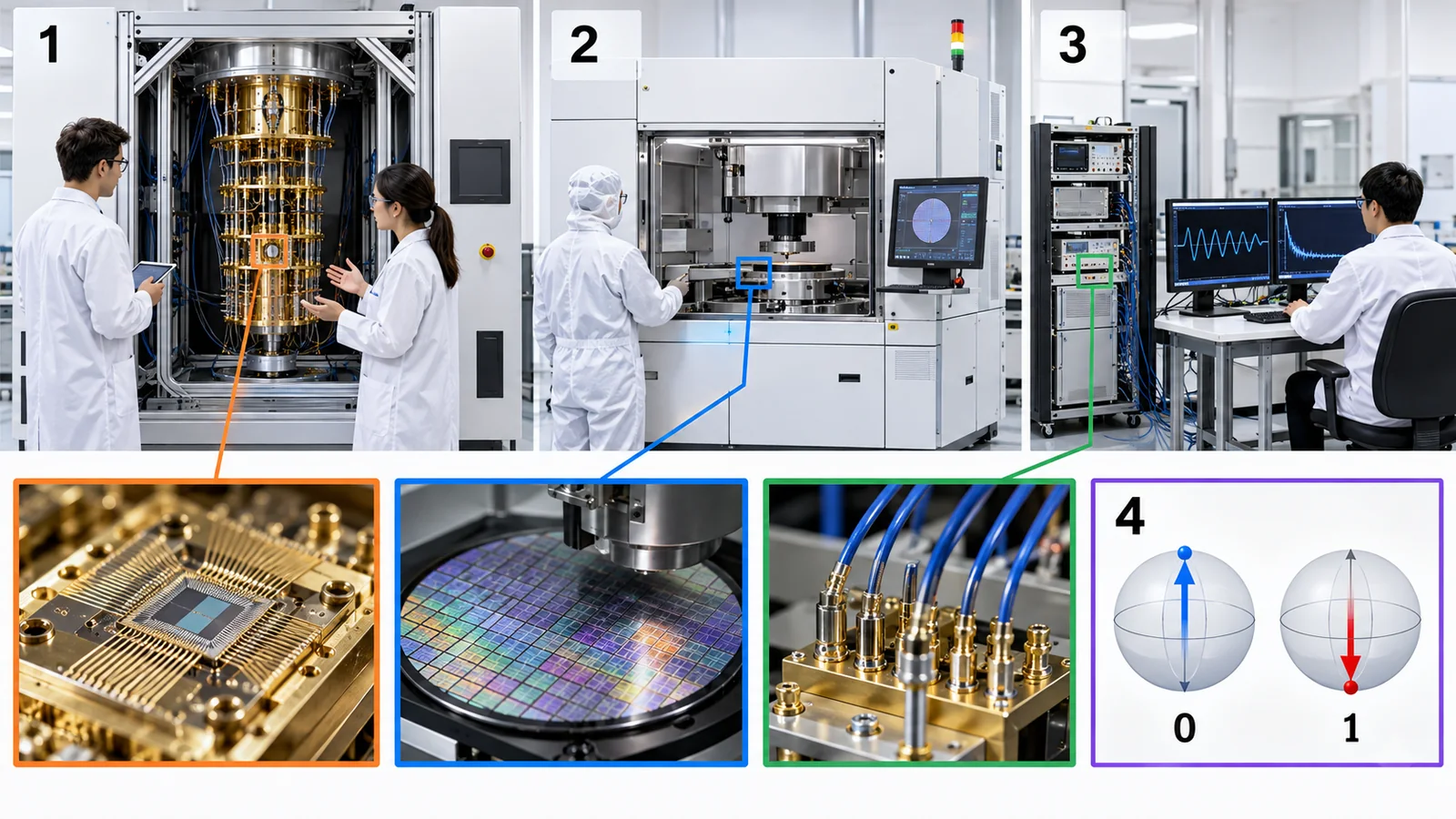
- AIST in 30 seconds
- What kind of institution? Four types of influence
- What it does for quantum computing
- How far its influence reaches (powers and geography)
- Who is involved, and how the money flows
- Outlook
- Glossary / References / Claim-to-source audit
1. AIST in 30 seconds
(AIST)Headquarters in Tsukuba, Ibaraki Prefecture (Tokyo headquarters in Chiyoda Ward)
(Act No. 203 of 1999)In force from 6 January 2001 (supplementary provisions). We did not check the date the institute was formally established
AIST is a research hub that carries out the national quantum strategy. It is not the body that sets the strategy. G-QuAT was established on 27 July 2023, after the "Quantum Future Industry Creation Strategy" (April 2023), decided by the Cabinet's Integrated Innovation Strategy Promotion Council, announced the creation of a development hub for industrialisation Sourced. AIST's influence comes from having several types of real quantum computer in Japan and a prototyping facility open to outside users, and from holding a chairing role in international standards work (IEC/ISO JTC 3) Sourced. But it does not decide a standard alone, and it has no power over subsidies or regulation.
2. What kind of institution? Four types of influence
Unlike companies, the institutions that appear in quantum computing coverage do not sell quantum computers. Instead they can be sorted into four types by the route through which they influence the field. AIST is mainly of the "convening" type, with a share in "standards". It runs a hub that shares real machines and a prototyping facility and connects companies, universities and overseas institutions. In international standards its role is to move the discussion along, while decisions come from agreement among the international bodies.
3. What it does for quantum computing
An ordinary computer calculates with bits, each of which is either 0 or 1. A quantum computer calculates with quantum bits (qubits), which can be in a state that blends 0 and 1. There are several approaches. This article mentions superconducting (electrical circuits cooled to extremely low temperatures), neutral-atom (atoms held by light) and optical (using particles of light, working at room temperature and pressure). Numbers such as "64" and "260" count physical qubits, raw qubits with no error correction. For more, see our explainers on the basics of quantum computing, superconducting qubits, neutral atoms and optical quantum computers.
The table below lists AIST's quantum computing activities, keeping what is running apart from what is being prepared or planned.
| Activity | Date and status | What it does | Status type |
|---|---|---|---|
| Global Research and Development Center for Business by Quantum-AI Technology (G-QuAT) | Established 27 July 2023 | Aims at social deployment of computing that combines quantum and classical (AI-type) computing, at creating use cases, at developing evaluation methods for high-quality parts and materials and leading their standardisation, and at large-scale integration of qubits. Director: Kazuya Masu | Running |
| Quantum-classical hybrid computing infrastructure "ABCI-Q" | General availability began 14 October 2025 (GPU supercomputer "System H"). External provision of two quantum computers began 24 March 2026 | Built around System H (a GPU supercomputer with NVIDIA H100s) plus System F (Fujitsu, superconducting, 64 physical qubits), System Q (QuEra, neutral atom, 260 physical qubits) and System O (an optical quantum computer from OptQC). External provision began with joint research in national projects such as NEDO's | H, F and Q running. O in preparation (operating status of 11 September 2026) |
| Optical quantum computer "MoQuren" | Start of operation announced 21 July 2026 | OptQC's first machine, installed at G-QuAT. Described as a big step toward a component of ABCI-Q, but ABCI-Q's own status page still read "in preparation" on 11 September 2026 | Operation started (ABCI-Q integration in preparation) |
| Superconducting quantum circuit prototyping facility "Qufab" | Open to outside users for a fee since October 2024. The fourth application round for FY2026 was announced on 1 September 2026 | Japan's only shared foundry for superconducting quantum circuits (METI document). That document describes a service with six multi-project wafer runs a year, for users in Japan and abroad. Currently 4-inch; extension to 8 inches and a decision on the operating structure beyond that are due by the end of 2026 | Running. The extension is a plan |
| International standardisation (IEC/ISO JTC 3) | Hosted an international meeting in May 2025 (about 120 experts from 24 countries). Became convenor of WG12 in October 2025 | In JTC 3, the joint committee that makes international quantum standards, G-QuAT Deputy Director Masahiro Horibe chairs WG12, which handles quantum computing benchmarking. Japan's national body is Q-STAR | Under way |
| Supply-chain roadmaps | Technical report published 9 September 2025; roadmap for the optical approach (second report) 3 September 2026 | Done jointly with RIKEN and Fujitsu. Sets out the challenges for the building-block technologies needed by large quantum computers (for superconducting: signal amplifiers, cables, connectors, dilution refrigerators and so on; for optical: light sources, photodetectors, modulators and so on). Part of a Cabinet Office SIP (Cross-ministerial Strategic Innovation Promotion Program) project | Published (other approaches to follow) |
| NEDO "Post-5G Information and Communication Systems Infrastructure Enhancement R&D Project" | Selected 19 August 2025. Further themes announced 17 September 2026 | AIST is lead institution for the research and development of an optical detection system that can resolve photon numbers. It joins as a participating institution in themes led by Fujitsu, Yaqumo, QuEra Computing Japan, OptQC, Fujikura and Hamamatsu Photonics, among others. It also joins themes of Hitachi and Intel, Kyocera, and Mitsubishi Electric | Selected (R&D under way) |
| Partnerships with companies, universities and overseas institutions | Many, 2024 to 2026 | The announcement headlines include memoranda signed with IBM, IQM, Bluefors, Intel, ORCA Computing, IonQ, NVIDIA, QuEra and others. A cooperation agreement with Fujitsu was signed on 26 September 2025, aiming to build an international supply chain | Signed (see each announcement for what the cooperation covers) |
Note: machine specifications (qubit counts and so on) are values published by AIST itself, not third-party evaluations.
G-QuAT states that it will develop evaluation methods so that high-quality parts and materials can be supplied reliably and lead their standardisation. Its supply-chain roadmap lists signal amplifiers, cables, connectors, dilution refrigerators, light sources and photodetectors as "building-block technologies needed to scale up quantum computers" Sourced. That document names, as a problem, that "the technical specifications of quantum computer systems are not clear, so the hurdle to entry is high, especially for small and medium-sized firms", and says it will clarify the specifications to encourage new entrants. For suppliers of materials and components, AIST could be a place to measure whether your material meets the specifications a quantum computer needs. In NEDO projects, AIST joins themes on small cryogenic cables and connectors (Fujikura) and on optical parts (Hamamatsu Photonics, NGK Insulators and others), taking on evaluation technology and the preparation of components.
4. How far its influence reaches (powers and geography)
| Aspect | What AIST has | What it does not have |
|---|---|---|
| Powers | The power to research and develop quantum computers, install and share them, and spread the results. The AIST Act sets out, beyond R&D in mining and manufacturing science and technology, the task of setting measurement standards (Article 11) | The power to set national policy or strategy. The power to decide subsidies (AIST is on the receiving end of NEDO's selection). Regulatory or export-control powers |
| Standards and certification | Chairing the discussion in an international standards committee (JTC 3, WG12). Developing evaluation methods for parts and materials and leading their standardisation | The power to decide an international standard alone. The power to run a certification scheme for quantum computers |
| Funding | Building up its hub with money it receives: the operating grant (JPY 67.4 billion in the FY2026 plan, all fields) and facility funds provided in supplementary budgets. It can be lead institution in NEDO projects | Handing out research funds to other bodies. Deciding METI's total budget |
| Geography | Sites in Japan (Tsukuba). ABCI-Q accepts applications from companies and universities in Japan and abroad. It has signed many memoranda with overseas institutions | The power to move other countries' policies or sites. Use by people living abroad needs a declaration and a checklist review as a non-resident, and residents are also asked to submit an export-control confirmation |
| Scale | 3,100 employees and 2,304 research staff (1 January 2026). FY2026 planned revenue of about JPY 127.4 billion (all fields) | A published headcount or budget for quantum alone (not found) |
The roughly JPY 127.4 billion is AIST's whole FY2026 revenue plan, not an amount spent on quantum. Its breakdown is: operating grant JPY 67.4 billion, facility subsidy JPY 9.8 billion, commissioned income JPY 28.2 billion, and other income JPY 22.0 billion Sourced. METI's JPY 100.4 billion (3 years) in the FY2025 supplementary budget is for next-generation R&D, large-scale demonstrations, building up G-QuAT and similar uses, and it is shown in a separate frame from AIST's revenue plan. We could not confirm how much of it AIST receives Not yet confirmed.
5. Who is involved, and how the money flows
AIST's G-QuAT sits among the government bodies that set strategy, the bodies that provide funding, the companies that supply machines and the companies and universities that use them. The diagram below shows only relationships stated on official pages.
METI's draft policy direction of 8 July 2026 proposes positioning G-QuAT as a "key production base of national strategic importance". This is a draft and has not been adopted Not yet confirmed. RIKEN is a joint research partner on the supply-chain roadmap. We could not confirm in any document how roles are divided between RIKEN and AIST (see our RIKEN profile in this series).
6. Outlook
| What we can read from the record | Primary evidence | Status |
|---|---|---|
| When the optical quantum computer (System O) becomes available as part of ABCI-Q cannot be confirmed as of 16 October 2026 | Start of MoQuren operation announced on 21 July 2026. ABCI-Q's operating status of 11 September 2026 reads "System O: in preparation" | Not yet confirmed |
| A decision on extending Qufab to 8 inches and on the operating structure beyond that is due by the end of 2026 | METI's draft policy direction of 8 July 2026 (it also looks ahead to 12-inch service in the early 2030s) | Not yet confirmed |
| Whether G-QuAT will be positioned as a "key production base of national strategic importance" | METI's draft policy direction (draft) | Not yet confirmed |
| AIST's influence will probably continue to rest on being a hub that brings real machines, a prototyping facility and standards discussions together in one place | G-QuAT holds machines of several approaches, Qufab, the chair of JTC 3 WG12 and participation in many NEDO themes all at once | Inference |
| The supply-chain roadmap will extend to approaches other than superconducting and optical (neutral atoms, trapped ions and others) | The "future plans" section of the 3 September 2026 announcement | Not yet confirmed |
7. Glossary
- G-QuAT
- AIST's Global Research and Development Center for Business by Quantum-AI Technology, a hub for developing, evaluating and sharing quantum computers.
- ABCI-Q
- G-QuAT's quantum-classical hybrid computing infrastructure: a GPU supercomputer combined with quantum computers of several approaches.
- Qufab
- AIST's prototyping facility for superconducting quantum circuits, a shared foundry where outside companies can make prototype quantum chips.
- IEC/ISO JTC 3
- The joint technical committee of the International Electrotechnical Commission and the International Organization for Standardization (set up in January 2024) that makes international quantum standards.
- Convenor
- The chair of a working group on international standards. The convenor steers the discussion, while decisions rest on the agreement of participating countries.
- SIP
- The Cross-ministerial Strategic Innovation Promotion Program, a Cabinet Office framework for R&D.
- Shared foundry
- A prototyping or manufacturing facility for semiconductor or quantum chips that several users can use together.
- Deemed export control
- The idea that providing technology to a person inside Japan can itself fall under export control if that person is strongly influenced by a foreign entity.
8. References
- AIST Page of the Global Research and Development Center for Business by Quantum-AI Technology (G-QuAT) (statement of aims and activities; contact address) (in Japanese). https://unit.aist.go.jp/g-quat/
- AIST G-QuAT announcements list (FY2023 to FY2026: headlines on memoranda, cooperation agreements, NEDO projects, Qufab application rounds) (in Japanese). https://unit.aist.go.jp/g-quat/ja/results/topics.html
- AIST Press release "Establishment of the Global Research and Development Center for Business by Quantum-AI Technology" (27 July 2023) (in Japanese). https://www.aist.go.jp/aist_j/news/pr20230727.html
- AIST ABCI-Q user guide (configuration and qubit counts of Systems H, F, Q and O; how to apply; fees; use by non-residents; deemed export control; operating status updated 11 September 2026) (in Japanese). https://unit.aist.go.jp/g-quat/HowToUse/abci_q/index.html
- AIST Announcement "General availability of the quantum-classical hybrid computing infrastructure 'ABCI-Q' begins" (6 October 2025; start on 14 October 2025) (in Japanese). https://www.aist.go.jp/aist_j/news/au20251006.html
- AIST News "External provision of ABCI-Q quantum computers begins" (24 March 2026) (in Japanese). https://unit.aist.go.jp/g-quat/HowToUse/news/news_20260324.html
- AIST and OptQC Announcement "OptQC and AIST build and start operating the optical quantum computer 'MoQuren', unit 1" (21 July 2026) (in Japanese). https://www.aist.go.jp/aist_j/news/announce/au20260721.html
- AIST Announcement "Appointed convenor of IEC/ISO JTC 3 WG12 'Benchmarking of quantum computing'" (24 October 2025) (in Japanese). https://www.aist.go.jp/aist_j/news/au20251024.html
- AIST Announcement "Roadmap on supply chains for large-scale quantum computer systems published" (3 September 2026; second report, optical approach; joint work with RIKEN and Fujitsu; SIP) (in Japanese). https://unit.aist.go.jp/g-quat/ja/results/announce/announce_20260903.html
- AIST Announcement "G-QuAT selected for a NEDO project" (19 August 2025; themes as lead and participating institution) (in Japanese). https://www.aist.go.jp/aist_j/news/au20250819.html
- AIST Announcement "G-QuAT joins several R&D themes in NEDO projects" (17 September 2026) (in Japanese). https://unit.aist.go.jp/g-quat/ja/results/announce/announce_20260917.html
- AIST and Fujitsu Announcement "Fujitsu and AIST sign a cooperation agreement on strengthening international industrial competitiveness in quantum technology" (29 September 2025; signed 26 September 2025) (in Japanese). https://unit.aist.go.jp/g-quat/ja/results/announce/announce_20250929.html
- AIST Number of staff by type of work (1 January 2026: 3,100 in total, 2,304 research staff) (in Japanese). https://www.aist.go.jp/Portals/0/resource_images/aist_j/comp-info/idpo/staff20260101.pdf
- AIST FY2026 Plan (March 2026; Appended Table 1: FY2026 budget plan) (in Japanese). https://www.aist.go.jp/Portals/0/resource_images/aist_j/outline/plan/nendokeikaku_r8.pdf
- e-Gov Law Search Act on the National Research and Development Agency, National Institute of Advanced Industrial Science and Technology (Article 3: purpose; Article 11: scope of work; Article 13: competent minister; supplementary provisions: effective date) (in Japanese). https://laws.e-gov.go.jp/law/411AC0000000203
- Ministry of Economy, Trade and Industry Future Direction of Quantum Computer Policy (8 July 2026, Innovation and Environment Bureau: the state of Qufab and the 8-inch extension, the proposed positioning of G-QuAT; labelled as a proposal) (in Japanese). https://www.meti.go.jp/shingikai/sankoshin/sangyo_gijutsu/innovation/pdf/014_04_02.pdf
- Cabinet Office, Science, Technology and Innovation Promotion Office Quantum-related measures in the FY2025 supplementary budget (24 December 2025: METI's JPY 100.4 billion, G-QuAT's full-scale operation) (in Japanese). https://www8.cao.go.jp/cstp/ryoshigijutsu/27kai/sanko3.pdf
9. Claim-to-source audit
| Claim in the text | Status | Source |
|---|---|---|
| G-QuAT's aims and activities (use-case creation, evaluation methods and standardisation for parts and materials, large-scale qubit integration) and update history | Sourced | Reference 1 https://unit.aist.go.jp/g-quat/ |
| Announcement headlines (partners of memoranda, JTC 3, NEDO projects, Qufab application rounds, ABCI-Q general and external provision) and dates | Sourced | Reference 2 https://unit.aist.go.jp/g-quat/ja/results/topics.html |
| Establishment of G-QuAT (27 July 2023), and that the Quantum Future Industry Creation Strategy (April 2023) announced the creation of a development hub | Sourced | Reference 3 https://www.aist.go.jp/aist_j/news/pr20230727.html |
| ABCI-Q's configuration (Systems H, F, Q and O), qubit counts (64 and 260), how to apply, use by non-residents and deemed export control, and the operating status of 11 September 2026 | Sourced | Reference 4 https://unit.aist.go.jp/g-quat/HowToUse/abci_q/index.html |
| Start date of ABCI-Q general availability (14 October 2025) and System H's configuration (2,020 GPUs) | Sourced | Reference 5 https://www.aist.go.jp/aist_j/news/au20251006.html |
| Start of external provision of two quantum computers (superconducting and neutral atom) on 24 March 2026 | Sourced | Reference 6 https://unit.aist.go.jp/g-quat/HowToUse/news/news_20260324.html |
| Start of operation of the optical quantum computer MoQuren (OptQC) on 21 July 2026 | Sourced | Reference 7 https://www.aist.go.jp/aist_j/news/announce/au20260721.html |
| Establishment of JTC 3 (January 2024), hosting the May 2025 international meeting (about 120 experts, 24 countries), appointment as WG12 convenor, and Q-STAR as Japan's national body | Sourced | Reference 8 https://www.aist.go.jp/aist_j/news/au20251024.html |
| The supply-chain roadmap (optical approach, second report, 3 September 2026), joint work with RIKEN and Fujitsu, SIP, the list of building-block technologies, and future plans | Sourced | Reference 9 https://unit.aist.go.jp/g-quat/ja/results/announce/announce_20260903.html |
| Selection for NEDO's Post-5G project (19 August 2025), the themes as lead and participating institution (Fujitsu, Yaqumo, QuEra Computing Japan, OptQC, Fujikura, Hamamatsu Photonics, NGK Insulators and others) | Sourced | Reference 10 https://www.aist.go.jp/aist_j/news/au20250819.html |
| The additional NEDO themes announced on 17 September 2026 (Hitachi and Intel, Kyocera, Mitsubishi Electric, Hamamatsu Photonics, and talent development with Osaka University) | Sourced | Reference 11 https://unit.aist.go.jp/g-quat/ja/results/announce/announce_20260917.html |
| Purpose of the cooperation agreement with Fujitsu (signed 26 September 2025) | Sourced | Reference 12 https://unit.aist.go.jp/g-quat/ja/results/announce/announce_20250929.html |
| 3,100 employees and 2,304 research staff (1 January 2026) | Sourced | Reference 13 https://www.aist.go.jp/Portals/0/resource_images/aist_j/comp-info/idpo/staff20260101.pdf |
| FY2026 planned revenue (operating grant JPY 67.4 billion, facility subsidy JPY 9.8 billion, commissioned income JPY 28.2 billion, other income JPY 22.0 billion; about JPY 127.4 billion in total) | Sourced | Reference 14 https://www.aist.go.jp/Portals/0/resource_images/aist_j/outline/plan/nendokeikaku_r8.pdf |
| The AIST Act's purpose, scope of work (including setting measurement standards), competent minister (the Minister of Economy, Trade and Industry) and effective date (6 January 2001). We did not check the date of formal establishment | Sourced | Reference 15 https://laws.e-gov.go.jp/law/411AC0000000203 |
| Qufab's current state (4-inch, open for a fee since October 2024), the 8-inch extension and decision on structure by the end of 2026, and the proposed positioning of G-QuAT | Sourced | Reference 16 https://www.meti.go.jp/shingikai/sankoshin/sangyo_gijutsu/innovation/pdf/014_04_02.pdf |
| METI's FY2025 supplementary quantum amount of JPY 100.4 billion (3 years) and G-QuAT's full-scale operation (May 2025) | Sourced | Reference 17 https://www8.cao.go.jp/cstp/ryoshigijutsu/27kai/sanko3.pdf |
| The four-type classification of institutions, and the diagram of ABCI-Q's operating status | Our calculation | This article's own organisation of the material |
| AIST's quantum-only headcount and budget, how much of the JPY 100.4 billion AIST receives, and the division of roles between AIST and RIKEN | Not yet confirmed | Not stated in references 1 to 17. This article does not estimate them |
| When System O will be available, the 8-inch extension of Qufab and the decision on structure, and the proposed positioning of G-QuAT | Not yet confirmed | References 4, 7 and 16. These cannot be settled from primary sources as of 16 October 2026, so this article leaves them open |
| The Section 6 inference that AIST's influence rests on being a hub that brings machines, a prototyping facility and standards discussions together | Inference | This article's reading of references 4, 8, 10 and 16 |
Last updated: 16 October 2026 / Troy Technical
Figures in this article come from the official pages of AIST and G-QuAT, e-Gov Law Search, and documents of METI and the Cabinet Office. Quantum computing moves fast, and the operating status of machines and plans may change, so the date of checking (16 October 2026) is shown. Items marked "Inference" are this article's own reading of the primary sources. Some G-QuAT pages refuse command-line retrieval, so we opened them in a browser to check them.