

Key Findings
MatterGen-e⁻ demonstrates a superior ability to generate inorganic crystals that are simultaneously valid, stable, unique, and novel when targeting specific formation energies and band gaps. By shifting the AI’s focus to predict electrons rather than just atoms, the model overcomes data scarcity issues that previously limited the correlation between macroscopic properties and crystal structures.
Technical Details
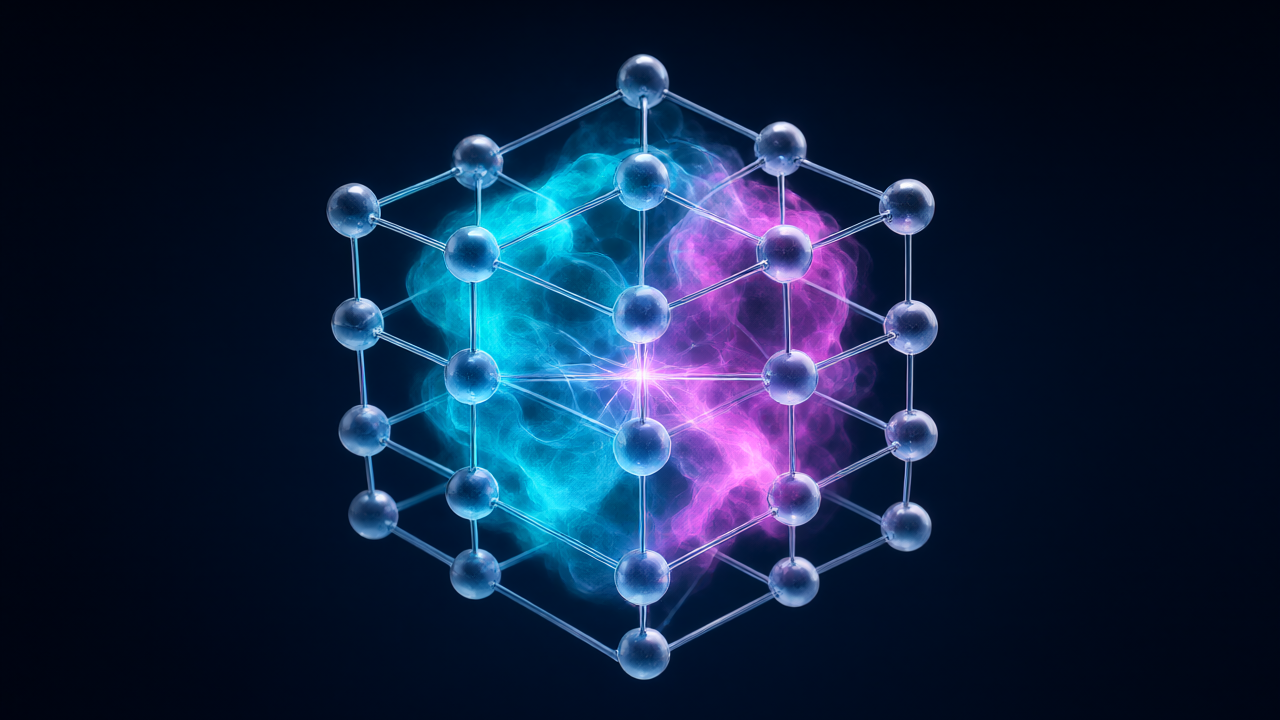
The model is an extension of MatterGen, a diffusion-based generative AI developed by Microsoft Research in early 2025. While the original MatterGen focused on three variables—atom types, spatial coordinates, and unit cell lattice geometry—MatterGen-e⁻ introduces two critical electronic descriptors as an intermediate language:
- Bader charge: A computational chemistry quantity that assigns electronic charges to each atom to capture electron sharing and transfer.
- Atomic density of states: A description of how electronic energy levels are distributed around individual atoms.
By generating these descriptors jointly with the atomic structure, the model embeds known physics into the generative process, allowing it to reason through the relationship between local atomic arrangement and macroscopic properties.
Background & Context
Traditional computational materials discovery typically focuses on crystal structure (the 3D pattern of atoms) and then screens for properties. However, the University of Tokyo team argues this is inefficient because the electronic structure sits physically between the atomic arrangement and the resulting material property. Because data linking macroscopic properties directly to crystal structures is limited, the researchers used electronic descriptors to provide a physically grounded stepping stone for the neural network.
Significance & Outlook
The integration of electronic descriptors allows every training example to provide a stronger signal than in purely structure-based models. This approach reduces the reliance on statistical shortcuts and increases the likelihood of discovering materials that can actually exist outside of a computer. Additionally, the model provides the density of states for newly generated materials, with predictions that align well with established data.
Get our weekly technology intelligence — free
Receive an infographic that lets you judge at a glance whether each field’s analysis report is worth reading.
Subscribe Free — Weekly Tech Intelligence
By subscribing, you’ll receive Troy-Technical’s weekly technology intelligence newsletter.
- Your email and selected fields are used only to deliver the newsletter.
- We never share your information with third parties.
- You can unsubscribe anytime via the link in each email.
See our Privacy Policy for details.
Takes about a minute · Unsubscribe anytime