


Key Findings
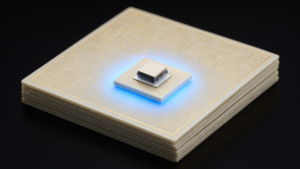
The reported photonic integrated engine achieves the first single-chip integration of the entire beamline required for cold-atom generation. The system successfully supports sustained 3D-MOT operation, trapping more than 1 million atoms at an average temperature of 350 μK. This integration allows for full electrical control over the process, supporting both atom-number and temperature measurements.
Technical Details
The single-chip architecture integrates several critical components:
- Two frequency-agile self-injection-locked lasers.
- Laser frequency and intensity control mechanisms.
- Passive beam combining and splitting.
- Signal monitoring and routing for laser offset locking.
- Optical power modulation.
- High-efficiency beam delivery capable of providing 3 mW across three beams to the physics package.
The engine provides stable, low-noise cooling and repump light, utilizing integrated resonator-based lasers that offer linewidth and frequency noise stability comparable to or exceeding traditional tabletop external-cavity diode lasers (ECDLs).
Background & Context
Cold atoms are essential for quantum sensing, precision metrology, computing, and timekeeping. Traditionally, the “beamline”—the path from light generation to delivery—consists of table- and rack-scale technologies using discrete optics and optical fibers. These bulky configurations limit the deployment of cold-atom technology outside of laboratory settings and restrict use by non-experts. While previous efforts have miniaturized vacuum cells and individual laser sources, integrating the entire generation and control sequence onto one substrate remained a significant challenge.
Significance & Outlook
By co-locating light generation and delivery on a common substrate, the system reduces laser output power requirements and suppresses accumulated phase noise and sensitivity to environmental vibrations. This miniaturization improves robustness, reliability, and manufacturability while reducing cost. The development provides a path toward portable, space-based precision measurements and the creation of compact cold-atom clocks and sensors.
Source: https://arxiv.org/html/2610.17918v1
Get our weekly technology intelligence — free
Receive an infographic that lets you judge at a glance whether each field’s analysis report is worth reading.
Subscribe Free — Weekly Tech Intelligence
By subscribing, you’ll receive Troy-Technical’s weekly technology intelligence newsletter.
- Your email and selected fields are used only to deliver the newsletter.
- We never share your information with third parties.
- You can unsubscribe anytime via the link in each email.
See our Privacy Policy for details.
Takes about a minute · Unsubscribe anytime