Key Findings
The data center market is experiencing robust growth, projected to reach $620 billion by 2029 from $416 billion in 2024. Within this expansion, the AI segment is witnessing explosive growth, exceeding 25% annually, and is forecast to command a market size of $21-49 billion by 2026. This rapid acceleration has highlighted power supply as the most critical limiting factor for AI data centers, with projections indicating US AI data center power demand could reach an astounding 123 GW by 2035.
Technical / Clinical Details
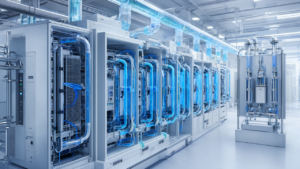
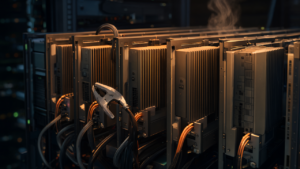
AI workloads, particularly the training and inference of large language models, demand exceptionally high computational power, leading to a dramatic increase in data center rack densities and electricity consumption. Traditional data center designs struggle to accommodate these power densities, making thermal management a severe challenge. The stagnation of the global data center’s Power Usage Effectiveness (PUE) at 1.54 since 2018 signals that conventional efficiency improvements are no longer sufficient to cope with the escalating power and heat issues. Consequently, liquid cooling has become indispensable for high-density AI racks, offering heat removal capabilities far beyond what traditional air cooling can provide. Liquid cooling, being significantly more efficient at transporting heat than air, is now essential for maximizing AI hardware performance while maintaining overall data center energy efficiency.
Background & Context
The explosive adoption of generative AI technologies is transforming industries worldwide, simultaneously driving an unprecedented demand for the underlying data center infrastructure. This surge in demand, however, is placing immense pressure on existing power grids and cooling technologies. The projected power requirements for AI data centers in the US, for instance, pose serious challenges to grid stability and the pace of new power plant construction, potentially bottlenecking the growth rate of the AI industry. Investors and enterprises, while continuing to pour capital into AI technologies, are actively seeking solutions to these fundamental physical and energy constraints.
Strategic Significance & Outlook
The constraints imposed by power supply will profoundly influence the site selection, design, and cooling technology choices for future AI data centers. We anticipate an accelerated adoption of liquid cooling technologies and the development of distributed data centers powered by renewable energy sources. Furthermore, leading AI chip manufacturers like NVIDIA are designing hardware with integrated liquid cooling, which will likely standardize the technology across the industry. While AI is a primary driver of data center market growth, addressing the fundamental challenge of power supply will be key to ensuring the sustainable development of the entire AI industry moving forward.
Source: https://technologychecker.io/blog/data-center-market-statistics-ai
Get our weekly technology intelligence — free
Receive an infographic that lets you judge at a glance whether each field’s analysis report is worth reading.
Subscribe Free — Weekly Tech Intelligence
By subscribing, you’ll receive Troy-Technical’s weekly technology intelligence newsletter.
- Your email and selected fields are used only to deliver the newsletter.
- We never share your information with third parties.
- You can unsubscribe anytime via the link in each email.
See our Privacy Policy for details.
Takes about a minute · Unsubscribe anytime