TECHNOLOGY EXPLAINER
Materials Databases and the FAIR Principles
— Checking whether public data may be used, and whether it can be trusted
Materials databases are the “fuel” of MI. Many are free to use: Materials Project, AFLOW, OQMD, NOMAD, JARVIS, and the MDR and PoLyInfo of NIMS (the National Institute for Materials Science in Japan). But the numbers in a database cannot always be used as if they were measurements. Values differ when calculation conditions differ, and the terms of use (licenses) differ from database to database. This article explains, with primary sources and check dates, how a materials engineer can check whether public data may be used (terms of use) and whether it can be trusted (quality of values), and the idea behind the international principles for making data easy to find and reuse (the FAIR principles).
- Three-line summary, prerequisites, and where this fits in the series
- A map of materials databases: the main ones at a glance
- How to read terms of use (licenses)
- How far can the values in a database be trusted?
- The FAIR principles: making data easy to find and reuse
- Moving your own data closer to FAIR
- Six checks before using a public database
- Limits, what we could not confirm, and a summary
- How to read the yardsticks and standards
- Glossary
- References (primary sources)
- Claim-to-source audit
Sourced = stated in a published source (reference link given)
Our calculation = a value this article computed from stated assumptions
Not yet confirmed = plans, revisions in progress and other matters not yet settled
Our reading of what this means for materials research is labeled commentary. An Inference is shown in bold.
The size, version and terms of a database change. What we write here is what we could confirm on the official site or official documentation on the check date (22 October 2026). Where we could not confirm an item we say so, and we have not filled the gap by guessing. Statements about licenses introduce the official wording and are not legal advice. Whether your use (R&D, productization, publishing outside the company) falls under a condition should be checked with your intellectual-property or legal department. We do not quote the contents of fee-based databases (such as ICSD). The calculation on synthetic data in Chapter 4 does not use values from any real database.
1. Three-line summary, prerequisites, and where this fits in the series
- Databases are handy, but “as is” is risky. Computed values change when conditions (functional, pseudopotential, corrections) change. Even for the same material, differences of up to 0.105 eV/atom in formation energy and up to 0.21 eV in band gap have been reported among databasesSourced
- Terms of use differ by database. Some allow even commercial use if you credit the source (CC BY 4.0), some are non-commercial only (BY-NC and the like), and some require registration and forbid bulk downloads. “Public” does not mean “free to use”
- The FAIR principles are fifteen principles for findability, accessibility, interoperability and reusability of data. They do not demand that data be published; they are a way of preparing data so that machines and people can use it. They also help in organizing your own data
DFT (density functional theory) is a physics simulation that calculates material properties from the behavior of electrons; it contains approximations and does not necessarily agree with measurements. Most databases gather values calculated by DFT. A descriptor is a “business card” of a material in numbers. Machine learning is an approximator that learns trends from past data. These are explained in our introduction to materials informatics and in our explainer on materials data and descriptors.
This is the third article in the series. The previous one covered how to put your own data into a table. This one covers how to use data made by other people (public databases). The next article, on machine learning with small data, covers what to do when you have little data, and the one after, on uncertainty and applicability domain, covers how far a prediction can be trusted.
2. A map of materials databases: the main ones at a glance
An analogy: if the search for materials is “looking for treasure on a very large map,” a database is a record of the places earlier people have already dug. Using the record saves you from digging the same place again. But unless the record says “who dug, with what tool, and when,” you cannot tell whether to trust it. This chapter sorts the main materials databases by “what they provide.”
Of the three groups in Fig. 2, those that provide DFT-computed data are the most used in MI (commentary). The table below lists, for each database, what we could confirm on the official site or in papers. We have not left blanks: where we could not confirm an item we write “could not be confirmed.”
| Database | What it provides | Calculation / collection conditions (as far as confirmed) | Size (checked 22 October 2026) | Terms of use (as far as confirmed) |
|---|---|---|---|---|
| Materials Project (MP) | DFT-computed data on inorganic crystals and other materials. A U.S. Department of Energy (DOE) effort to pre-compute properties and make them public [Refs. 3, 4]Sourced | PAW method, plane-wave cutoff 520 eV, k-point mesh of 1000 per reciprocal atom, GGA / GGA+U [Ref. 9]. r2SCAN (meta-GGA) calculations were added from the October 2022 release [Ref. 10]Sourced | Total could not be confirmed. The version history says GNoME-derived r2SCAN data were added, bringing that set to 117k (April 2026 release) [Ref. 5]. The latest version is v2026.09.28 (went live 19 October 2026) [Ref. 5] | Terms differ by data product. GNoME-derived data are BY-NC (non-commercial) [Refs. 5, 6]. The old terms page states CC BY 4.0 [Ref. 7]. The current terms page showed an automated-access check and could not be opened, so it could not be confirmed |
| AFLOW | A framework for high-throughput DFT (AFLOW) and a repository of results (AFLOWLIB) [Refs. 11, 12]Sourced. Its library of crystal-structure prototypes has been expanded to 1,783 prototypes [Ref. 14]Sourced | Could not be confirmed (a paper points to the choice of pseudopotentials and +U as causes of differences among databases [Ref. 26]) | Could not be confirmed | The REST API page states: “the data included within the repository is free for scientific, academic and non-commercial purposes; any other use is prohibited” [Ref. 13]Sourced. We could not confirm the date of that statement |
| OQMD | DFT total energies of compounds and assessment of their stability [Refs. 15, 16]Sourced | Could not be confirmed (the paper says the calculations cover compounds from the ICSD and decorations of commonly occurring crystal structures) | Nearly 300,000 DFT total-energy calculations in the 2015 paper [Ref. 16]. The current count could not be confirmed because the site did not respond on the check date (server error) | The paper says the entire database is made available for download “without restrictions” [Ref. 16]. The current license statement could not be confirmed |
| JARVIS (NIST) | An infrastructure covering DFT, force fields, machine learning, quantum computation and experiments: JARVIS-DFT, JARVIS-FF, JARVIS-Leaderboard and others [Refs. 20, 21]Sourced | JARVIS-DFT uses the OptB88vdW and TBmBJ methods (with and without spin-orbit coupling) [Ref. 21]Sourced | 2020 paper: about 40,000 materials and about 1 million computed properties in JARVIS-DFT [Ref. 20]. Official site: more than 80,000 materials in JARVIS-DFT [Ref. 21] | Registration is free, and access to the database and web apps requires credentials [Ref. 21]. The software (JARVIS-tools) carries NIST terms [Ref. 22]. The license of the data could not be confirmed |
| NOMAD | A platform for uploading, sharing and searching computational materials-science data, stored in a code-independent normalized form [Refs. 17, 18]Sourced | Output of many computational codes is normalized and stored [Ref. 17]Sourced | 19,419,360 public entries (the count returned by the API) [Ref. 19]. An “entry” is the record of one calculation, not the number of distinct materials | Could not be confirmed (we did not confirm statements of terms for each dataset) |
| PoLyInfo (NIMS) | Polymer property data collected from the academic literature, covering about 100 property types [Ref. 23]Sourced | Collected from the literature; measurement conditions, forming methods, raw monomers and polymerization methods are recorded in linked form [Ref. 23] | Public data as of 30 September 2026: homopolymers 16,064; polymer samples 112,771; copolymers 5,638; property points 357,812; polymer blends 1,978; literature records 15,365; composites 2,153 [Ref. 23] | User registration and an application for service use are required. Web scraping and bulk retrieval are prohibited. NIMS holds the copyright, and reproduction, copying or distribution to third parties without permission is prohibited. Fee-based datasets including unpublished data are offered [Ref. 23]Sourced |
| MDR (NIMS) | NIMS's repository for materials data, in which papers and research data are registered and published [Ref. 25]Sourced | Differs by dataset | The official page gives no count, so it could not be confirmed | States: “Datasets are available under licenses specified on their pages” [Ref. 25]Sourced |
The arrangement of this table is our own commentary. Size and terms change; always check the latest statement on the official site before use. The NOMAD count is a value returned by the public API (checked 22 October 2026).
NOMAD's 19.42 million is the number of records, one per calculation (entries). If one material was calculated with several settings, each record is counted. The “polymer samples” and “property points” of PoLyInfo are likewise not numbers of material types. When you compare the size of databases, check what is counted as one item (commentary).
For computed values of inorganic crystals (battery materials, ceramics, catalyst supports and so on), the DFT databases (MP, AFLOW, OQMD, JARVIS, NOMAD) are candidates. For measured data on polymers, a literature-based database such as PoLyInfo is a candidate. But conditions that govern the performance of a real product, such as the distribution of chain lengths, additives and forming conditions, may not be well covered by a database's items (commentary). A database is a tool for grasping trends; it does not replace values for your own material under your own conditions.
3. How to read terms of use (licenses)
The first thing to check before using values from a database is the terms of use. Data that do not fit the terms cannot be used however good they are. We group the statements we could confirm into four types (Sourced).
| Type | How it is written (statements we confirmed) | What it means (commentary) |
|---|---|---|
| Free to use if you credit the source | CC BY 4.0: you may copy and redistribute the material, and remix, transform and build on it, for any purpose, even commercially, provided attribution is given [Ref. 28]. The old Materials Project terms page states this [Ref. 7] | Easy to use even for in-house R&D. You must keep the source (database name, version, citing paper) |
| Non-commercial only | CC BY-NC 4.0: “You may not use the material for commercial purposes” [Ref. 29]. GNoME-derived data in Materials Project are BY-NC [Ref. 5]. The AFLOW REST page says “free for scientific, academic and non-commercial purposes” [Ref. 13] | Whether it can be used for a company's product development depends on the wording and on how it is used. Check with the intellectual-property or legal department |
| Registration required, retrieval limited | PoLyInfo: registration and a service-use application are required; scraping and bulk retrieval are prohibited [Ref. 23]. JARVIS: registration is free and use requires credentials [Ref. 21] | Check individually whether bulk retrieval by program is allowed. Collecting data by a prohibited method can lead to measures such as account suspension (PoLyInfo's notice) |
| Terms differ by dataset | MDR: “Datasets are available under licenses specified on their pages” [Ref. 25]. Materials Project: terms of use differ by data product [Ref. 6] | Check the terms not for the whole database but for each item of data you use |
The two left columns introduce official statements; the right column is our own commentary. This is not legal advice.
That is wrong. Being public and being free to use are different things. As the table shows, there are data that are non-commercial only, that require registration, that forbid bulk retrieval, and that have terms that differ by item. Even within one database, terms can differ by where the data came from (for example, GNoME-derived data in Materials Project). Check the terms of the data you use, and record the source, version and access date (Chapter 7).
4. How far can the values in a database be trusted?
Next is the quality of the values. Most database values are computed. Computed values change with conditions and do not necessarily match experiment. Let us look at three facts.
(1) Even for the same material, values differ among databases
Hegde and colleagues merged three DFT databases, AFLOW, Materials Project and OQMD, and compared values pairwise for materials computed from the same initial crystal structure. Formation energies and volumes were generally more reproducible than band gaps and total magnetizations. Even so, up to 7% of materials disagreed on whether they are metallic, and up to 15% on whether they are magnetic. The variance between values was as high as 0.105 eV/atom for formation energy (a median relative difference of 6%), 0.65 Å3/atom for volume (4%), 0.21 eV for band gap (9%) and 0.15 μB/formula unit for magnetization (8%), comparable to the differences between DFT and experimentSourced [Ref. 26]. They trace some of the larger discrepancies to choices involving pseudopotentials (approximations that simplify the inner electrons), DFT+U (a correction for strongly correlated electrons) and the elemental reference states [Ref. 26].
(2) A computed value is not a measured value
The official Materials Project documentation says, for DFT-computed band gaps, that in an internal test on 237 compounds the computed gaps were underestimated by an average factor of 1.6 relative to experiment, and that the residual error, even after accounting for this shift, is significant (a mean absolute error of 0.6 eV)Sourced [Ref. 8]. The OQMD paper reports that the mean absolute error between DFT-calculated formation energies and measured values is 0.096 eV/atom over 1,670 compounds, and that even experiments differ among themselves by 0.082 eV/atomSourced [Ref. 16].
(3) Adding data with a different baseline can make things worse
When data are scarce, it is tempting to combine several databases for training. But Hutchinson and colleagues point out that a property with the same name may be measured or computed differently depending on the data source, and that these hidden contextual differences introduce irreducible errors. One remedy is transfer learning (using information learned from one source to inform a model for another)Sourced [Ref. 27].
A small numerical experiment shows the mechanism (Our calculation). The true relation is shared; source A has the correct baseline, while source B reads 0.10 too high (a value mimicking a difference in calculation settings). A has 40 points and B has 200. We measure the prediction error on the A baseline.
The results are in Fig. 4. Training on A alone gives an error of 0.061. Merging A and B as they are, which looks like six times more data, makes the error worse, at 0.097. Training on B alone and predicting A is worse still, at 0.112. But if we merge them and add a column saying where each point came from (A or B), the error is 0.051, the best.
Our calculation. Synthetic data (a shared curve plus noise 0.03, with a shift of +0.10 for B). Fitted with a quartic polynomial. Average of 100 runs. Not values from any real database.
Even when the name “formation energy” is the same, if the functional (the type of DFT approximation), the pseudopotentials or the corrections differ, it may have to be treated as a different quantity. For example, from the October 2022 release Materials Project added r2SCAN calculations and provides a correction scheme for mixing GGA, GGA+U and r2SCAN results [Ref. 10]. When you mix sources, add a column for the source. It is a simple and effective measure (commentary).
Database values are handy for looking at the order and trends among materials, but their absolute values differ from experiment. So first place the database values next to the few measured values you have, and find “how far off they are.” If the offset is in a consistent direction it may be correctable (for example, band gaps consistently coming out low). If the offsets are scattered, database values alone cannot be relied on for that property (commentary).
5. The FAIR principles: making data easy to find and reuse
The international idea for making data easy to share and reuse is the FAIR principles. FAIR stands for Findable, Accessible, Interoperable and Reusable. Wilkinson and colleagues first formally published them in Scientific Data in 2016, as a concise and measurable set of principles jointly endorsed by stakeholders from academia, industry, funding agencies and scholarly publishers, meant as a guideline for enhancing the reusability of data holdings. They put specific emphasis on enhancing the ability of machines to automatically find and use the data, in addition to supporting reuse by individualsSourced [Ref. 1].
There are fifteen items in all (Fig. 5). The official wording of each is in the original paper and on the GO FAIR page [Refs. 1, 2]. For example, F1 says “(meta)data are assigned a globally unique and persistent identifier,” for which the DOI used for papers is a typical case. The NOMAD paper says that uploaded data are tagged by a persistent identifier and that users can also request a digital object identifier to make data citableSourced [Ref. 17]. The DOI system is set out in the international standard ISO 26324, whose third edition was published in March 2025 [Ref. 32]Sourced. The Materials Project documentation also explains that its data are placed in AWS Open Data in an effort to make them as accessible as possible (“FAIR principle”) [Ref. 37]Sourced.
The FAIR principles do not say that data must be made public. A1.2 provides that the protocol allows for an authentication and authorization procedure where necessary [Ref. 2]. So even an in-house database can be close to FAIR if it has identifiers, metadata, provenance and terms of use (the top left of Fig. 6). Conversely, data that are public but only as images of figures, with no conditions or license, are hard to reuse and are not FAIR (bottom right). Openness and FAIRness are different axes (commentary).
The FAIR principles are guidance, not a standard with legal force. Even when something says “FAIR-compliant,” you need to check which of the fifteen items it meets, and how well. Also, we could not confirm a standard method for evaluating FAIRness.
6. Moving your own data closer to FAIR
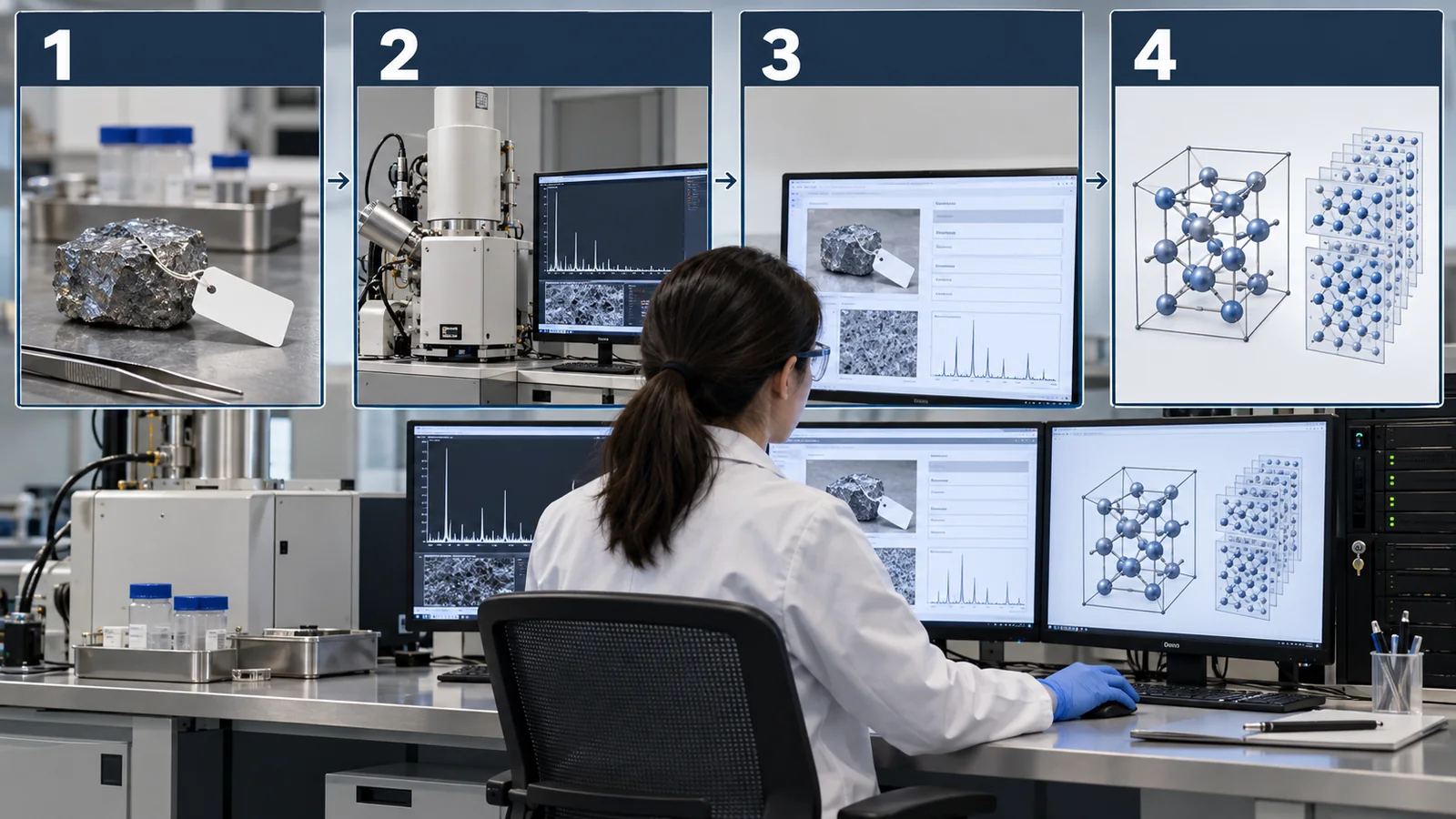
The FAIR principles are not only for people who run public databases. They also work as an idea for tidying your own data. Fig. 7 shows the flow from the creation of data to its reuse and what a materials engineer tidies at each step.
View original SVG, values and sources
Original SVG reference: Conceptual diagram (vector drawing). The life of data and what a materials engineer tidies at each step. The link to FAIR is our own summary, not a procedure set by the principles.
| Step | What to do (commentary) | Related FAIR items (our summary) |
|---|---|---|
| 2. Record | Keep conditions, units, instruments, software versions and dates in table columns. Record failures and below-detection-limit results too, with reasons | R1 (rich, accurate, relevant attributes), R1.2 (provenance) |
| 3. Assign IDs | Give sample IDs and lot IDs, with one ID per item of data. Manage by ID rather than packing conditions into file names | F1 (unique, persistent ID), F3 (metadata include the data ID) |
| 4. Set terms | Decide and record the scope: in-house only, specified partners, public, with an expiry. Whether to publish follows company rules, contracts and intellectual-property decisions | R1.1 (clear usage license), A1.2 (authentication where necessary) |
| 5. Register and store | Store in an in-house database or a shared repository, in an agreed format. Keep it searchable | F2 (rich metadata), F4 (registered in a searchable place), A2 (metadata outlive the data) |
| 6. Search and retrieve | Make data retrievable by an agreed method (search or API). Manage the permissions of those who retrieve | A1, A1.1, A1.2 |
| 7. Reuse and cite | Let users record the source and version of the data. Keep a history of corrections and additions | I3 (references to other data), R1.2, R1.3 |
The correspondence is our own organization based on the wording of the fifteen FAIR items [Ref. 2]; it is not a procedure set by the principles themselves.
Public databases can go down, and their versions change. On the check date, the home page of the Crystallography Open Database (COD) said it was temporarily unavailable while the server was being upgraded [Ref. 36]. The OQMD site also returned a server error on the check date. The Materials Project's version history announces data corrections (for example, a fix to inconsistencies in the mixing-scheme thermodynamic data [Ref. 5]).
So record the version and access date of the data you used and, within what the terms allow, keep a copy of the data you used. Then you can reproduce the results later. An analysis that cannot be reproduced cannot be explained to others (commentary).
7. Six checks before using a public database
Fig. 9 gathers into six items what to check before using values from a public database in your own work (commentary).
- Fit for purpose. Check whether your material and property are in the database. You cannot predict for a range that is not included
- What kind of value. Computed or measured. If computed: the method (functional, corrections), version and date of calculation. For databases that are updated, such as MP, check the version
- May we use it. Check the terms as in Chapter 3: non-commercial, registration, bans on bulk retrieval and so on
- How reliable. Check the gap to experiment (Chapter 4) and the gaps among databases. Be careful with properties that are systematically off, such as the band gap
- Compare with your data. Place the values next to the few measurements you have, and find the size and direction of the offset
- Record the source. Record database name, version, access date, ID and citing paper (for reproduction and citation)
8. Limits, what we could not confirm, and a summary
(1) What we could not confirm
- Current Materials Project terms. On the check date the terms page showed an automated-access check and did not open (we did not do anything to get around the check). So the current conditions, including whether commercial use is allowed, are not confirmed. We only introduce the statement on the old terms page (CC BY 4.0) and the official documentation (terms differ by data product; GNoME-derived data are BY-NC)
- Size of each database. We did not confirm the current counts for Materials Project, AFLOW and OQMD. NOMAD's count is the number of “entries,” not of materials
- AFLOW's calculation conditions and latest license. Not confirmed. The date of the REST page statement is also unknown
- OQMD's current terms. The site did not respond on the check date (server error), so we could not confirm them. We only introduce the statement in the paper (made available without restrictions)
- Licenses of NOMAD and JARVIS data. Not confirmed (for JARVIS-tools we confirmed only the software terms)
- A standard method for evaluating FAIRness. We could not confirm one. We do not judge whether each database meets the FAIR principles
- Other databases. We do not cover Open Catalyst, OMat24, Materials Cloud and others. We do not quote the contents of fee-based databases (such as ICSD)
- Legal interpretation. Statements about licenses introduce the official wording and are not legal advice
- Public databases are the fuel of MI. But calculation conditions, terms of use and the way size is counted differ by databaseSourced
- Check the terms of use first. There are four types: CC BY 4.0 (commercial use allowed with attribution), BY-NC (non-commercial), registration required with bulk retrieval banned, and terms that differ by datasetSourced
- Values cannot be used as measurements as they are. For the same material, databases differ by up to 0.105 eV/atom in formation energy and up to 0.21 eV in band gap, and computed band gaps came out 1.6 times too small on average in one testSourced
- Mixing data with different baselines makes things worse. In synthetic data the error went from 0.061 to 0.097, and improved to 0.051 with a source columnOur calculation
- The FAIR principles are fifteen principles for findability, access, interoperability and reuse. They do not demand openness, and can be used to tidy your own dataSourced
9. How to read the yardsticks and standards
How good a database and its data sharing are depends on which yardstick you use. Examples are the error of database values (gap to experiment, gaps among databases), the ease of reuse of data (the FAIR principles), the clarity of terms of use (licenses), the quality management of data (international standards on data quality), and benchmarks that compare machine-learning models on common tasks. Each measures something different and leaves something out. For example, the FAIR principles address whether data are organized in a usable form, not whether the values are correct. The table lists what we could confirm (checked 22 October 2026). We could not confirm an international standard specific to materials databases.
| What is evaluated | Representative benchmark or evaluation method (name, source) | Standard or guideline (ISO/IEC, NIST, international principles, etc.) | Cautions in reading |
|---|---|---|---|
| Sharing and reuse of data | — (a principle, not an evaluation) | FAIR principles (Wilkinson et al., 2016): fifteen principles. Findability (F), accessibility (A), interoperability (I), reusability (R) [Refs. 1, 2]Sourced | Recommended principles without legal force. They do not demand openness. We could not confirm a standard method for evaluating FAIRness |
| Reliability of database values | Hegde et al. (2023): values of AFLOW, MP and OQMD compared from the same initial structures [Ref. 26]. OQMD: mean absolute error DFT versus experiment 0.096 eV/atom [Ref. 16]Sourced | Could not be confirmed (no international standard defining the quality of materials-database values found) | Differences among databases can be comparable to the DFT-versus-experiment difference. Check against your own measurements |
| Persistent identifiers | — | ISO 26324:2025 (the digital object identifier [DOI] system; third edition, March 2025) [Ref. 32]Sourced | The DOI is a typical example for F1 (persistent ID). Having a DOI does not guarantee that the values are correct. Standard text not read |
| Terms of use (licenses) | — | Creative Commons CC BY 4.0 [Ref. 28] and CC BY-NC 4.0 [Ref. 29] (public license documents, not ISO/IEC standards)Sourced | Terms differ by dataset. Whether commercial use is allowed depends on the wording and on how the data are used. Check with the intellectual-property or legal department |
| Quality management of data | Could not be confirmed (we found no common benchmark for the quality of materials datasets) | ISO/IEC 5259-1:2024 (data quality: overview, terminology and examples) [Ref. 30]; ISO/IEC 5259-3:2024 (data quality management requirements and guidelines) [Ref. 31] (both July 2024)Sourced | Standards for data quality in analytics and machine learning in general. They set no specific criteria for materials data. Full text not read |
| Model performance comparison (common tasks) | Matbench (Dunn et al., 2020) [Ref. 33], Matbench Discovery (Riebesell et al., 2025) [Ref. 35], JARVIS-Leaderboard (Choudhary et al., 2024) [Ref. 34]Sourced | Could not be confirmed | These are tasks that compare models using database data. A ranking differs from performance on your material. Beware of splits and data leakage (see our explainer on the basics of machine learning and neural networks) |
The arrangement of the table is Our calculation (organization). ISO/IEC and ISO numbers, titles and dates were checked on the official ISO pages (22 October 2026). Standard texts are paywalled, so we checked only titles and dates and wrote no requirements.
Cautions in reading (for materials engineers)
- FAIR is about usability, not correctness. Data that meet the FAIR principles may still have wrong values. The quality of values is checked separately as in Chapter 4
- A database's rank or size differs from performance on your material. Being large does not mean that your material is included
- Read the wording of principles and licenses. FAIR is a recommendation; a license concerns legal agreements and rights. Even when something says “open,” check the conditions
- A plan is not what is actually delivered. Check new features and newly added data in the version history
10. Glossary
- Materials database
- A collection of materials' composition, structure, properties and so on, made searchable and retrievable.
- DFT (density functional theory)
- A physics simulation that calculates material properties from electron behavior. Contains approximations.
- Functional
- The type of DFT approximation. Different types give different computed values.
- Pseudopotential
- An approximation that simplifies inner electrons to lighten the calculation. Values change with the type.
- DFT+U
- DFT with a correction for strongly correlated electrons (such as d electrons of transition metals).
- Formation energy
- The energy change when a compound forms from its elements. A guide to stability.
- Band gap
- The width between the filled and empty electron energy bands. DFT tends to give a small value.
- Entry
- One record in a database. Not necessarily the number of material types.
- API
- A gateway for retrieving data from a program.
- License
- An agreement that states under what conditions data may be used.
- CC BY 4.0
- A public license that allows copying and modifying, even commercially, if the source is credited.
- CC BY-NC 4.0
- A public license that allows use with credit but not for commercial purposes.
- Metadata
- Data about data: conditions, units, source, terms of use and so on.
- Persistent identifier (such as a DOI)
- A fixed unique ID attached to data, used for citation and search.
- Provenance
- The record of when, by whom and how data were made and how they were changed.
- FAIR principles
- Fifteen principles for making data findable, accessible, interoperable and reusable.
- Open data
- Data published so that anyone can use them freely. A concept different from FAIR.
- Transfer learning
- Using information learned from one source of data to inform a model for another.
- Benchmark
- A common task, dataset and metric for comparing methods.
- Lot
- A group of raw materials or samples made under the same conditions at the same time.
11. References (primary sources)
- Wilkinson M. D. et al. "The FAIR Guiding Principles for scientific data management and stewardship", Sci. Data 3, 160018 (2016), DOI 10.1038/sdata.2016.18 (open access) — doi.org/10.1038/sdata.2016.18
- GO FAIR Foundation "FAIR Principles" (list of the fifteen principles) — go-fair.org/fair-principles/
- Jain A. et al. "Commentary: The Materials Project: A materials genome approach to accelerating materials innovation", APL Mater. 1, 011002 (2013), DOI 10.1063/1.4812323 — doi.org/10.1063/1.4812323
- Materials Project "Materials Project Documentation" (introduction page) — docs.materialsproject.org/
- Materials Project "Database Versions" (history of database releases) — docs.materialsproject.org/changes/database-versions
- Materials Project "Access-controlled Data" (terms by data product, GNoME) — docs.materialsproject.org/materials-project-data-lakehouse/access-controlled-data
- Materials Project "Terms of Use & Privacy Policy" (terms page of the old site, legacy.materialsproject.org) — legacy.materialsproject.org/terms
- Materials Project "Electronic Structure" (computed versus experimental band gaps) — docs.materialsproject.org/methodology/materials-methodology/electronic-structure
- Materials Project "GGA/GGA+U Calculations: Parameters and Convergence" — docs.materialsproject.org/…/gga+u-calculations/parameters-and-convergence
- Materials Project "r2SCAN Calculations" — docs.materialsproject.org/…/calculation-details/r2scan-calculations
- Curtarolo S. et al. "AFLOW: An automatic framework for high-throughput materials discovery", Comput. Mater. Sci. 58, 218–226 (2012), DOI 10.1016/j.commatsci.2012.02.005 — doi.org/10.1016/j.commatsci.2012.02.005
- Curtarolo S. et al. "AFLOWLIB.ORG: A distributed materials properties repository from high-throughput ab initio calculations", Comput. Mater. Sci. 58, 227–235 (2012), DOI 10.1016/j.commatsci.2012.02.002 — doi.org/10.1016/j.commatsci.2012.02.002
- AFLOW REST API page (statement of the repository's terms of use) — aflowlib.duke.edu/AFLOWDATA/LIB2_WEB/Ge_hLi_sv/121
- Eckert H. et al. "The AFLOW library of crystallographic prototypes: Part 4", Comput. Mater. Sci. 240, 112988 (2024), arXiv:2401.06875 — arxiv.org/abs/2401.06875
- Saal J. E. et al. "Materials Design and Discovery with High-Throughput Density Functional Theory: The Open Quantum Materials Database (OQMD)", JOM 65, 1501–1509 (2013), DOI 10.1007/s11837-013-0755-4 — doi.org/10.1007/s11837-013-0755-4
- Kirklin S. et al. "The Open Quantum Materials Database (OQMD): assessing the accuracy of DFT formation energies", npj Comput. Mater. 1, 15010 (2015), DOI 10.1038/npjcompumats.2015.10 (open access) — doi.org/10.1038/npjcompumats.2015.10
- Draxl C., Scheffler M. "The NOMAD laboratory: from data sharing to artificial intelligence", J. Phys. Mater. 2, 036001 (2019), DOI 10.1088/2515-7639/ab13bb — doi.org/10.1088/2515-7639/ab13bb
- NOMAD "NOMAD Documentation" (introduction page) — nomad-lab.eu/prod/v1/docs/
- NOMAD API documentation (used to query the number of public entries; checked 22 October 2026) — nomad-lab.eu/prod/v1/api/v1/extensions/docs
- Choudhary K. et al. "The joint automated repository for various integrated simulations (JARVIS) for data-driven materials design", npj Comput. Mater. 6, 173 (2020), DOI 10.1038/s41524-020-00440-1 — doi.org/10.1038/s41524-020-00440-1
- NIST "NIST-JARVIS" (official site) — jarvis.nist.gov/
- NIST Terms of use of JARVIS-Tools (GitHub, LICENSE.rst) — github.com/usnistgov/jarvis/blob/master/LICENSE.rst
- NIMS "Polymer Database (PoLyInfo)" (official page, in Japanese; public data counts as of 30 September 2026) — polymer.nims.go.jp/
- Ishii M. et al. "NIMS polymer database PoLyInfo (I): an overarching view of half a million data points", Sci. Technol. Adv. Mater.: Methods 4, 2354649 (2024), DOI 10.1080/27660400.2024.2354649 — doi.org/10.1080/27660400.2024.2354649
- NIMS "MDR: NIMS Materials Data Repository" (official page) — mdr.nims.go.jp/
- Hegde V. I. et al. "Quantifying uncertainty in high-throughput density functional theory: A comparison of AFLOW, Materials Project, and OQMD", Phys. Rev. Mater. 7, 053805 (2023), DOI 10.1103/PhysRevMaterials.7.053805 (abstract checked on arXiv:2007.01988) — doi.org/10.1103/PhysRevMaterials.7.053805
- Hutchinson M. L. et al. "Overcoming data scarcity with transfer learning", arXiv:1711.05099 — arxiv.org/abs/1711.05099
- Creative Commons "Attribution 4.0 International (CC BY 4.0)" — creativecommons.org/licenses/by/4.0/
- Creative Commons "Attribution-NonCommercial 4.0 International (CC BY-NC 4.0)" — creativecommons.org/licenses/by-nc/4.0/
- ISO/IEC "ISO/IEC 5259-1:2024 Artificial intelligence — Data quality for analytics and machine learning (ML) — Part 1: Overview, terminology, and examples" (ISO page) — iso.org/standard/81088.html
- ISO/IEC "ISO/IEC 5259-3:2024 Artificial intelligence — Data quality for analytics and machine learning (ML) — Part 3: Data quality management requirements and guidelines" (ISO page) — iso.org/standard/81092.html
- ISO "ISO 26324:2025 Information and documentation — Digital object identifier system" (ISO page) — iso.org/standard/88862.html
- Dunn A. et al. "Benchmarking materials property prediction methods: the Matbench test set and Automatminer reference algorithm", npj Comput. Mater. 6, 138 (2020), DOI 10.1038/s41524-020-00406-3 (open access) — doi.org/10.1038/s41524-020-00406-3
- Choudhary K. et al. "JARVIS-Leaderboard: a large scale benchmark of materials design methods", npj Comput. Mater. 10, 93 (2024), DOI 10.1038/s41524-024-01259-w — doi.org/10.1038/s41524-024-01259-w
- Riebesell J. et al. "A framework to evaluate machine learning crystal stability predictions", Nat. Mach. Intell. 7, 836–847 (2025), DOI 10.1038/s42256-025-01055-1 — doi.org/10.1038/s42256-025-01055-1
- Crystallography Open Database home page (showed a maintenance notice on the check date) — crystallography.net/cod/
- Materials Project "AWS Open Data" (description of where public data are placed) — docs.materialsproject.org/downloading-data/aws-opendata
12. Claim-to-source audit
| Claim in the text | Basis | Category |
|---|---|---|
| The FAIR principles were first formally published in Scientific Data in 2016; they are a concise, measurable set jointly endorsed by academia, industry, funders and publishers; they emphasize that machines, not only people, can find and use data automatically | Abstract of Wilkinson et al. (2016) Reference 1 https://doi.org/10.1038/sdata.2016.18 | Sourced |
| The wording of the fifteen FAIR items (F1–F4, A1, A1.1, A1.2, A2, I1–I3, R1–R1.3); A1.2 allows authentication and authorization where necessary; R1.1 asks for a clear usage license | The GO FAIR list Reference 2 https://www.go-fair.org/fair-principles/ | Sourced |
| Materials Project is a U.S. Department of Energy effort to pre-compute properties and make them public (introduction of the official documentation), and its paper | MP documentation and Jain et al. (2013) Reference 3 https://doi.org/10.1063/1.4812323 Reference 4 https://docs.materialsproject.org/ | Sourced |
| The April 2026 release added 74 thousand GNoME-derived r2SCAN data, bringing the set to 117 thousand; the latest version v2026.09.28 went live on 19 October 2026; a fix to inconsistencies in the mixing-scheme thermodynamic data | The MP version history Reference 5 https://docs.materialsproject.org/changes/database-versions | Sourced |
| Not all data products have the same terms; GNoME-derived data are BY-NC (non-commercial) and require explicit acceptance | MP documentation Reference 6 https://docs.materialsproject.org/materials-project-data-lakehouse/access-controlled-data | Sourced |
| The old terms page states that downloading content means accepting the CC BY 4.0 license. The current terms are not confirmed | Terms page of the old MP site Reference 7 https://legacy.materialsproject.org/terms | Sourced |
| In an internal test on 237 compounds, computed band gaps were underestimated by an average factor of 1.6, and the error after accounting for the shift is an MAE of 0.6 eV | MP documentation (figure caption) Reference 8 https://docs.materialsproject.org/methodology/materials-methodology/electronic-structure | Sourced |
| MP's GGA / GGA+U calculation conditions (PAW, 520 eV, 1000 k-points per reciprocal atom). r2SCAN added from the October 2022 release, with a GGA (PBEsol) structure optimization followed by an r2SCAN optimization | MP documentation Reference 9 https://docs.materialsproject.org/methodology/materials-methodology/calculation-details/gga+u-calculations/parameters-and-convergence Reference 10 https://docs.materialsproject.org/methodology/materials-methodology/calculation-details/r2scan-calculations | Sourced |
| The AFLOW framework and AFLOWLIB.ORG (repository) papers. The prototype library has been expanded to 1,783 prototypes. The REST page says the data are free for scientific, academic and non-commercial purposes only | Two papers by Curtarolo et al. (2012), the AFLOW prototype paper, and the AFLOW REST page Reference 11 https://doi.org/10.1016/j.commatsci.2012.02.005 Reference 12 https://doi.org/10.1016/j.commatsci.2012.02.002 Reference 13 https://aflowlib.duke.edu/AFLOWDATA/LIB2_WEB/Ge_hLi_sv/121 Reference 14 https://arxiv.org/abs/2401.06875 | Sourced |
| OQMD collects DFT total-energy calculations and evaluates stability; nearly 300,000 calculations at the time of the 2015 paper; the paper says the whole database is made available without restrictions. Mean absolute error DFT versus experiment 0.096 eV/atom (1,670 compounds); between experiments 0.082 eV/atom | Abstracts of Saal et al. (2013) and Kirklin et al. (2015) Reference 15 https://doi.org/10.1007/s11837-013-0755-4 Reference 16 https://doi.org/10.1038/npjcompumats.2015.10 | Sourced |
| NOMAD is a platform for sharing and using computational materials-science data, storing it in a code-independent normalized form; uploaded data get a persistent identifier and a DOI can be requested; 19,419,360 public entries | Abstract of Draxl and Scheffler (2019), the NOMAD documentation and the NOMAD API (checked 22 October 2026) Reference 17 https://doi.org/10.1088/2515-7639/ab13bb Reference 18 https://nomad-lab.eu/prod/v1/docs/ Reference 19 https://nomad-lab.eu/prod/v1/api/v1/extensions/docs | Sourced |
| What JARVIS contains (2020 paper: about 40,000 materials and about 1 million properties in JARVIS-DFT). Official site statements (JARVIS-DFT over 80,000 materials; OptB88vdW and TBmBJ; registration free and access to the database and web apps needs credentials). JARVIS-Tools carries NIST software terms | Choudhary et al. (2020), the JARVIS official site, and the GitHub LICENSE Reference 20 https://doi.org/10.1038/s41524-020-00440-1 Reference 21 https://jarvis.nist.gov/ Reference 22 https://github.com/usnistgov/jarvis/blob/master/LICENSE.rst | Sourced |
| What PoLyInfo contains, public data counts (30 September 2026), the need for registration and an application, the ban on scraping and bulk retrieval, NIMS's copyright, and the fee-based dataset offering | The PoLyInfo official page and Ishii et al. (2024) Reference 23 https://polymer.nims.go.jp/ Reference 24 https://doi.org/10.1080/27660400.2024.2354649 | Sourced |
| MDR is NIMS's data repository, and datasets are available under the licenses specified on their pages | The MDR official page Reference 25 https://mdr.nims.go.jp/ | Sourced |
| Comparison of AFLOW, MP and OQMD values (formation energy up to 0.105 eV/atom [median difference 6%], volume up to 0.65 ų/atom [4%], band gap up to 0.21 eV [9%], magnetization up to 0.15 μB/formula unit [8%]; disagreement on metal/non-metal up to 7%, on magnetism up to 15%; causes: pseudopotentials, +U, reference states) | Abstract of Hegde et al. (2023) Reference 26 https://doi.org/10.1103/PhysRevMaterials.7.053805 | Sourced |
| A property with the same name can be measured or computed differently by source, and hidden differences introduce irreducible errors; transfer learning is a remedy | Abstract of Hutchinson et al. Reference 27 https://arxiv.org/abs/1711.05099 | Sourced |
| CC BY 4.0 allows copying, redistributing and adapting for any purpose, even commercially, with attribution; CC BY-NC 4.0 does not allow commercial use | The Creative Commons deed pages Reference 28 https://creativecommons.org/licenses/by/4.0/ Reference 29 https://creativecommons.org/licenses/by-nc/4.0/ | Sourced |
| Numbers, titles and dates of ISO/IEC 5259-1:2024, 5259-3:2024 (both July 2024) and ISO 26324:2025 (March 2025, third edition) | ISO pages (checked 22 October 2026) Reference 30 https://www.iso.org/standard/81088.html Reference 31 https://www.iso.org/standard/81092.html Reference 32 https://www.iso.org/standard/88862.html | Sourced |
| Matbench, JARVIS-Leaderboard and Matbench Discovery are frameworks for comparing materials models on common tasks | Abstracts of each paper Reference 33 https://doi.org/10.1038/s41524-020-00406-3 Reference 34 https://doi.org/10.1038/s41524-024-01259-w Reference 35 https://doi.org/10.1038/s42256-025-01055-1 | Sourced |
| On the check date, the COD home page said it was temporarily unavailable while the server was upgraded | The COD home page (checked 22 October 2026) Reference 36 https://www.crystallography.net/cod/ | Sourced |
| MP explains that its public data in AWS Open Data are placed there in an effort to make them as accessible as possible (FAIR principle) | MP documentation Reference 37 https://docs.materialsproject.org/downloading-data/aws-opendata | Sourced |
| The errors when A and B are merged (0.061, 0.097, 0.051, 0.112) | Our calculation (Python and NumPy; synthetic data, fixed seeds, average of 100 runs). Not values from any real database | Our calculation |
| MP's current terms of use, current counts for MP, AFLOW and OQMD, AFLOW's calculation conditions and latest license, OQMD's current terms, licenses of NOMAD and JARVIS data, and a standard method for evaluating FAIRness | Not confirmed in the primary sources we could access, so not stated (the MP terms page showed an automated-access check and would not open; the OQMD site returned a server error) | Commentary |
| The three-way grouping of databases, the difference between entries and materials, each "materials engineer's view", the six checks, and the mapping of tidying steps to FAIR items | Our own organization and commentary based on the published content. Not views expressed by the institutions | Commentary |
| That the figures are explanatory drawings, not observations of real data; that the hero image and Fig. 8 are ImageGen-generated conceptual illustrations | Our note in this article | Commentary |
Last updated: 22 October 2026 / Sources are limited to primary materials (official sites and documentation of each database, peer-reviewed papers, and official pages of Creative Commons and ISO). The full text of ISO standards is paywalled and was not checked. The size and terms of databases change; check the official site for the latest statement before use. Statements about licenses are introductions, not legal advice. We could not confirm the current Materials Project terms, the current counts or terms of AFLOW and OQMD, the licenses of NOMAD and JARVIS data, or a standard method for evaluating FAIRness, so these are not stated. All figures are explanatory concept diagrams or drawings that include our own calculation; the hero image and Fig. 8 are ImageGen-generated conceptual illustrations.