THE FIRST GUIDE FOR NEWCOMERS
Read This First: Materials Informatics, Including How It Differs from LLMs
Understand MI as a workflow, its relationship with LLMs, the role of experiments and a conditional future combining them.
- MI is a field for using data and computation to decide what to try next in materials development.
- An LLM is a type of learned model, primarily associated with language. It is not the same category of concept as MI and can be one tool within it.
- Proposing a candidate does not establish that it can be made or works under the required conditions. Computational and experimental evidence must support those claims.
1. What problem does MI address?
Imagine a material protecting electronic components: it should carry heat away but resist electrical conduction. Changing the polymer, filler, mixing ratio, processing or curing conditions can also change flow, strength and manufacturability. Testing every combination in sequence is difficult.
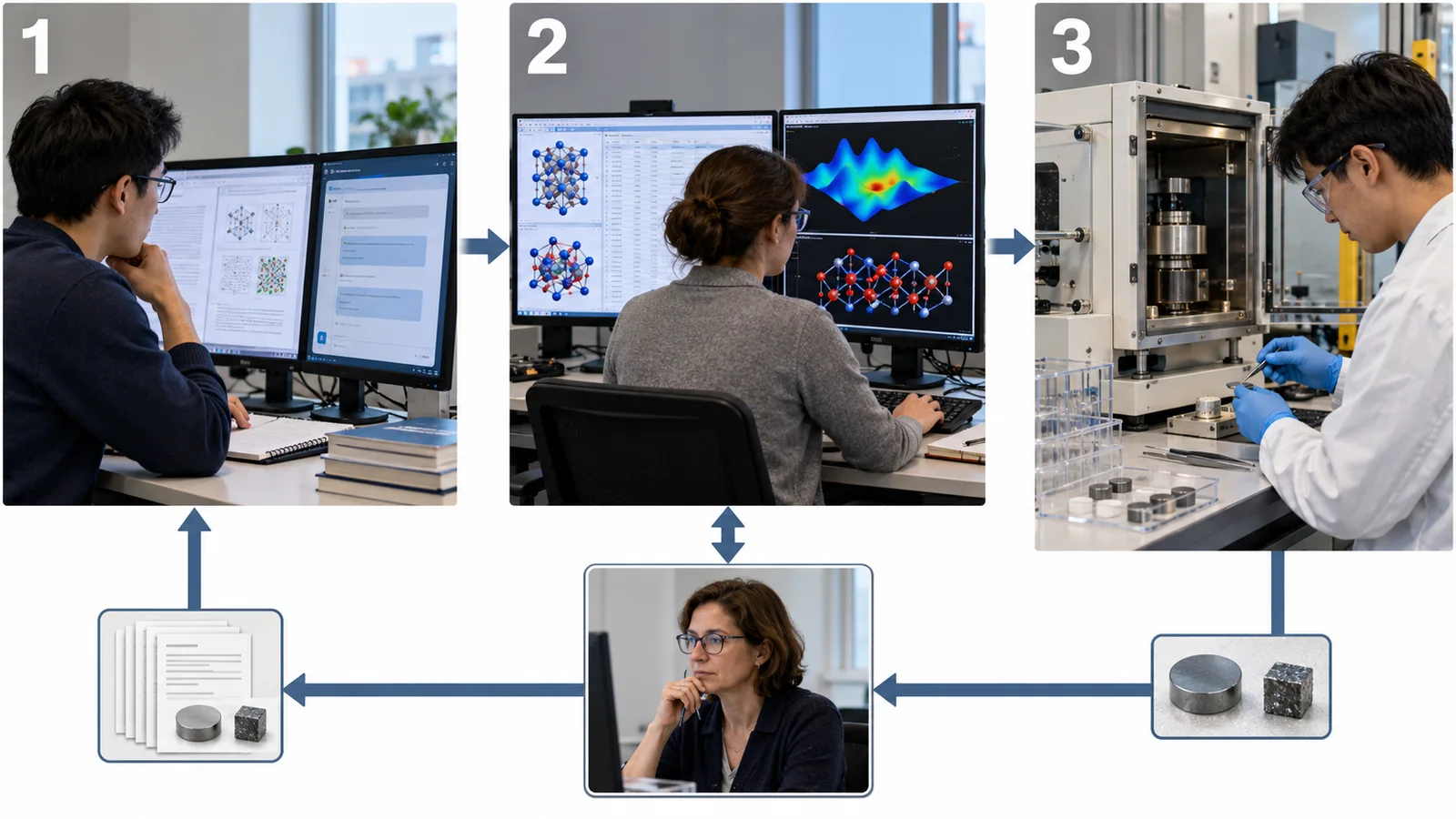
Organise past tests, use comparable records and physical calculations to narrow the next candidates, then make and measure them. Record why predictions failed and choose again. That is the starting picture of MI in this guide: not discarding human experience, and not a guarantee of discovering a material.
This is an illustrative development problem, not a particular product, formulation or performance specification.
2. The whole picture: organise, predict, test and feed back
Materials informatics (MI) connects materials science with ways of using data. Databases, experimental design, physical simulation and measurement records matter alongside machine learning. The original Matbench study provides concrete examples of predicting properties from composition or crystal structure. [1]
- Define the objective: what should improve, what must not deteriorate, and what constraints apply?
- Collect comparable records: connect specimens, processing, measurement methods and units, not just material names.
- Estimate candidates: select suitable rules, statistics, ML or physical calculations.
- Choose the next test: consider uncertainty, cost and feasibility as well as promise.
- Make and measure: use controls and repeats to compare prediction with reality.
- Feed back: preserve failures and reasons a test could not be performed, not only successes.
These six steps are an editorial learning framework, not a prescribed standard. The workflow and tools depend on the objective. Think of a loop rather than a single AI box.
3. How do MI and LLMs differ?
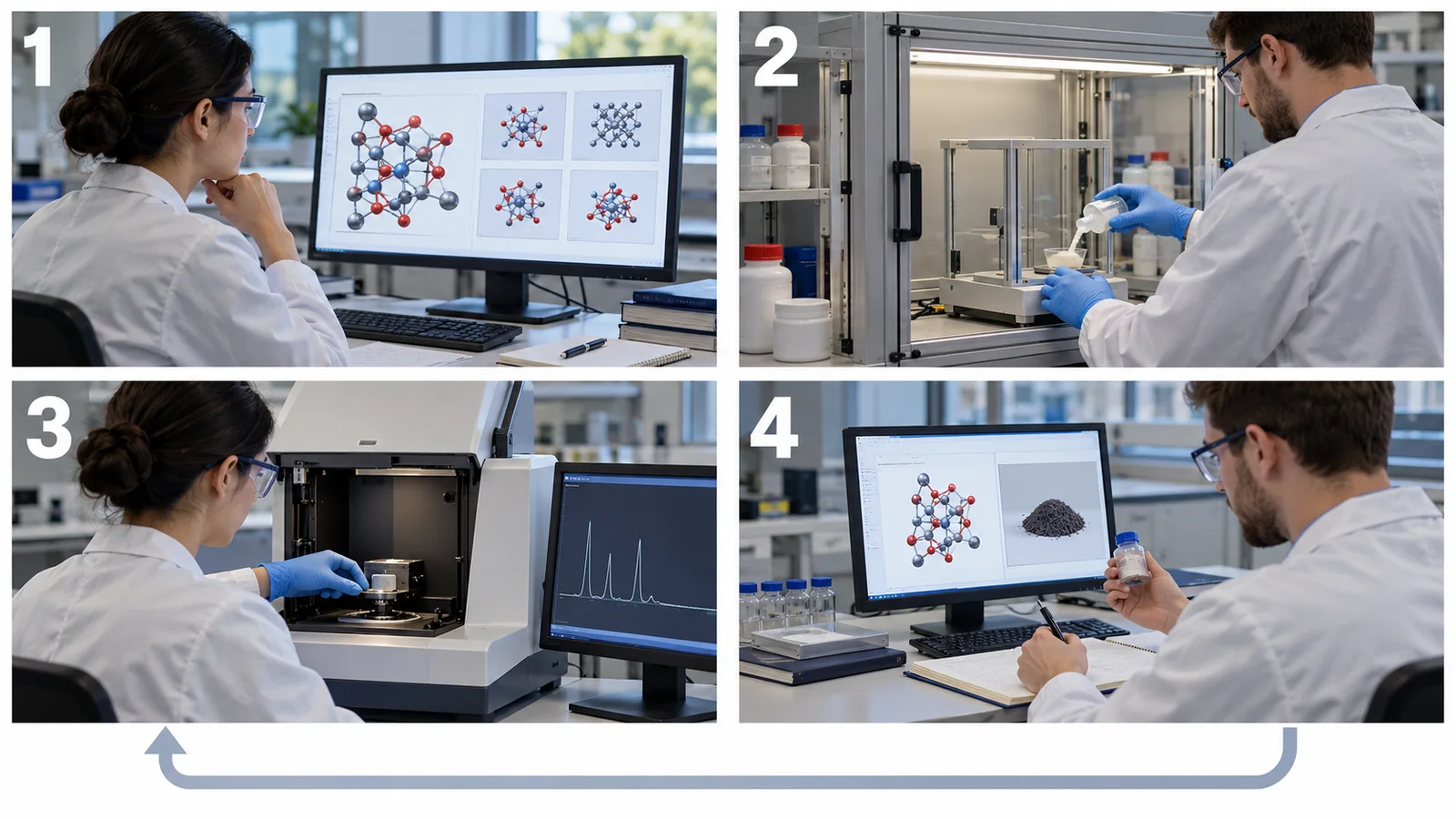
MI names a field or undertaking; LLM (large language model) names a model type. They are not mutually exclusive alternatives. Compare a development activity with a tool that may help perform it.
| Aspect | MI as an undertaking | A primarily language-oriented LLM |
|---|---|---|
| Main question | Which material or condition should we investigate next? | What text, structured output or proposed action should follow from the context? |
| Inputs | Composition, structure, processing, images, spectra, measurements and literature. | Primarily text and code; some models also accept other modalities or connect to external tools. |
| Outputs | Predictions, candidates, experimental priorities and comparable records. | Explanations, summaries, extracted tables, code or tool instructions; task-specific designs may also predict numbers. |
| Validation | Suitable evaluation, independent data, measurements and application requirements. | Source fidelity, correctness and execution results evaluated by task. Materials claims still need materials-specific validation. |
An LLM learns patterns and relationships from large collections of sequences such as text. Fluent wording and correct property values are different achievements. But saying that LLMs can never predict numbers is also inaccurate. Jablonka and colleagues studied language models fine-tuned on task-specific chemistry and materials data. That involved dedicated training and evaluation, not validation of arbitrary answers from an ordinary chat session. [2]
Graph models, learned interatomic potentials and structural generative models serve different purposes. Conversely, MI also includes statistics and physical calculations that do not use AI.
4. Divide the roles within one development problem
Return to the thermally conductive, electrically insulating material. The following is our teaching example, not a reconstruction of a deployed system.
- People: define test conditions and requirements beyond thermal behaviour.
- LLM assistance: extract candidate names and conditions from permitted documents, linking them to original passages. Leave unreported conditions missing.
- Data work: connect specimen identity, formulation, processing, measurement temperature, method, values and units.
- Specialised prediction and computation: compare candidates using suitable models, considering uncertainty and unfamiliar domains.
- People and experiments: review safety and feasibility, prepare samples and measure them with controls.
- The next decision: investigate disagreements and feed records back. A promising candidate still requires application-level evaluation.
Asking an LLM for the best formulation does not replace this workflow. Equally, a tidy table is insufficient if its measurements and intended use are unclear.
5. Where LLMs can help, and where checks remain essential
Potential roles include literature access, drafts that reconcile terminology, calculation code, explanations and plans for invoking specialised tools. Each requires validation.
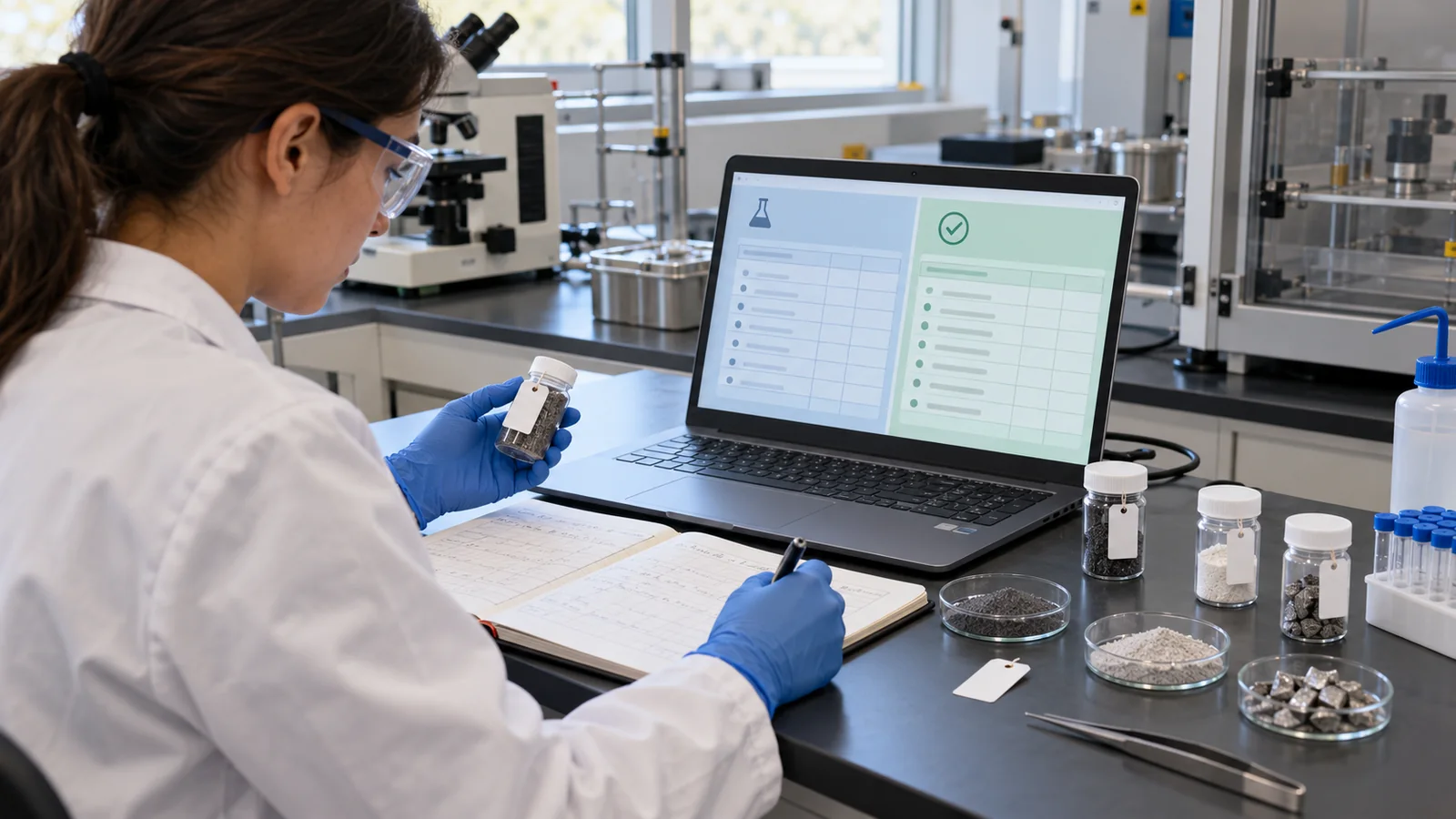
- Extraction: check material, condition, value and unit against the source. Do not invent absent information.
- Code and calculations: inspect inputs, units, methods, convergence and outputs. Executable code need not implement the correct calculation.
- Instrument connections: define allowed operations, safety, stopping rules and approval. Do not pass unconstrained prose directly to equipment.
- Explanations: distinguish computed prediction, sample preparation, measured confirmation and application demonstration. Eloquence cannot substitute for evidence.
Boiko and colleagues’ Coscientist study connected LLMs with search, code and experimental tools in chemistry. Demonstrations under particular tasks, equipment and conditions do not establish universal, safe autonomous materials development. [3]
6. Reading evaluations and standards: accuracy alone is not enough
Use these five questions as a learning checklist, not a universal pass standard.
- What was answered? Reproduction of calculated values, prediction of measurements, or actual performance of a new specimen?
- What was the comparison? Were simple baselines, known materials and human procedures assessed under comparable conditions and budgets?
- How were data split? Did repeated measurements, closely related compositions or common batches leak across training and evaluation?
- Where does it apply? Were other material families, processes and environments tested? Are failures and unknown domains reported?
- Can evidence be traced? Retain raw data, specimens, units, measurement methods, model versions and analysis settings.
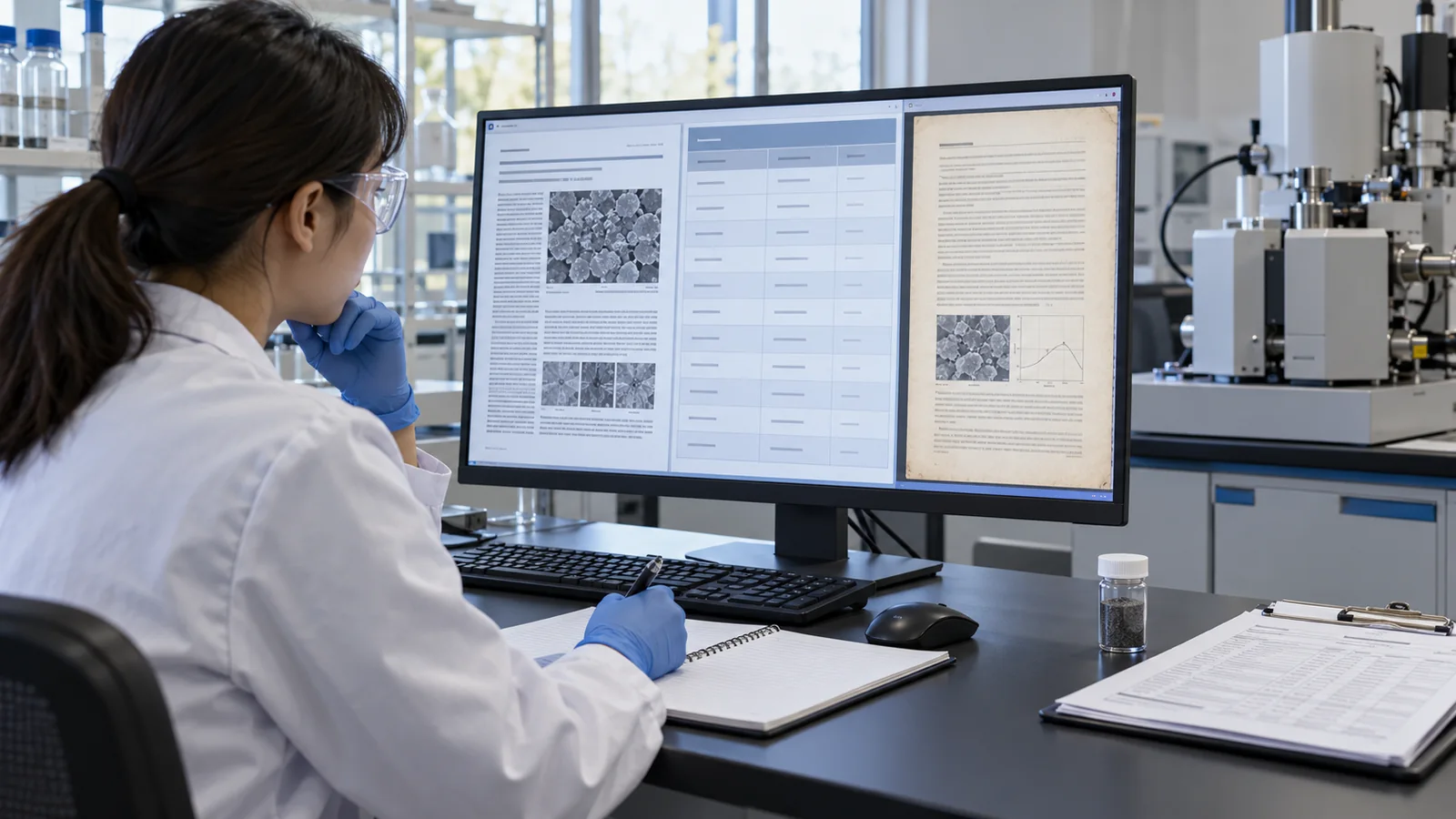
Correctly extracting a literature table and predicting material strength measure different capabilities. Do not combine language answers, property prediction and laboratory automation into one undifferentiated success rate.
FAIR principles address finding, accessing, interoperating and reusing data. They do not mean that all data must be unrestricted and public; permissions and confidential information still matter. [4] Real platforms such as NIMS DICE also require attention to individual service and data conditions. [5]
7. A future combining LLMs and MI
The following is our analysis. It does not turn research demonstrations into already-delivered products or predict a universal timetable. Maturity differs by material, equipment and organisation.
1. Assist with records and translation between specialisms
A researcher describes an objective; an LLM searches permitted literature and records, reconciles names and units, and drafts entries linked to sources. Reviewed records enter MI datasets. Value depends on reducing search effort and condition mismatches, not merely producing text quickly.
2. Coordinate specialised tools
The LLM handles dialogue and planning while appropriate tools perform physical calculations, property prediction, optimisation and experimental management. Approved actions proceed within defined limits; uncertainty, constraint violations or hazards return to a person. Logs remain traceable when models or tools change.
3. Connect development across organisations and processes
A longer-term direction links laboratory candidates, pilot production, manufacturing and failures in use. Barriers include instrument compatibility, calibration, specimen matching, intellectual property, contracts, data-sharing limits and responsibility. A larger LLM alone does not remove these barriers.
A useful picture is not a chat model replacing an entire researcher. People retain objectives and responsibility; LLMs connect information and work; specialised models and experiments supply evidence.
8. Where should a newcomer start?
You do not need a giant database or autonomous laboratory first. Define one application, a consistent measurement and a condition you want to choose next. Make existing records comparable, check a simple baseline, test independent specimens and retain failures. Understanding this small loop clarifies why more advanced tools might help.
9. What to read next
You need not read everything in sequence. Begin with data and prediction, then choose a material or tool. These routes cover all 38 existing technology explainers.
Data and prediction
Introduction to Materials Informatics / Materials Data and Descriptors / Materials Databases and the FAIR Principles / Machine Learning and Neural Network Fundamentals / Machine Learning with Small Data / Uncertainty and Applicability Domain
Computational tools
Quantum Chemistry and Materials Simulation / Fundamentals of Density Functional Theory / Molecular Dynamics / Machine-Learning Interatomic Potentials / Graph Neural Networks / High-Throughput Computation / Multiscale Simulation and Digital Twins / Crystal Structure Prediction and Stability
Choosing and validating experiments
Bayesian Optimization and Active Learning / High-Throughput Experiments and Robotic Synthesis / Closed-Loop Optimization / Self-Driving Laboratories / Explainable AI and Materials Insight / How to Read Evaluation and Reproducibility in Materials Informatics
LLMs, generative models and agents
Transformers and Large Language Models / Large Language Models and Text Mining for Materials / How AI Agents Work / AI Agents for Materials Research / Generative AI for Materials Design
Materials and measurement applications
Applications to Alloys and Structural Materials / High-Entropy Alloys / Polymer Informatics / Polymer Basics / Applications to Battery Materials / Next-Generation Battery Chemistries Compared / Applications to Catalysts / Platinum Group Metals and Catalysts / Metal-Organic Frameworks (MOFs) / Applications to Semiconductor and Electronic Materials / AI Analysis of Spectra and Images
Evaluation and programmes
Benchmarks and How to Read AI Evaluations / National MI Strategies and Data Infrastructure
Explore company and institution roles
NIMS (National Institute for Materials Science) / National Institute of Standards and Technology (NIST) / Google DeepMind / Microsoft / Citrine Informatics / Preferred Networks / Chemspeed Technologies
Takeaway: MI is the development undertaking; an LLM can be one of its tools
MI uses data and computation to choose candidates, make and measure them, and learn again. LLMs can connect literature, language, code and tools, or serve as task-trained and evaluated predictors. Neither a plausible answer nor a computed candidate should be confused with a material proven useful in practice.
Sources and editorial analysis
These sources are original studies, the original principles and the platform operator. The teaching example, workflow categories, comparison table and future scenarios are our editorial framework, not external forecasts or demonstrated product specifications. Checked 23 October 2026.
- Dunn et al. (2020), Benchmarking materials property prediction methods: the Matbench test set and Automatminer reference algorithm — Original benchmark study: composition/structure inputs, property targets and evaluation protocols; not a claim about every industrial material.
- Jablonka et al. (2024), Leveraging large language models for predictive chemistry — Original task-specific fine-tuning study. Does not establish the reliability of an unvalidated general chat model.
- Boiko et al. (2023), Autonomous chemical research with large language models — Original tool-assisted chemistry demonstrations under the reported conditions; not universal autonomous materials development.
- Wilkinson et al. (2016), The FAIR Guiding Principles for scientific data management and stewardship — Original articulation of data stewardship principles, not a claim that all FAIR data must be openly accessible.
- NIMS, DICE materials data platform — Platform operator information about services and materials data. Individual service terms and data conditions still apply.