COMPANY PROFILE / MATERIALS INFORMATICS
Preferred Networks
It builds PFP, the "brain" of the Matlantis atomistic simulator, and took it to market together with ENEOS
Preferred Networks (PFN) is a Japanese AI company founded in 2014. In materials, it developed PFP, an AI model that predicts the forces between atoms very quickly, and built the atomistic simulator Matlantis around it jointly with ENEOS. The company that sells Matlantis is a separate legal entity (Matlantis Corporation), whose shareholders are PFN, ENEOS and Mitsubishi Corporation. This profile sets out, using official sources only, where PFN sits in the materials informatics (MI) workflow and how it relates to ENEOS.
- PFN in 30 seconds, and where it stands in materials informatics
- The logo and how the names are written (sorting out similar names)
- Where the company sits in materials informatics
- Scale
- Resources committed to materials informatics
- What it has done so far
- What comes next
- What the company is aiming for
- Map of partnerships (including the relationship with ENEOS)
- Technology, products and services
- The risks this company carries
- Glossary / References / Claim-to-source audit
1. PFN in 30 seconds, and where it stands in materials informatics
UnlistedShareholders are companies and financial institutions (official list)
Foundation models & compute (secondary)Our classification; see Fig. 1
16 July 2026Announced by Matlantis Corporation. Covers 96 elements
PFN is not "the company that sells Matlantis". It is "the company that builds the brain of Matlantis (PFP) and the computing base used to train it" Sourced. Selling and supporting the cloud service is done by Matlantis Corporation, which began as a joint venture in 2021 and took its current name in July 2025. So the split is: PFN builds the model and the compute, Matlantis Corporation runs the service, and ENEOS is the co-developer with chemistry know-how and also a shareholder.
PFN's July 2026 factsheet lists Matlantis Corporation among its subsidiaries Sourced, but the current ownership split after Mitsubishi Corporation joined could not be confirmed from official sources (at setup it was PFN 51% / ENEOS 49%).
2. The logo and how the names are written
A note on names: the parent is Preferred Networks (PFN). The product is Matlantis and the AI model is PFP (Preferred Potential). The table below sorts out the similar names that appear later. The official logo is not used in this profile, because PFN's "Corporate Logo" page sets conditions of use that include a request procedure; the name is shown as text instead.
Official site: https://www.preferred.jp/en/company/| Name | What it is | Note |
|---|---|---|
| Preferred Networks (PFN) | The subject of this profile. An AI research and development company | Founded 2014. Unlisted |
| Matlantis (product) | An atomistic simulator offered as a cloud service | Launched July 2021 |
| PFP | The core AI model of Matlantis | Short for Preferred Potential. Developed by PFN |
| Matlantis Corporation | The company that sells and supports Matlantis | Formerly Preferred Computational Chemistry (PFCC). Renamed July 2025 |
| PFCI | PFN Group computing-infrastructure company (Preferred Computing Infrastructure) | Founded 2025. Offers a cloud built on MN-Core |
| ENEOS Innovation Partners | A wholly owned subsidiary of ENEOS Holdings that manages investments | Listed officially as a PFN shareholder. Its 100% ownership is stated in an ENEOS release |
3. Where the company sits in materials informatics
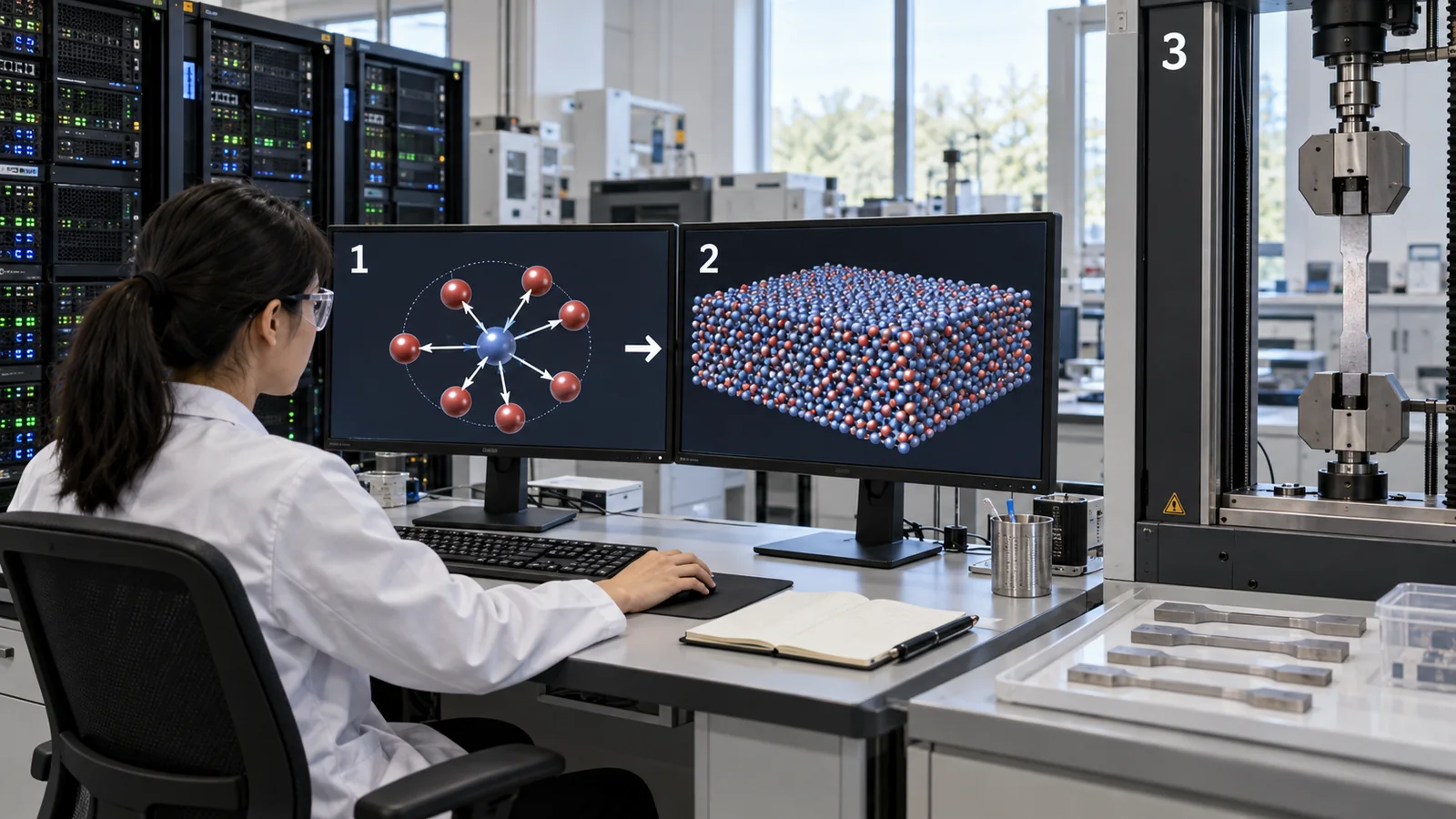
Materials informatics (MI) means using data and AI to speed up materials development. Roughly, it runs (1) make data, (2) predict and design with AI, (3) narrow candidates by calculation, (4) confirm by experiment. Companies differ in which part of this flow they cover. First, PFN's coverage.
The next illustration shows what PFN, Matlantis Corporation and the users each take on within the MI flow.
4. Scale
PFN is unlisted, and its revenue, profit and capital are not published as far as we could confirm. The table shows only what the company overview and the factsheet updated in July 2026 allow us to confirm Sourced.
| Item | PFN | Matlantis Corporation |
|---|---|---|
| Founded | 26 March 2014 | 1 June 2021 (formerly Preferred Computational Chemistry) |
| Address | Chiyoda-ku, Tokyo (Otemachi Building) | Chiyoda-ku, Tokyo (Otemachi Building). US base in Cambridge, Massachusetts |
| Employees | About 450 (July 2026 factsheet) | Not disclosed (could not be confirmed) |
| Capital | Could not be confirmed | JPY 310 million (company profile) |
| Revenue and profit | Not disclosed | Not disclosed |
| Listing | Unlisted | Unlisted |
| Leaders | Toru Nishikawa (co-founder, chairman); Daisuke Okanohara (co-founder, CEO) | Daisuke Okanohara (CEO) |
| Shareholders / investors | Chugai Pharmaceutical, Development Bank of Japan, ENEOS Innovation Partners, Fanuc, Hitachi, Mitsubishi Corporation, NTT, Toyota Motor and others (official list; holdings not disclosed) | Preferred Networks, ENEOS Holdings, Mitsubishi Corporation (holdings could not be confirmed) |
| Customers | - | More than 150 companies and research institutions (company statement, e.g. the 16 July 2026 release) |
PFN's business is broad, covering a generative-AI foundation model (PLaMo), AI chips (MN-Core) and robots, and the share of materials (Matlantis) in the whole is not disclosed. The headcount above is for the whole company and is not the number of people working on MI. Read the scale of the company and the scale committed to this field as two different things.
5. Resources committed to materials informatics
The table covers four angles, showing what official sources did and did not let us confirm. "Could not confirm" is useful information too.
| Angle | What we could confirm | Type |
|---|---|---|
| People | About 450 people company-wide (July 2026). The number dedicated to MI is not disclosed. Prof. Ju Li of MIT is a PFN technical advisor (company overview) and was named technical advisor of Matlantis Corporation in August 2024 (company profile). He is also a co-author of the PFP v8 paper. | Sourced |
| Money (R&D and facilities) | R&D spending and capital expenditure for MI are not disclosed. On compute, the company says generating the PFP v9 training data took the equivalent of 3,200 years of one GPU (company statement). | Sourced / not disclosed |
| Money (funding) | In June 2019 PFN received about JPY 1 billion from JXTG Holdings (later ENEOS Holdings) and planned joint materials development using MI (official release). Further capital ties followed in December 2024, April 2025 and June 2025 (milestones). Amounts are not given on the milestones page. | Sourced |
| Investments, joint ventures, acquisitions | Joint venture: Preferred Computational Chemistry (now Matlantis Corporation, June 2021, PFN 51% / ENEOS 49%). Mitsubishi Corporation joined as a shareholder in June 2024. PFCI joined the PFN Group in 2025. No investment in or acquisition of an MI start-up could be confirmed. | Sourced |
| Universities, institutes and public funding | PFP v9 was developed using the AIST AI Bridging Cloud Infrastructure (ABCI) 2.0 and 3.0, with support under "ABCI 3.0 development acceleration use" (Matlantis release). The MIT link is through advisory work and co-authorship. No public funding such as DOE, NSF or NEDO could be confirmed. | Sourced |
Status of the main models, products and facilities
| Name | Kind | Main specifications (company-stated) | Form of release and licence | Stage and date |
|---|---|---|---|---|
| PFP v1 to v9 | Machine-learning interatomic potential (graph neural network) | v1: 55 elements, about 10 million training structures (July 2021); v7: 96 elements, 59 million (September 2024); v9: 96 elements, over 63 million (July 2026) | Used through the Matlantis cloud. Release of the model weights or training data could not be confirmed | In service. v9 on 16 July 2026 |
| Matlantis | Atomistic simulator (cloud service) | Runs in the browser. Pre-trained model, property-calculation libraries and compute environment come together. US service since April 2023 | Commercial service (plans and contracts; price not disclosed). Terms of use apply. Separate public repositories exist | In service (since July 2021) |
| LightPFP | Builds a lightweight potential from PFP predictions | Up to the hundreds of thousands of atoms (about 500,000 in a high-entropy Cantor alloy example). Data creation and training said to drop from months to days | Commercial feature | On sale from January 2025 |
| Matlantis CSP | Crystal structure prediction (finds stable crystals for a given composition) | About 3 to 6 times the search efficiency of random search (company statement) | Commercial feature | Launched 28 January 2026 |
| AI agent integration | Writes simulation code from natural-language instructions | Skills (a knowledge pack) published on GitHub. Claude Code or Codex run in the Matlantis terminal | Skills: Apache-2.0 (public). The integration itself is in the commercial environment | Announced 27 May 2026 (the installer was described as "coming soon") |
| Calculation on MN-Core 2 | Dedicated AI chip for some calculations | Up to 4 times faster than GPUs for selected tasks such as crystal structures (test result) | Planned as a selectable compute option for users | Planned for within 2026 Not yet confirmed |
The PFP training data are results of DFT (quantum-mechanical calculations), and PFN says it generated them in large numbers on its own computing base (over 63 million structures for v9) Sourced. For a materials engineer the key point is that the range of atomic arrangements used in training is the range of materials the model is good at. With v9, the company says it added surfaces, adsorption structures, complexes and molecular crystals to the training data (Matlantis).
On the other hand, because the training data and model weights are not published, there are few ways to check from outside whether your own system falls inside the training range. In its customer story, Kuraray says Matlantis alone has difficulty predicting the performance of industrial-grade solid catalysts, and that it trains its own AI on Matlantis calculation data to fill the gap (a customer statement published by the company).
6. What it has done so far
| When | What happened | Meaning |
|---|---|---|
| June 2019 | PFN received about JPY 1 billion from JXTG Holdings and planned joint research on refinery optimisation and joint development of new materials using MI | The starting point of the relationship with the ENEOS group. The ENEOS name change took effect on 25 June 2020 |
| April to June 2021 | PFN and ENEOS announced a materials-discovery joint venture (27 April). Preferred Computational Chemistry (PFCC) was set up on 1 June with capital of JPY 310 million, PFN 51% / ENEOS 49% | A company to turn the jointly developed simulator into a business |
| July 2021 | Matlantis launched as a cloud service. PFP v1 covered 55 elements | Service begins |
| May 2022 | A paper describing PFP appeared in Nature Communications (30 May) and was chosen for Editor’s Highlights on 1 June | The technology was published in a peer-reviewed paper |
| September 2022 | PFP v3: 72 elements, 22 million training structures | Wider element coverage |
| April 2023 | Matlantis launched in the United States | Overseas expansion begins |
| October 2023 | MN-Core adopted as Matlantis compute. About 3 times faster than general-purpose GPUs on real materials-discovery workloads (PFN's assessment). Provided to ENEOS as a commercial service from August 2023 | First practical use of PFN's own chip for this |
| June 2024 | PFCC entered a business and capital alliance with Mitsubishi Corporation to strengthen overseas sales | Three shareholders |
| September 2024 | PFP v7: 96 elements (all naturally occurring ones), 59 million structures. Released by PFN and ENEOS | Element limits largely gone |
| January 2025 | LightPFP put on sale | Handles simulations more than 10 times larger |
| March 2025 | PFCC and ENEOS announced a collaboration using NVIDIA ALCHEMI to search for lubricants and immersion coolants for data centres (announced 18 March at NVIDIA GTC) | An example of ENEOS chemistry know-how combined with Matlantis |
| July 2025 | Renamed Matlantis Corporation. PFP v8 (r2SCAN calculation mode offered as a beta) | Company and product names now match |
| January 2026 | Matlantis CSP launched (Honda R&D adopted it) | Crystal structure prediction feature |
| March 2026 | PFP v8 preprint posted on arXiv (9 March) | A design aimed at better agreement with experiment, written up |
| July 2026 | PFP v9: r2SCAN mode extended to 96 elements and made the default calculation mode | The latest version |
| August 2026 | v9 tied for first in the MLIP Arena overall ranking (run by PFN itself, compared with the leaderboard as of 1 March 2026) | Mind the evaluation conditions (Chapter 10) |
Note: the "PFP Version History" page on the Matlantis site still calls v7 the latest and does not reflect v8 onward (checked 22 October 2026). The dates in this article follow the news releases and company profile. The June 2024 Mitsubishi release gives the founding date as 11 June 2021, while the company profile and the 2021 release say 1 June, so the official sources disagree.
7. What comes next
On 18 September 2026, PFN and PFCI announced a plan to let Matlantis users choose MN-Core 2 computing resources, delivered through PFCI's cloud service. In tests, calculations such as battery-material crystals ran up to four times faster than on GPUs with accuracy kept, the companies say. But this is for "selected calculation tasks" and does not mean every calculation becomes four times faster. The offering is planned for within 2026, after trial evaluation with some Matlantis users Sourced Not yet confirmed.
None of the following could be confirmed from official sources Not yet confirmed.
The timing of the next PFP version; any plan to release model weights or training data; the current ownership split of Matlantis Corporation; a breakdown of MI revenue or contracts; the price and scope of the MN-Core 2 offering.
8. What the company is aiming for in materials informatics
This part includes things the company has not said directly. It sets out inferences we draw from primary sources, together with the evidence.
| What we read from it | Primary-source basis | Type |
|---|---|---|
| It is built around keeping a general-purpose "brain" in-house | From v1 (2021) to v9 (2026) it keeps updating elements, training data and features. It says it generates the training data on PFN's own compute | Inference |
| The emphasis is shifting from "calculation speed" to "agreement with experiment" | It introduced the r2SCAN mode in v8 and made it the default in v9. Its internal benchmarks are described as avoiding over-fitting to one DFT functional and stressing comparison with experimental values | Inference |
| It is extending vertical integration from its own chips through to materials calculation into this field | It adopted MN-Core in 2023 and plans MN-Core 2 in 2026. PFN describes itself as integrated from chips to applications | Inference |
| Overseas sales rely on a partner's sales network | In June 2024 it said it would use Mitsubishi Corporation's global network | Inference |
| ENEOS is a co-developer and shareholder, and also the first serious user | The MN-Core version of Matlantis was provided commercially to ENEOS from August 2023. In March 2025 it collaborated with ENEOS on NVIDIA ALCHEMI | Sourced |
The v9 release lists first that the r2SCAN calculation mode was extended to 96 elements and made the default Sourced. r2SCAN is a more accurate method than the commonly used PBE; it costs more computing time but is said to agree better with experimental values (Matlantis's explanation). The v8 preprint also puts "better experimental agreements" in its title.
Putting these together, we read PFN as moving from "give the same answer as DFT, only faster" to "give answers that can be compared directly with experiment" Inference. Note, though, that the agreement with experiment is the company's own verification for particular properties (stability of crystals and surfaces, melting points, the viscosity of water), not a guarantee for every material.
9. Map of partnerships in materials informatics
The ENEOS and Matlantis relationship in time order
| When | Relationship with ENEOS | Type |
|---|---|---|
| June 2019 | JXTG Holdings (renamed ENEOS Holdings on 25 June 2020) invested about JPY 1 billion in PFN. Alongside refinery automation, the two planned joint development of new materials using MI | Sourced |
| Until 2021 | PFN and ENEOS co-developed Matlantis, described as combining PFN's AI and compute with ENEOS's chemistry know-how | Sourced |
| June 2021 | Joint venture PFCC founded (PFN 51% / ENEOS 49%), handling sales and consulting | Sourced |
| 2022 | The companies say they used ENEOS's chemical-technology knowledge when improving PFP's accuracy and applications | Sourced |
| From August 2023 | PFCC provided the MN-Core version of Matlantis to ENEOS as a commercial cloud service | Sourced |
| June 2024 | Mitsubishi Corporation took a stake. Shareholders became PFN, ENEOS and Mitsubishi Corporation | Sourced |
| March 2025 | PFCC and ENEOS announced a collaboration using NVIDIA ALCHEMI to search for data-centre lubricants and immersion coolants (the initial focus; catalysts and polymers are listed as possible later targets) | Sourced / later targets are Not yet confirmed |
| Now | ENEOS Holdings is a shareholder of Matlantis Corporation (company profile). The current ownership split could not be confirmed | Sourced |
PFN and ENEOS also work together on autonomous operation at a refinery (August 2023 and May 2024, per the milestones page), but that is a separate business from MI Sourced.
Among Matlantis customers, the official customer-story list includes Sumitomo Electric, Atomis, Seoul National University, Honda R&D and the University of Tokyo. Official releases also record adoption by Hyundai Motor (Korea) and Volkswagen (Germany) Sourced.
10. Technology, products and services
Matlantis is an atomistic simulator that runs in a browser. It builds an AI model (PFP) into a conventional physical simulator and predicts "energy and forces" from "how atoms are arranged". These predictions are used to study stability of structures, how readily reactions proceed, diffusion, melting points and so on.
Performance figures the company gives, and their conditions
| Item | Value the company gives | Conditions and cautions (as stated officially) |
|---|---|---|
| Calculation speed | About 70 million times faster than the estimated time for r2SCAN-level DFT (3,000 atoms) | The DFT time is an estimate. PFP's training data were produced separately with a very large amount of computing (company statement) |
| Maximum atoms | About 44,000 atoms (Pt fcc) | The number actually available depends on the contract. It is a Matlantis acceptance limit, not a GPU memory limit |
| Elements | 96 elements (hydrogen to curium) | The r2SCAN mode also covers 96 elements in v9 (70 in v8) |
| Training data | Over 63 million structures (v9) | Equivalent to about 3,200 GPU-years of computing (company statement). Publication of the data itself could not be confirmed |
| Verification: crystals | Reproduces DFT energies and forces on structures from the Crystallography Open Database (COD) | The COD structures are said not to be in the training data. The verification is shown in figures; we could not find an error table |
| Verification: external benchmark | Ties for first in the MLIP Arena overall ranking (level with MACE-MPA) | Run by PFN itself in PBE mode. Other models' values come from the public leaderboard as of 1 March 2026. The r2SCAN mode is outside the comparison because no public r2SCAN benchmark exists yet |
| Customers | More than 150 companies and research institutions | Company statement. Overseas expansion since 2023 |
Note: MLIP Arena is a public benchmark built by outside researchers (Chiang et al., NeurIPS 2025), but this ranking compares PFN's own run with the leaderboard. We could not find a result reproduced by a third party under the same conditions.
Comparison with open machine-learning potentials (the company's measurement conditions)
The official comparison page expands a system of fcc Pt and compares PFP v9 (on Matlantis) with open models run on an NVIDIA A100 (80 GB). The numbers are the company's own measurements under its own conditions and do not rank the models Sourced.
| Model (environment) | Largest system run (atoms, Pt fcc) |
|---|---|
| PFP v9 (Matlantis) | 42,875 |
| UMA-S (A100) | 97,336 |
| SevenNet-Omni (A100) | 19,683 |
| MACE-MPA-0 (A100) | 13,824 |
| MatterSim-v1-5M / Orb-v3 cons-inf-omat (A100) | 10,648 |
| CHGNet (A100) | 4,913 |
Note: the company states that the maximum for PFP is set by the system-size limit Matlantis accepts, not by GPU memory. The same page says UMA-S can handle larger systems, but at about 30,000 atoms its speed is roughly one sixth that of PFP (company measurement).
1. Calculation mode. The v9 default is r2SCAN; the older PBE can still be chosen. PFN says customers' accuracy needs had reached the point where the gap between PBE and experimental values was no longer acceptable (Version History page), and the v9 release says the r2SCAN mode beats the PBE mode in reproducing experiment for crystal and surface stability, melting points and the viscosity of water (company verification). When you compare with past calculations, always record which mode was used.
2. Scale. For systems larger than PFP can handle (grain boundaries, solid-liquid interfaces), LightPFP builds a lightweight potential from PFP predictions. The official page shows examples of about 200,000 atoms (a GaN/AlN thin film) and about 500,000 atoms (a Cantor alloy) with PFP-level accuracy kept (company calculation examples).
3. Dividing the work between calculation and experiment. Matlantis is a tool for narrowing which candidates to test, not a replacement for experiment. For example, the "more than 10 previously unknown stable crystals" reported for Matlantis CSP are computational predictions, and the official announcement does not say they were synthesised and confirmed Sourced. Honda's story likewise describes searching for promising candidates by calculation and then demonstrating the results by experiment.
11. The risks this company carries
| Risk | Detail | Type |
|---|---|---|
| The model and training data cannot be seen from outside | PFP is used through the cloud, and release of weights or training data could not be confirmed. It is hard for users to check independently where it is strong or weak | Inference |
| Evidence leans on the company's own evaluation | The "tie for first" was run by PFN in PBE mode and compared with public values as of 1 March 2026. The company itself says no external r2SCAN benchmark exists yet | Sourced |
| Between computational prediction and experiment | The new crystals found by CSP are computational, and no experimental confirmation is stated. Agreement with experiment is the company's verification for particular properties | Sourced |
| Uncertainty in plans | The MN-Core 2 offering is at the "planned for within 2026" stage and depends on trial evaluation. It covers selected calculation tasks only | Not yet confirmed |
| Official pages not kept in step | The Version History page still names v7 as the latest, and the founding date is written two ways. Readers may take in outdated information | Sourced |
| Transparency of ownership | How PFN's stake changed after Mitsubishi Corporation joined cannot be confirmed from official sources. Sources describe the company sometimes as a subsidiary and sometimes as a joint venture | Sourced |
| Spread of open alternatives | The company itself compares against open models (UMA, MACE and others) on its comparison page. It will keep needing to explain the difference from options that can be used free of charge | Inference |
12. Glossary
- Machine-learning interatomic potential (MLIP)
- An AI model that predicts the force on each atom and the energy from how atoms are arranged. It replaces a physics calculation to gain speed.
- PFP (Preferred Potential)
- A general-purpose MLIP developed by PFN. The core of Matlantis.
- DFT (density functional theory)
- The standard quantum-mechanical way to calculate the properties of matter from its electrons. Precise but slow.
- PBE / r2SCAN
- Two "approximations" (functionals) used in DFT. r2SCAN costs more to compute and is said to agree better with experiment.
- Foundation model
- A large pre-trained AI model usable for a wide range of tasks. PFN describes PFP in this sense.
- MN-Core
- An AI chip for deep-learning computation developed by PFN together with Kobe University.
- MLIP Arena
- A public benchmark that compares general-purpose MLIPs on tasks close to real simulations.
- Matlantis CSP
- A feature that searches for crystal structures likely to be stable once the composition is set (crystal structure prediction).
- ABCI
- A large AI computing infrastructure operated by AIST (the National Institute of Advanced Industrial Science and Technology).
13. References
- Matlantis Corporation Company profile. Name, founding, address, capital, shareholders and history (2019 to July 2025). https://matlantis.com/en/company/profile/
- Matlantis Corporation "Our Strength". Company-stated figures on customers, speed, supported elements and cumulative atoms simulated. https://matlantis.com/en/company/strength/
- Matlantis Corporation "What is our AI Model, PFP?" Position of PFP, graph neural network design, training data and the PFVM inference engine. https://matlantis.com/en/product/about-pfp/
- Matlantis Corporation PFP Version History. Evolution from v1 to v7 (elements, atoms, training data) and future direction. The page still calls v7 the latest. https://matlantis.com/en/product/pfp-version-history/
- Matlantis Corporation Comparison with Open Source MLIP. Maximum atoms and speed of PFP v9 against open models (conditions stated). https://matlantis.com/en/product/comparison/
- Matlantis Corporation Verification of Predicted Performance of PFP. Energies and forces on COD structures, organic liquid densities and energy above hull. https://matlantis.com/en/product/validation/
- Matlantis Corporation LightPFP. How a lightweight potential is built from PFP predictions. https://matlantis.com/en/product/lightpfp/
- Matlantis Corporation News release, "Matlantis updates its core PFP to v9" (16 July 2026, in Japanese). The r2SCAN mode becomes official, 96 elements, new default mode, use of ABCI. https://matlantis.com/ja/news/release-260716/
- Matlantis Corporation Announcement, "PFP v9 ties for first on MLIP Arena" (21 August 2026, in Japanese). Evaluation conditions (PBE mode, public leaderboard as of 1 March 2026). https://matlantis.com/ja/news/pfp-v9-mlip-arena/
- Preferred Networks PFN Tech Blog, "Introducing PFP v9" (17 August 2026, in Japanese). Comparison with v8, MLIP Arena results and the internal benchmark policy. https://tech.preferred.jp/ja/blog/introducing-matlantis-pfp-v9/
- arXiv Shinagawa et al., "Matlantis-PFP v8: Universal Machine Learning Interatomic Potential with Better Experimental Agreements via r2SCAN Functional" (March 2026, preprint). https://arxiv.org/abs/2603.11063
- Matlantis Corporation News release, "Matlantis CSP now available" (28 January 2026). Company-stated search efficiency and number of crystals found. https://matlantis.com/ja/news/release-260128/
- Matlantis Corporation News release, "PFCC enters a business and capital alliance with Mitsubishi Corporation" (3 June 2024, in Japanese). https://matlantis.com/ja/news/business-and-capital-alliance-with-mc/
- Matlantis Corporation News release on the PFCC and ENEOS collaboration using NVIDIA ALCHEMI software for lubricants and immersion coolants (posted 31 March 2025, in Japanese). https://matlantis.com/ja/news/news-20240327/
- Matlantis Corporation News release, "AI agent integration now available" (27 May 2026, in Japanese). https://matlantis.com/ja/news/release-260527/
- Preferred Networks News release, "PFN and PFCI to accelerate Matlantis with proprietary MN-Core 2 AI chips in 2026" (18 September 2026). https://www.preferred.jp/en/news/pr20260918
- Preferred Networks News release, "PFN and ENEOS release v7 of PFP" (17 September 2024). 96 elements, 59 million training structures. https://www.preferred.jp/en/news/pr20240917
- Preferred Networks News release, "MN-Core now powers Matlantis" (page dated 16 October 2023). https://www.preferred.jp/en/news/pr20231016
- Preferred Networks News release, "PFN and ENEOS to establish a joint venture for materials discovery" (27 April 2021). Ownership 51% / 49%. https://www.preferred.jp/en/news/pr20210427
- ENEOS / PFN / PFCC News release, "PFCC launches Matlantis as a cloud service" (6 July 2021, PDF in Japanese). https://www.ENEOS.co.jp/newsrelease/20210706_01_01_1170836.pdf
- Preferred Networks News release, "PFN and ENEOS release PFP v3" (16 September 2022). 72 elements, 22 million training structures. https://www.preferred.jp/en/news/pr20220916
- Preferred Networks News release, "PFN receives about 1 billion yen from JXTG Holdings" (25 June 2019). https://www.preferred.jp/en/news/pr20190625
- Preferred Networks Company overview. Founding, address, directors, technical advisors and shareholders. https://www.preferred.jp/en/company/
- Preferred Networks Company Factsheet (updated July 2026, PDF). Headcount, subsidiaries and investors. https://www.preferred.jp/downloads/PFN_Company_Factsheet_en.pdf
- Preferred Networks Milestones and Awards. Capital ties, autonomous operation at an ENEOS refinery, launch of Matlantis. https://www.preferred.jp/en/company/milestones
- Nature Communications Takamoto et al., "Towards universal neural network potential for material discovery applicable to arbitrary combination of 45 elements", Nat. Commun. 13, 2991 (2022). https://www.nature.com/articles/s41467-022-30687-9
- NeurIPS 2025 Chiang et al., MLIP Arena (Datasets and Benchmarks Track). https://papers.nips.cc/paper_files/paper/2025/hash/bfa45223cc236855dbaa5c468c809896-Abstract-Datasets_and_Benchmarks_Track.html
- GitHub Matlantis's GitHub organisation. matlantis-contrib (Apache-2.0), tutorials (CC-BY-4.0) and matlantis-agent-skills (Apache-2.0). https://github.com/matlantis
- Preferred Networks Industry page, "Materials & Chemicals". Where Matlantis sits and related news. https://www.preferred.jp/en/industries/materials
- Matlantis Corporation Customer story: Kuraray Co., Ltd. (29 May 2025, in Japanese). https://matlantis.com/ja/case-study/kuraray/
- Matlantis Corporation Customer story: Honda R&D Co., Ltd. (28 January 2026, in Japanese). https://matlantis.com/ja/case-study/honda-rd/
- Preferred Networks News release, "PFP paper selected for Nature Communications Editor’s Highlights" (1 June 2022). https://www.preferred.jp/en/news/pr20220601
- Preferred Networks News release, "PFCC launches Matlantis in the United States" (28 April 2023). https://www.preferred.jp/en/news/pr20230428
- ENEOS Release by JXTG Holdings and others (20 May 2020, PDF). Notes that the company names change to ENEOS Holdings and ENEOS Corporation on 25 June 2020. https://www.eneos.co.jp/english/newsrelease/2020/pdf/20200520_01.pdf
- Preferred Networks Corporate Logo (terms of use and guidelines for the logo). https://www.preferred.jp/en/company/logo
- ENEOS News release, "Exhibiting at CES 2024" (5 January 2024, PDF in Japanese). Notes that ENEOS Innovation Partners is wholly owned by ENEOS Holdings. https://www.eneos.co.jp/information/upload_pdf/20240105_01_01_0906370.pdf
- Matlantis Corporation List of customer stories. Sumitomo Electric, Atomis, Seoul National University, Honda R&D, the University of Tokyo and others. https://matlantis.com/en/case-study/
14. Claim-to-source audit
| Claim in the text | Type | Source |
|---|---|---|
| Legal name, founding date, address, directors, technical advisors, shareholders (list) | Sourced | Reference 23, 24 https://www.preferred.jp/en/company/ https://www.preferred.jp/downloads/PFN_Company_Factsheet_en.pdf |
| About 450 employees; Matlantis Corporation among the subsidiaries (July 2026) | Sourced | Reference 24 https://www.preferred.jp/downloads/PFN_Company_Factsheet_en.pdf |
| PFN's revenue, profit, capital, and MI-specific R&D spend and headcount | Not yet confirmed | Not disclosed or not confirmed. Not estimated in this article Reference 23, 24 https://www.preferred.jp/en/company/ https://www.preferred.jp/downloads/PFN_Company_Factsheet_en.pdf |
| Matlantis Corporation: founding, capital, shareholders, history, renaming | Sourced | Reference 1 https://matlantis.com/en/company/profile/ |
| June 2019 investment of about JPY 1 billion by JXTG Holdings and the joint-research plan | Sourced | Reference 22 https://www.preferred.jp/en/news/pr20190625 |
| Renaming of JXTG Holdings to ENEOS Holdings (25 June 2020) | Sourced | Reference 34 https://www.eneos.co.jp/english/newsrelease/2020/pdf/20200520_01.pdf |
| The joint venture plan (27 April 2021, PFN 51% / ENEOS 49%) and its founding | Sourced | Reference 19, 20 https://www.preferred.jp/en/news/pr20210427 https://www.ENEOS.co.jp/newsrelease/20210706_01_01_1170836.pdf |
| Launch of Matlantis (July 2021, 55 elements) | Sourced | Reference 20 https://www.ENEOS.co.jp/newsrelease/20210706_01_01_1170836.pdf |
| The PFP paper (Nature Communications 2022) and Editor’s Highlights selection | Sourced | Reference 26, 32 https://www.nature.com/articles/s41467-022-30687-9 https://www.preferred.jp/en/news/pr20220601 |
| PFP v3 (72 elements, 22 million structures) | Sourced | Reference 21 https://www.preferred.jp/en/news/pr20220916 |
| PFP v7 (96 elements, 59 million structures), use of ABCI | Sourced | Reference 17 https://www.preferred.jp/en/news/pr20240917 |
| Progress of PFP v1 to v7 in elements, atoms and training data | Sourced | Reference 4 https://matlantis.com/en/product/pfp-version-history/ |
| PFP v8: r2SCAN mode as a beta, and the v8 preprint | Sourced | Reference 8, 10, 11 https://matlantis.com/ja/news/release-260716/ https://tech.preferred.jp/ja/blog/introducing-matlantis-pfp-v9/ https://arxiv.org/abs/2603.11063 |
| PFP v9 (16 July 2026): r2SCAN for 96 elements, new default mode, better agreement with experiment | Sourced | Reference 8, 10 https://matlantis.com/ja/news/release-260716/ https://tech.preferred.jp/ja/blog/introducing-matlantis-pfp-v9/ |
| PFP v9 training data of over 63 million structures, about 3,200 GPU-years, graph neural network design | Sourced | Company statement. Reference 2, 3 https://matlantis.com/en/company/strength/ https://matlantis.com/en/product/about-pfp/ |
| Tie for first on MLIP Arena (PBE mode, compared with public values of 1 March 2026, run by PFN) | Sourced | Company evaluation. Reference 9, 10, 27 https://matlantis.com/ja/news/pfp-v9-mlip-arena/ https://tech.preferred.jp/ja/blog/introducing-matlantis-pfp-v9/ https://papers.nips.cc/paper_files/paper/2025/hash/bfa45223cc236855dbaa5c468c809896-Abstract-Datasets_and_Benchmarks_Track.html |
| Comparison of atoms and speed with open MLIPs (A100, Pt fcc) | Sourced | Company measurement conditions. Reference 5 https://matlantis.com/en/product/comparison/ |
| Verification on COD structures, liquid densities and energy above hull | Sourced | Company verification. Reference 6 https://matlantis.com/en/product/validation/ |
| "About 70 million times", "about 44,000 atoms", "more than 150 customers", "125 trillion cumulative atoms" | Sourced | Company-stated values. DFT time is an estimate. Reference 2, 3 https://matlantis.com/en/company/strength/ https://matlantis.com/en/product/about-pfp/ |
| LightPFP features and the comparison of data-creation and training time | Sourced | Company statement. Reference 7 https://matlantis.com/en/product/lightpfp/ |
| Launch of Matlantis CSP, 3 to 6 times efficiency, more than 10 new crystals (computational predictions) | Sourced | Company statement. No experimental confirmation stated. Reference 12 https://matlantis.com/ja/news/release-260128/ |
| Business and capital alliance with Mitsubishi Corporation (3 June 2024) | Sourced | Reference 13 https://matlantis.com/ja/news/business-and-capital-alliance-with-mc/ |
| The PFCC and ENEOS collaboration with NVIDIA ALCHEMI (2025) | Sourced | Reference 14 https://matlantis.com/ja/news/news-20240327/ |
| Adoption of MN-Core (2023), about 3 times faster, commercial provision to ENEOS | Sourced | Company assessment. Reference 18 https://www.preferred.jp/en/news/pr20231016 |
| The MN-Core 2 plan (within 2026, up to 4 times) | Not yet confirmed | Company plan. Reference 16 https://www.preferred.jp/en/news/pr20260918 |
| AI agent integration and the Skills (Apache-2.0) | Sourced | Reference 15, 28 https://matlantis.com/ja/news/release-260527/ https://github.com/matlantis |
| Autonomous operation at an ENEOS refinery (a separate business from MI) | Sourced | Reference 25 https://www.preferred.jp/en/company/milestones |
| Honda R&D and Kuraray customer stories (statements published by the company) | Sourced | Customer statements. Reference 30, 31 https://matlantis.com/ja/case-study/kuraray/ https://matlantis.com/ja/case-study/honda-rd/ |
| ENEOS Innovation Partners being wholly owned by ENEOS Holdings; the customer-story list | Sourced | Reference 36, 37 https://www.eneos.co.jp/information/upload_pdf/20240105_01_01_0906370.pdf https://matlantis.com/en/case-study/ |
| Start-up investments and public funding (DOE, NSF, NEDO and others) in MI | Not yet confirmed | Could not be confirmed from official sources; we do not claim they do not exist Reference 23, 25 https://www.preferred.jp/en/company/ https://www.preferred.jp/en/company/milestones |
| Release of PFP weights and training data, the current ownership split of Matlantis Corporation, MI revenue | Not yet confirmed | Not stated in official sources. Not estimated in this article Reference 1, 3, 24 https://matlantis.com/en/company/profile/ https://matlantis.com/en/product/about-pfp/ https://www.preferred.jp/downloads/PFN_Company_Factsheet_en.pdf |
| The four types of MI company and where PFN sits | Our calculation | Our own classification. Company names are examples from this series |
| The MI flow (1 to 4) and who covers which part | Our calculation | Our own organisation of the official descriptions |
| "Keeping the brain in-house", "shifting to agreement with experiment", "extending vertical integration", "relying on partner sales networks" | Inference | Our own reading. Evidence is in Chapter 8 |
| The risks of a closed model, self-run evaluation and open alternatives | Inference | Our own reading. Evidence is in Chapter 11 |
Last updated: 22 October 2026 / Troy Technical
The figures and facts in this article rest on official announcements by PFN, Matlantis Corporation and ENEOS, and on published papers. We have not used market estimates from research firms or figures that appear only in press reports. Performance figures and customer counts are company statements, not independent third-party verification. Passages marked "Inference" are our own reading of primary sources and are not statements by the company. The article does not touch share prices, valuations or investment judgements.