TECHNOLOGY EXPLAINER
Self-Driving Laboratories
— running experiments automatically and letting a machine decide the next one
Set the conditions, make the sample, measure it, and decide the next conditions from the result. In a self-driving laboratory this loop of "propose, experiment, assess, learn" is run by machines, not by people. This article sets out the mechanism in figures and reads real cases (the A-Lab, a mobile robotic chemist, Ada, the Acceleration Consortium and others) through four questions: how many experiments, how success was defined, how much people intervened, and whether the result was verified independently. For the A-Lab there was criticism and a correction after publication, so the published documents are set side by side without taking either side.
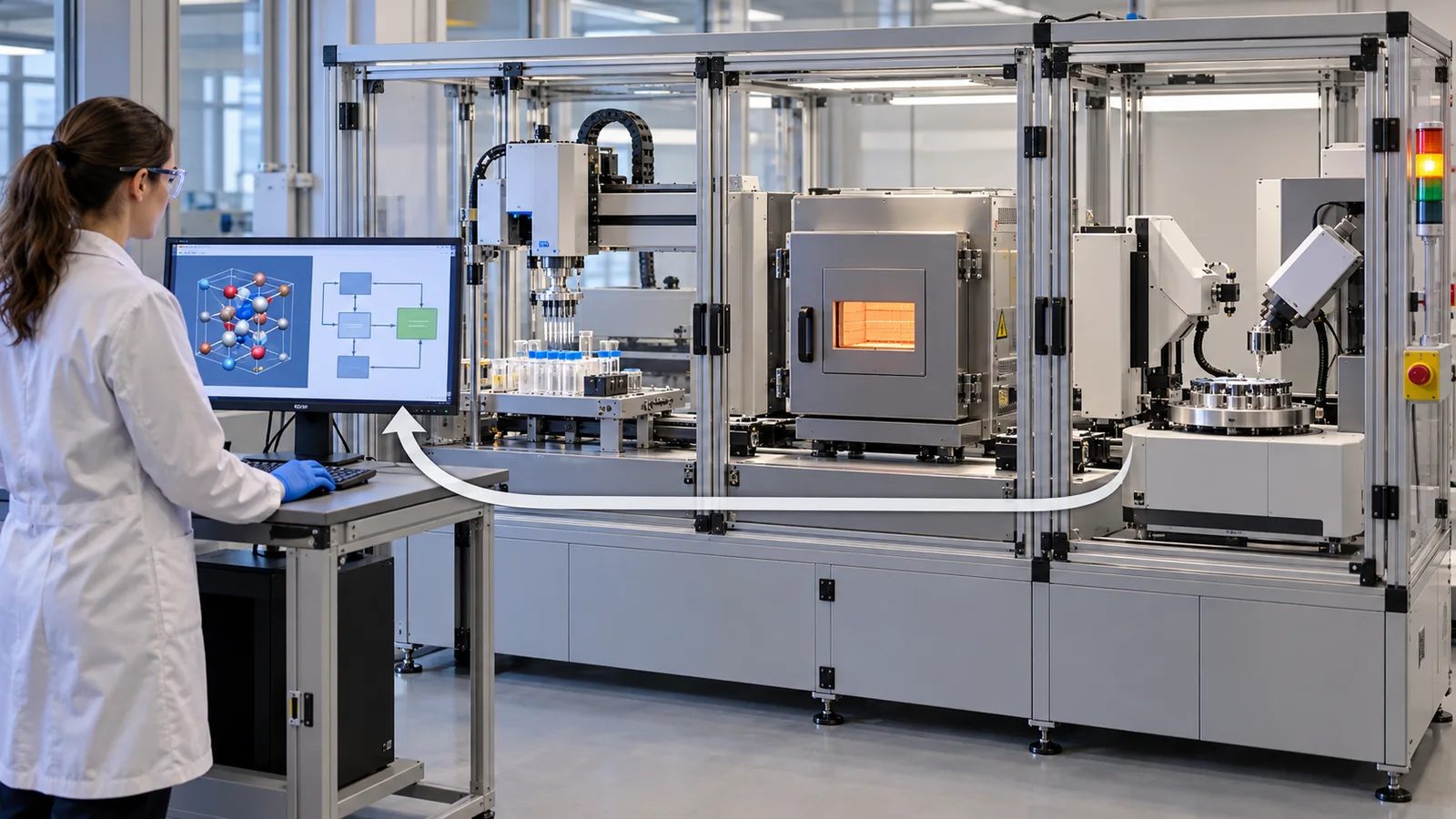
- The short version / what to know first / place in the series
- What a self-driving lab is: "automated" versus "autonomous"
- A map of real cases: counts alone cannot be compared
- A closer look: the A-Lab (solid-state powder synthesis)
- Critique and re-evaluation: the published documents side by side
- Other cases: what was "success" measured by
- Practical challenges: why it is hard
- A materials engineer's view
- Limits, what could not be confirmed, and a summary
- How to read the yardsticks and standards
- Glossary
- References
- Claim-to-source audit
Sourced = stated in published material (link given)
Our calculation = a figure this article derived, with the assumptions spelled out
Not yet confirmed = a plan, target, draft or other item that is not settled
Interpretations for materials engineers are marked separately as commentary; inference is shown in bold; claims by research groups, companies or institutions are labelled as claims.
Reports on self-driving labs contain a part in which a substance predicted stable by calculation was synthesized and measured, and a part about whether that prediction and interpretation are right. This article separates the prediction, the result confirmed by experiment and the independent verification of that result. The words "success" and "novel" used by research groups are read only after checking what they were taken to mean.
1. The short version / what to know first / place in the series
- A self-driving lab is a system in which machines run the loop of "propose, experiment, assess, learn". If machines only perform the experiment it is "automation"; if they also decide the conditions of the next one it is "autonomy"Sourced[Ref. 11, 10]
- Cases differ in number, definition of success, human involvement and verification. The A-Lab ran 353 experiments in 17 days and made 36 of 57 targets (63%); Burger et al. ran 688 experiments in 8 days; Ada optimized 35 samples in under 30 hoursSourced[Ref. 1, 6, 7]
- The A-Lab drew criticism after publication, and its authors issued a correction in January 2026. The successes were updated from 41 of 58 (71%) to 36 of 57 (63%), and "novel" was explained as new to the prediction platformSourced[Ref. 3, 2]. The one thing to remember: read not only the number of "successes" but what counted as success, where human work remains and whether the result was verified independently
Methods that search for optimal conditions with few experiments (Bayesian optimization, active learning) are explained in the series explainers on Bayesian optimization and active learning and on closed-loop optimization; here they are just "the part that decides the next conditions". Making many samples in parallel is in the explainer on high-throughput experiments and robotic synthesis, and LLMs operating equipment is in the one on AI agents for materials research. This article can be read alone; terms are explained where they first appear.
It is about mechanizing the experimental side of "propose candidates by calculation (crystal structure prediction and stability, high-throughput computation) and confirm by experiment". Of the division of labour among calculation, experiment and AI (calculation offers candidates cheaply and quickly, experiment confirms whether it is true, AI narrows where to look), it looks closely at running the experiments. Judging results is covered in the explainer on evaluation and reproducibility.
2. What a self-driving lab is: "automated" versus "autonomous"
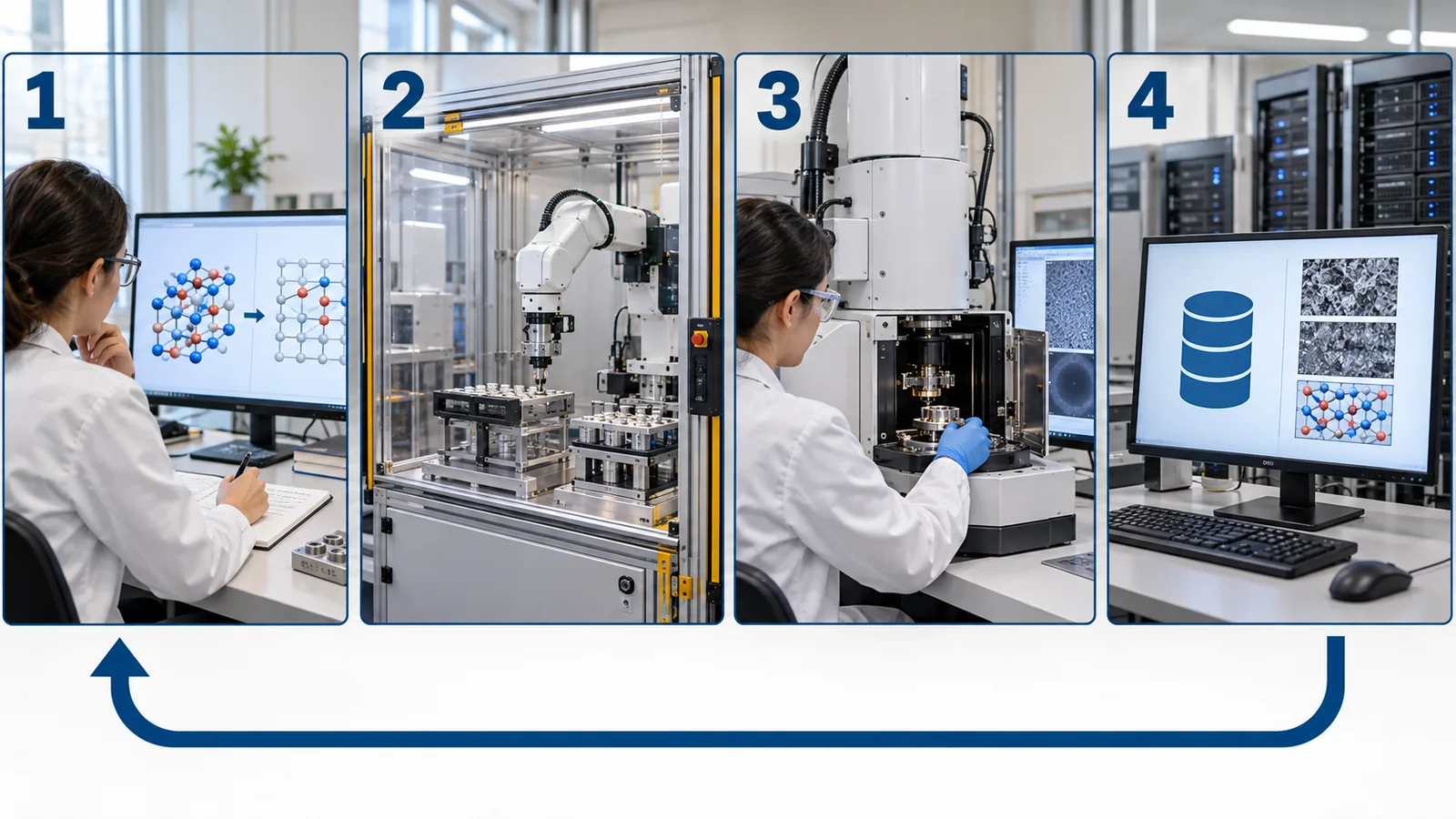
Think of a self-driving car. A car in which a machine merely presses the accelerator differs from one in which, once given a destination, a machine also chooses and judges the route. Experiments are the same: "automation", where a robot makes the sample, is distinguished from "autonomy", where a machine also decides from the measured result which condition to try next. When the latter is in place the loop of experiments "closes", hence the term closed loop.
View original SVG, values and sources
Original SVG reference: Conceptual diagram (vector drawing).The difference between "automated" (a machine runs the experiment) and "autonomous" (a machine also decides the next one) is whether steps 1 and 4 as well as step 2 are on the machine side (commentary).
A review describes self-driving laboratories (SDLs) as combining the automation of experimental workflows with autonomous experimental planning to accelerate the scientific methodSourced[Ref. 11]. But "how autonomous" varies. Volk and Abolhasani divide it into four types by how people are involvedSourced[Ref. 10].
A self-driving car has traffic rules and a map and the "right way to drive" is known. In experiments the answer being sought is itself unknown, measurements carry error and unexpected results appear (an unintended substance forms, for example). So how much to hand over to machines is decided even more carefully than in driving (commentary).
In real cases people restock reagents and consumables, clean equipment and deal with faults (Chapters 4 and 6). "Closed loop" means people do not insert judgments into the goal-seeking loop, not that people never enter the labSourced[Ref. 10]. When reading, check in the methods section what people actually do.
3. A map of real cases: counts alone cannot be compared
Representative cases are set side by side by four questions: number and duration of experiments, definition of success, human intervention and whether verification was independent.
| Case | Target and goal | Experiments and duration | Definition of success | Human intervention (as stated) | Independent verification |
|---|---|---|---|---|---|
| A-Lab (2023) | Solid-state powder synthesis; 57 targets (oxides and phosphates predicted stable by calculation) | 353 experiments, 17 daysSourced[Ref. 1] | Target is the majority phase (over 50% yield), confirmed by X-ray diffractionSourced | Loading precursors and consumables, cleaning holders, handling hardware exceptionsSourced[Ref. 1] | Chapter 5: both the authors' manual re-analysis (peer-reviewed after publication) and a critical examination by another group exist |
| Mobile robot (Burger et al. 2020) | Search for photocatalyst mixtures that make hydrogen from water (ten variables) | 688 experiments, 8 daysSourced[Ref. 6] | Activity six times that of the initial formulationsSourced | Not checked; the main text is behind a subscription | Not confirmed |
| Ada (2020) | Optimizing doping ratio and annealing time of a thin film (an organic hole-transport material) | Two campaigns of 35 samples, each under 30 hours (including restocking)Sourced[Ref. 7] | Maximizing a pseudomobility (a surrogate)Sourced | Restocking of consumables (included in the time)Sourced | The two campaigns converged on the same optimum (reproduction within the paper)Sourced |
| Mobile robots (Dai et al. 2024) | Exploratory organic, supramolecular and photochemical synthesis | Almost four consecutive days (in one experiment)Sourced[Ref. 8] | NMR and UPLC-MS judged by rules; reproducibility also checked automaticallySourced | Restocking only (as stated)Sourced | Not confirmed |
As an organizational example there is the Acceleration Consortium at the University of Toronto. According to the university's announcement (May 2023) it received a $200 million grant from the Canada First Research Excellence Fund and is advancing self-driving labs that combine AI, robotics and computingSourced[Ref. 16]. The consortium's site states aims and figures such as building self-driving labs, more than 30 self-driving labs worldwide and discovery that is 10-100 times faster and cheaper[Ref. 17]. These are the organization's claims and targets, and independent support was not confirmed hereNot yet confirmed. Also CRESt, a catalyst-discovery robot platform, reported over 900 compositions, 3,500 tests and 3 monthsSourced[Ref. 9] (the authors' claim; see the explainer on AI agents for materials research).
Dividing the number of experiments by the days gives experiments per day. But as the next figure shows, this does not rank the platforms.
- The A-Lab ran 353 / 17 ≈ 20.8 experiments a day, Burger et al. 688 / 8 = 86 a day, and Ada 35 / 30 h × 24 h ≈ 28 a day (a lower bound, since it was under 30 hours)Our calculation.
- One A-Lab experiment includes weighing, mixing, a 4-hour heat and an 8-minute X-ray scanSourced[Ref. 1]. Even for the same number of days, what one experiment involves differs, so a larger count is not a better platform (commentary).
4. A closer look: the A-Lab (solid-state powder synthesis)
The A-Lab is a self-driving lab reported in Nature in 2023 by a group at the University of California, Berkeley and Lawrence Berkeley National Laboratory (Szymanski et al.)Sourced[Ref. 1]. It runs the synthesis of solid inorganic powders using calculation, the literature, machine learning, active learning and robots. The flow is shown below.
- Targets: 57 compounds predicted stable, or very close to the convex hull, by Materials Project and Google DeepMind calculations, restricted to those predicted stable in airSourced[Ref. 1]. The paper itself notes that such databases represent compounds as ordered structures even though some may form with partial disorder in experiments
- Recipes: a language model trained on the literature offers up to five recipes by analogy with similar materials. If the yield does not reach 50%, an active-learning algorithm called ARROWS3 proposes the next recipe based on thermodynamic driving forcesSourced[Ref. 1]
- Analysis: X-ray diffraction patterns are analysed by two machine-learning models and confirmed by automated Rietveld refinement. The target counts as "success" when it forms the majoritySourced[Ref. 1]
An X-ray diffraction pattern is like the "fingerprint" of a crystal. If the measured pattern matches that of the target compound, the compound is judged to have formed. Rietveld analysis fits a model pattern to the measurement to obtain the fraction of each phase. Where the analogy breaks: just as similar fingerprints can belong to different people, compounds whose atomic arrangements differ slightly (for example elements sharing the same sites) can give similar patterns. That is why people checking the analysis matters (Chapter 5).
The results are shown below. The numbers are as stated in the paper reflecting the correction.
- Of the 57 targets, 36 were obtained (63%), 4 could not be decided from X-ray diffraction alone and 17 were not obtained. They span 33 elements and 40 structural prototypesSourced[Ref. 1]
- The main reasons for the 17 not obtained were slow kinetics (11), precursor volatility, amorphization of the product and computational inaccuracy. The authors say some could be overcome by small adjustments to decision-making, giving a success rate of 67%, or 70% (38 of 54) if computationally problematic compounds are excludedSourced[Ref. 1] (these are the authors' projections, not achieved numbersNot yet confirmed)
- Of the 353 recipes about 30% gave their target. Even though 63% of targets were eventually obtained, the success rate of individual recipes is low. The paper speaks of minimal human intervention, while restocking, cleaning and handling exceptions are done by peopleSourced[Ref. 1]
5. Critique and re-evaluation: the published documents side by side
The A-Lab report was criticized after publication. Here the statements of three published documents (the original paper, a critical perspective and the authors' correction) are set side by side without taking either side. The chronology is below.
| Point | Critical perspective (Leeman et al., PRX Energy 2024) | Authors' correction (Nature, 19 January 2026) |
|---|---|---|
| Meaning of "novel" | The authors examine the reported products and conclude that no new materials were discoveredSourced[Ref. 3] | Acknowledges that "novel" was meant as new to the prediction platform, not necessarily new to science; the text was updated because it could be misreadSourced[Ref. 2] |
| Analysis of X-ray diffraction | Automated Rietveld analysis is not yet reliable; points out one or more problems in the analysis of the products classified as successesSourced[Ref. 3] | The patterns were manually re-analysed: 36 of the 40 reported successes confirmed, 4 inconclusive; the re-analysis was peer-reviewed after publicationSourced[Ref. 2] |
| Number of successes | Describes the original report as 41 of 58 targets (71%), 43 (78%) with human interventionSourced[Ref. 3] | The 4 inconclusive ones are excluded and one compound included in the training data by mistake is dropped from the discussion; the paper now states 36 of 57 targets (63%)Sourced[Ref. 2, 1] |
| Disorder | Says about two thirds of the claimed successes are likely known compositionally disordered versions of the predicted ordered compoundsSourced[Ref. 3] | The correction notice states no separate conclusion on this point (as far as we read); the original paper notes that database compounds are represented as ordered structuresSourced[Ref. 2, 1] |
The two documents have points of agreement and points of disagreement. They agree that the number of successes was revised downward and that "new to the prediction platform" and "new to science" must be distinguished. They differ over how to judge the remaining 36 products, especially the question of disorder. This article draws no conclusion on disorder. Settling it would need independent verification by other methods, such as single-crystal diffraction or compositional analysis (commentary).
There is also criticism on the computational side that chose the A-Lab's targets. Merchant et al. of Google DeepMind reported 2.2 million structures below the convex hull, of which 736 had already been independently realized in experimentsSourced[Ref. 5] (a claim). Cheetham and Seshadri found scant evidence for compounds that fulfil novelty, credibility and utility together and said domain expertise in synthesis and crystallography must be brought inSourced[Ref. 4] (a critique). Both point to the need for expert checking before a prediction is read as a "discovery" (commentary).
This is not correct. The targets of the A-Lab were substances predicted stable by calculation, and a success meant that the predicted crystalline phase was judged to have been obtained from analysis of X-ray diffraction. The authors themselves clarified that "novel" meant new to the prediction platformSourced[Ref. 2]. A self-driving lab shows how fast predictions can be tested by experiment; confirming novelty, performance and use is separate work (commentary).
6. Other cases: what was "success" measured by
- Burger et al. (Nature 2020): a mobile robot took over the actions of a researcher (carrying samples, weighing, operating instruments) and, over 688 experiments in 8 days, searched a ten-variable space with a batched Bayesian search. The activity of the photocatalyst mixtures became six times the initial formulations, they report. The authors describe the idea of automating the researcher rather than the instrumentsSourced[Ref. 6]
- Ada (MacLeod et al., Sci. Adv. 2020): a robot performs film preparation (mixing, spin-coating, annealing), imaging, UV-vis-NIR spectroscopy and four-point electrical measurement, while Bayesian optimization (Phoenics) decides the next conditions. The target is a "pseudomobility", the sheet conductance of the film divided by the absorptance of the oxidized material, a surrogate proportional to hole mobility. Two independent 35-sample campaigns (each under 30 hours including restocking) converged on the same optimum (doping ratio about 0.4 equivalents, annealing about 75 s), each with one failed sampleSourced[Ref. 7]
- Dai et al. (Nature 2024): mobile robots link a synthesis platform (Chemspeed), a liquid chromatography-mass spectrometer and a benchtop NMR. The judgment is made not by machine learning but by rules set by people (a heuristic) that combine several measurements to select successful reactions and automatically check reproducibility. One experiment ran for almost four consecutive days, and the only human interventions were restocking and fresh consumables. A distinguishing feature is that the equipment can be shared with people without extensive redesignSourced[Ref. 8]
The "success" of the four cases is entirely different: phase identification (A-Lab), relative activity (Burger et al.), a surrogate (Ada) and a rule-based judgment (Dai et al.). When applying this to your own materials, check whether the indicator corresponds to product requirements (strength, lifetime, cost, lot-to-lot variation) (commentary). The pseudomobility, for example, is a surrogate chosen as a quickly measurable quantity (conductance and absorptance of a thin film) and is not device performance itselfSourced[Ref. 7]. Conditions optimized on a surrogate should be re-checked in the final evaluation (devices or parts).
7. Practical challenges: why it is hard
- Handling powders and solids: the A-Lab paper notes that solid inorganic powders differ in density, flow, particle size, hardness and compressibility and often need milling for good reactivity, making them harder to automate than liquidsSourced[Ref. 1]
- Ambiguity of measurement: X-ray diffraction of multiphase samples is hard to interpret. The A-Lab paper itself says characterizing multiphase samples remains challenging, and the critical perspective says automated Rietveld analysis is not yet reliableSourced[Ref. 1, 3]. How to read the indices of fit quality (R factors) is a specialist question[Ref. 15]
- Failures arise on both the experimental and the computational side: the 17 targets not obtained by the A-Lab split into experimental barriers (slow kinetics, precursor volatility, amorphization) and limits of 0 K DFT calculations (computational inaccuracy)Sourced[Ref. 1]
- Hardware faults and human work: the A-Lab's exception rate averaged about 3.9% across stations over 1.5 years, and restocking and cleaning are done by peopleSourced[Ref. 1]. As a performance metric, it is proposed to report separately the time a platform ran without human help (demonstrated unassisted lifetime) and the assisted lifetimeSourced[Ref. 10]
- Failure data are lost: failures rarely reach papers, whereas a self-driving lab can collect information-rich data, failures included, with conditions and metadata; placed in open repositories these allow reproduction and re-analysis, say Seifrid et al.Sourced[Ref. 13]
- Common standards for connecting equipment: open standards for controlling lab equipment from machines include SiLA 2 (it describes a device's functions as features and commands and uses gRPC)Sourced[Ref. 18] and OPC UA LADS (OPC 30500-1, a manufacturer-independent information model)Sourced[Ref. 19]. These connect equipment; they do not guarantee that an experimental result is correct
8. A materials engineer's view
As the cases show, dispensing and mixing liquids is easy to automate, whereas solid powders, high-viscosity materials and long steps such as firing are harder (commentary; the A-Lab paper notes the difficulty of powdersSourced[Ref. 1]). When thinking about your own lab: first write down every place where people are involved, then start with steps where automation pays most (many repeats, quick measurement). For materials with a long time to a measurable result (a multi-hour firing, say) the count per day grows slowly, so the number of parallel furnaces and batched search matter (Burger et al. used a batched searchSourced[Ref. 6]).
The output of a self-driving lab is a candidate and measurement results under stated conditions. As the A-Lab episode shows, it is desirable that phase identification can be confirmed by another method or by another person's analysis (commentary). In your own lab, do not adopt a candidate as it is: decide before introduction on (1) a control (a known material) measured on the same equipment, (2) repeats including lot-to-lot variation and (3) confirmation by another measurement method such as compositional analysis. The two independent Ada campaigns converging on the same optimum are an example of reproduction possible within a paperSourced[Ref. 7].
One value of a self-driving lab is that data with conditions, failures included, are keptSourced[Ref. 13]. To benefit in your own lab, keep (1) equipment logs (temperature history, atmosphere, weighed amounts), (2) precursor lots and storage conditions, (3) raw data such as X-ray diffraction and the analysis settings, and (4) who restocked or cleaned and when, in a form from which results can be traced afterwards. The FAIR principles (findable, accessible, interoperable, reusable)[Ref. 20] help organize that thinking (see the explainer on materials databases and FAIR).
9. Limits, what could not be confirmed, and a summary
(1) What could not be confirmed
- The main text of Burger et al. (behind a subscription) was not read; details of human intervention and verification are limited to the abstract and Extended Data legends.
- The list of individual compounds updated in the A-Lab correction (supplementary files) and any separate response to the disorder point were not checked here.
- The original figure of 41 of 58 (71%) was confirmed through the critical perspective; the earlier text of the original paper was not checked.
- Figures of the Acceleration Consortium such as "10-100 times" are the organization's claims, and independent support was not confirmed.
- Cases of self-driving labs in Japan are not covered.
- An international standard specific to self-driving labs was not found. For standards that connect equipment (SiLA 2 and LADS), check the version and current status on each body's official page. ISO/IEC texts are paid, so only the title was checked.
- A self-driving lab is a system in which machines run "propose, experiment, assess, learn", and there is a difference between automation and autonomy and between four types of human involvementSourced
- Four questions for reading a case: number of experiments, definition of success, human intervention and independent verification. Counts cannot be compared, and the definition of success differs (phase identification, relative activity, a surrogate, a rule-based judgment)Sourced
- The A-Lab made 36 of 57 targets (63%) in 17 days and 353 experiments. After publication there was criticism and an author correction (41 of 58 to 36 of 57, and an explanation of "novel"), and the question of disorder has no settled conclusionSourced
- Human work remains (restocking, cleaning, exceptions). A self-driving lab shows how quickly predictions can be tested; confirming novelty and performance is separate workSourced
- If introducing one, start with automatable steps, and design first the confirmation by controls, repeats and another method, and the records including failures (commentary)
10. How to read the yardsticks and standards
The yardsticks for a self-driving lab are not only the number of experiments or a success rate. Volk and Abolhasani list seven performance metrics to report: degree of autonomy, operational lifetime, throughput, experimental precision (the scatter of replicates), material usage, accessible parameter space and optimization efficiencySourced[Ref. 10]. There are also ways to measure how many times faster a search is than random selection (the acceleration factor). Checked on 22 October 2026.
| What is assessed | Representative benchmark or method (name, source) | Standards and guidance (ISO/IEC, open standards) | How to read it |
|---|---|---|---|
| Degree of autonomy and lifetime | The seven metrics of Volk and Abolhasani (degree of autonomy, demonstrated unassisted and assisted lifetime and others)[Ref. 10]Sourced | Not found (no international standard specific to self-driving labs was found) | Distinguish demonstrated from theoretical lifetime, and time with human restocking |
| Speed of search | The acceleration factor (compared with random selection). Rohr et al. report, on four chemical spaces of 2,121 catalysts each, up to a factor of 20 in specific scenarios and, for some choices, slower than random[Ref. 14]Sourced | Not found | Depends on the dataset and the definition of "good"; measure again on your own search space |
| Experimental precision | The standard deviation of replicates of one condition (Volk and Abolhasani)[Ref. 10]Sourced | Laboratory competence: ISO/IEC 17025:2017 (general requirements for the competence of testing and calibration laboratories)[Ref. 21]Sourced | 17025 is not a standard for self-driving labs; it is a reference when thinking about measurement uncertainty and records (commentary). The text is paid, so only the title was checked |
| Confirming results (phase identification and so on) | Manual re-analysis (the authors, peer-reviewed after publication) and an examination by another group (A-Lab)[Ref. 2, 3]Sourced | Not found | Look for confirmation by another measurement method, not only the fit quality (R factors) |
| Equipment connection and data | Not found | SiLA 2 (an open standard for communication with lab equipment)[Ref. 18], OPC 30500-1 LADS (an OPC UA information model for laboratory and analytical devices)[Ref. 19] and the FAIR Guiding Principles (2016)[Ref. 20]Sourced | Conventions and principles for connecting and sharing, not criteria for correctness. FAIR is a set of principles without legal force |
The arrangement of the table is Our calculation (organization). Numbers, titles and status checked on the ISO, SiLA and OPC Foundation pages (22 October 2026). The two pages checked for LADS gave different version information (1.0.0 and a later one), so the version is not stated. Standard texts are paid, so only titles and scope are described and requirements are not.
Reading notes (for materials engineers)
- Do not read a "success rate" alone: see what counted as success, how targets were chosen and how much human work went in. The 63% of the A-Lab and the convergence of Ada's two independent campaigns measure different things
- Separate prediction, experimental confirmation and independent verification: making a substance predicted stable and checking it is one stage; someone else confirming that it is new and correctly identified is another
- Separate recommendation from requirement: SiLA 2 and LADS are open standards for connecting equipment, ISO/IEC 17025 sets requirements for laboratory competence and FAIR is a set of principles. None guarantees the correctness of a self-driving lab's results. Targets stated by institutions (10-100 times and so on) are read as plans and claims
11. Glossary
- Self-driving laboratory (SDL)
- A lab combining automated experiments with autonomous planning of the next one, with machines running the loop.
- Automation
- Machines performing the operations of an experiment; people may still decide the next conditions.
- Autonomy
- A machine also deciding the conditions of the next experiment.
- Closed loop
- Operation in which no human judgment enters the goal-seeking loop.
- Active learning
- A way of choosing what to measure next while watching results (see another article in this series).
- Bayesian optimization
- A way of finding optimal conditions with few trials (see another article in this series).
- ARROWS3
- The active-learning method the A-Lab uses, proposing the next synthesis using reaction driving forces.
- Solid-state synthesis
- Mixing powder precursors and firing at high temperature to obtain the target compound.
- Precursor
- A starting substance for a synthesis.
- X-ray diffraction (XRD)
- A measurement that shines X-rays on a crystal and uses the diffraction pattern (a crystal fingerprint) to find which phases are present.
- Rietveld refinement
- A calculation fitting a model diffraction pattern to the measurement to obtain phase fractions and structure.
- Convex hull (a stability guide)
- The lowest-energy envelope in calculation; compounds above it are predicted unstable against decomposition.
- Order and disorder
- Whether elements sit on fixed sites (ordered) or share sites and mix (disordered).
- Surrogate metric (pseudomobility and so on)
- Using a quickly measurable quantity in place of the one you really want.
- Heuristic
- Judging by rules of thumb set by people.
- Mobile robot
- A robot that moves around the lab and uses the same equipment as people.
- Demonstrated unassisted lifetime
- The time a platform actually kept running without human help.
- Acceleration factor
- How many times faster a search reaches a target than random selection.
- Final evaluation
- Evaluation in a form close to actual use, such as a device or a part.
- SiLA 2
- An open communication standard for controlling lab equipment from machines.
- OPC UA / LADS
- A specification defining an information model for laboratory and analytical devices on top of the industrial communication standard OPC UA.
- FAIR principles
- Principles for making data findable, accessible, interoperable and reusable.
- Doping ratio
- The proportion of dopant added to the main material.
12. References
- Szymanski N. J. et al. "An autonomous laboratory for the accelerated synthesis of inorganic materials", Nature 624, 86–91 (2023), DOI 10.1038/s41586-023-06734-w (checked in the published version reflecting the January 2026 correction) — doi.org/10.1038/s41586-023-06734-w
- Szymanski N. J. et al. "Author Correction: An autonomous laboratory for the accelerated synthesis of inorganic materials", Nature 650, E1 (19 January 2026), DOI 10.1038/s41586-025-09992-y — doi.org/10.1038/s41586-025-09992-y
- Leeman J. et al. "Challenges in High-Throughput Inorganic Materials Prediction and Autonomous Synthesis", PRX Energy 3, 011002 (2024), DOI 10.1103/PRXEnergy.3.011002 — doi.org/10.1103/PRXEnergy.3.011002
- Cheetham A. K., Seshadri R. "Artificial Intelligence Driving Materials Discovery? Perspective on the Article: Scaling Deep Learning for Materials Discovery", Chem. Mater. 36, 3490–3495 (2024), DOI 10.1021/acs.chemmater.4c00643 — doi.org/10.1021/acs.chemmater.4c00643
- Merchant A. et al. "Scaling deep learning for materials discovery", Nature 624, 80–85 (2023), DOI 10.1038/s41586-023-06735-9 — doi.org/10.1038/s41586-023-06735-9
- Burger B. et al. "A mobile robotic chemist", Nature 583, 237–241 (2020), DOI 10.1038/s41586-020-2442-2 (abstract and Extended Data legends checked; the main text is behind a subscription) — doi.org/10.1038/s41586-020-2442-2
- MacLeod B. P. et al. "Self-driving laboratory for accelerated discovery of thin-film materials", Sci. Adv. 6, eaaz8867 (2020), DOI 10.1126/sciadv.aaz8867 — doi.org/10.1126/sciadv.aaz8867
- Dai T. et al. "Autonomous mobile robots for exploratory synthetic chemistry", Nature 635, 890–897 (2024), DOI 10.1038/s41586-024-08173-7 — doi.org/10.1038/s41586-024-08173-7
- Zhang Z. et al. "A multimodal robotic platform for multi-element electrocatalyst discovery", Nature 647, 390–396 (2025), DOI 10.1038/s41586-025-09640-5 (abstract checked) — doi.org/10.1038/s41586-025-09640-5
- Volk A. A., Abolhasani M. "Performance metrics to unleash the power of self-driving labs in chemistry and materials science", Nat. Commun. 15, 1378 (2024), DOI 10.1038/s41467-024-45569-5 — doi.org/10.1038/s41467-024-45569-5
- Tom G. et al. "Self-Driving Laboratories for Chemistry and Materials Science", Chem. Rev. 124, 9633–9732 (2024), DOI 10.1021/acs.chemrev.4c00055 — doi.org/10.1021/acs.chemrev.4c00055
- Abolhasani M., Kumacheva E. "The rise of self-driving labs in chemical and materials sciences", Nat. Synth. 2, 483–492 (2023), DOI 10.1038/s44160-022-00231-0 — doi.org/10.1038/s44160-022-00231-0
- Seifrid M. et al. "Autonomous Chemical Experiments: Challenges and Perspectives on Establishing a Self-Driving Lab", Acc. Chem. Res. 55, 2454–2466 (2022), DOI 10.1021/acs.accounts.2c00220 — doi.org/10.1021/acs.accounts.2c00220
- Rohr B. et al. "Benchmarking the acceleration of materials discovery by sequential learning", Chem. Sci. 11, 2696–2706 (2020), DOI 10.1039/C9SC05999G — doi.org/10.1039/C9SC05999G
- Toby B. H. "R factors in Rietveld analysis: How good is good enough?", Powder Diffr. 21, 67–70 (2006), DOI 10.1154/1.2179804 (title only; the content is not described here) — doi.org/10.1154/1.2179804
- U of T Engineering News "'Self-driving labs': $200-million federal grant powers AI-driven materials discovery for clean energy, advanced manufacturing and more" (1 May 2023) — news.engineering.utoronto.ca/self-driving-labs-200-million-federal-grant-powers-ai-driven-materials-discovery-for-clean-energy-advanced-manufacturing-and-more/
- Acceleration Consortium "Acceleration Consortium" (official site, checked 22 October 2026) — acceleration.utoronto.ca/
- SiLA Consortium "SiLA 2 standard" (official page, checked 22 October 2026) — sila-standard.com/standards/
- OPC Foundation "Laboratory and Analytical Devices (LADS)" working-group page (specification OPC 30500-1) — opcfoundation.org/about/working-groups/view/12
- Wilkinson M. D. et al. "The FAIR Guiding Principles for scientific data management and stewardship", Sci. Data 3, 160018 (2016), DOI 10.1038/sdata.2016.18 — doi.org/10.1038/sdata.2016.18
- ISO/IEC "ISO/IEC 17025:2017 General requirements for the competence of testing and calibration laboratories" (ISO page) — iso.org/standard/66912.html
13. Claim-to-source audit
| Claim in the text | Basis | Class |
|---|---|---|
| A-Lab: 17 days and 353 experiments, 36 of 57 targets made (63%), 4 inconclusive, 17 not obtained, 33 elements and 40 prototypes. Targets predicted stable by Materials Project and Google DeepMind calculations. Three stations, four box furnaces and robot arms, 4 h hold, 8 min X-ray scans, success as the target being the majority phase (over 50% yield). Literature ML (up to five recipes) and ARROWS3. About 30% of 353 recipes gave the target, 30 of 36 successes from literature-ML recipes, 9 targets improved by active learning (6 with zero initial yield). Reasons for failure (slow kinetics 11 and others), projections of 67% and 70% (38 of 54). Human work: loading precursors and consumables, cleaning holders, handling exceptions (about 3.9%), the phrase "minimal human intervention". Difficulty of powders and of multiphase characterization; databases representing ordered structures | Reference 1 https://doi.org/10.1038/s41586-023-06734-w | Sourced |
| Nature correction (19 January 2026): "novel" meaning new to the prediction platform, text updated, manual re-analysis of diffraction confirming 36 of 40 reported successes with 4 inconclusive, the number of successes updated, Zn2Cr3FeO8 removed from the discussion (included in training data by mistake), the re-analysis peer-reviewed after publication | Reference 2 https://doi.org/10.1038/s41586-025-09992-y | Sourced |
| Leeman et al. (PRX Energy, 7 March 2024): describes the original A-Lab report as 41 of 58 targets (71%) and 43 (78%) with human intervention, examines 43 products and points to four common problems, concludes that no new materials were discovered, says automated Rietveld analysis is not reliable and that about two thirds are likely known disordered compounds | Reference 3 https://doi.org/10.1103/PRXEnergy.3.011002 | Sourced |
| Merchant et al.: 2.2 million structures below the convex hull, 736 already independently realized (a claim). Cheetham and Seshadri: scant evidence for compounds fulfilling novelty, credibility and utility, expertise needed (a critique) | Reference 5 https://doi.org/10.1038/s41586-023-06735-9 Reference 4 https://doi.org/10.1021/acs.chemmater.4c00643 | Sourced |
| Burger et al.: a mobile robot, 688 experiments in 8 days, ten variables, batched Bayesian search, photocatalyst mixture activity six times the initial formulations, the idea of automating the researcher | Reference 6 https://doi.org/10.1038/s41586-020-2442-2 | Sourced |
| Ada: the steps (mixing, coating, annealing, imaging, spectroscopy, four-point measurement), Phoenics, the definition of the pseudomobility, two campaigns of 35 samples each under 30 hours with one failed sample each, converging on the same optimum (doping about 0.4 equivalents, annealing about 75 s) | Reference 7 https://doi.org/10.1126/sciadv.aaz8867 | Sourced |
| Dai et al.: mobile robots, Chemspeed synthesis platform, UPLC-MS and benchtop NMR, a heuristic decision-maker, automatic reproducibility checks, almost four consecutive days, human intervention limited to restocking and consumables, equipment shared with people | Reference 8 https://doi.org/10.1038/s41586-024-08173-7 | Sourced |
| CRESt: over 900 catalyst chemistries, 3,500 electrochemical tests, 3 months (the authors' claim) | Reference 9 https://doi.org/10.1038/s41586-025-09640-5 | Not yet confirmed |
| The definition of an SDL (automation of experiments with autonomous planning). Volk and Abolhasani: four types of degree of autonomy, seven performance metrics, demonstrated unassisted and assisted lifetime, precision as the standard deviation of replicates. Seifrid et al.: information-rich data with conditions and metadata, open repositories | Reference 11 https://doi.org/10.1021/acs.chemrev.4c00055 Reference 10 https://doi.org/10.1038/s41467-024-45569-5 Reference 13 https://doi.org/10.1021/acs.accounts.2c00220 | Sourced |
| Rohr et al.: four chemical spaces of 2,121 catalysts each, up to a factor of 20 against random selection, slower for some choices. The title of Toby's paper on R factors | Reference 14 https://doi.org/10.1039/C9SC05999G Reference 15 https://doi.org/10.1154/1.2179804 | Sourced |
| Acceleration Consortium: the University of Toronto announcement (1 May 2023) of $200 million from the Canada First Research Excellence Fund for self-driving labs combining AI, robotics and computing. The statements on the consortium's site (building self-driving labs, more than 30 worldwide, 10-100 times faster and cheaper) are the organization's claims and targets | Reference 16 https://news.engineering.utoronto.ca/self-driving-labs-200-million-federal-grant-powers-ai-driven-materials-discovery-for-clean-energy-advanced-manufacturing-and-more/ Reference 17 https://acceleration.utoronto.ca/ | Sourced |
| SiLA 2: an open communication standard for lab equipment, functions as features and commands, based on gRPC. OPC 30500-1 LADS: an OPC UA information model for lab and analytical devices, manufacturer-independent. The FAIR Guiding Principles (2016). Title and status of ISO/IEC 17025:2017 | Reference 18 https://sila-standard.com/standards/ Reference 19 https://opcfoundation.org/about/working-groups/view/12 Reference 20 https://doi.org/10.1038/sdata.2016.18 Reference 21 https://www.iso.org/standard/66912.html | Sourced |
| 353 / 17 ≈ 20.8, 688 / 8 = 86, 35 / 30 × 24 ≈ 28 (a lower bound), 353 × 0.30 ≈ 106, 36 / 57 ≈ 63%, 41 / 58 ≈ 71% | Our calculation (Python) | Our calculation |
| The main text of Burger et al. (human work and verification details), the list of compounds after the A-Lab correction and any separate response on disorder, cases in Japan, independent support for the Acceleration Consortium figures, an international standard specific to self-driving labs | Not confirmed in the primary sources reachable in this survey, so not stated | Commentary |
| The readings "four questions: number of experiments, definition of success, human work, independent verification", "automation versus autonomy", "the A-Lab critique and correction agree on some points (downward revision, distinguishing new to the platform from new to science) and differ on others (disorder)", "start with automatable steps", "controls, repeats and another method" and "keep failure records" | Our own arrangement and commentary based on published material; not a view stated by the researchers or institutions | Commentary |
| Figs. 2, 3, 5, 7 and 8 are conceptual diagrams; Figs. 4 and 6 include calculations; Figs. 1 and 9 are slots for AI-generated images; the bar lengths of human involvement in Fig. 3 are rough | Note by this article | Commentary |
Last updated: 22 October 2026. Sources are limited to primary material (peer-reviewed papers, the Nature correction notice, and official pages of a university and of standards bodies). Worked numbers are our own calculations, not results of actual experiments. The criticism of and correction to the A-Lab are published documents set side by side without taking either side, and no conclusion is drawn on the disorder question. The main text of Burger et al., the list of compounds after the correction and any separate response on disorder, cases in Japan, independent support for the Acceleration Consortium figures and an international standard specific to self-driving labs could not be confirmed and are not stated. Figs. 1 and 9 are slots for AI-generated images; the other figures are explanatory diagrams or figures including calculations.