TECHNOLOGY EXPLAINER
High-Throughput Experiments and Robotic Synthesis
— making and measuring many samples in parallel
The combinations of composition and conditions for materials are countless, and making and measuring them one at a time would not finish in a lifetime. So methods developed that make and measure many samples in parallel, in small amounts and automatically. This is high-throughput experimentation. This article explains, with figures and small calculations, its three approaches (thin films whose composition varies continuously, plates holding liquids, and robots that handle powders), how liquids and powders differ in handling, what sets the speed, and where practice stumbles. It is not "add a robot and everything gets faster" but what gets faster and what does not, set out as far as the papers confirm.
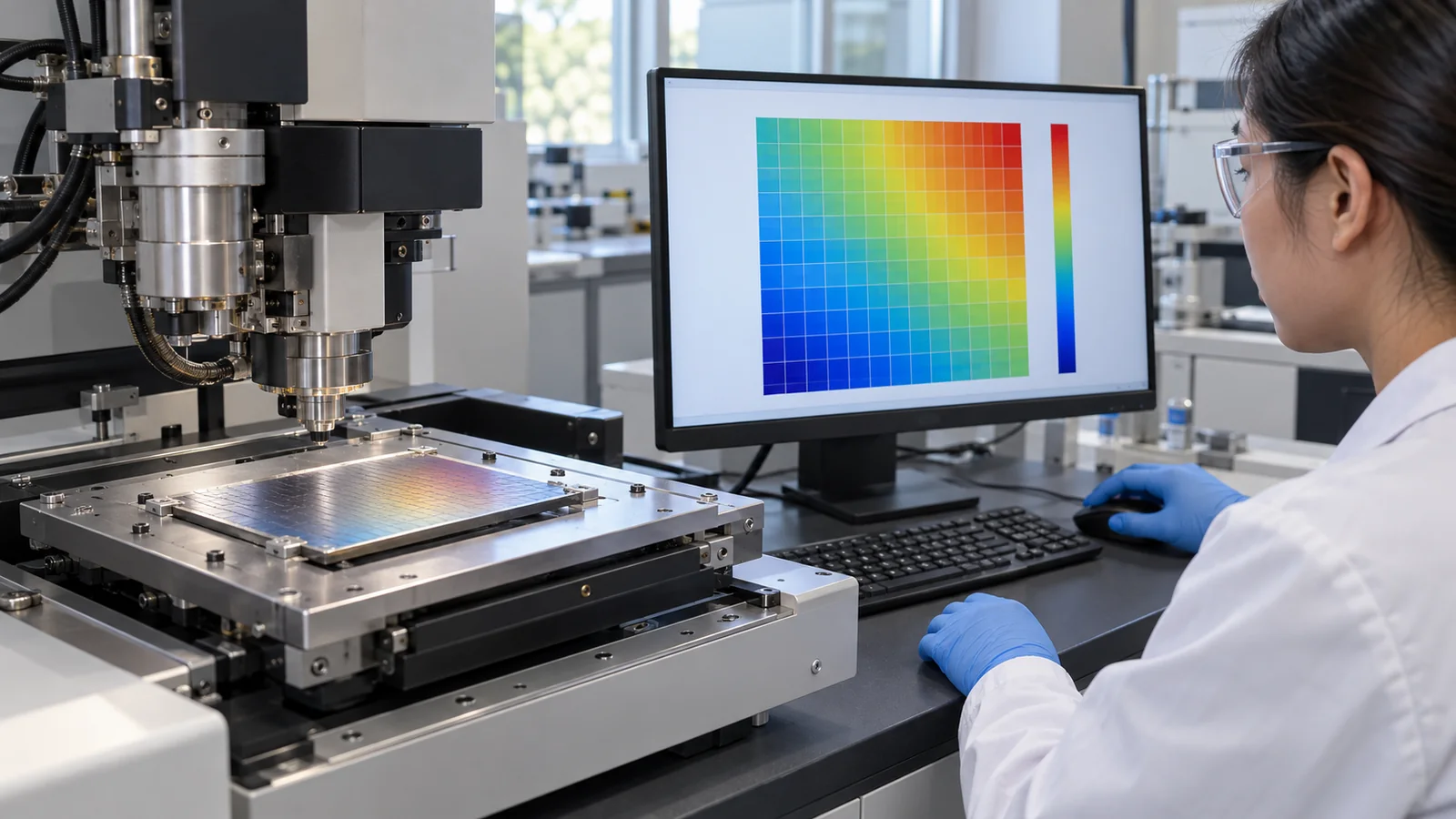
- The short version / what to know first / place in the series
- What high-throughput experiments are: why "parallel" is needed
- Three approaches: thin films, plates and robots
- Combinatorial thin films: drawing a composition "map" in one go
- Handling liquids and powders: differences in ease of automation
- What sets the speed: theoretical and demonstrated values
- The flow of an experiment and where people come in
- Bringing a finding closer to use: from film to bulk to parts
- A materials engineer's view
- Limits, what could not be confirmed, and a summary
- How to read the yardsticks and standards
- Glossary
- References
- Claim-to-source audit
Sourced = stated in published material (link given)
Our calculation = a figure this article derived, with the assumptions spelled out
Not yet confirmed = a plan, target, draft or other item that is not settled
Interpretations for materials engineers are marked separately as commentary; inference is shown in bold; claims by research groups, companies or institutions are labelled as claims.
Figures such as "so many experiments a day" or "over 1,500 experiments" hold for that paper's target, equipment and conditions. If what one experiment involves differs (just mixing liquids or a 4-hour heat), a larger count does not rank the equipment. The theoretical maximum speed and the speed actually demonstrated are also different values.
1. The short version / what to know first / place in the series
- High-throughput experimentation makes and measures many samples in parallel, in small amounts and automatically. Approaches include thin films of continuously varying composition, liquids arrayed in plates and robots that handle powders, and thousands of compositions can be examined in one experimentSourced[Ref. 2]
- Liquids are well automated, but solids and powders are hard, it is reported. Shevlin says no general automated solution for dispensing solids yet exists. Buitrago Santanilla et al. changed the reactions themselves to suit automation and ran over 1,500 experiments in under a daySourced[Ref. 6, 7]
- The one thing to remember: speed is set by the long step and by measurement, and the theoretical and demonstrated speeds differ. Also, a property found in a thin film does not necessarily appear in the bulk material as it isSourced[Ref. 11, 4]
If materials discovery is "searching a vast map for buried treasure", calculation offers candidates cheaply and quickly, experiment confirms whether it is true, and AI narrows where to look. High-throughput experimentation is a tool that makes the experimental side faster and larger, and is combined with methods for narrowing where to look (see the explainers on Bayesian optimization and active learning and on closed-loop optimization). This article can be read alone; terms are explained where they first appear.
Examining many candidates by calculation is in the explainer on high-throughput computation, and machines running experiments and deciding the next one is in the explainer on self-driving laboratories. This article covers the hardware side: how many samples are arrayed, made and measured. Analysis of measured data is in the explainer on AI analysis of spectra and images, and data management in the one on materials databases and FAIR.
2. What high-throughput experiments are: why "parallel" is needed
Take treasure hunting. Digging one big hole at a time and digging hundreds of small holes at once reveal different amounts of the map in the same time. High-throughput experimentation is the latter. Each hole (sample) is small, and the job is to cover the conditions and find promising places. Where the analogy breaks: because the holes are small, what is found is a clue that "this looks promising", and whether treasure was really hit is checked by digging again, bigger.
Why is parallel work needed? See the calculation in the next figure. Varying just 10 variables (composition, temperature, time and so on) at 3 levels each gives 3 to the tenth, or 59,049 combinations. At one hour each, that is about 6.7 years of round-the-clock workOur calculation.
The triangle on the right shows mixing proportions of three components A, B and C: 66 points at 10% steps, 231 at 5% and 5,151 at 1%Our calculation. Filling in this "composition map" is the idea of the combinatorial approach. Koinuma and Takeuchi say the combinatorial approach was pioneered in the pharmaceutical industry and adapted to materials scienceSourced[Ref. 2]. A review adds that as materials become complex, rational design from prior knowledge becomes limited, and combinatorial and high-throughput experiments have come to be recognized as a way to generate new knowledgeSourced[Ref. 3].
Parallel means making many at the same time. Even for a heat that takes 4 hours, putting 100 pieces in a furnace and heating them together makes it faster per piece. Fast means one run is itself short. High-throughput experimentation gains speed mainly through the former (the A-Lab, for example, heats in four furnacesSourced[Ref. 8]). But parallelization brings a new problem: conditions may not be the same for all samples (Chapters 5 and 7).
3. Three approaches: thin films, plates and robots
High-throughput experiments divide roughly into three by what is arrayed.
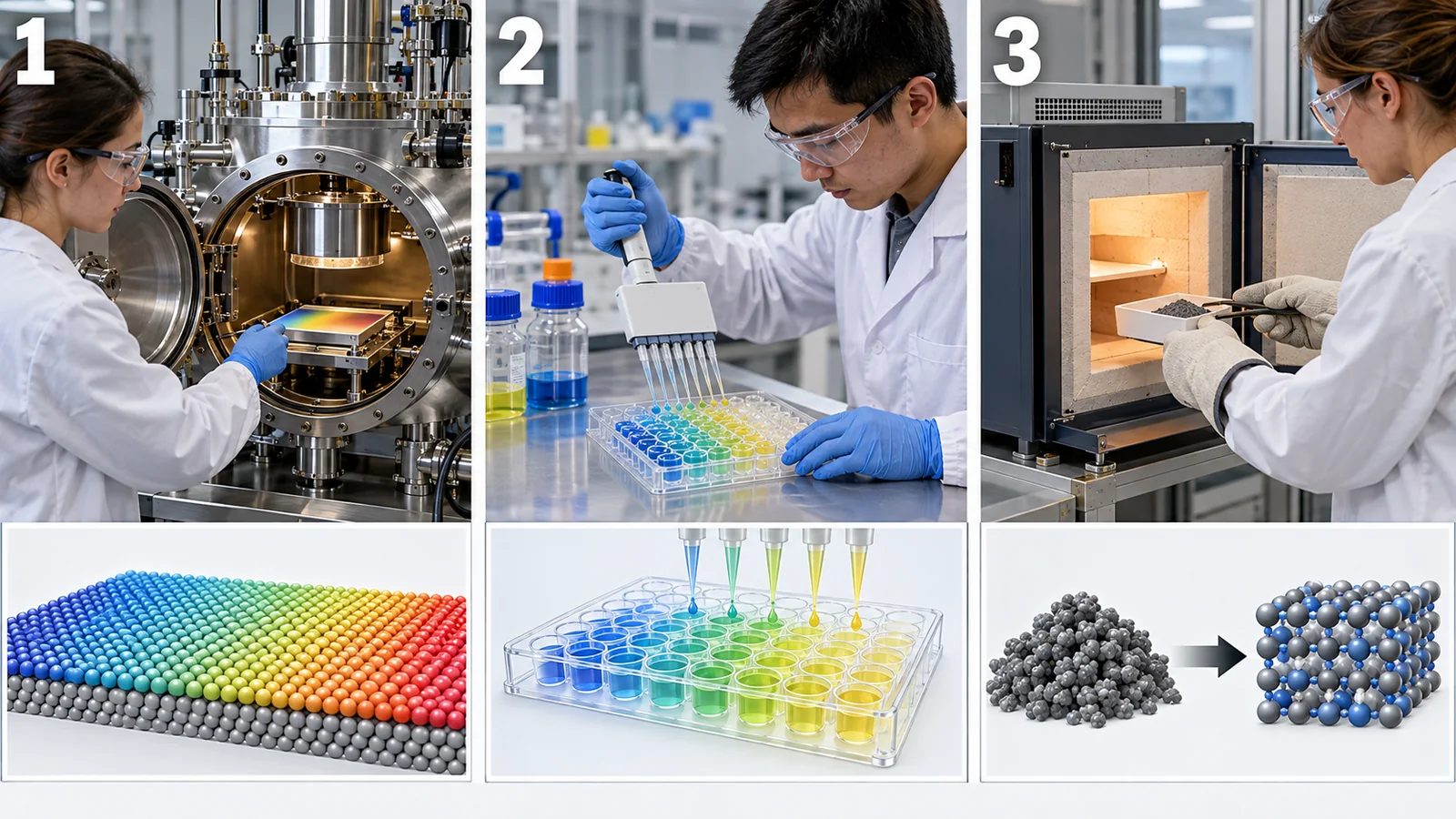
View original SVG, values and sources
Original SVG reference: Conceptual diagram (vector drawing).Examples are from Xiang et al. (Science 1995), Buitrago Santanilla et al. (Science 2015), Shevlin (ACS Med. Chem. Lett. 2017) and Szymanski et al. (Nature 2023).
- Xiang et al. (1995) combined thin-film deposition with masking to make spatially addressable libraries of solid materials in parallel. They made samples as small as 200 µm × 200 µm at 10,000 sites per square inch, sintered them and identified BiSrCaCuO and YBaCuO superconducting filmsSourced[Ref. 1]. Ten thousand sites per square inch corresponds to a spacing of about 0.25 mm (25.4 mm divided by 100)Our calculation.
- Buitrago Santanilla et al. (2015) ran over 1,500 experiments in under a day, with as little as 0.02 mg per reaction, for palladium-catalysed coupling reactionsSourced[Ref. 7]. Shevlin (2017) describes a standard scale of 100 µL reactions in 96-well plates (10 µmol of substrate per well)Sourced[Ref. 6]
- The A-Lab (2023) had robots run solid-state powder synthesis from weighing and mixing through heating to X-ray diffraction, performing 353 experiments in 17 daysSourced[Ref. 8] (covered in detail in the explainer on self-driving laboratories)
4. Combinatorial thin films: drawing a composition "map" in one go
A thin-film library makes a film whose composition varies continuously on one substrate. According to Ludwig (2019), most are made by depositing from several sources at once or by stacking wedge-type multilayers to build a composition gradient. A thickness of several hundred nanometres is a guide, to make measurement reliable and avoid nanoscale effectsSourced[Ref. 4].
- Measurement is parallel and automated too: X-ray diffraction with a micro-focus source and an area detector can measure spots under 1 mm, and electrical resistance, magnetism and other quantities are also measured place by placeSourced[Ref. 4]. All experimental and analysed data should be transferred to a database together with metadata, it is statedSourced[Ref. 4]
- An example: in the Co-Ti-W system a ternary mu-phase was found from high-throughput X-ray diffraction and resistivity data and verified by electron microscopy on bulk samples and by DFT calculationSourced[Ref. 4]
- Working with calculation: calculations screen thousands of candidates, and some 10 to 100 composition-spread libraries are made around the most promising compositionsSourced[Ref. 4] (see the explainer on high-throughput computation)
Not necessarily. Ludwig says thin-film libraries efficiently reveal intrinsic properties (composition, crystal structure and so on), while extrinsic properties (those depending on microstructure) differ between film and bulk of the same materialSourced[Ref. 4]. The accurate statement is that a thin film is a tool for narrowing candidates, and the finding must be re-checked in bulk or in the form of a part (Chapter 8).
5. Handling liquids and powders: differences in ease of automation
Even for the same "dispense by robot", liquids and solids differ greatly in difficulty. From experience at the pharmaceutical company Merck, Shevlin (2017) says the followingSourced[Ref. 6].
- Liquids are fast and accurate: neat liquids, solutions and homogeneous suspensions or slurries can be dosed quickly and accurately, and dispensing stock solutions speeds set-up
- Solids are hard: solid handling is difficult in large arrays, different dispensing technologies suit different solids, and no general automated solution exists
- Mixing is also hard: in 96-well plates magnetic stirring suffers from an insufficient magnetic field across the array, while small 24-well arrays can use an ordinary stir plate; tumble stirring or vortex mixing are used instead
- Equipment and training: liquid-handling robots need significant capital investment and training to use
Buitrago Santanilla et al. (2015) say that automated, miniaturized chemistry is difficult in the presence of solids or volatile organic solvents, so most of the synthetic "toolkit" cannot be readily miniaturized. They therefore developed automation-friendly reactions (in dimethyl sulfoxide at room temperature) and ran over 1,500 experiments in under a daySourced[Ref. 7]. In other words, the experimental conditions were changed to suit the robot (commentary).
For powder synthesis the A-Lab paper says solid powders differ in density, flow, particle size, hardness and compressibility and need milling and mixing to ensure reactivity, so they bring difficulties distinct from automating liquidsSourced[Ref. 8]. The A-Lab weighs on an automatic balance, mixes with ethanol and zirconia balls and moves the mixture into crucibles. Precursor powders (50-100 g per bottle) are loaded by hand before a campaignSourced[Ref. 8].
This is not correct. Dispensing liquids is well automated, but no general solution for dispensing solids exists yet, it is reportedSourced[Ref. 6]. Whether something can be automated depends on the form of the material (liquid, powder or sticky mass) and the length of each step. The right check is to look again at your own materials and processes: can they be made liquid, and can they be measured at a small size? (commentary).
6. What sets the speed: theoretical and demonstrated values
Throughput is not set by equipment speed alone. Volk and Abolhasani (2024) say that even if experiments are done quickly, throughput is greatly throttled if the reaction time is long and there is no parallelization, and conversely if the reaction is fast but measurement is slow, early changes are missed and part of the parameter space is neglectedSourced[Ref. 11]. With non-destructive measurement a single sample can also yield several measurements, raising the data rate.
The authors recommend reporting throughput both as a "theoretical maximum" and as a "demonstrated value". For their own microfluidic spectral-sampling system, over 1,200 measurements per hour were possible in theory, but experiments with longer reaction times demonstrated about 100 per hour, a twelve-fold differenceSourced[Ref. 11]Our calculation (1,200 / 100 = 12).
Not only speed but also the amount of material used per run matters. Volk and Abolhasani say that the smaller the amount of hazardous substances, the easier it is to contain critical failures, and the smaller the cost and environmental impactSourced[Ref. 11]. In the Merck example it was as little as 0.02 mg per reactionSourced[Ref. 7]. But the smaller it gets, the more sample inhomogeneity and measurement scatter can affect the result (commentary).
7. The flow of an experiment and where people come in
A single campaign of high-throughput experiments can be divided into seven steps. Stein and Gregoire (2019) propose a framework that diagrams the lifecycle of a materials experiment and arranges how far automation has goneSourced[Ref. 5]. The seven steps here are a simplified arrangement inspired by it.
- Where people come in is visible in real cases: at the A-Lab people load precursors and consumables, clean X-ray sample holders and handle hardware exceptionsSourced[Ref. 8]. In the almost four-day run of Dai et al.'s mobile robots, the only human intervention was restocking and fresh consumablesSourced[Ref. 9]
- Equipment can also be shared with people: Dai et al. showed mobile robots linking a synthesis platform (Chemspeed), a liquid chromatography-mass spectrometer and a benchtop NMR, so that existing equipment can be shared with people without extensive redesignSourced[Ref. 9]
- A thin-film example: MacLeod et al.'s Ada had a robot run thin-film preparation through electrical measurement, completing a 35-sample campaign in under 30 hours including restocking. One sample failed, which they describe as a typical failure rate for the systemSourced[Ref. 10]
8. Bringing a finding closer to use: from film to bulk to parts
The output of high-throughput experiments is promising candidates and measurement results under stated conditions. To bring them closer to use, they are re-checked step by step. Ludwig's examples serve to arrange this.
- For Ti-Ni-Cu-Pd shape-memory alloys bulk experiments were prohibitively costly because of the noble metals, so a thin-film composition spread verified the predicted compositions in one experiment, and the result transferred to bulkSourced[Ref. 4]
- For Ti-Ni-Cu films the alloy found is brittle in bulk and is applicable only as a thin filmSourced[Ref. 4]. Working as a thin film and working as bulk or a part are different questions (commentary).
- There is also a proposal to check data quality by fabricating and measuring nominally identical libraries in different labs and by different methodsSourced[Ref. 4].
9. A materials engineer's view
If your final evaluation (long-term durability, destructive tests, tests in real equipment) cannot be parallelized or takes long, use high-throughput experiments to screen with quickly measurable surrogate metrics and run the final evaluation only on the narrowed candidates (commentary). First check, on a few samples, whether the surrogate ranks candidates in the same order as the final evaluation. The pseudomobility of Ada is an example of a surrogate built from quickly measurable quantities, conductance and absorptance of a thin filmSourced[Ref. 10].
With parallel work, conditions may not be the same at every position on a plate. In 96-well plates insufficient magnetic field for magnetic stirring is reportedSourced[Ref. 6]. To tell position effects (differences in heating, stirring and evaporation) apart, place controls of the same condition at several positions on the plate and look at the differences in results (commentary). The "experimental precision" of Volk and Abolhasani, the standard deviation of replicates of one condition, quantifies that ideaSourced[Ref. 11].
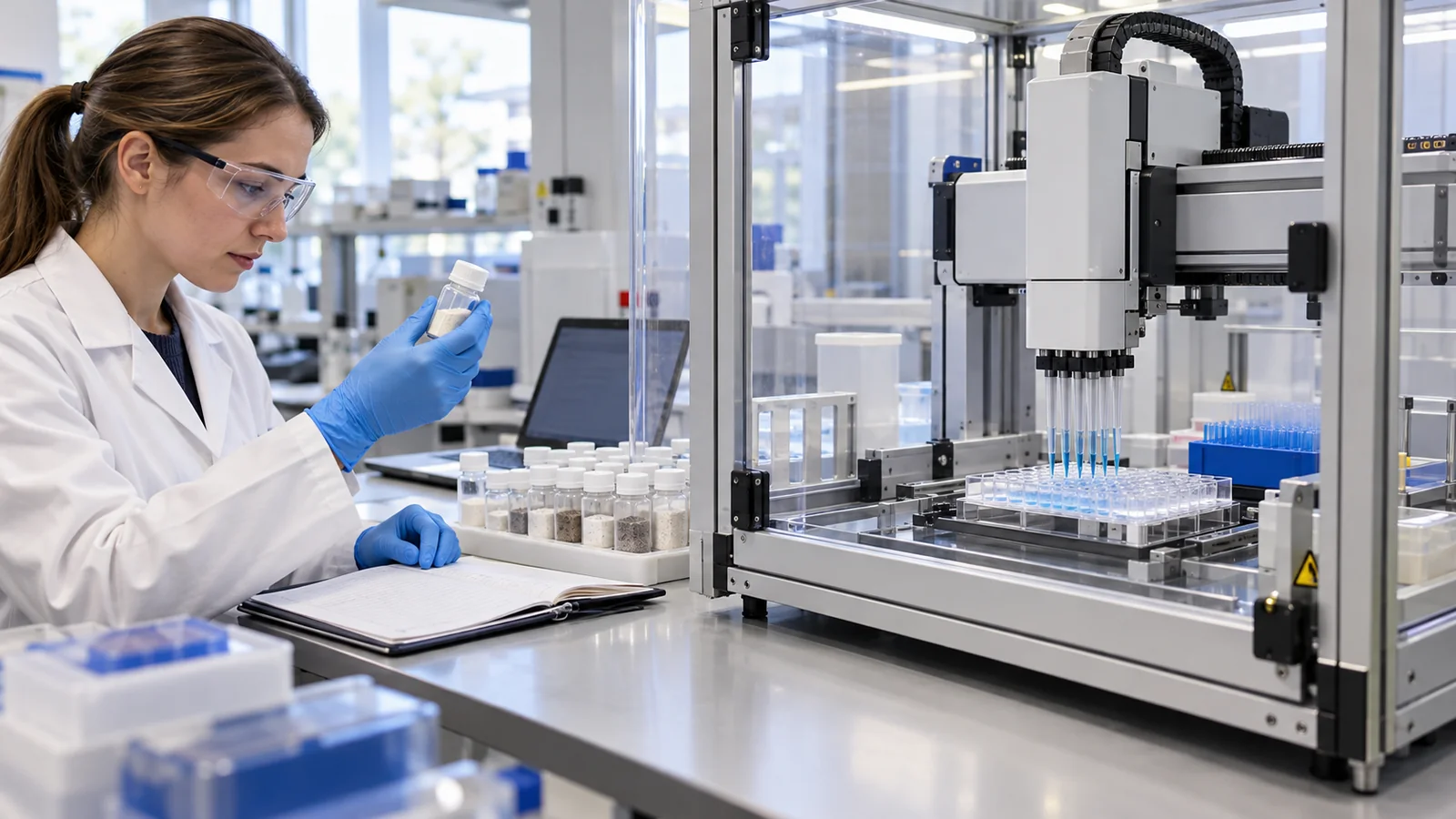
Since automating solids is hardSourced[Ref. 6], first ask whether some part of your process can be made liquid (precursor solutions, inks, pastes). That Buitrago Santanilla et al. remade the reaction into automation-friendly conditions is an example of this thinkingSourced[Ref. 7]. But going liquid changes the process and conditions of the final product, so check separately whether a finding holds in the real process (Chapter 8).
High-throughput experiments produce much data, but their value is lost if it becomes unclear which sample was made under which conditions. Ludwig states that experimental and analysed data should be transferred to a database together with metadataSourced[Ref. 4]. In your own lab keep (1) precursor lots and storage, (2) equipment settings and calibration dates, (3) positions on the plate, (4) measurement settings and (5) failed samples and the reasons, tied to the sample number. The FAIR principles[Ref. 16] help organize this (see the explainer on materials databases and FAIR).
10. Limits, what could not be confirmed, and a summary
(1) What could not be confirmed
- The statements of Shevlin and Buitrago Santanilla et al. come from experience with parallel experiments in pharmaceutical and organic chemistry and need not apply as they are to inorganic powders or materials experiments.
- The review by Green et al. (on the Materials Genome Initiative and high-throughput experiments) could not be read at abstract level and its content is not described here.
- The content of Xiang et al. and Koinuma and Takeuchi was checked at the level of abstracts; details in the main text (such as numbers of samples) were not checked.
- The corrected numbers of the A-Lab and the critique and re-evaluation are covered in the explainer on self-driving laboratories and are not repeated here.
- Cases of high-throughput experiments and robotic synthesis in Japan are not covered.
- An international standard specific to high-throughput experiments was not found. The microplate dimension standards (ANSI/SLAS) were confirmed on the official page up to their 2017 reaffirmation, and their later status was not confirmed. ISO/IEC texts are paid, so only the title was checked.
- High-throughput experimentation makes and measures many samples in parallel, small and automatic. All combinations reach millions, so both parallelization and methods for narrowing where to look are neededOur calculation
- Three approaches: thin films of continuously varying composition (an example with 10,000 sites per square inch), liquids in plates (over 1,500 in under a day) and robots handling powders (353 experiments in 17 days)Sourced
- Liquids are easy to automate; solids and powders are hard. In some cases the conditions were changed to suit automationSourced
- Speed is set by the long step and by measurement. Theoretical and demonstrated values differ (for example by a factor of 12), and a property found in a film must be re-checked in bulkSourcedOur calculation
- In your own lab screen with surrogate metrics and run the final evaluation only on narrowed candidates, put controls and repeats at several positions, and record conditions, lots and measurement settings (commentary)
11. How to read the yardsticks and standards
The yardsticks of high-throughput experiments are not only speed (throughput). Volk and Abolhasani list the performance to report as degree of autonomy, operational lifetime, throughput, experimental precision, material usage, accessible parameter space and optimization efficiencySourced[Ref. 11]. Of these, the most important for high-throughput experiments are throughput (theoretical and demonstrated), experimental precision (scatter of replicates of one condition) and material usage. Checked on 22 October 2026.
| What is assessed | Representative benchmark or method (name, source) | Standards and guidance (ISO/IEC, open standards) | How to read it |
|---|---|---|---|
| Throughput | Report both theoretical and demonstrated values (Volk and Abolhasani); for example 1,200 per hour (theory) and about 100 per hour (demonstrated)[Ref. 11]Sourced | Not found (no international standard specific to high-throughput experiments was found) | If what one experiment involves differs, a larger count does not rank platforms |
| Experimental precision | The standard deviation of replicates of one condition (Volk and Abolhasani)[Ref. 11]Sourced | ISO/IEC 17025:2017 (general requirements for the competence of testing and calibration laboratories)[Ref. 17]Sourced | 17025 is not a standard for high-throughput experiments; it is a reference for thinking about measurement uncertainty and records (commentary). The text is paid, so only the title was checked |
| Material usage and safety | Report total usage and the amount of hazardous substances (Volk and Abolhasani); an example of as little as 0.02 mg per reaction (Buitrago Santanilla et al.)[Ref. 11, 7]Sourced | Not found | The smaller the amount, the more inhomogeneity and measurement scatter affect results |
| Correspondence between film and bulk | Distinguishing intrinsic from extrinsic properties and confirming in bulk (Ludwig)[Ref. 4]Sourced | Not found | A result in a film is a candidate; re-check in bulk or in parts |
| Compatibility of labware and equipment | Not found | ANSI/SLAS microplate standards: 1-2004 (R2012) footprint dimensions, 2-2004 (R2012) height dimensions, 3-2004 (R2012) bottom outside flange dimensions, 4-2004 (R2012) well positions and 6-2012 well bottom elevation[Ref. 13]; SiLA 2[Ref. 14] and OPC 30500-1 LADS[Ref. 15]Sourced | These fix dimensions and communication and are not criteria for correctness of results. The SLAS standards are stated as reaffirmed in 2017 (their later status was not confirmed) |
| Data | Not found | FAIR Guiding Principles (2016)[Ref. 16]Sourced | Principles without legal force; they presuppose metadata on conditions, lots and positions |
The arrangement of the table is Our calculation (organization). Numbers, titles and status checked on the ISO, SLAS, SiLA and OPC Foundation pages (22 October 2026). The two pages checked for LADS gave different version information, so the version is not stated. Standard texts are paid, so only titles and scope are described and requirements are not.
Reading notes (for materials engineers)
- "So many a day" is not a ranking: what one experiment involves differs (just mixing liquids or heating powders). Distinguish theoretical from demonstrated values as well
- Separate candidates from confirmation for use: results in thin films or at small scale are candidates; confirmation in bulk or in parts is a separate stage
- Separate dimensions and communication conventions from requirements and principles: the SLAS standards fix dimensions, SiLA 2 and LADS communication, ISO/IEC 17025 laboratory competence and FAIR is a set of principles. None guarantees that high-throughput results are correct
12. Glossary
- High-throughput experimentation (HTE)
- Experiments that try many samples or conditions in parallel, small and automatic.
- Combinatorial
- The idea of trying combinations of components or conditions systematically and exhaustively.
- Materials library
- A set of many samples with varied composition or conditions arrayed on one substrate or plate.
- Composition spread (gradient)
- Composition varying continuously across a substrate.
- Co-deposition (co-sputtering)
- Depositing from several sources at once to make a film in which atoms are mixed.
- Phase diagram
- A diagram showing which phase is stable for given composition, temperature and so on.
- Plate (microplate)
- A container with small wells in a grid, such as a 96-well plate.
- Dispensing
- Measuring out fixed amounts of liquid or powder and placing them.
- Stock solution
- A concentrated solution prepared in advance and then diluted or measured out for use.
- Slurry
- A thick mixture of powder dispersed in liquid.
- Throughput
- The number of experiments or measurements handled per unit time.
- Rate-limiting step
- The slowest step, which sets the speed of the whole.
- Non-destructive measurement
- Measuring without destroying the sample, so that the same sample can be measured again.
- Surrogate metric
- Using a quickly measurable quantity in place of the one you really want.
- Intrinsic / extrinsic properties
- Properties set by composition and crystal structure / properties depending on microstructure and shape.
- Bulk
- Material in lump form rather than a thin film.
- Arc melting
- Melting metals with an electric arc to make an alloy lump.
- Control
- A sample of known conditions or material used as the reference for comparison.
- Metadata
- Accompanying information describing the conditions, origin and settings of data.
- Mobile robot
- A robot that moves around the lab and uses the same equipment as people.
- ANSI/SLAS microplate standards
- Standards fixing dimensions of microplates, such as footprint and well positions.
- SiLA 2
- An open communication standard for controlling lab equipment from machines.
- FAIR principles
- Principles for making data findable, accessible, interoperable and reusable.
13. References
- Xiang X.-D. et al. "A Combinatorial Approach to Materials Discovery", Science 268, 1738–1740 (1995), DOI 10.1126/science.268.5218.1738 — doi.org/10.1126/science.268.5218.1738
- Koinuma H., Takeuchi I. "Combinatorial solid-state chemistry of inorganic materials", Nat. Mater. 3, 429–438 (2004), DOI 10.1038/nmat1157 — doi.org/10.1038/nmat1157
- Potyrailo R. et al. "Combinatorial and High-Throughput Screening of Materials Libraries: Review of State of the Art", ACS Comb. Sci. 13, 579–633 (2011), DOI 10.1021/co200007w — doi.org/10.1021/co200007w
- Ludwig A. "Discovery of new materials using combinatorial synthesis and high-throughput characterization of thin-film materials libraries combined with computational methods", npj Comput. Mater. 5, 70 (2019), DOI 10.1038/s41524-019-0205-0 — doi.org/10.1038/s41524-019-0205-0
- Stein H. S., Gregoire J. M. "Progress and prospects for accelerating materials science with automated and autonomous workflows", Chem. Sci. 10, 9640–9649 (2019), DOI 10.1039/C9SC03766G — doi.org/10.1039/C9SC03766G
- Shevlin M. "Practical High-Throughput Experimentation for Chemists", ACS Med. Chem. Lett. 8, 601–607 (2017), DOI 10.1021/acsmedchemlett.7b00165 — doi.org/10.1021/acsmedchemlett.7b00165
- Buitrago Santanilla A. et al. "Nanomole-scale high-throughput chemistry for the synthesis of complex molecules", Science 347, 49–53 (2015), DOI 10.1126/science.1259203 — doi.org/10.1126/science.1259203
- Szymanski N. J. et al. "An autonomous laboratory for the accelerated synthesis of inorganic materials", Nature 624, 86–91 (2023), DOI 10.1038/s41586-023-06734-w (version reflecting the January 2026 correction) — doi.org/10.1038/s41586-023-06734-w
- Dai T. et al. "Autonomous mobile robots for exploratory synthetic chemistry", Nature 635, 890–897 (2024), DOI 10.1038/s41586-024-08173-7 — doi.org/10.1038/s41586-024-08173-7
- MacLeod B. P. et al. "Self-driving laboratory for accelerated discovery of thin-film materials", Sci. Adv. 6, eaaz8867 (2020), DOI 10.1126/sciadv.aaz8867 — doi.org/10.1126/sciadv.aaz8867
- Volk A. A., Abolhasani M. "Performance metrics to unleash the power of self-driving labs in chemistry and materials science", Nat. Commun. 15, 1378 (2024), DOI 10.1038/s41467-024-45569-5 — doi.org/10.1038/s41467-024-45569-5
- Tom G. et al. "Self-Driving Laboratories for Chemistry and Materials Science", Chem. Rev. 124, 9633–9732 (2024), DOI 10.1021/acs.chemrev.4c00055 — doi.org/10.1021/acs.chemrev.4c00055
- SLAS "ANSI/SLAS Microplate Standards" (official page, checked 22 October 2026) — slas.org/education/ansi-slas-microplate-standards/
- SiLA Consortium "SiLA 2 standard" (official page, checked 22 October 2026) — sila-standard.com/standards/
- OPC Foundation "Laboratory and Analytical Devices (LADS)" working-group page (specification OPC 30500-1) — opcfoundation.org/about/working-groups/view/12
- Wilkinson M. D. et al. "The FAIR Guiding Principles for scientific data management and stewardship", Sci. Data 3, 160018 (2016), DOI 10.1038/sdata.2016.18 — doi.org/10.1038/sdata.2016.18
- ISO/IEC "ISO/IEC 17025:2017 General requirements for the competence of testing and calibration laboratories" (ISO page) — iso.org/standard/66912.html
14. Claim-to-source audit
| Claim in the text | Basis | Class |
|---|---|---|
| Xiang et al.: parallel synthesis of libraries of solid materials by thin-film deposition and masking, combinations of BaCO3, Bi2O3, CaO, CuO, PbO, SrCO3 and Y2O3, samples of 200 µm × 200 µm, 10,000 sites per square inch, identification of BiSrCaCuO and YBaCuO superconducting films | Reference 1 https://doi.org/10.1126/science.268.5218.1738 | Sourced |
| Koinuma and Takeuchi: the combinatorial approach was pioneered in the pharmaceutical industry and adapted to materials science, and thousands of compositions can be examined in one experiment. Potyrailo et al.: rational design becomes limited as materials grow complex, and combinatorial and high-throughput experiments have come to be recognized as a way to generate new knowledge | Reference 2 https://doi.org/10.1038/nmat1157 Reference 3 https://doi.org/10.1021/co200007w | Sourced |
| Ludwig: thin-film libraries (composition gradients by co-deposition or wedge-type multilayers, thickness of several hundred nm), micro-focus X-ray diffraction (under 1 mm), transfer to a database with metadata, the Co-Ti-W mu-phase, thousands of candidates by calculation then 10 to 100 composition-spread libraries, intrinsic versus extrinsic properties (different in film and bulk), the Ti-Ni-Cu-Pd example (cost, one experiment, transfer to bulk), Ti-Ni-Cu applicable only as a thin film, the proposal to re-measure in different labs | Reference 4 https://doi.org/10.1038/s41524-019-0205-0 | Sourced |
| Shevlin: 100 µL, 96-well plates and 10 µmol per well, liquids fast and accurate, homogeneous suspensions and slurries dispensable, immiscible liquids not transferring well, no general automated solution for solids, insufficient magnetic field for stirring in 96-well plates, capital investment and training for liquid-handling robots, evaporative solvent loss with volatile solvents | Reference 6 https://doi.org/10.1021/acsmedchemlett.7b00165 | Sourced |
| Buitrago Santanilla et al.: difficulty of automating and miniaturizing with solids and volatile solvents, automation-friendly reactions (DMSO, room temperature), over 1,500 experiments in under a day, as little as 0.02 mg per reaction | Reference 7 https://doi.org/10.1126/science.1259203 | Sourced |
| A-Lab: 17 days and 353 experiments, four box furnaces, 4 h hold, differences between powders, automatic balance and mixing with ethanol and zirconia balls, hand loading of precursor powders (50-100 g bottles) and consumables, cleaning of X-ray sample holders, handling of hardware exceptions | Reference 8 https://doi.org/10.1038/s41586-023-06734-w | Sourced |
| Dai et al.: mobile robots, Chemspeed synthesis platform, liquid chromatography-mass spectrometer and benchtop NMR, existing equipment shared with people, almost four consecutive days with human intervention limited to restocking and consumables. Ada: 35 samples in under 30 hours including restocking, one failed sample (a typical failure rate), the pseudomobility | Reference 9 https://doi.org/10.1038/s41586-024-08173-7 Reference 10 https://doi.org/10.1126/sciadv.aaz8867 | Sourced |
| Volk and Abolhasani: throughput depends on reaction time, parallelization and measurement speed, non-destructive measurement, reporting both theoretical and demonstrated values, 1,200 per hour (theory) and about 100 per hour (demonstrated), material usage (hazardous amounts, cost, environment), experimental precision (standard deviation of replicates), seven performance metrics. Stein and Gregoire: a framework for the lifecycle of a materials experiment and levels of automation. Tom et al.: a review of SDLs | Reference 11 https://doi.org/10.1038/s41467-024-45569-5 Reference 5 https://doi.org/10.1039/C9SC03766G Reference 12 https://doi.org/10.1021/acs.chemrev.4c00055 | Sourced |
| Numbers and titles of ANSI/SLAS microplate standards 1-2004 (R2012), 2-2004 (R2012), 3-2004 (R2012), 4-2004 (R2012) and 6-2012, stated as reaffirmed in June 2017. SiLA 2: an open communication standard for lab equipment. OPC 30500-1 LADS: an OPC UA information model for lab and analytical devices. The FAIR Guiding Principles (2016). Title and status of ISO/IEC 17025:2017 | Reference 13 https://www.slas.org/education/ansi-slas-microplate-standards/ Reference 14 https://sila-standard.com/standards/ Reference 15 https://opcfoundation.org/about/working-groups/view/12 Reference 16 https://doi.org/10.1038/sdata.2016.18 Reference 17 https://www.iso.org/standard/66912.html | Sourced |
| 3 to the tenth is 59,049; 59,049 / 24 / 365 ≈ 6.7 years; 2 to the tenth is 1,024; 5 to the tenth is 9,765,625. Grid points for three components (66 at 10% steps, 231 at 5%, 5,151 at 1%) and four components (286 and 1,771). 25.4 mm / 100 ≈ 0.25 mm. 1,200 / 100 = 12 | Our calculation (Python) | Our calculation |
| The content of the review by Green et al., details in the main text of Xiang et al. and Koinuma et al., cases in Japan, the status of the ANSI/SLAS standards after 2017, an international standard specific to high-throughput experiments | Not confirmed in the primary sources reachable in this survey, so not stated | Commentary |
| The readings "conditions are changed to suit the robot", "first ask whether it can be made liquid", "screen with surrogate metrics and run the final evaluation only on narrowed candidates", "put controls and repeats at several positions", "tie conditions, lots and measurement settings to the sample number" and "a thin film is a tool for narrowing candidates" | Our own arrangement and commentary based on published material; not a view stated by the researchers or institutions | Commentary |
| Figs. 2 and 6 include calculations; Figs. 3, 4, 5, 7 and 8 are conceptual diagrams; Figs. 1 and 9 are slots for AI-generated images; the colours and grids in Fig. 4 and the bar lengths in Figs. 5 and 8 are illustrative | Note by this article | Commentary |
Last updated: 22 October 2026. Sources are limited to primary material (peer-reviewed papers and official pages of standards bodies). Worked numbers are our own calculations, not results of actual experiments. The content of the review by Green et al., details in the main text of Xiang et al. and Koinuma et al., cases in Japan, the status of the ANSI/SLAS standards after 2017 and an international standard specific to high-throughput experiments could not be confirmed and are not stated. Figs. 1 and 9 are slots for AI-generated images; the other figures are explanatory diagrams or figures including calculations.