TECHNOLOGY EXPLAINER
Generative AI for Materials Design
What exactly does "N thousand new materials discovered" count?
The technology behind image-making AI has started to be used to "make" crystals and molecules: the hope is to specify the desired properties and directly generate plausible candidate materials. Microsoft's MatterGen and Google DeepMind's GNoME are the best known. This article explains how diffusion models and similar methods generate crystals, how generated crystals are evaluated, and what "N thousand new materials" counts. It keeps computational predictions apart from the number confirmed by experiment, and where criticism or re-evaluation exists (the A-Lab and the MatterGen synthesis example), it sets both sides next to each other neutrally, within what papers, corrections and peer-reviewed articles let us confirm.
- The short version, what to know first, and where this fits in the series
- What "generation" means: making rather than searching
- How diffusion models make crystals, and the main generative models
- How to evaluate generated crystals
- The MatterGen example: from generation to synthesis
- The GNoME example: what do "2.2 million", "381,000" and "736" count?
- Criticism and re-evaluation: both sides together
- A materials engineer's view
- Limits, what we could not confirm, and a summary
- How to read the yardsticks and standards
- Glossary
- References
- Claim-to-source audit
Sourced = stated in a published source (linked)
Our calculation = a value computed in this article from the stated assumptions
Not yet confirmed = plans, targets, drafts, work in progress, outlooks: not settled
Our own reading for materials engineers is marked as commentary. Inference is shown in bold. Announcements by companies and research groups are labelled as the authors' claims or reports.
1. The short version, what to know first, and where this fits in the series
- A generative model learns a distribution from data on known materials and makes new candidates. The MatterGen paper says its diffusion model is more than twice as likely as earlier generative models to produce new and stable structures. What was confirmed by synthesis in the lab was one of four candidates, and what was made was compositionally disordered TaCr₂O₆ Sourced[Ref. 1]
- "N thousand new materials discovered" is a count of computational predictions. GNoME reports 2.2 million crystals that DFT put as stable against existing data, and 381,000 "newly discovered" on the updated hull. The number confirmed by experiment is separate: 736 matched experimental ICSD structures Sourced[Refs. 5, 6]
- There is criticism and re-evaluation. The A-Lab (a study that synthesized candidates from GNoME and others automatically) had the meaning of "novel" and its counts revised in an author correction in January 2026. A peer-reviewed paper also argues that the MatterGen synthesis example is "not new". This article sets both sides next to each other and does not judge who wins Sourced[Refs. 9, 11]
The prerequisites are the indicator of "stable" for materials (the height above the energy convex hull, E_hull) and the difference between "stable" and "can be made" (see our explainer on crystal structure prediction and stability). Machine learning is "an approximator that learns trends from past data", and it is weak outside the range of the data (extrapolation). This article is readable on its own.
The ideas shared across this series: searching for materials is looking for buried treasure on a vast map; computation "proposes candidates quickly and cheaply", experiment "checks whether it is really so", and AI "narrows where to look". The forward problem is predicting "material → property"; the inverse problem is proposing "desired property → material". Generative models take on the inverse problem.
We suggest reading it after our explainers on crystal structure prediction and stability and on machine-learning interatomic potentials. Checking generated candidates by experiment continues in our explainers on self-driving laboratories and on closed-loop optimization, and evaluating the results in our explainer on reading the evaluation and reproducibility of MI results.
2. What "generation" means: making rather than searching
Earlier search was a method of choosing good ones from among candidates that already exist (screening). The MatterGen paper says screening is limited by the number of known materials, and that even the largest explorations of previously unknown crystals are of the order of 10⁶ to 10⁷, a small fraction of the potentially stable inorganic compounds. For example, considering only combinations of composition, there are said to be about 10¹⁰ quaternary compounds (Davies et al., 2016) Sourced[Refs. 1, 2, 18].
A generative model learns a distribution of "what is plausible" from data on known materials and makes new candidates directly from it. It can also be told a desired property (for example, bulk modulus) and make ones that fit (called inverse design). Gómez-Bombarelli et al. (2018) showed a method that converts molecules into continuous vectors of numbers and operates on those vectors to make new molecules (a variational autoencoder) Sourced[Ref. 17]. For crystals, the same idea has been tried with diffusion models and with language models.
That is inaccurate. What a generative model makes is candidate structures that resemble the training data. Whether they are stable, can be made, or have the target property must be checked by calculations such as DFT and by synthesis and measurement. The MatterGen paper also uses DFT to evaluate the structures it generates and keeps synthesis to one example as a "proof of concept" [Ref. 1]. AI narrows "where to look"; people and experiments do the checking (commentary).
3. How diffusion models make crystals, and the main generative models
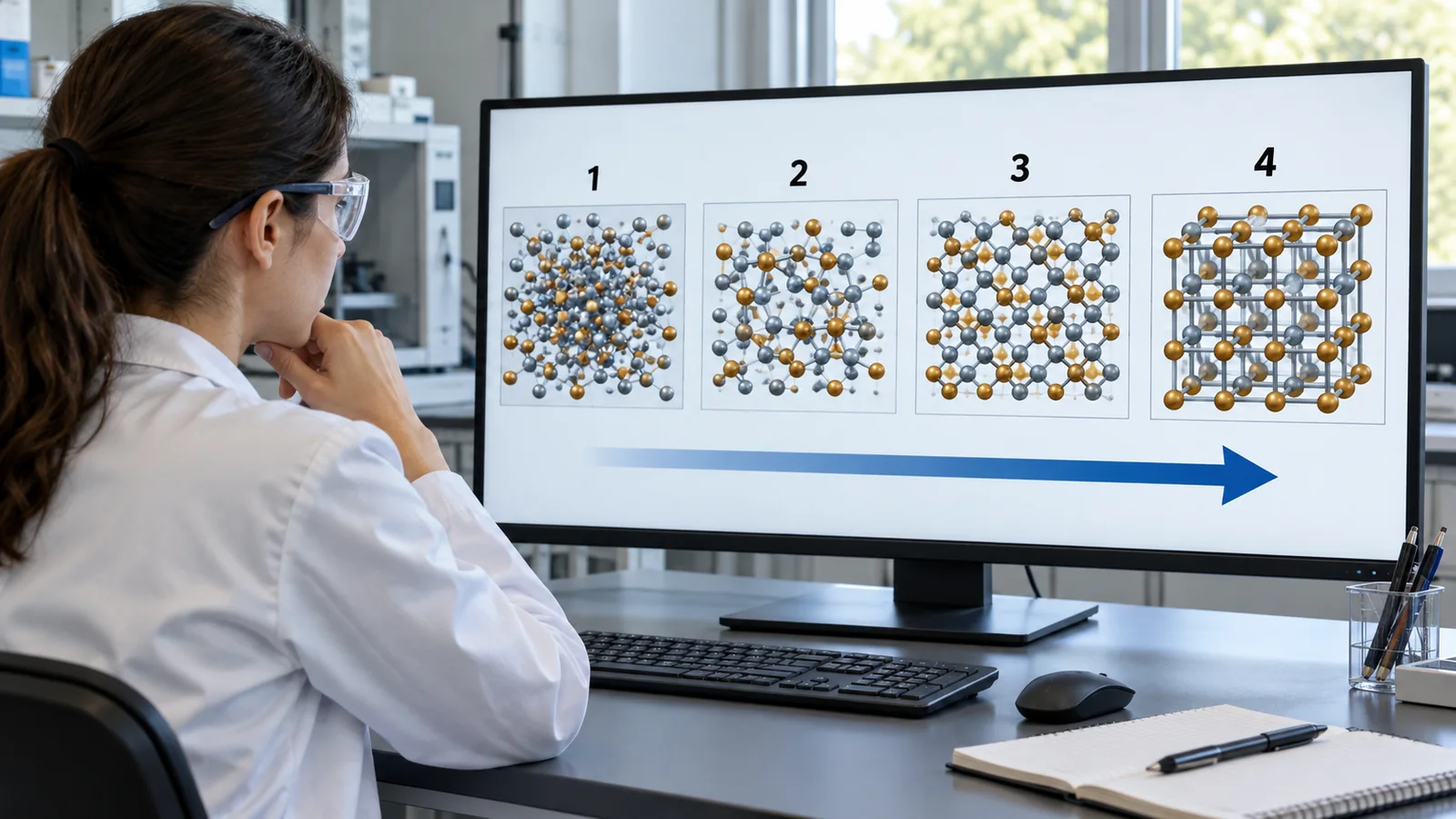
The method now widely used for generating crystals is the diffusion model: the method known from image generation (Ho et al., 2020) Sourced[Ref. 13] adapted to crystals. The idea is to break something, then follow the reverse.
View original SVG, values and sources
Original SVG reference: Concept diagram (vector drawing). The idea of a diffusion model. Adding noise to the atomic positions of a crystal (1) breaks it down through 2, 3 and 4 until it is nearly random. Generation follows this in reverse. The four panels at the top are a simple two-dimensional example made by our own calculation.
- Breaking (forward): add noise to the atomic positions of a crystal little by little until only randomness remains. A crystal is a periodically repeating structure, so coordinates are wrapped at the periodic boundary. Elements are replaced by "unknown"
- Making (reverse): a trained network indicates "the direction that removes a little noise" and, starting from randomness, brings the state step by step toward a crystal
- What MatterGen adds: it corrupts three things, atom types, coordinates and the periodic lattice, each with noise suited to it, and follows the reverse. The network is built to be equivariant to rotation and translation, so symmetries need not be learned from data. Adapters (small adjustment parts plugged into an existing model) let it generate for a specified composition, symmetry or property, and classifier-free guidance steers it toward the target. It was trained on 607,683 stable structures with up to 20 atoms (Alex-MP-20), made from the Materials Project and Alexandria Sourced[Ref. 1]
| Approach (example) | Idea | What the paper says (the authors' report) | Reading note |
|---|---|---|---|
| Variational-autoencoder type (CDVAE, Xie et al.) | Compress a crystal into a latent vector, and generate by a diffusion process that moves atoms toward lower energy | Outperforms past methods in three tasks: reconstructing the input structure, generating valid and diverse materials, and generating materials that optimise a property [Ref. 14] Sourced | Treats the periodicity and symmetry of crystals explicitly. The evaluation is within the paper's setup |
| Diffusion model (DiffCSP, Jiao et al.) | Generate lattice and atomic coordinates jointly with a periodic equivariant network, using fractional coordinates | On crystal structure prediction (where the composition is given), significantly outperforms existing methods at a much lower computational cost than DFT-based methods [Ref. 15] Sourced | A task in which the composition is given and the structure is made. Also extended to settings where the composition is generated |
| Diffusion model (MatterGen) | Generate atom types, coordinates and lattice together. Conditioning by adapters | More than twice as likely as earlier generative models to produce new and stable structures, and more than ten times closer to the local energy minimum [Ref. 1] Sourced | Targets inorganic crystals with up to 20 atoms (the model card lists more than 20 atoms, organic crystals and non-crystalline materials as out of scope) [Ref. 4] |
| Language model (Gruver et al.) | Represent crystals as text and fine-tune a large language model to generate | The strongest model (fine-tuned LLaMA-2 70B) generates materials predicted to be metastable at about twice the rate of CDVAE (49% vs 28%) [Ref. 16] Sourced | Evaluated with energies from learned MLIPs and DFT. We do not assert which model is better, as conditions differ |
| Molecules (Gómez-Bombarelli et al.) | Convert molecules into continuous vectors, operate on them and convert back | Demonstrated on drug-like molecules and on molecules with fewer than nine heavy atoms [Ref. 17] Sourced | Molecules, not crystals. Introduced here as an example of the idea |
The numbers for the models cannot be lined up to decide which is better, because the data, the evaluation setups and the references differ. CDVAE, DiffCSP and Gruver et al. are as described on arXiv (conference papers); we did not check differences from the published versions.
4. How to evaluate generated crystals
It is not enough for generated structures to "look plausible". The MatterGen paper evaluates them with the criterion of being stable, unique and new (SUN).
- The criterion for stable is loose: "stable" in the MatterGen paper means that the energy after DFT relaxation is within 0.1 eV/atom above the hull of the reference data. Checking 1,024 structures with DFT, 78% were within 0.1 eV/atom against the MP hull, and 13% were at or below 0; against the Alex-MP-ICSD hull, 75% were within and 3% were at or below 0 Sourced[Ref. 1]. As in our explainer on crystal structure prediction and stability, even observed crystals have a median height above the hull of 15 meV/atom and a 90th percentile of 67 meV/atom, so 0.1 eV (100 meV) is a lenient criterion [Ref. 21] (commentary)
- Closeness to the local minimum: for 95% of the generated structures, the deviation (RMSD) from the DFT-relaxed structure was below 0.076 Å Sourced[Ref. 1]
- Uniqueness and novelty: the share of unique structures is 100% at 1,000 generated and falls to 52% at 10 million. The share of new structures is 61%. MatterGen also reports that it rediscovered more than 2,000 experimentally verified ICSD structures not seen in training Sourced[Ref. 1]
- Comparison with earlier generative models: trained on the same small data, MatterGen-MP gives 60% more SUN structures than CDVAE and DiffCSP, with 50% smaller deviation after relaxation. With the larger data, MatterGen gives a further 70% more SUN and a five-fold smaller deviation, the paper says Sourced[Ref. 1]
- Efficiency of search: the paper says that in quinary systems MatterGen reached a strong result with about 10,000 generated samples, against about 70,000 for substitution and about 600,000 for random structure search (RSS). The same paper also says that for ternary and quaternary systems substitution is comparable or more efficient Sourced[Ref. 1]
- Design with a specified property: aiming at a bulk modulus of 400 GPa, with a budget of 180 DFT property calculations, MatterGen found 106 SUN structures (95 compositions) and screening of existing data found 40 (28 compositions). These properties are DFT-computed values Sourced[Ref. 1]
"New" is decided by what the structure was compared with. In the MatterGen paper, "new" means matching none of the structures in a reference set extended with 117,652 disordered ICSD structures [Ref. 1]. A known material that is not in the reference data is judged "new". The author correction of the A-Lab also says that "novel" was meant as "new to the prediction platform", not necessarily new to science [Ref. 9]. When something is called "new", check what it was compared with (commentary).
Evaluation frameworks are also taking shape. LeMat-GenBench (preprint, December 2025) evaluates 12 generative models of crystals on unified metrics and reports that as stability rises, novelty and diversity fall on average, and no model excels in every dimension Sourced[Ref. 20]. And the official MatterGen repository, noting that its bundled evaluation code uses MatterSim, advises confirming with DFT, because results can differ from the DFT evaluation in the paper [Ref. 3].
5. The MatterGen example: from generation to synthesis
The MatterGen paper actually synthesized a generated material and measured its property, as a "proof of concept". Let us follow the numbers.
- Generation and narrowing: for each of four bulk-modulus targets (50, 100, 150, 200 GPa), 8,192 structures were generated and narrowed by novelty and uniqueness, stability by MatterSim and DFT, phonon stability by MatterSim, and containing oxygen, down to 75. From these, experts selected four and synthesis was tried. One of the four was successfully made Sourced[Ref. 1]
- The substance made: Rietveld analysis (a method of refining a crystal structure from X-ray diffraction data) shows the substance was TaCr₂O₆, a compositionally disordered version of the ordered structure MatterGen predicted. For a target of 200 GPa, the DFT value of the ordered structure was 222 GPa, and the experimental value, converted from the Young's modulus by nanoindentation, was up to 169 GPa over four measurements (158±11 GPa). The powder sample is likely not compact, and the maximum was taken as the best estimate Sourced[Ref. 1]
- Our reading: 169 is about 15.5% below 200 Our calculation. The paper says "within 20% of our target". That what was made was a disordered version, not the predicted ordered structure itself, is central to the discussion in chapter 7
6. The GNoME example: what do "2.2 million", "381,000" and "736" count?
GNoME of Merchant et al. (2023) searched for stable crystals with graph networks trained at scale. We read the reported numbers by what each counts.
- 2.2 million: the number of crystal structures the GNoME models found stable with respect to the Materials Project (below its hull). It is a calculation (DFT) result Sourced[Refs. 5, 6]
- 381,000: of these, the number of "newly discovered" stable materials that lie on the updated convex hull. On top of about 48,000 earlier stable crystals, there are about 421,000 stable crystals in total. It is a calculation result Sourced[Ref. 6]
- 736: the number of experimental structures aggregated in the ICSD that match structures GNoME had (earlier) found. GNoME's candidates derive from database snapshots of March 2021, and crystals that researchers made in experiments afterwards served as a check. This is a match to experimentally reported structures, and it is the number that bears on experiment Sourced[Ref. 6]
- Accuracy of prediction: the authors say the final models predict energies to 11 meV/atom, and that the precision of stable predictions (hit rate) improved to above 80% with structure and 33% per 100 trials with composition only, from 1% in previous work Sourced[Ref. 6]
- Cautions the paper itself states: GNoME materials could be bumped off the hull by future discoveries, and GNoME displaces at least 5,000 materials that were "stable" in MP and OQMD Sourced[Ref. 6]. "Stable" is a judgement relative to the data of the time
- Handling of the data: the GNoME data are under CC BY-NC 4.0 (non-commercial) and the code under Apache-2.0. The official notice says the data are for theoretical modelling only and to be used with caution Sourced[Ref. 7]. Check the license text on whether commercial use is allowed (this article is not legal advice)
No. The 381,000 is the number of structures that DFT calculation put on the updated hull. The independent confirmation bearing on experiment (a match with experimental ICSD structures) is 736, a different order of magnitude. And the 736 is not necessarily a subset of the 381,000; it is a match against a wider set of structures GNoME produced (within the range of the paper's description). Do not divide numbers that count different things to make a "success rate" (commentary).
7. Criticism and re-evaluation: both sides together
In this field, claims and the later checks proceed at the same pace. This chapter sets out neutrally what papers, corrections and peer-reviewed articles let us confirm. We do not judge who is right.
The A-Lab and GNoME candidates
- The claim: Szymanski et al. (2023) synthesized, in the autonomous laboratory A-Lab over 17 days of continuous operation, targets chosen from GNoME and Materials Project computational data, and reported 41 novel compounds from 58 targets Sourced[Ref. 8]
- The criticism (Leeman et al., 2024): they examined 43 products, pointed out four common shortfalls in the analysis, and concluded that no new materials had been discovered in that work. Their reasons: predictions tend to ignore "disorder", in which elements share crystallographic sites, and two thirds of the claimed successes are likely known compositionally disordered versions of the predicted ordered compounds. They also say automated Rietveld analysis of powder X-ray diffraction is not yet reliable Sourced[Ref. 10]
- The author correction (19 January 2026): Nature published an author correction. It says the claims of novelty were subject to misinterpretation: the intention was that the materials were new to the prediction platform, not necessarily new to science. It also says the diffraction patterns were manually re-analysed and that the prediction platform came to the correct conclusion in 36 of its 40 reported successes, with 4 inconclusive from XRD alone (excluded from the success count), and that one compound mistakenly included in the training data was removed from the discussion. The re-analysis is said to have been peer-reviewed post-publication. The abstract now reads 36 compounds from 57 targets Sourced[Refs. 9, 8]
- A perspective: Cheetham and Seshadri (2024) wrote a perspective on the GNoME article with a title posed as a question ("Artificial Intelligence Driving Materials Discovery?"). We could not check the full text, so we do not go into its content [Ref. 12]
The MatterGen synthesis example
- The claim: as in chapter 5, what was made was compositionally disordered TaCr₂O₆ (corresponding to Ta₁/₃Cr₂/₃O₂), a disordered version of the ordered structure MatterGen predicted. The paper presents this as a "proof of concept" Sourced[Ref. 1]
- The criticism (Juelsholt, 2026): in a peer-reviewed paper (Materials Horizons), the author argues from crystallographic analysis that this is not a novel compound but identical to Ta₁/₂Cr₁/₂O₂ reported in 1971 and included in MatterGen's training data. The paper states that misclassifying known disordered phases as new ordered compounds is a persistent challenge for these tools and that rigorous human verification is needed Sourced[Ref. 11]
- The response: we did not find a response by the MatterGen authors to this claim within what we checked. The MatterGen paper itself, however, states clearly that the substance made was a disordered version [Ref. 1]
- Where both sides agree: (1) The treatment of disorder (elements sharing sites) is a challenge for prediction. The MatterGen paper (appendix of the arXiv version) also acknowledges that a disordered material has several ordered approximations that represent the same composition, and that novelty and the height above the hull may then not be assessed correctly Sourced[Ref. 2]. (2) Crystallographic verification by people is needed. (3) Confirmation of synthesis depends on the analysis of diffraction data (the A-Lab correction excludes four that are inconclusive)
- Where opinions differ: whether that study can be said to have "discovered new materials" (Leeman et al.: no; the A-Lab correction: "novel" was meant relative to the prediction platform). Whether the MatterGen synthesis example is "new" (Juelsholt: known and in the training data; the MatterGen paper: a proof of concept). A different definition of "new" seems to be one cause of the mismatch (inference)
When two or more elements enter a site in a crystal at random, this is called disorder (a solid solution). A structure made by calculation is usually an "ordered arrangement" in which each site has a fixed element. But real samples may be disordered; the symmetry deduced from diffraction is then higher, and the material can be "a known alloy or solid solution". A "new ordered arrangement" from calculation may turn out in experiment to be "a known disordered substance" (as pointed out by Leeman et al. and Juelsholt).
8. A materials engineer's view
Generated candidates are a tool for increasing the candidates you try in experiments. In the MatterGen synthesis, 8,192 × 4 generated structures became 75 after filtering, 4 after expert inspection and 1 successful synthesis [Ref. 1]. Translated to your own company, that "expert inspection" is a step that narrows candidates by raw materials and equipment, competing phases, toxicity and supply risk, and cost. It matters especially to include a crystallography expert (someone who can read X-ray diffraction) in the judgement (commentary).
Before you say, after synthesis and X-ray diffraction, that "it matches the predicted structure", always consider whether it is a disordered version (a higher-symmetry structure with shared sites) or a known alloy or solid solution. Fit the diffraction data with both an ordered model and a disordered model and compare, and check against databases of known phases (such as the ICSD). Add controls (making a known related phase under the same conditions) and a check of lot-to-lot differences. Because it has been pointed out that automated Rietveld analysis is not yet reliable, have a person check the analysis [Ref. 10] (commentary).
When a report says "new and stable", check (1) what it was compared with (the range of the reference data, whether disordered structures are included), (2) the criterion for stable (zero above the hull, or within 0.1 eV/atom), and (3) what it was confirmed with (DFT, a machine-learning potential, or experiment). The MatterGen paper counts within 0.1 eV/atom as "stable"; at or below 0 it was 13% of the 1,024 against the MP hull and 3% against the Alex-MP-ICSD hull [Ref. 1]. If the criterion changes, the percentage changes a lot.
Models, data and code may carry different licenses. The model card records that the MatterGen code and weights are under the MIT License and that the training data, MP and Alexandria, are under CC BY 4.0 [Refs. 4, 3]. The GNoME data are under CC BY-NC 4.0 (non-commercial) and the code under Apache-2.0 [Ref. 7]. Check the license text on whether commercial use is allowed (this article is not legal advice). And if you use your own formulation and experimental data to train or fine-tune an external generative model, decide in advance how confidentiality and intellectual property will be handled.
9. Limits, what we could not confirm, and a summary
- Generative models (diffusion models and others) make candidate new crystals from data on known materials. Stable, unique and new (SUN) is used for evaluation, and the numbers change a lot with the criterion for "stable" (within 0.1 eV/atom or at or below 0) and with the reference data for "new" Sourced
- "N thousand new materials" is a count of computational predictions. GNoME's 2.2 million and 381,000 are DFT results; what bears on experiment is the 736 matches with experimental ICSD structures. Numbers that count different things must not be divided into a success rate SourcedOur calculation
- There is criticism and re-evaluation. In an author correction in January 2026 the A-Lab revised the meaning of "novel" and its counts (36 of 57 targets), and a claim has been made that the MatterGen synthesis example is a known disordered phase (Juelsholt). The treatment of disorder and crystallographic verification by people are the shared challenge Sourced
- AI narrows where to look; calculation and experiment do the checking. In an experiment plan, use generated candidates to prioritise, and include a crystallography expert in the judgement
What we could not confirm
- We could not check the full text of Cheetham and Seshadri (2024) and handled it within the range of the title
- We could not confirm a response by the MatterGen authors to Juelsholt's (2026) claim. We make no final judgement here on the novelty of TaCr₂O₆
- We did not check the Supplementary Information of the MatterGen paper. The statement on disordered materials is from the appendix of the arXiv version
- We did not check the breakdown of how many of the 381,000 the 736 covers
- CDVAE, DiffCSP and Gruver et al. are as described on arXiv, and we did not check differences from the published (conference) versions. LeMat-GenBench is a preprint and we did not check a post-review version
- We did not check the details of the judgement of individual compounds after the A-Lab correction (only the correction text and the updated abstract)
- We could not find an international standard for evaluating generated materials or their synthesizability
10. How to read the yardsticks and standards
The yardsticks for design by generation are, first, the quality of generation (is it valid, stable, unique, new?), then whether the target property is reached (in DFT-computed values), and finally confirmation by experiment (could it be made, and are structure and property as predicted?). What the yardsticks do not measure is differences in the criteria for "new" and the treatment of disordered phases. Checked on 23 October 2026.
| Item | Representative benchmarks and methods (name, source) | Standards and guidance (ISO/IEC, IUCr, NIST, etc.) | Reading notes |
|---|---|---|---|
| Quality of generation (stable, unique, new) | SUN (MatterGen, Zeni et al.): stable = within 0.1 eV/atom above the hull; new = matching none in the reference data [Ref. 1] Sourced. CDVAE's evaluation tasks: reconstruction, validity and diversity, property optimisation [Ref. 14] Sourced | Could not be confirmed (an international standard for evaluating generated materials) | Numbers change with the reference data, the criterion for stable and the way structures are matched. Definitions differ from paper to paper |
| A unified evaluation of generative models | LeMat-GenBench (preprint): 12 models on unified metrics. As stability rises, novelty and diversity fall [Ref. 20] Sourced | Could not be confirmed | A preprint. The leaderboard is updated. Not the same as how well a model does on your own system |
| Stability decision | Matbench Discovery (evaluation of machine learning for searching; mismatch of regression and classification metrics) [Ref. 19] Sourced. Comparison with the DFT hull [Ref. 5] Sourced | Could not be confirmed | "Stable" is a judgement relative to the hull of the data of the time. It can be overturned by later discoveries (GNoME paper) |
| Confirmation by experiment (identifying the structure) | Rietveld analysis of X-ray diffraction (the A-Lab and the MatterGen synthesis example). In re-analysis the A-Lab confirmed 36 of 40 successes, with 4 inconclusive [Ref. 9] Sourced | IUCr's CIF and its validation service checkCIF [Ref. 22] Sourced | checkCIF checks the consistency of a CIF; it does not judge the novelty of a material or the presence of disorder |
| Licenses of data and models | MatterGen: MIT. Training data MP and Alexandria: CC BY 4.0 [Ref. 4]. GNoME data: CC BY-NC 4.0; code: Apache-2.0 [Ref. 7] Sourced | Could not be confirmed (a license standard for generative models for materials) | Code, weights and data may carry separate licenses. Check the texts |
| Frameworks for AI in general | NIST AI Risk Management Framework 1.0 (released 26 January 2023): a voluntary framework. NIST's page notes that revision is under way (at the checking date) [Ref. 23] SourcedNot yet confirmed | We could not find an international standard specific to generated materials | General AI guidance does not go as far as the definition of "new" or the treatment of disorder |
The organisation of the table is Our calculation (our arrangement). Numbers, titles and values were checked in papers and on official pages (checked on 23 October 2026). The standards are all recommendations, formats or voluntary frameworks, not standards with legal force. We did not confirm any applicable ASTM standard within the scope of this article.
Reading notes (for materials engineers)
- A benchmark rank is not how well it will do on your material: evaluations of generative models concern inorganic crystals such as those in MP and the ICSD. Polymers, interfaces and composites may be out of scope (see also the out-of-scope uses in the model card) [Ref. 4]
- Prediction versus experimental confirmation: "N thousand new materials" is a count of computational predictions. Check separately the number confirmed by experiment (GNoME: 736; the MatterGen synthesis: one of four)
- Data leakage and split pitfalls: if a generated structure matches a known substance in the training data (disordered versions included), it is not new even if it looks new (the point made by Juelsholt) [Ref. 11]
- Are standards and guidance recommended or required? CIF, checkCIF and the NIST AI RMF are a format, a validation service and a voluntary framework, not standards with legal force
- Plan versus achievement: a "discovery" announced by a company or research group is a claim. Corrections and re-evaluations can follow, so check the date and the version
11. Glossary
- Generative model
- A machine-learning model that learns a distribution from data and makes new examples from it.
- Inverse design (inverse problem)
- Making or proposing a material that fits a desired property.
- Diffusion model
- A generative model that adds noise to data to break it down and makes new data by following the reverse.
- Variational autoencoder (VAE)
- A method that compresses data into a latent vector and reconstructs or newly generates from it.
- Equivariant
- The property that outputs rotate in the same way when the system is rotated. Symmetry need not be learned from data.
- Adapter
- A small adjustment part plugged into a trained model. Used for fine-tuning for conditioning.
- Classifier-free guidance
- A method that uses the difference between conditioned and unconditioned generation to steer toward a target.
- SUN
- Stable, unique, new. The evaluation criterion of the MatterGen paper.
- Energy convex hull / E_hull
- The line of the most stable combinations of phases at each composition / the height above it. An indicator of stability.
- New
- Matching none of the reference data. Not necessarily "world first".
- Disorder
- Several elements entering the same site of a crystal at random.
- Ordered arrangement
- An arrangement in which each site has a fixed element. Most structures made by calculation.
- Rietveld analysis
- A method of refining a crystal structure from X-ray diffraction data.
- RMSD
- The size of the deviation between two structures. An indicator of how close a generated structure is to its relaxed one.
- MP / ICSD / Alexandria
- Materials Project / Inorganic Crystal Structure Database / a database of computed crystals.
- GNoME
- Google DeepMind's search for stable crystals with graph networks (Merchant et al.).
- A-Lab
- A laboratory that performs solid-state synthesis of inorganic powders automatically (Szymanski et al.).
- Author correction
- A correction by the authors of a paper, after publication, of errors or statements.
- Proof of concept
- Showing with one example that something can be done. Not a general success rate.
- License
- The terms of use for code, weights and data. They can differ from one to the next.
- Preprint
- A paper made public before peer review.
12. References
- Zeni C. et al. "A generative model for inorganic materials design", Nature 639, 624–632 (2025), DOI 10.1038/s41586-025-08628-5 — doi.org/10.1038/s41586-025-08628-5
- Zeni C. et al. MatterGen: a generative model for inorganic materials design (arXiv version; the appendix statement on disordered materials is cited from it), arXiv:2312.03687 (2023) — arxiv.org/abs/2312.03687
- Microsoft "mattergen repository README (license shown by GitHub: MIT; notes on evaluation with MatterSim)" — github.com/microsoft/mattergen
- Hugging Face (microsoft) "MatterGen model card (license: MIT; intended and out-of-scope uses; training data)" — huggingface.co/microsoft/mattergen
- Merchant A. et al. "Scaling deep learning for materials discovery", Nature 624, 80–85 (2023), DOI 10.1038/s41586-023-06735-9 — doi.org/10.1038/s41586-023-06735-9
- Merchant A. et al. Scaling deep learning for materials discovery (open-access full text on PubMed Central; the numbers in this article are taken from it), PMC10700131 (2023) — pmc.ncbi.nlm.nih.gov/articles/PMC10700131
- Google DeepMind "materials_discovery repository README (GNoME: code Apache-2.0; data CC BY-NC 4.0)" — github.com/google-deepmind/materials_discovery
- Szymanski N. J. et al. "An autonomous laboratory for the accelerated synthesis of inorganic materials (current version, updated after the author correction)", Nature 624, 86–91 (2023), DOI 10.1038/s41586-023-06734-w — doi.org/10.1038/s41586-023-06734-w
- Szymanski N. J. et al. "Author Correction: An autonomous laboratory for the accelerated synthesis of inorganic materials", Nature 650, E1 (2026), DOI 10.1038/s41586-025-09992-y — doi.org/10.1038/s41586-025-09992-y
- Leeman J. et al. "Challenges in High-Throughput Inorganic Materials Prediction and Autonomous Synthesis", PRX Energy 3, 011002 (2024), DOI 10.1103/PRXEnergy.3.011002 — doi.org/10.1103/PRXEnergy.3.011002
- Juelsholt M. "Continued challenges in high-throughput materials predictions: MatterGen predicts compounds from the training dataset", Mater. Horiz. 13 (11), 5672–5679 (2026), DOI 10.1039/d6mh00268d — doi.org/10.1039/d6mh00268d
- Cheetham A. K., Seshadri R. "Artificial Intelligence Driving Materials Discovery? Perspective on the Article: Scaling Deep Learning for Materials Discovery", Chem. Mater. 36, 3490–3495 (2024), DOI 10.1021/acs.chemmater.4c00643 — doi.org/10.1021/acs.chemmater.4c00643
- Ho J., Jain A., Abbeel P. "Denoising Diffusion Probabilistic Models", arXiv:2006.11239 (NeurIPS 2020) (2020) — arxiv.org/abs/2006.11239
- Xie T. et al. "Crystal Diffusion Variational Autoencoder for Periodic Material Generation", arXiv:2110.06197 (ICLR 2022) (2021) — arxiv.org/abs/2110.06197
- Jiao R. et al. "Crystal Structure Prediction by Joint Equivariant Diffusion", arXiv:2309.04475 (NeurIPS 2023) (2023) — arxiv.org/abs/2309.04475
- Gruver N. et al. "Fine-Tuned Language Models Generate Stable Inorganic Materials as Text", arXiv:2402.04379 (ICLR 2024) (2024) — arxiv.org/abs/2402.04379
- Gómez-Bombarelli R. et al. "Automatic Chemical Design Using a Data-Driven Continuous Representation of Molecules", ACS Cent. Sci. 4, 268–276 (2018), DOI 10.1021/acscentsci.7b00572 — doi.org/10.1021/acscentsci.7b00572
- Davies D. W. et al. "Computational Screening of All Stoichiometric Inorganic Materials", Chem 1, 617–627 (2016), DOI 10.1016/j.chempr.2016.09.010 — doi.org/10.1016/j.chempr.2016.09.010
- Riebesell J. et al. "A framework to evaluate machine learning crystal stability predictions", Nat. Mach. Intell. 7, 836–847 (2025), DOI 10.1038/s42256-025-01055-1 — doi.org/10.1038/s42256-025-01055-1
- Betala S. et al. "LeMat-GenBench: A Unified Evaluation Framework for Crystal Generative Models", arXiv:2512.04562 (preprint) (2025) — arxiv.org/abs/2512.04562
- Sun W. et al. "The thermodynamic scale of inorganic crystalline metastability", Sci. Adv. 2, e1600225 (2016), DOI 10.1126/sciadv.1600225 — doi.org/10.1126/sciadv.1600225
- IUCr (International Union of Crystallography) Crystallographic Information Framework (includes the checkCIF validation service; page checked 22 October 2026) — www.iucr.org/what-we-do/digital-standards/cif
- NIST (National Institute of Standards and Technology) "AI Risk Management Framework (AI RMF 1.0, released 26 January 2023; page checked 22 October 2026)" — www.nist.gov/itl/ai-risk-management-framework
13. Claim-to-source audit
| Claim in the text | Basis | Type |
|---|---|---|
| MatterGen (Zeni et al., 2025): a diffusion model that generates atom types, coordinates and the periodic lattice together. Conditioned by adapters on composition, symmetry and property, and steered by classifier-free guidance. Alex-MP-20: 607,683 stable structures (up to 20 atoms). More than twice as likely as earlier generative models to give new and stable structures, and more than ten times closer to the local energy minimum | Reference 1 https://doi.org/10.1038/s41586-025-08628-5 | Sourced |
| Screening is limited by the number of known materials. The largest explorations of unknown crystals are of the order of 10⁶ to 10⁷ and a fraction of potentially stable inorganic compounds. About 10¹⁰ quaternary compounds from composition alone (the MatterGen paper and its arXiv version cite Davies et al., 2016) | Reference 1 https://doi.org/10.1038/s41586-025-08628-5 Reference 2 https://arxiv.org/abs/2312.03687 Reference 18 https://doi.org/10.1016/j.chempr.2016.09.010 | Sourced |
| The basics of diffusion models (Ho et al., 2020). CDVAE (Xie et al.): outperforms past methods in three tasks. DiffCSP (Jiao et al.): outperforms existing methods on crystal structure prediction at a lower cost than DFT-based methods. Gruver et al.: fine-tuned LLaMA-2 70B generates materials predicted metastable at about twice the rate of CDVAE (49% vs 28%). Gómez-Bombarelli et al. (2018): generating molecules by converting them into continuous vectors | Reference 13 https://arxiv.org/abs/2006.11239 Reference 14 https://arxiv.org/abs/2110.06197 Reference 15 https://arxiv.org/abs/2309.04475 Reference 16 https://arxiv.org/abs/2402.04379 Reference 17 https://doi.org/10.1021/acscentsci.7b00572 | Sourced |
| Fig. 2: a simple two-dimensional example (16 atoms, 2 elements) with normal noise added to coordinates (σ = 0.03 and 0.10, wrapped at the periodic boundary). Panel 4 is uniform random with elements set to "unknown" | our calculation (a simple example for a concept figure) | Our calculation |
| MatterGen evaluation (DFT on 1,024 structures): 78% within 0.1 eV/atom against the MP hull (13% at or below 0); 75% against the Alex-MP-ICSD hull (3% at or below 0). 95% have an RMSD below 0.076 Å. Unique 100% at 1,000 and 52% at 10 million. New 61%. More than 2,000 ICSD structures not used in training rediscovered. Definition of SUN (stable = within 0.1 eV/atom above the hull of the Alex-MP-ICSD reference; new = matching none in the reference extended with 117,652 disordered ICSD structures) | Reference 1 https://doi.org/10.1038/s41586-025-08628-5 | Sourced |
| MatterGen-MP gives 60% more SUN than CDVAE and DiffCSP with 50% smaller deviation after relaxation. With the larger data, SUN rises a further 70% and the deviation is five times smaller. Quinary systems: MatterGen about 10,000 generated, substitution about 70,000, RSS about 600,000 (substitution is comparable or better for ternary and quaternary systems). Bulk modulus 400 GPa: with a budget of 180 DFT calculations MatterGen finds 106 SUN (95 compositions) and screening 40 (28 compositions) | Reference 1 https://doi.org/10.1038/s41586-025-08628-5 | Sourced |
| MatterGen synthesis example: 8,192 generated for each of four targets. Filtered by novelty and uniqueness, stability by MatterSim and DFT, phonon stability and containing oxygen to 75. Experts chose four and one was made. Rietveld analysis: a compositionally disordered version of TaCr₂O₆. Target 200 GPa, DFT value of the ordered structure 222 GPa, experiment up to 169 GPa (158±11 GPa; nanoindentation, DFT Poisson ratio 0.30). A "proof of concept" | Reference 1 https://doi.org/10.1038/s41586-025-08628-5 | Sourced |
| 169 GPa is about 15.5% below the target of 200 GPa (1 − 169/200) | our calculation | Our calculation |
| The official MatterGen repository: code under MIT. The bundled evaluation code uses MatterSim and can differ from the DFT evaluation of the paper, so DFT confirmation is recommended. Model card: MIT; more than 20 atoms, organic crystals and non-crystalline materials are out of scope. Training data MP and Alexandria: CC BY 4.0 | Reference 3 https://github.com/microsoft/mattergen Reference 4 https://huggingface.co/microsoft/mattergen | Sourced |
| GNoME (Merchant et al., 2023): 2.2 million structures stable against MP. 381,000 newly discovered stable materials on the updated hull (about 421,000 in total). Earlier stable crystals about 48,000. Energy 11 meV/atom; hit rate above 80% (with structure) and 33% (composition only, per 100 trials) against 1% before. 736 match experimental ICSD structures. More than 5,000 materials stable in MP and OQMD displaced; GNoME materials could be bumped off the hull | Reference 5 https://doi.org/10.1038/s41586-023-06735-9 Reference 6 https://pmc.ncbi.nlm.nih.gov/articles/PMC10700131 | Sourced |
| The official GNoME repository: data under CC BY-NC 4.0, code under Apache-2.0. The notice says the data are for theoretical modelling only, to be used with caution | Reference 7 https://github.com/google-deepmind/materials_discovery | Sourced |
| LeMat-GenBench (preprint): 12 generative models on unified metrics. As stability rises, novelty and diversity fall on average, and no model excels in every dimension. Matbench Discovery: mismatch between regression and classification metrics | Reference 20 https://arxiv.org/abs/2512.04562 Reference 19 https://doi.org/10.1038/s42256-025-01055-1 | Sourced |
| Observed inorganic crystals: median height above the hull 15 and 90th percentile 67 meV/atom (the basis for saying the 0.1 eV criterion is lenient) | Reference 21 https://doi.org/10.1126/sciadv.1600225 | Sourced |
| The A-Lab (Szymanski et al., 2023): targets chosen from GNoME and MP stability data, synthesized automatically over 17 days. Originally 41 of 58 targets. The current abstract says 36 of 57 targets | Reference 8 https://doi.org/10.1038/s41586-023-06734-w | Sourced |
| Leeman et al. (2024): examined 43 products, four common shortfalls, concluded no new materials were discovered. Disorder ignored; two thirds of successes likely known disordered versions; automated Rietveld analysis unreliable | Reference 10 https://doi.org/10.1103/PRXEnergy.3.011002 | Sourced |
| Author correction (Nature, 19 January 2026): "novel" was meant as new to the prediction platform. Re-analysis confirmed 36 of 40 successes with 4 inconclusive. Success count updated; one compound mistakenly in the training data (Zn₂Cr₃FeO₈) removed from the discussion | Reference 9 https://doi.org/10.1038/s41586-025-09992-y | Sourced |
| Juelsholt (Materials Horizons, 2026, peer-reviewed): argues TaCr₂O₆ (the disordered version Ta₁/₃Cr₂/₃O₂) is identical to Ta₁/₂Cr₁/₂O₂ reported in 1971 and included in MatterGen's training data. A response by the MatterGen authors could not be confirmed | Reference 11 https://doi.org/10.1039/d6mh00268d | Sourced |
| The MatterGen paper (appendix of the arXiv version): a disordered material has several ordered approximations, and novelty and height above the hull may not be assessed correctly | Reference 2 https://arxiv.org/abs/2312.03687 | Sourced |
| Cheetham and Seshadri (2024): a perspective on the GNoME article (title only; full text not checked) | Reference 12 https://doi.org/10.1021/acs.chemmater.4c00643 | Sourced |
| IUCr's CIF and checkCIF (a validation service for CIF). NIST AI RMF 1.0: released 26 January 2023, voluntary; the page notes that revision is under way (at the checking date) | Reference 22 https://www.iucr.org/what-we-do/digital-standards/cif Reference 23 https://www.nist.gov/itl/ai-risk-management-framework | SourcedNot yet confirmed |
| A materials engineer's views (prioritising, telling ordered from disordered, definitions of new and stable, licenses and handling of data). Framing "AI invents materials", "new = world first" and "380,000 were made" as misconceptions is commentary | commentary (our own view) | |
| We could not find an international standard for evaluating generated materials or synthesizability. We could not confirm the full text of Cheetham and Seshadri, a response by the MatterGen authors, the MatterGen Supplementary Information or the breakdown of the 736 | our own check (could not be confirmed) |
Last updated: 23 October 2026. Sources are limited to primary material (papers, preprints, corrections of papers, and official GitHub, Hugging Face, IUCr and NIST pages). Numerical examples are our own calculations and are not outputs of a real generative model. We could not confirm the full text of Cheetham and Seshadri, a response by the MatterGen authors to Juelsholt, the MatterGen Supplementary Information, the breakdown of the 736 in GNoME, the judgement of individual compounds after the A-Lab correction, or any international standard for evaluating generated materials, so we do not assert them. For the cases with criticism or re-evaluation we set out both sides within what papers, corrections and peer-reviewed articles let us confirm, and make no judgement of who is right. Figs. 2 to 8 are illustrative concept diagrams or drawings that include our calculations; Figs. 1 and 9 are AI-generated images (only the scene to be drawn is specified).