TECHNOLOGY EXPLAINER
Crystal Structure Prediction and Stability
Ways of predicting a structure, and the difference between "stable" and "can be made"
When you think up a new compound, the first thing you want to know is "what crystal will these atoms form?" Crystal structure prediction searches by calculation for low-energy atomic arrangements from the composition alone. The next questions are "is it stable?" and "can we make it?" In calculation, the height above the energy convex hull is the indicator of stability. But "stable by calculation" and "can be synthesized in the lab" are not the same. Checking papers as we go, this article sorts out, from a materials engineer's viewpoint, how the search works and why it is hard (with a small calculation of our own), how to read the convex hull, and the steps between stable and synthesizable.

- The short version, what to know first, and where this fits in the series
- What is crystal structure prediction?
- Why it is hard: the number of arrangements, and energy valleys
- Search methods and how they are evaluated
- What "stable" means: formation energy and the energy convex hull
- The yardstick for "stable": how many meV per atom?
- The difference between "stable" and "can be made"
- Search with machine learning, and keeping "predicted" apart from "confirmed"
- A materials engineer's view
- Limits, what we could not confirm, and a summary
- How to read the yardsticks and standards
- Glossary
- References
- Claim-to-source audit
Sourced = stated in a published source (linked)
Our calculation = a value computed in this article from the stated assumptions
Not yet confirmed = plans, targets, drafts, work in progress, outlooks: not settled
Our own reading for materials engineers is marked as commentary. Inference is shown in bold. Announcements by research groups are labelled as the authors' reports or claims.
1. The short version, what to know first, and where this fits in the series
- Crystal structure prediction is a calculation that searches for low-energy atomic arrangements from the composition. The search methods include random generation, evolutionary methods and particle swarms. But the number of arrangements is enormous and energy valleys are countless, so it is not easy. In our small calculation, random starts reached the true answer 7% of the time for a cluster of 13 atoms, and 0 times in 800 for 38 atoms Our calculation
- The indicator of "stable" is the height above the energy convex hull (E_hull). Zero means on the hull (stable); a positive value shows a tendency to decompose into more stable phases Sourced[Ref. 11]. But a stable structure cannot always be made.
- Of the 29,902 observed inorganic crystals, 50.5±4% were "metastable" (above the hull) in DFT calculations (Sun et al., 2016) Sourced[Ref. 11]. "Above the hull" does not mean "cannot be made", and "on the hull" does not mean "can be made". Count what was predicted by calculation and what was confirmed by experiment separately
The prerequisites are that a crystal is atoms in a regular arrangement, that the arrangement (the structure) changes the properties even for the same composition, and that a state of lower energy is more stable. Energy is computed with DFT (a physics simulation that computes the energy of matter from the behaviour of electrons) (see our explainer on density functional theory). DFT contains approximations and does not always agree with measurement. This article is readable on its own.
The ideas shared across this series: searching for materials is looking for buried treasure on a vast map; computation "proposes candidates quickly and cheaply", experiment "checks whether it is really so", and AI "narrows where to look". This article especially covers the distinction between "candidates produced by calculation" and "facts confirmed by experiment".
We suggest reading it after our explainers on density functional theory, on machine-learning interatomic potentials (a faster way to get energies) and on high-throughput calculation (how to compute at scale). How to treat candidates proposed by generative AI is in our explainer on generative AI for materials design, the flow of synthesizing and checking automatically is in our explainer on self-driving laboratories, and evaluating predictions is in our explainer on reading the evaluation and reproducibility of MI results.
2. What is crystal structure prediction?
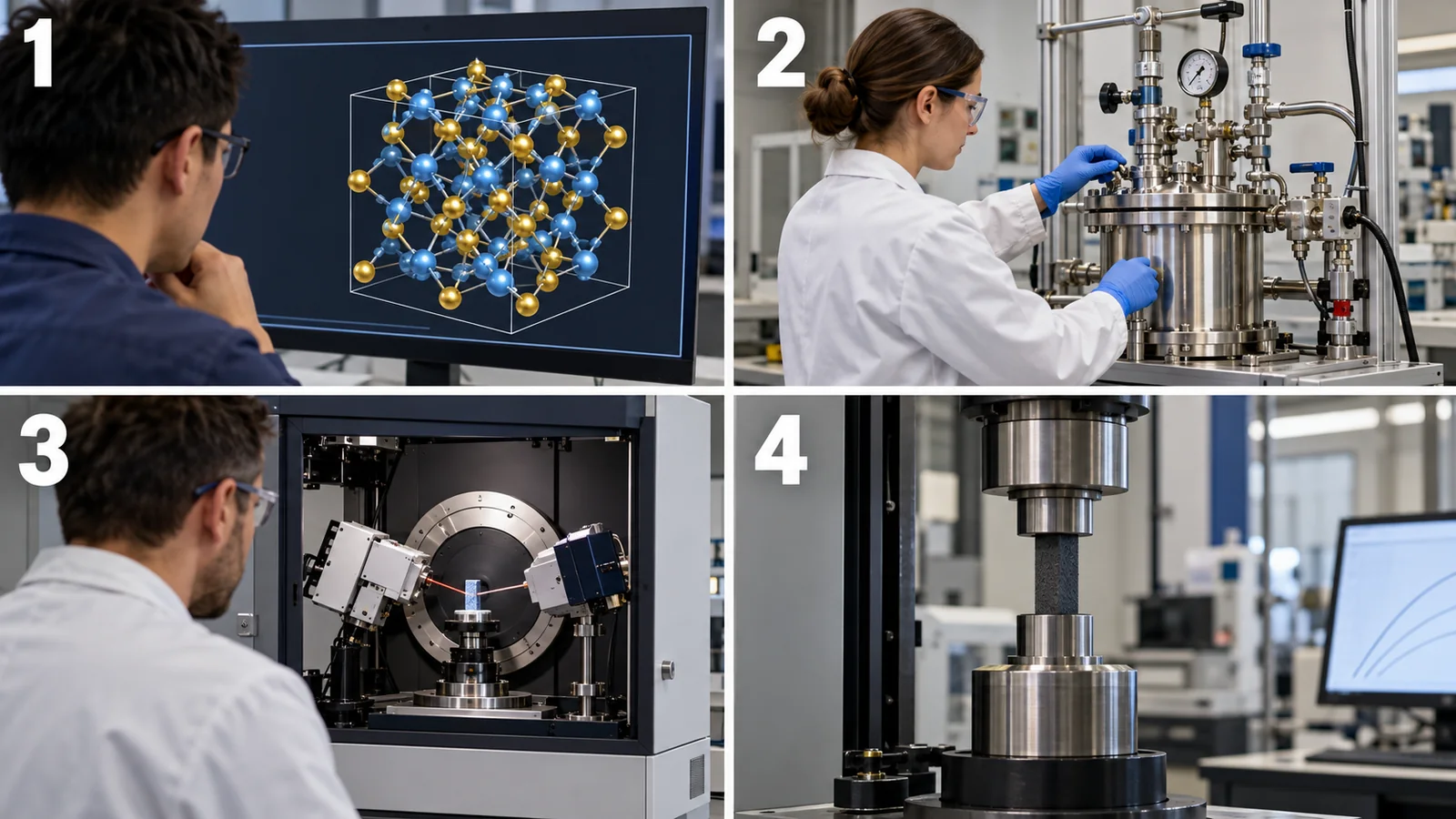
Even with the same iron and carbon, a different arrangement of atoms makes a different material. In a crystal, which atoms sit where, and how they are arranged sets the properties. Crystal structure prediction (CSP) is the problem of searching for that arrangement by calculation, without experimental information.
This problem has long been seen as a hard one. In 1988 Nature's editor Maddox wrote that being unable to predict the structure of even the simplest crystals from their composition was a continuing "scandal" of the physical sciences Sourced[Ref. 1]. Catlow (2023), however, judges that remark to be "of questionable accuracy but a powerful stimulus" to the field of crystal-structure modelling and prediction. Catlow stresses that modelling and prediction are different. Finding a valley precisely near a known structure is "modelling"; "prediction" means searching the space of the structural variables to find regions that may correspond to stable structures, and then refining them Sourced[Ref. 2].
3. Why it is hard: the number of arrangements, and energy valleys
There are two reasons. The first is that the number of arrangements explodes. The second is that there are countless energy valleys.
- The number of arrangements: the number of ways to place A and B atoms half-and-half on lattice sites is 12,870 for 16 sites, about 6.0×10⁸ for 32 sites and about 1.8×10¹⁸ for 64 sites Our calculation. In a real crystal atomic positions vary continuously, so the candidates are far more numerous still
- The number of valleys, and how hard the deep one is to find: for a cluster of 13 Lennard-Jones atoms, 1500 random starts dropped into valleys reached the true minimum (an icosahedron, energy −44.3268) 7% of the time. For 38 atoms it is 0 of 800 (best −170.99, true −173.93) Our calculation. The true values are listed in the Cambridge Cluster Database Sourced[Ref. 10]
- With a cleverer method: a method that repeatedly "nudges, drops into a valley, and accepts if better" (basin hopping, Wales and Doye, 1997) Sourced[Ref. 9] found the minimum in 30 of 30 runs for 13 atoms, within 200 steps (median 4.5 steps). For 38 atoms it was 1 of 20 runs (within 400 steps) Our calculation. The search method changes how easily the answer is found, and for some systems it stays hard even with a cleverer method
If you place atoms at random, forces act on them. Moving the atoms little by little along those forces until the forces vanish is called structure relaxation. It is like a ball rolling down a slope and stopping at the bottom of a valley (see our explainer on molecular dynamics). Different starting points stop in different valleys, so one relaxation finds only that valley. Note that the clusters in this article are not crystals; they are an example for checking, in a small system, that "there are many valleys and the deep one is hard to find" (commentary).
4. Search methods and how they are evaluated
| Method | Idea | What the paper says (the authors' report) | Reading note |
|---|---|---|---|
| Random search (AIRSS) | Generate many random structures, relax them with DFT and choose the lowest | Pickard and Needs (2011): a simple and powerful approach, applied to solids, point defects, surfaces and clusters [Ref. 4] Sourced | Simple, but the number of candidates explodes with system size (Fig. 3) |
| Evolutionary method (USPEX) | Make the next candidates from low-energy structures by crossover and mutation | Oganov and Glass (2006): predicts the most stable and low-energy metastable structures with no experimental input; a success rate of nearly 100% in a few tens of tests with up to 40 atoms per cell [Ref. 3] Sourced | The success rate is for the systems the authors tried. It depends on the system and its size |
| Particle-swarm method (CALYPSO) | Move candidates as a "swarm" and gather them at good positions | Wang et al. (2010): crystal structure prediction via particle-swarm optimization (title) [Ref. 5] Sourced | We treat it only within the range of the title |
| Substitution from known structures | Replace the elements of a known crystal with chemically similar ones | The test set of Matbench Discovery (WBM) was made by chemical-similarity-based substitution from MP structures followed by DFT relaxation [Ref. 20] Sourced | Suited to making candidates close to known structures; hard to make genuinely new structures (commentary) |
| Search with machine-learning potentials | Replace DFT with a machine-learning potential for the energies in relaxation | CSPBench (preprint): methods using machine-learning potentials have become competitive with methods using DFT [Ref. 8] Sourced | See our explainer on machine-learning interatomic potentials. They go wrong outside their range |
The classification of methods is our own organisation. Catlow (2023) also lists simulated annealing, genetic algorithms, topological principles for framework structures and packing algorithms for molecular crystals [Ref. 2].
How often are they right? Two examples of evaluation.
- Blind tests for organic crystals: competitions run by the CCDC in which the answers are withheld. The sixth (Reilly et al., 2016) had five targets, and it is reported that all but one target (a possibly disordered polymorph) were predicted by at least one submission. That is "at least one", not "every method always gets it" Sourced[Ref. 7]
- CSPBench (preprint): it evaluates 13 algorithms on 180 test structures and concludes that the performance of current methods is far from satisfactory. Most methods could not even identify the correct space group, the exception being template-based methods when similar templates exist. It says that methods using machine-learning potentials have become competitive with those using DFT Sourced[Ref. 8]
For small systems (up to a few tens of atoms) many successes are reported (USPEX and others). But systematic evaluations such as CSPBench say current methods are still not sufficient (the conclusion of a preprint) [Ref. 8]. Catlow (2023) also names as a main limitation that many methods give no information on the paths and barriers between structures (how to make them) [Ref. 2]. A predicted structure is "a low-energy candidate", not "the answer for the conditions under which it can be made" (commentary).
5. What "stable" means: formation energy and the energy convex hull
What does it mean for a compound A₂B to be "stable"? First we use the formation energy: how much the energy drops per atom when A₂B forms from the elements A and B. If negative, it is more stable than the elements. But that is not enough. A₂B might lower its energy by splitting not into elements but into other compounds (for example AB and A).
- The convex hull: the line joining, at each composition, "the combination of phases with the lowest energy". It is the green line in Fig. 5. The points on it (A, AB, AB₂, B) are the stable phases
- The height above the hull (E_hull): how far a phase lies above the hull. Zero is stable. A positive value means that splitting into the stable phases on either side would lower the energy. In Fig. 5, A₂B is 20 meV/atom, A₃B is 30 meV/atom and AB₃ is about 57 meV/atom Our calculation (made-up data)
Even with a negative formation energy, a phase above the hull has lower energy if it decomposes into other phases. The Matbench Discovery paper takes as the starting point of its evaluation design that there is a disconnect between thermodynamic stability and formation energy Sourced[Ref. 20]. Bartel et al. (2020) also critically examine whether the stability of a compound can be predicted from machine-learned formation energies (title) [Ref. 17]. Whether something is stable is decided by comparison with competing phases.
A representative database for stability calculations is the Materials Project. It holds a large number of DFT-computed energies of structures from the ICSD (a database of known inorganic crystal structures) [Refs. 15, 11]. There is also a review of computational approaches for predicting stability (Bartel, 2022) [Ref. 16].
6. The yardstick for "stable": how many meV per atom?
Whether E_hull is zero is a sharp line, but there are DFT errors and temperature effects. Up to how many meV/atom do we regard a phase as "stable" or "likely to be made"? We line up values from the papers (Fig. 6).
- Many observed crystals lie above the hull: Sun et al. (2016) examined 29,902 observed inorganic crystals in the Materials Project and report that 50.5±4% are metastable (E_hull > 0), with a median height above the hull of 15 meV/atom and a 90th percentile of 67 meV/atom. Nitrides had higher values: median 63 and 90th percentile 195 meV/atom Sourced[Ref. 11]
- DFT accuracy: the same paper says DFT predicts ground-state phases more than 90% of the time, and that formation energies from adjacent stable compounds can be computed to within about 24 meV/atom. But it adds that errors in DFT formation energies cannot be used directly as error bars on the hull Sourced[Ref. 11]
- The gap to measurement: Kirklin et al. (2015) compared DFT formation energies in the OQMD with 1,670 experimental values and report a mean absolute error of 0.096 eV/atom. They also find a large mean absolute error of 0.082 eV/atom between different experimental measurements themselves, and say a considerable part of the DFT-experiment gap may be due to experimental uncertainty Sourced[Ref. 14]. Note that this is an error in the formation energy (the difference from the elements), a different quantity from the error in the height above the hull (the difference between compounds)
- A soft criterion for "synthesizable": Aykol et al. (2018) say that a reasonable multiple of k_B T (about 25, 50 or up to 100 meV/atom) is often cited as a soft criterion for synthesizability Sourced[Ref. 12]. At room temperature (300 K), k_B T is 25.9 meV Our calculation
The facts say the opposite. Half of the observed crystals lie above the hull in DFT (Sun et al., 2016) [Ref. 11]. Metastable materials abound in nature and in industry. As a textbook example, at ordinary pressure diamond has a higher energy than graphite, yet it exists (commentary). A small E_hull is a rough sign that something is likely to be made, but not a guarantee. And an E_hull of zero does not guarantee that it can be made either (next chapter).
7. The difference between "stable" and "can be made"
Even when calculation says "stable", that does not mean "can be made". The reason is that stability is a matter of thermodynamics, while synthesis is a matter of kinetics and conditions.
View original SVG, values and sources
Original SVG reference: Concept diagram (vector drawing). The steps from "stable" to "usable". Calculation can directly answer mainly steps 1 and 2. From step 3 on, experiment must confirm.
- Competing phases: in a reaction, a different (metastable) phase can form before the target phase. The choice of precursors, the reaction pathway and the nucleation barrier all matter (commentary)
- Remnant metastability: Sun et al. (2016) argue that not every low-energy metastable compound can necessarily be synthesized, and propose a principle called "remnant metastability": observable metastable phases are generally remnants of thermodynamic conditions where they were once the lowest free-energy phase Sourced[Ref. 11]
- The amorphous limit: Aykol et al. (2018) proposed a thermodynamic upper limit on the energy scale for synthesis, defined on the basis of the amorphous state. It classified more than 700 polymorphs in 41 inorganic material systems for synthesizability, in complete agreement with existing polymorphs, they report. The limit depends strongly on chemistry and ranges from about 50 to 500 meV/atom for metal oxides Sourced[Ref. 12]. It is an indicator of an upper limit (above it, synthesis is highly unlikely), not a guarantee that anything below it can be made
- No information on barriers: Catlow (2023) lists as a limitation that many crystal structure prediction methods give no information on the pathways and barriers between predicted structures or on how structures group into superbasins [Ref. 2]. How to make it lies outside the landscape picture
The accurate statement is that "a material that calculation says is stable (small E_hull) is a candidate that may be made". Synthesis involves conditions (temperature, atmosphere, time, raw materials), reaction pathways, competing phases and impurities. The map of ternary metal nitrides by Sun et al. (2019) points to hundreds of promising spaces by stability calculations, and reports that of these, seven new Zn- and Mg-based ternary nitrides were realized experimentally Sourced[Ref. 13]. The number shown by calculation and the number confirmed by experiment are counted separately.
8. Search with machine learning, and keeping "predicted" apart from "confirmed"
With machine-learning potentials we can sift far more candidates. But the number predicted and the number confirmed are different things. As an example, take the M3GNet paper of Chen and Ong (2022).
- The M3GNet example (the authors' report): they screened 31 million hypothetical crystal structures and, based on M3GNet energies, found about 1.8 million that are potentially stable against existing Materials Project crystals. Of the top 2,000 with the lowest height above the hull, 1,578 were verified stable by DFT (about 79%) Sourced[Ref. 18] Our calculation. This verification is a DFT calculation, not synthesis in the lab
- The OQMD example: Kirklin et al. (2015) "predicted" the existence of about 3,200 new compounds not yet experimentally characterised [Ref. 14] Sourced
- A point of view on evaluation: the Matbench Discovery paper points out that, in evaluating machine learning for searching, regression metrics (error) and metrics for the stability decision (classification) do not line up, and that even an accurate regressor can make more wrong calls near the decision boundary (on the hull) Sourced[Ref. 20]
- Machine learning of synthesizability: there is also work predicting synthesizability from structure with partially supervised learning (Jang et al., 2020, title) [Ref. 21]. We did not check its content here
9. A materials engineer's view
Candidates with a small E_hull are best used as grounds for raising a candidate's priority in experiments. But priority is not decided by E_hull alone. Add the raw materials and equipment you can use, the synthesis temperature and atmosphere, competing stable phases and tolerance to impurities, and narrow down to the 3 to 5 candidates to try first. In some systems, such as nitrides, compounds with a high E_hull (up to about 195 meV/atom) actually exist [Ref. 11]. Revisit the criterion for each system (commentary).
When you try a synthesis, record the precursors, the mixing method, temperature, time and atmosphere, cooling, and the result (identification of phases by X-ray diffraction, impurity phases) in fixed fields. Conditions that did not work (phases that did not form) are valuable data too. When a prediction is wrong, this record is what lets you separate whether the cause is "a calculation error" or "the conditions". Add controls (making a known related phase under the same conditions) and a check of lot-to-lot differences.

Most E_hull values are for idealised conditions close to 0 K and vacuum. In real synthesis, temperature (entropy effects), pressure, atmosphere (partial pressures of oxygen and nitrogen), trace impurities and particle size all matter. Sun et al. (2016) say that the scale of metastability is unlikely to differ much from the one surveyed at zero temperature and pressure, but for an individual system the effect of conditions must be checked separately (commentary) [Ref. 11].
Crystal structure data are normally described in CIF (Crystallographic Information File), an IUCr standard. According to the IUCr, CIF was adopted in 1990 as a standard for archiving and distributing crystallographic information [Refs. 23, 22]. If you keep your own synthesis and diffraction data in CIF, together with metadata on conditions (temperature, atmosphere, time), they can later be matched with calculations or used as machine-learning data.
10. Limits, what we could not confirm, and a summary
- Crystal structure prediction searches for low-energy atomic arrangements from the composition; it is hard because the number of arrangements explodes and valleys are countless. Even for small clusters, random search found the answer 0 times in 800 for 38 atoms Our calculation
- "Stable" is measured by the height above the energy convex hull (E_hull). Half of the observed crystals lie above the hull in DFT, with a median of 15 and a 90th percentile of 67 meV/atom Sourced
- "Stable" and "can be made" are different. Competing phases, barriers and conditions matter. The amorphous limit is an indicator of an upper limit for synthesis, not a guarantee for anything below it Sourced
- Count predictions and experimental confirmations separately. The M3GNet example stops at DFT confirmation; in the nitride map, seven new nitrides were synthesized out of hundreds of promising spaces Sourced
What we could not confirm
- We could not check the original text of Maddox (1988) and rely on the quotation and assessment by Catlow (2023) (summarised here)
- CALYPSO (Wang et al., 2010), Bartel et al. (2020), Bartel (2022), Jang et al. (2020) and Oganov et al. (2019) are handled within the range of the title; we did not check their contents
- CSPBench is a preprint, and we did not check a post-review version
- The cluster calculation in Fig. 3 concerns small groups of Lennard-Jones atoms, not crystals, and does not show the success rate of crystal structure prediction. The proportions change with the random seed and settings
- The hull in Fig. 5 uses illustrative made-up data, not a real system
- Whether the candidates screened in the M3GNet example were later synthesized in experiments could not be confirmed
- The size of the temperature and pressure corrections to the height above the hull differs from system to system, and we did not confirm figures even in general terms
- We could not find an international standard that defines crystal structure prediction itself
11. How to read the yardsticks and standards
The yardsticks for crystal structure prediction and stability are, first, whether the predicted structure agrees with the experimental one (success of structure prediction); then the accuracy of the height above the hull and the correctness of the stable-or-not decision; and finally success or failure of synthesis in experiments. What the yardsticks do not measure is the conditions and pathway of synthesis. Checked on 23 October 2026.
| Item | Representative benchmarks and methods (name, source) | Standards and guidance (ISO/IEC, IUCr, NIST, etc.) | Reading notes |
|---|---|---|---|
| Success of structure prediction | Blind tests for organic crystals (CCDC, sixth) [Ref. 7]. CSPBench: 180 structures, 13 algorithms (preprint) [Ref. 8] Sourced | Could not be confirmed (an international standard for crystal structure prediction) | The blind tests concern organic molecular crystals. Evaluations like CSPBench are new for inorganic crystals. Success can mean "at least one" submission |
| Stability classification | Matbench Discovery: training on MP, testing on 257,487 WBM structures. Evaluated with F1 and so on [Refs. 19, 20] Sourced | Could not be confirmed | Regression and classification metrics do not line up. Wrong calls increase near the hull |
| DFT accuracy (the gap to measurement) | OQMD: comparison with 1,670 experimental values. Mean absolute error 0.096 eV/atom; the scatter between experimental values is 0.082 [Ref. 14] Sourced | Could not be confirmed (a standard for the accuracy of DFT formation energies) | This is an error in formation energy, not in E_hull. Experimental uncertainty is also large |
| Indicators of synthesizability | The amorphous limit (Aykol et al.): validated on 700+ polymorphs in 41 systems [Ref. 12] Sourced. The scale of metastability (Sun et al.) [Ref. 11] Sourced | Could not be confirmed (a standard for synthesizability indicators) | Indicators of an upper limit, not guarantees. Aykol et al. also say there is no rigorous metric |
| Format and exchange of structure data | CIF: an IUCr standard, adopted in 1990 (Hall et al., 1991) [Ref. 22] Sourced. OPTIMADE: a common API for materials databases (specification v1.0) [Ref. 24] Sourced | IUCr's CIF (Crystallographic Information Framework) [Ref. 23] Sourced. OPTIMADE is a specification by a consortium | Format standards do not guarantee data quality. Metadata on conditions are needed separately |
The organisation of the table is Our calculation (our arrangement). Numbers, titles and status were checked in papers and on the IUCr page (checked on 23 October 2026). The standards are all data formats or specifications, not standards with legal force. We did not confirm any applicable ASTM standard within the scope of this article.
Reading notes (for materials engineers)
- A benchmark rank is not how well it will do on your system: evaluations of structure prediction are values on test structures. Try your own composition and conditions in a small way first
- Prediction versus experimental confirmation: "predicted stable" is a calculation result. Always read whether it was confirmed by experiment (the M3GNet example stops at DFT; in the nitride map seven were synthesized)
- Data leakage and split pitfalls: candidates close to the training structures look easy to get right. Matbench Discovery removes overlapping structures [Ref. 20]
- Are standards and guidance recommended or required? CIF and OPTIMADE are a format and a specification; using them or not is decided by contract or practice (commentary)
- Plan versus achievement: "N thousand new materials predicted" is a computational prediction. Check separately the number confirmed by experiment
12. Glossary
- Crystal structure prediction (CSP)
- The problem of searching by calculation for low-energy atomic arrangements from the composition.
- Structure relaxation
- Moving atoms along the forces until the forces vanish (the bottom of an energy valley).
- Energy landscape
- The relation between atomic arrangement and energy, pictured as terrain. Valleys correspond to stable structures.
- Global minimum
- The deepest of all valleys: the most stable structure.
- Metastable
- Not the most stable, but able to persist because a barrier prevents change.
- AIRSS
- Ab initio random structure searching: relaxing random structures with DFT.
- USPEX
- A crystal structure prediction method that combines an evolutionary algorithm with DFT.
- CALYPSO
- A crystal structure prediction method based on particle-swarm optimization.
- Basin hopping
- A search method that repeats "nudge, drop into a valley, accept if better".
- Formation energy
- The change of energy per atom when a compound forms from the elements.
- Energy convex hull
- The line joining the lowest-energy combinations of phases at each composition.
- E_hull (height above the hull)
- How far a phase lies above the hull. Zero is stable. In meV/atom.
- Thermodynamic stability
- Not decomposing into other phases, in terms of energy (free energy).
- Kinetics
- The speed, path and barriers of change. It bears on whether something can be made.
- Amorphous limit
- A thermodynamic upper limit for synthesis based on the energy of the amorphous state (Aykol et al.).
- Remnant metastability
- The idea that observed metastable phases are remnants of conditions where they were once the lowest free-energy phase (Sun et al.).
- MP / ICSD / OQMD
- Materials Project / Inorganic Crystal Structure Database / Open Quantum Materials Database.
- Blind test
- A prediction competition in which the answers are withheld. For organic crystals, run by the CCDC.
- CIF
- The standard file format for crystal structure data (IUCr). Crystallographic Information File.
- OPTIMADE
- A specification of an API for searching materials databases in a common way.
- Preprint
- A paper made public before peer review.
13. References
- Maddox J. "Crystals from first principles", Nature 335, 201 (1988), DOI 10.1038/335201a0 — doi.org/10.1038/335201a0
- Catlow C. R. A. "Crystal structure prediction: achievements and opportunities (editorial)", IUCrJ 10, 143–144 (2023), DOI 10.1107/S2052252523001835 — doi.org/10.1107/S2052252523001835
- Oganov A. R., Glass C. W. "Crystal structure prediction using ab initio evolutionary techniques: principles and applications", J. Chem. Phys. 124, 244704 (2006), DOI 10.1063/1.2210932 — doi.org/10.1063/1.2210932
- Pickard C. J., Needs R. J. "Ab initio random structure searching", J. Phys.: Condens. Matter 23, 053201 (2011), DOI 10.1088/0953-8984/23/5/053201 — doi.org/10.1088/0953-8984/23/5/053201
- Wang Y., Lv J., Zhu L., Ma Y. "Crystal structure prediction via particle-swarm optimization", Phys. Rev. B 82, 094116 (2010), DOI 10.1103/PhysRevB.82.094116 — doi.org/10.1103/PhysRevB.82.094116
- Oganov A. R., Pickard C. J., Zhu Q., Needs R. J. "Structure prediction drives materials discovery", Nat. Rev. Mater. 4, 331–348 (2019), DOI 10.1038/s41578-019-0101-8 — doi.org/10.1038/s41578-019-0101-8
- Reilly A. M. et al. "Report on the sixth blind test of organic crystal structure prediction methods", Acta Crystallogr. B 72, 439–459 (2016), DOI 10.1107/S2052520616007447 — doi.org/10.1107/S2052520616007447
- Wei L. et al. "CSPBench: a benchmark and critical evaluation of Crystal Structure Prediction", arXiv:2407.00733 (preprint) (2024) — arxiv.org/abs/2407.00733
- Wales D. J., Doye J. P. K. "Global Optimization by Basin-Hopping and the Lowest Energy Structures of Lennard-Jones Clusters Containing up to 110 Atoms", J. Phys. Chem. A 101, 5111–5116 (1997), DOI 10.1021/jp970984n — doi.org/10.1021/jp970984n
- Doye J. P. K. (Cambridge Cluster Database) "Table of Lennard-Jones cluster global minima (N < 150)" — doye.chem.ox.ac.uk/jon/structures/LJ/tables.150.html
- Sun W. et al. "The thermodynamic scale of inorganic crystalline metastability", Sci. Adv. 2, e1600225 (2016), DOI 10.1126/sciadv.1600225 — doi.org/10.1126/sciadv.1600225
- Aykol M., Dwaraknath S. S., Sun W., Persson K. A. "Thermodynamic limit for synthesis of metastable inorganic materials", Sci. Adv. 4, eaaq0148 (2018), DOI 10.1126/sciadv.aaq0148 — doi.org/10.1126/sciadv.aaq0148
- Sun W. et al. "A map of the inorganic ternary metal nitrides", Nat. Mater. 18, 732–739 (2019), DOI 10.1038/s41563-019-0396-2 — doi.org/10.1038/s41563-019-0396-2
- Kirklin S. et al. "The Open Quantum Materials Database (OQMD): assessing the accuracy of DFT formation energies", npj Comput. Mater. 1, 15010 (2015), DOI 10.1038/npjcompumats.2015.10 — doi.org/10.1038/npjcompumats.2015.10
- Jain A. et al. "Commentary: The Materials Project: A materials genome approach to accelerating materials innovation", APL Mater. 1, 011002 (2013), DOI 10.1063/1.4812323 — doi.org/10.1063/1.4812323
- Bartel C. J. "Review of computational approaches to predict the thermodynamic stability of inorganic solids", J. Mater. Sci. 57, 10475–10498 (2022), DOI 10.1007/s10853-022-06915-4 — doi.org/10.1007/s10853-022-06915-4
- Bartel C. J. et al. "A critical examination of compound stability predictions from machine-learned formation energies", npj Comput. Mater. 6, 97 (2020), DOI 10.1038/s41524-020-00362-y — doi.org/10.1038/s41524-020-00362-y
- Chen C., Ong S. P. "A universal graph deep learning interatomic potential for the periodic table", Nat. Comput. Sci. 2, 718–728 (2022), DOI 10.1038/s43588-022-00349-3 — doi.org/10.1038/s43588-022-00349-3
- Riebesell J. et al. "A framework to evaluate machine learning crystal stability predictions", Nat. Mach. Intell. 7, 836–847 (2025), DOI 10.1038/s42256-025-01055-1 — doi.org/10.1038/s42256-025-01055-1
- Riebesell J. et al. Matbench Discovery - A framework to evaluate machine learning crystal stability predictions (arXiv version, the numbers in this article are taken from it), arXiv:2308.14920 (2023) — arxiv.org/abs/2308.14920
- Jang J. et al. "Structure-Based Synthesizability Prediction of Crystals Using Partially Supervised Learning", J. Am. Chem. Soc. 142, 18836–18843 (2020), DOI 10.1021/jacs.0c07384 — doi.org/10.1021/jacs.0c07384
- Hall S. R., Allen F. H., Brown I. D. "The crystallographic information file (CIF): a new standard archive file for crystallography", Acta Crystallogr. A 47, 655–685 (1991), DOI 10.1107/S010876739101067X — doi.org/10.1107/S010876739101067X
- IUCr (International Union of Crystallography) Crystallographic Information Framework (page checked 22 October 2026) — www.iucr.org/what-we-do/digital-standards/cif
- Andersen C. W. et al. "OPTIMADE, an API for exchanging materials data", Sci. Data 8, 217 (2021), DOI 10.1038/s41597-021-00974-z — doi.org/10.1038/s41597-021-00974-z
14. Claim-to-source audit
| Claim in the text | Basis | Type |
|---|---|---|
| Maddox (1988): the remark that being unable to predict the structure of even the simplest crystals from composition is a continuing scandal of the physical sciences. Catlow (2023) judges it of questionable accuracy but a powerful stimulus. The difference between "modelling" and "prediction", an overview of search methods (simulated annealing, genetic algorithms, topology, packing), and the limitation that no information on paths and barriers is given | Reference 1 https://doi.org/10.1038/335201a0 Reference 2 https://doi.org/10.1107/S2052252523001835 | Sourced |
| AIRSS (Pickard and Needs, 2011): a simple and powerful approach of relaxing random structures with DFT. Applied to solids, point defects, surfaces and clusters | Reference 4 https://doi.org/10.1088/0953-8984/23/5/053201 | Sourced |
| USPEX (Oganov and Glass, 2006): an evolutionary method with DFT. Predicts the most stable and low-energy metastable structures with no experimental input; a success rate of nearly 100% in a few tens of tests with up to 40 atoms per cell (authors' report). CALYPSO (Wang et al., 2010; particle-swarm optimization; title). Oganov et al. (2019; a review of structure prediction; title) | Reference 3 https://doi.org/10.1063/1.2210932 Reference 5 https://doi.org/10.1103/PhysRevB.82.094116 Reference 6 https://doi.org/10.1038/s41578-019-0101-8 | Sourced |
| Numbers in Fig. 3 (our calculation): ways to place A and B atoms half-and-half on lattice sites, C(16,8) = 12,870, C(32,16) = about 6.0×10⁸, C(64,32) = about 1.8×10¹⁸ | our calculation | Our calculation |
| Numbers in Fig. 3 (our calculation): clusters of Lennard-Jones atoms. 13 atoms: 7% of random starts (1500 local minimisations) reached the true minimum (−44.3268); basin hopping 30 of 30 runs (within 200 steps, median 4.5). 38 atoms: 0 of 800 (best −170.99); basin hopping 1 of 20 runs (within 400 steps) | our calculation (minimisation by L-BFGS; depends on random starts and settings) | Our calculation |
| Global minima of Lennard-Jones clusters: 13 atoms −44.326801 (icosahedron), 38 atoms −173.928427 (octahedral symmetry). The basin-hopping paper | Reference 10 http://doye.chem.ox.ac.uk/jon/structures/LJ/tables.150.html Reference 9 https://doi.org/10.1021/jp970984n | Sourced |
| The sixth blind test of organic crystals (Reilly et al., 2016): five targets. All but one were predicted by at least one submission | Reference 7 https://doi.org/10.1107/S2052520616007447 | Sourced |
| CSPBench (preprint): 180 test structures, 13 algorithms. Performance is far from satisfactory. Most cannot find the correct space group. Methods using machine-learning potentials have become competitive with those using DFT | Reference 8 https://arxiv.org/abs/2407.00733 | Sourced |
| Matbench Discovery: training on MP, testing on WBM (structures made from MP by chemical-similarity-based substitution and relaxed with DFT). The disconnect between thermodynamic stability and formation energy. The mismatch of regression and classification metrics. Bartel et al. (2020; stability prediction from machine-learned formation energies; title), Bartel (2022; a review of stability prediction; title) | Reference 19 https://doi.org/10.1038/s42256-025-01055-1 Reference 20 https://arxiv.org/abs/2308.14920 Reference 17 https://doi.org/10.1038/s41524-020-00362-y Reference 16 https://doi.org/10.1007/s10853-022-06915-4 | Sourced |
| The hull in Fig. 5: illustrative made-up data. E_hull: A₃B 30, A₂B 20, AB 0, AB₂ 0, AB₃ about 57 meV/atom (computed here from the hull) | our calculation (made-up data) | Our calculation |
| The Materials Project: a database of DFT energies of ICSD structures | Reference 15 https://doi.org/10.1063/1.4812323 Reference 11 https://doi.org/10.1126/sciadv.1600225 | Sourced |
| Sun et al. (2016): 50.5±4% of 29,902 observed inorganic crystals are metastable. Median height above the hull 15, 90th percentile 67 meV/atom. Nitrides: median 63, 90th percentile 195. DFT predicts ground states more than 90% of the time. Formation energies from adjacent stable compounds are accurate to about 24 meV/atom. Errors in formation energy are not directly errors in the hull. The proposal of remnant metastability. Not every low-energy metastable compound can be synthesized | Reference 11 https://doi.org/10.1126/sciadv.1600225 | Sourced |
| Kirklin et al. (2015): mean absolute error of OQMD DFT formation energies against 1,670 experimental values 0.096 eV/atom. Scatter between experimental values 0.082. About 3,200 new compounds not experimentally characterised are predicted | Reference 14 https://doi.org/10.1038/npjcompumats.2015.10 | Sourced |
| Aykol et al. (2018): multiples of k_B T (about 25, 50, 100 meV/atom) are often cited as soft criteria. The amorphous limit classifies 700+ polymorphs in 41 systems. The limit for metal oxides is about 0.05 to 0.5 eV/atom | Reference 12 https://doi.org/10.1126/sciadv.aaq0148 | Sourced |
| k_B T at 300 K = 25.9 meV. The arrangement of the scale in Fig. 6 | our calculation | Our calculation |
| Sun et al. (2019): a stability map of ternary metal nitrides. Points to hundreds of promising spaces; seven new Zn- and Mg-based ternary nitrides were synthesized in experiments | Reference 13 https://doi.org/10.1038/s41563-019-0396-2 | Sourced |
| M3GNet paper: screening of 31 million hypothetical structures. About 1.8 million potentially stable. Of the top 2,000, 1,578 verified stable by DFT (about 79% = 1578 ÷ 2000, computed here). A DFT verification, not synthesis in the lab | Reference 18 https://doi.org/10.1038/s43588-022-00349-3 | SourcedOur calculation |
| Jang et al. (2020): structure-based synthesizability prediction (partially supervised learning; title) | Reference 21 https://doi.org/10.1021/jacs.0c07384 | Sourced |
| CIF: an IUCr standard. Adopted in 1990 as a standard file structure for archiving and distributing crystallographic information (Hall et al., 1991). OPTIMADE: a common API for materials databases (specification v1.0) | Reference 22 https://doi.org/10.1107/S010876739101067X Reference 23 https://www.iucr.org/what-we-do/digital-standards/cif Reference 24 https://doi.org/10.1038/s41597-021-00974-z | Sourced |
| A materials engineer's views (prioritising, recording with conditions, temperature, pressure and impurities outside the calculation, data formats). The diamond and graphite example and the explanation of competing phases and nucleation are general commentary | commentary (our own view) | |
| We could not find an international standard for crystal structure prediction or synthesizability. We could not confirm the original text of Maddox or whether the M3GNet candidates were synthesized | our own check (could not be confirmed) |
Last updated: 23 October 2026. Sources are limited to primary material (papers, preprints, the Cambridge Cluster Database and the IUCr page). Numerical examples are our own calculations and are not results for a real crystal system. We could not confirm the original text of Maddox, some details of the full texts of papers, the post-review content of CSPBench, whether the M3GNet candidates were synthesized in experiments, the size of temperature and pressure corrections, or any international standard for crystal structure prediction, so we do not assert them. Figs. 2 to 8 are illustrative concept diagrams or drawings that include our calculations; Figs. 1 and 9 are AI-generated images (only the scene to be drawn is specified).