COMPANY PROFILE / MATERIALS INFORMATICS
Microsoft
Releasing a generative AI for materials (MatterGen) and a simulation AI (MatterSim), and building them into a research platform
In materials science, Microsoft has both a research arm and a product line. Its researchers have released MatterGen, an AI that generates crystal structures (published in Nature in January 2025), and MatterSim, an AI that computes how atoms move, both under the MIT licence. On the product side, Microsoft Discovery, a platform for research and development, reached general availability in June 2026. At the same time, MatterGen's experimental confirmation rests on one compound. The paper itself says that the product made was a version with swapped atoms rather than the predicted structure, and in 2026 an independent paper argued that it is identical to a known compound. This profile separates the company's claims, computed predictions, experimental confirmation and criticism, and uses only what primary sources let us confirm.
- Microsoft in 30 seconds, and where it stands in materials informatics
- The logo and how the name is written
- Where the company sits in the materials informatics field
- Scale (the company as a whole, in brief)
- Resources committed to materials informatics
- What it has done so far
- What comes next
- What the company is aiming for in materials informatics
- Map of materials informatics partnerships
- Technology, products and services (how to read the numbers, and the criticism)
- The risks this company carries
- Glossary, references and claim-to-source audit
1. Microsoft in 30 seconds, and where it stands in materials informatics
Materials informatics (MI) means using data, computation and AI to find new materials more efficiently. Its workflow has three broad steps: "data, then prediction and design, then experimental confirmation". Microsoft releases AI models for the prediction and design step and also offers a platform for using them (Microsoft Discovery).
Nasdaq: MSFTWashington State, U.S.
(primary type)MI software and materials AI (Microsoft Discovery) as a secondary type
MatterSim (simulation)Both released under the MIT licence (as stated on GitHub)
Generally available since June 2026Official blog. We could not confirm pricing or the number of customers
Microsoft's MI figures differ greatly between computed evaluation and experimental confirmation Sourced. In the MatterGen paper, DFT calculations on 1,024 generated structures showed 78% to be "nearly stable", but the experimental check consists of four candidates chosen for synthesis, one of which worked. And the paper itself states that the product was not the predicted "atoms at fixed sites" structure but a version in which atoms had swapped places. Throughout this profile we keep claims by the company or research group, computed predictions, experimental confirmation and independent criticism apart.
2. The logo and how the name is written

A note on naming: in this article, "Microsoft" means Microsoft Corporation, the U.S. listed company. The materials AI is developed by Microsoft Research AI for Science, a research group inside it. The product name Microsoft Discovery and the earlier Azure Quantum Elements are different names, and we keep them apart. The 10-K reports figures for the whole company, not for the research group alone.
Official website: https://www.microsoft.com/ (the logo is the four-coloured square mark from Microsoft's own Azure blog)3. Where the company sits in the materials informatics field
As Fig. 1 shows, Microsoft belongs mainly to the "foundation models and compute" type, and spills over into "MI software and materials AI" as a secondary type. Of the MI workflow (data, then prediction and design, then experiment), its centre of gravity is learning AI from the crystal structures in public databases and producing predictions and generated candidates. MatterGen's training data is about 608,000 stable crystals from two public databases, the Materials Project and Alexandria (both CC BY 4.0) Sourced. The experimental side is done together with PNNL (a U.S. national laboratory) and a research team at the Chinese Academy of Sciences.
A generative model is an AI that, like a text-writing AI, proposes new crystal structures when given a condition such as "a crystal of this hardness". MatterGen is an example. A machine-learning force field is a way to compute the forces between atoms quickly with AI, running orders of magnitude faster than DFT. MatterSim is an example. Combining generation and evaluation lets researchers loop between "propose a candidate" and "check quickly whether it is stable". For the technical detail, see our explainers on generative AI for materials design, machine-learning interatomic potentials, and crystal structure prediction and stability.
4. Scale (the company as a whole, in brief)
Microsoft is a large company in cloud, software, gaming and more. We show only its size as a whole Sourced. Revenue, headcount and budget for materials AI alone are not disclosed Not yet confirmed.
| Metric (whole company, US$ million) | FY2024 (year to June 2024) | FY2025 (year to June 2025) | FY2026 (year to June 2026) |
|---|---|---|---|
| Total revenue | 245,122 | 281,724 | 331,839 |
| Research and development | 29,510 | 32,488 | 35,562 |
| Additions to property and equipment | 44,477 | 64,551 | 115,948 |
| Item | Detail |
|---|---|
| Employees (30 June 2026, full-time) | About 223,000 (77,000 of them in product research and development) |
| Headquarters | Redmond, Washington, U.S. |
| Listing | NASDAQ Stock Market (MSFT) |
| Mentions of materials AI | In the 10-K (year to June 2026), we could not find any mention of MatterGen, MatterSim, Microsoft Discovery or Azure Quantum Elements |
The figures above describe the company as a whole. How much of the roughly US$35.6 billion of R&D in the year to June 2026 went to materials AI is not disclosed. The 10-K gives prominent place to investment in computing capacity for AI, but does not mention work on materials. The size of the company and the size of its commitment to materials AI are two different things.
5. Resources committed to materials informatics
Amounts and headcounts are not disclosed, but we can set out what official sources do and do not show, under four headings.
| Heading | What we could confirm | Type |
|---|---|---|
| People | The MatterGen paper has 26 authors. Twenty-three are at Microsoft Research AI for Science (Cambridge in the UK, Berlin in Germany, Redmond in the U.S., Amsterdam in the Netherlands, Shanghai and Beijing in China) and three at the Shenzhen Institute of Advanced Technology of the Chinese Academy of Sciences. The total number of people working on materials AI is not disclosed | Sourced / not disclosed |
| Money | R&D spending, capital expenditure and computing investment for materials AI are not disclosed. The acknowledgements of the paper say that part of the computing came from the company's AI-on-Xbox team | Could not confirm |
| Investments, acquisitions, joint ventures, divestments | We could not confirm any investment, acquisition, joint venture or divestment concerning materials AI | Could not confirm |
| Universities, research institutes and public funding | (1) PNNL (a U.S. Department of Energy national laboratory): a multi-year collaboration; it synthesised and prototyped an electrolyte candidate. (2) Shenzhen Institute of Advanced Technology (SIAT), Chinese Academy of Sciences: synthesised a MatterGen candidate. (3) Materials Project and Alexandria: sources of training data. (4) NVIDIA and Synopsys: integration into Microsoft Discovery planned in 2025. We could not confirm receipt of public research funding | Sourced / could not confirm |
Status of the main models and products
| Name | Kind | Main specifications and conditions | Release and licence | Stage and date |
|---|---|---|---|---|
| MatterGen | Diffusion model (generates crystal structures) | Trained on about 608,000 stable crystals (Materials Project and Alexandria, up to 20 atoms per cell). In the paper, DFT on 1,024 generated structures found 78% within 0.1 eV/atom of the convex hull | Code and models under the MIT licence; training data under its original licence (CC BY 4.0), on GitHub and Hugging Face. The released checkpoints were re-trained and are not identical to those in the paper | Released (January 2025) |
| MatterSim | Machine-learning force field (computes atomic motion) | The paper describes coverage of elements, temperatures from 0 to 5000 K and pressures up to 1000 GPa. Two public versions, 1M and 5M. Designed for solids (bulk); the README says surfaces and interfaces are not suitable for quantitative analysis | Released under the MIT licence. The README says more advanced versions are in Azure Quantum Elements | Released (paper in May 2024) |
| Skala | Deep-learning DFT functional | Claimed error of 2.8 kcal/mol on the main-group chemistry benchmark GMTKN55 (paper). We did not check its performance on solid materials for this article | The paper states that the model and inference code are under the MIT licence | Released (June 2025) |
| Azure Quantum Elements | Cloud for chemistry and materials (AI plus HPC) | Launched in June 2023 (January 2024 blog) | Commercial cloud | On the check date, the old product page URL redirected to the Microsoft Discovery blog. We could not confirm whether it is still offered as a separate product |
| Microsoft Discovery | Agentic AI platform for research and development | A "Discovery Engine" that repeats hypothesis generation, simulation and analysis. Product documentation says connection to physical labs and robots is "possible" | Commercial cloud plus a local app (preview). We could not confirm pricing | Offered (private preview in May 2025; generally available on 2 June 2026) |
MatterGen and MatterSim are released under the MIT licence, so companies can use them Sourced. There are, however, points to check first. (1) The released MatterGen checkpoints are re-trained versions, so results can differ slightly from the paper. (2) The bundled evaluation script judges stability with MatterSim rather than DFT, and the documentation cautions that this is fast but not necessarily as accurate as DFT. (3) MatterGen targets crystals with up to 20 atoms per cell. Organic crystals, non-crystalline materials, noble gases, radioactive elements and heavy elements are outside its scope (model card). (4) MatterSim is for bulk solids, and properties driven by surfaces, interfaces or long-range forces are not suited to quantitative analysis. The practical first step is to check whether your own material system falls within these limits.
6. What it has done so far
| When | What happened | What it means |
|---|---|---|
| June 2023 | Launched Azure Quantum Elements, a cloud for chemistry and materials (January 2024 official blog) | Start of a commercial cloud for materials |
| December 2023 | Posted MatterGen on arXiv (not yet peer-reviewed) | Later became the Nature paper |
| January 2024 | Announced an electrolyte search with PNNL. From about 32.6 million candidates it went through about 500,000 predicted stable to 18 candidates; PNNL synthesised a top candidate and built a prototype battery. The paper (not peer-reviewed) says it took under 80 hours on about 1,000 virtual machines | Claims by the company and its collaborators. We could not confirm independent verification of the performance |
| May 2024 | Posted MatterSim on arXiv | Release of the simulation AI |
| 16 January 2025 | Published MatterGen in Nature. Released code, checkpoints and training data (MIT licence for code and models). Synthesised TaCr2O6 together with SIAT | Release of a generative model, and one experimental confirmation |
| 19 May 2025 | Announced Microsoft Discovery (Build 2025, private preview). Described a non-PFAS coolant prototype found in about 200 hours and synthesised within four months | The company's claim. The company itself calls it "only an experiment" |
| June 2025 | Released Skala, a deep-learning DFT functional (MIT licence) | Work on improving DFT accuracy |
| 20 April 2026 | An independent researcher published a paper in Materials Horizons arguing that MatterGen's experimental example, TaCr2O6, is not new | Explained in detail in section 10 |
| 2 June 2026 | Made Microsoft Discovery generally available and released the local Microsoft Discovery app in preview | Start of a commercial platform for research and development |
7. What comes next
Announced in 2025 as a planWe could not confirm that it has happened
All of these are company plans and targets, not accomplished facts Not yet confirmed. The integration with NVIDIA was described in May 2025 as something the company "plans" to do. On the date of this check (22 October 2026), we could not confirm from official sources that it has been completed.
None of the following appeared in official sources Not yet confirmed.
The timing of a successor to MatterGen, Microsoft Discovery's pricing and number of customers, whether Microsoft has its own automated laboratory, investment and headcount for materials AI, and the relationship as products between Azure Quantum Elements and Microsoft Discovery.
8. What the company is aiming for in materials informatics
This section includes points the company has not stated directly. We give them as inferences drawn from primary sources, together with the evidence.
| What we read from the sources | Primary evidence | Type |
|---|---|---|
| It wants materials AI to be a core function of a cloud research platform | Microsoft Discovery is described as bringing together HPC, specialised models and connections to lab equipment. The MatterSim README points to Azure Quantum Elements for more advanced versions | Inference |
| It wants to release models openly to build a user base and lead users to paid computing and platforms | MatterGen, MatterSim and Skala are under the MIT licence, while more advanced versions and the computing base are offered on a commercial cloud | Inference |
| It appears to rely on outside research institutions for experiments rather than run its own | Synthesis was done by SIAT and PNNL. We found no statement about a laboratory of its own | Inference |
| It treats its definition of novelty for generated crystals (a comparison that allows for disorder) as a strength | The official blog presents its disorder-aware structure-matching algorithm as "a new definition of novelty and uniqueness" | Inference |
The Microsoft Discovery documentation says the platform can connect to HPC, specialised large quantitative models, and laboratory instruments and robots Sourced. The MatterSim README, for its part, says that "more advanced pre-trained versions and additional materials capabilities" are in Azure Quantum Elements. Together they suggest a two-tier arrangement: open versions for researchers, and advanced versions plus cloud computing sold to companies. But because the old Azure Quantum Elements page redirected to the Microsoft Discovery blog on the check date, we could not confirm which product now carries this second tier Not yet confirmed.
9. Map of materials informatics partnerships
10. Technology, products and services
What Microsoft offers for materials is open models (MatterGen, MatterSim, Skala) and a commercial cloud platform (Microsoft Discovery). This section explains how MatterGen works, the conditions behind its numbers, the experimental check and the criticism, and then the PNNL electrolyte search and the coolant example.
How MatterGen works (illustration)
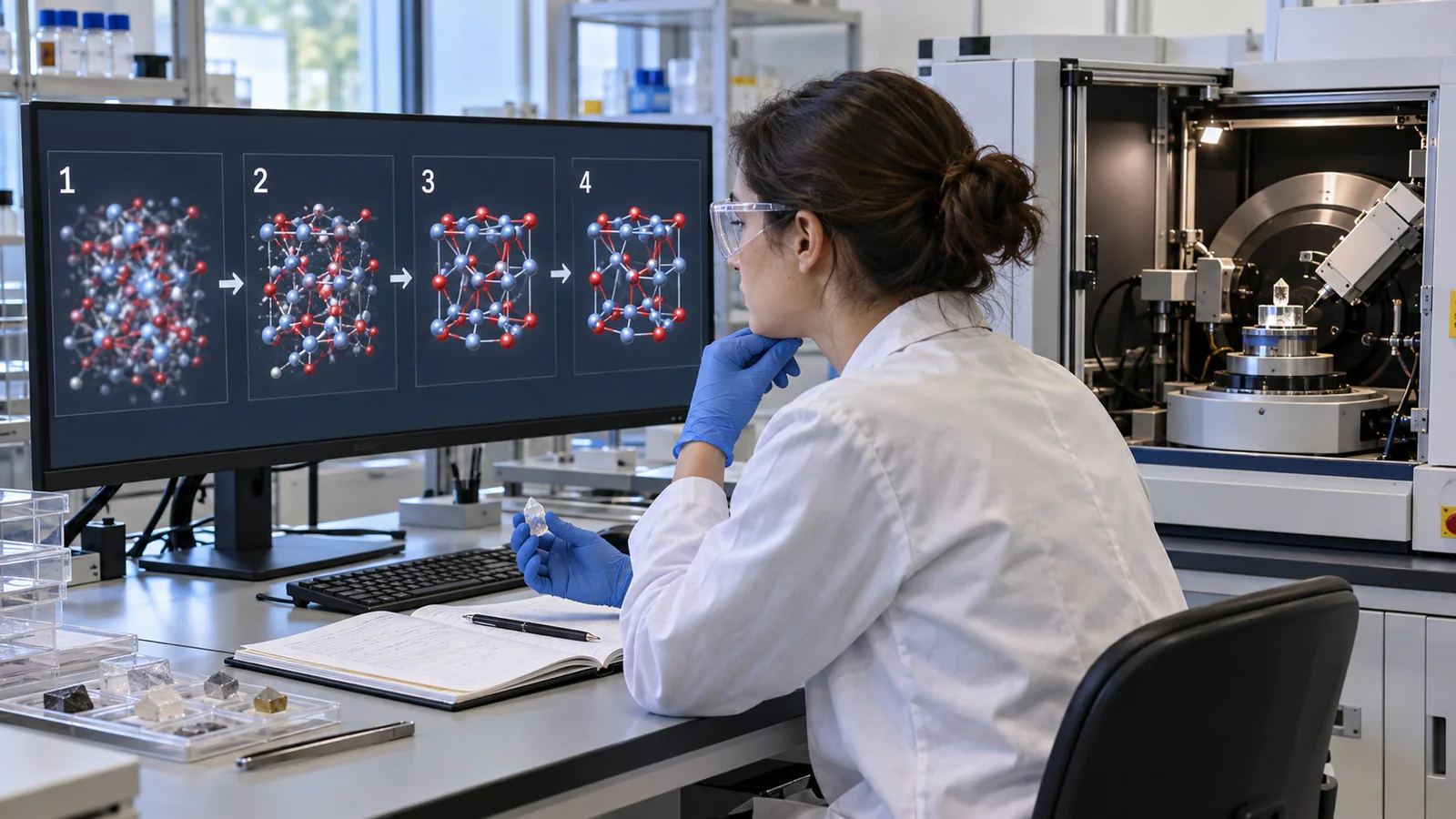
According to the paper, MatterGen is a diffusion model. It applies the idea behind image AIs that make pictures out of noise to crystals, building a structure by refining step by step the atom types, the atom positions and the size and shape of the repeating cell (the lattice). It can also be fine-tuned afterwards to target a property such as hardness, chemical composition or space group Sourced.
How to read the numbers: what was measured, and under what conditions
| Figure (claimed by the company and paper) | Conditions and definition | Nature of the figure |
|---|---|---|
| 78% of generated structures within 0.1 eV/atom of the convex hull | 1,024 generated structures evaluated with DFT. The reference is the Materials Project hull, and 13% are at or below 0 eV/atom. Against the combined hull of Alexandria, the Materials Project and the ICSD, 75% (3% at or below zero) | Computed prediction |
| 95% of generated structures have an RMSD below 0.076 Å | The displacement between the structure as generated and after DFT relaxation. The paper describes it as almost an order of magnitude smaller than the radius of a hydrogen atom (0.53 Å) | Computed prediction |
| More than twice as many "new and stable" structures as earlier generative models | The share of stable, unique and new (SUN) structures, averaged over 1,000 samples per method. "New" is judged with a matching method that allows for atoms swapping sites | Computed evaluation (model against model) |
| 100% unique at 1,000 structures and 52% at 10 million; 61% new | A measure of how little duplication grows as more structures are generated | Computed evaluation |
| Four candidates synthesised, one succeeded | For four target bulk moduli (50, 100, 150 and 200 GPa) it generated 8,192 candidates each, narrowed them to 75 through several filters, and experts chose four for synthesis | Experimental confirmation (one compound) |
| Measured bulk modulus within 20% of the 200 GPa target | Estimated from the Young's modulus by nanoindentation and the DFT Poisson ratio. The estimate is up to 169 GPa (the maximum of four measurements; 158 ± 11 GPa), because the paper says the powder sample is likely non-compact. The DFT prediction was 222 GPa | Experimental value (an estimate) |
| 101 ICSD compounds absent from the training set were rediscovered | The number of experimentally known compounds that appeared among the generated candidates | Computed evaluation |
In a crystal, two kinds of atoms can share the same site at random. This is called a disordered structure. The structures an AI proposes are often "ordered", with atoms at one fixed site each, and a real sample may turn out as a disordered version. The MatterGen paper itself says that the product was a compositionally disordered version of the ordered structure it predicted Sourced. Whether something is "a new substance" depends on whether this disorder is taken into account.
Criticism and re-evaluation (reported neutrally)
| Source | Subject | Main points (as each source states) |
|---|---|---|
| The MatterGen paper (Nature, January 2025) | Synthesis of TaCr2O6 | States that the product is a compositionally disordered version of the predicted ordered structure. One of four candidates succeeded, within 20% of the target value. Positions it as a proof of concept |
| Juelsholt (Materials Horizons, April 2026) | MatterGen's experimental example | Argues from detailed crystallographic analysis that the product is not a new compound but identical to a compound reported in 1971, which was also in MatterGen's training data. Concludes that unresolved problems with disorder and dataset validation mean human verification is essential |
| Microsoft's response | The criticism above | Within the scope of this check, we could not find an official rebuttal or a correction to the MatterGen paper |
| The electrolyte search with PNNL | A solid electrolyte candidate | The official blog describes a new electrolyte candidate that uses "approximately 70% less lithium", and PNNL built a prototype battery and tested it at room temperature and about 80 °C. It says further validation and optimisation are ongoing. We could not confirm independent verification of its novelty or performance |
These are matters on which opinions differ, and this article does not decide who is right. What can be confirmed is the following. (1) The MatterGen paper itself says that the product is a "disordered version" of the predicted structure. (2) An independent peer-reviewed paper (2026) argues that the product is identical to a known compound. (3) On the check date, we found no correction to the paper and no official rebuttal.
Microsoft Discovery as a product, and an example the company presents
According to the official blog, Microsoft Discovery used AI models and HPC simulation to find a prototype non-PFAS coolant for immersion cooling of data centres in about 200 hours, and the company then synthesised it within four months of the digital search. The company says that some of the main properties it tested matched the AI's predictions, and also says "this project is only an experiment" Sourced. This is the company's own account, and we could not confirm independent verification.
Three points matter directly to a materials engineer Sourced.
(1) Generated structures are "ordered". A real sample can be disordered, so X-ray diffraction results should be checked against known disordered compounds before anything is called a "new material". The MatterGen paper also computes the bulk modulus for several ordered approximations of the disordered structure (219 to 222 GPa).
(2) The gap between target and measured properties. For the bulk modulus, the target was 200 GPa, DFT gave 222 GPa and the measured estimate was up to 169 GPa, so the value depends on the method. The paper notes that a measurement on a powder sample may come out low if the sample is not dense.
(3) You can fine-tune on your own data. MatterGen has a procedure for fine-tuning on your own property-labelled data. The fine-tuning in the paper, however, covers crystals with up to 20 atoms per cell and does not reach the complex microstructure (grain boundaries, defects) of practical materials.
11. The risks this company carries
| Risk | Detail | Type |
|---|---|---|
| Little experimental confirmation | One of four candidates worked in MatterGen's experiment, and the product was a disordered version rather than the prediction itself. An independent paper argues that it is not new | Sourced |
| A dispute over what "new" means | How to judge novelty when disorder is involved is debated in the research community. We could not find an official rebuttal from Microsoft | Sourced |
| Limits of the released models | MatterGen is for crystals of up to 20 atoms and excludes organic and non-crystalline materials. MatterSim is for bulk solids and is not suited to quantitative work on surfaces and interfaces | Sourced |
| Product relationships are hard to see from outside | The old Azure Quantum Elements page redirects to the Microsoft Discovery blog, so its current form of offering cannot be confirmed | Not yet confirmed |
| Integration plans not confirmed as delivered | The integrations with NVIDIA ALCHEMI and Synopsys were 2025 plans. We could not confirm completion from official sources | Not yet confirmed |
| Continued investment in materials AI is invisible from outside | The 10-K does not mention materials AI, and spending and headcount are not disclosed | Inference |
| Limits built into the calculations | Evaluation rests on DFT and machine-learning force fields. The bundled script uses MatterSim for speed, and the documentation notes that differences from DFT need attention | Sourced |
12. Glossary
- Materials informatics (MI)
- Using data, computation and AI to find new materials efficiently.
- MatterGen
- Microsoft's diffusion model that generates new crystal structures from specified conditions.
- MatterSim
- Microsoft's machine-learning force field that computes the forces between atoms quickly with AI.
- Diffusion model
- A type of AI that builds a picture or a structure by removing noise step by step.
- SUN
- Stable, Unique and New. A measure of the quality of generated structures.
- DFT (density functional theory)
- A method that calculates the energy of an arrangement of atoms from the behaviour of its electrons. Accurate, but slow.
- Convex hull
- The line joining the most stable combinations for a given set of elements. A substance above the line would be more stable if it split into others.
- Disordered structure
- A structure in which several kinds of atom share the same site at random. It can differ from the ordered structure an AI predicts.
- Bulk modulus
- How hard a material is to compress evenly. Larger means harder. Measured in GPa.
- Microsoft Discovery
- An agentic AI platform for research and development. Generally available since June 2026.
- PFAS
- A family of organofluorine compounds that break down very slowly and whose regulation is under debate.
- MIT licence
- A permissive licence that allows free use, including commercial use, as long as the copyright notice is kept.
- 10-K
- The annual report that U.S.-listed companies file with the SEC.
13. References
- Microsoft Form 10-K for the fiscal year ended June 30, 2026 (filed with the U.S. SEC on 29 July 2026). Group-wide revenue, R&D, capital expenditure, headcount, headquarters and listing. Also used to confirm that materials AI, MatterGen and Microsoft Discovery are not mentioned. https://www.sec.gov/Archives/edgar/data/789019/000119312526323660/msft-20260630.htm
- Nature Zeni, C. et al. “A generative model for inorganic materials design”, Nature 639, 624–632 (16 January 2025, DOI 10.1038/s41586-025-08628-5, CC BY 4.0). MatterGen's method, evaluation conditions, the experiment (TaCr2O6) and data release. https://www.nature.com/articles/s41586-025-08628-5
- Microsoft Research MatterGen: A new paradigm of materials design with generative AI (official blog, 16 January 2025). Overview of MatterGen, training data, release under the MIT licence and the synthesis with SIAT. https://www.microsoft.com/en-us/research/blog/mattergen-a-new-paradigm-of-materials-design-with-generative-ai/
- Microsoft (GitHub) README, MODEL_CARD and data-release of microsoft/mattergen. Release of checkpoints and data, MIT licence, the note on re-trained checkpoints and the caution on the evaluation script. https://github.com/microsoft/mattergen
- Microsoft (Hugging Face) Model page of microsoft/mattergen. Release of the checkpoints and the licence (MIT). https://huggingface.co/microsoft/mattergen
- Microsoft (GitHub) README of microsoft/mattersim. Pre-trained models (v1.0.0-1M and 5M), MIT licence, stated limitations, and the note that more advanced versions are in Azure Quantum Elements. https://github.com/microsoft/mattersim
- arXiv Yang, H. et al. “MatterSim: A Deep Learning Atomistic Model Across Elements, Temperatures and Pressures” (arXiv:2405.04967, 8 May 2024). https://arxiv.org/abs/2405.04967
- arXiv Chen, C. et al. “Accelerating computational materials discovery with artificial intelligence and cloud high-performance computing: from large-scale screening to experimental validation” (arXiv:2401.04070, 8 January 2024; not peer-reviewed at posting). Search for solid electrolytes. https://arxiv.org/abs/2401.04070
- Microsoft Azure Quantum Blog Unlocking a new era for scientific discovery with AI: How Microsoft’s AI screened over 32 million candidates to find a better battery (official blog, 9 January 2024). The electrolyte search with PNNL and the launch timing of Azure Quantum Elements. https://azure.microsoft.com/en-us/blog/quantum/2024/01/09/unlocking-a-new-era-for-scientific-discovery-with-ai-how-microsofts-ai-screened-over-32-million-candidates-to-find-a-better-battery/
- Pacific Northwest National Laboratory PNNL Kicks Off Multi-Year Energy Storage, Scientific Discovery Collaboration with Microsoft (PNNL news release). The multi-year collaboration and validation within nine months. https://www.pnnl.gov/news-media/pnnl-kicks-multi-year-energy-storage-scientific-discovery-collaboration-microsoft
- Microsoft Azure Blog Transforming R&D with agentic AI: Introducing Microsoft Discovery (official blog, 19 May 2025). Announcement of Microsoft Discovery, the non-PFAS coolant prototype, and plans to integrate NVIDIA ALCHEMI and Synopsys. https://azure.microsoft.com/en-us/blog/transforming-rd-with-agentic-ai-introducing-microsoft-discovery/
- Microsoft Azure Blog Announcing Microsoft Discovery general availability and Microsoft Discovery app preview (official blog dated 2 June, at Microsoft Build; the text refers to the private preview at Build “last year”, so we read it as 2026). https://azure.microsoft.com/en-us/blog/announcing-microsoft-discovery-general-availability-and-microsoft-discovery-app-preview/
- Microsoft Learn What is Microsoft Discovery? (product documentation). Structure of the product and the statement that connection to physical labs and robotics is possible. https://learn.microsoft.com/en-us/azure/microsoft-discovery/overview-what-is-microsoft-discovery
- arXiv Luise, G. et al. “Accurate and scalable exchange-correlation with deep learning” (arXiv:2506.14665, first posted 17 June 2025). The Skala deep-learning exchange-correlation functional and the statement that it is released under the MIT licence. https://arxiv.org/abs/2506.14665
- Materials Horizons (RSC) / Humboldt University repository Juelsholt, M. “Continued challenges in high-throughput materials predictions: MatterGen predicts compounds from the training dataset”, Materials Horizons 13, 5672–5679 (20 April 2026, DOI 10.1039/d6mh00268d). The university repository page of the paper was used. https://edoc.hu-berlin.de/items/2081bca4-f044-43d3-a5f5-1d7c39f9e3e7/full
- Microsoft Official website (the logo image comes from Microsoft's own Azure blog). https://www.microsoft.com/
14. Claim-to-source audit
| Claim in the text | Type | Source |
|---|---|---|
| Microsoft's revenue, R&D and capital expenditure for FY2024 to FY2026, about 223,000 employees (77,000 in R&D), headquarters and listing | Sourced | Reference 1 https://www.sec.gov/Archives/edgar/data/789019/000119312526323660/msft-20260630.htm |
| The 10-K does not mention materials, MatterGen, MatterSim, Microsoft Discovery or Azure Quantum Elements | Sourced | Reference 1 https://www.sec.gov/Archives/edgar/data/789019/000119312526323660/msft-20260630.htm |
| Revenue, headcount and budget for materials AI are not disclosed | Not yet confirmed | Not in the 10-K. Reference 1 https://www.sec.gov/Archives/edgar/data/789019/000119312526323660/msft-20260630.htm |
| MatterGen is a diffusion model that refines atom types, coordinates and lattice step by step, with adapter-based fine-tuning on properties | Sourced | Reference 2 https://www.nature.com/articles/s41586-025-08628-5 |
| DFT on 1,024 generated structures: 78% within 0.1 eV/atom of the hull (13% at or below 0); 75% (3%) on the Alex-MP-ICSD hull | Sourced | Reference 2 https://www.nature.com/articles/s41586-025-08628-5 |
| 95% of generated structures have an RMSD below 0.076 Angstrom | Sourced | Reference 2 https://www.nature.com/articles/s41586-025-08628-5 |
| More than twice as likely to be new and stable and more than ten times closer to the local minimum than earlier generative models (paper's statement) | Sourced | Reference 2 https://www.nature.com/articles/s41586-025-08628-5 |
| 100% unique at 1,000 structures, 52% at 10 million, 61% new | Sourced | Reference 2 https://www.nature.com/articles/s41586-025-08628-5 |
| 8,192 candidates for each of four targets, narrowed to 75, four synthesised, one succeeded; the product TaCr2O6 is a compositionally disordered version of the ordered structure | Sourced | Reference 2 https://www.nature.com/articles/s41586-025-08628-5 |
| Bulk modulus: target 200 GPa, DFT prediction 222 GPa, measured estimate up to 169 GPa (158 +/- 11 GPa), relative error within 20% | Sourced | Reference 2 https://www.nature.com/articles/s41586-025-08628-5 |
| 101 ICSD compounds absent from the training data were rediscovered | Sourced | Reference 2 https://www.nature.com/articles/s41586-025-08628-5 |
| Affiliations of the 26 authors of the MatterGen paper (23 at Microsoft Research AI for Science, 3 at SIAT) | Sourced | Reference 2 https://www.nature.com/articles/s41586-025-08628-5 |
| About 608,000 stable crystals as training data (Materials Project and Alexandria), release under the MIT licence, synthesis with SIAT | Sourced | Reference 3 https://www.microsoft.com/en-us/research/blog/mattergen-a-new-paradigm-of-materials-design-with-generative-ai/ |
| Release of checkpoints and data, MIT licence, note on re-trained checkpoints, out-of-scope uses (more than 20 atoms and others), caution that the evaluation script uses MatterSim | Sourced | Reference 4 https://github.com/microsoft/mattergen |
| Release of the MatterGen checkpoints on Hugging Face (MIT) | Sourced | Reference 5 https://huggingface.co/microsoft/mattergen |
| MatterSim pre-trained models (1M and 5M), MIT licence, designed for bulk solids and not for quantitative work on surfaces and interfaces, more advanced versions in Azure Quantum Elements | Sourced | Reference 6 https://github.com/microsoft/mattersim |
| MatterSim paper: coverage of 0 to 5000 K and up to 1000 GPa, posted May 2024 | Sourced | Reference 7 https://arxiv.org/abs/2405.04967 |
| Solid electrolyte search: more than 32 million candidates, about 500,000 predicted stable, 18 candidates, under 80 hours on about 1,000 VMs (not peer-reviewed) | Sourced | Reference 8 https://arxiv.org/abs/2401.04070 |
| PNNL synthesised a top candidate described as using about 70% less lithium; prototype all-solid-state battery tested at room temperature and about 80 C; within nine months; validation and optimisation ongoing; Azure Quantum Elements launched in June 2023 | Sourced | Reference 9 https://azure.microsoft.com/en-us/blog/quantum/2024/01/09/unlocking-a-new-era-for-scientific-discovery-with-ai-how-microsofts-ai-screened-over-32-million-candidates-to-find-a-better-battery/ |
| The multi-year collaboration between PNNL and Microsoft and validation within nine months | Sourced | Reference 10 https://www.pnnl.gov/news-media/pnnl-kicks-multi-year-energy-storage-scientific-discovery-collaboration-microsoft |
| Microsoft Discovery announced on 19 May 2025; non-PFAS coolant prototype found in about 200 hours and synthesised within four months; described as only an experiment | Sourced | Reference 11 https://azure.microsoft.com/en-us/blog/transforming-rd-with-agentic-ai-introducing-microsoft-discovery/ |
| Plans to integrate NVIDIA ALCHEMI and Synopsys (as of May 2025) | Not yet confirmed | Reference 11 https://azure.microsoft.com/en-us/blog/transforming-rd-with-agentic-ai-introducing-microsoft-discovery/ |
| Microsoft Discovery generally available and the app in preview (2 June 2026) | Sourced | Reference 12 https://azure.microsoft.com/en-us/blog/announcing-microsoft-discovery-general-availability-and-microsoft-discovery-app-preview/ |
| Structure of Microsoft Discovery, connection to HPC, specialised models, physical labs and robots described as possible, potential future quantum integration | Sourced | Reference 13 https://learn.microsoft.com/en-us/azure/microsoft-discovery/overview-what-is-microsoft-discovery |
| Skala: error of 2.8 kcal/mol on GMTKN55, MIT licence stated | Sourced | Reference 14 https://arxiv.org/abs/2506.14665 |
| Juelsholt's argument that TaCr2O6 is identical to a known compound that was in the training data | Sourced | Reference 15 https://edoc.hu-berlin.de/items/2081bca4-f044-43d3-a5f5-1d7c39f9e3e7/full |
| The old Azure Quantum Elements page redirected to the Microsoft Discovery blog on the check date (our own check) | Our calculation | Our own check, fetching the old page URL on 22 October 2026. We could not confirm the current form of offering |
| Timing of a MatterGen successor, Discovery pricing and customer numbers, an own laboratory, materials AI spending and headcount, and any official rebuttal | Not yet confirmed | Not in official sources. Not estimated in this article. Reference 3 https://www.microsoft.com/en-us/research/blog/mattergen-a-new-paradigm-of-materials-design-with-generative-ai/ |
| Investments, acquisitions, joint ventures or divestments in materials AI, and receipt of public research funding | Not yet confirmed | Could not confirm. We do not claim they do not exist either. Reference 1 https://www.sec.gov/Archives/edgar/data/789019/000119312526323660/msft-20260630.htm |
| The logo image (the four-coloured square mark from Microsoft's Azure blog) | Sourced | Reference 16 https://www.microsoft.com/ |
| The four-type grouping (foundation models and compute as primary, MI software and materials AI as secondary) and the arrangement of Fig. 1 and Fig. 2 | Our calculation | Our own arrangement. Company names are examples from the companies covered in this series |
| The reading that it wants materials AI to be a core function of the platform | Inference | Our own interpretation of the Microsoft Discovery documentation and the MatterSim README |
| The reading that it wants to lead from open models to paid advanced versions | Inference | Our own interpretation of the licences and product descriptions |
| The reading that it relies on outside institutions for experiments | Inference | Our own interpretation of the fact that synthesis was done at SIAT and PNNL |
| The reading that it treats its disorder-aware definition of novelty as a strength | Inference | Our own interpretation of the official blog |
| The risk that continued investment in materials AI is invisible from outside | Inference | Our own interpretation of the absence of materials AI in the 10-K |
Last updated 22 October 2026 / Troy Technical
The figures in this article come from Microsoft's 10-K filed with the U.S. Securities and Exchange Commission, Microsoft Research's official blog and GitHub, papers in Nature and elsewhere, and publications by public bodies. We do not use market estimates from research firms or figures from news reports. Passages marked "Inference" are our own readings of primary sources and are not statements by the company. Terms such as "new material" and "novel" are presented as claims by the company or research group, and we keep computed predictions apart from experimental confirmation. We say nothing about share prices, valuation or investment decisions.