


Key Findings
The optimized multilayer sensor achieves a peak angular sensitivity of 372 degrees per refractive-index unit (RIU) and a figure of merit of 47.0 RIU⁻¹ at a sample index of 1.332. When utilizing phase-based readout instead of intensity, the simulated sensor reaches a phase sensitivity of 29,200 degrees per RIU, allowing for the detection of refractive-index changes as small as 3.4 × 10⁻⁷ RIU.
Technical Details
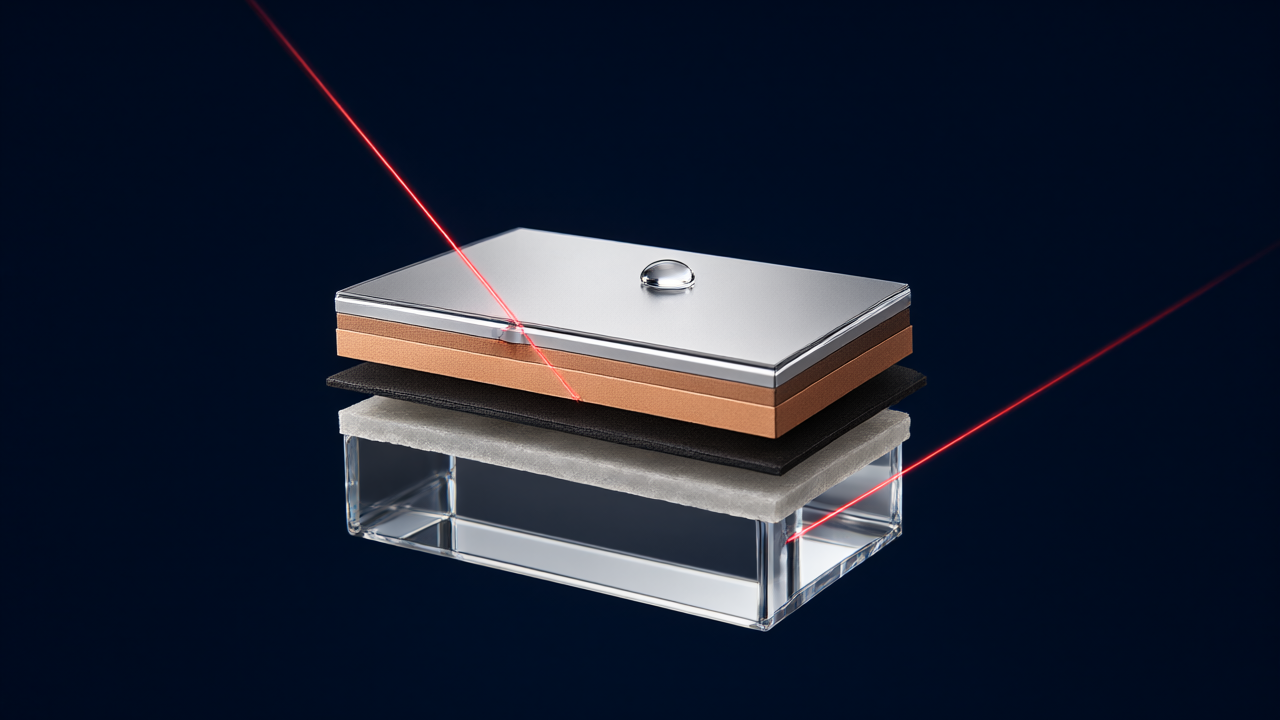
The chip employs a five-material stack in a Kretschmann geometry: calcium fluoride (prism substrate), silver, copper, black phosphorus, and franckeite. The researchers used the transfer matrix method to solve the frequency-domain Maxwell wave equation at a wavelength of 633 nanometers. The optimal configuration consists of approximately 31 nanometers of silver capped by roughly 7 nanometers of copper, resulting in a reflectance dip minimum of 1.1 × 10⁻³.
- Silver: Primary layer for exciting surface plasmon polaritons.
- Copper: Protects silver from aqueous environments and provides a tunable absorption knob.
- Black Phosphorus: A 2D material with an anisotropic electronic structure for light interaction.
- Franckeite: A layered van der Waals mineral providing chemically active sites for capture molecules.
The evanescent field probes the sample at a working distance of 178 to 201 nanometers from the surface.
Background & Context
SPR biosensing detects molecules, such as the cancer-related protein carcinoembryonic antigen, by monitoring shifts in the resonance condition caused by changes in the local refractive index. Traditional SPR designs often face a trade-off where metals that confine optical energy also absorb it, limiting the sensing field’s reach.
Significance & Outlook
By implementing a layered heterostructure, the design overcomes traditional sensitivity limitations. The researchers also conducted stress tests against manufacturing imperfections, finding that size-dependent damping in thin metals reduced the figure of merit by only about 5%.
Get our weekly technology intelligence — free
Receive an infographic that lets you judge at a glance whether each field’s analysis report is worth reading.
Subscribe Free — Weekly Tech Intelligence
By subscribing, you’ll receive Troy-Technical’s weekly technology intelligence newsletter.
- Your email and selected fields are used only to deliver the newsletter.
- We never share your information with third parties.
- You can unsubscribe anytime via the link in each email.
See our Privacy Policy for details.
Takes about a minute · Unsubscribe anytime