TECHNOLOGY EXPLAINER
eVTOL and Air Taxis
— Layouts, batteries and range, and how to tell “type-certified” from “in progress”
News about air taxis (eVTOL) is full of phrases such as “certified”, “begins commercial operations” and “type certificate imminent”. But an aircraft that holds a type certificate and an aircraft still working toward one are clearly different things. This article is written for materials engineers with no background in aircraft certification. It explains (1) three eVTOL layouts, (2) how battery and range are linked (and why going straight up is so costly), (3) the FAA’s official five phases of type certification versus the way companies count them, and (4) where Joby, Archer, BETA and EHang stand, as far as Federal Register notices, regulator documents and company filings allow us to confirm.
This article does not rank companies or aircraft, and gives no legal or investment advice. Company plans and targets are “not yet confirmed”. Checked on 25 October 2026.
- Three-line summary / Before you read / Place in the series
- What is an eVTOL (air taxi)?
- Three layouts
- Battery and range: going straight up is costly
- What a type certificate is: the FAA’s five phases and company labels
- Issued versus in progress: where four companies stand
- A materials engineer’s view, and what we could not confirm
- How to read the yardsticks and standards / Glossary / References / Claim-to-source audit
Sourced = stated in a published source (link given)
Our calculation = a value this article calculated from stated assumptions
Not yet confirmed = plans, targets, design targets and other things not yet settled
Our own readings are marked as commentary, and Inference is shown in bold.
We write “type certificate issued” and “in progress” as clearly separate. Range, speed and passenger counts are each company’s design targets or stated values, not certified performance. A company’s progress figure (for example “75% through stage four”) is the company’s description, not a number endorsed by an authority. Status is as of the check date (25 October 2026), and the latest company filings are from up to August 2026. We found no official record of an FAA type certificate being issued for these aircraft as of the check date.
1. Three-line summary / Before you read / Place in the series
- Within what we could confirm, the only passenger-carrying eVTOL with a type certificate is EHang’s EH216-S (China’s CAAC, October 2023): according to the company’s filing, its operations are limited to daytime, no adverse weather, segregated airspace and so on [Reference 15]. Joby, Archer and BETA are still working toward an FAA type certificate [References 10, 12, 13, 14]. Sourced
- Rising vertically takes about four times the cruise power: in our illustration (a 2,177 kg aircraft) it is 643 kW versus 147 kW. The battery would be about 9% of the aircraft weight for a 20-mile flight and about 31% for 100 miles (200 Wh/kg assumed). Our calculation
- Phases are counted differently by the FAA and by companies: FAA documents describe five phases, Joby its own five “stages”, and Archer four phases. A company’s progress percentage is not a figure endorsed by the FAA [References 1, 2, 11, 12].
You only need the feel that a helicopter goes straight up while an airplane flies on wings. The basics of how aircraft stay up are in our explainers on fixed-wing, VTOL and long-endurance flight and on multicopter principles. This article is limited to electric aircraft large enough to carry people, and their certification.
Batteries are covered in “Lithium-Ion Battery Basics”, “Thermal Runaway and Battery Safety” and “Power Sources for Robots and Drones”, airframe materials in “Structural Materials for Robots and Drones”, motor magnets in “Permanent Magnets and Rare Earths”, communication and positioning in “Drone Communication, Positioning and Collision Avoidance”, and the overall rules in “Drone Regulation and Airspace Management”.
2. What is an eVTOL (air taxi)?
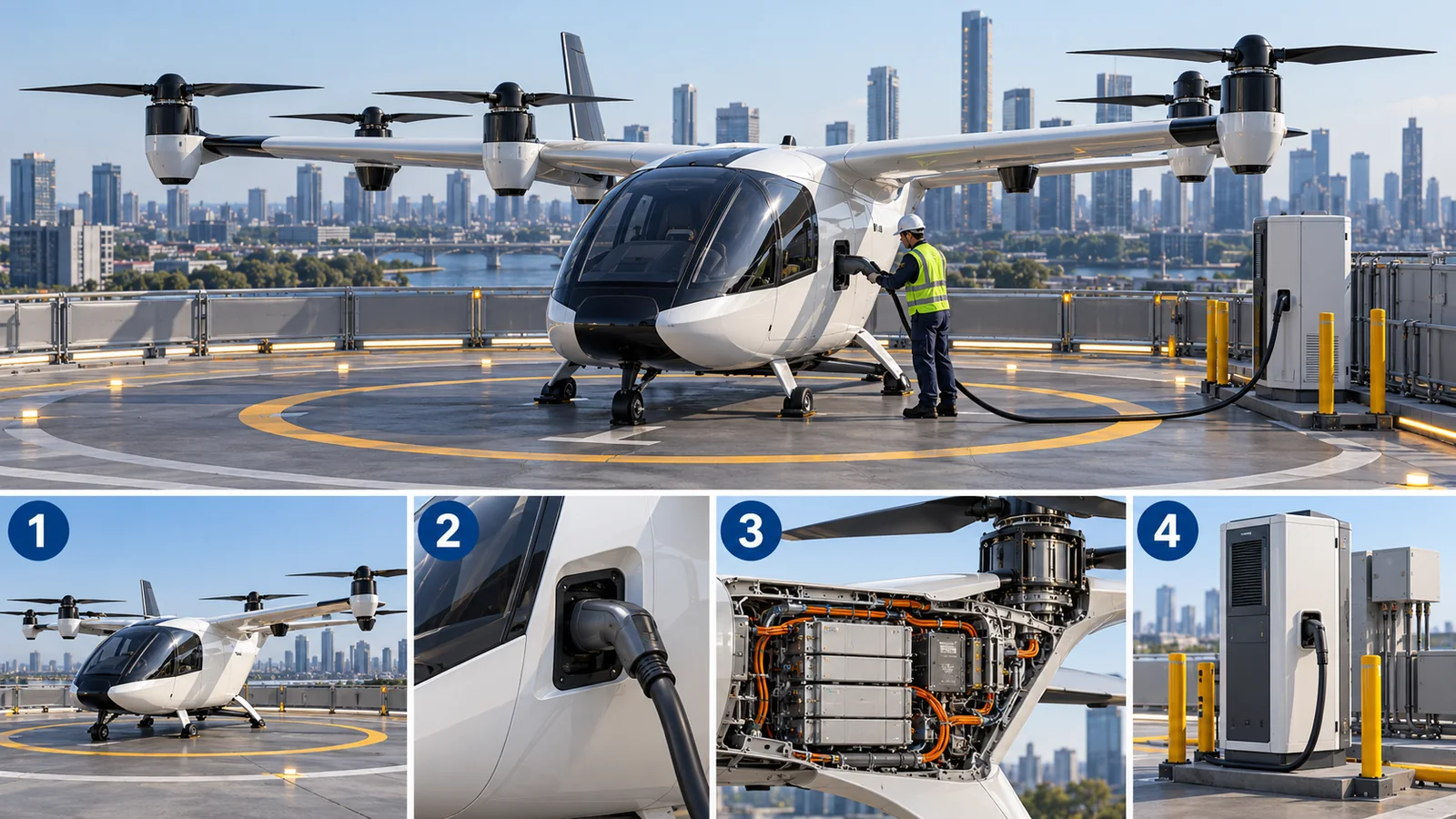
An eVTOL is an electric aircraft that can take off and land vertically. Like a helicopter it needs no runway, and because it uses many electric motors its structure is described as relatively simple and quiet (company descriptions).
The US FAA treats such aircraft as powered-lift. In its Federal Register notice on Joby’s aircraft the FAA says it “has characteristics of both a rotorcraft and an airplane” [Reference 3]. Sourced Limit of the analogy with a car: unlike a car on a road, an aircraft needs certification as an aircraft, plus separate approvals for pilot qualification, airspace and operation (chapter 5).
What is actually true: within what we could confirm, we found no passenger-carrying eVTOL that holds an FAA type certificate. What happens under the FAA’s eIPP (integration pilot program) is operations tried by state and local governments with industry on real missions, under FAA oversight [Reference 9]. EHang’s EH216-S has a type certificate in China, but with restrictions such as daytime only, no adverse weather and segregated airspace [Reference 15]. Sourced
3. Three layouts
Original SVG, detailed explanation and sources
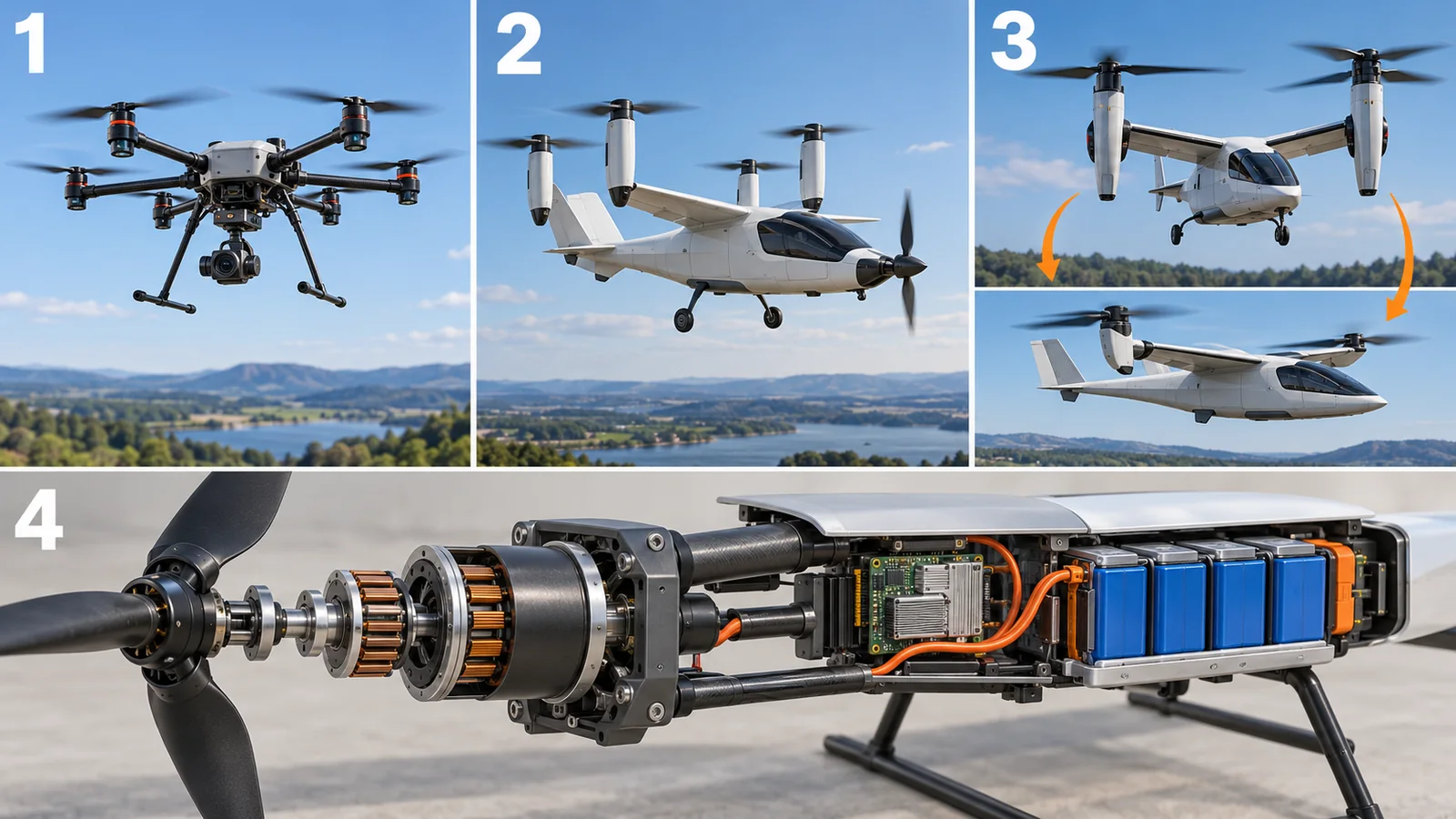
Original SVG reference: Concept diagram (vector drawing). Three eVTOL layouts, with examples from FAA and company documents. The classification is a general arrangement (commentary) and does not rank aircraft [References 3, 4, 15].
- Tilt: According to the FAA’s Federal Register notice, Joby’s JAS4-1 has a maximum takeoff weight of 4,800 lb (about 2,177 kg), carries a pilot and four passengers, uses six tilting electric engines with five-blade propellers on a fixed wing and V-tail, and has a composite structure and propellers [Reference 3]. Sourced
- Tilt plus lift-only: Archer’s M001 has a maximum takeoff weight of 6,500 lb (about 2,948 kg) and 12 electric engines. Six on the front edge tilt to give both lift and forward thrust; six on the rear edge give vertical thrust only and are switched off in wing-borne flight, with the propellers faired along the fuselage [Reference 4]. Sourced
- Lift + cruise: EHang’s VT35 is described in the company’s filing as a lift-and-cruise pilotless aircraft, and its type-certificate application was accepted in March 2025 [Reference 15]. Sourced
The ideas are the same as in “the four VTOL layouts” of our explainer on fixed-wing, VTOL and long-endurance flight: tilt tends to be efficient in cruise, while adding lift-only propellers makes control easier but adds dead weight (commentary).
4. Battery and range: going straight up is costly
An electric eVTOL carries batteries instead of fuel. A battery stores little energy per kilogram compared with fuel (see “Lithium-Ion Battery Basics”), so how much battery can be carried sets the range. Here we do an illustrative calculation to get a feel for the numbers. It does not describe any real aircraft.
As Fig. 3 shows, while rising or hovering the aircraft needs about 4.4 times the power of cruise, because the rotors must keep pushing air downward to hold up the aircraft’s weight (the same thinking as Figs. 2 and 3 of our explainer on fixed-wing, VTOL and long-endurance flight). Our calculation
As Fig. 4 shows, a flight of about 20 miles needs a battery of about 9% of the aircraft weight, while about 100 miles needs about 31% (a 200 Wh/kg pack assumed). Our calculation Five times the distance raises the battery share about 3.4 times, because the hover energy is needed regardless of distance. From this calculation we can see why the first uses tend to be short urban flights (commentary).
In company descriptions, Joby describes a pilot and four passengers, up to 200 mph and a target range of 100 miles (design targets) [Reference 11]. Archer says it optimised for short trips of around 20 miles [Reference 12]. Sourced Not yet confirmed For its conventional-take-off CX300, BETA says it carries 225 kWh (five 45 kWh battery packs), flies missions of up to about 215 nautical miles, and flew 336 nautical miles in a demonstration [Reference 14]. Sourced All of these are company descriptions, not certified performance.
What is actually true: better batteries extend range, but the power needed to rise vertically is set by the aircraft’s weight and thrust and does not shrink. The longer the distance, the heavier the battery, and a heavier battery needs still more power: a loop (commentary). For long distances, wing-borne CTOL (conventional take-off and landing) aircraft or aircraft that use a ground roll may be more suitable.
Because eVTOLs carry people, countering thermal runaway (heat from one cell spreading to its neighbours) is especially important. Archer writes in its filing that battery cells can, on rare occasions, release smoke and flames that ignite nearby materials [Reference 12]. Sourced BETA describes a modular structure (five 45 kWh packs, each with eleven sub-pack modules) that simplifies testing and certification [Reference 14]. Cell materials (electrolyte, separator), insulation and flame-retardant materials in the pack, and the cooling structure govern both safety and weight. See “Thermal Runaway and Battery Safety”.
5. What a type certificate is: the FAA’s five phases and company labels
A type certificate is an authority’s confirmation that the “design” of an aircraft type meets the safety standards. It resembles the type approval of a car (limit of the analogy: for aircraft, a certificate for each individual aircraft, permission for the operating company and the pilot’s qualification are separate).
The FAA describes a design approval (a type certificate and so on) as a five-phase process [Reference 1]. Sourced In Order 8110.4C (Change 7, 20 October 2023) the phases are (1) Conceptual Design, (2) Requirements Definition, (3) Compliance Planning, (4) Implementation and (5) Post-Certification Activities [Reference 2]. Sourced
For the same process, Joby explains it in its own “five stages” (certification basis, means of compliance, certification plans, testing and analysis, show and verify), and Archer says Order 8110.4C “defines the 4 phases” [References 11, 12]. The FAA’s official phase names and the companies’ labels are not the same. When a company says “75% through stage four”, it is progress on the company’s own yardstick, not a progress rate endorsed by the FAA [Reference 10]. Sourced
The path for new aircraft: special class and airworthiness criteria
Powered-lift does not fit the existing categories (airplane, helicopter), so the FAA published, as a special class (14 CFR 21.17(b)), airworthiness criteria for each aircraft in the Federal Register. The criteria for Joby’s JAS4-1 became final on 8 March 2024 (89 FR 17230) and those for Archer’s M001 on 24 May 2024 (89 FR 45944) [References 3, 4]. Joby applied for a type certificate on 2 November 2018 and Archer on 30 March 2022 [References 3, 4]. Special conditions for BETA’s electric engines were published on 17 December 2024 (89 FR 101854) [Reference 6]. Sourced These are documents along the way, not type certificates.
A type certificate is only one of five approvals: (1) the type certificate (TC) for the design, (2) the production certificate (PC), (3) the airworthiness certificate (AC) for each aircraft, (4) the operating certificate (OC) of the operator, and (5) pilot qualification and operating rules. The FAA adopted the powered-lift pilot and operating rules (a ten-year SFAR) in a final rule on 21 November 2024 (89 FR 92296, effective 21 January 2025) [Reference 5]. A draft advisory circular on type certification of powered-lift, AC 21.17-04, was open for comment from 12 June 2024; we could not confirm a final version in the Federal Register [Reference 7]. Sourced
What is actually true: a type certificate confirms that that company’s design of that type meets that set of standards. EHang’s EH216-S has a CAAC type certificate, but the same filing lists operating restrictions: daytime only, no flying in rain, snow, thunderstorms, icing, sandstorms or heavy fog, segregated uncontrolled airspace, sparsely populated areas and within sight of ground crew [Reference 15]. Sourced Do not read “certified” as one block; read the scope and conditions.
6. Issued versus in progress: where four companies stand
- EHang EH216-S (issued, CAAC): its 20-F (15 May 2026) says it obtained the type certificate in October 2023, the airworthiness certificate in December 2023, the production certificate in March 2024 and the operating certificate in March 2025. It is a two-seat pilotless aircraft with a maximum range of 30 km, 25 minutes of flight time and a top speed of 130 km/h (company-stated), 169 units delivered in 2025 and over 83,000 safe flights in total (company) [Reference 15]. Sourced We found no independent verification.
- Joby JAS4-1 (in progress, FAA): its 10-Q (6 August 2026) says three of five stages are complete or substantially complete, it is about 75% through stage four and making progress in stage five, and it targets carrying its first passengers in 2026 [Reference 10]. Sourced Not yet confirmed
- Archer M001 Midnight (in progress, FAA): its 10-K (2 March 2026) says its means of compliance was fully accepted by the FAA in January 2026, and its 10-Q (10 August 2026) says work toward FAA type certification continues [References 12, 13]. Sourced
- BETA (in progress, FAA): its 10-K (9 March 2026) says the CX300 (conventional take-off and landing) targets Part 23 certification about 12 months after type certification of the H500A electric motor, and the A250 (vertical take-off and landing) about 12 months after the CX300. No certified aircraft has been delivered [Reference 14]. Sourced Not yet confirmed
EASA (Europe) publishes the VTOL special condition (SC-VTOL) and means of compliance (MOC) for consultation (page updated 18 July 2025) [Reference 16]. Sourced We did not check the status of individual aircraft in Europe or Japan.
Flying before type certification: the eIPP
On 16 September 2025 the FAA published a call for proposals for the eVTOL Integration Pilot Program (eIPP) in the Federal Register, and on 9 March 2026 it selected eight public-private projects (28 states) [References 8, 9]. Sourced The FAA describes it as using next-generation aircraft on real missions under full FAA oversight. Joby says the eIPP gives it a chance to begin initial operations before type certification [Reference 10]. Flights in the eIPP are different from certified commercial service (commentary).
7. A materials engineer’s view, and what we could not confirm
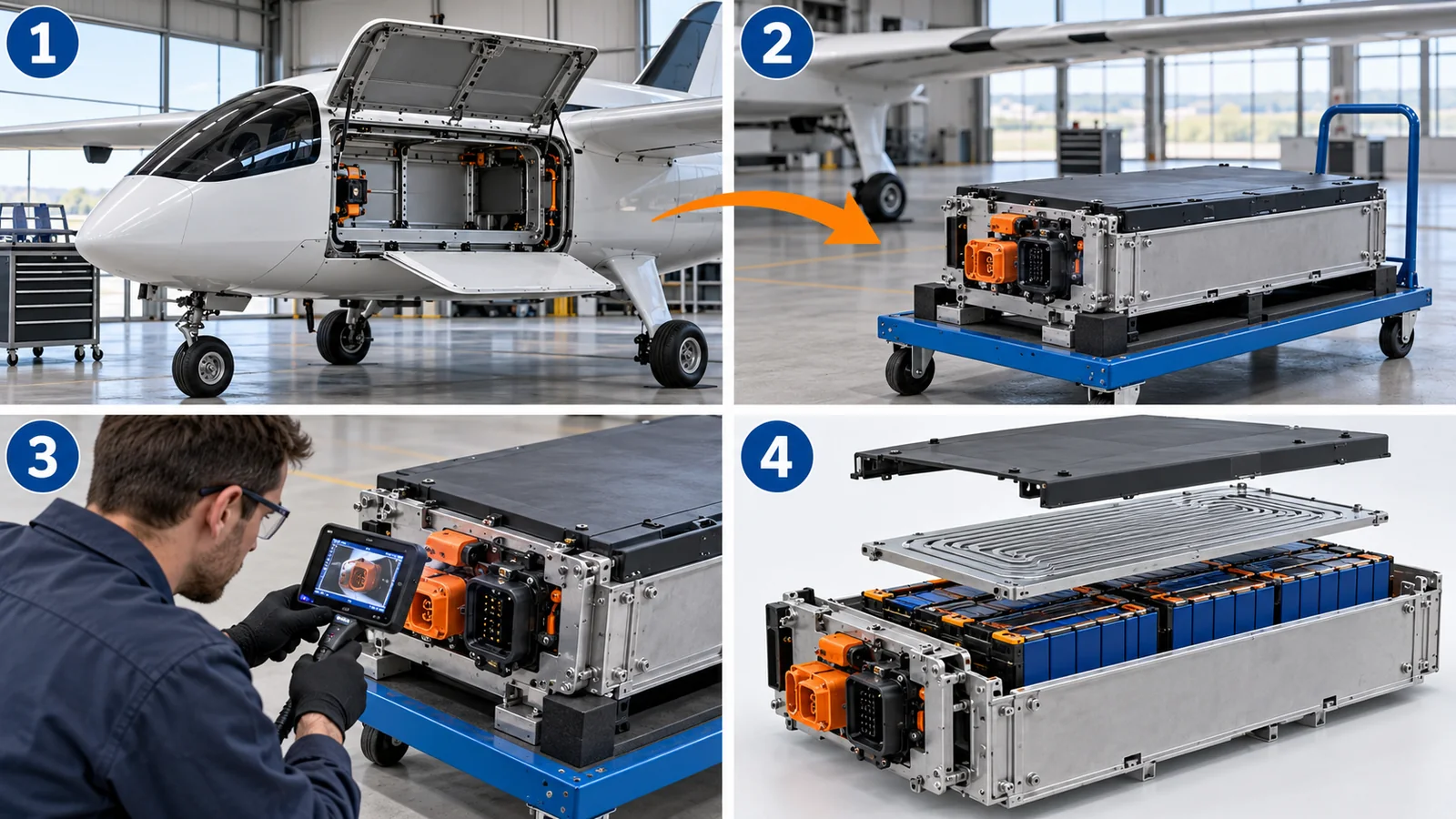
According to the FAA’s Federal Register notice, the structure and propellers of Joby’s JAS4-1 are made of composite materials [Reference 3]. Sourced Because lightness converts directly into battery quantity (Fig. 4), composites such as carbon-fibre-reinforced plastics are the main material for reducing aircraft weight. At the same time, composite fatigue, impact damage (birds, lightning), water ingress and ease of inspection are among the things tested during certification (commentary). Joby describes noise of about 65 dBA at take-off and landing and near silence in overhead flight at 500 ft, but this is a company claim and we found no independent verification [Reference 11].
Joby says each of its six propellers is driven by two independent motors and the aircraft is powered from four batteries [Reference 11]. Electric propulsion improves safety by making many motors redundant (company description). Motor performance rests on strong magnets (see “Permanent Magnets and Rare Earths”), winding insulation and cooling. The FAA set special conditions for BETA’s electric engines because using an electric motor, motor controller and high-voltage systems as the primary propulsion is a “novel or unusual design feature” [Reference 6]. Sourced High-voltage insulation and cooling materials are a materials challenge (commentary).
What we could not confirm
- An official FAA record of a type certificate being issued (none found as of the check date; the latest company filings run to August 2026).
- FAA confirmation of companies’ progress percentages (such as “75% through stage four”).
- Independent verification of design-target range, speed and noise.
- Independent verification of EHang’s operations (the 83,000 flights and similar figures are company statements).
- The status of individual aircraft in Europe, Japan and other countries.
- A final version of AC 21.17-04 (only the draft was confirmed).
- Accident and incident statistics (this article does not use official investigation reports).
8. How to read the yardsticks and standards
An eVTOL is measured by the safety standard of its design (the type-certification standard), range and speed, noise, battery safety and operating rules. The key point is to read “which stage of certification” and “what was certified” separately. Even among aircraft that are “in progress”, the stage where criteria are final in the Federal Register, the stage where means of compliance are accepted, and the stage of ongoing tests are different things.
| What is measured | Typical test or benchmark (name, source) | Standard, rule or guidance (name, source checked) | Reading note |
|---|---|---|---|
| Stage of type certification | The FAA’s five phases (Order 8110.4C Change 7) [References 1, 2] Sourced | 14 CFR Part 21 (special class: section 21.17(b)); Joby criteria 89 FR 17230; Archer criteria 89 FR 45944 [References 3, 4] Sourced | Companies’ ways of counting phases differ from the FAA’s names. Progress figures are company statements |
| Design safety standard | Not confirmed (the test details are in each company’s means of compliance) | Airworthiness criteria per aircraft (Federal Register); special conditions for electric engines, 89 FR 101854 [References 3, 4, 6] Sourced | Criteria are written per aircraft. We did not read the details (test conditions) of the criteria |
| Pilots and operation | Not confirmed | Powered-lift SFAR (89 FR 92296, effective 21 January 2025) [Reference 5] Sourced | A permission separate from the type certificate. An operating certificate and pilot qualification are needed |
| Type-certification guidance | Not confirmed | Draft AC 21.17-04 “Type Certification of Powered-lift” (89 FR 50042) [Reference 7] Sourced Not yet confirmed | A final version could not be confirmed in the Federal Register |
| European standards | Not confirmed | EASA SC-VTOL and means of compliance (MOC) [Reference 16] Sourced | Includes documents under consultation. Check the final status case by case |
| Chinese certification | Not confirmed | CAAC type, airworthiness, production and operating certificates (as stated in EHang’s filing) [Reference 15] Sourced | CAAC’s own documents were not checked directly. Operating restrictions apply |
| Range, speed, noise | Company design targets and stated values (Joby: 100 miles, 200 mph, about 65 dBA) [Reference 11] Sourced Not yet confirmed | Not confirmed | Not certified performance. Independent verification not confirmed. ASTM standards were not consulted |
The arrangement of the table is Our calculation (organisation). Names and status were checked in the Federal Register and in filings (checked 25 October 2026).
Reading notes (for materials engineers)
- Read the scope of “certified”: a type certificate is for the design; production, airworthiness, operation and pilots are separate. As EHang shows, operating restrictions apply.
- A company’s progress figure is not the authority’s stage: “75% through stage four” is on the company’s own yardstick.
- Design targets are not certified performance: 100 miles, 200 mph and so on are design targets, not yet confirmed.
- Separate proposal, final and in force: airworthiness criteria are final in the Federal Register, the advisory circular is only a draft, and so on; the documents are at different stages.
9. Glossary
- eVTOL
- Electric vertical take-off and landing aircraft; “air taxi” in everyday speech.
- Powered-lift
- An FAA category for aircraft with characteristics of both rotorcraft and airplanes.
- Type certificate (TC)
- Approval that an aircraft design meets the applicable standards.
- Production certificate (PC)
- Approval that an organisation can build to the approved design consistently.
- Airworthiness certificate (AC)
- Approval that an individual aircraft is fit to fly.
- Operating certificate (OC)
- Permission for an operator to run services (air operator certificate).
- Special class (14 CFR 21.17(b))
- A path for new aircraft that fit no existing category, using criteria written for the design.
- Airworthiness criteria
- Safety criteria set for a given design, published in the Federal Register.
- G-1 (certification basis)
- The agreed document listing the standards that apply to the aircraft.
- Means of compliance (MOC)
- The tests and analyses used to show the standards are met.
- SFAR
- Special Federal Aviation Regulation; the powered-lift rules are a 10-year SFAR.
- eIPP
- FAA eVTOL integration pilot program: governments and industry test real missions.
- CTOL
- Conventional take-off and landing, with a ground roll.
- Tilt
- Swivelling propellers or rotors between lift and forward flight.
- Lift + cruise
- Separate propulsion for lift and for cruise.
- Hover
- Staying still in the air.
- Maximum takeoff weight (MTOW)
- The greatest weight at which the aircraft may take off.
- kWh
- Unit of energy; 1 kW for one hour is 1 kWh.
- SC-VTOL
- EASA special condition for VTOL aircraft.
- CAAC
- Civil Aviation Administration of China.
- Pilotless aircraft
- An aircraft with no pilot on board, supervised from the ground.
10. References (primary sources)
- FAA Original Design Approval Process (an FAA design approval is a five-phase process) — www.faa.gov/aircraft/air_cert/design_approvals/orig_des_approv_proc
- FAA Order 8110.4C, Type Certification, Change 7 (20 October 2023; five phases) — www.faa.gov/documentLibrary/media/Order/Order_8110.4C_CHG_7.pdf
- Federal Register (FAA) Airworthiness Criteria: Special Class Airworthiness Criteria for the Joby Aero, Inc. Model JAS4-1 Powered-Lift, 89 FR 17230 (8 March 2024) — www.federalregister.gov/documents/2024/03/08/2024-04690/airworthiness-criteria-special-class-ai
- Federal Register (FAA) Airworthiness Criteria: Special Class Airworthiness Criteria for the Archer Aviation, Inc. Model M001 Powered-Lift, 89 FR 45944 (24 May 2024) — www.federalregister.gov/documents/2024/05/24/2024-11192/airworthiness-criteria-special-class-ai
- Federal Register (FAA) Integration of Powered-Lift: Pilot Certification and Operations, 89 FR 92296 (21 November 2024; final rule and 10-year SFAR) — www.federalregister.gov/documents/2024/11/21/2024-24886/integration-of-powered-lift-pilot-certi
- Federal Register (FAA) Special Conditions: BETA Technologies Inc. Model H500A Electric Engines, 89 FR 101854 (17 December 2024) — www.federalregister.gov/documents/2024/12/17/2024-29490/special-conditions-beta-technologies-in
- Federal Register (FAA) Draft Advisory Circular for the Type Certification of Powered-Lift, 89 FR 50042 (12 June 2024) — www.federalregister.gov/documents/2024/06/12/2024-12859/draft-advisory-circular-for-the-type-ce
- Federal Register (FAA) Electric Vertical Takeoff and Landing and Advanced Air Mobility Integration Pilot Program, 90 FR 44751 (16 September 2025) — www.federalregister.gov/documents/2025/09/16/2025-17844/electric-vertical-takeoff-and-landing-a
- FAA The eIPP: Accelerating AAM into American Skies (eight projects in 28 states selected on 9 March 2026) — www.faa.gov/aam/eipp
- Joby Aviation (company) Form 10-Q for the quarter ended 30 June 2026 (filed 6 August 2026) — www.sec.gov/Archives/edgar/data/1819848/000181984826000435/joby-20260630.htm
- Joby Aviation (company) Form 10-K for the year ended 31 December 2025 (filed 27 February 2026) — www.sec.gov/Archives/edgar/data/1819848/000181984826000160/joby-20251231.htm
- Archer Aviation (company) Form 10-K for the year ended 31 December 2025 (filed 2 March 2026) — www.sec.gov/Archives/edgar/data/1824502/000182450226000019/achr-20251231.htm
- Archer Aviation (company) Form 10-Q for the quarter ended 30 June 2026 (filed 10 August 2026) — www.sec.gov/Archives/edgar/data/1824502/000182450226000059/achr-20260630.htm
- BETA Technologies (company) Form 10-K for the year ended 31 December 2025 (filed 9 March 2026) — www.sec.gov/Archives/edgar/data/1784570/000162828026015838/bta-20251231.htm
- EHang (company) Form 20-F for the year ended 31 December 2025 (filed 15 May 2026) — www.sec.gov/Archives/edgar/data/1759783/000119312526226608/d39307d20f.htm
- EASA Special Condition VTOL and Means of Compliance (page updated 18 July 2025; fifth proposed means of compliance) — www.easa.europa.eu/en/document-library/product-certification-consultations/special-condition-vt
11. Claim-to-source audit
| Claim in the text | Basis | Type |
|---|---|---|
| An FAA design approval is a five-phase process | FAA page Reference 1 https://www.faa.gov/aircraft/air_cert/design_approvals/orig_des_approv_proc | Sourced |
| FAA Order 8110.4C (Change 7, 20 October 2023): Conceptual Design, Requirements Definition, Compliance Planning, Implementation, Post-Certification Activities | Table of contents and text of the FAA order Reference 2 https://www.faa.gov/documentLibrary/media/Order/Order_8110.4C_CHG_7.pdf | Sourced |
| Joby describes type certification in five of its own “stages” (certification basis, means of compliance, certification plans, testing and analysis, show and verify) | Company filing (10-K) Reference 11 https://www.sec.gov/Archives/edgar/data/1819848/000181984826000160/joby-20251231.htm | Sourced |
| Archer’s filing says Order 8110.4C “defines the 4 phases” | Company filing (10-K); differs from the FAA documents (five phases) Reference 12 https://www.sec.gov/Archives/edgar/data/1824502/000182450226000019/achr-20251231.htm | Sourced |
| Joby 10-Q (6 August 2026): three of five stages complete or substantially complete, about 75% through stage 4, stage 5 in progress (company description); type certificate not issued | Company filing Reference 10 https://www.sec.gov/Archives/edgar/data/1819848/000181984826000435/joby-20260630.htm | Sourced |
| Joby JAS4-1: MTOW 4,800 lb, pilot and four passengers, six tilting electric engines with five-blade propellers, fixed wing and V-tail, composite structure; TC applied 2 November 2018; criteria final 8 March 2024 | Federal Register Reference 3 https://www.federalregister.gov/documents/2024/03/08/2024-04690/airworthiness-criteria-special-class-airworthiness-criteria-for-the-joby-aero-inc-model-jas4-1 | Sourced |
| Archer M001: MTOW 6,500 lb, pilot and four passengers, 12 electric engines (six tilting forward, six vertical-only aft, off in cruise); TC applied 30 March 2022; criteria final 24 May 2024 | Federal Register Reference 4 https://www.federalregister.gov/documents/2024/05/24/2024-11192/airworthiness-criteria-special-class-airworthiness-criteria-for-the-archer-aviation-inc-model-m001 | Sourced |
| Archer says its means of compliance was fully accepted by the FAA in January 2026 (company); 10-Q (August 2026) says work toward type certification continues | Company filings Reference 12 https://www.sec.gov/Archives/edgar/data/1824502/000182450226000019/achr-20251231.htm Reference 13 https://www.sec.gov/Archives/edgar/data/1824502/000182450226000059/achr-20260630.htm | Sourced |
| The powered-lift pilot and operating final rule and 10-year SFAR: 21 November 2024 (89 FR 92296) | Federal Register Reference 5 https://www.federalregister.gov/documents/2024/11/21/2024-24886/integration-of-powered-lift-pilot-certification-and-operations-miscellaneous-amendments-related-to | Sourced |
| BETA H500A electric engine special conditions: 17 December 2024 (89 FR 101854), effective 16 January 2025 | Federal Register Reference 6 https://www.federalregister.gov/documents/2024/12/17/2024-29490/special-conditions-beta-technologies-inc-model-h500a-electric-engines | Sourced |
| BETA 10-K: CX300 is conventional take-off and landing, A250 is VTOL; no certified aircraft delivered; CX300 targets Part 23 certification about 12 months after the electric-motor type certification | Company filing Reference 14 https://www.sec.gov/Archives/edgar/data/1784570/000162828026015838/bta-20251231.htm | Sourced |
| BETA CX300 carries 225 kWh (five 45 kWh packs), missions up to about 215 nautical miles, a 336 nautical mile flight (company description) | Company filing Reference 14 https://www.sec.gov/Archives/edgar/data/1784570/000162828026015838/bta-20251231.htm | Sourced |
| EHang EH216-S: CAAC issued TC (October 2023), AC (December 2023), PC (March 2024), OC (March 2025) | Company filing (20-F) Reference 15 https://www.sec.gov/Archives/edgar/data/1759783/000119312526226608/d39307d20f.htm | Sourced |
| EH216-S operations are limited to daytime, no adverse weather, segregated uncontrolled airspace, sparsely populated areas and within sight of ground crew (company text) | Company filing (20-F) Reference 15 https://www.sec.gov/Archives/edgar/data/1759783/000119312526226608/d39307d20f.htm | Sourced |
| EH216-S: two seats, range 30 km, flight time 25 min, top speed 130 km/h (company-stated); 169 units delivered in 2025 and more than 83,000 flights (company) | Company filing (20-F) Reference 15 https://www.sec.gov/Archives/edgar/data/1759783/000119312526226608/d39307d20f.htm | Sourced |
| EHang VT35 is a lift-and-cruise aircraft; its TC application was accepted in March 2025 | Company filing (20-F) Reference 15 https://www.sec.gov/Archives/edgar/data/1759783/000119312526226608/d39307d20f.htm | Sourced |
| Draft AC 21.17-04 (type certification of powered-lift) was open for comment from 12 June 2024 | Federal Register Reference 7 https://www.federalregister.gov/documents/2024/06/12/2024-12859/draft-advisory-circular-for-the-type-certification-of-powered-lift | Sourced |
| eIPP: call for proposals on 16 September 2025; eight projects selected on 9 March 2026 (28 states); operated under FAA oversight | Federal Register and FAA page Reference 8 https://www.federalregister.gov/documents/2025/09/16/2025-17844/electric-vertical-takeoff-and-landing-and-advanced-air-mobility-integration-pilot Reference 9 https://www.faa.gov/aam/eipp | Sourced |
| Joby says the eIPP offers a chance to begin initial flights before type certification (company) | Company filing Reference 10 https://www.sec.gov/Archives/edgar/data/1819848/000181984826000435/joby-20260630.htm | Sourced |
| EASA publishes the VTOL special condition and means of compliance for consultation | EASA page Reference 16 https://www.easa.europa.eu/en/document-library/product-certification-consultations/special-condition-vtol | Sourced |
| Joby design targets: pilot and four passengers, up to 200 mph, target range 100 miles (company design targets, not confirmed) | Company filing (design targets) Reference 11 https://www.sec.gov/Archives/edgar/data/1819848/000181984826000160/joby-20251231.htm | Sourced |
| Archer targets trips of around 20 miles (company) | Company filing Reference 12 https://www.sec.gov/Archives/edgar/data/1824502/000182450226000019/achr-20251231.htm | Sourced |
| Vertical flight needs about 4.4 times cruise power (643 kW versus 147 kW); battery is about 9% of weight for 20 miles and 31% for 100 miles (200 Wh/kg assumed) | Our calculation (assumptions in Figs. 3 and 4) | Our calculation |
| We found no official record of an FAA type certificate being issued for these aircraft as of the check date | Commentary: within what this article checked (latest company filings are from August 2026) | Sourced |
Last updated: 25 October 2026 / Sources are limited to primary sources (the FAA, the Federal Register, EASA and SEC filings of Joby, Archer, BETA and EHang). An official FAA record of a type certificate being issued, FAA confirmation of companies’ progress figures, independent verification of design targets, independent verification of EHang’s operations, the status of individual aircraft in Europe and Japan, the final version of AC 21.17-04, accident and incident statistics, and ASTM standards could not be confirmed and are therefore not stated. Share prices, valuations, funding and patent litigation are not discussed. This article does not rank companies or aircraft and is not legal or investment advice. Weapons are not covered.