TECHNOLOGY EXPLAINER
Drone Logistics
— How package-delivery drones work, and how to read the numbers: delivery counts, speed and “quietness”
News about drone delivery comes with numbers such as “2 million deliveries”, “as fast as 2 minutes 47 seconds” and “quieter than others”. What these numbers mean depends heavily on who counted what, and under which conditions. This article is for materials engineers with no logistics or drone background. It explains (1) what a delivery drone does in one delivery, (2) how the aircraft is built and how heavy a load it carries, and (3) the constraints on real operations (weather, payload, noise, rules, sites), using official US Federal Aviation Administration (FAA) environmental assessments and company publications, kept apart, with diagrams.
This article does not rank companies. Delivery counts, speed and quietness are treated as company figures, and plans in FAA documents are “not yet confirmed”. Checked on 25 October 2026.
- Three-line summary / Before you read / Place in the series
- One delivery, step by step
- How the aircraft is built, and how heavy the load is
- How to read delivery counts and speed
- Five constraints on operations (weather, payload, noise, rules, sites)
- A materials engineer’s view, and what we could not confirm
- How to read the yardsticks and standards / Glossary / References / Claim-to-source audit
Sourced = stated in a published source (link given)
Our calculation = a value this article calculated from stated assumptions
Not yet confirmed = plans, applications, targets and other things not yet settled
Our own readings are marked as commentary, and Inference is shown in bold.
A company’s cumulative counts, speed and quietness are “company figures”; we found no independent verification. Site counts, daily numbers and noise predictions in FAA environmental assessments are plans filed by companies and predictions based on them, not achieved results. Performance figures can differ between a company’s stated value and the operating assumption in an FAA document (for example Zipline’s cruise speed). Status as of 25 October 2026.
1. Three-line summary / Before you read / Place in the series
- A delivery drone flies, hovers and lowers: In the FAA document, Zipline’s P2 Zip flies at 330 ft (about 100 m) at 47 mph, hovers for about 75 seconds at the delivery point and lowers a pod holding the package on a line. Wing flies at 150-300 ft (about 46-91 m) and hovers at 23 ft (about 7 m) to lower the package [References 2, 3]. Sourced
- The package is a small part of the aircraft: the Zip is under 63 lb including a maximum 8 lb payload; Wing’s Hummingbird 7000W-B is under 15 lb with a 2.7 lb payload. Against the stated weight upper bounds the payload share is about 13-20% (our calculation), so the aircraft and battery mass dominate the energy [References 2, 3]. Our calculation
- Read numbers in three kinds: company totals (Zipline over 2 million, Wing over 1 million), ceilings in filings (number of sites, deliveries per day), and best single results (fastest 2 min 47 s). Do not mix them [References 5, 7].
All you need is a feel for how a parcel delivery works. How drones stay up (thrust and wings) is explained in our explainers on multicopter principles and on fixed-wing, VTOL and long-endurance flight. This article is limited to the job of delivering with an aircraft.
Communication, positioning and collision avoidance are in “Drone Communication, Positioning and Collision Avoidance”, the overall rules in “Drone Regulation and Airspace Management”, batteries in “Lithium-Ion Battery Basics” and “Power Sources for Robots and Drones”, airframe materials in “Structural Materials for Robots and Drones”, and indoor and factory logistics robots in “Warehouse and Logistics Robots”.
2. One delivery, step by step
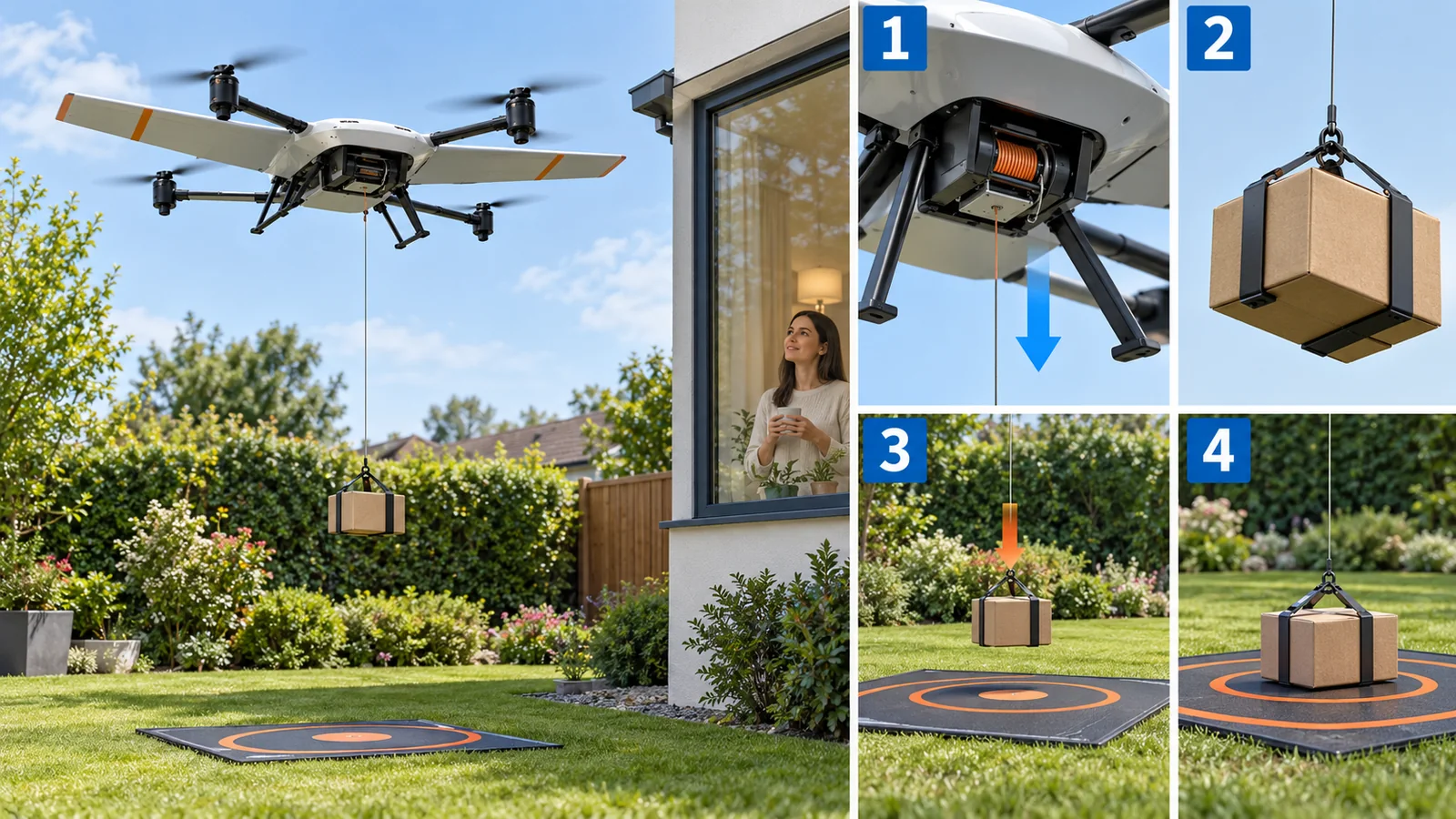
Start with an everyday comparison. A courier on a motorbike picks up a parcel at a shop, rides along roads and hands it over at the door. A delivery drone follows the same flow, but uses the sky instead of roads and drops the parcel from the air above a yard or car park. Most aircraft do not land at the customer’s place: they stay in the air (hover) and lower the package on a line (winch line). Limit of the analogy: a motorbike is supported by the ground, whereas a drone spends energy all the time just to stay up.
According to the FAA document, in Zipline’s operation a package is placed in a container called a “droid”, stored in the aircraft’s payload bay, and at the delivery point the droid is lowered to the ground on a line. During descent the droid controls its own lateral position and checks that the delivery site is clear [Reference 2]. Sourced The aircraft flies a predefined route; if it leaves its operating area it automatically terminates the flight and either returns to a dock or exits the airspace by hovering or by parachute landing, and the remote pilot can command flight termination [Reference 2]. Sourced Aircraft are said to share position, velocity and intent over radio and cellular links and to adjust their flight plans automatically to keep apart, even if communication with the remote pilot is lost (the company’s description) [Reference 2].
In the FAA document, a remote pilot in command (RPIC) is involved and can command termination of a flight. Rather than flying each aircraft by hand, people supervise many flights (Wing likewise says pilots oversee multiple flights and individual flights need no human control [Reference 8]). Whether an operation is fully autonomous or remotely piloted can only be confirmed within what the company says.
3. How the aircraft is built, and how heavy the load is
A delivery drone must take off and land vertically, hover, and fly a long way, which are almost contradictory demands (the VTOL idea in our explainer on fixed-wing, VTOL and long-endurance flight). The FAA document describes the Zipline P2 Zip as a multi-rotor design with five propellers, and the company says it uses those five for take-off and landing and aims to spend more of each flight in wing-borne fixed-wing mode [References 2, 6]. Wing describes a “dual propulsion” system with separate lift and cruise motors [Reference 8]. Sourced
As Fig. 3 shows, the package is a part of the aircraft. For the Zip, the payload is about 13% or more of total weight, leaving 87% or less for the aircraft, battery and package-lowering equipment (our calculation). This is why a lighter battery and a lighter aircraft translate directly into payload and range.
What is actually true: the maximum payloads we could confirm in FAA documents are 8 lb (about 3.6 kg) for the Zip and 2.7-5 lb for Wing, and Amazon’s MK30 is described as carrying up to 5 lb [References 2, 3, 9]. Sourced The loads are everyday goods and food that fit in a small box; heavy loads are outside what delivery drones assume today.
Zipline describes two platforms (P1: 4 lb payload, over 120 miles round trip; P2: 8 lb payload, 10-mile service radius, 70 mph cruise), all as company-stated values [Reference 4]. The FAA environmental assessment, however, gives a typical en-route speed of 47 mph for the P2 Zip, so the stated value (close to the best conditions) and the operating assumption differ [References 2, 4]. Sourced To get a feel for distance: a round trip to the edge of a 10-mile radius takes about 25.5 minutes of cruise at 47 mph, and Wing’s “12 miles round trip” takes about 12 minutes at 59 mph (delivery hover excluded). Our calculation
4. How to read delivery counts and speed
Back to the numbers at the start. Read delivery “numbers” in the three kinds of Fig. 4.
- (1) Company totals: in a release of 21 January 2026 Zipline reported over 2 million commercial deliveries and a median flight time of 3 minutes [Reference 5]. Wing’s website displays “1M+ commercial deliveries” and “fastest delivery 2 min 47 secs” [Reference 7]. Sourced These are company figures with no independent verification found. What counts as one delivery, and the cut-off date, are up to the company.
- (2) Ceilings in filings: Zipline’s Dallas-Fort Worth plan is up to 75 sites and 500 docks, up to 400 deliveries a day per site, and a 10-mile radius, starting with five sites at 20 flights a day [Reference 2]. Wing’s current authorisation allows up to 400 deliveries a day from 25 nests [Reference 3]. Sourced Not yet confirmed These are ceilings the companies seek to operate, not numbers achieved.
- (3) Best single results: “fastest 2 min 47 s” is one favourable result. Zipline’s “median 3 minutes” is a median flight time, not the time from order to handover (within what the company says).
What is actually true: the fastest is a favourable case. The full time includes order processing, loading, pre-departure checks and confirming the drop spot. A figure such as “most orders arrive in less than 30 minutes” in Zipline’s fact sheet is also the company’s description [Reference 4]. Sourced Check which kind of number it is: fastest, median, average or ceiling.
5. Five constraints on operations
How far delivery drones are usable in practice is set by five constraints (Fig. 5).
(1) Weather
Wing says its aircraft are built to operate in windy days and moderate rain [Reference 8]. Amazon says the MK30 can fly in light rain and a range of temperatures and wind speeds, but the delivery option does not appear at checkout when conditions are unsafe [Reference 9]. Zipline says it runs a large test campaign to deliver in rain, wind, storms and cold [Reference 4]. Sourced All of these are company statements, and we found no specific wind-speed or rainfall limits in the public documents we checked. On the rules side, the US small-drone rule (Part 107) sets, among other things, a flight visibility of at least 3 statute miles and an altitude of at most 400 ft [Reference 11]. Sourced The FAA assessment also says routes are generated taking weather risk, wind direction and population density into account [Reference 2].
(2) Payload
As Fig. 3 shows, the payload is a few pounds. In its UK example Amazon says items of 5 lb or less that fit in a large shoebox are eligible [Reference 9]. Beyond weight there are limits on box size and on the lowering equipment (container, line).
(3) Noise
FAA environmental assessments treat noise in detail. In Wing’s tests of the Hummingbird 7000W-B (April 2024, at a test site in California), cruise at 100 ft gave a sound exposure level (SEL) of 59.2 dBA with a package and 55.5 dBA without; one delivery event (a 13 ft hover and flight at 165 ft, measured 50 ft away) gave 83.4 dBA [Reference 3]. For Zipline’s P2 Zip the FAA assessment states 69.1 dBA SEL in cruise at 330 ft [Reference 2]. Sourced
The 3.7 dB difference between with and without package in Fig. 6 is about 2.3 times in sound energy (our calculation). A heavier load needs more thrust, so more noise (commentary). The decibel is a logarithmic unit: a 10 dB difference is a factor of 10 in energy. The FAA also uses DNL (day-night average sound level, with night noise weighted by adding 10 dB) in environmental assessments. Zipline’s assessment predicts that a single point exposed to 800 flights (400 round trips) would see en-route noise of DNL 50.3 dBA or less [Reference 2]. Sourced The “six times quieter than others” that the company publishes is a company claim; we found no independent verification [Reference 6].
(4) Rules and airspace
In the US, the small-drone rule (Part 107) covers unmanned aircraft weighing less than 55 pounds on takeoff including everything on board, and generally requires visual line of sight [References 10, 12]. Sourced To carry packages beyond visual line of sight, as the FAA explains, an operator must obtain a Part 135 certificate and an exemption or waiver for BVLOS. Altitude must be under 400 ft, and the FAA has completed more than 20 environmental assessments, each ending in a finding of no significant impact [Reference 1]. Sourced For where the new BVLOS proposed rule (Part 108) stands, see “Drone Communication, Positioning and Collision Avoidance” and “Drone Regulation and Airspace Management”.
(5) Sites and drop spots
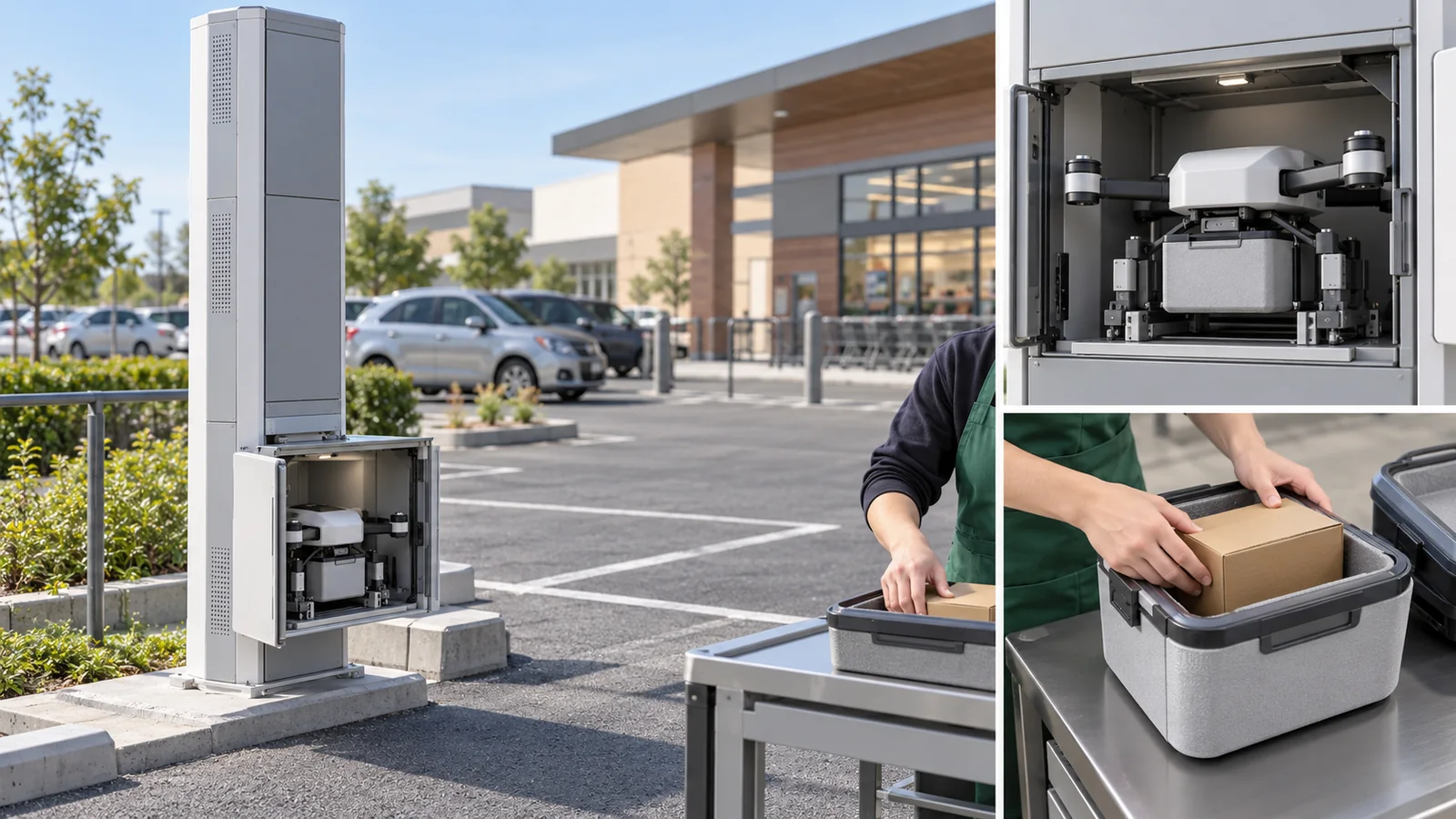
Delivery drones need places to take off, land and charge: docks (Zipline) or nests (Wing). Zipline’s docks house the aircraft, charge them, manage heat, exchange data and give weather protection, and are built on paved land such as car parks. Wing’s nests are planned in car parks of commercially zoned areas [References 2, 3]. Sourced Drop spots such as yards, driveways, car parks and parks must allow a safe lowering from above and keep clear of people and vehicles nearby (operating description in the FAA documents).
6. A materials engineer’s view, and what we could not confirm
The main noise source of a delivery drone is the propeller. The number of blades, shape and rotation speed change the pitch and loudness (commentary). Zipline says it reduces noise by limiting the number of propellers and running them efficiently and by delivering from a high altitude, and Wing says its propellers are designed to minimise noise [References 6, 8]. Sourced On the materials side, light, stiff and low-deflection composites such as carbon-fibre-reinforced plastics, and resins that damp vibration, are involved. A heavy propeller also raises the energy needed to change rotation speed.
The FAA documents say both Zipline’s and Wing’s aircraft run on lithium-ion batteries, and that docks handle charging and thermal management [References 2, 3]. A delivery drone battery is used with many charge-discharge cycles a day and short charging times (commentary). Ageing from repeated cycling, heat from fast charging and tolerance to outdoor heat and cold feed directly into fleet availability and cost. The basics are in “Lithium-Ion Battery Basics” and “Thermal Runaway and Battery Safety”.
A container that holds the package must be light, protect the contents from drops and rain, and fit the payload bay (commentary). The lowering line is wound in repeatedly, whipped by wind and scuffed on the ground. Lightness, strength, abrasion resistance and weather resistance must be met together, and the choice of material affects how few failures occur (commentary). We could not confirm which materials the companies actually use.
What we could not confirm
- Independent third-party verification of delivery counts, speed and quietness.
- Specific operational weather limits (wind speed, rainfall); the companies give only qualitative statements.
- The actual materials of the companies’ containers, lines and propellers.
- The latest status of the FAA authorisations of Zipline and Wing (an environmental assessment is a document at application time; the conditions of an authorisation are separate).
- Delivery-drone rules in Japan and Europe (covered in “Drone Regulation and Airspace Management”).
- Accident and incident statistics. This article does not use official investigation reports.
7. How to read the yardsticks and standards
Delivery drones are measured by delivery time, payload, service radius, delivery success rate, noise and few accidents or faults. The key point is to separate numbers a company publishes itself from numbers confirmed in a regulator’s review. For example, the noise figures in an FAA environmental assessment are predictions based on company-supplied information and tests, and Wing’s document states that its tests followed FAA direction.
| What is measured | Typical test or benchmark (name, source) | Standard, rule or guidance (name, source checked) | Reading note |
|---|---|---|---|
| Delivery time and counts | Company totals, fastest and median (Zipline over 2 million, Wing over 1 million) [References 5, 7] Sourced | No common yardstick was found | Separate fastest, median and average. Company figures; independent verification not confirmed |
| Payload and aircraft | Aircraft specifications in FAA environmental assessments (weight, payload, wingspan) [References 2, 3] Sourced | 14 CFR 107.3 (small unmanned aircraft: under 55 lb including everything on board) [Reference 10] Sourced | Some figures differ within the same document (8000-A payload). Check the appendices too |
| Operating safety and rules | FAA environmental assessments (more than 20, all with a finding of no significant impact) [Reference 1] Sourced | 14 CFR Part 135 (certification), exemption or waiver (BVLOS), Part 107 sections 107.31 and 107.51 [References 1, 11, 12] Sourced | An environmental assessment reviews environmental effects; it is not proof of aircraft safety (commentary). The scope of an authorisation is per site, aircraft and period |
| Noise | SEL and Lmax (tests), DNL (daily average) [References 2, 3] Sourced | FAA “Measuring Drone Noise for Environmental Review Process” (October 2023, cited in Wing’s document; guidance text not read) and FAA Order 1050.1F (environment) [Reference 3] Sourced | SEL is per event, DNL a daily average with +10 dB at night. Do not compare values in different units |
| Weather tolerance | Companies’ qualitative statements (wind, rain) [References 4, 8, 9] Sourced | Not confirmed (no standard for delivery-drone weather performance was found) | No numerical limits published. Operating decisions are the company’s |
| International operating standard | Not confirmed | ISO 21384-3 “Operational procedures” (UAS; current edition not confirmed) / ASTM standards were not consulted | An international standard is voluntary; legal force depends on national rules (commentary) |
The arrangement of the table is Our calculation (organisation). Names and status were checked on official pages (checked 25 October 2026).
Reading notes (for materials engineers)
- Read the scope of an “approval”: the conclusion of an environmental assessment is that the operation has no significant environmental impact, not a guarantee of aircraft safety. Authorisations are per site, aircraft and period.
- Separate plans from results: “up to 400 a day” in a filing is not an achieved value; the filing says rollout starts with five sites at 20 flights a day.
- A company’s “quiet” or “fast” is a claim: check the measuring conditions (altitude, distance, payload, method) and whether anyone independent verified it.
8. Glossary
- Part 135
- US rules for small commercial air carriers; drone delivery operators are certified under it.
- Part 107
- US rules for small unmanned aircraft (under 55 lb); visual line of sight by default.
- Exemption / waiver
- Permission to depart from part of a rule, under conditions.
- BVLOS
- Beyond visual line of sight.
- Environmental assessment (EA)
- A US document assessing environmental effects; the FAA prepares one per delivery proposal.
- FONSI
- Finding of no significant impact.
- OpSpecs
- Operations specifications: the document setting an operator’s approved operations.
- Dock / nest
- The place where an aircraft takes off, lands, charges and waits.
- Hover
- Staying still in the air.
- Payload
- The mass of cargo carried.
- AGL
- Height above ground level.
- dBA
- A-weighted decibels: sound level weighted to human hearing.
- SEL
- Sound exposure level: one event’s sound energy expressed over one second.
- Lmax
- Maximum sound level during the period.
- DNL
- Day-night average sound level; night noise is weighted by adding 10 dB.
- RPIC
- Remote pilot in command.
- Deconfliction
- Arranging flight paths so aircraft do not conflict.
- Winch line
- A retractable line used to lower a package from the air.
9. References (primary sources)
- FAA Package Delivery by Drone (Part 135) (certification, BVLOS exemption or waiver, under 400 ft, more than 20 environmental assessments) — www.faa.gov/uas/advanced_operations/package_delivery_drone
- FAA Final Environmental Assessment for Zipline International Inc. Proposed Drone Package Delivery Operations in Dallas-Fort Worth, Texas (December 2025) — www.faa.gov/uas/advanced_operations/nepa_and_drones/20251223_Zipline_Final_DFW_EA_508_signed.pd
- FAA Final Supplemental Environmental Assessment for Wing Aviation, LLC, Proposed Drone Package Delivery Operations in Dallas-Fort Worth, Texas (April 2025) — www.faa.gov/uas/advanced_operations/nepa_and_drones/20250421_Wing_DFW_Final_SEA_Combined.pdf
- Zipline (company) Zipline Fact Sheet (platform 1 and platform 2; company-stated; page dated July 2023 but includes 2025 content) — www.zipline.com/about/zipline-fact-sheet
- Zipline (company) Zipline Surpasses 2 Million Deliveries (21 January 2026; company press release) — www.zipline.com/newsroom/zipline-surpasses-2-million-deliveries-raises-more-than-600m-to-power-
- Zipline (company) Zipline’s Never-Ending Quest to Make Quiet Deliveries Even Quieter (25 March 2026; company blog) — www.zipline.com/newsroom/zipline-s-never-ending-quest-to-make-quiet-deliveries-even-quieter
- Wing (company) Wing Drone Delivery home page (1M+ commercial deliveries; fastest delivery 2 min 47 s; company display, checked 25 October 2026) — wing.com
- Wing (company) How Wing’s Drone Delivery Technology Works (separate lift and cruise motors; windy days and moderate rain; up to 60 mph and 12 miles round trip; company-stated) — wing.com/technology
- Amazon (company) Inside Amazon’s first UK drone delivery site for Prime Air (MK30 carries up to 5 lb; light rain; unsafe weather removes the option; company statement) — www.aboutamazon.com/news/transportation/amazon-drone-prime-air-uk
- US eCFR 14 CFR 107.3 Definitions (small unmanned aircraft: under 55 pounds on takeoff including everything on board) — www.ecfr.gov/current/title-14/part-107/section-107.3
- US eCFR 14 CFR 107.51 Operating limitations for small unmanned aircraft (groundspeed, 400 ft, visibility of 3 statute miles) — www.ecfr.gov/current/title-14/part-107/section-107.51
- US eCFR 14 CFR 107.31 Visual line of sight aircraft operation — www.ecfr.gov/current/title-14/part-107/section-107.31
10. Claim-to-source audit
| Claim in the text | Basis | Type |
|---|---|---|
| Package delivery drones use the Part 135 certification process and obtain an exemption or waiver for BVLOS; flights stay under 400 ft; FAA completed more than 20 environmental assessments, each ending in a finding of no significant impact | FAA page Reference 1 https://www.faa.gov/uas/advanced_operations/package_delivery_drone | Sourced |
| Zipline P2 Zip: multi-rotor with five propellers, under 63 lb with maximum payload 8 lb, wingspan about 7.8 ft | FAA environmental assessment (company’s description) Reference 2 https://www.faa.gov/uas/advanced_operations/nepa_and_drones/20251223_Zipline_Final_DFW_EA_508_signed.pdf | Sourced |
| Zip operations: 330 ft, 47 mph, about 75 s of hover per delivery, pod lowered on a line | FAA environmental assessment Reference 2 https://www.faa.gov/uas/advanced_operations/nepa_and_drones/20251223_Zipline_Final_DFW_EA_508_signed.pdf | Sourced |
| Zipline plan (application): up to 75 sites and 500 docks, up to 400 a day per site, 10-mile radius, starting with five sites at 20 flights a day | FAA environmental assessment (a company plan, not achieved) Reference 2 https://www.faa.gov/uas/advanced_operations/nepa_and_drones/20251223_Zipline_Final_DFW_EA_508_signed.pdf | Sourced |
| Per the FAA document, a Zip that leaves its operating area terminates the flight automatically and returns to a dock or uses hover or parachute landing | FAA environmental assessment Reference 2 https://www.faa.gov/uas/advanced_operations/nepa_and_drones/20251223_Zipline_Final_DFW_EA_508_signed.pdf | Sourced |
| Wing Hummingbird 7000W-B: 16 propellers, under 15 lb with 2.7 lb payload, wingspan about 4.9 ft; 8000-A: 12 propellers, under 25 lb, payload 5 lb (main text) | FAA supplemental environmental assessment Reference 3 https://www.faa.gov/uas/advanced_operations/nepa_and_drones/20250421_Wing_DFW_Final_SEA_Combined.pdf | Sourced |
| For the 8000-A the appendix of the same document gives 6.6 lb payload (24.3 lb total) | Appendix of the FAA supplemental assessment Reference 3 https://www.faa.gov/uas/advanced_operations/nepa_and_drones/20250421_Wing_DFW_Final_SEA_Combined.pdf | Sourced |
| Wing operations: 150-300 ft; hover at 23 ft at the delivery point; typical speed 59 mph; currently up to 400 a day from 25 nests | FAA supplemental assessment Reference 3 https://www.faa.gov/uas/advanced_operations/nepa_and_drones/20250421_Wing_DFW_Final_SEA_Combined.pdf | Sourced |
| Wing 7000W-B noise tests (April 2024): cruise at 100 ft with package SEL 59.2 dBA, without 55.5 dBA, one delivery 83.4 dBA | Technical noise report in the FAA document Reference 3 https://www.faa.gov/uas/advanced_operations/nepa_and_drones/20250421_Wing_DFW_Final_SEA_Combined.pdf | Sourced |
| P2 Zip in-flight noise at 330 ft is 69.1 dBA SEL; a point exposed to 800 flights (400 round trips) stays at or below DNL 50.3 dBA (prediction) | FAA environmental assessment (prediction based on company information) Reference 2 https://www.faa.gov/uas/advanced_operations/nepa_and_drones/20251223_Zipline_Final_DFW_EA_508_signed.pdf | Sourced |
| A 3.7 dB difference is about 2.3 times in sound energy | Our calculation (10^0.37) | Our calculation |
| Payload share lower bounds: Zip 8/63 = about 13%; 8000-A 5/25 = 20%; 7000W-B 2.7/15 = 18% | Our calculation (illustrative, using the stated upper bounds) | Our calculation |
| Zip: a round trip to the edge of a 10-mile radius takes about 25.5 min of cruise at 47 mph (hover excluded); Wing: a 12-mile round trip at 59 mph takes about 12 min | Our calculation | Our calculation |
| Zipline P2: 8 lb payload, 10-mile radius (24 miles one way), 70 mph cruise (company-stated); the FAA assessment gives a typical 47 mph | Zipline fact sheet (company-stated) and FAA environmental assessment Reference 4 https://www.zipline.com/about/zipline-fact-sheet Reference 2 https://www.faa.gov/uas/advanced_operations/nepa_and_drones/20251223_Zipline_Final_DFW_EA_508_signed.pdf | Sourced |
| Zipline passed 2 million commercial deliveries (company release of 21 January 2026); median flight time 3 minutes (company) | Company press release Reference 5 https://www.zipline.com/newsroom/zipline-surpasses-2-million-deliveries-raises-more-than-600m-to-power-next-phase-of-growth-and-expands-operations-to-houston-and-phoenix | Sourced |
| Wing displays 1M+ commercial deliveries and a fastest delivery of 2 min 47 s on its website | Company website Reference 7 https://wing.com | Sourced |
| Zipline takes off and lands on five propellers and aims to spend more flight in fixed-wing mode; typical altitude at least 300 ft | Company blog Reference 6 https://www.zipline.com/newsroom/zipline-s-never-ending-quest-to-make-quiet-deliveries-even-quieter | Sourced |
| Zipline’s “six times quieter than others” is a company claim; independent verification was not found | Company blog (as a claim). Commentary: no independent verification found Reference 6 https://www.zipline.com/newsroom/zipline-s-never-ending-quest-to-make-quiet-deliveries-even-quieter | Sourced |
| Wing uses separate lift and cruise motors, up to 60 mph and 12 miles round trip, and says it operates in windy days and moderate rain (company-stated) | Company technology page Reference 8 https://wing.com/technology | Sourced |
| Amazon MK30 carries up to 5 lb, flies in light rain, and the option is withdrawn in unsafe weather (UK) | Company statement Reference 9 https://www.aboutamazon.com/news/transportation/amazon-drone-prime-air-uk | Sourced |
| Part 107: small UA under 55 lb including cargo, 400 ft, flight visibility of 3 statute miles, visual line of sight | eCFR Reference 10 https://www.ecfr.gov/current/title-14/part-107/section-107.3 Reference 11 https://www.ecfr.gov/current/title-14/part-107/section-107.51 Reference 12 https://www.ecfr.gov/current/title-14/part-107/section-107.31 | Sourced |
| The Wing document says tests followed the FAA guidance “Measuring Drone Noise for Environmental Review Process” (October 2023) | Statement in the FAA document (the guidance itself was not read) Reference 3 https://www.faa.gov/uas/advanced_operations/nepa_and_drones/20250421_Wing_DFW_Final_SEA_Combined.pdf | Sourced |
Last updated: 25 October 2026 / Sources are limited to primary sources (the FAA, US eCFR and company web pages). Third-party verification of delivery counts, speed and quietness, specific weather limits, the materials the companies use, the latest status of authorisations, accident and incident statistics, the Japanese and European systems, and ASTM standards could not be confirmed and are therefore not stated. Investment-related information such as company valuations and funding is not discussed. This article does not rank companies or aircraft and is not legal advice. Weapons are not covered.