TECHNOLOGY EXPLAINER
How to Read Robot Safety Standards
– “Conforms to a standard” is not the same as “safe”: a map of ISO 10218, 13482, 3691-4, 25785-1 and 13849-1
Robot catalogues and announcements often say “conforms to ISO XXXX.” But the standard numbers differ by type of robot, and some are published while others are still being drafted. And conforming to a standard does not mean there is no danger, anywhere, for anyone. This article assumes no robotics background. In order, it covers (1) what “safe” means, (2) a map of the standards, (3) the industrial-robot standards and their 2025 revision, (4) standards for other kinds of robots, (5) safety of the control system, (6) how standards connect to law, and (7) how to read “conformity” versus “safety”, with figures and small calculations. The standards themselves are paid documents, so this article stays with titles, scope and status (published or in development) and does not state requirements.
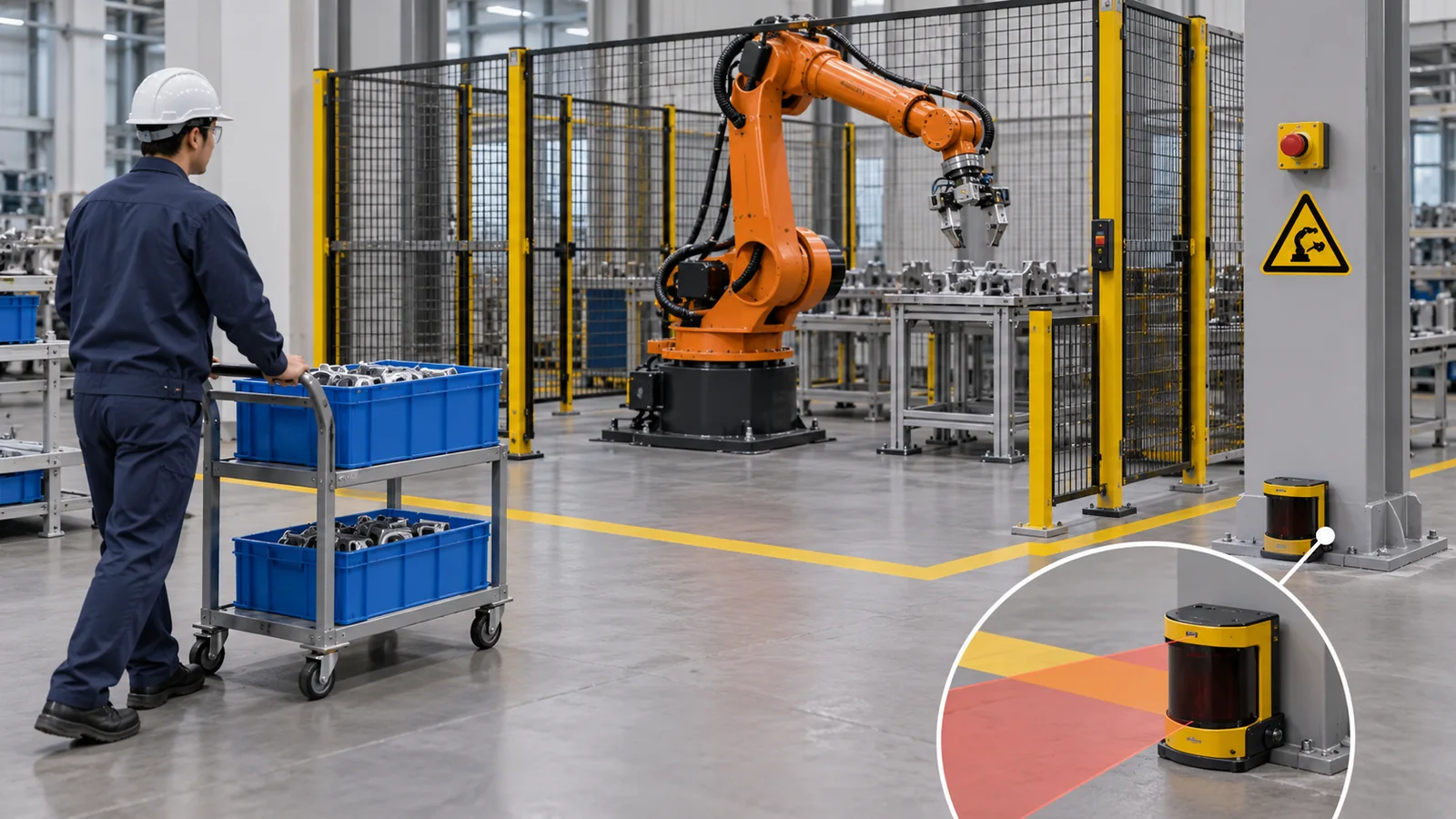
- The short version / what to know first / where this sits in the series
- What “safe” means: risk never reaches zero
- A map of the standards: from basic to specific
- Industrial robot standards: ISO 10218-1 and -2:2025
- Stopping distance and impact force in numbers
- Standards for other kinds of robots: personal care, driverless trucks, legged robots
- Safety of the control system: ISO 13849-1 and performance levels
- From standards to law: Japan, the US and the EU
- Seven questions for reading “conformity” versus “safety”
- Limits, what could not be confirmed, and summary
- How to read the yardsticks and standards
- Glossary
- References (primary sources)
- Claim-to-source audit
Sourced = stated in an official source (standards body, authority or association publication), with a link
Our calculation = a value this article computed from stated assumptions
Not yet confirmed = standards in development, planned revisions, plans: anything not yet settled
Our readings of structure and of materials are labelled commentary. An Inference is shown in bold. Every analogy comes with its limit.
The standards are paid documents and we have not read them. What follows comes from the number, title, scope summary and status shown on official pages such as ISO’s, and from what associations and authorities have published. We have not guessed at requirements (numerical limits, test procedures, pass criteria). Standards change, and this field moves fast. Each item carries a check date (25 October 2026). This is a general explainer. It does not certify the safety of any robot or facility, give design, purchasing or operating advice, or judge legal compliance. For real design or deployment, consult the standards themselves, the law, and qualified experts (safety professionals, certification bodies).
1. The short version / what to know first / where this sits in the series
- A standard is an agreed way of building and checking safety, not a guarantee of safety. Risk (how bad an injury is x how likely it is) never reaches zero, and even a robot that conforms can be dangerous if its use or surroundings differ from what was assumed. Germany’s IFA likewise writes that for collaborative robots “a residual risk remains” Sourced[Ref. 17].
- Each type of robot has its own standard, and each is at a different stage. For industrial robots it is ISO 10218-1 and -2:2025 (revised in 2025; the collaborative content of ISO/TS 15066 was taken in) Sourced[Ref. 1, 13]. Personal care and service robots have ISO 13482:2014 (a revision is at its final stage), driverless trucks have ISO 3691-4:2023, and for legged and other self-balancing robots ISO 25785-1 is still a committee draft (in development) Not yet confirmed[Ref. 5, 6, 7, 8].
- “Conformity” only means something once you read which edition of which standard, covering what, claimed by whom, under what conditions. A standard is not itself law; it becomes binding when law or a contract refers to it, and the route differs by country and region. Chapter 9 turns this into seven questions.
You need no background in robotics or safety. A robot is a combination of sensing, thinking (control and intelligence) and moving (actuators), and an actuator is the robot’s muscle (motor plus reducer), the common view across this series (see the overview article on drones and robotics). This article is about the agreed rules for the “moving” part, so that robots do not hurt people. ISO (the International Organization for Standardization) writes international standards; JIS is the Japanese national standard.
This article is an entrance to the question “what rules does a robot follow in order to work near people?” Individual robots are covered in the series articles on industrial and collaborative robots, humanoid robots, legged and inspection robots, and warehouse and logistics robots; this article collects how to read the phrase “conforms to a standard” that appears there. Drone rules are covered separately in the article on drone regulation and airspace management.
2. What “safe” means: risk never reaches zero
Think of a car. Seat belts, brakes and airbags do not make accidents “zero.” Yet we drive, because we think: “lower the danger to an acceptable level, and handle what remains through how we use it.” Robot safety works the same way.
(1) Hazard and risk
A robot has “sources” that can injure people: a fast-moving arm, strong force, a sharp tool tip, a gap that can trap. Such a source is called a hazard. Risk is the combination of how serious an injury from that hazard would be and how likely it is (our commentary; the ISO 12100 page describes that standard as covering the procedure of identifying hazards, estimating and evaluating risk, and eliminating the hazard or reducing risk sufficiently) Sourced[Ref. 10].
(2) Three steps to lower risk
The ISO 10218-1 page says the standard deals with inherently safe design, risk-reduction measures and information for use. The scope of ISO 13482 lists the same three Sourced[Ref. 1, 5]. Fig. 2 sets them out.
A sharp kitchen knife is a hazard, but in a closed drawer its risk is small. Put the same knife where a child can reach it and the risk grows. Robots are the same: “there is a hazard” and “the risk is large” are different things. That is why standards first ask how to remove or shrink the hazard itself (the idea that the steps are generally considered in this order comes from ISO 12100, but we have not checked its text). Limit of the analogy: a knife sits still, while a robot moves and changes position.
This is inaccurate. The ISO 13849-1 page (the control-system standard) itself says the standard does not specify which safety functions or which performance levels are needed Sourced[Ref. 9]. What must be protected is decided by the risk assessment of that particular use. Germany’s IFA writes that where collaborative robots remove guards, other technical protective measures are needed and “a residual risk remains” [Ref. 17]. An A3 article also explains that standards are guidance, and that employers must obey other safety regulations beyond what a standard covers [Ref. 13].
3. A map of the standards: from basic to specific
Robot standards fit together like building blocks, from “basic (common to all machinery)” to “specific (by type of robot).” The ISO 12100 page says that standard is meant as a basis for preparing more specific standards (what ISO calls type B and type C) Sourced[Ref. 10]. The ISO 13849-1 page likewise says requirements specific to a certain machine can be considered in a “type-C standard” [Ref. 9]. Robot standardization is handled by ISO/TC 299 (created in 2015; robotics excluding toys and military applications); WG 3 deals with industrial safety and WG 2 with service-robot safety Sourced[Ref. 12].
| Standard | Title (ISO page) | What it covers (scope summary) | Status (checked 25 Oct 2026) |
|---|---|---|---|
| ISO 10218-1:2025 | Robotics — Safety requirements — Part 1: Industrial robots | The industrial robot itself, treated as “partly completed machinery”; covers inherently safe design, risk-reduction measures and information for use. Does not apply to robots made before its publication Sourced[Ref. 1] | Published (3rd edition, February 2025). Replaces the 2011 edition |
| ISO 10218-2:2025 | Robotics — Safety requirements — Part 2: Industrial robot applications and robot cells | Integration, commissioning, operation, maintenance and disposal of industrial robot applications and robot cells Sourced[Ref. 2] | Published (2nd edition, 2025) |
| ISO/TS 15066:2016 | Robots and robotic devices — Collaborative robots | Safety of collaborative industrial robot systems and the work environment. A technical specification (TS) that supplements ISO 10218-1 and -2 Sourced[Ref. 3] | Published. Stage 90.92 “to be revised”. A successor, ISO/AWI 15066-1, is at the registered stage (20.00) Not yet confirmed[Ref. 4] |
| ISO 13482:2014 | Robots and robotic devices — Safety requirements for personal care robots | Three types: mobile servant, physical assistant and person carrier robots. Excludes robots faster than 20 km/h, toys, waterborne and flying robots, industrial robots, medical devices and military robots Sourced[Ref. 5] | Published (February 2014). The replacement, ISO/FDIS 13482 (titled for service robots), is at stage 50.20 [Ref. 6] |
| ISO 3691-4:2023 | Industrial trucks — Safety requirements and verification — Part 4: Driverless industrial trucks and their systems | Driverless industrial trucks; examples include automated guided vehicles (AGVs) and autonomous mobile robots (AMRs). Trucks guided only by rails and remotely controlled trucks are excluded Sourced[Ref. 7] | Published (2nd edition, June 2023). A next version (ISO/DIS) is shown as under development |
| ISO/CD 25785-1 | Robotics — Safety requirements for dynamically stable industrial mobile robots (legged, wheeled, or other forms of locomotion) — Part 1: Robots | Industrial mobile robots that need active control to stay balanced and could become unstable without power: quadruped, biped, balancing wheeled robots and so on. Part 2 (applications) is to be developed separately Sourced[Ref. 8] | In development. Committee draft, stage 30.60 “close of comment period” Not yet confirmed |
| ISO 13849-1:2023 | Safety of machinery — Safety-related parts of control systems — Part 1: General principles for design | Method and requirements for designing the control systems that carry safety functions. Does not decide which safety functions are needed Sourced[Ref. 9] | Published (4th edition, April 2023) |
| ISO 12100:2010 | Safety of machinery — General principles for design — Risk assessment and risk reduction | Basic terms, principles, and the method of risk assessment and risk reduction for machinery Sourced[Ref. 10] | Published. A next version is shown as under development |
| ISO 8373:2021 | Robotics — Vocabulary | Definitions of terms used in robotics Sourced[Ref. 11] | Published (3rd edition, November 2021). A next version (ISO/DIS) is shown as under development |
The “scope summary” column paraphrases the abstracts on the ISO pages. The texts are paid and have not been checked.
International standards are not finished in one step. The ISO pages show stages such as a newly registered project (stage 20.00), close of the committee-draft comment period (30.60), start of the final-draft ballot (50.20), and published but due for review (90.92, “to be revised”). In general the order is AWI (approved work item), CD (committee draft), DIS (draft international standard), FDIS (final draft international standard), then publication (our commentary). So a standard at CD or AWI is a “plan” whose content can still change. If something says “designed to ISO XXXX,” check whether that is a published standard or a draft.
4. Industrial robot standards: ISO 10218-1 and -2:2025
The core safety standard for the “industrial robots” that move, weld and assemble parts in factories is ISO 10218. In 2025 it was revised over almost eight years by experts from more than 20 countries (A3 article) Sourced[Ref. 13].
(1) Two parts: “the robot” and “how the robot is used”
Part 1 is the standard for the robot itself, treated as “partly completed machinery.” Part 2 is the standard for the “robot application” and the robot cell: the robot plus its tool (end effector), workpieces, peripheral equipment and task program. In A3’s description, Part 1 is for robot manufacturers and Part 2 for integrators (companies that build the working system) Sourced[Ref. 13, 1, 2]. A robot can conform to the standard, and the danger still changes once someone fits a sharp tool. That is why a separate standard for the “application” exists.
(2) Main changes in 2025 (as A3 describes them)
- Functional-safety requirements went from implied to explicit. Functional safety means that safety functions (stopping, monitoring) really work (Chapter 7) Sourced[Ref. 13].
- The content of ISO/TS 15066 was taken in. Where appropriate it was added to Part 1; in Part 2 the safety requirements for collaborative applications were incorporated, and cybersecurity requirements were added Sourced[Ref. 13].
- Terminology changed. “Collaborative robot” and “collaborative operation” are no longer used; the standard says “collaborative application” instead, because only the actual use, not the robot alone, can be designed, tested and confirmed. “Safety rated-monitored stop” was renamed “monitored standstill” Sourced[Ref. 13, 14].
- Size. An A3 article says Part 1 grew from 50 to 95 pages and Part 2 from 72 to 223 pages (the 95 pages for Part 1 matches the ISO page) Sourced[Ref. 14, 1]. That is too much to summarize in a few lines.
In an A3 article, the chair of the US R15.06 drafting subcommittee says that the term “collaborative robot” has wrongly come to mean robots that use power and force limiting, and that in fact “there is no such thing as a cobot”: there are robots that use collaborative technologies. The recognized collaborative technologies are hand guiding, speed and separation monitoring, and power and force limiting [Ref. 14]. What has to be made safe is the whole “application”: robot, tool and task (Fig. 5).
(3) What is the status of ISO/TS 15066 now?
On the ISO page, ISO/TS 15066:2016 is a published document that was reviewed and confirmed in 2022. At the same time it is at stage 90.92 (“to be revised”), and its successor, ISO/AWI 15066-1 “Robotics — Physical contact with robots — Part 1: Biomechanical thresholds and data” (limits and data for contact with the human body), is at the registered stage (20.00) SourcedNot yet confirmed[Ref. 3, 4]. In Japan, JIS TS B 0033:2017 corresponds to ISO/TS 15066:2016 (list of the Japan Robot Association, as of 30 November 2024) Sourced[Ref. 19].
A3 explains that the 2025 ISO 10218 took in the content of ISO/TS 15066 (the requirements for collaborative applications). On the ISO page, however, TS 15066:2016 itself stays current, and a successor dealing with “contact limits and data” is moving separately. Where the line falls between what was taken in and what stays in TS 15066 (or moves to the new document) could not be confirmed, because the texts are paid. So one cannot say “TS 15066 is no longer needed,” nor “it can be used as is.” When you use it, check which edition the relevant national standard or contract refers to (commentary).
5. Stopping distance and impact force in numbers
The language of standards looks hard, but the ideas can be checked with everyday numbers. Here we use assumed numbers, for practice in reading, not values from any standard.
(1) The longer the stop takes, the farther away it must be detected
Take a person approaching a robot that must be stopped. Assume the person approaches at 1.0 m/s and keeps that speed from detection until the robot has fully stopped. Then distance = speed x time. A stop in 0.2 s means 0.2 m, 0.5 s means 0.5 m, 1.0 s means 1.0 m, and 2.0 s means 2.0 m Our calculation. A robot that needs two seconds to stop must detect the person when they are still 2 m away, or it is too late.
In real design, the robot’s own stopping distance, the sensor’s detection delay and the assumed walking speed are fixed on a documented basis, following the standards. This article does not state those values.
(2) The lighter the moving part, the smaller the impact
The kinetic energy of a moving object is 1/2 x mass x speed squared. A 10 kg part moving at 1 m/s has 1/2 x 10 x 1^2 = 5 J. At 2 m/s it has 1/2 x 10 x 2^2 = 20 J (twice the speed, four times the energy). Halve the mass to 5 kg and at 1 m/s it is 2.5 J Our calculation.
| Mass of the moving part | Speed | Kinetic energy (1/2 x mass x speed^2) |
|---|---|---|
| 10 kg | 1 m/s | 5 J |
| 10 kg | 2 m/s | 20 J (twice the speed, four times the energy) |
| 5 kg | 1 m/s | 2.5 J (half the mass, half the energy) |
The numbers are assumed examples, not values for any real robot. Our calculation
A leaflet from Japan’s Ministry of Health, Labour and Welfare (December 2013) lists the points to watch especially when assessing the risk of an industrial robot: the force and kinetic energy of the manipulator, the possibility that a person is trapped between the manipulator and surrounding structures, and the shape of the manipulator (protrusions, sharp parts, trapping at joints). For trapping, it gives as one example of “no danger” a minimum clearance of 500 mm or more from surrounding structures, or the ability to free the person by hand without drive power Sourced[Ref. 18]. As the calculation above shows, at the same speed a lighter moving part hits with less energy. So making arms from light metals or CFRP (carbon-fibre-reinforced plastic), rounding and softening surfaces, and covering sharp parts with guards or cushioning are design choices that help performance and also lower safety risk (commentary). But light materials trade off against stiffness and life, and how much a cover or cushion really softens an impact depends on the material and shape and has to be confirmed by tests in the standards (we have not checked any test conditions). Material properties are covered in the series articles on structural materials for robots and drones and on soft robots and artificial muscles.
6. Standards for other kinds of robots: personal care, driverless trucks, legged robots
ISO 10218 is for industrial robots in factories. For both parts, the ISO pages say service robots (which the public can approach), consumer products, medical, underwater, military and people-lifting or people-carrying uses are out of scope. Also excluded are the hazards of “mobility” when the robot is fixed to a driverless truck or a mobile platform, and use in explosive atmospheres Sourced[Ref. 1, 2]. In other words, once the robot moves around, you need to look at a different standard.
(1) Personal care and service robots: ISO 13482
ISO 13482:2014 covers three types: mobile servant robots, physical assistant robots and person carrier robots. The ISO page includes a note that, for impact hazards such as collisions, no exhaustive, internationally recognized data (such as pain or injury limits) existed at the time of publication Sourced[Ref. 5]. It is an example of a standard saying what is not yet known. The 2014 edition is current, but its replacement, ISO/FDIS 13482 (titled Robotics — Safety requirements for service robots), is at the final stage (50.20) and is described as covering service robots in personal and professional or commercial applications Not yet confirmed[Ref. 6]. In Japan, JIS B 8445:2016 corresponds to ISO 13482:2014 [Ref. 19].
(2) Driverless trucks and AMRs: ISO 3691-4
Driverless carts that carry loads in warehouses and factories fall under ISO 3691-4, one of the “industrial trucks” standards. The ISO page gives “automated guided vehicle,” “autonomous mobile robot” and “tunnel tugger” among its examples. It also says that the condition of the operating zone strongly affects safety, and that preparing the zone is specified in Annex A Sourced[Ref. 7]. AMRs are covered in more detail in the series article on warehouse and logistics robots.
(3) Legged and other “self-balancing” robots: ISO 25785-1 (in development)
Unlike a wheeled cart that simply stands still, a quadruped or a two-legged humanoid can fall if power is cut or control stops. The scope of ISO/CD 25785-1 covers this kind of industrial mobile robot that “needs active control to stay balanced,” with quadruped, biped and balancing wheeled robots as examples. It is limited to industrial environments, where the public is excluded or restricted. Non-industrial uses (household and consumer, medical, military, space, underwater and so on) are out of scope, with a note that other standards such as ISO 13482 apply there. Vertical surfaces, underground use, explosive atmospheres and nuclear environments are also not covered as hazards Sourced[Ref. 8]. Its status on the ISO page of 25 October 2026 is “committee draft, close of comment period (30.60)” Not yet confirmed. The date of publication and the final requirements could not be confirmed.
As far as the official pages show today, two-legged and four-legged robots in industrial environments are meant to be covered by ISO 25785-1 (in development), non-industrial settings by the ISO 13482 family, and in explosive atmospheres neither 25785-1 nor 10218 applies. So one cannot say that “a humanoid standard” is in place. This is an area where standards have not caught up with the technology (commentary). If a product in this area says “conforms to a safety standard,” always check which standard and which edition. Humanoids are covered in the series article on humanoid robots.
7. Safety of the control system: ISO 13849-1 and performance levels
Safety is not built from sturdy fences alone. Often it is built from safety functions: detect that a person is near (input), decide (logic), and stop (output). If any link in that chain fails, safety is lost. ISO 13849-1:2023 deals with the design of this chain (the safety-related parts of the control system) Sourced[Ref. 9].
According to an IFA document, the standard combines the category (the structure of the control system), the MTTFd (mean time to dangerous failure of components), the DC (diagnostic coverage, the share of faults that are detected) and other inputs to find the frequency of dangerous failure and the performance level (PL) Sourced[Ref. 15]. A page describing an IFA/BGIA report says it gives examples for PL a to e and categories B to 4 [Ref. 16]. PL is a measure of how dependably that safety function works; it is not a safety rating of the whole robot. The PL needed is decided by the risk assessment (commentary).
If a stop button or sensor is labelled “PL d,” it means roughly that the part can be one element of a PL d safety function. The performance of a safety function depends on the whole combination of detecting, deciding and stopping. If one link is weak, the whole is weak (commentary; the calculation method is in the standard’s text and is not given here). Analogy: a chain breaks at its weakest link. Limit of the analogy: with redundancy, a design can keep working even if one element fails.
MTTFd is a number for the reliability of a part, and underneath it lie material fatigue, wear and degradation: fatigue of the sheath and conductors of a cable that bends repeatedly, wear of a brake’s friction material, dirt and discoloration on a sensor window or lens, hardening of a seal. If a part that is supposed to deliver a safety function loses performance through material degradation during use, a PL on paper means nothing (commentary. Inference: which materials account for most real failures has not been confirmed in our sources). The ISO 10218 pages also say that use in explosive atmospheres, in uses with hygiene requirements and in extreme climates is out of scope Sourced[Ref. 1]. In food, pharmaceutical and chemical plants, the choice of materials (resins that resist static charge, materials that withstand washing, permitted lubricants) becomes part of safety, so conditions outside a standard’s scope have to be checked against other criteria.
8. From standards to law: Japan, the US and the EU
An ISO standard is not law by itself. It becomes something that must be followed only when national law or a contract refers to it. Fig. 8 sets out the routes in three regions, as far as we could confirm.
(1) Japan
Article 150-4 of the Industrial Safety and Health Regulations requires employers to take measures such as fences or enclosures when contact with an industrial robot of more than 80 W rated output could be dangerous. By a notice of 24 December 2013 (Kihatsu 1224 No. 2), the Ministry of Health, Labour and Welfare made the safety criteria for collaborative work clear. Collaborative work is described as possible (1) when a risk assessment can show that the risk of danger from contact has been removed, or (2) when an industrial robot designed, made and installed according to ISO 10218-1:2011 and ISO 10218-2:2011 (with a technical file and declaration of conformity prepared) is used appropriately under its conditions of use Sourced[Ref. 18]. How this notice relates to the 2025 edition of ISO 10218 could not be confirmed. As for JIS, B 8433-1 and -2:2015 (matching the 2011 editions of ISO 10218) appear in the Japan Robot Association’s list as of 30 November 2024 [Ref. 19]. A JIS for the 2025 editions could not be found in that list.
(2) United States
In A3’s explanation, OSHA has no robot-specific regulation; employers have a duty to protect workers from workplace hazards, and standards such as ISO 10218 are guidance that helps Sourced[Ref. 13]. ANSI/A3 R15.06-2025, based on ISO 10218-1 and -2:2025, was announced on Wednesday 10 September 2025. The Canadian Standards Association is said to be publishing the two parts as Z434 [Ref. 14].
(3) EU
Machinery Regulation (EU) 2023/1230 replaces Directive 2006/42/EC and applies from 20 January 2027 (the rules on notified bodies apply from 20 January 2024). The essential health and safety requirements are set by law, the technical detail comes mainly from harmonised European standards, and the CE marking shows that a product meets the requirements. EU-OSHA says the regulation also aims to deal with autonomous mobile machinery (robots) and machinery that uses AI Sourced[Ref. 20]. Not yet confirmed Which standards will be cited as harmonised standards in practice after 2027 could not be confirmed.
9. Seven questions for reading “conformity” versus “safety”
When you see “conforms to ISO XXXX,” check these seven things. This list is our own arrangement (commentary), not a requirement of any standard.
| Question | Why it matters (basis) |
|---|---|
| 1. Which standard, and which edition? | ISO 10218 was revised from the 2011 edition to the 2025 edition, and the ISO page says the 2025 edition does not apply to robots made before its publication [Ref. 1]. The Japanese notice of 2013 assumes the 2011 edition [Ref. 18]. |
| 2. Which scope: the robot, or the application? | Part 1 is the robot itself; Part 2 covers the application and cell, including tool, workpiece and program. A robot that conforms on its own says nothing about the safety of how it is used [Ref. 13]. |
| 3. Who says it conforms? | Even in the Japanese notice’s format, the technical file and declaration of conformity are documents prepared by the maker side (designer, manufacturer, installer) [Ref. 18]. Whether third-party review is involved differs by scheme (we have not checked the details of each scheme). |
| 4. Is the intended use and environment inside the scope? | ISO 10218 excludes uses the public can approach, explosive atmospheres, uses with hygiene requirements and others [Ref. 1, 2]. |
| 5. Has a risk assessment been done for your own site? | ISO 13849-1 does not decide the needed safety functions or performance levels [Ref. 9]. The Japanese notice also rests on risk assessment [Ref. 18]. |
| 6. Does it still hold after changes or modifications? | The “application” in Part 2 includes tools, workpieces, task programs and peripherals [Ref. 13]. Changing to a sharper tool or raising the speed can change the risk (commentary). |
| 7. Who manages the remaining risk, and how? | Residual risk remains even when a standard is met [Ref. 17]. The user side has to put the information for use (manuals, training) into practice (the third step in Fig. 2). |
10. Limits, what could not be confirmed, and summary
(1) The texts of the standards
The texts of ISO 10218-1 and -2, ISO/TS 15066, ISO 13482, ISO 3691-4, ISO 25785-1, ISO 13849-1, ISO 12100 and ISO 8373 are paid, and we have not checked them. We stayed with the numbers, titles, scope summaries and status shown on the ISO pages, and did not state requirements or numerical limits.
(2) How much of ISO/TS 15066 was taken in
The A3 article says it was “taken in,” but which numbers or tables moved into the 2025 edition, and which will move into the new ISO/AWI 15066-1, could not be confirmed.
(3) The latest position in each country
The Japanese notice and regulation were checked through the December 2013 leaflet. Later amendments, and a JIS matching the 2025 edition of ISO 10218, could not be confirmed. Neither could the citation of harmonised standards in the EU or the publication of Canada’s Z434.
(4) Other standards and fields
IEC 61508 (functional safety), IEC 60204-1 (electrical equipment of machines), ISO 13855 and 13857 (safety distances and gaps), cybersecurity standards, medical robots (surgical assistance) and drone rules are not covered here. ASTM standards are not covered because we do not open the ASTM site.
- Safety does not mean “making risk zero”; it means lowering it to an acceptable level and managing what remains. Standards are agreed ways of lowering and checking it, not guarantees Sourced
- The core industrial-robot standard is ISO 10218-1 and -2:2025 (published February 2025). The collaborative content (ISO/TS 15066) was taken in, and the thinking is “collaborative application,” not “collaborative robot” Sourced
- Where robots move around, the standards are still being built. ISO 13482 has a revision at its final stage, and the legged-robot standard ISO 25785-1 is a committee draft Sourced / Not yet confirmed
- Read “conformity” through seven points: edition, scope, who claims it, conditions, risk assessment, changes and residual risk. A standard is not law, and how it connects to law differs by country and region
- Stopping time and the mass of the moving part are basic quantities in safety numbers (assumed calculations) Our calculation
11. How to read the yardsticks and standards
Robot safety cannot be measured by performance numbers such as “fast” or “strong.” You show that hazards were identified, risk was estimated, and the measures that lower risk really work, through design records and tests. The yardsticks are (1) the reliability of safety functions (performance level and so on), (2) whether force and pressure on contact stay within limits (for collaboration), (3) the time and distance needed to stop, (4) the range of conditions and environments of use, and (5) the record of the risk assessment. These numbers measure values under assumed conditions; they do not measure unforeseen uses or environments. The table below shows what we could confirm (checked 25 October 2026).
| What is evaluated | Typical test or benchmark (name, source) | Standard, rule or guidance | Reading notes |
|---|---|---|---|
| Safety of the industrial robot itself | Could not be confirmed (test methods are thought to be in the standard’s text, which we have not checked) | ISO 10218-1:2025 (3rd edition, February 2025) [Ref. 1] Sourced | Does not apply to robots made before 2025. A standard for the robot alone |
| Safety of robot applications and cells | Could not be confirmed | ISO 10218-2:2025 (2nd edition) [Ref. 2] Sourced | Includes tool, workpiece and program. “Mobility” on a mobile platform is out of scope |
| Collaborative contact (force and pressure on the body) | Could not be confirmed (limit values are in the text of the standard and are not given here) | ISO/TS 15066:2016 (to be revised) [Ref. 3]; successor ISO/AWI 15066-1 (20.00) [Ref. 4]. Japan: JIS TS B 0033:2017 [Ref. 19] Sourced Not yet confirmed | How much was taken into the 2025 ISO 10218 is unconfirmed. The successor is only at the registered stage |
| Personal care and service robots | Could not be confirmed | ISO 13482:2014 [Ref. 5]; replacement ISO/FDIS 13482 (50.20) [Ref. 6]. Japan: JIS B 8445:2016 [Ref. 19] Sourced Not yet confirmed | The standard notes that no exhaustive international data on impact limits existed at publication |
| Driverless trucks and AMRs | Could not be confirmed | ISO 3691-4:2023 (2nd edition, June 2023) [Ref. 7] Sourced | Rail-guided-only and remotely controlled trucks are excluded. Preparation of the operating zone is set in Annex A |
| Legged and self-balancing industrial robots | Could not be confirmed | ISO/CD 25785-1 (30.60) [Ref. 8] Not yet confirmed | A committee draft whose content can change. Non-industrial use and explosive atmospheres are out of scope |
| Reliability of safety functions (control system) | IFA’s performance level calculator (PLC): read PFH and PL from category, MTTFd and DC [Ref. 15] Sourced | ISO 13849-1:2023 (4th edition) [Ref. 9] Sourced | PL is a measure for a safety function. The risk assessment decides the PL needed |
| Risk assessment | Could not be confirmed | ISO 12100:2010 [Ref. 10]. Japan: Article 150-4 of the Industrial Safety and Health Regulations and the 2013 notice [Ref. 18] Sourced | Done for each use. A claim of conformity does not replace it |
| Terminology | – | ISO 8373:2021 [Ref. 11]. Japan: JIS B 0134:2024 (list of the Japan Robot Association) [Ref. 19] Sourced | Terms change between editions (“collaborative robot” became “collaborative application”) |
| National and regional law | – | Japan: Article 150-4 [Ref. 18]. US: ANSI/A3 R15.06-2025 [Ref. 14]. EU: Machinery Regulation (EU) 2023/1230, applying from 20 January 2027 [Ref. 20] Sourced | A standard is not law by itself. It binds only when referred to |
The arrangement of the table is our own Our calculation (arrangement). Standard numbers, titles, editions and stages were checked on the official ISO pages (25 October 2026). The texts are paid, so only the scope summaries are given.
Reading notes (for materials engineers)
- Demos and catalogues are not standards or sites: a trade-show video of a robot working near people does not show “the risk under those conditions.” Ask for the record of the risk assessment and the range of conditions of use
- A maker’s declaration and a third party’s verification are different: a declaration of conformity is a document the maker side prepares (in the format of the Japanese notice). Whether a third party reviews it depends on the scheme and the contract
- Whether a standard is a recommendation or a requirement depends on the country: an ISO standard alone has no legal force. Check the law or contract that cites it
- Separate planned standards from published ones: ISO 25785-1 (committee draft) and ISO/AWI 15066-1 (registered stage) are assumed to change
- Check the scope of any certification or conformity: “the robot conforms” and “the application conforms” are different statements
12. Glossary
- ISO / JIS
- The International Organization for Standardization / Japanese Industrial Standards. The body that writes standards, or the Japanese standard.
- ISO/TC 299
- ISO’s technical committee for robotics, excluding toys and military uses.
- Hazard
- A source of injury or harm (a fast arm, strong force, a sharp tip, a trapping gap).
- Risk
- The combination of how serious a harm is and how likely it is (this article’s description).
- Risk assessment
- The procedure of finding hazards, estimating risk and deciding how to lower it.
- Residual risk
- The risk that remains after measures are taken. It is never zero.
- Inherently safe design
- Design that makes the hazard itself smaller or removes it (lighter, slower, rounder).
- Protective measures
- Fences, laser scanners, emergency stops and other devices that protect people from a hazard.
- Partly completed machinery
- A machine that cannot work alone and is meant to be built into another machine. The position of the robot in Part 1.
- Robot application
- The whole way the robot is used: robot, tool, workpiece, task program and peripheral equipment.
- Integrator
- A company that builds and delivers a system that uses robots.
- Collaborative application
- A use in which people and robots work close together (the term in the 2025 edition).
- Monitored standstill
- A scheme that stops the robot and holds it while a person is in the work area. Formerly “safety rated-monitored stop.”
- Hand guiding
- A person guides the robot by hand.
- Speed and separation monitoring (SSM)
- Slowing down as the distance to a person shrinks, and stopping if too close.
- Power and force limiting (PFL)
- Keeping the robot’s power and force within limits even on contact.
- Technical specification (TS)
- A type of ISO document, issued as a step before an international standard or as a supplement (for example ISO/TS 15066).
- AWI / CD / DIS / FDIS
- Stages of a draft standard: approved work item, committee draft, draft international standard, final draft international standard (this article’s description).
- AGV / AMR
- Automated guided vehicle / autonomous mobile robot. A driverless cart that carries loads.
- Self-balancing (actively controlled stability)
- A robot that can fall if control stops (legged robots and the like).
- Safety-related parts of control systems (SRP/CS)
- The parts of the control system that carry safety functions: the chain of detect, decide and stop.
- Performance level (PL)
- A level (a to e) for how dependably a safety function works.
- MTTFd / DC
- Mean time to dangerous failure / the share of faults that are detected.
- Declaration of conformity / technical file
- Documents in which the maker side sets out the basis for conformity with a standard.
- CE marking
- A mark used in the EU to show that a product meets the requirements.
- Harmonised standard
- A European standard written by European standards bodies as a way of meeting the requirements of EU law.
- Industrial Safety and Health Regulations
- Japan’s basic rules for workplace safety (the “Ansei-soku”).
13. References (primary sources)
- ISO “ISO 10218-1:2025 Robotics — Safety requirements — Part 1: Industrial robots” (ISO page; 3rd edition, February 2025, 95 pages, ISO/TC 299) — iso.org/standard/73933.html
- ISO “ISO 10218-2:2025 Robotics — Safety requirements — Part 2: Industrial robot applications and robot cells” (ISO page; 2nd edition, 2025) — iso.org/standard/73934.html
- ISO “ISO/TS 15066:2016 Robots and robotic devices — Collaborative robots” (ISO page; February 2016, 33 pages; reviewed and confirmed in 2022; stage 90.92 “to be revised”) — iso.org/standard/62996.html
- ISO “ISO/AWI 15066-1 Robotics — Physical contact with robots — Part 1: Biomechanical thresholds and data” (ISO page; stage 20.00; will replace ISO/TS 15066:2016) — iso.org/standard/91522.html
- ISO “ISO 13482:2014 Robots and robotic devices — Safety requirements for personal care robots” (ISO page; February 2014, 79 pages; reviewed and confirmed in 2020; stage 90.92 “to be revised”) — iso.org/standard/53820.html
- ISO “ISO/FDIS 13482 Robotics — Safety requirements for service robots” (ISO page; 2nd edition; stage 50.20; 160 pages; will replace ISO 13482:2014) — iso.org/standard/83498.html
- ISO “ISO 3691-4:2023 Industrial trucks — Safety requirements and verification — Part 4: Driverless industrial trucks and their systems” (ISO page; 2nd edition, June 2023, 74 pages, ISO/TC 110/SC 2; a next version, ISO/DIS, shown as under development) — iso.org/standard/83545.html
- ISO “ISO/CD 25785-1 Robotics — Safety requirements for dynamically stable industrial mobile robots (legged, wheeled, or other forms of locomotion) — Part 1: Robots” (ISO page; under development; stage 30.60 “close of comment period”; checked 25 October 2026) — iso.org/standard/91469.html
- ISO “ISO 13849-1:2023 Safety of machinery — Safety-related parts of control systems — Part 1: General principles for design” (ISO page; 4th edition, April 2023, 152 pages, ISO/TC 199; replaces the 2015 edition) — iso.org/standard/73481.html
- ISO “ISO 12100:2010 Safety of machinery — General principles for design — Risk assessment and risk reduction” (ISO page; November 2010, 77 pages, ISO/TC 199; a next version is shown as under development) — iso.org/standard/51528.html
- ISO “ISO 8373:2021 Robotics — Vocabulary” (ISO page; 3rd edition, November 2021, 22 pages; a next version, ISO/DIS, shown as under development) — iso.org/standard/75539.html
- ISO “ISO/TC 299 Robotics” (ISO committee page; created 2015; scope: standardization in the field of robotics, excluding toys and military applications; WG 3 = industrial safety, WG 2 = service robot safety) — iso.org/committee/5915511.html
- A3 (Association for Advancing Automation) “Updated ISO 10218: Answers to Frequently Asked Questions (FAQs)”, 20 March 2025 (what changed, new terms, relation to OSHA) — automate.org/robotics/blogs/updated-iso-10218-faq
- A3 (Association for Advancing Automation) “ANSI, A3 Publish Revised R15.06 Industrial Robot Safety Standard”, 10 September 2025 (announcement of R15.06-2025; why the term “collaborative application” is used) — automate.org/robotics/industry-insights/ansi-a3-publish-revised-r15-06-industrial-robot-safety-standard/aph
- IFA (Germany) IFA (Institute for Occupational Safety of the German Social Accident Insurance), “Performance Level Calculator – PLC. A handy disc to determine the performance level according to EN ISO 13849-1” (leaflet, August 2026 edition) — dguv.de/medien/ifa/en/pra/drehscheibe/instruction.pdf
- IFA/BGIA IFA/BGIA, “Functional safety of machine controls – Application of EN ISO 13849 (BGIA Report 2/2008e)” (page describing a report with examples for PL a to e and categories B to 4) — dguv.de/ifa/publikationen/reports-download/bgia-reports-2007-bis-2008/bgia-report-2-2008/index-2.jsp
- IFA (Germany) IFA, “Collaborative robots (COBOTS) – Safe co-operation between human beings and robots” (technical information page; text on residual risk) — dguv.de/ifa/fachinfos/kollaborierende-roboter/index-2.jsp
- MHLW (Japan) Ministry of Health, Labour and Welfare (MHLW), leaflet “Safety criteria that make work with industrial robots alongside people possible, clarified (Art. 150-4 of the Industrial Safety and Health Regulations)”, December 2013 (in Japanese) — mhlw.go.jp/bunya/roudoukijun/dl/pamphlet_140115.pdf
- JARA (Japan) Japan Robot Association (JARA), “Industrial and service robot related standards (JIS) and standard specifications (excerpt)”, as of 30 November 2024 (in Japanese) — jara.jp/various/standard/img/irsr-jis_241130.pdf
- EU-OSHA EU-OSHA (European Agency for Safety and Health at Work), “Regulation 2023/1230/EU – machinery” (explanatory page; updated 16 January 2025) — osha.europa.eu/en/legislation/directive/regulation-20231230eu-machinery
14. Claim-to-source audit
| Claim in the text | Basis | Type |
|---|---|---|
| ISO 10218-1:2025 is the 3rd edition (published February 2025, 95 pages, ISO/TC 299) and replaces the 2011 edition. It treats the robot as partly completed machinery and does not apply to robots made before its publication. List of excluded uses | ISO page Reference 1 https://www.iso.org/standard/73933.html | Sourced |
| ISO 10218-2:2025 is the 2nd edition. It covers integration, operation and maintenance of robot applications and cells. Potentially explosive atmospheres and mobility on mobile platforms are excluded | ISO page Reference 2 https://www.iso.org/standard/73934.html | Sourced |
| The revision took almost eight years with experts from more than 20 countries. Functional safety made explicit, ISO/TS 15066 content taken in, cybersecurity added, term changed to “collaborative application”, renamed “monitored standstill” | A3 article (20 March 2025) Reference 13 https://www.automate.org/robotics/blogs/updated-iso-10218-faq | Sourced |
| R15.06-2025 was announced on 10 September 2025 and is based on ISO 10218-1 and -2:2025. Canada plans to publish Z434. Part 1 grew from 50 to 95 pages and Part 2 from 72 to 223. The three collaborative technologies (hand guiding, speed and separation monitoring, power and force limiting) | A3 article (10 September 2025) Reference 14 https://www.automate.org/robotics/industry-insights/ansi-a3-publish-revised-r15-06-industrial-robot-safety-standard/aph | Sourced |
| OSHA has no robot-specific rules; ISO 10218 is guidance. Employers must also follow other safety regulations beyond the standard | A3 FAQ Reference 13 https://www.automate.org/robotics/blogs/updated-iso-10218-faq | Sourced |
| ISO/TS 15066:2016 was published in February 2016 (33 pages), reviewed and confirmed in 2022, stage 90.92 “to be revised”. It covers collaborative industrial robot systems | ISO page Reference 3 https://www.iso.org/standard/62996.html | Sourced |
| ISO/AWI 15066-1 “Physical contact with robots — Part 1: Biomechanical thresholds and data” is at the registered stage (20.00) and will replace ISO/TS 15066:2016 | ISO page Reference 4 https://www.iso.org/standard/91522.html | SourcedNot yet confirmed |
| ISO 13482:2014: three covered types, exclusions, and the note that no exhaustive international impact data existed at publication. February 2014, 79 pages, confirmed 2020, stage 90.92 | ISO page Reference 5 https://www.iso.org/standard/53820.html | Sourced |
| ISO/FDIS 13482 (titled Robotics — Safety requirements for service robots) is a 2nd edition of 160 pages at stage 50.20 and will replace the 2014 edition | ISO page Reference 6 https://www.iso.org/standard/83498.html | SourcedNot yet confirmed |
| ISO 3691-4:2023 is the 2nd edition (June 2023, 74 pages, ISO/TC 110/SC 2). It gives AGVs and AMRs as examples, excludes rail-guided and remotely controlled trucks, and sets operating-zone preparation in Annex A. A next version (ISO/DIS) is in development | ISO page Reference 7 https://www.iso.org/standard/83545.html | Sourced |
| Title and scope of ISO/CD 25785-1 (actively controlled stability, industrial environment, Part 2 to be developed separately, list of exclusions). Stage 30.60 (close of comment period), under development | ISO page (checked 25 October 2026) Reference 8 https://www.iso.org/standard/91469.html | SourcedNot yet confirmed |
| ISO 13849-1:2023 is the 4th edition (April 2023, 152 pages, ISO/TC 199) and does not specify safety functions or required performance levels. It gives no security measures | ISO page Reference 9 https://www.iso.org/standard/73481.html | Sourced |
| The framework that derives PL from category, MTTFd, DC and other inputs. PL runs from a to e and categories from B to 4 (report with examples) | IFA document; description of the BGIA report Reference 15 https://www.dguv.de/medien/ifa/en/pra/drehscheibe/instruction.pdf Reference 16 https://www.dguv.de/ifa/publikationen/reports-download/bgia-reports-2007-bis-2008/bgia-report-2-2008/index-2.jsp | Sourced |
| ISO 12100:2010 (77 pages, next version in development) covers hazard identification, risk estimation and evaluation, and risk reduction, and is meant as a basis for type B and C standards | ISO page Reference 10 https://www.iso.org/standard/51528.html | Sourced |
| ISO 8373:2021 (3rd edition, November 2021) is the vocabulary. ISO/TC 299 was created in 2015, covers robotics excluding toys and military, with WG 2, WG 3 and WG 8 | ISO pages Reference 11 https://www.iso.org/standard/75539.html Reference 12 https://www.iso.org/committee/5915511.html | Sourced |
| IFA states that collaborative robots need other technical protective measures where guards are absent, and that a residual risk remains | IFA technical information page Reference 17 https://www.dguv.de/ifa/fachinfos/kollaborierende-roboter/index-2.jsp | Sourced |
| Art. 150-4 of the Industrial Safety and Health Regulations (rated output over 80 W), the notice of 24 December 2013 (Kihatsu 1224 No. 2), the two routes (risk assessment, or design and installation per ISO 10218 2011 editions with a technical file and declaration), the points to watch in risk assessment (force and kinetic energy, trapping, shape), and the 500 mm minimum-clearance example | MHLW leaflet (December 2013) Reference 18 https://www.mhlw.go.jp/bunya/roudoukijun/dl/pamphlet_140115.pdf | Sourced |
| Pairings of JIS B 8433-1 and -2:2015, JIS TS B 0033:2017, JIS B 8445:2016 and JIS B 0134:2024 with their ISO counterparts | JARA list (as of 30 November 2024) Reference 19 https://www.jara.jp/various/standard/img/irsr-jis_241130.pdf | Sourced |
| Regulation (EU) 2023/1230 replaces Directive 2006/42/EC and applies from 20 January 2027 (notified-body rules from 20 January 2024). Harmonised standards carry the technical detail, and CE marking shows the requirements are met. Autonomous mobile machinery and AI are in view | EU-OSHA page Reference 20 https://osha.europa.eu/en/legislation/directive/regulation-20231230eu-machinery | Sourced |
| The distance calculation from stopping times of 0.2 to 2.0 s and a person speed of 1.0 m/s (0.2 to 2.0 m), and the kinetic energies for 10 kg and 5 kg at 1 and 2 m/s (5 J, 20 J, 2.5 J) | Our calculation (assumed examples, not values from a standard) | Our calculation |
| Requirements in the standards, the extent to which ISO/TS 15066 was taken in, a JIS for the 2025 editions, later amendments to the Japanese notice, and the citation of harmonised EU standards | Could not be confirmed in the scope of this research, so not stated (this article) | Commentary |
| The readings “risk combines severity and likelihood”, “priority among the three steps”, “humanoids are an area where standards lag”, “material design for lightness and contact”, “safety-function life and material degradation”, and the seven questions | Our commentary based on the published content; not a view stated by any of the bodies | Commentary |
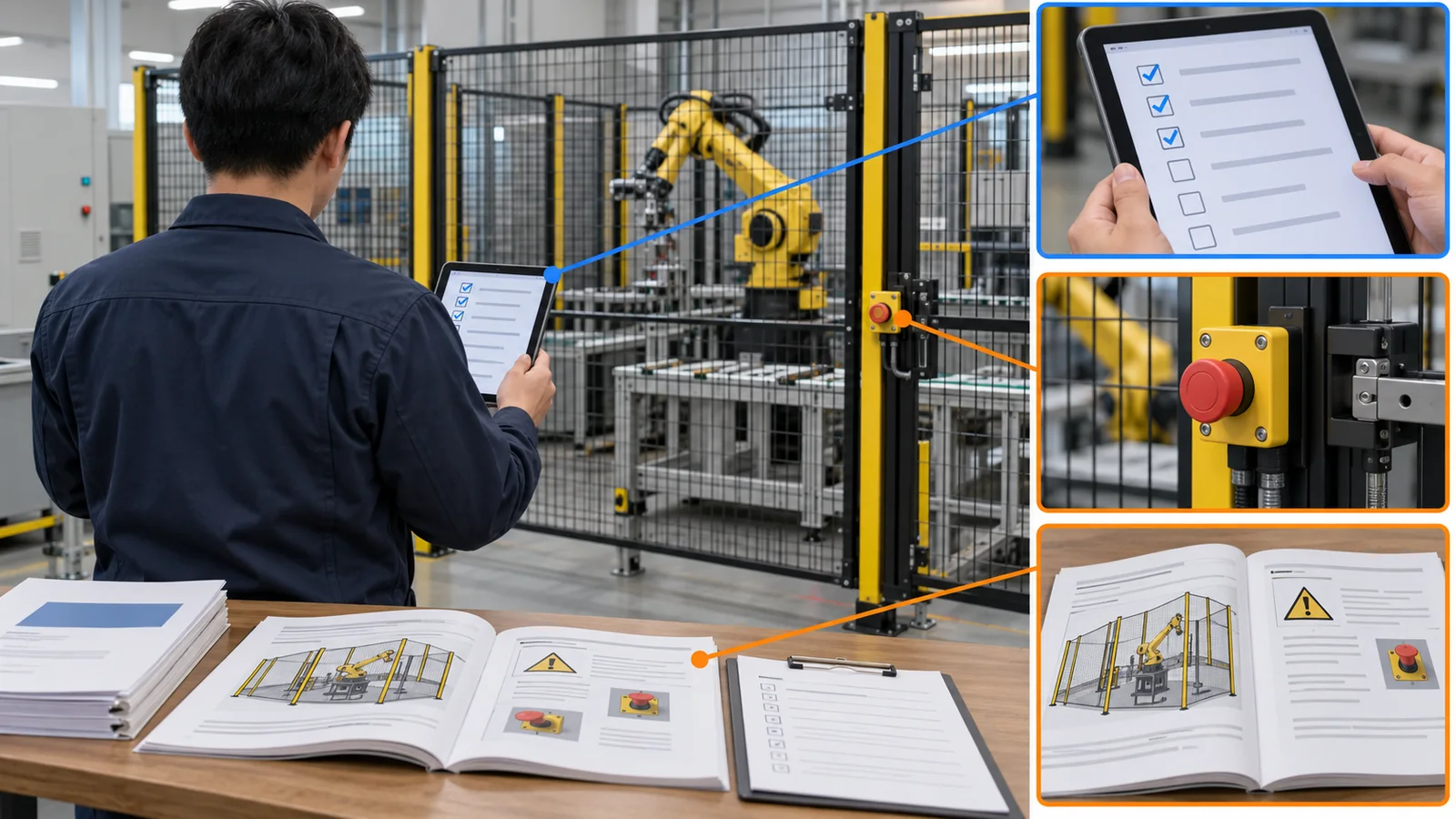
| Figures 2 to 8 are explanatory drawings, not observations of real data; Figures 1 and 9 are frames for AI-generated images | Note in this article | Commentary |
Last updated: 25 October 2026 / Sources are limited to official ISO pages and publications of associations (A3, the Japan Robot Association), authorities (Japan’s Ministry of Health, Labour and Welfare, EU-OSHA) and a research institute (IFA). The texts of the standards are paid and have not been checked. The calculations are examples under assumptions made in this article, not values from a standard or a real robot. The requirements in the standards, the extent to which ISO/TS 15066 was taken in, a JIS matching the 2025 edition of ISO 10218, later amendments to the Japanese notice, and the citation of harmonised standards in the EU could not be confirmed and are not stated. The figures are explanatory concept drawings or drawings that include our calculation; Figures 1 and 9 are ImageGen-generated conceptual illustrations.