TECHNOLOGY EXPLAINER
Robot Hands and Grasping
— From finger count, grasp types, friction and fingertip materials to the yardsticks of dexterity
A robot hand that grasps and re-grasps objects like a human hand is defined by a combination of finger count and degrees of freedom, drive method, grasp types, and friction and fingertip materials. This article organizes these in plain terms with numerical examples, drawing on official material and papers on hands such as the Shadow Dexterous Hand and the LEAP Hand.
For materials engineers, it shows how fingertip rubber, tendon fibers and pulleys, and 3D-printed plastic parts decide friction, life and cost.
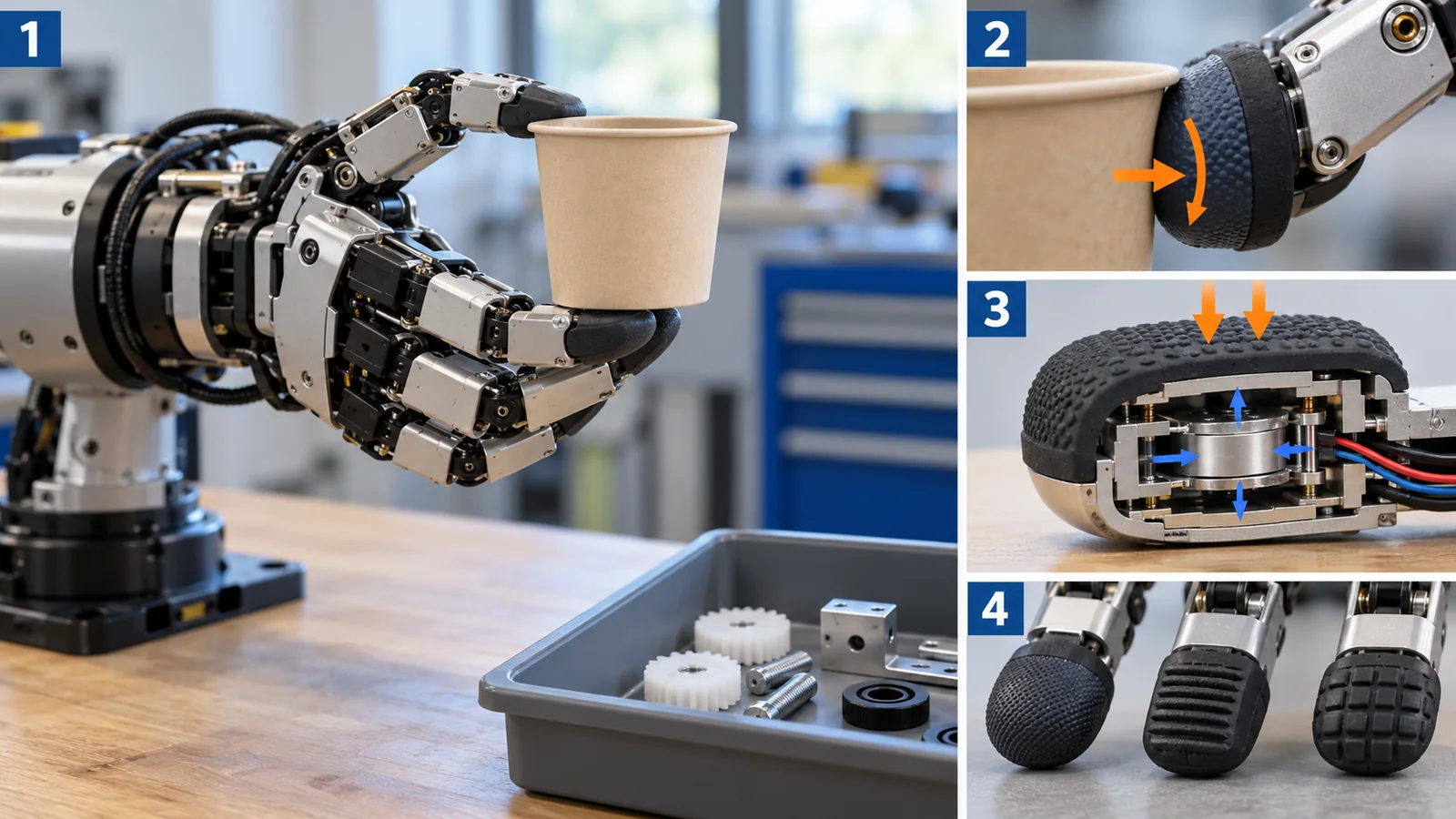
- Short version / before you read / place in the series
- What a hand does
- Ways of grasping
- How hands are driven
- Force and friction
- Fingertip materials
- Dexterity today
- Limits and summary
- How to read the yardsticks and standards
- Glossary
- References
- Claim-to-source audit
Sourced = stated in a published source (link given)
Our calculation = a value this article calculated from stated assumptions
Not yet confirmed = drafts, plans, targets and other items that are not settled
Our own readings for materials and design are marked as commentary. Inference is shown in bold. Every analogy comes with its limits.
The success rates (60% and 20% for the Rubik’s cube; over 95% and over 300 picks per hour for Dex-Net 4.0) are results reported by each paper’s authors for specific objects, hands and numbers of trials and need not hold under other conditions. Maker values (the Shadow’s 24 degrees of freedom and 20 motors) are stated values. “Our calculation” applies simple models such as Coulomb friction with illustrative assumptions (friction coefficients and the like) and is not the value of a specific material or product. For standards and drafts only number, title, edition and stage were checked, not the paid text. ASTM standards are not covered. Checked 25 October 2026.
1. The short version / what to know first / where this fits in the series
- A robot hand does two jobs: grasping and manipulating in the hand. Grasps divide into “power” grasps that wrap with force and “precision” grasps that pinch with the fingertips. Feix et al. organized human grasps into 33 typesSourced[Ref. 2, 1].
- The number of joints is not always the number of motors. The Shadow Dexterous Hand drives 24 joints with 20 motors and tendonsSourced[Ref. 5, 6], the LEAP Hand drives 16 joints directly with 16 motorsSourced[Ref. 8], and some “underactuated” hands grasp with a single motorSourced[Ref. 4].
- Whether an object can be held depends on force and friction. To hold a 0.5 kg object between two opposing fingers, each finger needs about 4.9 N at a friction coefficient of 0.5 and about 12.3 N at 0.2Our calculation. The fingertip material (rubber and the like) is the part that sets this friction.
No prior knowledge is needed. A robot “hand” is the device at the end that holds, pinches and turns objects, also called an end effector. It ranges from a simple two-jaw gripper to a multi-fingered hand close to a human hand. Degrees of freedom (DOF) is the number of directions of motion. Grasping means taking hold of an object and keeping it. The overall picture of robots is in the article “Introduction to Drones and Robotics”.
The parts that move finger joints are in the articles on joint actuators and on speed reducers and gears; fingertip touch is in the next article on tactile sensors and electronic skin; soft hands are in the articles on soft actuators and soft robots; and learned dexterity is in the article on imitation and reinforcement learning. This article concentrates on the structure of hands, ways of grasping, friction and fingertip materials, and yardsticks.
2. What a hand does: grasping and manipulating
Take everyday examples. Picking up a cup is “grasping”. Turning a pen in your fingers to change your hold is “manipulating” (in-hand manipulation). The first succeeds if the object is held without dropping; the second keeps changing the contacts between fingers and object and is much harder.
A human finger has four main motions. The base joint (MCP) is a ball joint with two degrees of freedom (side-to-side opening and flexion/extension); the middle (PIP) and tip (DIP) joints are hinges with one degree each. The thumb can oppose the fingers, which allows many graspsSourced[Ref. 8]. The LEAP Hand reproduces these four motions per finger, for 16 degrees of freedom in four fingersSourced[Ref. 8].
Putting one motor on every joint makes the hand large and heavy. So one motor sometimes moves two joints together (bending a finger bends the middle and tip joints together). In the Shadow hand, 16 of the 24 joints are independent and the other 8 form 4 coupled pairsSourced[Ref. 6]. In human fingers too, the tip joint is hard to bend alone (commentary). More degrees of freedom does not mean more dexterity; what matters is whether they can be controlled independently.
3. Ways of grasping: power and precision
Researchers have organized ways of grasping. Cutkosky (1989) studied the grasps machinists use in small-batch manufacturing and built a taxonomy of grasps and a simple expert system about how grasps are chosenSourced[Ref. 1]. Feix et al. (2016) merged existing taxonomies into 33 grasp types arranged by (1) the type of opposition, (2) the assignment of virtual fingers, (3) power, precision or intermediate, and (4) the thumb position, and note that considering only hand shape reduces them to 17Sourced[Ref. 2].
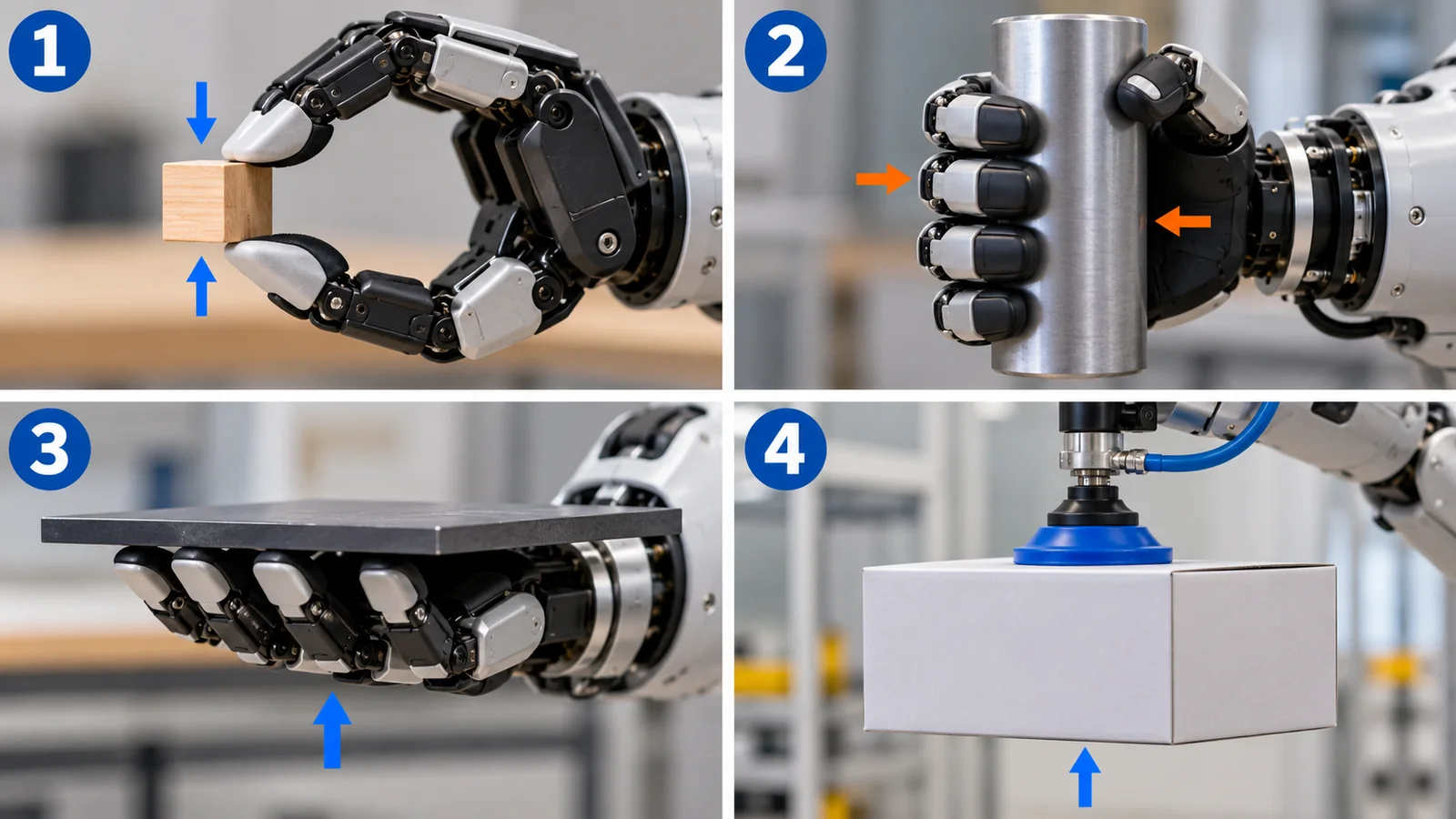
Original SVG, detailed explanation and sources
Original SVG reference: Concept diagram (vector drawing). Concept diagrams of four grasps (top) and the organization in two papers (bottom). Hand and object shapes are simplified and the names are our plain-language paraphrases.
| Group | Characteristics (commentary) | Example | Demands on the robot hand (commentary) |
|---|---|---|---|
| Power | Wraps with the palm and whole fingers; holds with large force | Tool handle, bottle | Large force, wide contact, a non-slip surface |
| Precision | Fingertips only; picks small things accurately | Pen, screw, coin | Fingertip position accuracy, fine force control, touch |
| Intermediate | In between; squeezes with the side of a finger and the like | Key, thin plate | Side friction and a moderate force |
The group names follow the “power, precision, intermediate” of Feix et al.; the column descriptions and demands are our commentary.[Ref. 2]
Doing both power and precision with one hand is not easy. Bicchi (2000) divided hand design into hands that mimic human anatomy and physiology and hands that meet restricted practical requirements, and argued for a “minimalistic” attitude for the latter: the fewest actuators and the simplest sensors for a given taskSourced[Ref. 3].
4. How hands are driven: tendon, direct and underactuated
Where should the motors that move the fingers sit? There are three main philosophies.
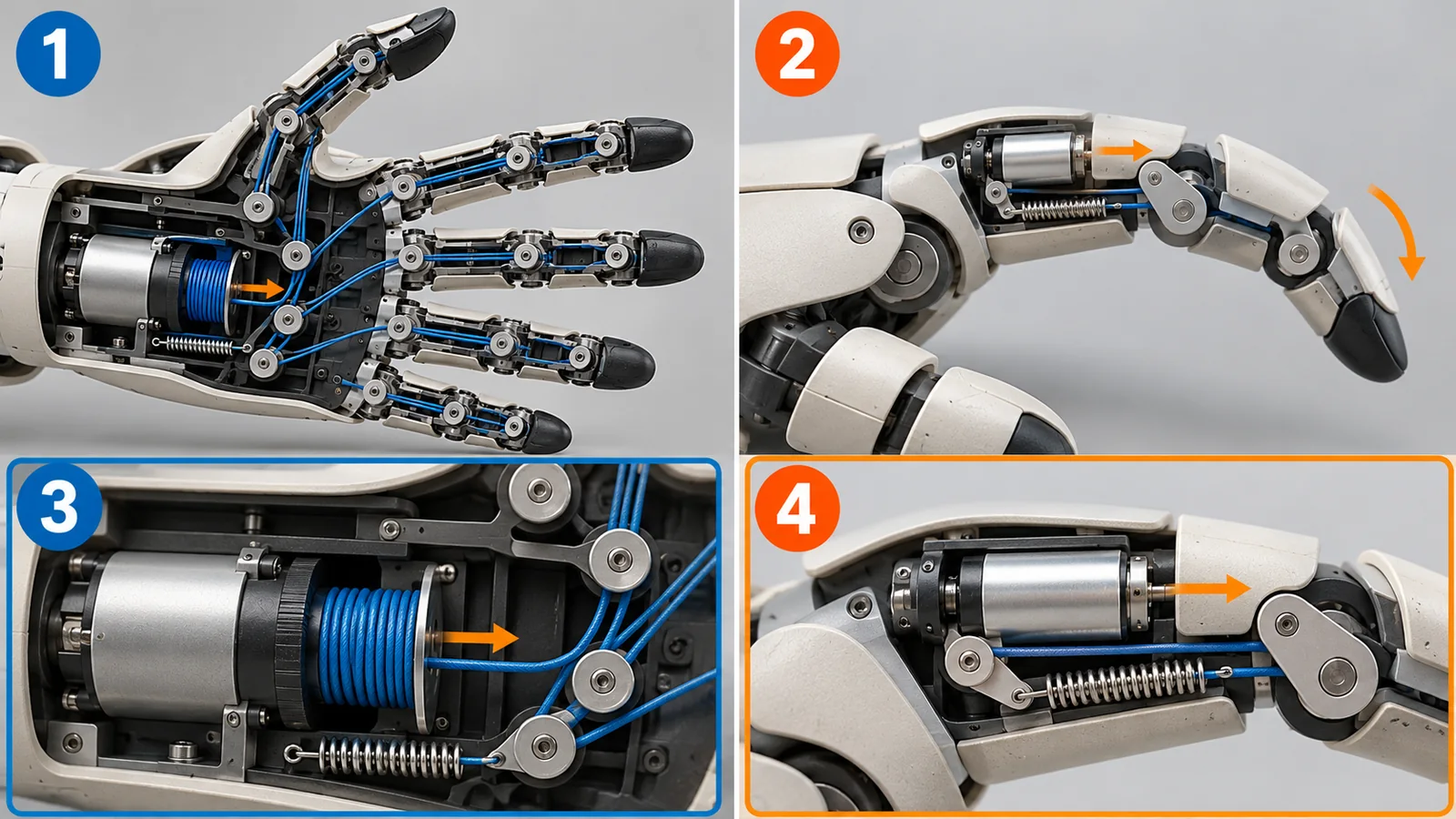
Original SVG, detailed explanation and sources
Original SVG reference: Concept diagram (vector drawing). Concept diagrams of tendon drive and direct drive. + marks advantages and – marks issues, per the sources (Shadow’s official page, the OpenAI papers, the LEAP Hand paper). The figure does not rank them.
- Tendon drive: motors sit at the wrist or forearm side and pull the fingers with tendons (cords). Shadow states that tendon drive provides “postural stability, shock mitigation and bending” Sourced[Ref. 5]. The OpenAI paper, on the other hand, says the physical tendon-driven hand has a substantial amount of backlashSourced[Ref. 6], and in the Rubik’s cube work it reports that enlarging the wrist pulley extended the wrist tendon life to more than three times the typical mean time before failure, and upgraded tensioners extended finger-tendon life by about five to ten timesSourced[Ref. 7].
- Direct drive: motors sit next to the finger joints. The LEAP Hand uses direct drive and claims a simple structure that is easy to repairSourced[Ref. 8]. In the same paper’s test, another direct-drive hand it compared (Allegro) is reported to have stopped moving after 15 minutes of repeated grasping because its motor overheated (the authors’ test, limited to what the paper describes)Sourced[Ref. 8].
- Underactuated (adaptive): far fewer motors than joints, with a hand designed so that its shape conforms to the object. The SDM Hand of Dollar and Howe is built by layering polymers and is reported to grasp objects of different size, shape, mass and position with a single actuator and to withstand large impactsSourced[Ref. 4]. The idea is that softness and adaptability in the mechanical structure can simplify control and sensing.
The facts: A multi-fingered hand can do more but is harder to control, more fragile and more costly. Bicchi argued for designs with the fewest actuators and sensors for practical usesSourced[Ref. 3]. The underactuated hand of Dollar and Howe is reported to grasp varied objects with a single motorSourced[Ref. 4]. The hand needed depends on the use (commentary).
5. Force and friction for holding: checking with numbers
When you lift an object, what holds it up is the friction between fingers and object. Take two opposing fingers holding an object of mass m. If each finger presses with force N and the friction coefficient is μ, the two fingers give a friction force of 2μN. If that is at least the weight mg, the object does not fall. That is, N >= mg / (2μ) (a simple Coulomb-friction calculation; commentary).
Checking with numbers (Our calculation): for a 0.5 kg object the weight is 0.5 x 9.81 = about 4.9 N. At μ = 0.5, each finger needs N >= 4.9 / (2 x 0.5) = 4.9 N. For a slippery surface with μ = 0.2 it is 12.3 N, and for rubber-like μ = 1.0 only 2.5 N. If the object is accelerated upward at 5 m/s² while being lifted, the required force rises by (9.81 + 5) / 9.81 = about 1.5 times. With a safety factor of 2, about 10 N at μ = 0.5.
A soft fingertip widens its contact the harder it presses
Real rubber fingertips do not follow the simple formula above. Xydas and Kao (1999) proposed a theory in which the radius of contact of a soft finger is proportional to the pressing force raised to a power γ, with γ between 0 and 1/3; 1/3 corresponds to the Hertzian contact of a linearly elastic material. They validated the theory with artificial fingertips made of rubber and silicone and with human fingers, and report that the friction limit surface (the limits of friction force and of twisting moment about the contact) can be approximated by an ellipseSourced[Ref. 9].
Checking with numbers (Our calculation): at γ = 1/3, doubling the pressing force raises the contact radius by 2^(1/3) = about 1.26 times and the area by 1.26 squared = about 1.59 times. A soft fingertip widens its contact the harder it grips, so it “conforms” to the object and resists slipping (commentary). A hard fingertip, in contrast, hardly widens its contact.
The facts: Gripping too hard can crush fragile objects and overheat motors. The LEAP Hand paper says it limits its powerful motors by current or torque to handle fragile objects and raise durabilitySourced[Ref. 8]. In the same paper’s comparison test, a hand whose motor overheated under repeated grasping and could no longer produce torque is reported (Allegro; the authors’ test)Sourced[Ref. 8]. The required force should be estimated from friction and weight and kept within what the object tolerates.
6. Fingertip materials: friction, softness and life
From the above we can see what a fingertip material needs: high friction, moderate softness, resistance to wear, and the ability to cover sensors well. A review of soft grippers (Shintake et al., 2018) organizes soft gripping into (1) grasping by actuation, (2) by controlled stiffness and (3) by controlled adhesion, and says that materials such as silicone elastomers are used for lighter, simpler and more universal grippersSourced[Ref. 10].

Original SVG, detailed explanation and sources
Original SVG reference: Concept diagram (vector drawing). A conceptual layer diagram of a fingertip (left) and material examples in the primary sources (right). Thickness and arrangement are illustrative and are not the structure of a specific product.
- LEAP Hand: printed a hard palm and soft rubber fingertips from a flexible filament (Ninjaflex). Because 3D-printed parts are often not strong enough, it used inexpensive (about US$10) off-the-shelf reinforced plastic brackets where strength was needed and printed parts such as the palm and fingertipsSourced[Ref. 8].
- Shadow (modified by OpenAI): extended the rubber-covered area on the distal part of the fingers to increase grip on objectsSourced[Ref. 7].
- Tendons: the OpenAI paper states that the Shadow tendons are SpectraSourced[Ref. 6] (Spectra is understood to be the trade name of a high-strength polyethylene fiber; commentary). Enlarging the pulley diameter to lower the stress on a tendon is reported to have extended its life to more than three timesSourced[Ref. 7].
Fingertip rubber needs friction coefficient, hardness (softness), wear resistance, resistance to dirt and oil, and stability against temperature (commentary). If it is made too soft to raise friction, it wears quickly and tears more easily when an object is gripped and dragged. As Chapter 5 showed, softness also affects effective friction through the widening of the contactSourced[Ref. 9]. A test of how many grasps a fingertip lasts could not be confirmed in primary sources.
A tendon is pulled many times while bent over a pulley. The smaller the bending radius, the larger the strain and friction on the fibers, and the shorter the life (commentary). The OpenAI modifications fixed exactly this: a larger pulley diameter extended the wrist tendon life to more than three times, and improved tensioners extended finger-tendon life by about five to ten timesSourced[Ref. 7]. Not only the fiber material but the shape of the part that bends it decides the life.
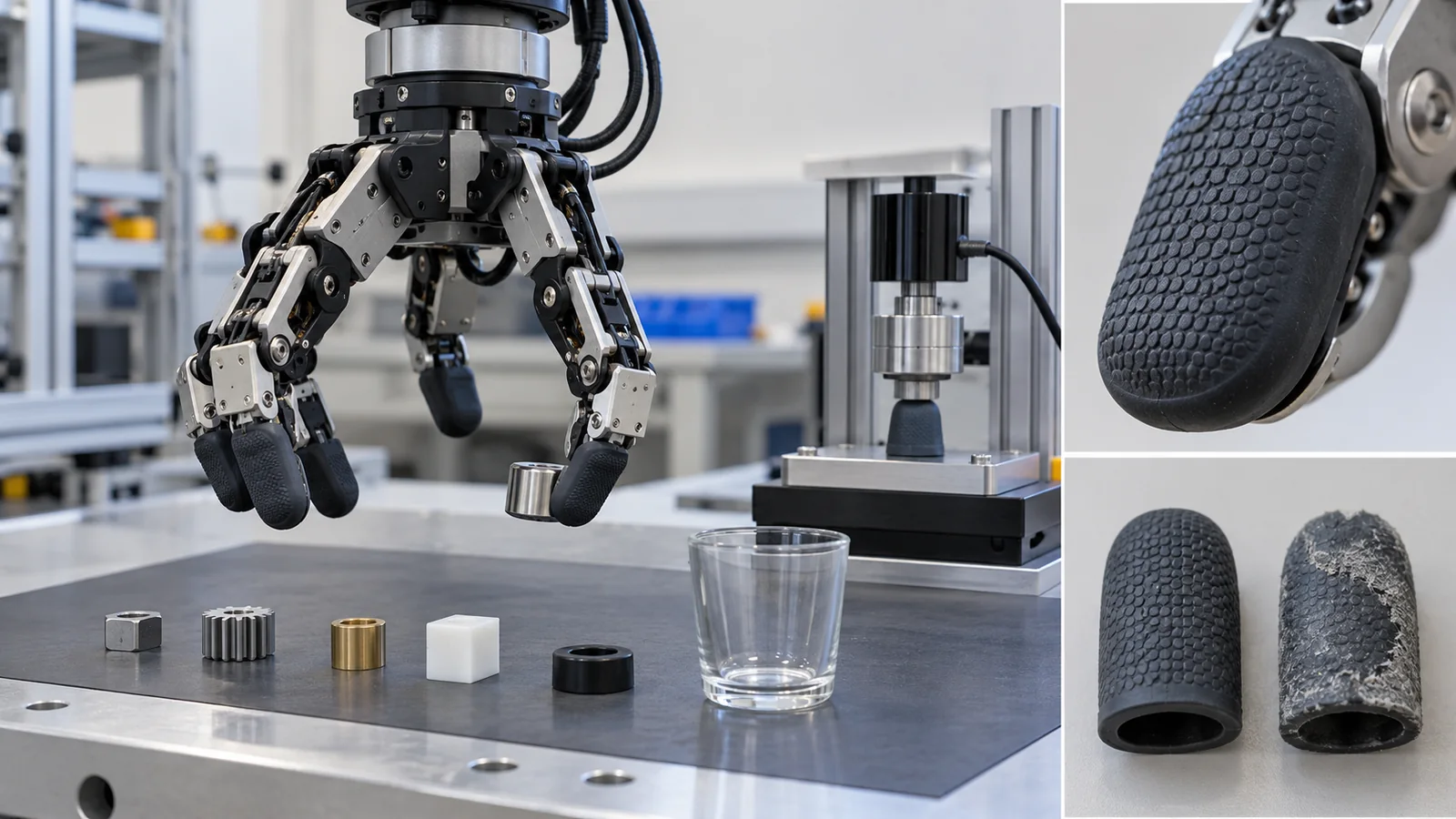
7. Dexterity today: what research has shown
OpenAI used the Shadow Dexterous Hand to transfer to a real hand policies trained only in simulation and solved tasks of turning objects in the hand. In its 2019 paper it tackled solving a Rubik’s cube with one hand and reports that its best policy solved 60% of scrambles needing 15 face rotations and 20% of the hardest scrambles needing 26 (10 trials per policy)Sourced[Ref. 7]. The paper presents this as a laboratory result after extensive training and does not claim the same success rate in real factories or homes (commentary).
Another example is “picking” objects out of a bin. Mahler et al.’s Dex-Net 4.0, on a robot with two kinds of grippers (a parallel-jaw gripper and a suction cup), reports a reliability above 95% and a rate above 300 picks per hour on clearing bins of up to 25 novel objectsSourced[Ref. 13]. The first Amazon Picking Challenge, a contest for autonomous robots picking items from shelves, produced a survey of 26 teams that organizes trends in mechanisms, perception and planningSourced[Ref. 11].
The facts: Success rates in videos and papers are results for specific objects, a specific hand and a given number of trials. The Rubik’s cube result is from 10 trials and differs by policySourced[Ref. 7]. The Dex-Net 4.0 result is for heaps of up to 25 objects and need not hold for other objects or environmentsSourced[Ref. 13]. For a demonstration, check what was tried how many times and how many succeeded, whether it was autonomous or teleoperated, and whether a third party verified it. A demonstration without these details is treated as a company claim.
8. Limits, what could not be confirmed, and a summary
- The total number of degrees of freedom of the human hand could not be confirmed in primary sources. The four motions per finger rely on the LEAP Hand paper.
- The prices and durable life of commercial hands (Shadow, Allegro and others) were not confirmed. Prices and failure statements in papers are claims by the team comparing against other hands, and are not adopted here.
- Specific material names, hardness and friction coefficients of fingertip rubbers could not be confirmed in primary sources. The friction coefficients in the figure are illustrative examples.
- The NIST test methods are a draft of October 2018 and not an international standard. The texts of ISO 14539 (gripper vocabulary) and ISO 18646-3 (manipulation performance) are paid, so only titles and stages were checked.
- Tactile sensors and electronic skin are covered in the next article. This article does not detail how fingertip force and contact are measured.
- A hand’s jobs are grasping and manipulating. Grasps divide into power and precision, and human grasps are organized into 33 typesSourced[Ref. 2]
- Joints and motors are different counts. Shadow has 24 joints with 20 motors, LEAP 16 joints with 16, and the SDM Hand one motor. The hand needed depends on the useSourced[Ref. 5, 8, 4]
- Holding force is estimated from friction and weight. For a 0.5 kg object, about 4.9 N per finger at μ = 0.5. A soft fingertip widens its contact the harder it pressesOur calculation[Ref. 9]
- Fingertip materials and tendons set friction and life. There is a case where a larger pulley extended tendon life by more than three timesSourced[Ref. 7]
- Read success rates with their conditions. The 60% and 20% of the Rubik’s cube and the 95%+ and 300+ picks per hour of Dex-Net 4.0 are results of those particular testsSourced[Ref. 7, 13]
9. How to read the yardsticks and standards
The “quality” of a robot hand cannot be expressed by one number. It results from grasp strength, slip resistance, grasping speed, fingertip position accuracy, touch sensitivity, the range of objects it can hold, dexterity (in-hand manipulation) and durability. What matters is which objects, how many times, with what hand and under what conditions a success rate or performance number was obtained. The table below organizes what could be confirmed (checked on 25 October 2026).
| What is evaluated | Typical tests and benchmarks (name, source) | Standards, rules and guidance (ISO, NIST and others) | Reading notes |
|---|---|---|---|
| Performance of the hand itself (finger force, grasp strength, slip resistance, grasp time, touch sensitivity and others) | NIST Draft SP 1227 (October 2018) proposes measurements of finger strength, grasp strength, slip resistance, grasp cycle time, touch sensitivity, grasp efficiency, force calibration, finger force tracking, in-hand manipulation and object pose estimationSourced[Ref. 14] | Not found (no test method that has become an international standard was confirmed)Not yet confirmed[Ref. 14] | A draft working document meant as a base for future standardization. Once measurement methods are aligned, hands become easier to compare |
| Gripper vocabulary and presentation of characteristics | — (a vocabulary and presentation standard) | ISO 14539:2000 (vocabulary and presentation of characteristics for grasp-type grippers, November 2000, stage 90.60 “under review”)Sourced[Ref. 15] | An old edition under review. The requirements are paid and were not checked |
| Manipulation performance | Performance criteria and test methods for manipulation (ISO 18646-3) and the pose performance of industrial robots (ISO 9283)Sourced[Ref. 16, 18] | ISO 18646-3:2021 (service robots, June 2021, under review) and ISO 9283:1998 (confirmed in 2021, under review)Sourced | These are for the robot as a whole, not for the hand alone. The test details were not checked |
| Range of objects held (grasp success rate) | The YCB object set and protocols (Calli et al., 2015); the survey of the Amazon Picking Challenge (Correll et al.); Dex-Net 4.0: over 95% for up to 25 novel objects, over 300 picks per hourSourced[Ref. 12, 11, 13] | Not found | Success rates change with which objects and how many trials. A common object set makes studies easier to compare |
| Dexterity (in-hand manipulation) | OpenAI Rubik’s cube: best policy solved 60% of 15-rotation and 20% of 26-rotation scrambles (10 trials per policy)Sourced[Ref. 7] | Not found | A result for one hand, one task and 10 trials. It does not show dexterity on other tasks |
| Taxonomy of grasps | Cutkosky’s (1989) taxonomy and the GRASP taxonomy of Feix et al. (2016), 33 typesSourced[Ref. 1, 2] | — (research taxonomies, not standards) | A shared vocabulary to align which grasp a design or test refers to |
| Safety in collaboration with people | — (safety is shown by conformity to requirements, not by a performance number) | ISO/TS 15066:2016 (safety requirements for collaborative robots; February 2016; stage 90.92 “to be revised”)Sourced[Ref. 17] | The force a gripper applies to a person can also be a subject of safety (commentary). The requirements were not checked |
The table layout is our organization (Our calculation). Numbers, titles, editions and stages were checked on the official ISO pages and in the NIST document (checked 25 October 2026). Standard texts are paid, so only titles and scope are given. ASTM standards are not covered.
Reading notes (for materials engineers)
- A demonstration, a benchmark and a real site are different. A laboratory hand works with set objects and lighting. In the field, dirt, wet objects, oil and temperature come in, and the friction and life of the fingertip rubber start to matter.
- A maker’s stated value and third-party verification are different. Shadow’s “24 degrees of freedom and 20 motors” is maker-stated and agrees with the paper’s description, but fingertip force and life were not confirmed.
- Standards may be recommendations or requirements. The NIST draft is a proposed test method; ISO standards generally bind mainly when cited by law or contract (commentary).
- A plan and an achievement are different. “The next-generation hand will be more dexterous” is a plan, not an achieved fact.
10. Glossary
- End effector
- The device at the end of a robot that holds or processes things: hands, grippers and so on.
- Grasping
- Taking hold of an object and keeping it.
- In-hand manipulation
- Changing the orientation or position of an object with the fingers while holding it.
- Degrees of freedom (DOF)
- The number of directions of motion.
- Power grasp
- A grasp wrapping with the palm and whole fingers and holding with large force.
- Precision grasp
- A grasp pinching small things accurately with the fingertips only.
- GRASP taxonomy
- The classification of 33 human grasp types organized by Feix et al.
- Tendon drive
- A scheme with motors placed away from the fingers and tendons (cords) pulling them.
- Direct drive
- A scheme with motors beside the joints.
- Underactuated (adaptive)
- A design with fewer motors than joints that conforms to objects through structural compliance.
- Backlash
- Play from gaps in a mechanism; in tendon drive, tendon stretch also contributes.
- Friction coefficient μ
- The ratio of the force needed to slide to the force pressing the surfaces together.
- Coulomb friction
- A simple model in which friction force is proportional to the pressing force and independent of contact area.
- Soft finger
- A soft fingertip whose contact widens when pressed.
- Hertzian contact
- The classical theory of contact between elastic bodies; contact radius goes as the 1/3 power of force.
- Friction limit surface
- A surface showing the limiting combinations of friction force and twisting moment before slipping starts.
- Elastomer
- A polymer material that stretches and recovers like rubber; silicones, for example.
- 3D printing
- A manufacturing method that builds shapes by layering resin and other materials.
- Tendon life (MTBF)
- The average operating time before a tendon fails: mean time before failure.
- Picking
- Taking items out of a bin or shelf.
- Suction cup
- A gripper that sticks to an object by suction.
- Parallel jaw
- A basic gripper that clamps between two jaws moving in parallel.
- YCB object set
- A common set of objects that makes grasping and manipulation research easier to compare.
- Grasp success rate
- The share of attempted grasps that held the object.
11. References (primary sources)
- Cutkosky M. R. “On grasp choice, grasp models, and the design of hands for manufacturing tasks”, IEEE Transactions on Robotics and Automation 5, 269–279 (1989), DOI 10.1109/70.34763 — doi.org/10.1109/70.34763
- Feix T. et al. “The GRASP Taxonomy of Human Grasp Types”, IEEE Transactions on Human-Machine Systems 46, 66–77 (2016), DOI 10.1109/THMS.2015.2470657 — doi.org/10.1109/THMS.2015.2470657
- Bicchi A. “Hands for dexterous manipulation and robust grasping: a difficult road toward simplicity”, IEEE Transactions on Robotics and Automation 16, 652–662 (2000), DOI 10.1109/70.897777 — doi.org/10.1109/70.897777
- Dollar A. M., Howe R. D. “The Highly Adaptive SDM Hand: Design and Performance Evaluation”, International Journal of Robotics Research 29, 585–597 (2010), DOI 10.1177/0278364909360852 — doi.org/10.1177/0278364909360852
- Shadow Robot Company “Dexterous Hand” (product page; maker-stated: 20 motors, tendon driven, 24 degrees of freedom) — shadowrobot.com/dexterous-hand-series/
- OpenAI et al. “Learning Dexterous In-Hand Manipulation”, arXiv:1808.00177 (2018) — arxiv.org/abs/1808.00177
- OpenAI et al. “Solving Rubik’s Cube with a Robot Hand”, arXiv:1910.07113 (2019) — arxiv.org/abs/1910.07113
- Shaw K., Agarwal A., Pathak D. “LEAP Hand: Low-Cost, Efficient, and Anthropomorphic Hand for Robot Learning”, arXiv:2309.06440 (2023) — arxiv.org/abs/2309.06440
- Xydas N., Kao I. “Modeling of Contact Mechanics and Friction Limit Surfaces for Soft Fingers in Robotics, with Experimental Results”, International Journal of Robotics Research 18, 941–950 (1999), DOI 10.1177/02783649922066673 — doi.org/10.1177/02783649922066673
- Shintake J., Cacucciolo V., Floreano D., Shea H. “Soft Robotic Grippers”, Advanced Materials 30, 1707035 (2018), DOI 10.1002/adma.201707035 — doi.org/10.1002/adma.201707035
- Correll N. et al. “Analysis and Observations From the First Amazon Picking Challenge”, IEEE Transactions on Automation Science and Engineering 15, 172–188 (2018), DOI 10.1109/TASE.2016.2600527 — doi.org/10.1109/TASE.2016.2600527
- Calli B. et al. “Benchmarking in Manipulation Research: The YCB Object and Model Set and Benchmarking Protocols”, IEEE Robotics & Automation Magazine 22, 36–52 (2015), arXiv:1502.03143 — arxiv.org/abs/1502.03143
- Mahler J. et al. “Learning ambidextrous robot grasping policies”, Science Robotics 4, eaau4984 (2019), DOI 10.1126/scirobotics.aau4984 — doi.org/10.1126/scirobotics.aau4984
- Falco J., Van Wyk K., Messina E. “Performance Metrics and Test Methods for Robotic Hands”, NIST Draft Special Publication 1227 (October 2018; a working document of the IEEE RHGM technical committee, a draft) — nvlpubs.nist.gov/nistpubs/SpecialPublications/NIST.SP.1227-draft.pdf
- ISO ISO 14539:2000 “Manipulating industrial robots — Object handling with grasp-type grippers — Vocabulary and presentation of characteristics” (November 2000; stage 90.60 “under review”) — iso.org/standard/24062.html
- ISO ISO 18646-3:2021 “Robotics — Performance criteria and related test methods for service robots — Part 3: Manipulation” (June 2021; stage 90.60 “under review”) — iso.org/standard/73591.html
- ISO ISO/TS 15066:2016 “Robots and robotic devices — Collaborative robots” (February 2016; stage 90.92 “to be revised”) — iso.org/standard/62996.html
- ISO ISO 9283:1998 “Manipulating industrial robots — Performance criteria and related test methods” (April 1998; confirmed in 2021; stage 90.60 “under review”) — iso.org/standard/22244.html
12. Claim-to-source audit
| Claim in the text | Basis | Type |
|---|---|---|
| Shadow Dexterous Hand with 20 motors, tendon drive and 24 degrees of freedom; the stated benefits of tendon drive (postural stability, shock mitigation, bending); tactile options | Shadow product page (maker-stated) Reference 5 https://www.shadowrobot.com/dexterous-hand-series/ | Sourced |
| 24 joints, 20 motors, 40 Spectra tendons, 16 joints independent and 8 coupled in 4 pairs, and the backlash of tendon drive | OpenAI paper (2018) Reference 6 https://arxiv.org/abs/1808.00177 | Sourced |
| Rubik’s cube: best policy 60% for 15-rotation and 20% for 26-rotation scrambles, 10 trials, extended fingertip rubber area, wrist tendon life over three times, finger tendon life five to ten times with tensioners | OpenAI paper (2019) Reference 7 https://arxiv.org/abs/1910.07113 | Sourced |
| The four motions of a human finger, LEAP Hand’s 16 degrees of freedom, flexible-filament fingertips, reinforced plastic brackets, current limiting, the report of Allegro overheating, and the direct-drive claims | LEAP Hand paper (2023) Reference 8 https://arxiv.org/abs/2309.06440 | Sourced |
| Cutkosky’s taxonomy (study of machinists’ grasps and an expert system), and the 33 types, reduction to 17 and four axes of Feix et al. | Cutkosky (1989), Feix et al. (2016) Reference 1 https://doi.org/10.1109/70.34763 Reference 2 https://doi.org/10.1109/THMS.2015.2470657 | Sourced |
| Bicchi’s review: the classification of hand design and the argument for minimal design; SDM Hand: single actuator, polymer manufacturing and impact tolerance | Bicchi (2000), Dollar and Howe (2010) Reference 3 https://doi.org/10.1109/70.897777 Reference 4 https://doi.org/10.1177/0278364909360852 | Sourced |
| Contact radius of soft fingers proportional to force to the power γ (0 to 1/3), Hertz 1/3, experiments with rubber and silicone, and the elliptical approximation of the friction limit surface | Xydas and Kao (1999) Reference 9 https://doi.org/10.1177/02783649922066673 | Sourced |
| The three technologies of soft grippers (actuation, controlled stiffness, controlled adhesion) and silicone elastomers | Shintake et al. review (2018) Reference 10 https://doi.org/10.1002/adma.201707035 | Sourced |
| Dex-Net 4.0: over 95% for up to 25 novel objects, over 300 picks per hour, parallel-jaw and suction gripper; the survey of 26 teams in the Amazon Picking Challenge; the YCB object set and protocols | Mahler et al. (2019), Correll et al., Calli et al. (2015) Reference 13 https://doi.org/10.1126/scirobotics.aau4984 Reference 11 https://doi.org/10.1109/TASE.2016.2600527 Reference 12 https://arxiv.org/abs/1502.03143 | Sourced |
| The measurement items of NIST Draft SP 1227 (October 2018) and its status as a working document of the IEEE RHGM technical committee | NIST draft Reference 14 https://nvlpubs.nist.gov/nistpubs/SpecialPublications/NIST.SP.1227-draft.pdf | SourcedNot yet confirmed |
| Numbers, titles, editions and stages of ISO 14539:2000, ISO 18646-3:2021, ISO/TS 15066:2016 and ISO 9283:1998 | ISO pages Reference 15 https://www.iso.org/standard/24062.html Reference 16 https://www.iso.org/standard/73591.html Reference 17 https://www.iso.org/standard/62996.html Reference 18 https://www.iso.org/standard/22244.html | SourcedNot yet confirmed |
| N >= mg / (2μ) (0.5 kg: 4.9 N at μ = 0.5, 12.3 N at 0.2, 2.5 N at 1.0; about 1.5 times at 5 m/s²; about 10 N with a safety factor of 2), and contact radius x1.26 and area x1.59 (γ = 1/3, doubled force) | Our calculation (the simple Coulomb model and the Xydas and Kao relation; illustrative μ values) | Our calculation |
| The explanation of “joints > motors”, the tip joint of human fingers, the characteristics and demands in the power/precision/intermediate table, Spectra being a high-strength polyethylene fiber, the materials engineer’s views, and the grouping of levels | Our own commentary based on general textbook understanding | Commentary |
| The total degrees of freedom of the human hand, prices and durable life of commercial hands, specific names, hardness and friction coefficients of fingertip rubbers, a test of how many grasps a fingertip lasts, and a hand test method that has become an international standard | Not stated because they could not be confirmed within this survey | Commentary |
Last updated: 25 October 2026. Sources are limited to primary material (peer-reviewed papers, arXiv papers, maker product pages, a NIST draft and official ISO pages). Estimates from research firms and figures reported only in the news are not used. Numbers marked as our calculation come from simple models and illustrative assumptions. The total degrees of freedom of the human hand, prices and durable life of commercial hands, specific names and friction coefficients of fingertip rubbers, and a hand test method that has become an international standard could not be confirmed and are not stated. Figures 1 and 8 are ImageGen-generated conceptual illustrations; the rest are explanatory concept diagrams or drawings that include our calculation.