TECHNOLOGY EXPLAINER
Warehouse and Logistics Robots
— AMRs, picking robots, how a robot warehouse works, and how to read claims of “robots in operation” and “orders”
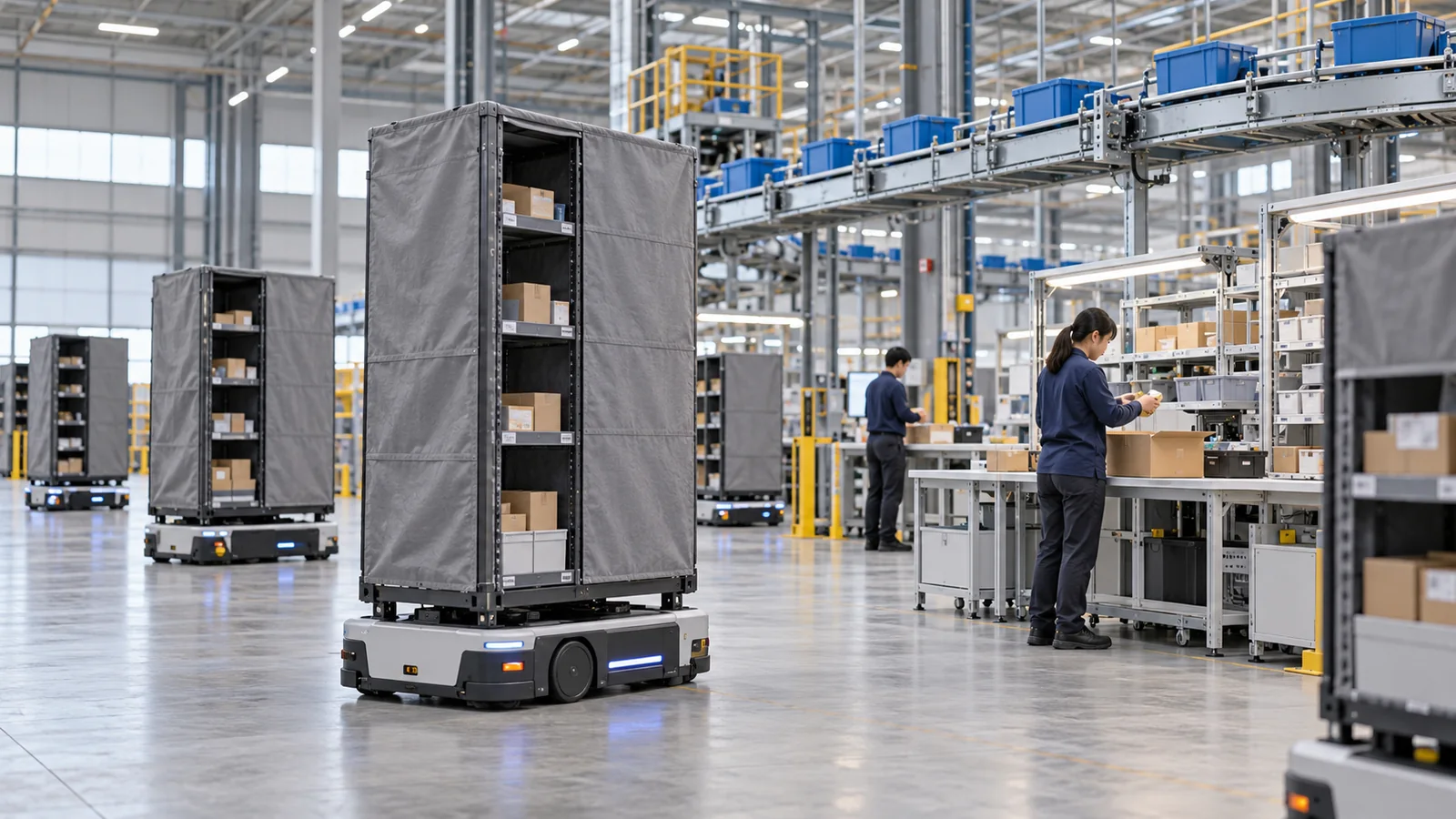
Behind fast delivery of online orders, robots inside warehouses carry shelves, sort packages and take items out of storage. You often see numbers such as “1 million robots” or “22,000 robots deployed”, but what was counted, when and where differs from one article to the next. This article assumes no robotics background. In order, it covers (1) the flow of work in a warehouse, (2) three ways of working, divided by who does the walking, (3) kinds of robots (AMRs, transport, picking arms), (4) why picking is hard, (5) safety and standards for mobile robots, and (6) how to read claims about “units” and “orders”, with figures and small calculations. The descriptions of Amazon, Locus Robotics, Symbotic and Boston Dynamics stay within official pages and filings, and the numbers are treated as company claims or stated values. We do not use market-size estimates from research firms.
- The short version / what to know first / where this sits in the series
- The flow of warehouse work, and where robots enter
- Three ways of working, divided by who does the walking
- Kinds of robots: shelf transport, autonomous carts, picking arms, storage structures, case handling
- Why picking is hard
- Safety and standards for mobile robots
- How to read claims about units in operation
- How to read claims about orders and backlog: from a filing
- Limits, what could not be confirmed, and summary
- How to read the yardsticks and standards
- Glossary
- References (primary sources)
- Claim-to-source audit
Sourced = stated in an official source (company page or filing, association, standards body, paper), with a link. Company claims and stated values are labelled as such
Our calculation = a value this article computed from stated assumptions
Not yet confirmed = plans, draft standards, forecasts: anything not yet settled
Our readings of structure and of materials are labelled commentary. An Inference is shown in bold. Every analogy comes with its limit.
Unit counts, pick counts, productivity and accuracy are claims or stated values that companies make on their own pages, not necessarily verified by a third party. A unit count changes meaning depending on whether it is cumulative or currently running, produced or deployed (Chapter 7). “Orders” and “backlog” measure the size of promised future deliveries, not the number of robots now running (Chapter 8). We do not rank numbers from different companies. This article does not touch any company’s share price, valuation or investment case. The filing figures are introduced as facts to show how to read claims. It does not advise on deploying any product or on judging safety. This field moves fast, so each status carries a check date (25 October 2026).
1. The short version / what to know first / where this sits in the series
- Warehouse robots take over a defined part of “walk, carry, pick, stack”. Amazon names Hercules, which carries shelves (pods), Proteus, which moves where people are, and Vulcan, which picks Sourced[Ref. 1, 2]. Locus describes a model in which robots handle travel while people concentrate on picking [Ref. 4], and Symbotic describes autonomous mobile robots moving inside a multi-level storage structure [Ref. 6].
- A “unit count” changes meaning with what is counted. Three Amazon articles word it differently: “developed, produced and deployed more than 1 million robots across its operations network since 2012” (a page showing 9 October 2024), “deployed more than 750,000 robots into fulfillment centers over the past dozen years” (7 May 2025), and “deployed our 1 millionth robot” (1 July 2025) Sourced[Ref. 3, 2, 1]. IFR published that 117,500 units of transport and logistics professional service robots were sold in 2025 (+21%) [Ref. 8].
- Picking is still a hard job, and safety standards are still being built out. Amazon says Vulcan can pick and stow about 75% of item types (a company claim) [Ref. 2]. ISO 21423:2026 (communications and interoperability of mobile robots) was published in October 2026 but has no safety requirements [Ref. 10].
You need no background. A robot is a combination of sensing, thinking and moving. An AMR is an autonomous mobile robot (a cart that looks at a map and its surroundings and chooses its own path), an AGV is an automated guided vehicle (a cart that follows a fixed route), a fulfillment center is a warehouse that processes online orders, a SKU is a type of product, and picking is taking the items of an order out of storage.
This article gives the overall picture of robots in warehouses and logistics. Factory industrial robots are in the article on industrial and collaborative robots; how to read standards in the article on robot safety standards; grasping in the article on robot hands and grasping; touch in the article on tactile sensors and electronic skin; learning in the articles on imitation and reinforcement learning and on robot foundation models and VLA; and delivery by drone in the article on drone logistics.
2. The flow of warehouse work, and where robots enter
Warehouse work flows through receiving, storage, picking, sorting and packing, and shipping. Robots usually take over a defined part of “walk, carry, pick, stack” rather than replacing every stage at once (commentary). Fig. 2 collects examples that the companies name officially.
Looking back, Amazon says it bought Kiva Systems in 2012 and began with a single type of robot that moved shelves Sourced[Ref. 3, 1]. A 2008 paper by D’Andrea and Wurman is titled “Future challenges of coordinating hundreds of autonomous vehicles in distribution facilities” [Ref. 17] (we did not check its text). A warehouse has faced from the start the challenge of many robots moving on the same floor without colliding.
3. Three ways of working, divided by who does the walking
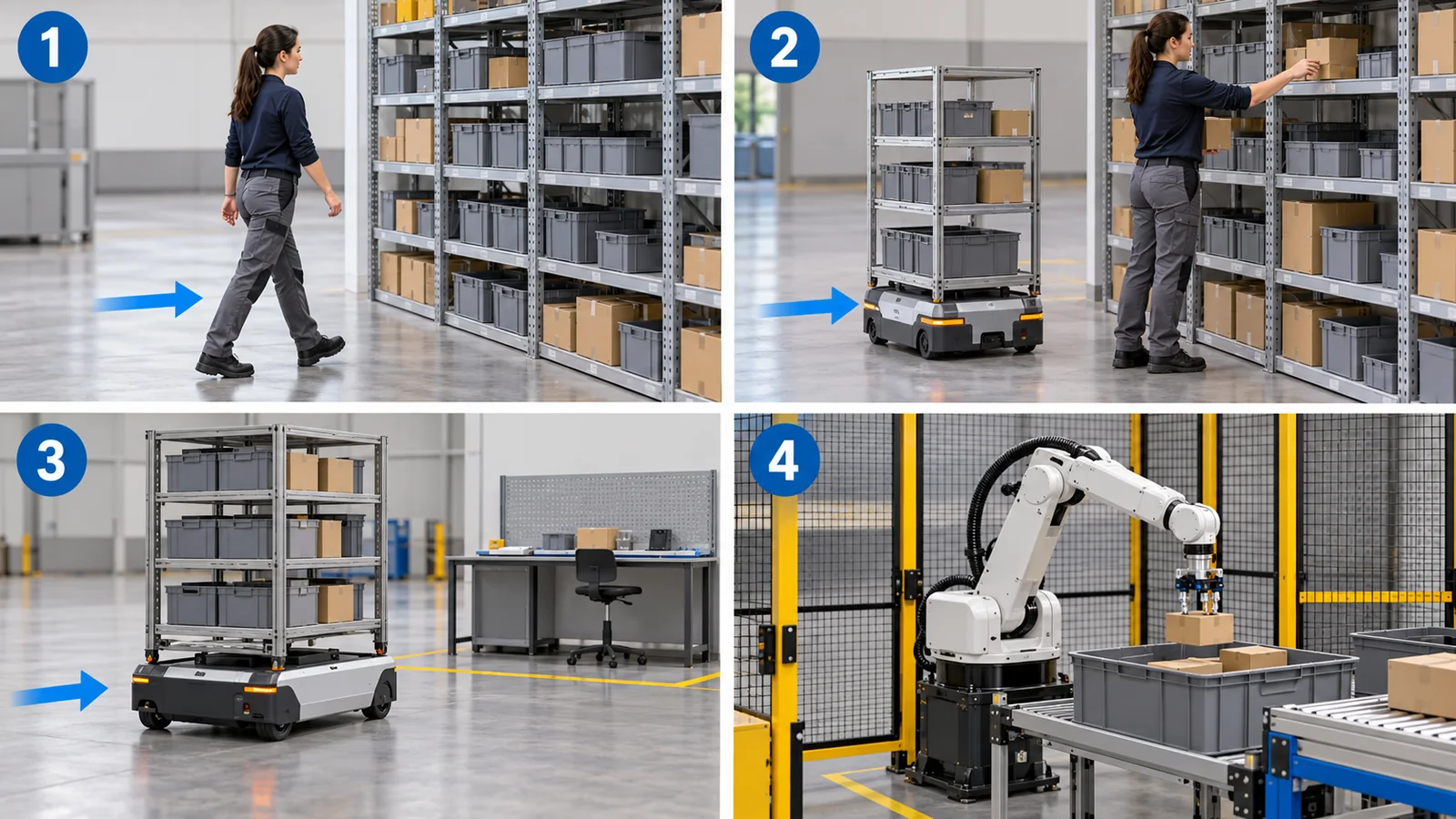
In a traditional warehouse, people walked the aisles and took the items. The ways of bringing in robots can be sorted into three by who does the walking (Fig. 3; our arrangement).
- Person-to-goods: robots move with people and handle the travel. For Origin and Vector, Locus says “associates stay focused on picking while robots handle the travel”, and claims that it removes up to 90% of unproductive walking and raises productivity 2 to 3 times (company claims) Sourced[Ref. 4].
- Goods-to-person: robots bring shelves or totes to a person at a workstation. Amazon says mobile robots carry inventory directly to employees at a workstation (the workstation being between mid-thigh and mid-chest height) [Ref. 3].
- Robot-to-goods: the robot itself picks in the aisle. In 2026 Locus introduced Locus Array (a method in which robots pick using robotic grasping and AI) and claims 90% lower labor costs and up to 2x storage density (company claims) [Ref. 4, 5]. Symbotic’s approach, with robots moving in a storage structure, is close in this respect [Ref. 6].
Original SVG, detailed explanation and sources
Original SVG reference: Conceptual diagram (vector drawing). Four ways, divided by who does the walking. The grouping is our own arrangement. Locus’s description [Ref. 4] and Amazon’s [Ref. 3] come from each company’s pages Sourced. The drawings suggest the mechanism and do not show real equipment.
The three are choices to fit a site, not a ranking (commentary). Person-to-goods can use existing shelves as they are (Locus says no fixed infrastructure is needed, a company claim). Robot-to-goods takes on the difficulty of picking (Chapter 5) itself. Which suits a site depends on the kinds of products, the order volume and the floor area, and we have not compared them.
4. Kinds of robots: shelf transport, autonomous carts, picking arms, storage structures, case handling
The robots that companies name officially are sorted here by “what they do” (Fig. 4). It is a map of kinds, not a ranking.
- Amazon (article of 1 July 2025): Hercules lifts and moves up to 1,250 pounds (about 567 kg) of inventory; Pegasus uses precision conveyor belts to handle individual packages; and Proteus is its “first fully autonomous mobile robot”, which can safely navigate around employees in open and unrestricted areas while moving heavy carts filled with customer orders (the company’s account) Sourced[Ref. 1].
- Symbotic (fiscal 2025 10-K): it describes a system of robotic arms for depalletizing inbound goods, scan tunnels, lifts, a storage structure (many levels stacked up), autonomous mobile robots that handle cases, eaches and totes, robotic arms for palletizing outbound goods, and software to run them [Ref. 6].
- Boston Dynamics (Stretch): says it can “move hundreds of cases an hour” (a company claim; no conditions given) [Ref. 7].
Kinetic energy of a heavy cart (rough estimate)
The hazard of a mobile robot comes from its speed and mass. The 1,250 pounds that Hercules can lift at most is about 567 kg. Counting only that load, moving at 1.5 m/s, its kinetic energy (1/2 x mass x speed squared) is about 638 J; it is about 71 J at 0.5 m/s, about 284 J at 1 m/s and about 1,134 J at 2 m/s Our calculation. For comparison, a 25 kg load moving at 5 m/s on a factory arm had 312.5 J (see the series article on industrial and collaborative robots). The speeds are our assumptions, not Amazon’s. Something heavy that moves is hard to stop and hits hard, which is why safety standards are needed (Chapter 6).
5. Why picking is hard
Taking an item out of a shelf is easy for people and hard for robots, because items differ in shape, size, material and placement. Amazon says it stores inventory in fabric-covered pods divided into compartments about a foot (30 cm) square, each holding up to 10 items on average. Pulling one item out of, or pushing one into, such a crowded space has historically been difficult for robots without the natural dexterity of people Sourced[Ref. 2].
Vulcan: a robot with a sense of touch
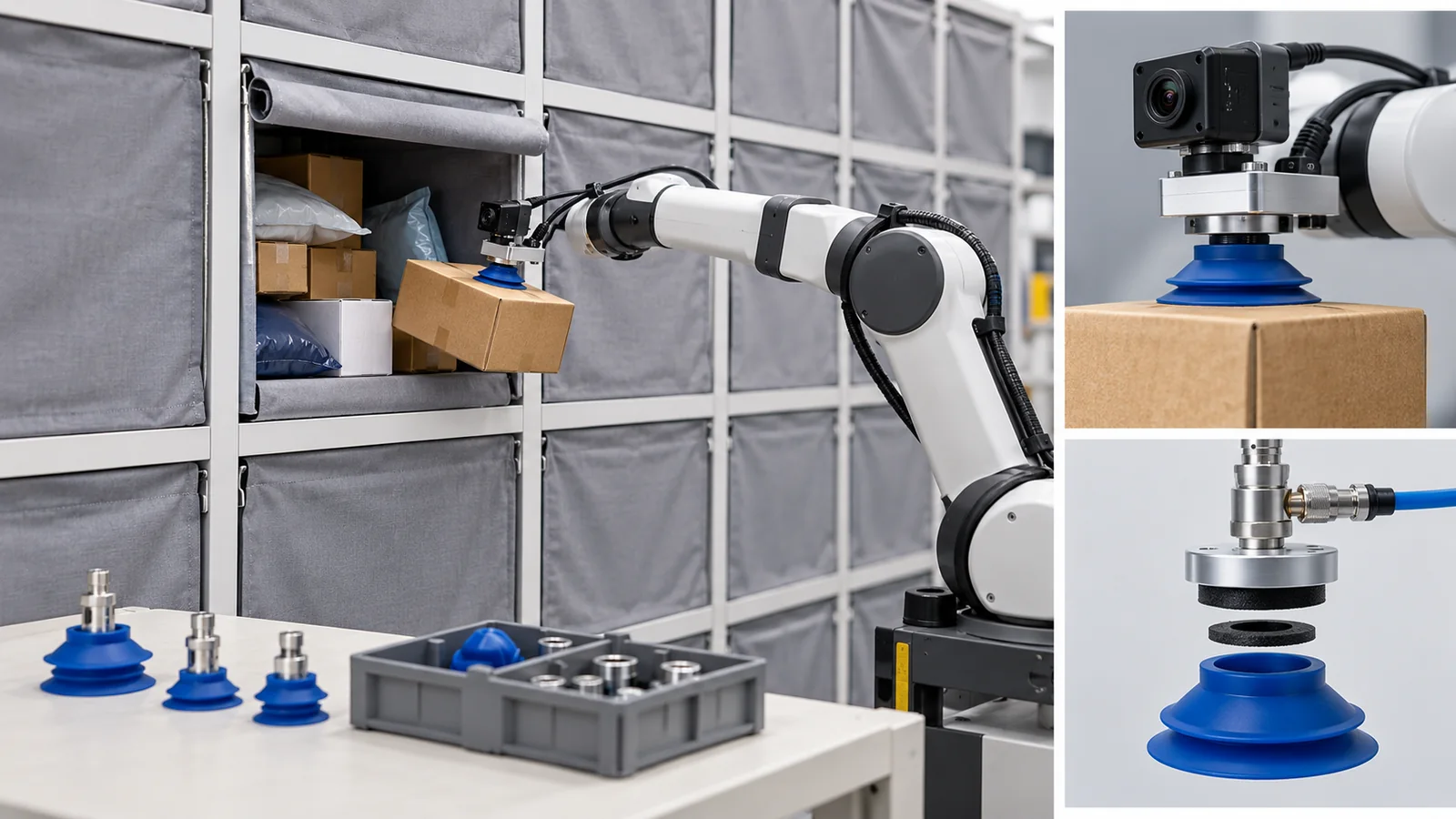
Amazon’s Vulcan (introduced in May 2025) is a robot that knows through force sensors when it makes contact and how hard it is pushing. To stow, a ruler-like blade pushes items already in the compartment aside to make room, and paddles with built-in conveyor belts slide the new item in. To pick, an arm with a camera and a suction cup is used: the camera picks out the item to grab and the best spot to hold it, and while the suction cup grabs it, the camera checks that no non-target item came along. Amazon says Vulcan can pick and stow about 75% of the types of items it stores, at speeds comparable to its employees, and asks a human partner to take over when it cannot move an item (a company claim; the “75%” is a share of item types, not of item volume or of orders) Sourced[Ref. 2]. Vulcan’s AI is described as trained not only in simulation but on real data that includes touch and force feedback.
This is inaccurate. What Amazon states is about 75% of the item types within the scope of picking and stowing, which is one kind of work. It is not the whole of warehouse work (receiving, sorting, packing, shipping, maintenance). The same article also says the robot asks a person to take over when it cannot move an item. The share of item types, and the success rate, the speed and the record of a day’s operation, are different numbers (commentary).
Other picking robots, and research
- Amazon names Sparrow, Cardinal and Robin as robots that move individual products or packages with computer vision and suction cups [Ref. 2].
- A 2019 paper by Mahler and co-authors reports that an “ambidextrous” grasping policy trained on synthetic data consistently cleared bins of up to 25 novel objects on a physical robot (the Science Robotics summary) [Ref. 15].
- Correll and co-authors published an analysis and observations from Amazon’s first picking competition, the Amazon Picking Challenge [Ref. 16] (we did not check its text).
Vulcan picks with a suction cup, stows with paddles and conveyor belts, and the inventory sits in fabric-covered pods [Ref. 2]. A string of materials issues follows (commentary). The rubber or elastomer of the suction cup has to grip and release reliably on items of different materials and dirtiness (bags, boxes, slick surfaces, dusty surfaces), and its performance changes with wear and contamination. Paddles and belts must not damage items, must not cling through static electricity, and must withstand repeated bending. Fabric pods are light and need surfaces that do not snag items. The material of product packaging (bags, boxes, film) affects how easily a robot can pick it (Inference: which materials Amazon actually uses could not be confirmed in its official articles).
6. Safety and standards for mobile robots
The standards for warehouse mobile robots are separate for safety, communications and performance (Fig. 7). When something says it “conforms to a standard”, check which kind of standard it is (see the series article on robot safety standards).
- Safety: ISO 3691-4:2023 is the safety standard for driverless industrial trucks, with AGVs and AMRs among its examples, and a next version (ISO/DIS) is shown as in development Sourced[Ref. 11]. In North America there is the ANSI/RIA R15.08 series (Part 1: the individual robot; Part 2: integration into a system; Part 3: continued safe use over the lifecycle). An A3 article (9 October 2026) says Part 1 was reaffirmed in 2026 and Part 3 published in June 2026 [Ref. 9].
- Communications and interoperability: ISO 21423:2026 (published October 2026, 85 pages) sets requirements for communication between mobile robots and fleet managers and other machines and equipment (lifts, automatic doors, ERP and so on). The document is not safety-related and has no safety requirements, and navigation requirements are out of scope Sourced[Ref. 10].
- Performance: ISO 18646-2:2024 describes test methods for the navigation performance of service robots (pose accuracy and repeatability, obstacle detection and avoidance, path deviation, narrow passages, mapping accuracy) and says it cannot be used to verify safety [Ref. 12].
- Out of scope: ISO 10218-1 excludes the “mobility” hazards when a robot is fixed to a driverless truck or mobile platform [Ref. 13]. Dynamically stable mobile robots (legged, humanoid) are the domain of ISO/CD 25785-1 (in development) [Ref. 14].
An A3 article explains that in a facility using robots from several makers, the challenge is for robots to navigate shared space without colliding or becoming unable to proceed when they meet, and that a common standard can help [Ref. 9]. That is the job of a communications standard (ISO 21423) and is separate from guaranteeing the safety of people (commentary). The ISO page for ISO 21423 also states that it has no safety requirements [Ref. 10].
A cart carrying 567 kg (the maximum load for Hercules) has a lot of energy when it hits something (Fig. 5), so soft cushioning in bumpers and outer shells and the strength of the frame become design conditions (commentary; the specific materials could not be confirmed in official articles). Because it runs on a floor, the material of the wheels and wear of the floor, dust and static electricity also matter (Inference). The battery needs fast charging and heat management, which brings in the series articles on power sources for robots and drones and on thermal runaway and battery safety.
7. How to read claims about units in operation
Unit counts differ in what is counted from one article to another (Fig. 8).
- Amazon: its three articles (a page showing 9 October 2024, 7 May 2025 and 1 July 2025) are worded differently. The first says it developed, produced and deployed more than 1 million robots across its operations network since 2012, but the same page also mentions DeepFleet (announced in July 2025), so it seems to have been updated after the date it shows (commentary). The May article says more than 750,000 robots deployed into fulfillment centers, and the July article says it deployed its 1 millionth robot, in a worldwide network of more than 300 facilities Sourced[Ref. 3, 2, 1]. Even for one company, produced or deployed, whole operations or inside warehouses, and as of when differ, and we do not judge which is “right”.
- Locus Robotics: its pages say more than 22,000 robots deployed, 360+ sites, 20+ countries and 8B+ picks completed (company claims; founded in 2014). The robot count can be read as cumulative deployment, but whether it is the number currently in operation is not stated [Ref. 4, 5].
- IFR: sales in 2025 of transport and logistics professional service robots were 117,500 units (+21% on the year, 47% of almost 250,000 professional service robots in all), used mainly for transport and for automating material flows and delivery. In the US, the model of providing robots by subscription (RaaS) is dominant Sourced[Ref. 8]. This is one year’s sales, not cumulative or in-operation units.
Dividing the numbers is a good exercise. Amazon’s “1,000,000 / 300 facilities” is about 3,300, but that is a cumulative deployment count divided by the number of sites, not the number running in one site (it includes retired robots and different kinds). Locus’s “22,000 / 360 sites” is about 61, again a cumulative average, whereas the company says a single site can grow from “10 bots to 1,000+” Our calculation. Locus’s “8B picks / 22,000 robots” is about 360,000 picks, but with differences in period and uptime it shows nothing about one robot’s ability Our calculation.
8. How to read claims about orders and backlog: from a filing
The annual filing (10-K) of a listed company defines its “backlog”. Symbotic’s 10-K for fiscal 2025 (ended 27 September 2025; filed 24 November 2025) defines backlog as “unperformed performance obligations under existing contracts”, puts it at about $22.5 billion, mostly agreements with Walmart and GreenBox (a warehouse-as-a-service joint venture), says $11.6 billion relates to GreenBox, and says about 12% is expected to be recognized as revenue in fiscal 2026. Walmart, its largest customer, accounted for about 85% of fiscal 2025 revenue Sourced[Ref. 6]. 12% of $22.5 billion is about $2.7 billion Our calculation. In other words, the size of the backlog is not the number of robots now running but the size of promised future deliveries, spread over a long period.
The same 10-K says Symbotic’s first case-picking system became operational at a customer distribution center in 2012, the latest version of its case-picking system in 2019 and its first BreakPack system (for broken-case picking) in 2025 [Ref. 6]. It also says that in 2017 it signed an agreement with Walmart to implement its systems in 25 of Walmart’s 42 regional distribution centers and that in 2022 this was amended and restated to cover all 42. This article makes no judgment of any company’s value or any investment. The point here is that a figure for “orders” should be read together with its definition and its timing.
This is inaccurate. Backlog is the total of contracts not yet performed, with deliveries planned over a long period. In the example above only about 12% is expected to become revenue in the next fiscal year. Figures that show actual operation, such as units running, hours of operation and picks, have to be checked separately.
9. Limits, what could not be confirmed, and summary
(1) Verification of company claims
Amazon’s “about 75% of item types” and DeepFleet’s “10%”, Locus’s “2 to 3 times”, “99.9% accuracy” and “up to 90%”, and Stretch’s “hundreds of cases” are all company claims, and we found no independent verification.
(2) The definition of unit counts
The reason for the differences among Amazon’s three articles (differences in definition, timing of updates) could not be confirmed. Whether Locus’s 22,000 robots is current operation is not stated.
(3) Companies not covered
Other AMR, picking-robot and warehouse-automation companies were not checked. We read Symbotic’s filing only for the system components and backlog, and did not evaluate its finances.
(4) Standards and regulation
The texts of ISO 3691-4, ANSI/RIA R15.08, ISO 21423 and ISO 18646-2 are paid and were not checked. Country-by-country regulation (workplace safety rules) is not covered, and neither are industry communication specifications such as VDA 5050.
- Warehouse robots take over part of “walk, carry, pick, stack”. By who does the walking, there are three: go to the person, shelves come to the person, and robots pick Sourced
- Picking is hard. Amazon’s Vulcan is claimed to pick about 75% of item types. But that is a share of item types, not the automation rate of the whole warehouse (company claim)
- Something heavy that moves carries a lot of energy. 567 kg at 1.5 m/s is about 638 J (assumed calculation) Our calculation
- A unit count changes meaning with produced or deployed, cumulative or running. Amazon’s three articles are worded differently. IFR’s 117,500 is one year’s sales in 2025 Sourced
- Backlog is the size of promised future deliveries. Symbotic’s 10-K shows about $22.5 billion, with about 12% expected in fiscal 2026 Sourced. Safety, communications and performance standards are separate, and ISO 21423 is not a safety standard
10. How to read the yardsticks and standards
The results of warehouse robots are expressed by picks per hour (throughput), pick accuracy, uptime, number of units and time to deploy. These are claims under conditions the company chose, and they have not been compared on a common benchmark. In research, whether a robot can pick objects it has not seen and the like are reported under each study’s conditions. The standards are separate for safety (ISO 3691-4, R15.08), communications (ISO 21423) and performance test methods (ISO 18646-2). The table below shows what we could confirm (checked 25 October 2026).
| What is evaluated | Typical test or benchmark (name, source) | Standard, rule or guidance | Reading notes |
|---|---|---|---|
| Productivity, picks | Locus’s claims: productivity 2 to 3 times, up to 90% less unproductive walking, 8B+ picks (cumulative) [Ref. 4] Sourced. No common benchmark was found | Could not be confirmed | A company claim. The warehouse, conditions and basis of comparison are not stated |
| Pick accuracy | Locus’s claim: 99.9% [Ref. 4] Sourced | Could not be confirmed | What counts as “accurate” and how it was measured are not stated |
| Ability to pick (grasp) | Vulcan: about 75% of item types (company claim) [Ref. 2]. Research: cleared bins of up to 25 novel objects (Mahler et al. 2019) [Ref. 15]. Analysis of the Amazon Picking Challenge [Ref. 16] Sourced | Could not be confirmed | The share of item types differs from success rate and speed. Research and real sites have different conditions |
| Unit counts | Amazon: wording differs by article [Ref. 3, 2, 1]. Locus: 22,000+ (deployed) [Ref. 4]. IFR: 117,500 transport and logistics service robots (sold in 2025) [Ref. 8] Sourced | – | Separate produced, deployed, sold, cumulative and running |
| Orders and backlog | Symbotic: backlog about $22.5 billion (defined as unperformed obligations); about 12% expected as fiscal 2026 revenue [Ref. 6] Sourced | Filing (Form 10-K) | The size of promised deliveries, not units in operation |
| Safety of driverless trucks and AMRs | Could not be confirmed | ISO 3691-4:2023 [Ref. 11]; ANSI/RIA R15.08 (Parts 1 to 3) [Ref. 9] Sourced | The texts are paid. A next version (DIS) is in development |
| Communications and interoperability | Could not be confirmed | ISO 21423:2026 (published October 2026) [Ref. 10] Sourced | No safety requirements. Navigation is also out of scope |
| Navigation performance | Test methods in ISO 18646-2 (pose accuracy and repeatability, obstacle detection and avoidance, path deviation and so on) [Ref. 12] Sourced | ISO 18646-2:2024 | Cannot verify safety. Indoor environments |
| Dynamically stable mobile robots | Could not be confirmed | ISO/CD 25785-1 (in development, 30.60) [Ref. 14] Not yet confirmed | A committee draft whose content can change |
The arrangement of the table is our own Our calculation (arrangement). Standard numbers, titles, editions and stages were checked on the ISO pages and the A3 article (25 October 2026). The texts are paid and were not checked.
Reading notes (for materials engineers)
- Case studies and demos are not a work site: a customer case study or a video may show a success under chosen conditions. Check uptime, failures and maintenance records
- A company’s claim and a third party’s verification are different: every number in this article is a company claim, stated value or filing figure, not a third-party measurement
- Whether a standard is a recommendation or a requirement differs: an ISO standard alone has no legal force. For “conforms to a standard”, check the kind (safety, communications, performance) and the edition
- Separate plans from results: “orders”, “plans” and “coming soon” are not yet results
- Check the scope: “75% of item types”, “1 million units” and “backlog” each refer to a different range
11. Glossary
- AMR
- Autonomous mobile robot: a cart that looks at a map and its surroundings and chooses its own path.
- AGV
- Automated guided vehicle: a cart that follows a fixed route.
- Fulfillment center
- A warehouse that takes online orders, picks the items, packs and ships them.
- SKU
- A type of product for inventory control.
- Picking
- Taking the items of an order out of storage.
- Pod
- Amazon’s fabric-covered shelf that holds inventory (carried by Hercules).
- Person-to-goods
- A method in which robots move with people and people pick.
- Goods-to-person
- A method in which robots bring shelves or totes to a person.
- Robot-to-goods
- A method in which the robot itself picks at the shelf.
- Depalletizing / palletizing
- Unstacking loads from a pallet / stacking loads onto a pallet.
- Suction cup
- A gripper, usually of rubber, that holds an item by removing air to cling to it.
- Force feedback
- Measuring how hard something is touched and reflecting it in the motion.
- Fleet management
- Managing the movements of many robots together (for example DeepFleet).
- RaaS
- Robots-as-a-Service: a model in which robots are provided as a monthly service.
- Backlog
- The total of contract obligations not yet performed (Symbotic’s definition).
- 10-K
- The annual report a US listed company files with the SEC.
- ISO 3691-4
- The safety standard for driverless industrial trucks (AGVs, AMRs and so on).
- ANSI/RIA R15.08
- The North American series of safety standards for industrial mobile robots.
- ISO 21423
- The standard for communications and interoperability of industrial mobile robots (published October 2026). It has no safety requirements.
- ISO 18646-2
- The standard of test methods for the navigation performance of service robots.
- Kinetic energy
- The energy a moving object has: 1/2 x mass x speed squared.
- Cumulative / running
- The total so far / what is operating now.
12. References (primary sources)
- Amazon “Amazon deploys over 1 million robots and launches new AI foundation model” (1 July 2025; the 1 millionth robot, DeepFleet, descriptions of Hercules and Proteus) — aboutamazon.com/news/operations/amazon-million-robots-ai-foundation-model
- Amazon “Introducing Vulcan: Amazon’s first robot with a sense of touch” (7 May 2025; pick and stow, about 75% of item types, pod dimensions, more than 750,000 robots) — aboutamazon.com/news/operations/amazon-vulcan-robot-pick-stow-touch
- Amazon “Amazon robotics: Meet the robots inside fulfillment centers” (page date shown as 9 October 2024; nine robots, the 2012 acquisition of Kiva Systems, the “more than 1 million robots” statement) — aboutamazon.com/news/operations/amazon-robotics-robots-fulfillment-center
- Locus Robotics “Home” (home page; 22,000+ robots, 360+ sites, 8B+ picks, productivity and accuracy claims; checked 25 October 2026) — locusrobotics.com/
- Locus Robotics “About Us” (company page; founded 2014, timeline, Locus Array (2026); checked 25 October 2026) — locusrobotics.com/about
- Symbotic Inc. Form 10-K (fiscal year ended 27 September 2025, filed 24 November 2025; backlog, Walmart share of revenue, system components) — sec.gov/Archives/edgar/data/1837240/000183724025000278/sym-20250927.htm
- Boston Dynamics “Stretch – Mobile Warehouse Robots” (product page; the company’s statement about “hundreds of cases an hour”; checked 25 October 2026) — bostondynamics.com/products/stretch/
- IFR (International Federation of Robotics) “Global Sales of Professional Service Robots Surge 24%” (World Robotics 2026 Service Robots press release, 30 September 2026) — ifr.org/ifr-press-releases/news/global-sales-of-professional-service-robots-surge-24-percent
- A3 (Association for Advancing Automation) “New Developments in Mobile Robot Safety and Interoperability”, 9 October 2026 (the ANSI/RIA R15.08 series; the status of ISO 21423) — automate.org/robotics/blogs/new-developments-mobile-robot-safety-interoperability
- ISO “ISO 21423:2026 Robotics — Industrial mobile robots — Communications and interoperability” (ISO page; 1st edition, October 2026, 85 pages; not a safety standard) — iso.org/standard/86749.html
- ISO “ISO 3691-4:2023 Industrial trucks — Safety requirements and verification — Part 4: Driverless industrial trucks and their systems” (ISO page; next version ISO/DIS shown as in development) — iso.org/standard/83545.html
- ISO “ISO 18646-2:2024 Robotics — Performance criteria and related test methods for service robots — Part 2: Navigation” (ISO page; 2nd edition, January 2024, 24 pages; not for verification of safety) — iso.org/standard/82643.html
- ISO “ISO 10218-1:2025 Robotics — Safety requirements — Part 1: Industrial robots” (ISO page; mobility hazards when fixed to driverless trucks or mobile platforms are out of scope) — iso.org/standard/73933.html
- ISO “ISO/CD 25785-1 Robotics — Safety requirements for dynamically stable industrial mobile robots (legged, wheeled, or other forms of locomotion) — Part 1: Robots” (ISO page; stage 30.60) — iso.org/standard/91469.html
- Mahler J. et al. “Learning ambidextrous robot grasping policies”, Science Robotics 4(26), 2019, DOI 10.1126/scirobotics.aau4984 — doi.org/10.1126/scirobotics.aau4984
- Correll N. et al. “Analysis and Observations From the First Amazon Picking Challenge”, IEEE Trans. Autom. Sci. Eng. 15(1), 172-188 (2018), DOI 10.1109/TASE.2016.2600527 — doi.org/10.1109/TASE.2016.2600527
- D’Andrea R., Wurman P. “Future challenges of coordinating hundreds of autonomous vehicles in distribution facilities”, Proc. 2008 IEEE International Conference on Technologies for Practical Robot Applications, pp. 80-83, DOI 10.1109/TEPRA.2008.4686677 — doi.org/10.1109/TEPRA.2008.4686677
13. Claim-to-source audit
| Claim in the text | Basis | Type |
|---|---|---|
| Amazon (1 July 2025): 1 millionth robot deployed, more than 300 facilities, DeepFleet improving fleet travel time by 10% (the company’s claim), Hercules up to 1,250 lb, Pegasus, Proteus (first fully autonomous mobile robot), start in 2012 with one type of robot | Amazon article (company claims) Reference 1 https://www.aboutamazon.com/news/operations/amazon-million-robots-ai-foundation-model | Sourced |
| Amazon (7 May 2025): Vulcan pick and stow, about 75% of item types, speeds comparable to employees, asking a person to take over, pod compartments (about one foot square, up to 10 items on average), Sparrow, Cardinal and Robin (vision and suction), more than 750,000 robots deployed into fulfillment centers over about a dozen years, learning from physical touch and force data | Amazon article (company claims) Reference 2 https://www.aboutamazon.com/news/operations/amazon-vulcan-robot-pick-stow-touch | Sourced |
| Amazon page (date shown 9 October 2024): the 2012 acquisition of Kiva Systems, more than 1 million robots developed, produced and deployed since 2012, Sequoia, a mention of DeepFleet, workstation height | Amazon article (company claims) Reference 3 https://www.aboutamazon.com/news/operations/amazon-robotics-robots-fulfillment-center | Sourced |
| Locus: 22,000+ robots deployed, 360+ sites, 20+ countries, 8B+ picks, 2 to 3 times productivity, up to 90% less unproductive walking, 99.9% accuracy, 10 to 1,000+ robots per site (company claims), Origin, Vector, Array, RaaS | Locus home page (company claims) Reference 4 https://locusrobotics.com/ | Sourced |
| Locus company page: founded in 2014, timeline, Locus Array in 2026 (robots-to-goods powered by robotic grasping and AI) | Locus company page Reference 5 https://locusrobotics.com/about | Sourced |
| Symbotic Form 10-K (fiscal year ended 27 September 2025, filed 24 November 2025): backlog of about $22.5 billion (defined as unperformed obligations), $11.6 billion for GreenBox, about 12% expected in fiscal 2026, Walmart about 85% of revenue, the 2017 agreement for 25 centers and its 2022 restatement for all 42, operations beginning in 2012, 2019 and 2025, and system components (storage structure, lifts, MiniBots, depalletizing and palletizing arms) | SEC filing Reference 6 https://www.sec.gov/Archives/edgar/data/1837240/000183724025000278/sym-20250927.htm | Sourced |
| Stretch: the company’s statement that it can move “hundreds of cases an hour” | Maker product page (company claim) Reference 7 https://bostondynamics.com/products/stretch/ | Sourced |
| IFR (30 September 2026): almost 250,000 professional service robots (+24%); transport and logistics 117,500 units (+21%, 47%); RaaS dominant in the US | IFR press release Reference 8 https://ifr.org/ifr-press-releases/news/global-sales-of-professional-service-robots-surge-24-percent | Sourced |
| A3 article (9 October 2026): the three parts of ANSI/RIA R15.08, Part 1 reaffirmed in 2026, Part 3 published in June 2026, robots of several makers sharing a space, ISO 21423 | A3 article Reference 9 https://www.automate.org/robotics/blogs/new-developments-mobile-robot-safety-interoperability | Sourced |
| ISO 21423:2026: 1st edition, October 2026, 85 pages. Communications and interoperability of industrial mobile robots; no safety requirements; navigation out of scope | ISO page Reference 10 https://www.iso.org/standard/86749.html | Sourced |
| The scope of ISO 3691-4:2023 (AGVs, AMRs and so on) and that a next version (ISO/DIS) is in development | ISO page Reference 11 https://www.iso.org/standard/83545.html | Sourced |
| ISO 18646-2:2024: navigation performance criteria (pose accuracy and repeatability, obstacle detection and avoidance, path deviation, narrow passage, mapping accuracy); not for verification of safety | ISO page Reference 12 https://www.iso.org/standard/82643.html | Sourced |
| ISO 10218-1:2025 excludes mobility hazards when the robot is fixed to a mobile platform or similar | ISO page Reference 13 https://www.iso.org/standard/73933.html | Sourced |
| ISO/CD 25785-1: safety standard for dynamically stable industrial mobile robots, stage 30.60, under development | ISO page Reference 14 https://www.iso.org/standard/91469.html | SourcedNot yet confirmed |
| Mahler et al. (2019): an ambidextrous grasping policy trained on synthetic datasets consistently cleared bins of up to 25 novel objects | Paper abstract (via Crossref) Reference 15 https://doi.org/10.1126/scirobotics.aau4984 | Sourced |
| Correll et al.: analysis and observations from the first Amazon Picking Challenge (title and bibliography) | Paper bibliography (via Crossref) Reference 16 https://doi.org/10.1109/TASE.2016.2600527 | Sourced |
| D’Andrea and Wurman, a 2008 paper on coordinating hundreds of autonomous vehicles in distribution facilities (title and bibliography) | Paper bibliography (via Crossref) Reference 17 https://doi.org/10.1109/TEPRA.2008.4686677 | Sourced |
| The kinetic energy of 567 kg (1,250 lb converted) at 0.5, 1, 1.5 and 2 m/s (about 71, 284, 638 and 1,134 J), 22.5 x 0.12 = about $2.7 billion, Amazon’s 1,000,000 / 300 facilities = about 3,300, Locus’s 22,000 / 360 sites = about 61 and 8B picks / 22,000 robots = about 360,000 picks | Our calculation (division of company claims and filing figures, and assumed speeds; not actual values) | Our calculation |
| The reason for the differences in unit counts among the three Amazon articles, whether Locus’s count is current operation, independent verification of company claims, the state of other companies, and the requirements in the standards | Could not be confirmed in the scope of this research, so not stated (this article) | Commentary |
| The readings that robots take over parts of the work, that robot-to-goods is not necessarily better, that 75% of item types is not 75% of the work, that a page appears to have been updated after its displayed date, that backlog is not units in operation, and the materials views | Our commentary based on the published content; not a view stated by any of the bodies | Commentary |
| Figures 2 to 5 and 7 to 9 are explanatory drawings, not observations of real data (Figure 9 redraws figures from Symbotic’s filing); Figures 1 and 6 are frames for AI-generated images | Note in this article | Commentary |
Last updated: 25 October 2026 / Sources are limited to companies’ official pages, Symbotic’s SEC filing, IFR publications, an A3 article, official ISO pages and papers. Unit counts, performance and accuracy are company claims or stated values, and no independent verification could be confirmed. The reason for the differences in Amazon’s three unit counts, whether Locus’s count is current operation, independent verification of company claims, the state of other companies, and the requirements in the standards could not be confirmed and are not stated. The figures are explanatory concept drawings or drawings that include our calculation; Figures 1 and 6 are ImageGen-generated conceptual illustrations.