TECHNOLOGY EXPLAINER
Imitation Learning and Reinforcement Learning
— learning by copying people, learning by trial and error, and moving from simulation to the real machine
To get a robot to do a new job, instead of programming every motion by hand there are two broad routes: have it copy a person’s demonstrations (imitation learning), or let it find the way itself from the score of what it tried (reinforcement learning). Both produce a learned policy (a function that decides actions), but they are strong in different situations and fail in different ways. This article explains how each works with analogies a materials engineer can relate to, and uses papers and a few small calculations of our own to check why a small slip grows in imitation learning, why trial and error on a real robot is heavy, and what role friction and other material properties play when a policy learned in simulation is moved to hardware (sim2real).
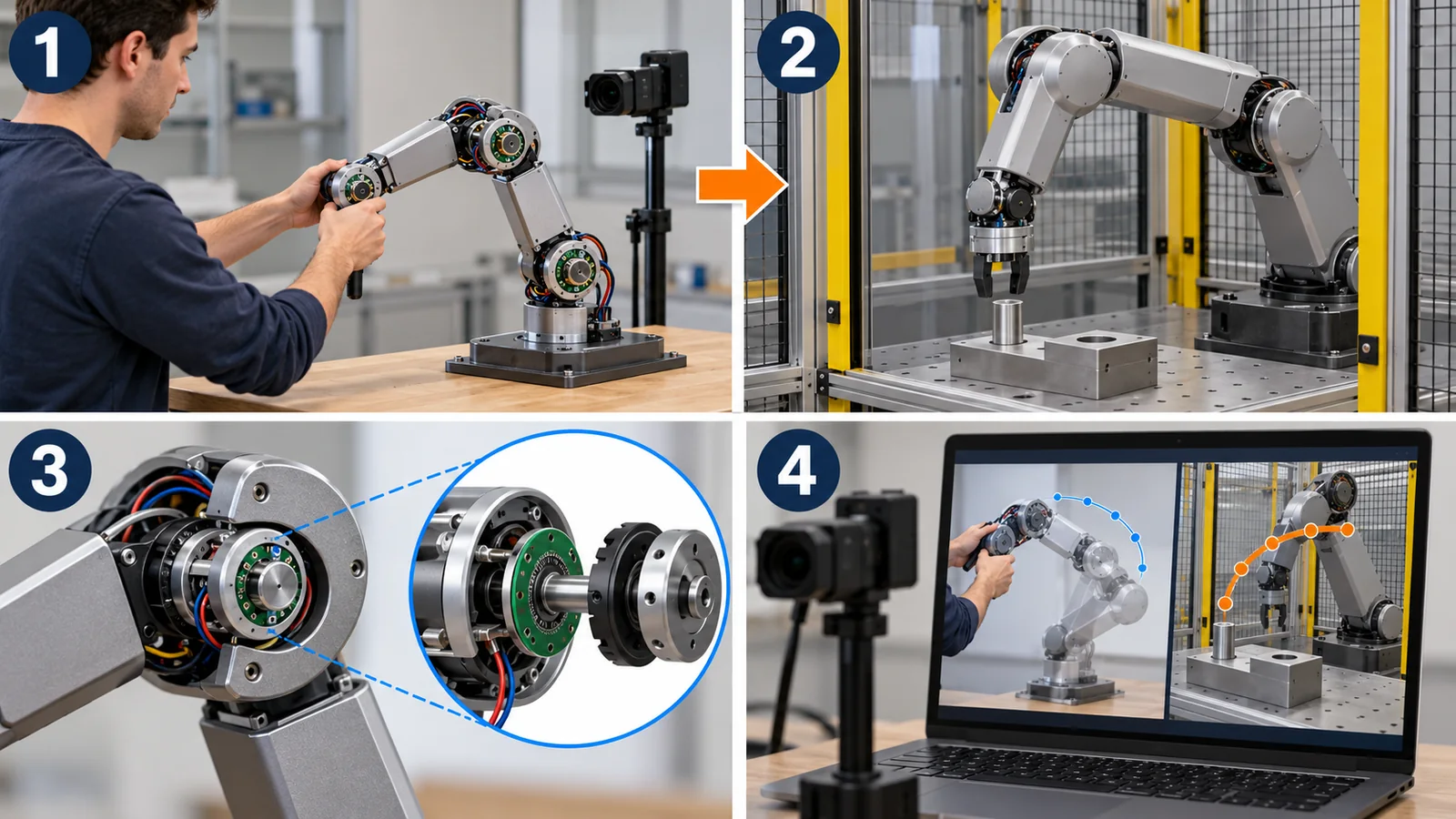
- What imitation learning and reinforcement learning are (the short version)
- Three routes by which a robot acquires a skill
- Imitation learning — learning “what is seen → what to do” from examples
- The pitfall of imitation learning — a small slip grows
- Reinforcement learning — finding the way from the score of the result alone
- How long does trial and error take on a real robot?
- Learn in simulation, move to the real machine (sim2real)
- A materials engineer’s view: the “spread” of material properties and the “ageing” of real machines
- Choosing and combining — which route to take
- Limits, and what could not be confirmed / summary
- How to read the yardsticks and standards
- Glossary
- References
- Claim-to-source audit
Sourced = stated in published material (link given)
Our calculation = a figure this article derived, with the assumptions spelled out
Not yet confirmed = a plan, draft or work in progress that is not settled
Interpretations are marked separately as Commentary. Inference is shown in bold.
The error bound in Chapter 4, the return in Chapter 5 and the training-time assumptions in Chapter 6 are calculations from values we assumed. They are not the performance of any real robot or policy. Success rates and training times in papers are values reported for the robots, tasks and conditions each paper chose, and we do not rank methods by placing numbers from different papers side by side. For standards (ISO) we confirmed only number, title and stage, and did not read the text. We do not compare specific products or companies.
1. What imitation learning and reinforcement learning are (the short version)
- Imitation learning is like learning by watching: a person’s demonstrations (what was seen, what action was taken) are treated as the right answer, and a policy is built by supervised learning. Having right answers makes learning fast, but it makes the policy weak in situations the demonstrations did not coverSourced[Ref. 1]
- Reinforcement learning is like trying things and being given a score: no right action is provided; the policy is improved by trial and error so that the score of the result (the reward) gets larger. It may go beyond what people can show, but it tends to need a huge number of trialsSourced[Ref. 9, 10]
- Doing everything on the real robot is heavy: so many trials are run in parallel in simulation and the result is moved to the real robot (sim2real). One report has a quadruped’s walking policy learned in about 20 minutes on one GPUSourced[Ref. 13]. But then the gap between simulation and the real machine (friction, for one) becomes the next wall
In this series’ shared picture, a robot is a combination of “sense (sensors), think (control and intelligence) and act (actuators)”. This article is about “think”: how to build the function (the policy) that decides the next action from what is seen (the observation). A policy is, for example, a neural network that takes a camera image and the joint angles and returns the target joint positions for the next instant. “Learning” means adjusting the numbers inside that function (the parameters) using data.
Our article on the fundamentals of robot control covers the lower layer that actually moves the robot to the targets a policy outputs, our article on robot vision and perception covers how observations are made, our article on robot simulation and digital twins covers the simulators themselves, our article on teleoperation and data collection covers how demonstrations are gathered, and our article on robot foundation models and VLA covers how large-scale pre-training relates to imitation and reinforcement learning. Our article on world models and embodied AI treats the simulation-to-reality gap and the calculation of confidence intervals for success rates in more detail. This article is limited to the two main families of learning and their pitfalls.
The weak point of imitation learning is “situations the demonstrations did not cover”; the weak points of reinforcement learning are “the number of trials and the design of the reward”. In both cases the only final check is on the real machine under your own conditions. Simulation is a powerful practice ground, but if the friction of the practice floor differs from the real one, the robot falls on the real floor.
2. Three routes by which a robot acquires a skill
Suppose you want a robot to take a part out of a box and fit it into a hole. Instead of a person programming the motion (teaching coordinates one by one), there are broadly two ways to build a policy by learning.
| Item | Imitation learning | Reinforcement learning |
|---|---|---|
| What you provide | A person’s demonstrations (pairs of observation and action) | A reward (a score for the result) and a place to try things (the real robot or a simulator) |
| Analogy (within the series’ shared pictures) | Watching a senior colleague’s hands and copying them | Trying, and refining one’s approach from the score of the result |
| Strengths (commentary) | Having right answers, it can get going with few repetitions. It can copy a person’s skill | It can find motions that are hard to teach (fast walking, for example) and optimise the result directly |
| Weaknesses (commentary) | Weak in situations the demonstrations did not cover. Bound by the quality and quantity of demonstrations | Needs many trials. A badly designed reward teaches behaviour that was not intended |
| Burden on the real machine | The effort of collecting demonstrations (people’s time) | Machine and time are spent in proportion to the number of trials |
The “strengths and weaknesses” rows are this article’s arrangement (commentary). Which method is better depends on the task, data and computing resources, and we do not rank them.
3. Imitation learning — learning “what is seen → what to do” from examples
(1) The simplest form: behavior cloning
At each demonstration, record what the robot could see (the observation) and the action the person took. Collect many such (observation, action) pairs and fit the mapping “in this observation, this action” with a neural network. That is behavior cloning. It has the same shape as ordinary supervised learning, with the person’s action as the “right answer”.
As an early well-known example, Bojarski et al. reported an end-to-end approach that learns from human driving data to map the pixels of a front camera to steering commands [Ref. 2]Sourced.
(2) Recent examples in robot manipulation
- ACT (ALOHA): from low-cost hardware and teleoperated demonstrations, it proposed generating actions several steps at a time (action chunking). It reports learning six difficult tasks, such as opening the lid of a translucent container and inserting a battery, at 80-90% success with only 10 minutes of demonstrations. The paper names errors that compound over time and human demonstrations that are not constant (non-stationary) as challenges [Ref. 3]Sourced
- Diffusion Policy: represents the policy as a diffusion process that extracts actions from noise. It reports an average improvement of 46.9% over existing methods on 12 tasks from four manipulation benchmarks (a comparison under the paper’s settings) [Ref. 4]Sourced
- robomimic: compared six offline learning methods on five simulated tasks and three real multi-stage tasks and analysed matters such as dependence on demonstration quality and variation with the time at which training is stopped [Ref. 5]Sourced
In the same scene a person may go around to the right or to the left. Taking the “average” can produce a path through the middle that is neither (commentary). That Diffusion Policy lists “handling several candidate actions” among its advantages is related to this problem [Ref. 4]. It is also why records of how the demonstration data were collected (who, under which conditions) matter.
4. The pitfall of imitation learning — a small slip grows
Behavior cloning has the same form as supervised learning, so why is it hard? Because the robot’s action changes what it sees next. In ordinary image classification, a wrong judgement on one image does not change the next image. For a robot, a slightly wrong decision shifts its position a little, and what it sees next differs from the demonstrations.
Ross et al. describe this as a problem in which the assumption of independent and identically distributed data fails. The result is that a policy with error rate ε on the demonstrator’s situations can make as many as T²ε mistakes over a T-step task on the situations it induces itself. They also show examples in which this bound is reached in the worst case [Ref. 1]Sourced.
Checking with numbers
Assume (this is an assumption) a per-step error rate of ε = 1%. Here is how the number of mistakes changes with the length of the task (the number of steps) T (Our calculation).
| Task length T | If it grew linearly (T x ε) | Upper bound (T² x ε) | Largest possible count |
|---|---|---|---|
| 10 | 0.1 | 1 | 10 |
| 50 | 0.5 | 25 | 50 |
| 100 | 1 | 100 | 100 (the bound says nothing) |
| 200 | 2 | 400 | 200 (the bound says nothing) |
Our calculation. ε = 1% is an assumed value. T²ε is the bound of Ross et al. [Ref. 1] and is a worst-case value (not the typical number of mistakes of a real policy). A policy cannot make more than T mistakes in T steps, so once T²ε exceeds T (that is, ε > 1/T) the bound tells us nothing.
In fact: the 1% is a value measured on the same situations as the demonstrations. Once the policy slips into a situation the demonstrations did not cover, its error rate there can be higher than 1%. The bound of Ross et al. (T²ε) is a worst case, not a typical value, but the longer the task, the more chances there are to leave the range of the demonstrations, and that direction does not change.
Examples of countermeasures
- DAgger: run the learned policy, have an expert label the situations the policy itself passed through with the right actions, add them to the data and retrain. Repeating this brings the situations the policy actually enters into the demonstrations [Ref. 1]Sourced
- Output several steps of actions at once (ACT): this aims to reduce the number of per-step decisions and so limit compounding. The ACT paper names compounding errors as a challenge and addresses it with this approach of generating action sequences [Ref. 3]Sourced
- Bring in human corrections: there are methods where a person corrects the policy’s motion midway and the corrections are used for learning; HIL-SERL combines demonstrations and human corrections with reinforcement learning [Ref. 11]Sourced
5. Reinforcement learning — finding the way from the score of the result alone
In reinforcement learning, the system learns through repetition: the policy acts, and receives an observation and a reward from the environment (the robot, objects and the laws of physics). No right action is provided; the only clue is a score such as “+1 if it worked”. It is like playing a game over and over with only the score to go on, without being told the strategy (the limit of the analogy: a game does not break the machine when you fail).
(1) Reward and return
The score at each step is the reward, and the sum of rewards over time is the return. Later rewards are counted smaller by a discount factor γ (between 0 and 1). For example, if the reward for success comes only 4 steps later, a γ of 0.9 gives a return of 0.9⁴ = 0.656 and a γ of 0.5 gives 0.0625Our calculation. With a small discount factor the future counts for little, so tasks where “the reward comes only at the end of a long procedure” become hard to learn (commentary).
(2) Representative methods
- PPO is a family of policy-gradient methods that collects data by interacting with the environment and updates a “surrogate objective” over several epochs of minibatches. It is reported to be simple to implement and to strike a good balance with sample complexity [Ref. 6]Sourced
- SAC is an off-policy method that can reuse data; it reports improved stability compared with earlier methods that had suffered from high sample complexity and brittle convergence [Ref. 7]Sourced
(3) The design of the reward decides what is learned
A reward turns “what counts as good” into a number. If the reward has a loophole, the policy may earn points in a way that was not intended (reward hacking). Amodei et al. list this as one cause of accidents in machine-learning systems [Ref. 8]Sourced. For example, if the reward is tied to “how high the part is lifted”, a policy might be found that flings the part up without grasping it (this is a hypothetical example of ours, not a result from a paper).
In imitation learning you are taught “this is the right move” in each scene. In reinforcement learning no right move is taught for each scene; only a score at the end comes back. So the system has to work out for itself which actions affected the score, which is the main reason for the large number of trials (commentary).
6. How long does trial and error take on a real robot?
Let us check by orders of magnitude why reinforcement learning is called heavy. First an assumption: the real robot needs 1 million steps of trials and control runs 10 times a second. 1 million / 10 = 100,000 seconds, about 27.8 hours. For 10 million steps at 50 times a second, it is 200,000 seconds, about 55.6 hoursOur calculation. And that is the time if the robot never stops moving; the time to put objects back, repair broken parts and so on is not included (commentary).
There are also reports of reinforcement learning on real robots.
- To learn grasping from camera images alone, Levine et al. report collecting over 800,000 grasp attempts over two months using 6 to 14 robotic arms [Ref. 9]Sourced
- QT-Opt reports training on over 580,000 real grasp attempts and reaching a 96% grasp success rate on unseen objects [Ref. 10]Sourced
- HIL-SERL reports that by bringing in human demonstrations and corrections it brought tasks such as precision assembly to high success rates in 1 to 2.5 hours of training, and states an average 2x improvement in success rate over imitation-learning baselines [Ref. 11]Sourced
The three reports differ in task, robot, whether humans helped and how success is defined, so neither superiority nor training time can be compared. They are lined up only to give a sense of scale: “on a real robot, a few hours can be enough in some cases”, “but pure trial and error without human demonstrations or corrections can reach hundreds of thousands of attempts” (commentary).
7. Learn in simulation, move to the real machine (sim2real)
If real-machine trials are heavy, the natural idea is to practise inside the computer and then move to the real machine. The Isaac Gym paper reports that running physics simulation and policy training together on a GPU gave a speed-up of two to three orders of magnitude over conventional CPU-based simulators [Ref. 12]Sourced.
(1) Examples with legged robots
- Rudin et al. report that with massively parallel simulation on a single GPU, ANYmal learned a policy for walking on flat terrain in under four minutes and on uneven terrain in twenty minutes, and that they transferred it to the real robot to validate it [Ref. 13]Sourced
- Hwangbo et al. report moving a policy trained in simulation to ANYmal and achieving precise following of velocity commands, faster running than before and recovery from falls in complex configurations [Ref. 14]Sourced
- Lee et al. report that a policy trained by reinforcement learning only in simulation, using only the body’s own sensing (proprioception), walked robustly in natural environments such as mud, snow and rubble [Ref. 15]. Miki et al. report a policy that integrates exteroceptive perception of the terrain with proprioception [Ref. 16]Sourced
(2) An example with drones
Swift by Kaufmann et al. is an autonomous drone that combines deep reinforcement learning in simulation with data collected in the real world. In real head-to-head races against three human champions (including world champions of two international leagues), it is reported to have won several races against each of them and to have recorded the fastest race time [Ref. 17]Sourced. These are results of competition on a defined course, not a demonstration of performance on general flight tasks (commentary).
(3) Reducing the gap: domain randomisation
A representative countermeasure against the gap between simulation and reality (the reality gap) is domain randomisation. The simulator’s appearance and physical values are varied every time during training so that “reality looks like just one more variation”. Tobin et al. report that a real-world object detector accurate to 1.5 cm could be learned from simulator images with only non-realistic random textures [Ref. 18]. OpenAI reports that in-hand manipulation with a Shadow Dexterous Hand was learned only in simulation with randomised friction coefficients and object appearance, and moved to the real machine without human demonstrations [Ref. 19]. A follow-up study took on manipulating a Rubik’s cube with a robot hand using automatic domain randomisation (ADR) [Ref. 20]Sourced.
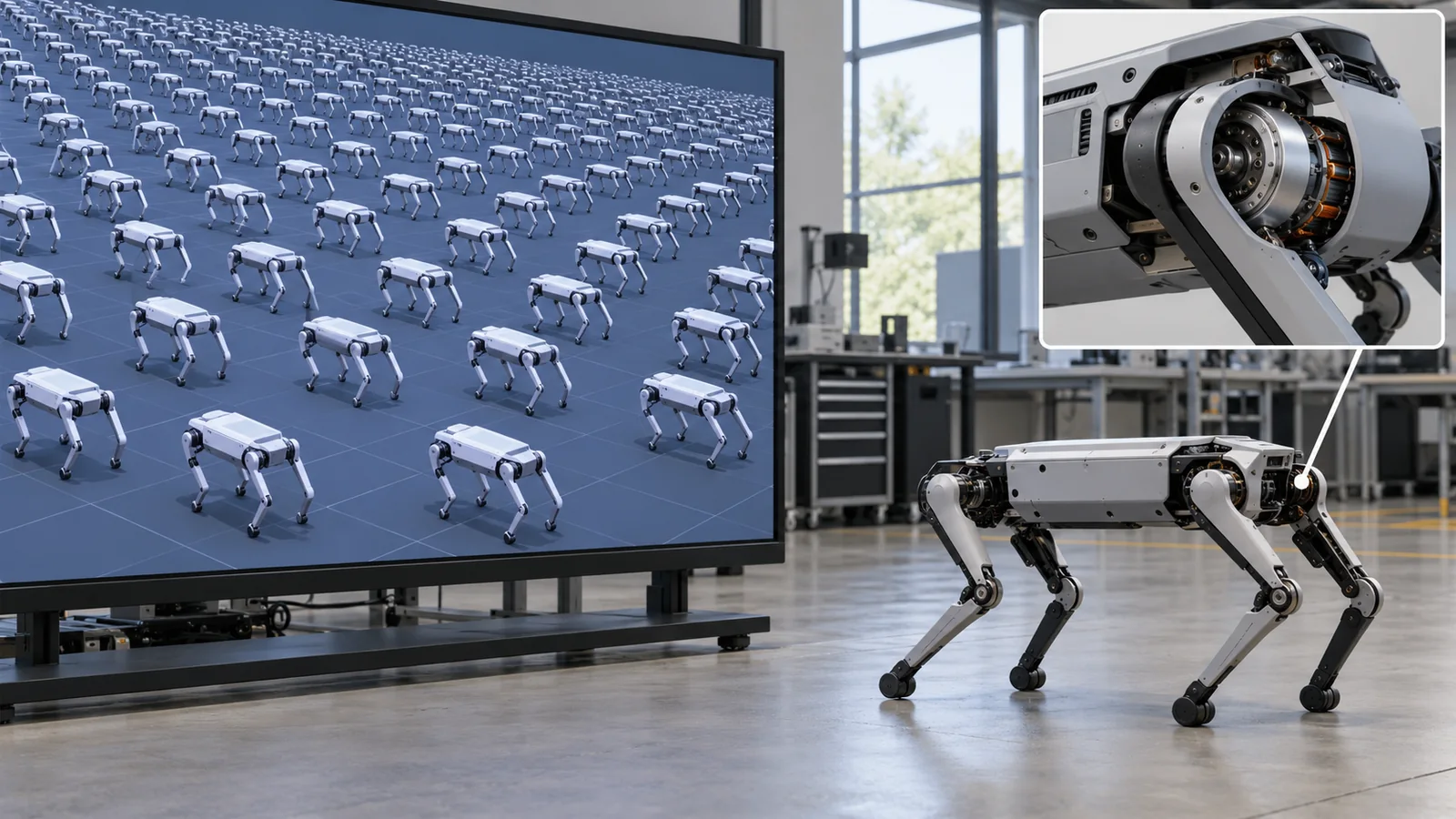
In fact: whether a policy that succeeds in simulation succeeds on the real machine is a separate question, because friction, contact, delays and sensor scatter can differ. Domain randomisation and setting ranges from measurements on the real machine are ways to reduce the gap, not guarantees of success. The factors behind the gap are laid out in Chapter 4 of our article on world models and embodied AI, and in our article on robot simulation and digital twins.
8. A materials engineer’s view: the “spread” of material properties and the “ageing” of real machines
The quantities that get randomised in domain randomisation include material properties such as the friction coefficient [Ref. 19]. This is where materials knowledge helps. For the surface of the object being grasped, the floor, the fixtures and the rubber of the fingertips, you can supply the friction coefficient and elastic modulus not as a single point but as a measured spread. If the range is widened arbitrarily without measuring, the policy may become over-cautious and slow; if it is too narrow, it fails on the real machine (Fig. 7; that a wide range makes a policy cautious is an inference).
Friction changes with surface roughness, contamination, humidity, temperature and contact force. So it is worth checking, under matched measurement conditions, whether “that friction coefficient holds under the conditions of the real machine”. Objects that deform or flow, such as cloth, cables, powders and liquids, are an even harder area to reproduce in simulation (this is this article’s general view; we did not check primary sources).
The rubber of a robot’s fingertips wears, gears and joints develop play, and the resistance of wiring and the state of lubrication change. The machine at the time of training and the machine a year later are not the same. Rather than learning a policy once and finishing, a routine for re-checking or re-training as the machine degrades may be needed (this is this article’s general view, not a measurement on a specific model). Trial and error on a real machine may also put heavy loads on the machine (inference). Reducing real-machine trials (through simulation or human help) is therefore also a matter of machine life and cost.
9. Choosing and combining — which route to take
| Situation | Route that tends to fit (commentary) | Why |
|---|---|---|
| A job a person can easily demonstrate (assembly, moving things) | Imitation learning | Demonstrations act as right answers, so it gets going with few repetitions. ACT reports learning six tasks from 10 minutes of demonstrations [Ref. 3] |
| Motions that are hard to teach (fast walking, flight) | Reinforcement learning plus simulation | Walking can be learned in a short time with parallel simulation [Ref. 13]. There is also the example of drone racing [Ref. 17] |
| You want precision and speed together on the real machine | Imitation plus human corrections plus RL | As in HIL-SERL, use demonstrations and corrections as a foothold and polish on the real machine [Ref. 11] |
| The properties of the objects vary widely | Measuring the range to randomise, plus confirmation on the real machine | On every route, measuring the spread of properties is the foundation (Fig. 7) |
The “route that tends to fit” column is this article’s arrangement (commentary), not a recommendation by the papers. Real methods combine several routes.
10. Limits, and what could not be confirmed / summary
(1) Comparing results in papers
Success rates and training times are values reported for the robots, tasks and conditions each paper chose. We do not rank methods by lining up numbers from different conditions. We did not confirm independent third-party reproduction.
(2) Calculations from assumed values
The numbers in Chapters 4 and 6 are arithmetic on assumptions we made (ε = 1%, 1 million steps and so on), not the performance of any real policy or robot. The bound of Ross et al. is a worst-case value, not a typical number of mistakes.
(3) The text of standards
For ISO standards we confirmed only number, title and stage and did not read the text. We could not confirm a published standard that directly defines how to assess the safety of learned policies. ISO/IEC TS 22440, on functional safety of AI, is at the committee-draft stage.
(4) What we did not cover
How large pre-trained models relate to imitation and reinforcement learning is covered in our article on robot foundation models and VLA, how to collect demonstrations in our article on teleoperation and data collection, and the details of simulators in our article on robot simulation and digital twins. We do not cover humanoid products or market size.
- Imitation learning uses a person’s demonstrations as the right answer, and errors compound in situations the demonstrations did not cover (the bound is T²ε, a worst-case value). Countermeasures include DAgger and action chunkingSourcedOur calculation
- Reinforcement learning learns from the score of the result alone, and its walls are the number of trials and the design of the reward. On real robots there is an example that collected hundreds of thousands of trials over two months, and an example in which simulation allowed learning in 20 minutesSourced
- In sim2real, the spread of material properties such as friction, and the ageing of the real machine, decide the outcome. Check success rates on the real machine under your own conditions (commentary)
11. How to read the yardsticks and standards
The basic yardstick for a learned policy is the success rate on a task. But a success rate changes with the number of trials, how objects are placed, the environment and who evaluates. The calculation of the width (confidence interval) of a success rate from few trials is in Chapter 6 of our article on world models and embodied AI. Here we list the benchmarks used to evaluate imitation and reinforcement learning, and the safety standards (checked 25 October 2026).
| Item evaluated | Representative tests and benchmarks (name, source) | Standards, rules and guidance (ISO and others) | Notes on reading |
|---|---|---|---|
| Success rate of imitation learning | robomimic (five simulated tasks plus three real tasks, six learning methods) [Ref. 5]. The 12 tasks from four manipulation benchmarks used by Diffusion Policy [Ref. 4]Sourced | Could not be confirmed | Results change with demonstration quality, the choice of evaluation tasks and when training is stopped. Comparisons are under each paper’s settings |
| Success rate and efficiency of reinforcement learning | Meta-World (50 manipulation tasks) [Ref. 22]. D4RL (datasets and evaluation for offline reinforcement learning) [Ref. 21]Sourced | Could not be confirmed | Results in simulation do not guarantee results on a real machine. Results cannot be compared if the reward is defined differently |
| Success rate on real machines | Real-machine trials in each paper (for example QT-Opt’s 96% grasp success on unseen objects [Ref. 10] and ACT’s 80-90% [Ref. 3])Sourced | Could not be confirmed (we could not confirm a standard that defines how to evaluate the generalisation of a learned policy) | The width varies with the number of trials, placement of objects and lighting. Read success rates from few trials with confidence intervals |
| Safety of industrial robots | — (a standard, not a benchmark) | ISO 10218-1:2025 (safety requirements for the robot itself) and ISO 10218-2:2025 (applications and robot cells) [Ref. 23, 24]Sourced | They do not directly define how to evaluate a learned policy. The text is paid, so we stay with the titles |
| Using AI in safety-related functions | — | ISO/IEC TR 5469:2024 (functional safety and AI; a technical report) [Ref. 25]. ISO/IEC CD TS 22440-1 (functional safety and AI: requirements; committee-draft stage) [Ref. 26]SourcedNot yet confirmed | A technical report provides information, not requirements. TS 22440 is in preparation and its content is not settled |
The arrangement of the table is Our calculation (organising). Numbers, titles, dates and stages of ISO standards were checked on the official ISO pages (25 October 2026). The text of the standards is paid, so we stay with titles and stages.
Notes on reading (for materials engineers)
- Demonstrations, benchmarks and the shop floor are different things: success rates in papers are values for chosen tasks in tidy environments. Re-measure with your own parts, floor, lighting and a worn machine
- Reported values and independent verification are different: training times and success rates are mostly measured by the research group that developed the method. Check whether there has been independent reproduction
- Is a standard a requirement, information, or in preparation? ISO 10218 sets safety requirements, ISO/IEC TR 5469 provides information, and ISO/IEC TS 22440 is in preparation. “Conforms to a standard” does not mean a learned policy is safe
- A success rate from few trials has a wide range: a “90%” from 9 of 10 trials is not the same as a “90%” from 900 of 1,000 (Chapter 6 of our article on world models and embodied AI)
12. Glossary
- Policy
- A function that returns the next action from what is currently observed. Here it is a neural network.
- Observation
- The information the robot receives (camera images, joint angles, forces and so on).
- Action
- The command the robot issues (target joint positions, forces, hand opening and closing, and so on).
- Imitation learning
- Learning a policy using a person’s demonstrations as the “right answers”.
- Behavior cloning (BC)
- The simplest form of imitation learning: fitting (observation, action) pairs with supervised learning.
- DAgger
- A method in which an expert labels the situations the learned policy itself visits, and these are added to the data for retraining.
- Distribution shift
- When the situations met in use differ from those in the training data.
- Action chunking
- Outputting several future steps of actions at once rather than one step at a time.
- Reinforcement learning (RL)
- Finding a policy that makes the total reward large, using only a score (the reward) for the results of actions.
- Reward
- A score for the outcome of actions, set by the designer.
- Return
- The sum of rewards over time, with later rewards discounted.
- Discount factor
- A number between 0 and 1 saying how little later rewards count.
- Environment
- What the policy acts on: the robot, objects, the laws of physics.
- PPO
- Proximal policy optimisation: a widely used RL method that updates the policy in small, controlled steps.
- Offline RL
- Doing RL from an existing dataset without new trials.
- Reward hacking
- Earning score through a loophole in the reward that the designer did not intend.
- Sim2real
- Moving a policy learned in simulation to the real machine.
- Reality gap
- The difference between simulation and the real world.
- Domain randomisation
- Varying a simulator’s appearance and physical values so that the policy tolerates the differences.
- Teleoperation
- A person operating a robot from a distance; also a way to collect demonstrations.
- Success rate
- The fraction of trials that achieved the task; read together with the number of trials and conditions.
13. References
- Ross S., Gordon G. J., Bagnell J. A. “A Reduction of Imitation Learning and Structured Prediction to No-Regret Online Learning” (DAgger), arXiv:1011.0686 (2010; AISTATS 2011) — arxiv.org/abs/1011.0686
- Bojarski M. et al. “End to End Learning for Self-Driving Cars”, arXiv:1604.07316 (2016) — arxiv.org/abs/1604.07316
- Zhao T. Z. et al. “Learning Fine-Grained Bimanual Manipulation with Low-Cost Hardware” (ALOHA, ACT), arXiv:2304.13705 (2023) — arxiv.org/abs/2304.13705
- Chi C. et al. “Diffusion Policy: Visuomotor Policy Learning via Action Diffusion”, arXiv:2303.04137 (2023) — arxiv.org/abs/2303.04137
- Mandlekar A. et al. “What Matters in Learning from Offline Human Demonstrations for Robot Manipulation”, arXiv:2108.03298 (2021) — arxiv.org/abs/2108.03298
- Schulman J. et al. “Proximal Policy Optimization Algorithms”, arXiv:1707.06347 (2017) — arxiv.org/abs/1707.06347
- Haarnoja T. et al. “Soft Actor-Critic: Off-Policy Maximum Entropy Deep Reinforcement Learning with a Stochastic Actor”, arXiv:1801.01290 (2018) — arxiv.org/abs/1801.01290
- Amodei D. et al. “Concrete Problems in AI Safety”, arXiv:1606.06565 (2016) — arxiv.org/abs/1606.06565
- Levine S. et al. “Learning Hand-Eye Coordination for Robotic Grasping with Deep Learning and Large-Scale Data Collection”, arXiv:1603.02199 (2016) — arxiv.org/abs/1603.02199
- Kalashnikov D. et al. “QT-Opt: Scalable Deep Reinforcement Learning for Vision-Based Robotic Manipulation”, arXiv:1806.10293 (2018) — arxiv.org/abs/1806.10293
- Luo J. et al. “Precise and Dexterous Robotic Manipulation via Human-in-the-Loop Reinforcement Learning” (HIL-SERL), arXiv:2410.21845 (2024) — arxiv.org/abs/2410.21845
- Makoviychuk V. et al. “Isaac Gym: High Performance GPU-Based Physics Simulation For Robot Learning”, arXiv:2108.10470 (2021) — arxiv.org/abs/2108.10470
- Rudin N. et al. “Learning to Walk in Minutes Using Massively Parallel Deep Reinforcement Learning”, arXiv:2109.11978 (2021) — arxiv.org/abs/2109.11978
- Hwangbo J. et al. “Learning agile and dynamic motor skills for legged robots”, Science Robotics 4, eaau5872 (2019), DOI 10.1126/scirobotics.aau5872 — doi.org/10.1126/scirobotics.aau5872
- Lee J. et al. “Learning quadrupedal locomotion over challenging terrain”, Science Robotics 5, eabc5986 (2020), DOI 10.1126/scirobotics.abc5986 — doi.org/10.1126/scirobotics.abc5986
- Miki T. et al. “Learning robust perceptive locomotion for quadrupedal robots in the wild”, Science Robotics 7, eabk2822 (2022), DOI 10.1126/scirobotics.abk2822 — doi.org/10.1126/scirobotics.abk2822
- Kaufmann E. et al. “Champion-level drone racing using deep reinforcement learning”, Nature 620, 982–987 (2023), DOI 10.1038/s41586-023-06419-4 — doi.org/10.1038/s41586-023-06419-4
- Tobin J. et al. “Domain Randomization for Transferring Deep Neural Networks from Simulation to the Real World”, arXiv:1703.06907 (2017) — arxiv.org/abs/1703.06907
- OpenAI et al. “Learning Dexterous In-Hand Manipulation”, arXiv:1808.00177 (2018) — arxiv.org/abs/1808.00177
- OpenAI et al. “Solving Rubik’s Cube with a Robot Hand”, arXiv:1910.07113 (2019) — arxiv.org/abs/1910.07113
- Fu J. et al. “D4RL: Datasets for Deep Data-Driven Reinforcement Learning”, arXiv:2004.07219 (2020) — arxiv.org/abs/2004.07219
- Yu T. et al. “Meta-World: A Benchmark and Evaluation for Multi-Task and Meta Reinforcement Learning”, arXiv:1910.10897 (2019) — arxiv.org/abs/1910.10897
- ISO ISO 10218-1:2025 “Robotics — Safety requirements — Part 1: Industrial robots” (Edition 3, February 2025). Checked 25 October 2026 — iso.org/standard/73933.html
- ISO ISO 10218-2:2025 “Robotics — Safety requirements — Part 2: Industrial robot applications and robot cells” (Edition 2, February 2025). Checked 25 October 2026 — iso.org/standard/73934.html
- ISO/IEC ISO/IEC TR 5469:2024 “Artificial intelligence — Functional safety and AI systems” (Edition 1, January 2024). Checked 25 October 2026 — iso.org/standard/81283.html
- ISO/IEC ISO/IEC CD TS 22440-1 “Artificial intelligence — Functional safety and AI systems — Part 1: Requirements” (committee draft; stage 30.60, close of comment period). Checked 25 October 2026 — iso.org/standard/89535.html
14. Claim-to-source audit
| Claim in the text | Basis | Class |
|---|---|---|
| End-to-end learning of a mapping from camera pixels to steering commands from human driving data (Bojarski et al.) | Bojarski et al. (abstract) Reference 2 https://arxiv.org/abs/1604.07316 | Sourced |
| That in imitation learning the policy’s actions affect later observations so the i.i.d. assumption fails; that mistakes can grow to T² × ε and the bound can be reached in the worst case; that DAgger addresses it | Ross et al. (introduction, theorems) Reference 1 https://arxiv.org/abs/1011.0686 | Sourced |
| The table and figure of the error bound (ε = 1%, T = 10 to 200) and that the bound becomes uninformative when ε > 1/T | Our calculation (arithmetic on the T² × ε bound of Ross et al.; ε = 1% is assumed). Not the error count of any real policy | Our calculation |
| ACT/ALOHA: low-cost hardware, imitation from demonstrations with a generative model over action sequences, six difficult tasks at 80-90% success with 10 minutes of demonstrations; errors compounding and non-stationary human demonstrations as the challenges | Zhao et al. (abstract) Reference 3 https://arxiv.org/abs/2304.13705 | Sourced |
| That Diffusion Policy represents a policy as a diffusion process and is reported to improve on existing methods by 46.9% on average over 12 tasks from four benchmarks | Chi et al. (abstract) Reference 4 https://arxiv.org/abs/2303.04137 | Sourced |
| robomimic: six offline learning methods compared on five simulated and three real multi-stage tasks, with analysis including dependence on demonstration quality | Mandlekar et al. (abstract) Reference 5 https://arxiv.org/abs/2108.03298 | Sourced |
| PPO (a family of policy-gradient methods allowing multiple epochs of minibatch updates) and SAC (an off-policy actor-critic; high sample complexity has been a challenge) | Schulman et al. (abstract); Haarnoja et al. (abstract) Reference 6 https://arxiv.org/abs/1707.06347 Reference 7 https://arxiv.org/abs/1801.01290 | Sourced |
| That a wrongly designed reward (reward hacking) and distribution shift can cause accidents in machine-learning systems | Amodei et al. (abstract) Reference 8 https://arxiv.org/abs/1606.06565 | Sourced |
| Real-robot trial and error: over 800,000 grasp attempts over two months with 6 to 14 arms (Levine et al.); 96% grasp success on unseen objects from over 580,000 real grasp attempts (QT-Opt); RL with human demonstrations and corrections reaching high success rates within 1 to 2.5 hours of training (HIL-SERL) | Levine et al.; Kalashnikov et al.; Luo et al. (abstracts) Reference 9 https://arxiv.org/abs/1603.02199 Reference 10 https://arxiv.org/abs/1806.10293 Reference 11 https://arxiv.org/abs/2410.21845 | Sourced |
| Massively parallel simulation on one GPU: ANYmal walking policies trained in under four minutes on flat terrain and twenty minutes on uneven terrain and transferred to the real robot (Rudin et al.); physics simulation and policy training on the GPU giving two to three orders of magnitude speed-up (Isaac Gym) | Rudin et al. (abstract); Makoviychuk et al. (abstract) Reference 13 https://arxiv.org/abs/2109.11978 Reference 12 https://arxiv.org/abs/2108.10470 | Sourced |
| A policy trained in simulation transferred to ANYmal for following velocity commands, running faster and recovering from falls (Hwangbo et al.); a policy using proprioception only walking robustly over mud, snow and rubble (Lee et al.); a policy integrating exteroceptive and proprioceptive perception (Miki et al.) | Hwangbo et al.; Lee et al.; Miki et al. (Science Robotics abstracts) Reference 14 https://doi.org/10.1126/scirobotics.aau5872 Reference 15 https://doi.org/10.1126/scirobotics.abc5986 Reference 16 https://doi.org/10.1126/scirobotics.abk2822 | Sourced |
| Swift: an autonomous drone combining deep RL in simulation with real-world data won several head-to-head races against each of three human champions and recorded the fastest race time | Kaufmann et al. (abstract) Reference 17 https://doi.org/10.1038/s41586-023-06419-4 | Sourced |
| Domain randomisation (random rendering to train a real-world detector accurate to 1.5 cm), in-hand manipulation with a Shadow Hand transferred to the real robot with randomised friction and other values and no human demonstrations, and the Rubik’s cube (ADR) | Tobin et al.; OpenAI (abstracts) Reference 18 https://arxiv.org/abs/1703.06907 Reference 19 https://arxiv.org/abs/1808.00177 Reference 20 https://arxiv.org/abs/1910.07113 | Sourced |
| D4RL (datasets and evaluation for offline RL) and Meta-World (a benchmark of 50 manipulation tasks) | Fu et al. (abstract); Yu et al. (abstract) Reference 21 https://arxiv.org/abs/2004.07219 Reference 22 https://arxiv.org/abs/1910.10897 | Sourced |
| The numbers, titles and stages of ISO 10218-1:2025 and ISO 10218-2:2025 (safety requirements for industrial robots, February 2025), ISO/IEC TR 5469:2024 (functional safety and AI, a technical report) and ISO/IEC CD TS 22440-1 (functional safety and AI, requirements; committee draft) | ISO pages Reference 23 https://www.iso.org/standard/73933.html Reference 24 https://www.iso.org/standard/73934.html Reference 25 https://www.iso.org/standard/81283.html Reference 26 https://www.iso.org/standard/89535.html | Sourced |
| The assumed real-robot training times (1 million steps / 10 Hz = 27.8 h; 10 million steps / 50 Hz = 55.6 h), the return calculation (0.9⁴ = 0.656) and the arrangement of Figure 6 | Our calculation (steps divided by control rate). Conditions differ from the reported values in papers; no ranking is implied | Our calculation |
| The readings that a policy breaks in situations the demonstrations do not cover, that the range of friction and similar values should be measured to set the randomisation range, that wear and contamination of real machines change conditions, and that a learned policy alone should not be used for safety | This article’s commentary based on the published material; not views stated by the institutions | Commentary |
| A standard directly defining the safety assessment of learned policies, statistics on failures and breakages in real-robot RL, and manufacturers’ stated training times for specific robots | Not included because they could not be confirmed from primary sources within this article’s research (commentary) | Commentary |
| That Figures 1 and 8 are frames for AI-generated images, Figures 2, 3 and 7 are explanatory concept diagrams, and Figures 4, 5 and 6 contain our calculations | This article’s own note | Commentary |
Last updated: 25 October 2026 / Sources are limited to primary material (arXiv papers, papers in Science Robotics and Nature, and official ISO pages). We could not read the text of the ISO standards because it is paid. The numerical examples are calculations from values we assumed and are not the performance of any real robot or policy. We could not confirm, and so do not state, a standard that directly defines the safety assessment of learned policies, statistics on failures and breakages in real-robot reinforcement learning, or manufacturers’ stated training times for specific robots. Figures 1 and 8 are ImageGen-generated conceptual illustrations; the other figures are explanatory concept diagrams or figures containing our calculations.