TECHNOLOGY EXPLAINER
Underwater and Marine Robots
― Machines that work where radio does not reach, pressure crushes and seawater corrodes
The sea is a completely different world from air. Radio hardly gets through, sound is slow, the weight of the water presses harder the deeper you go, and seawater attacks metal. Even so, tethered ROVs flown by a pilot, AUVs that follow a plan on their own, and gliders that move for months on buoyancy alone are all studying the ocean. This article assumes no background in robotics or oceanography. It covers (1) how the three types differ, (2) the problem of communication and not knowing where you are (checked with numbers), (3) water pressure and materials (ceramics, titanium, silicone), (4) corrosion and protection, and (5) recent research from MIT and EPFL, Purdue University and others, using diagrams and small calculations.
Research results are labeled as research-stage and no claim is made about practicality or superiority. It separates what could be confirmed, what is a university or company claim, what is a plan, and what could not be confirmed.
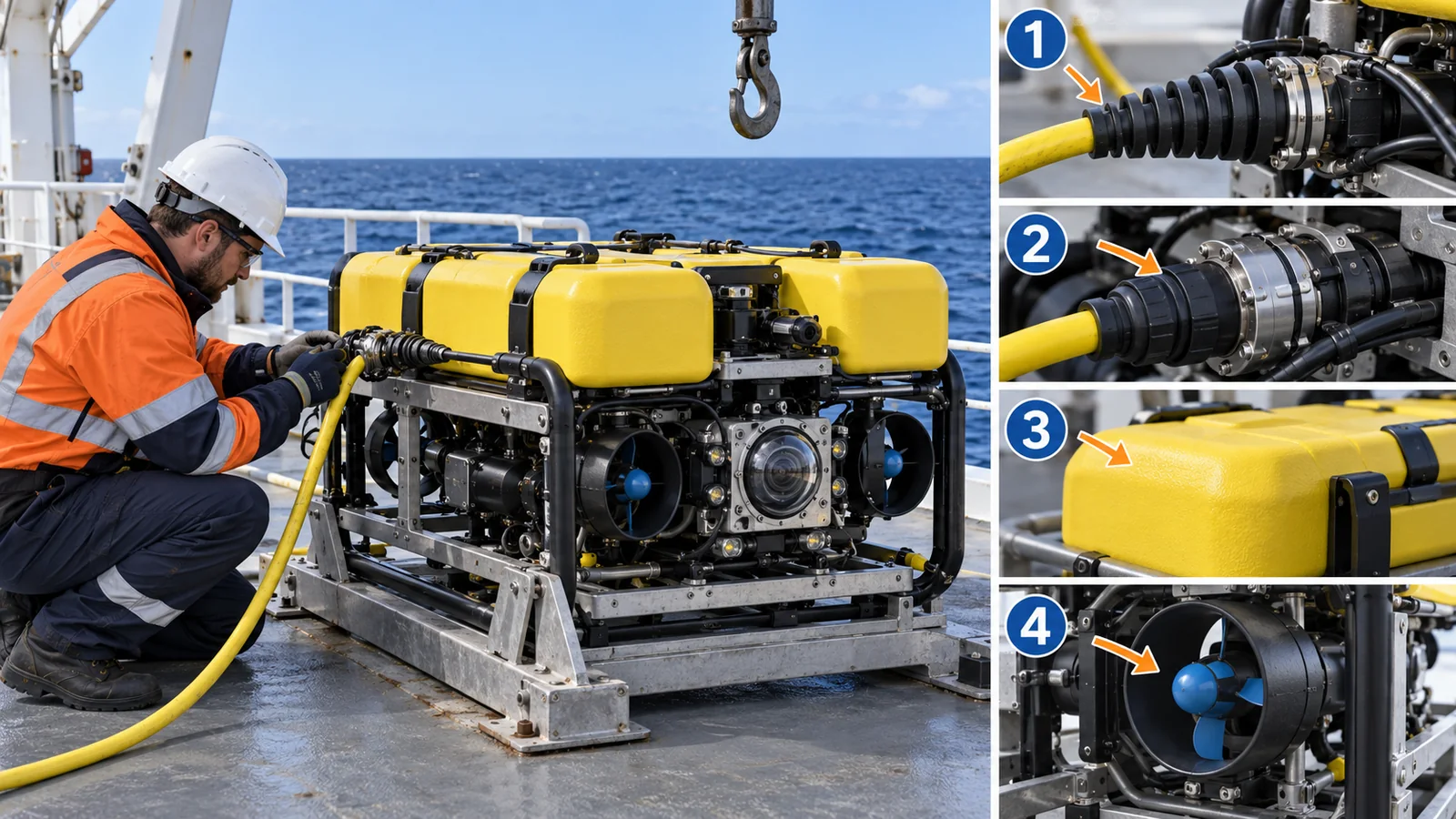
- The short version / what to know first / where this fits in the series
- Three types: ROVs, AUVs and gliders
- Communication underwater: radio does not reach, sound is slow
- Position underwater: estimating without GPS
- Pressure and materials: surviving 1,000 atmospheres
- Corrosion: metals become a “battery” in seawater
- Research examples: swim and fly, three modes, and soft endurance
- Where things stand (checked 25 October 2026)
- How to read the yardsticks and standards
- Glossary / References / Claim-to-source audit
Sourced = stated in a published source (link given)
Our calculation = a value we calculated from stated assumptions
Not yet confirmed = a plan, a target, or research with no confirmed track record
Structural summaries and materials-related readings are marked as “explanation”. Inference is shown in bold. Every analogy comes with its limits.
Depths, speeds and times are separated into values with a stated source (institution announcements and papers) and values we calculated under stated assumptions. Worked examples are explanatory and are not specifications of any vehicle. The research robots were tested in tanks, pools, lakes and short field trials; this says nothing about reliability or service life in real operation. This field changes quickly, so vehicle names and research status carry a check date (25 October 2026). Military equipment is not covered.
1. The short version / what to know first / where this fits in the series
- Underwater, communication and position are the hardest problems. GPS and radio signals fade quickly in water, so acoustics is used, but sound travels at only about 1,500 m/s and the bandwidth is narrow Sourced[Ref. 7]. In our calculation, sound takes about 6.7 seconds to reach something 10 km away Our calculation.
- In the deep sea, pressure sets the limits of materials. At the deepest point (about 10,935 m) our calculation gives about 110 MPa, or about 1,100 atmospheres Our calculation. Nereus, which went beyond 10,000 m, used light ceramic spheres for flotation and a hair-thin optical-fiber tether Sourced[Ref. 9]. A soft robot that embedded its electronics in silicone, with no rigid vessel, has also worked in the deep sea Sourced[Ref. 10].
- The latest research is still at the tank, pool or lake stage. The MIT and EPFL robot that leaps out of the water weighs under 300 g and was tested in a tank and a lake Sourced[Ref. 14]. Purdue University’s three-mode robot (drifting, gliding, thrusting) is at the pool-test stage Sourced[Ref. 15, 16].
No prior knowledge is needed. Think of a robot as three things combined: sensing (sensors), thinking (control and intelligence), and moving (actuators). For underwater robots, two things differ greatly from ground robots: the position information needed for “sensing” (GPS) is not available, and the machinery that does the “moving” is exposed to water pressure and seawater. What they share with drones is a trade-off between battery weight and how long the vehicle can operate.
In drones and robotics, this article covers robots for an environment that is neither air nor ground. For the idea of position estimation see our explainer on SLAM and localization; for batteries see our explainers on power sources for robots and drones and on lithium-ion battery basics; for materials see our explainer on structural materials for robots and drones; for soft actuation see our explainer on soft actuators and artificial muscles; and for flying hybrids see our explainer on fixed-wing, VTOL and long-endurance flight.
2. Three types: ROVs, AUVs and gliders
Underwater robots fall into three main types. The points that tell them apart are whether they are tied to a ship by a cable and how much a human is involved.
- ROV (remotely operated vehicle): an uncrewed underwater robot tethered to a ship. The cable carries the pilot’s commands, and the vehicle sends back live video and other data Sourced[Ref. 2]. NOAA says the cable carries power and signals (its example is an ROV connected by an eight-kilometre steel cable) Sourced[Ref. 2]. Vehicles range from laptop-sized to the size of a small truck.
- AUV (autonomous underwater vehicle): a robot cast off from the ship that carries out a pre-planned mission by itself, with no cable. When the mission ends it returns to a set location, and the data are collected afterward Sourced[Ref. 1, 3]. NOAA says AUVs can be smaller and lighter than ROVs and can be run from smaller ships Sourced[Ref. 3].
- Glider: a kind of AUV that moves not with a propeller but by changing its buoyancy. It adjusts buoyancy to dive and rise, and uses wings to turn that motion into horizontal progress Sourced[Ref. 5].
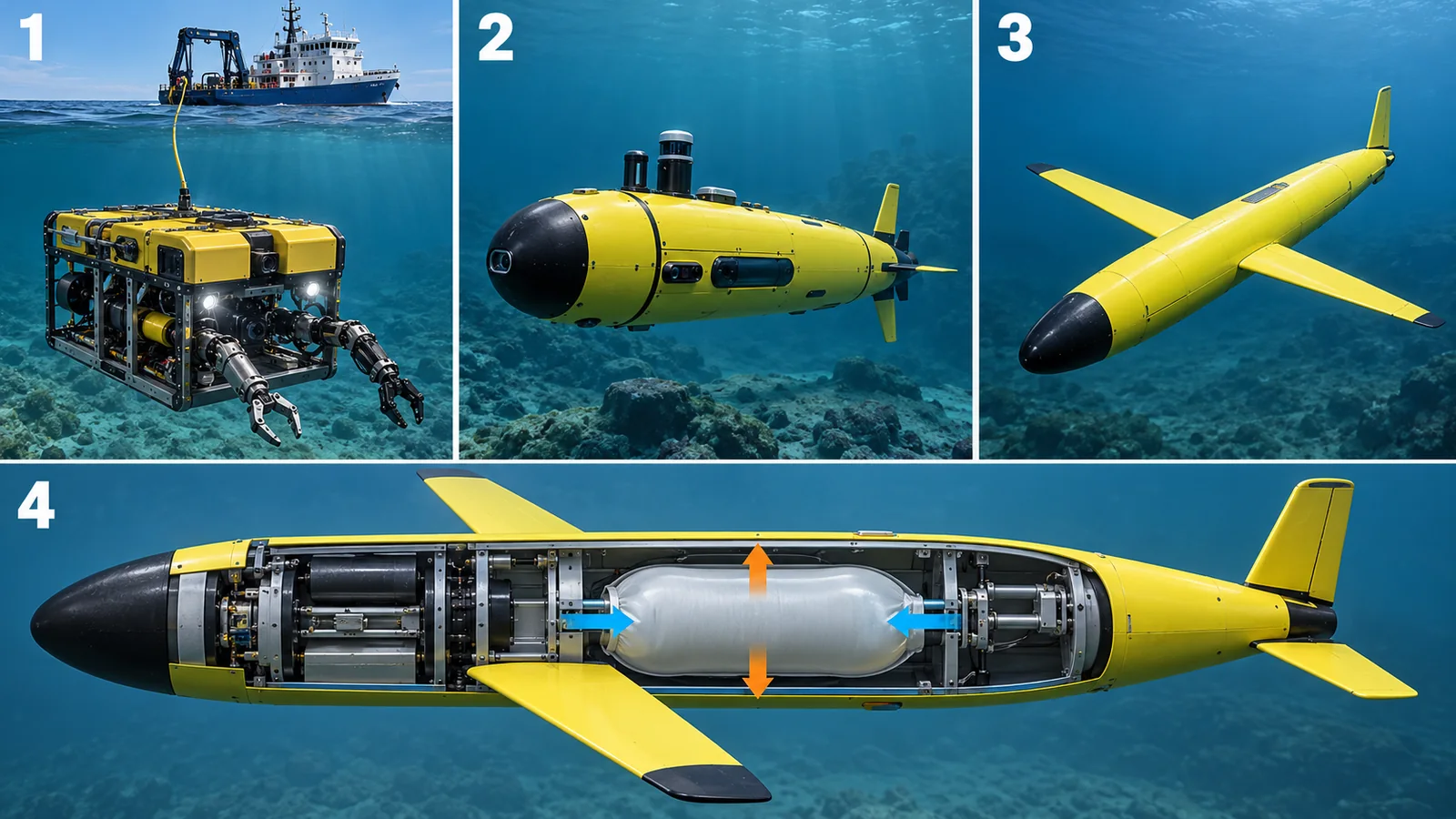
Original SVG, detailed explanation and sources
Original SVG reference: Concept diagram (vector drawing). Differences among ROVs, AUVs and gliders. The classification follows NOAA descriptions and the glider principle follows Rudnick et al. and APL-UW; this is a concept summary.
An ROV is close to “a drone a person flies”, an AUV to “a drone that flies itself”, and a glider is like a paper plane that slowly glides down while moving forward (limits of the analogy: a glider can change its buoyancy to rise again after diving).
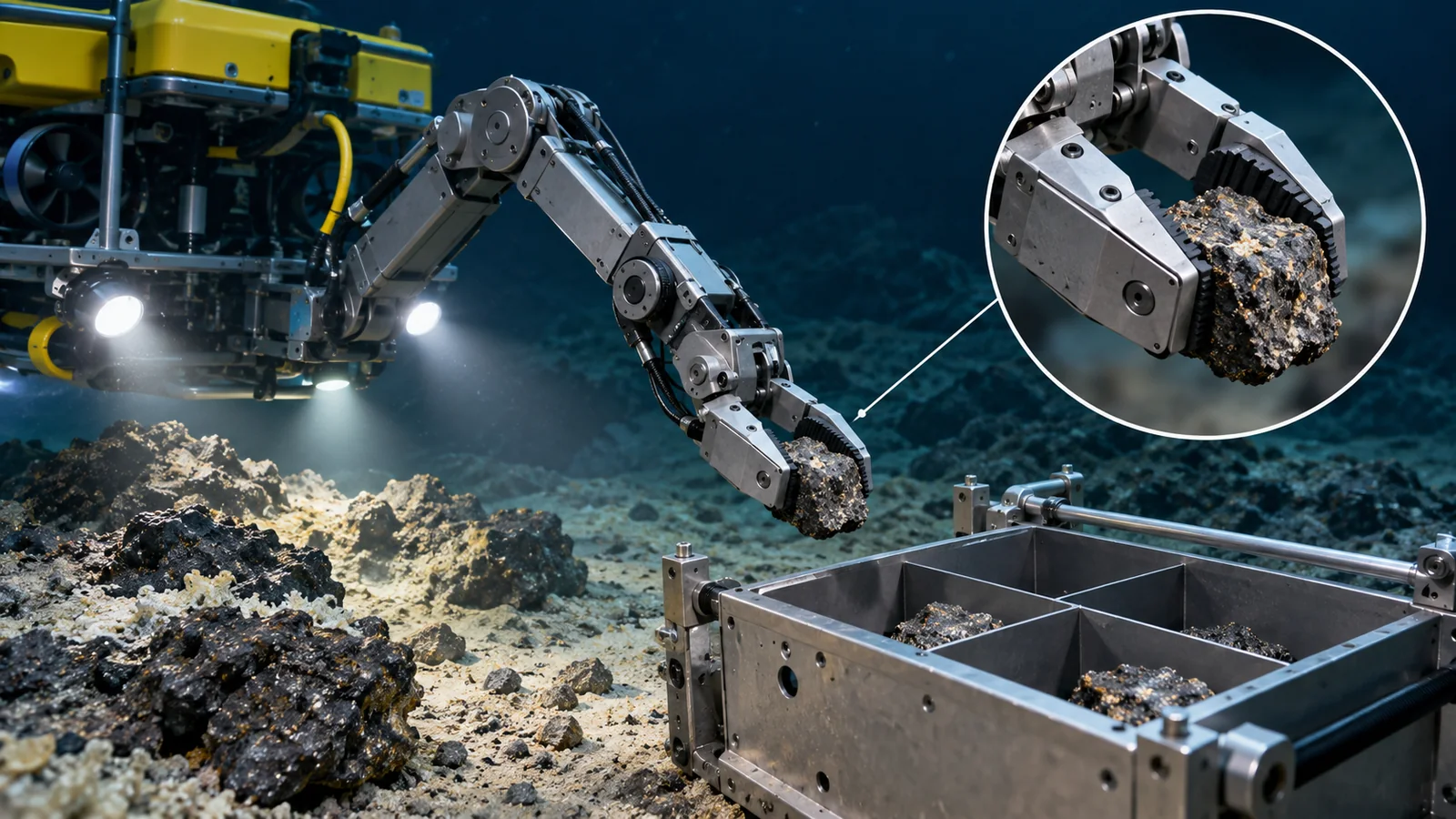
The glider’s long journey
Gliders use little power, so they can keep going for a very long time. The University of Washington Applied Physics Laboratory (APL-UW) describes its Seaglider as using buoyancy for thrust, working to a maximum depth of about 1,000 m, with records of a mission over 3,800 km and one lasting more than seven months Sourced[Ref. 6]. NOAA’s IOOS lists uses of gliders such as hurricane intensity forecasting, ecosystem monitoring, fisheries management and ocean acidification monitoring Sourced[Ref. 4].
AUVs and gliders are not steered by a person in real time. But planning beforehand, recovering the vehicle and checking the data remain as work. And because underwater links are thin (Chapter 3), it is hard to change instructions midway, so the quality of the plan decides the success of the mission (explanation). “Autonomous” does not mean “no human needed”.
A hybrid: Nereus, both ROV and AUV
WHOI’s Nereus was designed as a “hybrid” that can work as an ROV or as an AUV. In ROV mode it is connected to the ship by a hair-thin optical-fiber tether; in AUV mode it is cut loose and moves autonomously Sourced[Ref. 9]. The type of a vehicle is therefore not fixed; it can change with how it is operated (explanation).
3. Communication underwater: radio does not reach, sound is slow
Ground robots talk to distant partners by Wi-Fi or mobile radio. Underwater, this is almost impossible.
This is inaccurate. Underwater, GPS signals and radio travel only short distances and acoustics is used. Paull et al. (2014) list the weaknesses of underwater acoustic communication: narrow bandwidth, a low data rate, high delay (sound travels at about 1,500 m/s, slower than light), sound speed varying with temperature and salinity, multipath reflections from the surface and seabed, and unreliability Sourced[Ref. 7]. That is why ROVs are tied by a cable and why AUVs have their missions decided beforehand.
Checking with numbers: how far does radio reach?
Seawater contains salt, so it conducts electricity. In a conducting medium an electromagnetic wave fades quickly. The rate can be expressed as the depth at which the wave falls to about 37% (1/e). Assuming a seawater conductivity of 4 S/m, the distance gets shorter as frequency rises: about 8.0 m at 1 kHz, about 0.80 m at 100 kHz, about 0.25 m at 1 MHz and about 0.08 m (8 cm) at 10 MHz Our calculation. Wi-Fi frequencies (GHz) are shorter still (not calculated here).
What about sound? Sound travels well in water, but it is slow. At 1,500 m/s, reaching something 10 km away takes 10,000 / 1,500 = about 6.7 seconds Our calculation. If a radio signal could cover the same distance at the speed of light, it would take about 33 microseconds (0.000033 seconds) Our calculation. This “delay of about 200,000 times” makes real-time piloting underwater difficult.
A radio wave entering water weakens little by little as it goes. The “depth at which it falls to 1/e” is a guide to the distance at which the strength has dropped to about 37%, a bit over one third. Go the same distance again and it drops to 37% once more. Think of light moving through thick fog (limits of the analogy: the real fading changes in complicated ways with frequency, temperature and salinity). The formula used here is an approximation for a sufficiently conductive medium, and this is an explanatory calculation within our stated assumption.
A common language for underwater links is still growing
For underwater acoustic communication, modems (devices that communicate by sound) from different makers use different methods and cannot talk to each other. JANUS, developed by the NATO research centre CMRE, is a “common base” for the coding of underwater acoustic communication. A trade publication reported in May 2017 that it was recognized as a NATO standard (a STANAG) Sourced[Ref. 19] (the NATO text itself was not checked here).
4. Position underwater: estimating without GPS
GPS signals do not reach underwater either. An AUV has to estimate where it is by other means.
- Dead reckoning: calculating position by adding up heading and speed. Speed is measured with equipment such as a Doppler velocity log (DVL), which uses sound to measure motion. It is like counting steps to know how far you walked (limits of the analogy: real errors grow in more complicated ways than errors in stride length), and the error accumulates and keeps growing as the vehicle goes farther Sourced[Ref. 7].
- Acoustic references: USBL measures range and bearing with a device on the ship, and LBL measures from devices placed on the seabed. Both have limited range, and the devices must be installed beforehand at cost and effort Sourced[Ref. 7].
- Surface for GPS: gliders and others rise to the surface and take a new GPS fix with their antenna Sourced[Ref. 6].
The review by Paull et al. says the error of inertial navigation (accelerometers and gyroscopes) is about 0.1% of the distance travelled at best and 2-5% for modestly priced units Sourced[Ref. 7]. Let us calculate for 10 km. At 0.1% it is 10 m, at 2% it is 200 m, and at 5% it is 500 m Our calculation.
Inertial sensors (gyros) are affected by temperature and drift, a slow shift of the output. Underwater robots must put them inside a pressure vessel and hold the drift down in a sea whose temperature changes (our explanation). Acoustic sensors (transducers) are materials in direct contact with water and must withstand pressure, seawater and biological fouling. Position accuracy depends not only on software but also on the sensor’s materials and sealing (inference).
5. Pressure and materials: surviving 1,000 atmospheres
The weight of water presses on a machine harder as it goes deeper. At depth h the water pressure is P = rho x g x h, where rho is the density of seawater (assumed about 1,025 kg/m3) and g is gravitational acceleration (9.81 m/s2).
According to NOAA, the average depth of the ocean is 3,682 m and the deepest point, Challenger Deep, is about 10,935 m Sourced[Ref. 8]. Our calculation gives about 10 MPa at 1,000 m, about 37 MPa at 3,682 m, about 60 MPa at 6,000 m and about 110 MPa at 10,935 m Our calculation. 110 MPa is about 1,100 atmospheres, which works out to about 1.1 tonnes-force on a single square centimetre, about the area of a fingernail Our calculation. WHOI says Nereus withstood pressure about 1,000 times that at the surface Sourced[Ref. 9].
Three design approaches to pressure
There are three broad ways of thinking about pressure (the figure organizes concepts; it does not rank them).
- 1. Resist: a thick metal or ceramic rigid shell keeps the interior at 1 atmosphere. Nereus used ceramic hollow spheres for flotation (about 9 cm in diameter, about 800 in each hull) and is described as lighter than the traditional flotation, the syntactic foam used on vehicles such as Alvin and Jason Sourced[Ref. 9].
- 2. Balance: “pressure compensation”, in which the interior is filled with oil or similar so that it matches outside pressure. The Nature soft-robot paper lists rigid vessels and pressure compensation as the conventional ways of protecting deep-sea machinery Sourced[Ref. 10].
- 3. Embed softly: the robot in the Nature paper embedded its electronics in silicone, used no rigid shell, and moved with dielectric-elastomer fins. To reduce stress between parts it decentralized the electronics (increasing the spacing between components and separating them from the circuit board) Sourced[Ref. 10].
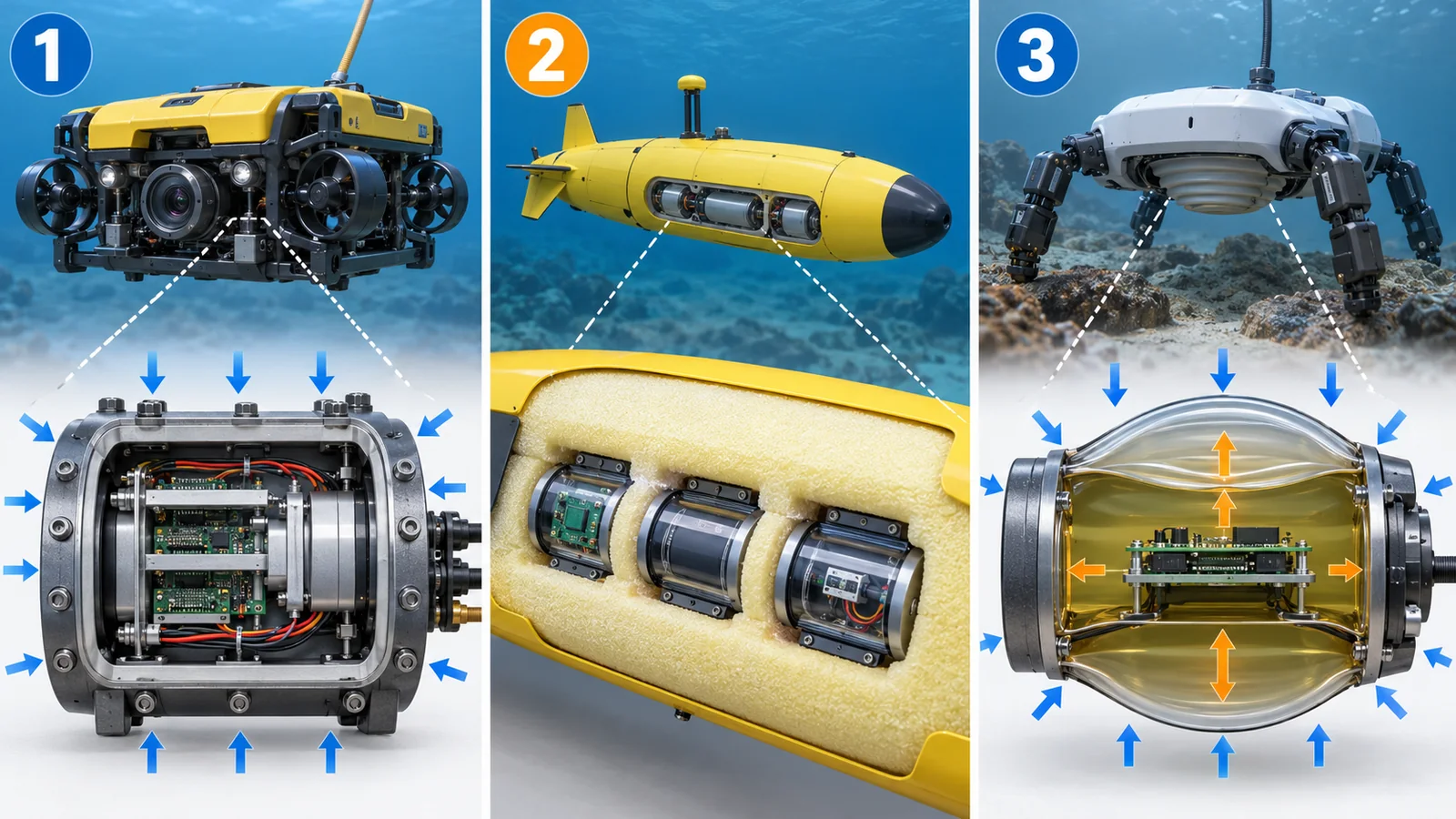
Original SVG, detailed explanation and sources
Original SVG reference: Concept diagram (vector drawing). Three design approaches to pressure. Examples come from WHOI’s Nereus announcement, APL-UW’s Seaglider page and the Nature soft-robot paper. It does not rank the approaches.
A deep-sea pressure shell gets stronger when thicker, but heavier and sinks. To float it you need flotation material, and that must withstand the pressure too. Nereus eased this tug of war with light ceramic spheres Sourced[Ref. 9]. APL-UW’s Seaglider is designed so that its hull compresses like seawater as it dives, reducing the buoyancy shift with depth (maximum depth about 1,000 m) Sourced[Ref. 6].
A metal shell suffers fatigue when pressure is applied again and again. Song et al. (2019) report that in a titanium alloy the longer the peak stress is held, the shorter the fatigue life (deep-sea submersible pressure hulls are named as one application) Sourced[Ref. 11]. Surviving one dive and diving dozens of times are therefore different conditions (our explanation).
WHOI explains that a thick steel-reinforced cable lowered into a trench deeper than 10,000 m would snap under its own weight. Nereus instead used a glass optical fiber with a thin plastic jacket, about as thick as a hair (breaking strength 4 kg, about 40 km on board) Sourced[Ref. 9]. A combination of lightness and strength made the vehicle smaller.
WHOI also says Nereus carried more than 4,000 lithium-ion batteries (similar to those in laptops and mobile phones), carefully tested to be used safely and reliably under pressure Sourced[Ref. 9]. Battery basics and safety are covered in our explainers on lithium-ion battery basics and on thermal runaway and battery safety.
6. Corrosion: metals become a “battery” in seawater
Seawater is a liquid that conducts electricity (an electrolyte). When two different metals touch in it, a small “battery” forms. A NOAA document calls this galvanic corrosion and explains that the less noble metal (the anode) gives up electrons and dissolves, while the more noble metal (the cathode) is protected Sourced[Ref. 12]. Think of the zinc in a dry cell dissolving to produce electricity (limits of the analogy: in a robot nothing useful is drawn out; it shows up as corrosion damage).
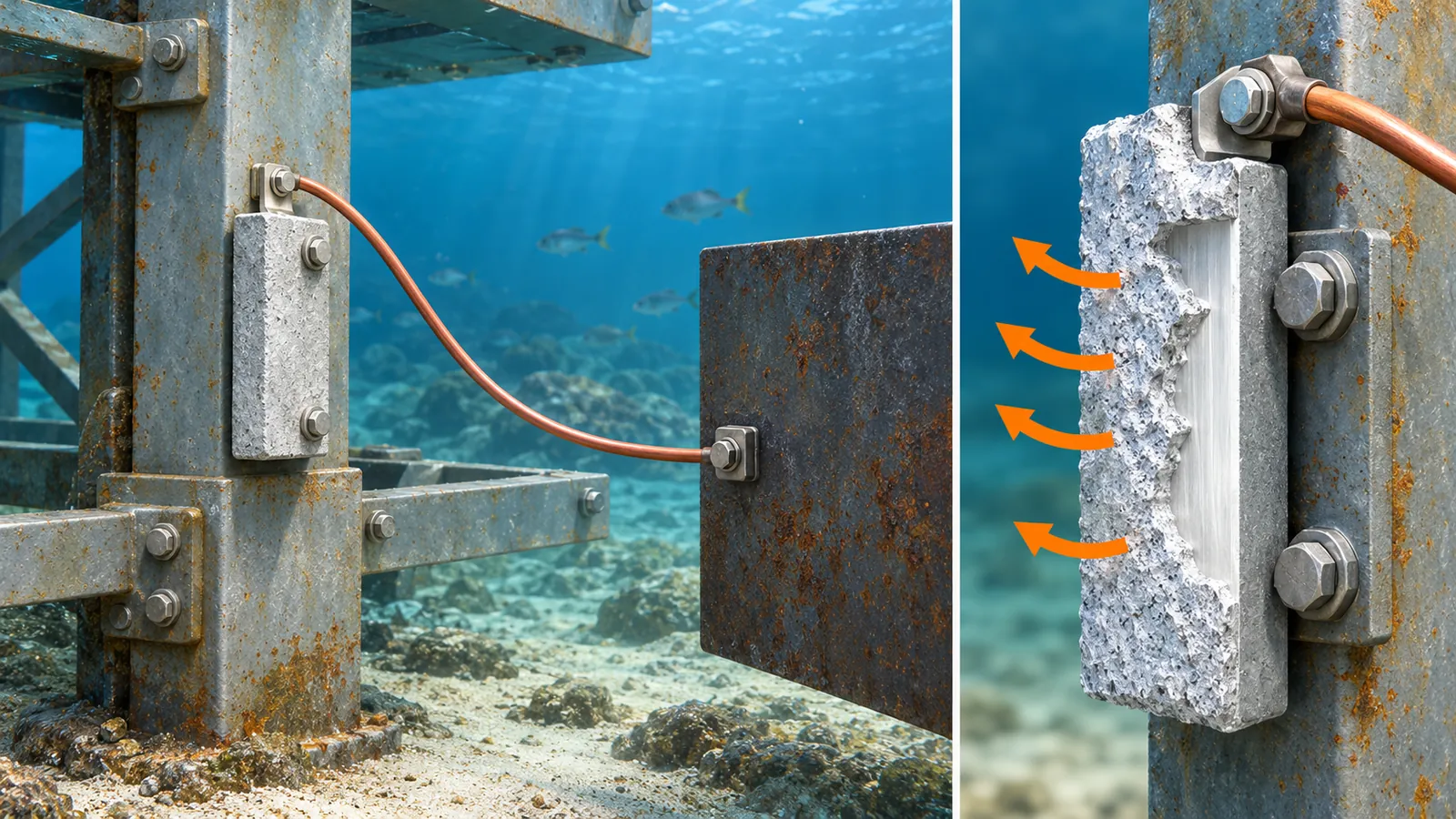
Original SVG, detailed explanation and sources
Original SVG reference: Concept diagram (vector drawing). Concept diagram of galvanic corrosion and sacrificial anodes, following a NOAA document. Real corrosion depends on the material pair, area and water chemistry.
The NOAA document’s example is a boat’s seawater piping in which an aluminum hose barb was fitted to a bronze sea strainer and the aluminum corroded. The same document says that zinc “sacrificial anodes” are sometimes fitted to protect aluminum hulls and other parts. Zinc is less noble than aluminum, so it dissolves first and protects the aluminum Sourced[Ref. 12].
An underwater robot can combine light aluminum frames, stainless-steel screws, copper-alloy connectors, titanium shells, and composites and ceramics. The design must sort out which metals touch each other and which places get wet with seawater, and use sacrificial anodes or insulation where needed (our explanation; the corrosion design of specific vehicles was not checked here).
The MIT and EPFL robot’s wings are thin membranes coated with hydrophobic nanoparticles to shed water Sourced[Ref. 14]. This is not corrosion protection but a device for moving from water to air, yet it is an example of a surface coating, a materials choice, tied directly to function.
7. Research examples: swim and fly, three modes, and soft endurance
Here is how far recent research has come on the problems above (communication, position, pressure, corrosion). All of it is at the research stage.
(1) From water to air: the MIT and EPFL flapping robot (Science, July 2026)
MIT and EPFL developed a “flapping-wing aerial-aquatic vehicle” (FAAV) that swims, then leaps from the water and flies, and published it in Science on 9 July 2026 Sourced[Ref. 13, 14]. It weighs under 300 g and consists of a fuselage, two flexible wings and a steerable tail. The body contains a battery and a waterproof electric motor, and a crankshaft moves the wings up and down at preset frequencies Sourced[Ref. 14].
Tests were done in a water tank and in Lake Geneva (Switzerland). With the robot placed about 0.5 m underwater, the researchers varied flapping frequency and tail angle to find the conditions in which it breaks through the surface. They made three wing sets: small (60 cm wide), medium (80 cm) and large (100 cm), and the medium wings let the robot swim, fly and transition reliably. A wing needs both flexibility, to limit flapping amplitude in water, and stiffness, to hold the robot aloft in air. At about 5 Hz it moved at about 1 m/s in water and about 6 m/s in air, and it left the water at a 70-degree angle. It did not need the “paddling with the feet” that birds use Sourced[Ref. 14]. The paper’s abstract says frequency adaptation, flexible wings and powerful actuation enable transitions without folding wings or legs Sourced[Ref. 13].
Limits: the flapping frequency and tail angle were set in advance; the team says it will next work on wings that can turn and will test in turbulence and wind Sourced[Ref. 14]. Sampling in the open sea was described only as the researchers’ “dream vision” (a plan) Not yet confirmed.
(2) Drifting, gliding and thrusting: Purdue University’s three-mode robot (ASME Letters, September 2026)
Athar et al. of Purdue University report a compact underwater robot that integrates drifting (drifter), gliding (glider) and thrusting (thruster) in one vehicle. It has a buoyancy control module, pitch regulation by a moving mass, foldable wings and a rear propulsion and steering assembly. The paper reports that underwater tests showed reliable buoyancy control, stable gliding, thruster-driven maneuvering and transitions among the three modes Sourced[Ref. 15].
A press report says the current prototype switches modes manually, that autonomous switching is planned for later versions, and that pool tests succeeded Sourced[Ref. 16]. Quantitative performance of battery endurance, range and maneuverability is left as future work Not yet confirmed.
Putting several functions into one vehicle adds mechanisms, adds weight, and adds places that can fail. An attempt to combine the strengths of three types in one vehicle may give up performance somewhere in exchange (explanation). The paper’s results confirm that the functions work, not that each mode matches a dedicated vehicle.
(3) Dropping the shell: a soft robot in the deep sea (Nature, 2021)
Li et al., inspired by the structure of a deep-sea snailfish, developed a soft robot with electronics embedded in silicone. It uses no rigid shell and carries its battery, control and actuation onboard, moving with dielectric-elastomer fins. Its fins actuated at 10,900 m in the Mariana Trench and it swam freely at 3,224 m in the South China Sea, the authors report. To reduce shear stress between components, the electronics were decentralized Sourced[Ref. 10]. These were small-scale, short tests; they do not show long-term operation or scaling to large vehicles (explanation). The basics of soft actuation are covered in our explainer on soft actuators and artificial muscles.
This is wrong. Tank and pool results do not show performance under waves, currents, salinity or long continuous operation. Read words such as “success” and “demonstration” together with what environment, how many times, for how long and under what conditions. For the three examples above, the tested stage is the laboratory, lake, pool or a short field trial.
8. Where things stand (checked 25 October 2026)
This field changes quickly, so here is what could be confirmed from primary sources, with check dates. University and institution announcements are written as their claims.
| Item | What was confirmed | Label |
|---|---|---|
| Three types | ROVs (tethered), AUVs (untethered) and gliders (buoyancy) are existing technologies described by NOAA, IOOS, APL-UW and others [Ref. 1, 2, 3, 6] | Sourced |
| Reaching the deepest point | Nereus reached 10,902 m on 31 May 2009 (WHOI announcement). The Nature soft robot’s fins actuated at 10,900 m (2021) [Ref. 9, 10] | Sourced |
| Water to air (MIT and EPFL) | Published in Science on 9 July 2026. Tested in a tank and in Lake Geneva. Flapping and tail angles are preset. Open-sea operation could not be confirmed [Ref. 13, 14] | Sourced Not yet confirmed |
| Three-mode underwater robot (Purdue) | Published in ASME Letters on 1 September 2026. Underwater tests confirmed transitions among three modes. Switching is manual; autonomy is a future plan [Ref. 15, 16] | Sourced Not yet confirmed |
| A standard for underwater communication | A trade publication reported in 2017 that JANUS was recognized as a STANAG. The NATO text could not be checked [Ref. 19] | Sourced |
| Applicable ISO or IEC standard numbers, pressure-hull materials by model, the cause of Nereus’s loss | Could not be confirmed within this article’s research | Not yet confirmed |
Checked 25 October 2026. University and institution plans and targets are separate from achieved facts.
Underwater and marine robots come in three types, ROVs (tethered), AUVs (autonomous) and gliders (buoyancy), and work where radio does not reach. Communication relies on sound, with a delay of about 6.7 seconds over 10 km, and position is a world in which dead-reckoning error grows at 0.1-5% of distance. Pressure reaches about 110 MPa at the deepest point, and materials such as ceramics, titanium and silicone are used to endure it. Seawater corrodes metals, so designs such as sacrificial anodes are needed. Recent research, a robot that swims and flies (2026), a three-mode robot (2026) and a shell-less soft robot (2021), is at the tank, pool, lake or short field-trial stage.
9. How to read the yardsticks and standards
The quality of an underwater robot cannot be measured by one number. There are several yardsticks: “how deep can it go (depth rating)”, “how long can it operate (endurance, days of operation)”, “how far off is its position (navigation accuracy, in % of distance)”, “how well does communication work” and “how good is the data”. Their meaning changes with the waters, season, vehicle and conditions in which they were measured. The table shows what each measures and does not measure, as far as could be confirmed.
| Item | Representative tests / benchmarks (name, source) | Standards, rules, guidance (ABS, NATO, IOOS and others) | Cautions when reading |
|---|---|---|---|
| Depth rating and pressure | Dive depths (for example Nereus 10,902 m, Seaglider about 1,000 m, Sentry up to 6,000 m) are vehicle records or descriptions [Ref. 9, 6, 3] Sourced | ABS’s rules for underwater vehicles. There is a January 2026 edition, and the 2021 edition’s table of contents has Section 18 (ROVs) and Section 19 (AUVs). Requirements were not read here [Ref. 17, 18] Sourced | “Depth reached”, “rated depth” and “safety factor” are different. Check whether a classification society’s rule is optional or required for your use |
| Navigation accuracy | Error as a share of distance travelled (0.1% at best, 2-5% for modest units) [Ref. 7] Sourced | A unified international standard could not be confirmed | “% of distance” changes with sensor combination, currents and depth. Check whether a DVL is used |
| Communication | Summary of acoustic bandwidth, delay and reliability [Ref. 7] Sourced | JANUS (reported as NATO STANAG 4748). A coding standard; it does not guarantee speed or range. The NATO text was not checked [Ref. 19] Sourced | A standard is a base for interoperability. Achievable range and speed vary greatly with the environment |
| Quality of observation data (gliders) | IOOS has a glider “manual for quality control of temperature and salinity data” [Ref. 4] Sourced | The text of the manual was not checked here | Data quality is a different yardstick from vehicle performance |
| Materials and corrosion | The principle of galvanic corrosion and an example of sacrificial anodes (NOAA) [Ref. 12] Sourced | A unified ISO or IEC standard for underwater robots could not be confirmed. No ASTM International standard or website was consulted | Corrosion protection is a design problem that varies with material pairs, areas and water chemistry. Do not apply a general explanation to a specific vehicle |
| Maturity of research robots | The stage of testing: laboratory, tank, pool, lake or field (our organization) Our calculation | No official unified scale of research maturity could be confirmed | “It moved” and “it can be operated” are different. Check the environment, number of trials and duration |
The arrangement of the table is Our calculation (organization). The text of the ABS rules was not read, so only titles and structure are given. No ASTM International standard or website was consulted.
Cautions when reading (for materials engineers)
- Demonstrations, benchmarks and operations are different. Tank and pool results do not show performance under waves, currents or long continuous operation. Check “how many times, for how long, in what environment”.
- Institution announcements and third-party verification are different. A university or laboratory announcement describes its own results. No independent replication could be found among the sources checked.
- Check whether a standard is a recommendation or a requirement. A classification society’s rules are required to obtain that class, and a communication-coding standard is an agreement to connect. Their legal force differs (inference).
- Plans and achievements differ. Autonomous mode switching, open-sea operation and sampling are all not yet confirmed.
10. Glossary
- ROV
- Remotely operated vehicle: an underwater robot tethered to a ship and operated by a person.
- AUV
- Autonomous underwater vehicle: an untethered underwater robot that carries out a pre-planned mission.
- Glider (underwater)
- An underwater robot that moves for long periods at low power using buoyancy changes and wings.
- Tether
- The cable between ship and ROV. It carries power, commands and video.
- Hybrid (HROV)
- A vehicle with both ROV and AUV modes (for example Nereus).
- Acoustic communication
- Underwater communication that sends information by sound. Slow, with narrow bandwidth.
- Conductivity
- How easily a material passes electricity. Seawater is salty and conducts.
- Dead reckoning
- Calculating position by adding up heading and speed. Error accumulates.
- DVL
- Doppler velocity log: a device that measures a vehicle’s speed from sound reflections.
- Inertial navigation (INS)
- Calculating motion with accelerometers and gyroscopes.
- USBL / LBL
- Acoustic positioning methods. USBL uses a small device under the ship; LBL uses several devices placed on the seabed.
- Water pressure
- Pressure from the weight of water. It rises about 0.1 MPa for every 10 m of depth.
- Pressure hull
- A rigid vessel that protects the interior from water pressure.
- Pressure compensation
- Filling the interior with oil or similar to match outside pressure.
- Syntactic foam
- A light, pressure-resistant flotation material made of hollow glass spheres in resin.
- Dielectric elastomer
- A soft film that deforms when voltage is applied; used for artificial muscles.
- Fatigue (dwell fatigue)
- Damage to a material from repeated or long-held loads.
- Galvanic corrosion
- Corrosion in which two different metals touch in an electrolyte (seawater) and the less noble one dissolves.
- Sacrificial anode
- A less noble metal (such as zinc) fitted to dissolve first and protect another metal.
- Hydrophobic
- Water-repelling.
- Skin depth
- The depth at which an electromagnetic wave falls to 1/e (about 37%) of its strength.
11. References
- NOAA National Ocean Service “What is the difference between an AUV and a ROV?” (checked 25 October 2026) — oceanservice.noaa.gov/facts/auv-rov.html
- NOAA Ocean Exploration “Remotely Operated Vehicles (ROVs)” (checked 25 October 2026) — oceanexplorer.noaa.gov/technology/subs-rovs/
- NOAA Ocean Exploration “Autonomous Underwater Vehicles” (published 22 June 2020, updated 14 October 2026; checked 25 October 2026) — oceanexplorer.noaa.gov/technology/subs-auvs/
- U.S. IOOS (NOAA) “Underwater Gliders” (uses of gliders and a list of glider quality-control documents; checked 25 October 2026) — ioos.noaa.gov/project/underwater-gliders/
- Rudnick D. L. et al. “Underwater Gliders for Ocean Research”, Marine Technology Society Journal 38(2), 73-84 (2004) — doi.org/10.4031/002533204787522703
- Applied Physics Laboratory, University of Washington “Seaglider” (project page: buoyancy propulsion, depth to about 1,000 m, missions over 3,800 km and 7 months; checked 25 October 2026) — apl.uw.edu/project/project.php?id=seaglider
- Paull L. et al. “AUV Navigation and Localization: A Review”, IEEE Journal of Oceanic Engineering 39(1), 131-149 (2014) — doi.org/10.1109/JOE.2013.2278891
- NOAA National Ocean Service “How deep is the ocean?” (average 3,682 m; Challenger Deep about 10,935 m; updated 23 September 2026; checked 25 October 2026) — oceanservice.noaa.gov/facts/oceandepth.html
- Woods Hole Oceanographic Institution “Hybrid Remotely Operated Vehicle Nereus Reaches Deepest Part of the Ocean” (2 June 2009; the institution’s announcement) — whoi.edu/press-room/news-release/hybrid-remotely-operated-vehicle-nereus-reaches-deepest-p
- Li G. et al. “Self-powered soft robot in the Mariana Trench”, Nature 591, 66-71 (2021) — doi.org/10.1038/s41586-020-03153-z
- Song X. et al. “Effect of Rise and Fall Time on Dwell Fatigue Behavior of a High Strength Titanium Alloy”, Metals 9(8), 914 (2019) — doi.org/10.3390/met9080914
- NOAA Office of Marine and Aviation Operations “Classic Galvanic Corrosion” (explanatory document using a NOAA boat as the example; checked 25 October 2026) — omao.noaa.gov/sites/default/files/documents/ClassicGalvanicCorrosion.pdf
- Zufferey R. et al. “Leaping out of the water: Aerial-aquatic locomotion with flapping wings”, Science 393(6807), 207-211 (9 July 2026) — doi.org/10.1126/science.aeb6744
- MIT News “New flapping robot swims and flies like a diving bird” (9 July 2026; the institution’s announcement: wing sizes, speeds, 70 degrees, hydrophobic coating, test method; checked 25 October 2026) — news.mit.edu/2026/new-flapping-robot-swims-and-flies-like-diving-bird-0709
- Athar S. et al. “Design and Development of a Multimodal Underwater Robot: An All-in-One Drifter, Glider, and Thruster”, ASME Letters in Translational Robotics 2(3), 031002 (1 September 2026) — doi.org/10.1115/1.4072705
- Tech Briefs “Purdue Engineers Create Multi-Mode Underwater Robot for Smarter Ocean Missions” (10 September 2026; an article relaying the university’s announcement: mode switching is manual, pool tests; checked 25 October 2026) — techbriefs.com/component/content/article/55847-purdue-engineers-create-multi-mode-underwat
- ABS Rules for Building and Classing Underwater Vehicles, Systems and Hyperbaric Facilities, Notices and General Information (January 2026 edition; checked 25 October 2026) — ww2.eagle.org/content/dam/eagle/rules-and-resources/RuleManager2/notices/january-2026/7-uw
- ABS Rules for Building and Classing Underwater Vehicles, Systems and Hyperbaric Facilities (January 2021 edition; table of contents with Section 18 ROVs and Section 19 AUVs checked; requirements not read) — ww2.eagle.org/content/dam/eagle/rules-and-guides/archives/special_service/7_rulesforbuildi
- Ocean News & Technology “JANUS Underwater Communication Protocol Becomes a NATO Standard” (12 May 2017; a trade-press article; the NATO text itself was not checked; checked 25 October 2026) — oceannews.com/news/subsea-cable/janus-underwater-communication-protocol-becomes-a-nato-sta
12. Claim-to-source audit
| Claim in the text | Basis | Label |
|---|---|---|
| ROVs are tethered to a ship and remotely operated; AUVs run pre-planned missions without a tether; ROVs range from laptop-size to small-truck size with buoyancy foam, cameras, lights, sonar and manipulators; the tether carries power and signals (an eight-kilometre steel cable for Seirios) | Three NOAA pages Reference 1 https://oceanservice.noaa.gov/facts/auv-rov.html Reference 2 https://oceanexplorer.noaa.gov/technology/subs-rovs/ Reference 3 https://oceanexplorer.noaa.gov/technology/subs-auvs/ | Sourced |
| AUVs mostly use onboard batteries, surface to update GPS and often return data after the dive; AUV development began in the 1960s; AUVs can be smaller and lighter than ROVs | NOAA Ocean Exploration Reference 3 https://oceanexplorer.noaa.gov/technology/subs-auvs/ | Sourced |
| Gliders profile vertically by controlling buoyancy and move horizontally on wings; Seaglider uses buoyancy for thrust, works to about 1,000 m, has a hull that compresses like seawater, and has completed missions over 3,800 km and 7 months, surfacing for GPS and radio | Rudnick et al. (2004) and APL-UW Reference 5 https://doi.org/10.4031/002533204787522703 Reference 6 https://apl.uw.edu/project/project.php?id=seaglider | Sourced |
| Uses of gliders (hurricane intensity forecasting, ecosystems, fisheries management and others) and the existence of a quality-control manual for glider data | U.S. IOOS (NOAA) Reference 4 https://ioos.noaa.gov/project/underwater-gliders/ | Sourced |
| Underwater, GPS and radio do not reach and acoustics is used; weaknesses of acoustic links (narrow bandwidth, low rate, a 1,500 m/s delay, varying sound speed, multipath, unreliability); dead-reckoning error grows without bound with distance; inertial drift of 0.1% of distance at best and 2-5% for modest units; acoustic references such as USBL and LBL | Paull et al. (2014) Reference 7 https://doi.org/10.1109/JOE.2013.2278891 | Sourced |
| Average ocean depth of 3,682 m; Challenger Deep at about 10,935 m | NOAA Reference 8 https://oceanservice.noaa.gov/facts/oceandepth.html | Sourced |
| Nereus reaching 10,902 m (31 May 2009), pressure about 1,000 times that at the surface, hair-thin fiber-optic tether (4 kg breaking strength, about 40 km), ceramic hollow spheres (about 9 cm, about 800 per hull), over 4,000 lithium-ion batteries, and a weight of nearly 3 tons | WHOI announcement (2009) Reference 9 https://www.whoi.edu/press-room/news-release/hybrid-remotely-operated-vehicle-nereus-reaches-deepest-part-of-the-ocean | Sourced |
| Soft robot: electronics embedded in silicone, no rigid vessel, flapping fins of dielectric elastomer; actuated at 10,900 m in the Mariana Trench and swam freely at 3,224 m in the South China Sea | Abstract of Li et al. (2021) Reference 10 https://doi.org/10.1038/s41586-020-03153-z | Sourced |
| In a titanium alloy (Ti-6Al-2Sn-2Zr-3Mo-X), holding the peak stress shortens fatigue life; deep-sea submersible pressure hulls are named as one application | Song et al. (2019) Reference 11 https://doi.org/10.3390/met9080914 | Sourced |
| Galvanic corrosion (when different metals touch in seawater the less noble one becomes the anode and dissolves) and the role of zinc sacrificial anodes; the example of an aluminum part on a bronze strainer | NOAA document Reference 12 https://www.omao.noaa.gov/sites/default/files/documents/ClassicGalvanicCorrosion.pdf | Sourced |
| Puffin-type robot: under 300 g, fuselage, two flexible wings and a steerable tail; wings of 60, 80 and 100 cm; tank and Lake Geneva tests; about 1 m/s swimming and 6 m/s flying at around 5 Hz; a 70-degree pitch; take-off without feet; hydrophobic nanoparticle coating; preset flapping and tail angles | MIT News announcement (9 July 2026) Reference 14 https://news.mit.edu/2026/new-flapping-robot-swims-and-flies-like-diving-bird-0709 | Sourced |
| Abstract of the Science paper: comparing bird data with robot experiments, frequency adaptation, flexible wings and powerful actuation enable transitions without folding wings or legs; large wings aid flight without much loss of underwater efficiency; tail-body distance and egress angle affect water exit | Zufferey et al. (2026) Reference 13 https://doi.org/10.1126/science.aeb6744 | Sourced |
| Purdue multimodal robot: buoyancy control module, moving-mass pitch regulation, foldable wings and a rear propulsion and steering assembly, with underwater tests confirming transitions among the three modes (paper abstract); mode switching is manual with autonomy planned for future versions (press report; plan) | Athar et al. (2026) and Tech Briefs Reference 15 https://doi.org/10.1115/1.4072705 Reference 16 https://www.techbriefs.com/component/content/article/55847-purdue-engineers-create-multi-mode-underwater-robot-for-smarter-ocean-missions | Sourced |
| ABS has a January 2026 edition of its underwater vehicle rules; the 2021 edition has Section 18 on ROVs and Section 19 on AUVs in its table of contents (requirements not read) | ABS documents Reference 17 https://ww2.eagle.org/content/dam/eagle/rules-and-resources/RuleManager2/notices/january-2026/7-uwvs_nandgi-jan26.pdf Reference 18 https://ww2.eagle.org/content/dam/eagle/rules-and-guides/archives/special_service/7_rulesforbuildingandclassingunderwatervehiclessystemsandhyperbaricfacilities_2021/uwvs-rules-jan21.pdf | Sourced |
| A trade report (May 2017) that JANUS was recognized as a NATO STANAG for digital underwater acoustic communication; the NATO text itself was not checked | Trade-press article Reference 19 https://oceannews.com/news/subsea-cable/janus-underwater-communication-protocol-becomes-a-nato-standard/ | Sourced |
| Depth at which an EM wave falls to 1/e, d = 503 / sqrt(f x sigma) (sigma assumed 4 S/m: 7.96 m at 1 kHz, 0.80 m at 100 kHz, 0.25 m at 1 MHz, 0.080 m at 10 MHz); one-way sound delay (distance / 1,500 m/s); dead-reckoning error over 10 km (0.1% = 10 m, 2% = 200 m, 5% = 500 m); water pressure P = rho g h (rho 1,025 kg/m3, g 9.81 m/s2: about 10 MPa at 1,000 m, 60 MPa at 6,000 m, 110 MPa at 10,935 m, about 1.1 tonnes-force per cm2); and radio travel time over 10 km (about 33 microseconds) | Our own calculation (assumptions stated in the text and figures) | Our calculation |
| The pressure-hull materials of specific vehicle models, service lives in real operation, open-sea operation of the puffin-type and Purdue robots, the cause of Nereus’s loss, underwater optical communication, and applicable ISO or IEC standard numbers for underwater robots could not be confirmed within this article’s research and are not included | The scope of research for this article | Explanation |
| The sense-think-act mapping, the battery analogy, the grouping of three design approaches to pressure, the materials-engineer readings (tethers, coatings, anodes), and the fact that the figures are explanatory drawings or frames | This article’s explanation (our reading of the sourced facts) | Explanation |
Last updated: 25 October 2026. Sources are limited to primary material (NOAA, WHOI, APL-UW, MIT and ABS documents, and papers in Science, Nature, IEEE JOE, ASME Letters and Metals). Institution and university announcements are labeled as announcements and kept separate from independent verification. Trade-press articles (Tech Briefs, Ocean News & Technology) are treated as reports of a university announcement and of a NATO standard, and the originals were not checked. The worked examples (electromagnetic penetration depth, sound delay, dead-reckoning error, water pressure) are our own explanatory calculations and not specifications of any vehicle. Military equipment is not covered. Pressure-hull materials by model, service lives in real operation, open-sea operation, the cause of Nereus’s loss and the applicable international standard numbers could not be confirmed and are therefore not given. All figures are explanatory concept diagrams or drawings with our own calculations, except Figs. 1 and 3, which are ImageGen-generated conceptual illustrations. They do not depict real vehicles, ships or appearances.