TECHNOLOGY EXPLAINER
Industrial and Collaborative Robots
— Four shapes, how to read catalogue numbers, how the meaning of “cobot” changed, and the IFR world statistics
Most of the robots that work in factories are “articulated” arms that resemble a human arm, but assembly and packaging use “SCARA” robots, fast box-packing uses “parallel (delta)” robots, and taking moulded parts out of machines uses “Cartesian” robots: the shape follows the job. And the phrase “collaborative robot” for robots that work near people has changed its meaning; the 2025 revision of the standard even stopped using it. This article assumes no robotics background. In order, it covers (1) what an industrial robot is, (2) the four shapes, (3) how to read catalogue numbers such as payload and repeatability, (4) how the word “cobot” has changed, (5) how collaborative safety is thought about, and (6) the world statistics that the International Federation of Robotics (IFR) published on 24 September 2026, with figures and small calculations. Performance values are given as the company’s stated value, and we do not rank different models.
- The short version / what to know first / where this sits in the series
- What an industrial robot is: the definition, and what is counted or not
- Four shapes: articulated, SCARA, parallel and Cartesian
- Reading catalogue numbers: payload, reach, repeatability and speed
- How the word “cobot” has changed
- How collaborative safety is thought about: it depends on the “application”, not the robot alone
- IFR World Robotics 2026: installations worldwide
- Limits, what could not be confirmed, and summary
- How to read the yardsticks and standards
- Glossary
- References (primary sources)
- Claim-to-source audit
Sourced = stated in an official source (association, authority, standards body, paper or maker publication), with a link
Our calculation = a value this article computed from stated assumptions
Not yet confirmed = forecasts, plans, standards in development: anything not yet settled
Our readings of structure and of materials are labelled commentary. An Inference is shown in bold. Every analogy comes with its limit.
Robot performance values (payload, reach, repeatability, speed, weight) are the company’s stated value, and the conditions (test standard, load, posture, temperature) are sometimes not given. Chapter 4 shows a case where two documents from the same maker give different values. We do not rank numbers from different makers or models. IFR’s unit counts are totals of figures reported by robot suppliers, published by the association itself (they are not estimates by a market research firm). Forecasts are marked Not yet confirmed. This field moves fast, so each status carries a check date (25 October 2026). This is a general explainer. It does not advise on buying a particular model or on judging safety.
1. The short version / what to know first / where this sits in the series
- An industrial robot is defined as “an automatically controlled, reprogrammable, multipurpose manipulator programmable in three or more axes,” and it comes in four main shapes (articulated, SCARA, parallel, Cartesian) Sourced[Ref. 5]. According to IFR, 603,307 units were installed worldwide in 2025 (+11% on the year), and the operational stock reached 5,079,078 units Sourced[Ref. 1].
- The meaning of “collaborative robot (cobot)” has changed over time. In 1990s research it was “an intrinsically passive device that shares a load with a person” Sourced[Ref. 13]. Today it often means an arm whose force is limited, yet the 2025 edition of ISO 10218 uses “collaborative application” instead of “collaborative robot” Sourced[Ref. 11].
- Catalogue numbers are read after checking the conditions. For the same maker’s UR20, repeatability is +/-0.01 mm on the product page and +/-0.1 mm in a two-page leaflet (stated as per ISO 9283) Sourced[Ref. 16, 17]. We do not judge which is right; we use it as an example of why a stated value without conditions should not be compared.
You need no background. A robot is a combination of sensing, thinking (control and intelligence) and moving (actuators); an actuator is the robot’s muscle (motor plus reducer); and degrees of freedom (DOF) means the number of directions a joint set can move (the common view across this series). This article deals with the “moving” side: arm-type robots in factories.
This article is an entrance that collects robot shapes, how to read the numbers, and the world statistics. For how to read standards, see the series article on robot safety standards; for reducers, the article on reducers and gears; for joints, the article on joint actuators; for hands, the article on robot hands and grasping; for humanoids, the article on humanoid robots; and for transport robots in warehouses, the article on warehouse and logistics robots.
2. What an industrial robot is: the definition, and what is counted or not
“Industrial robot” is actually a term with an international definition. A 2016 IFR document quotes the ISO 8373:2012 definition: “an automatically controlled, reprogrammable, multipurpose manipulator programmable in three or more axes, which can be either fixed in place or mobile for use in industrial automation applications” Sourced[Ref. 5]. According to IFR, the terms mean the following:
- Reprogrammable: the programmed motions or auxiliary functions can be changed without physical alteration
- Multipurpose: it can be adapted to a different application through physical alteration (a change to the mechanical system)
- Axis: a direction used to specify the robot’s motion, linear or rotary
This definition feeds straight into how the statistics are counted. IFR counts multipurpose robots that have their own control system, and does not count equipment dedicated to loading machine tools, dedicated assembly equipment such as for circuit boards, IC handlers, automated storage and retrieval systems, or automated guided vehicles (AGVs) Sourced[Ref. 5]. So only some of the things the public calls “robots” are in IFR’s count of industrial robots. ISO 8373 was revised in 2021 (3rd edition) and a further version is shown as under development [Ref. 10]; the wording of the current edition may differ from 2012, so this article uses the 2012 wording that IFR quoted in 2016.
“Three or more axes” means there are three or more joints (or straight-line motions). Picture an object on a desk. To fix its position in space you need three numbers (forward-back, left-right, up-down), and to fix its orientation you need three rotations. So to put an object at any position with any orientation takes six motions in all (our commentary; a general mathematical rule). That is why a six-axis arm can bring a tool to any point in its reach, facing any way you like. A robot with fewer axes is limited in what it can do, but its structure is simpler and it can move fast (commentary). Limit of the analogy: a real arm cannot reach every orientation, because of joint-angle limits and collisions with itself.
3. Four shapes: articulated, SCARA, parallel and Cartesian
IFR says that since 2004 robots have been classified by mechanical structure only. The classes are linear (Cartesian and gantry), SCARA, articulated, parallel (delta), cylindrical, and others. The main definitions are as follows Sourced[Ref. 5].
| Shape | IFR definition | Applications (as stated in the sources) | How to remember it (commentary) |
|---|---|---|---|
| Articulated | An arm with at least three rotary joints | Welding, machine tending, material handling, palletizing (shown on the UR20 product page) [Ref. 16] | Close to a human arm. It can change orientation freely, but the structure tends to be complex |
| SCARA | Two parallel rotary joints that give compliance in a plane | Assembly, packaging (IFR document) | Suited to pressing parts in from above (commentary) |
| Parallel (delta) | Arms with concurrent prismatic or rotary joints (a parallel mechanism) | Fast picking and packing; ABB product page [Ref. 20] | Several arms carry one light platform, so it can move light and fast |
| Cartesian (gantry) | An arm with three prismatic joints whose axes coincide with a Cartesian coordinate system | Handling for plastic moulding, sealing (IFR document) | The motion of a 3D printer or a gantry crane. Simple, and positions are easy to read |
The “How to remember it” column is our commentary. The origin of the name SCARA was not checked in our sources (it is generally explained as an acronym for Selective Compliance Assembly Robot Arm; commentary).
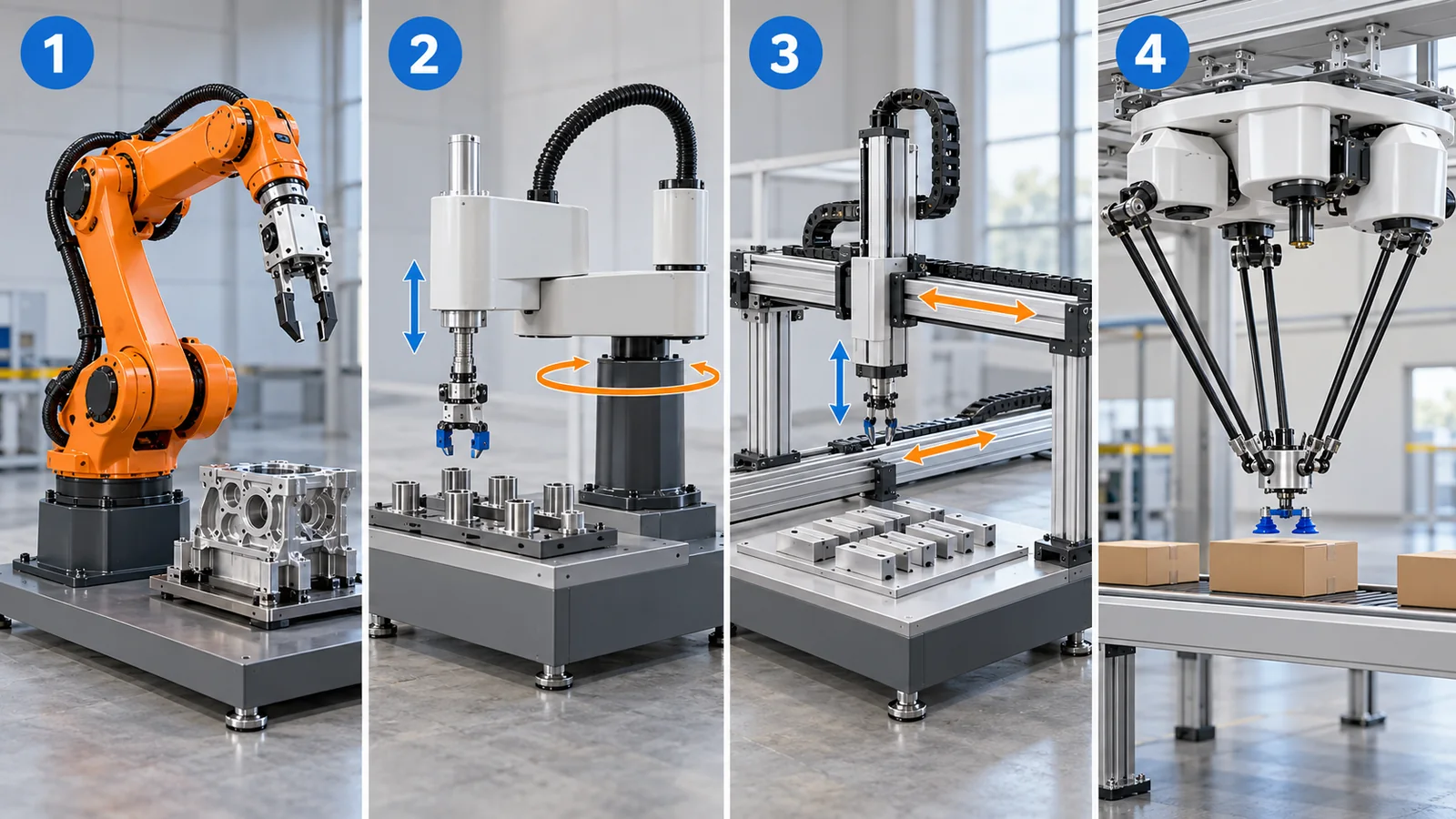
Original SVG, detailed explanation and sources
Original SVG reference: Conceptual diagram (vector drawing). Four typical shapes. Names and definitions follow the IFR document; applications come from the IFR document and maker product pages Sourced[Ref. 5, 16, 20]. The drawings only suggest shapes, not real structures or dimensions.
Product examples (company’s stated values)
Even within “industrial robots” the numbers differ by orders of magnitude. The following are companies’ stated values from their product pages; see each page for conditions. Read them as rough scales for each shape, not as a ranking of models.
- Articulated: FANUC America describes its M-20 Series as having “reach up to 2 m and payload up to 35 kg” Sourced[Ref. 21].
- Parallel: ABB’s IRB 360 comes in variants with payloads of 1 to 8 kg, 3 or 4 axes, and diameters of 1.13 m and 1.6 m. A stainless option is described as IP69K validated (washable with high-pressure hot water). ABB calls it the “fastest industrial delta robot in the world”, which is the company’s claim and was not verified here Sourced[Ref. 20].
- Origin of the parallel mechanism: US patent US4976582 by Reymond Clavel, known as the inventor of the delta type, has a priority date of 16 December 1985 and was granted on 11 December 1990. It describes a structure in which three control arms are each joined to one movable member by two links, so that the orientation of the movable member does not change. The Google Patents classification also lists “Delta type manipulators” Sourced[Ref. 15].
A parallel robot moves faster the lighter its moving platform and arms are, so light, stiff materials help (thin-walled metal tubes, carbon-fibre rods and so on; Inference: the actual materials were not confirmed in the sources above). In a SCARA, the bending stiffness of the column that carries the pressing force and of the horizontal arm sets the accuracy. An articulated robot has a reducer at each joint, and the fatigue and wear of its bearings and gears set the service life (commentary; reducers are covered in the series article on reducers and gears). A parallel robot used with food needs an outer shell that withstands washing (ABB’s page lists a stainless version validated to IP69K), so resistance to detergents and high-pressure hot water, and lubricants that do not leak, become design conditions. The choice of shape is therefore a difference not only in motion but also in materials and environmental conditions (commentary).
4. Reading catalogue numbers: payload, reach, repeatability and speed
Four numbers appear in almost every robot catalogue. Fig. 4 summarizes what they mean and what to watch for.
(1) Payload, and the robot’s own mass
For the Universal Robots UR20-1750, the product page gives a payload of 20 kg (25 kg extended), a reach of 1750 mm, a maximum TCP speed of 5 m/s, a weight of 64 kg, and support for IP65 and cleanroom (class 4) Sourced[Ref. 16]. Here the robot’s own mass (64 kg) is about 3.2 times the load it can carry (20 kg) (64 / 20) Our calculation. Another page from the same company says its robots are “up to 70% lighter than comparable traditional robots” (the company’s statement; the comparison target and conditions could not be confirmed) [Ref. 18]. A light robot is easier to mount and tends to hit with less force when it touches a person (Chapter 6). On the other hand, a light arm needs care in materials and structure for stiffness, heat and life (commentary).
(2) Repeatability: values differ between documents of the same maker
Repeatability is how small the scatter is in where the robot stops when it is sent to the same position again and again. Think of darts: the arrows land in a tight cluster (whether the cluster is on the bullseye is a separate matter, called positioning accuracy). Limit of the analogy: a robot’s scatter also changes with temperature, load and speed. ISO 9283:1998 “Manipulating industrial robots — Performance criteria and related test methods” is the standard that sets criteria and test methods for this kind of performance; on the ISO page it is a 2nd edition (April 1998) at stage 90.60, “under review” Sourced[Ref. 9]. In Japan, JIS B 8432:1999 corresponds to it (Japan Robot Association list) [Ref. 22]. The text is paid and was not checked here.
For the UR20, repeatability is “+/-0.01 mm” on the product page and “+/-0.1 mm” in the maker’s two-page leaflet (a table titled “Pose Repeatability per ISO 9283”), a tenfold difference Sourced[Ref. 16, 17]. The product page did not state which standard or conditions apply. We could not confirm the cause (a difference in model, in measuring method, or an error), and we do not say which is right. The lesson is simple: do not compare a bare “+/- xx mm” without its conditions.
Only partly true. The accuracy of real work depends on the robot’s scatter plus how the tool is mounted, errors in part dimensions, the position of fixtures and thermal expansion: the whole application (commentary). Moreover, repeatability is “scatter in returning to the same place”, a different quantity from positioning accuracy, “how correctly the robot goes to the target place”. A catalogue number is a value for the robot alone under test conditions, not a guarantee of accuracy on the shop floor.
(3) Maximum speed is not the speed you use
The UR20 product page gives a “maximum TCP speed of 5 m/s”; TCP is the Tool Center Point, the reference point at the tool tip [Ref. 16]. The company’s material says limits on speed, force, axes and workspace can be configured [Ref. 18]. The maximum speed is the upper limit the robot can reach, not the speed used near people. How this difference affects safety is worked out in the calculation in Chapter 6.
5. How the word “cobot” has changed
“Collaborative robot” (cobot) became a “word no longer used” in the 2025 revision of the standard. Fig. 5 follows the story in time order.
- 1996: it appears as a research term. The paper by Colgate, Wannasuphoprasit and Peshkin defines a cobot as a device that manipulates objects in collaboration with a human operator, and as intrinsically passive: it does not use servos to apply force, but builds constraints with steerable nonholonomic joints (such as a steerable wheel). Because it is passive, the authors argue it is well suited to safety-critical tasks such as surgery and to tasks with large interaction forces such as automobile assembly Sourced[Ref. 13].
- 1999: the paper by Peshkin and Colgate describes cobots as devices that interact directly with a person while handling a shared payload, and that use software-defined “virtual surfaces” to constrain and guide the motion of the payload, adding little or no power. It contrasts them with autonomous industrial robots that must be isolated from people Sourced[Ref. 14].
- 2005: Universal Robots says it has pioneered collaborative robots since its founding in 2005 (the company’s statement) Sourced[Ref. 19].
- 2016: ISO/TS 15066 was published as a technical specification on the safety of collaborative industrial robot systems and the work environment [Ref. 8].
- 2025: in the revision of ISO 10218-1 and -2, “collaborative robot” and “collaborative operation” are no longer used, and “collaborative application” is used instead, because only the actual use, not the robot alone, can be designed, tested and confirmed as safe Sourced[Ref. 11]. The chair of the US drafting subcommittee says the term “collaborative robot” has come to mean robots that use power and force limiting [Ref. 12].
It is the same word, but a different thing. The cobot of the 1990s was a “passive tool” that added no power to the person. Most robots called “cobots” today are motor-driven arms used with control that keeps the force within limits even when they touch a person (commentary, based on makers’ descriptions of their products). The history of the word shows that the same name does not guarantee the same mechanism or the same idea of safety.
6. How collaborative safety is thought about: it depends on the “application”, not the robot alone
The series article on robot safety standards sets out the standards in detail. Here we keep only the points needed when comparing industrial and collaborative robots.
(1) Collaboration is a property of the use, not of the robot
According to an A3 article, the 2025 ISO 10218-2 puts the weight on the “robot application” rather than the “robot system”. The application includes the workpieces, the task program, and the machinery and equipment that support the task Sourced[Ref. 11]. Even with the same robot, handing over a light part with a rounded gripper and handling a sharp part with a pointed tool carry different risk (Fig. 6).
In Japan, Article 150-4 of the Industrial Safety and Health Regulations requires measures such as fences or enclosures where contact with an industrial robot of more than 80 W rated output could be dangerous. By a notice of December 2013 (Kihatsu 1224 No. 2), the Ministry of Health, Labour and Welfare made clear the safety criteria under which collaborative work is possible, for example when a risk assessment can show that the danger has been removed Sourced[Ref. 23]. The series article on robot safety standards goes into more detail.
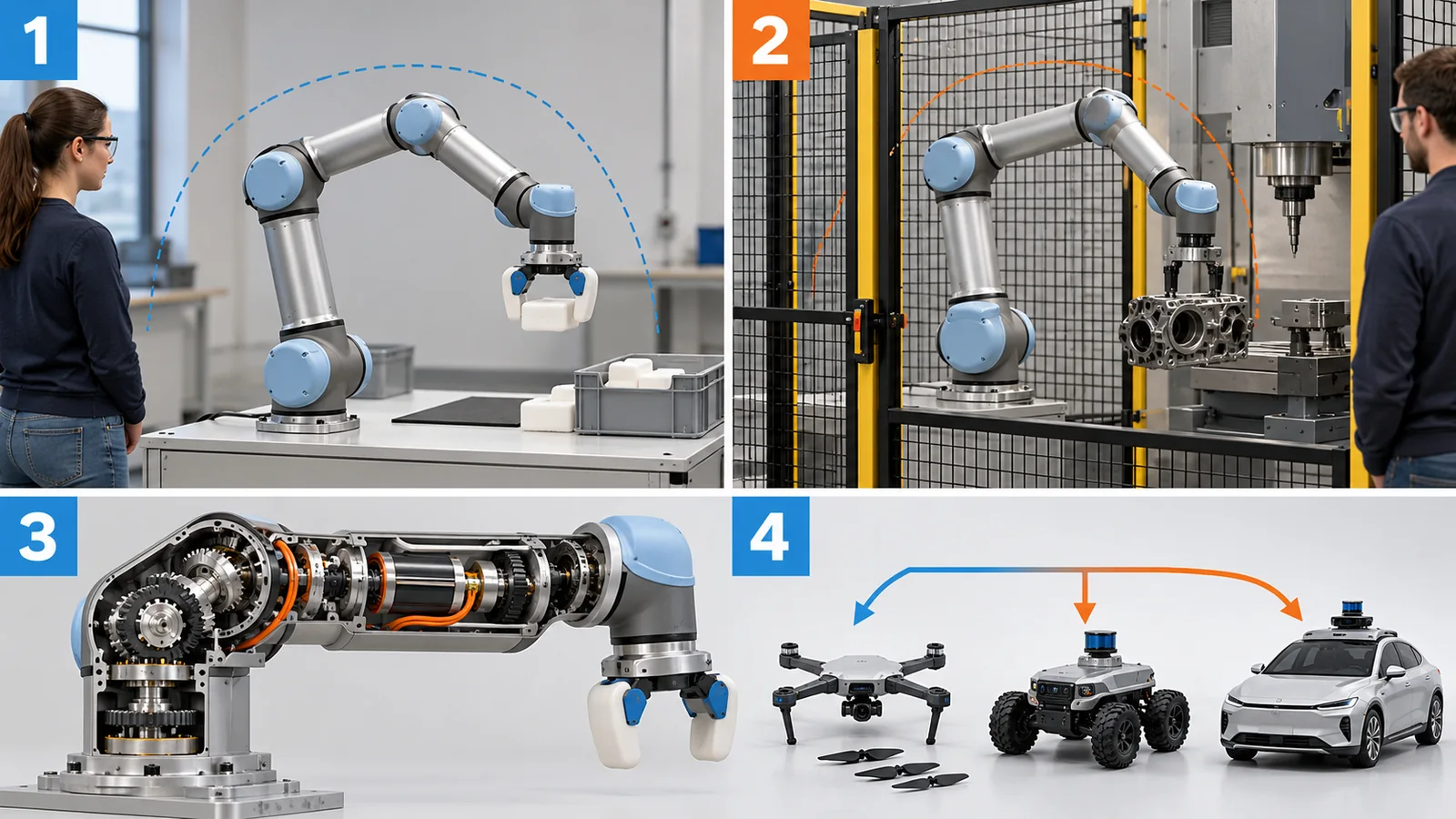
Original SVG, detailed explanation and sources
Original SVG reference: Conceptual diagram (vector drawing). The same robot, different risk with a different tool and part. That the “application” includes tool, workpiece, task program and peripherals is from the A3 explanation Sourced[Ref. 11]. Examples A and B are illustrations of the idea, not real equipment.
(2) Numbers for force and speed: at top speed the energy is in a different league
Count only the load (payload) of 25 kg, leaving out the arm’s own mass, and change the tip speed. The kinetic energy (1/2 x mass x speed squared) is 3.1 J at 0.5 m/s, 12.5 J at 1 m/s, 50 J at 2 m/s, and 312.5 J at 5 m/s Our calculation. Five times the speed gives 25 times the energy. The “maximum 5 m/s” on a product page is the upper limit of what the robot can do, not the speed used in collaborative operation. The maker explains that safety limits for speed, force, axes and workspace can be configured, with power and force limiting that is always active Sourced[Ref. 18].
A UR two-page leaflet says there are 17 configurable safety functions and states “in compliance with EN ISO 13849-1 (PLd category 3) and EN ISO 10218-1” Sourced[Ref. 17]. This is the maker’s statement, and it gives no edition (year) of the standard. ISO 10218-1 was revised in 2025, and the 2025 edition does not apply to robots made before its publication [Ref. 6]. To read “conformity” (edition, scope, who claims it, conditions), use the seven questions in the series article on robot safety standards.
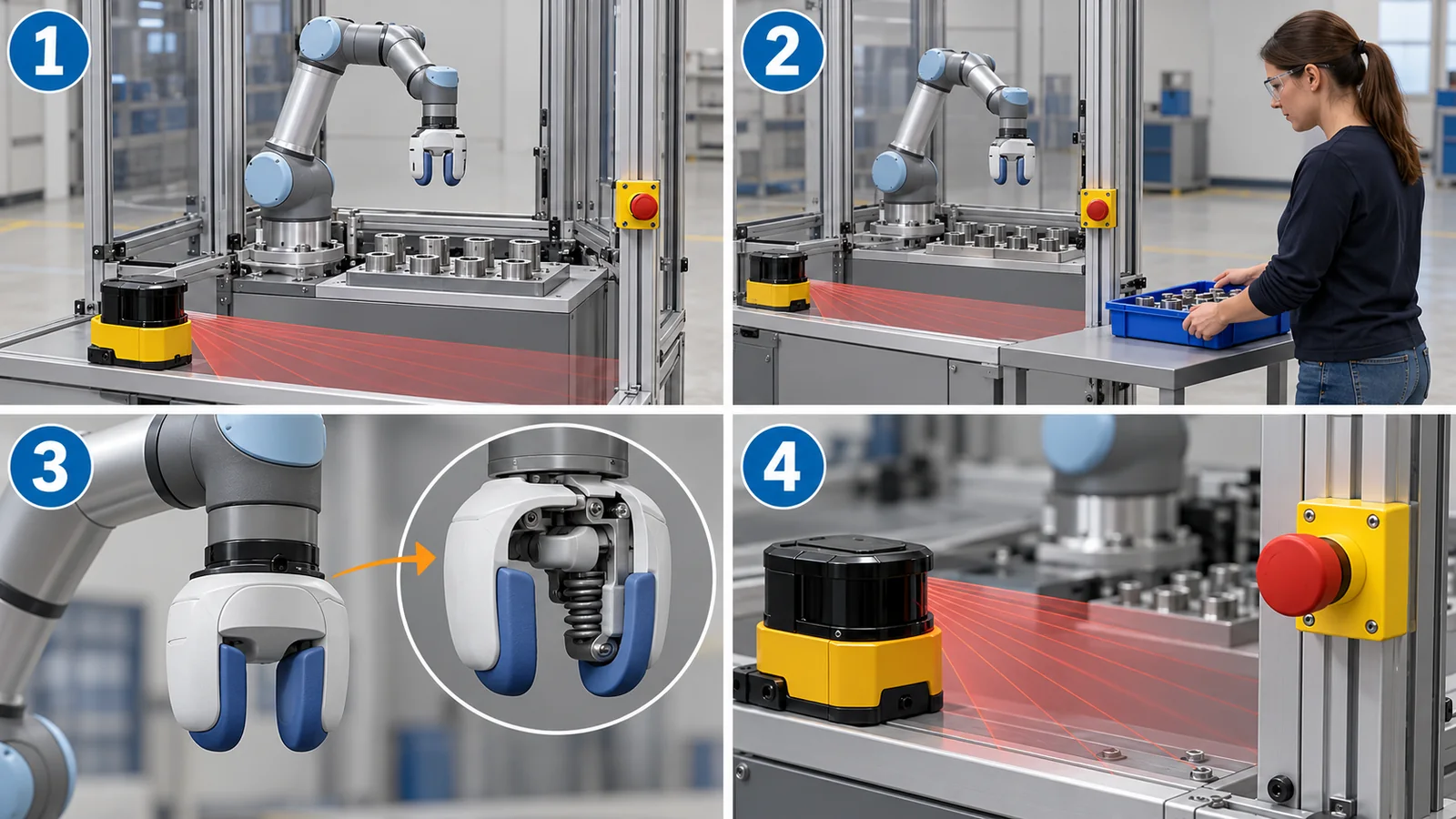
The UR20 page lists IP65 (dust-tight and protected against nozzle-projected water) and support for ISO class 4 cleanroom (at most 10,000 particles per cubic metre of air), and says these may be needed in semiconductor and pharmaceutical manufacturing Sourced[Ref. 16]. For cleanroom use, the condition is that the robot itself must not shed particles (wear dust, scattered lubricant, flaking of the outer shell), so material choices (wear-resistant surface treatments, low-dust lubricants, outer-shell resins) are put to the test (commentary. Inference: the materials the company actually uses were not confirmed in the sources above). For a robot that works beside people, the calculation above shows that a light arm lowers risk, so lightweight materials and a soft outer surface (which spreads the impact of a collision) become part of safety design. But how much a soft surface softens an impact changes with material, thickness and shape, and we did not check test data. Material properties are covered in the series articles on structural materials for robots and drones and on soft robots and artificial muscles.
7. IFR World Robotics 2026: installations worldwide
The IFR (International Federation of Robotics) published World Robotics 2026 on 24 September 2026. The main numbers below are taken from IFR’s Executive Summary Sourced[Ref. 1, 3].
| Item | IFR’s published value (2025) | Note |
|---|---|---|
| Annual installations worldwide | 603,307 units (+11% on the year) | About 550,000 a year for four years, then a jump; it exceeded the 2022 record of 552,946 units by 9% |
| Operational stock | 5,079,078 units (+9%) | Passed five million in 2025 |
| Asia | 457,315 units (+14%), 76% of the world | China 354,226 units (+20%), about 59% of the world [Ref. 4]. Since 2024, more than half of China’s installations are from Chinese brands |
| Europe | 73,054 units (-14%) | Weak demand from the automotive industry and others (IFR’s explanation) |
| The Americas | 57,044 units (+14%); US 38,428 units (+12%) | A record |
| Customer industries | Electrical/electronics 142,235; automotive 138,429; metal and machinery 108,571 units | These three industries total 389,235 units, about 65% of the world (our calculation) Our calculation |
| Forecast (not settled) | 655,000 units in 2026; 806,000 in 2029 | IFR forecast Not yet confirmed |
Numbers are from IFR’s Executive Summary. The total for the three industries and its share are our own addition and division (389,235 / 603,307 = 64.5%).
Cautions when reading the statistics
- Units are “industrial robots installed”: cobots alone, warehouse transport robots (AGVs) and humanoids are either not in this number or counted separately (the definition is in Chapter 2). In this summary the number of cobots alone could not be confirmed
- It is a total of reports: the statistics rest on world data reported by robot suppliers and on figures from national robot associations (A3, the Japan Robot Association and others) Sourced[Ref. 1]
- Regions differ: Asia accounts for 76% of the world, and Europe fell. “Installations worldwide rose” does not mean every region rose
- On humanoids: the IFR summary says most humanoids remain prototypes or pilot-stage technologies rather than industrial-grade products, that at the current stage industrial robots are economically superior for industrial production tasks, and that general-purpose physical AI is “not yet industry-grade”. It says humanoids may eventually complement industrial robots in selected applications, but wide deployment depends on substantial improvements in reliability, safety, operating time and economic viability Sourced[Ref. 1]. This is IFR’s assessment and does not settle the future (see the series article on humanoid robots).
8. Limits, what could not be confirmed, and summary
(1) Number and share of collaborative robots
The World Robotics 2026 summary gave no installation count or share for collaborative robots. We did confirm that IFR’s 2025 press-conference presentation (25 September 2025) has a slide showing double-digit growth (+12%) in collaborative robot installations [Ref. 2], but we did not confirm the share, the count or the year it refers to.
(2) The standard texts, and how performance is measured
The texts of ISO 8373, ISO 9283, ISO 10218 and ISO/TS 15066 are paid and were not checked. We could not confirm why the UR20 repeatability differs between two documents. A maker’s performance values sometimes come without conditions.
(3) Product examples and origins
The numbers for FANUC, ABB and Universal Robots are companies’ stated values on their own pages and were not verified. The history of SCARA and the origin of its name, and the history of the first articulated robot, are not covered here. For the delta patent we checked the patent record; we did not confirm how the mechanism was commercialized.
(4) Other topics
Robot density (units per worker), detailed country statistics, numerical contact limits for people, and robot prices and returns on investment are not covered. We did not use market-size estimates from research firms.
- An industrial robot is an automatically controlled, reprogrammable, multipurpose manipulator with three or more axes, in four main shapes. IFR statistics count only what fits this definition and exclude AGVs and the like Sourced
- In 2025, 603,307 units were installed worldwide (+11%) and 5,079,078 were in operation. Asia is 76%, and Europe fell. The 655,000 and 806,000 figures for 2026 and 2029 are forecasts Sourced / Not yet confirmed
- Check conditions and the standard behind catalogue numbers. The same maker’s UR20 repeatability was +/-0.01 mm on the product page and +/-0.1 mm in a leaflet Sourced
- The meaning of “cobot” has changed. From a “passive device” in the 1990s to “collaborative application” in the 2025 standard. Safety depends on the tool, the task and the surroundings, not on the robot alone Sourced
- Five times the speed gives 25 times the kinetic energy. The maximum speed is not the speed that is used Our calculation
9. How to read the yardsticks and standards
The performance of an industrial robot is expressed by payload, reach, repeatability (positioning accuracy), speed, protection class, weight, power consumption and so on. These are measured either by the test method of a standard (for example ISO 9283) or by the maker under its own conditions. The numbers measure “the robot alone under those test conditions”; they do not measure accuracy on the shop floor or safety in collaboration with people. Safety is handled by standards such as ISO 10218 and by a risk assessment for each application. The table below shows what we could confirm (checked 25 October 2026).
| What is evaluated | Typical test or benchmark (name, source) | Standard, rule or guidance | Reading notes |
|---|---|---|---|
| Positioning and repeatability | Tests based on ISO 9283 (text not checked). UR20 stated values: +/-0.01 mm (product page); +/-0.1 mm (leaflet, stated as per ISO 9283) [Ref. 16, 17] Sourced | ISO 9283:1998 (2nd edition, stage 90.60 “under review”) [Ref. 9]. Japan: JIS B 8432:1999 [Ref. 22] Sourced | Even one maker’s documents differ. Do not compare numbers without conditions |
| How characteristics are presented (payload etc.) | Could not be confirmed | ISO 9946:1999 (Manipulating industrial robots — Presentation of characteristics). Japan: JIS B 8431:1999 (Japan Robot Association list) [Ref. 22] Sourced (the ISO page was not checked) | Payload changes with conditions such as the centre of mass of the load (commentary) |
| Definition and terms of the robot | – | ISO 8373:2021 (3rd edition) [Ref. 10]. Japan: JIS B 0134:2024 [Ref. 22]. IFR statistics quote the ISO 8373:2012 definition [Ref. 5] Sourced | Wording can differ between editions. Check the edition behind a statistic’s definition |
| Safety of the robot itself | Could not be confirmed | ISO 10218-1:2025 [Ref. 6]; robot applications in ISO 10218-2:2025 [Ref. 7]. US: ANSI/A3 R15.06-2025 [Ref. 12] Sourced | The 2025 edition does not apply to robots made before its publication. Details are in the series article on robot safety standards |
| Collaborative contact | Could not be confirmed (limit values are in the standard’s text) | ISO/TS 15066:2016 (to be revised) [Ref. 8]. Japan: JIS TS B 0033:2017 [Ref. 22] Sourced Not yet confirmed | Its relation to the 2025 ISO 10218 is unconfirmed |
| Environment (dust, water, cleanliness) | Maker statements: IP65 and ISO class 4 cleanroom (UR20) [Ref. 16]; IP69K validated (stainless version of ABB IRB 360) [Ref. 20] Sourced | Could not be confirmed (we did not check the standard numbers for protection and cleanliness classes) | Company’s stated values. Whether a third party ran the tests could not be confirmed |
| Market and deployment statistics | IFR World Robotics 2026: 603,307 units installed in 2025, 5,079,078 in operation [Ref. 1] Sourced | – (association statistics) | A total of supplier reports. Excludes AGVs and dedicated machines. Forecasts are not settled |
The arrangement of the table is our own Our calculation (arrangement). Standard numbers, titles, editions and stages were checked on the ISO pages or the Japan Robot Association list (25 October 2026). The texts are paid and were not checked.
Reading notes (for materials engineers)
- Catalogue numbers and the shop floor are different things: repeatability and payload are values under test conditions. They change with tool mass, posture, temperature and speed
- A maker’s stated value and a third party’s verification are different: every number in this article is a company’s stated value or an association’s publication, not a third-party measurement
- Whether a standard is a recommendation or a requirement differs: an ISO standard alone has no legal force. How to read “conformity” is in the series article on robot safety standards
- Separate forecasts from results: IFR’s 2026 and 2029 figures are forecasts
- Check the scope: IFR’s counts cover only what meets the industrial-robot definition. They are not counts of humanoids, AGVs or cobots alone
10. Glossary
- Industrial robot
- An automatically controlled, reprogrammable, multipurpose manipulator with three or more axes (ISO 8373:2012, quoted by IFR).
- Manipulator
- The arm part that grasps and moves things.
- Axis / degrees of freedom (DOF)
- A direction of motion (linear or rotary); the number of directions a set of joints can move.
- Rotary joint / prismatic joint
- A joint that turns about an axis / a joint that slides in a straight line.
- Articulated robot
- A shape with three or more rotary joints, close to a human arm.
- SCARA
- A shape with two parallel rotary joints that moves in a plane. Used for assembly and packaging.
- Parallel (delta) robot
- A shape in which several arms join one platform. Light and fast.
- Cartesian (gantry) robot
- A shape with three straight axes at right angles.
- End effector
- The tool or hand (gripper) fitted to the end of the arm.
- Payload
- The mass of load and tool that can be fitted to the arm and moved.
- Reach
- The farthest distance the arm can reach.
- Repeatability
- How small the scatter is when the robot goes to the same position repeatedly.
- Positioning accuracy
- How correctly the robot goes to the target position; a different quantity from repeatability.
- TCP
- Tool Center Point: the reference point at the tool tip.
- Cobot / collaborative robot
- A robot that works close to people. Its meaning has changed over time (Chapter 5).
- Collaborative application
- The whole use in which people and robots work close together (the term in the 2025 ISO 10218).
- Power and force limiting
- An idea in which the robot’s power and force are kept within limits even on contact.
- AGV
- Automated guided vehicle. Not included in IFR’s industrial-robot statistics.
- Kinetic energy
- The energy a moving object has: 1/2 x mass x speed squared.
- IP65 / IP69K
- Protection classes against dust and water. IP65: no dust ingress and protected against nozzle-projected water (maker’s explanation). IP69K: validated against high-pressure hot-water washing (ABB’s description).
- IFR
- The International Federation of Robotics, which publishes the World Robotics statistics every year.
- Installations / operational stock
- The units newly installed in a year / the cumulative units in use.
- ISO 9283
- The standard on performance criteria and test methods for industrial robots (by its title).
- Physical AI
- AI for driving physical machines such as robots. See the series article on robot foundation models and VLA.
11. References (primary sources)
- IFR (International Federation of Robotics) “World Robotics 2026 – Industrial Robots, Executive Summary” (published 24 September 2026; 2025 installations, operational stock, regions, customer industries, forecasts, comment on humanoids) — ifr.org/img/worldrobotics/Executive_Summary_WR_2026_-_Industrial_Robots.pdf
- IFR (International Federation of Robotics) “World Robotics 2025” press conference presentation (25 September 2025; slide 12 shows double-digit growth of collaborative robot installations, +12%) — ifr.org/downloads/press_docs/PressConference2025_presentation.pdf
- IFR (International Federation of Robotics) “Five Million Robots now Operate in Factories Globally” (World Robotics 2026 press release, 24 September 2026) — ifr.org/ifr-press-releases/five-million-robots-now-operate-in-factories-globally
- IFR (International Federation of Robotics) “China Installs 59 Percent of World’s Industrial Robots” (press release, 24 September 2026) — ifr.org/downloads/press_docs/EN-2026-SEP-24-IFR_Press_Release_WR-CHINA.pdf
- IFR (International Federation of Robotics) “Industrial Robots – Definition and classification” (World Robotics 2016, chapter 1.2; ISO 8373:2012 definition, classification by mechanical structure, what is excluded from the statistics) — ifr.org/img/office/Industrial_Robots_2016_Chapter_1_2.pdf
- ISO “ISO 10218-1:2025 Robotics — Safety requirements — Part 1: Industrial robots” (ISO page; 3rd edition, February 2025) — iso.org/standard/73933.html
- ISO “ISO 10218-2:2025 Robotics — Safety requirements — Part 2: Industrial robot applications and robot cells” (ISO page; 2nd edition, 2025) — iso.org/standard/73934.html
- ISO “ISO/TS 15066:2016 Robots and robotic devices — Collaborative robots” (ISO page; February 2016; stage 90.92 “to be revised”) — iso.org/standard/62996.html
- ISO “ISO 9283:1998 Manipulating industrial robots — Performance criteria and related test methods” (ISO page; 2nd edition, April 1998, 60 pages, stage 90.60 “under review”) — iso.org/standard/22244.html
- ISO “ISO 8373:2021 Robotics — Vocabulary” (ISO page; 3rd edition, November 2021; a next version shown as under development) — iso.org/standard/75539.html
- A3 (Association for Advancing Automation) “Updated ISO 10218: Answers to Frequently Asked Questions (FAQs)”, 20 March 2025 — automate.org/robotics/blogs/updated-iso-10218-faq
- A3 (Association for Advancing Automation) “ANSI, A3 Publish Revised R15.06 Industrial Robot Safety Standard”, 10 September 2025 — automate.org/robotics/industry-insights/ansi-a3-publish-revised-r15-06-industrial-robot-safety-standard/aph
- Colgate J. E., Wannasuphoprasit W., Peshkin M. A. “Cobots: Robots for Collaboration With Human Operators”, Proc. ASME International Mechanical Engineering Congress and Exposition, 1996, pp. 433-439, DOI 10.1115/imece1996-0367 — doi.org/10.1115/imece1996-0367
- Peshkin M., Colgate J. E. “Cobots”, Industrial Robot 26(5), 335-341 (1999), DOI 10.1108/01439919910283722 — doi.org/10.1108/01439919910283722
- Clavel R. “Device for the movement and positioning of an element in space”, US patent US4976582 (applicant: Sogeva SA; priority date 16 December 1985; granted 11 December 1990; as listed by Google Patents) — patents.google.com/patent/US4976582A/en
- Universal Robots “UR20-1750” (product page; payload, reach, maximum TCP speed, weight, repeatability, IP65 and cleanroom; checked 25 October 2026) — universal-robots.com/products/ur20/
- Universal Robots “Automate with UR Series” (two-page leaflet; specification table for UR8 Long to UR30; pose repeatability “per ISO 9283”; PL d category 3; 17 configurable safety functions; January 2026 version) — a.storyblok.com/f/169662/x/38284ee67f/hq_2025_12_23_one_pager_urseries_v3-5.pdf
- Universal Robots “Robot Arms for Industrial Automation” (page introducing the robot families; the company’s statement “up to 70% lighter than comparable traditional robots”; checked 25 October 2026) — universal-robots.com/products/ur5e/
- Universal Robots “About Universal Robots” (company page; the company says it has pioneered collaborative robots since its founding in 2005) — universal-robots.com/about-universal-robots/
- ABB “IRB 360” (product page; delta robot; payload 1 to 8 kg; 3 or 4 axes; diameter 1.13 m and 1.6 m; IP69K stainless option; the company’s statement “fastest industrial delta robot in the world”) — abb.com/global/en/areas/robotics/products/robots/delta-robots/irb-360
- FANUC America “M-20 Series” (product page; the company states reach up to 2 m and payload up to 35 kg) — fanucamerica.com/products/series/m-20
- JARA (Japan) Japan Robot Association (JARA), “Industrial and service robot related standards (JIS) and standard specifications (excerpt)”, as of 30 November 2024 (in Japanese) — jara.jp/various/standard/img/irsr-jis_241130.pdf
- MHLW (Japan) Ministry of Health, Labour and Welfare (MHLW), leaflet “Safety criteria that make work with industrial robots alongside people possible, clarified (Art. 150-4 of the Industrial Safety and Health Regulations)”, December 2013 (in Japanese) — mhlw.go.jp/bunya/roudoukijun/dl/pamphlet_140115.pdf
12. Claim-to-source audit
| Claim in the text | Basis | Type |
|---|---|---|
| The definition of an industrial robot (ISO 8373:2012 wording, quoted by IFR), the explanations of reprogrammable, multipurpose and axis, the classification by mechanical structure and each definition, and what IFR statistics exclude (dedicated loading equipment, dedicated assembly equipment, IC handlers, automated storage, AGVs) | IFR document of 2016 Reference 5 https://ifr.org/img/office/Industrial_Robots_2016_Chapter_1_2.pdf | Sourced |
| Installations of 603,307 units in 2025 (+11%), forecasts of 655,000 (2026) and 806,000 (2029), operational stock of 5,079,078 (+9%), Asia 457,315 (+14%, 76%), China 354,226 (+20%), Europe 73,054 (-14%), the Americas 57,044 (US 38,428), customer industries (142,235 / 138,429 / 108,571), the basis of the statistics, and the comment on humanoids | IFR World Robotics 2026 summary Reference 1 https://ifr.org/img/worldrobotics/Executive_Summary_WR_2026_-_Industrial_Robots.pdf Reference 3 https://ifr.org/ifr-press-releases/five-million-robots-now-operate-in-factories-globally | Sourced |
| China accounted for about 59% (354,000 units) of installations | IFR press release Reference 4 https://ifr.org/downloads/press_docs/EN-2026-SEP-24-IFR_Press_Release_WR-CHINA.pdf | Sourced |
| A slide showing double-digit growth (+12%) of collaborative robot installations (2025 press conference) | IFR press conference presentation Reference 2 https://ifr.org/downloads/press_docs/PressConference2025_presentation.pdf | Sourced |
| ISO 10218-1:2025 is the 3rd edition (February 2025) and does not apply to robots made before it; ISO 10218-2:2025 is the 2nd edition | ISO pages Reference 6 https://www.iso.org/standard/73933.html Reference 7 https://www.iso.org/standard/73934.html | Sourced |
| The 2025 ISO 10218 uses “collaborative application” not “collaborative robot”; the application includes workpiece, task program and equipment; the remark of the drafting subcommittee chair; ANSI/A3 R15.06-2025 (10 September 2025) | A3 articles Reference 11 https://www.automate.org/robotics/blogs/updated-iso-10218-faq Reference 12 https://www.automate.org/robotics/industry-insights/ansi-a3-publish-revised-r15-06-industrial-robot-safety-standard/aph | Sourced |
| ISO/TS 15066:2016 was published in February 2016, stage 90.92 “to be revised” | ISO page Reference 8 https://www.iso.org/standard/62996.html | Sourced |
| ISO 9283:1998 is the 2nd edition (April 1998, 60 pages), stage 90.60 “under review”; the title covers performance criteria and test methods | ISO page Reference 9 https://www.iso.org/standard/22244.html | Sourced |
| ISO 8373:2021 is the 3rd edition (November 2021), with a next version shown as under development | ISO page Reference 10 https://www.iso.org/standard/75539.html | Sourced |
| The pairings of JIS B 8432:1999 (ISO 9283), JIS B 8431:1999 (ISO 9946), JIS TS B 0033:2017 (ISO/TS 15066) and JIS B 0134:2024 (ISO 8373:2021) | JARA list (as of 30 November 2024) Reference 22 https://www.jara.jp/various/standard/img/irsr-jis_241130.pdf | Sourced |
| The Colgate et al. paper (1996): a cobot manipulates objects with a human operator, is intrinsically passive through steerable nonholonomic joints, and was argued to suit tasks such as surgery and automobile assembly | Paper abstract Reference 13 https://doi.org/10.1115/imece1996-0367 | Sourced |
| The Peshkin and Colgate paper (1999): cobots interact directly with people on a shared payload, guide motion with virtual surfaces and add little or no power; contrast with autonomous industrial robots and teleoperators | Paper abstract Reference 14 https://doi.org/10.1108/01439919910283722 | Sourced |
| Priority date (16 December 1985) and grant date (11 December 1990) of Reymond Clavel’s patent US4976582, the structure with three control arms each joined to the movable member by two links, and the classification mentioning “Delta type manipulators” | Google Patents page Reference 15 https://patents.google.com/patent/US4976582A/en | Sourced |
| UR20-1750: payload 20 kg (extended 25 kg), reach 1750 mm, maximum TCP speed 5 m/s, weight 64 kg, repeatability +/-0.01 mm, IP65 and cleanroom ISO class 4 | Maker product page (company’s stated values) Reference 16 https://www.universal-robots.com/products/ur20/ | Sourced |
| UR20 “pose repeatability per ISO 9283” of +/-0.1 mm, 17 configurable safety functions, and the statement of compliance with EN ISO 13849-1 (PL d, category 3) and EN ISO 10218-1 (no edition given) | Maker two-page leaflet (company’s stated values) Reference 17 https://a.storyblok.com/f/169662/x/38284ee67f/hq_2025_12_23_one_pager_urseries_v3-5.pdf | Sourced |
| The company statement “up to 70% lighter than comparable traditional robots”, configurable limits on speed, force, axes and workspace, and always-active power and force limiting | Maker product-family page (company’s statements) Reference 18 https://www.universal-robots.com/products/ur5e/ | Sourced |
| Universal Robots’ own statement that it has pioneered collaborative robots since its founding in 2005 | Company page Reference 19 https://www.universal-robots.com/about-universal-robots/ | Sourced |
| ABB IRB 360: payload 1 to 8 kg, 3 or 4 axes, diameter 1.13 m and 1.6 m, IP69K stainless option, and the company’s statement “fastest industrial delta robot in the world” | Maker product page (company’s stated values and claim) Reference 20 https://www.abb.com/global/en/areas/robotics/products/robots/delta-robots/irb-360 | Sourced |
| FANUC America M-20 Series: reach up to 2 m and payload up to 35 kg, as stated by the company | Maker product page (company’s stated values) Reference 21 https://www.fanucamerica.com/products/series/m-20 | Sourced |
| Industrial robots over 80 W rated output and the 2013 notice (this article does not cite the 500 mm clearance example) | MHLW leaflet Reference 23 https://www.mhlw.go.jp/bunya/roudoukijun/dl/pamphlet_140115.pdf | Sourced |
| The robot’s own mass of 64 kg is about 3.2 times the 20 kg payload; the three industries total 389,235 units, about 64.5% of the world; kinetic energies of a 25 kg load (3.1, 12.5, 50, 312.5 J) | Our calculation (from maker-stated values and IFR figures; assumed examples) | Our calculation |
| The number of collaborative robots alone, the reason for the difference between the two UR20 repeatability values, test conditions in the standards, the origin of the name SCARA, and the standard numbers for protection and cleanliness classes | Could not be confirmed in the scope of this research, so not stated (this article) | Commentary |
| The readings on how to remember each shape, lighter arms reducing impact, the same word covering different mechanisms, material and environmental conditions, and six motions giving any position and orientation | Our commentary based on the published content; not a view stated by any of the bodies | Commentary |
| Figures 2 to 7 and 9 are explanatory drawings, not observations of real data (Figure 9 redraws IFR figures); Figures 1 and 8 are frames for AI-generated images | Note in this article | Commentary |
Last updated: 25 October 2026 / Sources are limited to IFR publications, official ISO pages, A3 articles, papers, a patent and maker product pages. The texts of the standards are paid and have not been checked. Performance values are companies’ stated values. The installation count for collaborative robots alone, the reason the UR20 repeatability differs between two documents, test conditions in the standards, and the origin of the name SCARA could not be confirmed and are not stated. The figures are explanatory concept drawings or drawings that include our calculation; Figures 1 and 8 are ImageGen-generated conceptual illustrations.