COMPANY PROFILE / DRONES AND ROBOTICS
Archer Aviation
– Telling “four phases” from “five stages”: an electric air-taxi company without a type certificate
Archer Aviation (United States) builds Midnight, an electric aircraft that takes off and lands vertically with a pilot and four passengers, and is widening into hybrid unmanned aircraft and aviation AI. The company says FAA type certification goes through “the 4 phases in the FAA order” and that it is in the final fourth phase (implementation). But the FAA order itself lists five phases, the last of which comes after the certificate is issued. Joby uses yet another count of five stages, so the two firms’ progress cannot be compared. As of 25 October 2026 it holds no type certificate, and its revenue is mainly airport rent and fuel. Using only SEC filings, the FAA’s Federal Register notices and order, a U.S. Department of Transportation announcement and company announcements, this article separates what is held from what is in progress or planned.
- Archer Aviation in 30 seconds, and where it sits in drones and robotics
- Logo and name
- Where this company sits in the drones and robotics world
- Company size
- Resources committed to robots and drones
- What it has done so far (reading the certification phases)
- Plans ahead
- What the company seems to be aiming for
- Partnership map
- Technology, products and services
- Risks the company faces
- Glossary / References / Claim-to-source audit
1. Archer Aviation in 30 seconds, and where it sits in drones and robotics
California190 West Tasman Drive. Volume factory in Covington, Georgia
four passengersFAA text: max takeoff weight 6,500 lb, twelve electric engines
500 contingent31 December 2025 (10-K)
Archer Aviation builds Midnight, an electric aircraft (an eVTOL, electric vertical take-off and landing aircraft) that takes off and lands vertically with a pilot and four passengers, and is also moving into air-taxi operations and defense-related aircraft (company description). Sourced
In its 10-K the company says FAA type certification (the FAA’s finding that an aircraft design meets safety standards) goes through “the 4 phases defined in FAA Order 8110.4C”, that “we are now substantially complete with the third phase”, and that it is in the final fourth phase (implementation) Sourced. But the order itself lists five phases, and the fifth, “post-certification activities”, comes after the certificate is issued. Archer’s four phases correspond to the first four of the FAA’s phases (see the illustration; our grouping).
As of 25 October 2026 the type certificate is not held. Reading the company’s “phases” apart from the FAA’s official stages is the heart of this article. Joby Aviation uses yet another count (five stages), so the two firms’ progress cannot be compared directly.
On 9 August 2026 Archer agreed to buy Wisk Aero (autonomous aircraft), SkyGrid (airspace management) and Insitu (an unmanned-aircraft maker) from Boeing. The price is about 19.75% of Archer’s shares plus two warrants, and closing needs regulatory and other approvals. The antitrust waiting period expired on 18 September (announced 24 September) Sourced (closing is Not yet confirmed).
In October 2026 it flew piloted test flights around San Francisco Bay on its “No Roads” tour. The company says the top speed was 131 mph and it flew over 200 miles across seven cities in three days (company claims).
2. Logo and name

The logo is the company’s trademark. This article does not recreate it with generated images; it uses the logo image used in the header of the official website (the white-on-dark version) as img/archer_logo.svg, placed on a dark panel.
Notes on naming: the legal name is Archer Aviation Inc. (a Delaware corporation) and the aircraft is Midnight. In FAA documents the model is “Model M001”, a different label from the company’s product name.
Official website: https://www.archer.com/3. Where this company sits in the drones and robotics world
It makes (1) a piloted electric air taxi (Midnight), (2) a hybrid-powered unmanned aircraft (developed with Anduril; the civil version is called Halo) and (3) aviation AI (ZEE). Its customers are airlines and operators (such as United), governments and operators abroad (such as in the UAE) and defense-related buyers (company description). See also our explainers on eVTOL aircraft and on drone regulation and airspace management.
This article does not cover the details of aircraft that are attack weapons. For the defense variant (Thunder) it only gives the name.
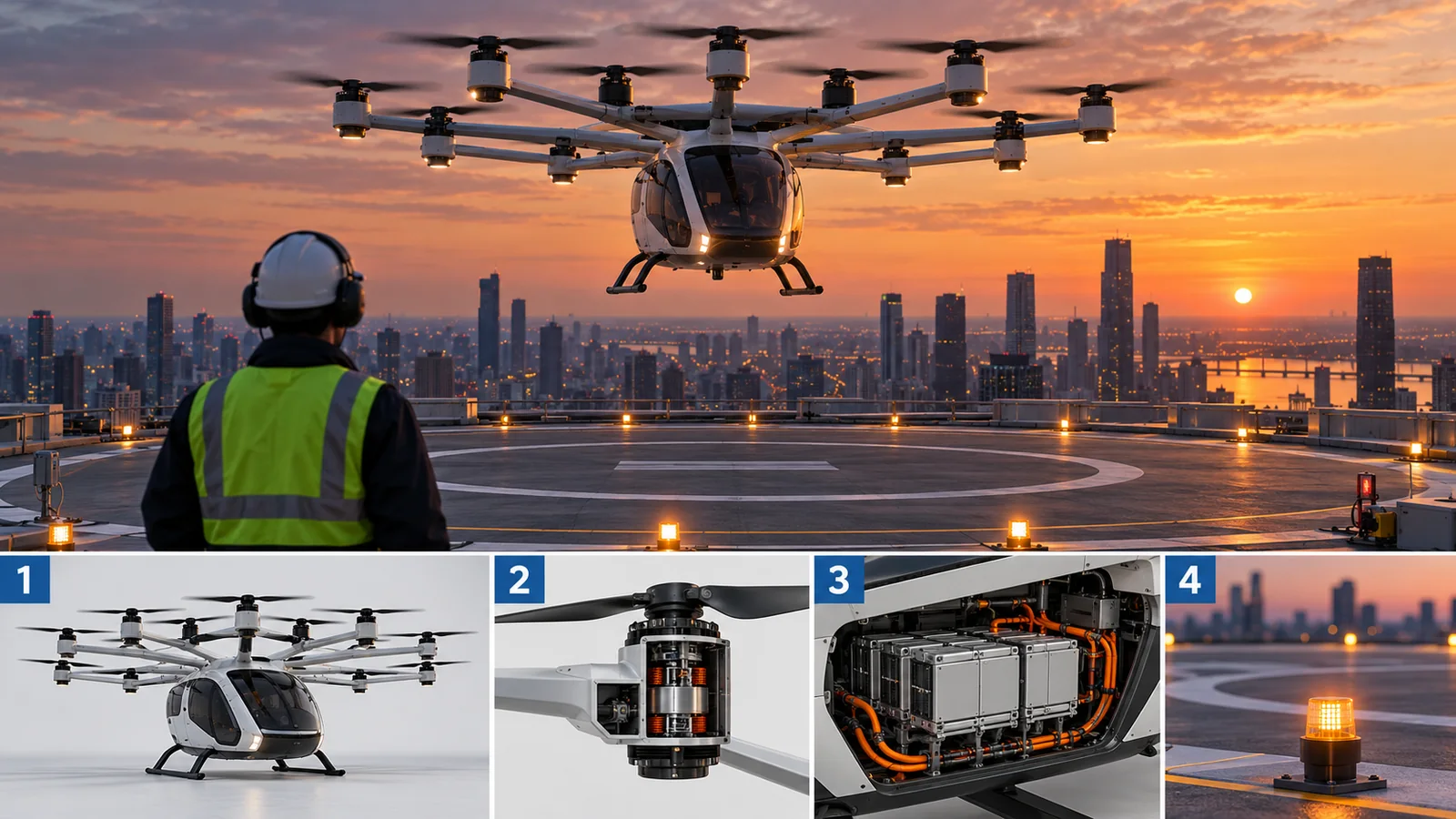
Midnight’s twelve propellers
4. Company size
| Measure (US$ million) | FY2023 | FY2024 | FY2025 |
|---|---|---|---|
| Revenue | 0 | 0 | 0.3 |
| Research and development | 276.4 | 357.7 | 493.9 |
| General and administrative | 168.4 | 152.0 | 235.4 |
| Net loss | 457.9 | 536.8 | 618.2 |
| Cash used in operating activities | 271.6 | 368.6 | 432.9 |
| Item | Figure | Date and source |
|---|---|---|
| Revenue, first half 2026 | US$6.6 million (Q2: US$5.0 million = fuel and ground services 3.0, rent 1.0, other 1.0) | 10-Q |
| R&D, first half 2026 | US$357.7 million | 10-Q |
| Net loss, first half 2026 | US$480.9 million | 10-Q |
| Cash used in operations, first half 2026 | US$305.5 million | 10-Q |
| Cash plus short-term investments, 30 June 2026 | US$1,560.6 million (plus US$7.3 million restricted cash) | 10-Q |
| Accumulated deficit, 30 June 2026 | US$2,784.7 million | 10-Q |
| Workforce, 31 December 2025 | 1,160 employees plus 500 contingent workers = 1,660 | 10-K |
| Q3 2026 adjusted EBITDA outlook | A loss of US$170-200 million (company outlook) | Announced 10 August 2026. Not yet confirmed |
Q2 2026 revenue of US$5.0 million comes mainly from fuel and ground services at Hawthorne Airport, which it took over in December 2025 (it bought the fixed-base-operator business there in April 2026), and from rent. There is no revenue yet from passenger flights or aircraft sales Sourced. The company writes that it does not expect significant revenue until design, certification and the manufacturing ramp-up are done.
5. Resources committed to robots and drones
| Resource | Details | Type |
|---|---|---|
| People and sites | 1,160 employees and 500 contingent workers (31 December 2025). Headquarters in San Jose; R&D sites in the San Francisco Bay Area and Huntington Beach; a flight-test site at Salinas Airport; volume manufacturing in Covington, Georgia; Hawthorne Airport near Los Angeles | Sourced |
| Money (R&D, funding) | R&D was US$494 million in FY2025 and US$358 million in the first half of 2026. Funding: three registered direct offerings in 2025 (February US$301.8 million, June US$850.0 million, November US$650.0 million, all gross) and, in the first half of 2026, shares issued to vendors to settle US$70.6 million of obligations | Sourced |
| Outside investments, acquisitions, joint ventures | Acquired: rights at Hawthorne Airport (December 2025, about US$127.1 million), the airport’s FBO business (April 2026, US$25 million), Overair’s patents and a Karem rotor-technology licence (2025). Agreement: three Boeing businesses (August 2026, not closed). With Stellantis only a manufacturing MOU (November 2024) | Sourced |
| Universities, research and public bodies | U.S. Air Force AFWERX (Agility Prime, since 2021), the FAA (review), DOT’s eIPP, the UAE’s GCAA. No university research ties are listed in the 10-K or 10-Q (not confirmed) | Sourced / not confirmed |
Status of the main products
Performance values are company targets or FAA-document descriptions. The speed and range figures on the company website could not be read on 25 October 2026 because the page animates them.
| Name | Type | Main specifications (company, FAA) | Use and track record (dated) | Regulatory scope | Stage |
|---|---|---|---|---|---|
| Midnight (Model M001) | Piloted electric air taxi | FAA text: maximum takeoff weight 6,500 lb, pilot plus four passengers, twelve electric engines (six tilting five-blade variable-pitch, six fixed two-blade), fixed tricycle landing gear, composite structure. Company: designed for short trips of around 20 miles | Piloted test flights began in June 2025. In July 2026 it flew between Salinas and Monterey (about nine minutes each way, company). In October 2026 a top speed of 131 mph around the Bay (company claim) | No type certificate. Operator side: Part 135 (2024), Part 145 (February 2024) and Part 141 certificates (company). UAE: a “Restricted Type Certification” route (GCAA, company) | Type certification phase 4 (implementation). Manufacturing is in a “new product introduction” stage |
| Halo (civil) / Thunder (defense) | Autonomous hybrid VTOL unmanned aircraft | The two share an airframe, hybrid powertrain and core systems; payload differs (company) | Unveiled at the Farnborough Airshow in July 2026 (company) | No certification or approval stated | Development |
| ZEE (aviation AI foundation model) | AI that predicts airspace conditions from aviation data | Combines ADS-B, ATC communication, maps, aircraft state, terrain and weather data (company) | Announced in 2026 | – | Development |
6. What it has done so far
| When | Event | Why it matters |
|---|---|---|
| October 2018 | Incorporated (10-K) | A shorter development history than some peers |
| 2021 | Starts working with the U.S. Air Force’s AFWERX (10-K); lists through a merger with a special-purpose acquisition company | A military test framework and funds |
| 30 Mar 2022 | Applies to the FAA for a type certificate (FAA) | The starting point |
| Aug 2023 | Agreements with Boeing and Wisk resolve the litigation with Wisk (10-K) | Settles a dispute with a competitor |
| 2024 | Obtains a Part 135 air-carrier certificate; a Part 145 repair-station certificate in February (the date of its Part 141 flight-school certificate is not given in the 10-K) | Qualifications to operate |
| 24 May and Jun 2024 | The FAA finalizes airworthiness criteria for the M001 (effective 24 June); the G-1 is finalized in June and the company says it closed “phase 2” | The yardstick for type certification is fixed |
| Nov 2024 | Powered-lift final rule and SFAR published (21 November). Manufacturing MOU with Stellantis (effective 1 November) | Operating rules set; a candidate manufacturing partner |
| Jun 2025 | Piloted flight testing begins (10-K) | The sign that phase 4 has started |
| Nov-Dec 2025 | Anduril and EDGE adopt its electric powertrain (November). Acquires rights at Hawthorne Airport for about US$127.1 million (8 December) | An outside sale in defense and a Los Angeles base |
| Jan 2026 | The means of compliance is fully accepted by the FAA (10-K) | Phase 3 nears completion |
| Mar 2026 | Selected for eIPP projects (9th); files an ITC patent complaint against Joby (9th, per Archer’s 10-Q); sues Vertical Aerospace over patents (23 February) | A tailwind from policy, and disputes with competitors |
| Jul-Aug 2026 | Unveils Halo and Thunder (July). Agreement to buy three Boeing businesses (9th) and Q2 results (10th) | The business broadens |
| Sep-Oct 2026 | Antitrust waiting period expires (18 September); “No Roads” flight tour around the Bay (October) | Flights in preparation for eIPP operations |
Reading the type-certification “phases”
Archer’s website says it was the first to close phase 3 of the FAA’s four-phase process, and Joby shows its own progress using another count. When the counts differ, who is “ahead” cannot be decided. Neither company’s figures nor its “world first” claims can be independently checked or compared.
In the FAA order the stages before certification run from conceptual design to implementation, and implementation contains testing, analysis and the FAA’s findings. Archer’s “about 15%” is its estimate of the share of compliance verification documents received in that stage. The 10-K does not say who they are received from; it could mean documents the FAA has received and accepted, but that cannot be confirmed Sourced.
7. Plans ahead
All of the above are the company’s plans and targets, not achieved facts Not yet confirmed. The company expects a Q3 adjusted EBITDA loss of US$170-200 million.
None of the following appears in the filings or official material Not yet confirmed.
The date of type certification and the start of TIA testing / the date of the first passenger flights / Midnight’s price and unit production cost / when the final Stellantis agreement will be signed / whether United’s purchase becomes firm (no obligation arises until the conditions are met) / the company website’s stated speed and range (the page animates them) / battery chemistry and supplier / closing of the Boeing businesses.
8. What the company seems to be aiming for in robots and drones
This section includes points the company does not state directly. They are inferences from primary sources, written with their grounds.
| What can be read | Primary-source basis | Type |
|---|---|---|
| It is widening from one air taxi to an aviation “physical AI” platform covering unmanned aircraft, aviation AI and airspace management | The June 2026 10-Q organizes its overview under “Air Taxis, UAS and AI”, and it signed the agreement for three Boeing businesses (autonomy, airspace management, unmanned aircraft) | Inference |
| It is building revenue from airport operations first | Airport rent and fuel revenue came first after the Hawthorne purchase and the FBO acquisition (10-K, 10-Q) | Sourced (company statement) |
| For defense it will share parts and supply chains with civil aircraft | Halo and Thunder share the airframe, powertrain and core systems; Anduril and EDGE adopt the electric powertrain (company) | Sourced (company statement) |
| It is trying to gain operating experience through eIPP and the UAE route before type certification | The 10-K cites its eIPP applications and the UAE restricted route, and the 10-Q reports the selection | Inference |
| Volume manufacturing relies on its own high-volume plant and Stellantis, but the final agreement is unsigned | The 10-K notes the MOU and that the final agreement is not executed | Sourced |
| It is fighting competitors in court and at the ITC | The Joby dispute and the suit against Vertical Aerospace (10-K, 10-Q) | Sourced |
The FY2025 10-K described its planned revenue lines as “commercial (aircraft, technologies, services and air-taxi service)” and “defense (aircraft, technologies)”. The June 2026 10-Q sets the overview under three headings, “Air Taxis, UAS and AI“, and adds “physical AI solutions” to both the commercial and the defense descriptions Sourced.
This article reads that as a reframing that fits the Boeing agreement of 9 August Inference. The grounds are the change in wording between the 10-K and 10-Q, and the fact that the targets split into autonomy (Wisk), airspace management (SkyGrid) and unmanned aircraft (Insitu). The company gives no reason, and if the purchase does not close the premise changes Not yet confirmed.
9. Partnership map for drones and robotics
10. Technology, products and services
Airframe and powertrain
| Item | What the company and the FAA say | How to read it |
|---|---|---|
| Propulsion | “12-tilt-6”: six tilting engines (front edge, five-blade variable pitch) and six fixed ones (rear edge, two-blade). The rear six are switched off in wing-borne cruise and faired in line with the fuselage (FAA) | Roles are split between vertical thrust and cruise efficiency. Stopping propellers in cruise is likely to cut drag (our reading) |
| Structure | Airframe and propellers are composite (FAA). Key raw materials are aluminum and composites (10-K) | Light, strong carbon-fibre-type composites are central |
| Parts | Propulsion and flight control are in-house; other parts are existing aerospace parts, many used on certified aircraft (10-K) | A design policy to limit certification risk and cost (company) |
| Selling the powertrain | Anduril and EDGE Group chose the electric powertrain for the unmanned “Omen” (November 2025, company) | It sells powertrains as well as aircraft |
| Patents | Issued patents expire between 2040 and 2046 (10-K) | The period of IP protection |
Midnight’s airframe and propellers are made of composites (FAA). A composite is carbon-fibre sheet and resin stacked in layers and cured; for the same strength it is lighter than metal. That lightness decides how far an electric aircraft can fly while carrying heavy batteries. The 10-K lists aluminum and composites as its key raw materials.
Six of the twelve propellers, on the rear edge, are switched off in cruise and lined up with the fuselage. A stationary propeller adds air drag, so aligning it reduces drag (our reading). For batteries, neither the chemistry (cathode and anode materials) nor the supplier is stated in the filings and could not be confirmed. The company sells its battery pack and electric engines for defense use (Anduril, EDGE), which shows the electric powertrain is central to its products. See also our explainers on power sources for robots and drones, lithium-ion battery basics and structural materials for robots and drones.
11. Risks the company faces
| Risk | Details | Type |
|---|---|---|
| No type certificate yet | Partway through phase 4 (implementation), about 15% of compliance documents at the 10-K date. Changes in rules or requirements could push it out. The company gives no completion date | Sourced |
| What the revenue is, and losses | Revenue is airport rent and fuel; there is no eVTOL revenue. FY2025 net loss was US$618 million | Sourced |
| Conditional contracts | United’s purchase (up to US$1.0 billion) gives rise to an obligation only after FAA certification and other conditions are met and details are agreed (10-K). The Stellantis final agreement is unsigned | Sourced |
| Dispute with a competitor | Joby sued Archer in November 2025 over trade secrets and related claims; Archer filed an ITC patent complaint in March 2026 (the judge set 14 September 2027 as the target date for the final determination). Archer has also sued Vertical Aerospace. Nothing is decided, and this article does not judge either side | Sourced |
| Integrating acquisitions | The three Boeing businesses are not closed; closing needs approvals, and integration afterwards is another challenge (10-Q) | Sourced / Not yet confirmed |
| Airport business regulation | Hawthorne Airport is regulated by the FAA, the state and the city; the master ground lease runs through 2055 (10-K) | Sourced |
| Programmes are not a substitute | eIPP and the UAE route do not replace type certification. The UAE “restricted type certification” is a route for early UAE operations | Inference |
12. Glossary
- eVTOL
- Electric vertical take-off and landing aircraft: takes off vertically like a helicopter and flies on wings like an airplane.
- Type certificate (TC)
- The FAA’s finding that an aircraft design meets safety standards.
- Production certificate (PC)
- Approval that an organization and its facilities can build aircraft that match the approved design.
- G-1 (issue paper)
- The paper that fixes the certification basis, meaning which rules must be met.
- Means of compliance
- The agreed tests and analyses used to show that a safety rule is met.
- SSCP
- Subject-specific certification plans: documents setting out the individual tests and analyses for the implementation phase (company term).
- TIA
- Type Inspection Authorization: a permission to run tests and inspections witnessed by the FAA.
- Powered-lift
- An aircraft that changes the direction of its propellers or similar to fly like both a helicopter and an airplane (an FAA category).
- Special class
- A way to type-certify an aircraft with no existing standards by writing airworthiness criteria for it.
- SFAR
- Special Federal Aviation Regulation. The powered-lift SFAR covers pilots and operations for ten years.
- eIPP
- eVTOL Integration Pilot Program: a U.S. scheme letting aircraft try limited operations before type certification.
- FBO
- Fixed-base operator: the business at an airport that provides fuel, ground handling and hangar rental.
- GCAA
- The UAE’s General Civil Aviation Authority.
- UAS
- Unmanned aircraft system: the aircraft together with the ground equipment that controls it.
- Warrant
- A right to buy shares on set terms. Part of the payment for the three Boeing businesses.
- Composite
- A light, strong material made by stacking carbon fibre or similar with resin and curing it.
13. References
- Archer Aviation Inc. – Form 10-K for the year ended 31 December 2025 (filed with the SEC on 2 March 2026). Business, the description of type-certification “phases” (the four phases of FAA Order 8110.4C), Midnight, the UAE, Anduril, headcount, finances, the Hawthorne Airport acquisition, litigation. https://www.sec.gov/Archives/edgar/data/1824502/000182450226000019/achr-20251231.htm
- Archer Aviation Inc. – Form 10-Q for the quarter ended 30 June 2026 (filed 10 August 2026). First-half revenue, R&D, net loss and cash outflow; cash; the agreement to buy three Boeing businesses; eIPP; the dispute with Joby and the ITC investigation. https://www.sec.gov/Archives/edgar/data/1824502/000182450226000059/achr-20260630.htm
- Archer Aviation Inc. – Form 8-K (agreement of 9 August 2026, filed 10 August 2026). The equity purchase agreement to acquire Wisk Aero, SkyGrid and Insitu from Boeing. https://www.sec.gov/Archives/edgar/data/1824502/000110465926093056/tm2622394d1_8k.htm
- Archer Aviation Inc. – Press release “Archer Announces Second Quarter 2026 Results; Announces Deal with Boeing to Shape Physical AI Future of Aerospace and Defense” (10 August 2026). Halo, Thunder and ZEE announcements, the Salinas-Monterey flight, cash, the third-quarter outlook. https://www.archer.com/news/archer-announces-second-quarter-2026-results-announces-deal-with-boeing
- Archer Aviation Inc. – Press release “Archer Completes Historic Electric Air Taxi Flights Over San Francisco Bay” (19 October 2026). Piloted flights around San Francisco Bay, top speed 131 mph, seven cities and over 200 miles in three days (company claims). https://www.archer.com/news/archer-completes-historic-electric-air-taxi-flights-over-san-francisco-bay
- Archer Aviation Inc. – Press release “Archer Announces Expiration of Hart-Scott-Rodino Waiting Period for its Acquisition of Boeing’s Wisk Aero, Insitu and SkyGrid Subsidiaries” (24 September 2026). The waiting period expired on 18 September 2026. https://www.archer.com/news/archer-announces-expiration-of-hsr-waiting-period-for-its-acquisition-of-boeings
- Archer Aviation Inc. – Company website, “Midnight” page (checked 25 October 2026). The company claim that it was “the first air taxi company to close Phase 3 of FAA’s 4-phase certification process”, and a list of named partners (no contract terms given). https://www.archer.com/midnight
- Federal Aviation Administration (FAA) – Federal Register document 2024-11192, “Airworthiness Criteria: Special Class Airworthiness Criteria for the Archer Aviation, Inc. Model M001 Powered-Lift” (89 FR 45944, published 24 May 2024, effective 24 June 2024). Description of the aircraft (maximum takeoff weight 6,500 lb, pilot plus four passengers, twelve electric engines) and the application date (30 March 2022). https://www.federalregister.gov/documents/2024/05/24/2024-11192/airworthiness-criteria-special-class-airworthiness-criteria-for-the-archer-aviation-inc-model-m001
- Federal Aviation Administration (FAA) – Federal Register document 2024-24886, “Integration of Powered-Lift: Pilot Certification and Operations; Miscellaneous Amendments Related to Rotorcraft and Airplanes” (89 FR 92296, published 21 November 2024, effective 21 January 2025). Final rule and a ten-year Special Federal Aviation Regulation (SFAR) for powered-lift pilots and operations. https://www.federalregister.gov/documents/2024/11/21/2024-24886/integration-of-powered-lift-pilot-certification-and-operations-miscellaneous-amendments-related-to
- Federal Aviation Administration (FAA) – FAA Order 8110.4C, “Type Certification” (26 October 2005). The five phases of the type-certification process (conceptual design, requirements definition, compliance planning, implementation, post-certification activities), special classes of aircraft, the role of issue papers and the certification basis. https://www.faa.gov/sites/faa.gov/files/2022-10/Order8110-4C.pdf
- U.S. Department of Transportation (DOT) – Announcement “Transportation Secretary Sean P. Duffy Unleashes Innovation, Taps Eight Programs to Test Next-Gen Aircraft in America’s Skies” (10 March 2026). Selection of eight eIPP proposals across 26 states. https://www.transportation.gov/briefing-room/driving-news-transportation-secretary-sean-p-duffy-unleashes-innovation-taps-eight
- Archer Aviation Inc. – Company website (source of the name and logo image; the logo is https://d3g33qwfulkxcy.cloudfront.net/logo.svg). https://www.archer.com/
14. Claim-to-source audit
| Claim in the text | Type | Source |
|---|---|---|
| Company name, headquarters (San Jose), incorporation (October 2018), workforce (1,160 employees plus 500 contingent workers), sites | Sourced | Reference 1 https://www.sec.gov/Archives/edgar/data/1824502/000182450226000019/achr-20251231.htm |
| Aircraft: max takeoff weight 6,500 lb, pilot plus four passengers, twelve electric engines (six tilting, six fixed), composites, VFR, application date 30 March 2022 | Sourced | Reference 8 Official FAA document https://www.federalregister.gov/documents/2024/05/24/2024-11192/airworthiness-criteria-special-class-airworthiness-criteria-for-the-archer-aviation-inc-model-m001 |
| Archer’s description of “the 4 phases in FAA Order 8110.4C”, the end of phase 2 (G-1, June 2024), full acceptance of the means of compliance (January 2026) and about 15% in phase 4 | Sourced | Reference 1 Company description https://www.sec.gov/Archives/edgar/data/1824502/000182450226000019/achr-20251231.htm |
| The five phases of FAA Order 8110.4C (the fifth is post-certification); special class needs individual airworthiness criteria | Sourced | Reference 10 https://www.faa.gov/sites/faa.gov/files/2022-10/Order8110-4C.pdf |
| The website claim that it was first to close phase 3 | Sourced | Reference 7 Company claim; not comparable with firms that count differently https://www.archer.com/midnight |
| The date of type certification, the start of TIA testing, the first passenger flights | Not yet confirmed | Reference 1, 2 The company gives no date https://www.sec.gov/Archives/edgar/data/1824502/000182450226000019/achr-20251231.htm https://www.sec.gov/Archives/edgar/data/1824502/000182450226000059/achr-20260630.htm |
| Powered-lift final rule and SFAR (published 21 November 2024, effective 21 January 2025) | Sourced | Reference 9 https://www.federalregister.gov/documents/2024/11/21/2024-24886/integration-of-powered-lift-pilot-certification-and-operations-miscellaneous-amendments-related-to |
| Selection of eight eIPP proposals (9 March 2026) and Archer’s participation | Sourced | Reference 11, 2 https://www.transportation.gov/briefing-room/driving-news-transportation-secretary-sean-p-duffy-unleashes-innovation-taps-eight https://www.sec.gov/Archives/edgar/data/1824502/000182450226000059/achr-20260630.htm |
| The GCAA moved the aircraft into a “Restricted Type Certification” route | Sourced | Reference 1 Company description https://www.sec.gov/Archives/edgar/data/1824502/000182450226000019/achr-20251231.htm |
| Revenue, R&D, G&A, net loss and operating cash flow (FY2023-FY2025) | Sourced | Reference 1 https://www.sec.gov/Archives/edgar/data/1824502/000182450226000019/achr-20251231.htm |
| First-half 2026 revenue, R&D, net loss and cash outflow; cash US$1,560.6 million; accumulated deficit US$2,784.7 million; Q2 revenue breakdown | Sourced | Reference 2 https://www.sec.gov/Archives/edgar/data/1824502/000182450226000059/achr-20260630.htm |
| Q3 2026 adjusted EBITDA outlook (a loss of US$170-200 million) | Not yet confirmed | Reference 4 Company outlook https://www.archer.com/news/archer-announces-second-quarter-2026-results-announces-deal-with-boeing |
| Three registered direct offerings in 2025 (US$301.8 million, US$850.0 million, US$650.0 million gross); US$70.6 million of vendor shares in the first half of 2026 | Sourced | Reference 2 https://www.sec.gov/Archives/edgar/data/1824502/000182450226000059/achr-20260630.htm |
| Hawthorne Airport rights acquired (8 December 2025, about US$127.1 million); FBO business acquired (1 April 2026) | Sourced | Reference 1, 2 https://www.sec.gov/Archives/edgar/data/1824502/000182450226000019/achr-20251231.htm https://www.sec.gov/Archives/edgar/data/1824502/000182450226000059/achr-20260630.htm |
| Agreement to buy Wisk, SkyGrid and Insitu from Boeing (9 August 2026): about 19.75% of shares plus two warrants, closing conditions | Sourced | Reference 3, 2 https://www.sec.gov/Archives/edgar/data/1824502/000110465926093056/tm2622394d1_8k.htm https://www.sec.gov/Archives/edgar/data/1824502/000182450226000059/achr-20260630.htm |
| Expiry of the antitrust waiting period (18 September 2026, announced 24 September) | Sourced | Reference 6 https://www.archer.com/news/archer-announces-expiration-of-hsr-waiting-period-for-its-acquisition-of-boeings |
| Halo, Thunder and ZEE announcements; the Salinas-Monterey flight (about nine minutes each way) | Sourced | Reference 4 Company announcement https://www.archer.com/news/archer-announces-second-quarter-2026-results-announces-deal-with-boeing |
| Piloted flights around San Francisco Bay, top speed 131 mph, seven cities and over 200 miles in three days | Sourced | Reference 5 Company claim https://www.archer.com/news/archer-completes-historic-electric-air-taxi-flights-over-san-francisco-bay |
| United’s conditional purchase (up to US$1.0 billion plus a US$0.5 billion option), the Stellantis MOU (effective 1 November 2024), no final agreement | Sourced | Reference 1 https://www.sec.gov/Archives/edgar/data/1824502/000182450226000019/achr-20251231.htm |
| Joint development with Anduril, Anduril and EDGE adopting the electric powertrain (November 2025), Overair patents and Karem licence | Sourced | Reference 1 https://www.sec.gov/Archives/edgar/data/1824502/000182450226000019/achr-20251231.htm |
| The dispute with Joby, the ITC investigation (instituted 9 April 2026, target date 14 September 2027) and the suit against Vertical Aerospace | Sourced | Reference 2, 1 Neither side’s claims are assessed https://www.sec.gov/Archives/edgar/data/1824502/000182450226000059/achr-20260630.htm https://www.sec.gov/Archives/edgar/data/1824502/000182450226000019/achr-20251231.htm |
| The 10-Q’s overview under “Air Taxis, UAS and AI”, and the added “physical AI solutions” | Sourced | Reference 1, 2 Comparison of the 10-K and 10-Q wording https://www.sec.gov/Archives/edgar/data/1824502/000182450226000019/achr-20251231.htm https://www.sec.gov/Archives/edgar/data/1824502/000182450226000059/achr-20260630.htm |
| The four company types; the match between Archer’s four phases and the FAA’s five stages | Our calculation | Our own grouping in this article |
| The reading that the presentation change fits the Boeing agreement | Inference | Reference 1, 2 The company gives no reason https://www.sec.gov/Archives/edgar/data/1824502/000182450226000019/achr-20251231.htm https://www.sec.gov/Archives/edgar/data/1824502/000182450226000059/achr-20260630.htm |
| The reading that it is widening to an aviation physical-AI platform | Inference | Reference 2, 3 Our interpretation https://www.sec.gov/Archives/edgar/data/1824502/000182450226000059/achr-20260630.htm https://www.sec.gov/Archives/edgar/data/1824502/000110465926093056/tm2622394d1_8k.htm |
| The reading that it is gaining operating experience through eIPP and the UAE before type certification | Inference | Reference 1, 2 Our interpretation https://www.sec.gov/Archives/edgar/data/1824502/000182450226000019/achr-20251231.htm https://www.sec.gov/Archives/edgar/data/1824502/000182450226000059/achr-20260630.htm |
| The risk that eIPP and the UAE route do not replace type certification | Inference | Reference 11 Our interpretation https://www.transportation.gov/briefing-room/driving-news-transportation-secretary-sean-p-duffy-unleashes-innovation-taps-eight |
| Battery chemistry and supplier, and the website’s speed and range figures | Not yet confirmed | Not in the filings or the official material that could be read; this article does not guess. https://www.sec.gov/Archives/edgar/data/1824502/000182450226000019/achr-20251231.htm |
Last updated: 25 October 2026 / Troy Technical
The figures in this article come from filings by Archer Aviation Inc. with the U.S. Securities and Exchange Commission, official FAA and U.S. DOT documents, and company announcements. It uses no analyst estimates or press-only figures. Items marked “Inference” are our interpretation of primary sources, not statements by the company. This article does not discuss share price, valuation or investment decisions (acquisition payments are given only as contract facts), and is not legal advice.