COMPANY PROFILE / DRONES AND ROBOTICS
FANUC
Factory robot arms make up over 40% of its sales, and it is now opening them up for “physical AI”
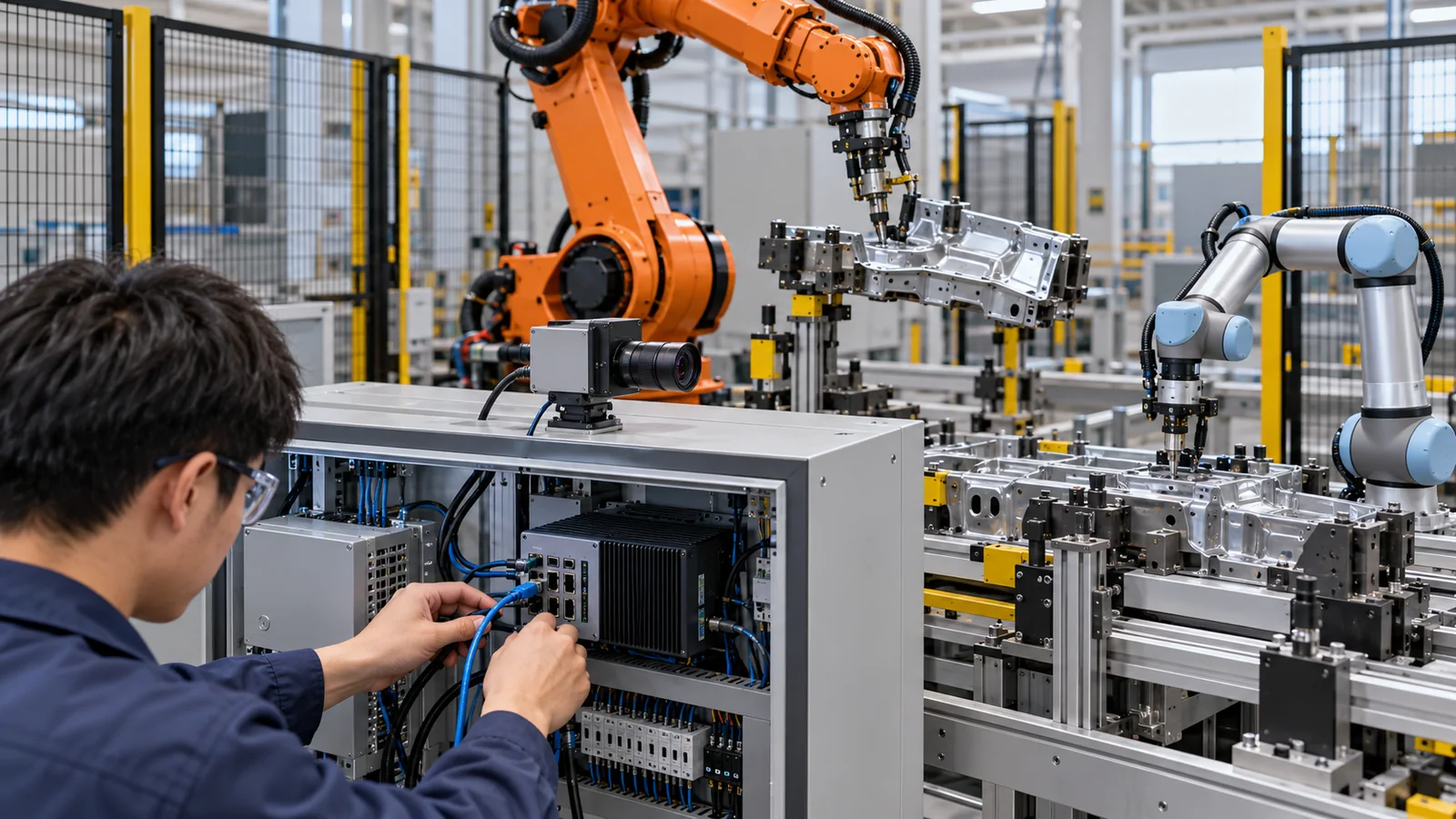
Robot arms that weld, move and assemble in factories are one of FANUC’s main products. In its annual securities report for the year to March 2026, the robot department had consolidated sales of ¥378.6 billion, or 44.1% of the total. In December 2025 the company announced that robots can now be connected to AI through ROS 2 and Python, and described its collaboration with NVIDIA. This article leaves aside the company’s other businesses and focuses on the robot side: what it sells, how far the numbers are disclosed, and which parts of its physical-AI work are company description and which are still unconfirmed, within what the annual securities report and official pages say. Products and partnerships change quickly, so each status carries its check date (25 October 2026).
- FANUC in 30 seconds, and where it stands in drones and robotics
- The logo and how the name is written
- Where the company sits in drones and robotics
- Scale (limited to the robot business)
- Resources committed to robots
- What it has done so far
- What comes next
- What the company is aiming for in drones and robotics
- Map of partnerships in drones and robotics
- Technology, products and services
- The risks this company carries
- Glossary / References / Claim-to-source audit
1. FANUC in 30 seconds, and where it stands in drones and robotics
JapanR&D and factories are concentrated in the headquarters area
Prime MarketAs stated in the annual securities report
specialist robotsThe grouping is ours. This article covers the robot business only
R-2000/E and othersCompany announcements (December 2025 and others)
NVIDIA and GoogleCompany initiatives. Contribution to sales is not disclosed
FANUC is a company of industrial robot arms that weld, move parts and assemble products in factories. It is not a humanoid-robot company. The annual securities report describes a business built on CNC (computer numerical control, the controller of machine tools) and servo motors, extended into robots and small machine tools called “Robomachines”. It reports as a single segment Sourced. Sales of the robot department alone (¥378.6 billion in the year to March 2026, 44.1% of consolidated sales) are disclosed, but profit, headcount, R&D and investment for the robot department are not.
The second point is opening up the robot to the “brains” of AI. The company says it has released a driver for ROS 2 (a common open-source software base for robot development) and made it possible to run Python on the robot controller itself Sourced. This article reads the company along three lines: what it sells, how far the numbers are disclosed, and which parts of its physical-AI work are the company’s own description or still unconfirmed.
2. The logo and how the name is written

A note on names: the company is FANUC CORPORATION (the English name in its annual securities report). Robots are sold and serviced through consolidated subsidiaries such as FANUC America Corporation and FANUC Europe Corporation. In contrast, SHANGHAI-FANUC Robotics CO., LTD. in China is a 50%-owned equity-method affiliate, a separate legal entity and not a consolidated subsidiary. This article keeps that distinction.
Official logo file: https://www.fanuc.co.jp/en/image/logo-ci.svg
3. Where the company sits in drones and robotics
Companies in this field are easiest to understand by what they build and who buys it. FANUC sits in “industrial & specialist robots”: robot arms that work in factories every day.
4. Scale (limited to the robot business)
FANUC as a whole also makes factory automation (CNC, servo, laser), Robomachines and services. This article covers robots only. Company-wide figures are as follows Sourced.
| Item (¥ million) | FY2023 (year to Mar 2024) | FY2024 (year to Mar 2025) | FY2025 (year to Mar 2026) |
|---|---|---|---|
| Consolidated sales | 795,274 | 797,129 | 857,831 |
| Robot department sales | 380,944 | 329,566 | 378,610 |
| Robot department share | 47.9% | 41.3% | 44.1% |
| R&D expenses (whole company) | 49,813 | 46,666 | 44,959 |
| Capital expenditure (whole company) | 52,464 | 40,136 | 21,990 |
| Employees (as of 31 March 2026) | Number | Note |
|---|---|---|
| Consolidated group | 10,040 | Plus 1,682 temporary staff (annual average) |
| Parent company (FANUC CORPORATION) | 4,842 | Plus 1,160 temporary staff. Average age 40.0 |
| Robot department employees | Not disclosed | The report says splitting staff by business department is difficult |
The R&D and capital expenditure figures above are for the whole company, not the robot business alone. Because FANUC reports a single segment, robot profit, R&D, capital expenditure and headcount are not disclosed Not yet confirmed. This article does not estimate them. Also, robot department sales are FANUC’s own robot sales, not a share of the world robot market (the company’s sustainability page mentions company-estimated market shares, but their basis could not be checked, so we do not use them).
5. Resources committed to robots
We sorted four angles (people, money, outside relationships, research institutions) by whether the annual securities report and official pages confirm them. “Not stated” is also a result.
| Angle | What we could confirm | Type |
|---|---|---|
| People | Consolidated group employees: 10,040 (whole company). The R&D organisation includes divisions for robot mechanisms, robot software and robot application technology. The number of robot-dedicated staff is not disclosed | Sourced / not disclosed |
| Money | R&D ¥44,959 million and capital expenditure ¥21,990 million, both whole company, year to March 2026. All funds needed were met from own funds with no external financing. Robot-only amounts are not disclosed | Sourced / not disclosed |
| Factories | Robot-dedicated factories were built in the headquarters area (2011) and in the Tsukuba area (2018) (history in the annual securities report). Production capacity is not stated | Sourced |
| Outside investments and joint ventures | SHANGHAI-FANUC Robotics in China (50% of voting rights, equity-method affiliate). In the year to March 2026, sales to this company were 10.4% of consolidated sales (¥89,639 million). In the past, a joint venture with General Motors of the US (set up in 1982, made a wholly owned subsidiary in 1992). No new robot-related investment or acquisition is stated in the annual securities report | Sourced / not stated |
| Patent and technology cross-licence | A reciprocal patent licence with Siemens of Germany covering CNC systems, CNC automatic programming devices and robots. The contract period runs from 19 April 1983 to 31 December 2026 (what happens after expiry is not stated) | Sourced |
| Universities and institutions | A University of Yamanashi research team is working on automating grape berry thinning using FANUC’s open platform (within a commissioned research programme for smart agriculture). This is a case study on FANUC’s own page; FANUC’s funding or staffing is not stated. Links with Japan’s METI or NEDO could not be confirmed in the sources we checked | Sourced / not confirmed |
Main robots and products (as far as official company sources confirm)
All performance values are FANUC’s stated values, and the comparison is usually with the previous model. We do not compare with other makers’ machines or rank them. Checked on 25 October 2026.
| Name (type) | Main specifications (company’s stated values, conditions) | Track record and approvals | Stage and date | Source |
|---|---|---|---|---|
| CRX-3iA (collaborative robot) | Payload 3 kg, reach 692 mm, mechanical unit weight 11 kg. Can be fixed with a magnetic base and detects its own mounting angle (company description) | Number deployed not confirmed. No approval or certification stated | Announced December 2025. Mass production planned for January 2026 (the start itself could not be confirmed) | Ref. 10 |
| CRX series overall | Six models (CRX-3iA to CRX-30iA). Payload 3 to 30 kg, reach 692 to 1,756 mm | Announced December 2019 (company description). Total shipments of the series not confirmed | On sale (company product list) | Refs. 10, 15 |
| R-2000/E series (large industrial robot) | Eight models. Versus the earlier R-2000: up to 20% faster motion, up to 10% more payload and reach, 15% lower power use (company comparisons). Battery-less encoders | The earlier R-2000 series has shipped over 350,000 units (company figure). Shipments of the new model not confirmed | Announced December 2025. Mass production planned for March 2026 (the start itself could not be confirmed) | Refs. 1, 11 |
| M-810 (machining robot) | Annual securities report: M-810/190-20B has a 190 kg payload and 2 m reach. Company page: IP67 protection, 3.4 times the machining load of the M-800 (company comparison) | Company page states shipment start in June 2025 (M-810/270-27B). Number not confirmed | On sale (shipments from June 2025) | Refs. 1, 12 |
| SR-9iA/R (rack-mounted SCARA robot) | Payload 9 kg, reach 620 mm. One round trip in 0.7 s under stated conditions (2.5 kg load, 500 mm horizontal, 100 mm vertical). The company claims the “world’s best processing capacity” (no independent verification found) | Main intended use: moving solar cell modules. Number deployed not confirmed | On sale (shipments from April 2025) | Ref. 13 |
| ROS 2 driver, Python support, Stream Motion | Robots from 3 kg to 2,300 kg payload can be controlled from ROS 2. Position commands run at a 1 ms cycle | Number of users not confirmed. The driver source code is public on GitHub | Available (officially announced December 2025) | Refs. 5, 6, 17 |
| ROBOGUIDE link to NVIDIA Isaac Sim | Links the company’s robot simulator with NVIDIA’s simulation platform. FANUC robots are offered as OpenUSD SimReady assets | Deployment record not confirmed | Available (notice dated 20 January 2026 on the company page) | Refs. 4, 9 |
Customers, quantities, operating hours, the scope of safety or explosion-proof certifications, and prices are not stated in the official sources we checked Not yet confirmed. The company site mentions the “world’s first” explosion-proof collaborative robot complying with international standards, but the standard and its scope could not be confirmed on that page, so we give no detail (company claim).
6. What it has done so far
| When | Event | Meaning |
|---|---|---|
| 1974 | Developed robots and installed them in its own factories | Company history |
| 1977 | Started commercial production and shipment of robots (ROBOT-MODEL 1). Set up a US subsidiary | Start of the robot business of a machine-tool controller maker |
| 1982 | Founded GMFanuc Robotics in the US as a joint venture with General Motors | Entry into US automotive plants. Made wholly owned in 1992 and renamed FANUC Robotics |
| 1997 | Founded the joint venture SHANGHAI-FANUC Robotics in China | Now an equity-method affiliate (50%) |
| 2002 | Put robot cells into practical use with 720 hours of continuous unmanned operation (company description) | Long unattended operation |
| 2015 | Developed the collaborative robot CR-35iA. Robot shipments reached 400,000. Announced a partnership with Preferred Networks | Start of ties with AI firms (details not confirmed) |
| 2017 | Robot shipments reached 500,000 | Company’s own figure |
| 2018 | Built a new robot factory in the Tsukuba area | History in the annual securities report |
| December 2019 | Announced the CRX collaborative robot series | A light series that can be taught by hand guiding (company description) |
| 2023 | Robot shipments reached 1 million | Company’s own figure |
| December 2025 | Announced the ROS 2 driver, Python support and collaboration with NVIDIA. Announced R-2000/E and CRX-3iA | The “opening up” for physical AI |
| 20 January 2026 | Notice that the ROBOGUIDE and NVIDIA Isaac Sim link is available | Posting on the company page |
| June 2026 | Annual securities report for the year to March 2026. Robot department sales up 14.9% | Domestic automotive demand weak; China EV-related and general industry strong (company description) |
7. What comes next
The annual securities report gives no sales, volume or investment targets for robots. What it gives is policy Sourced.
and service as one“one FANUC”, as stated in the annual securities report
product groupsAlso examining generative AI in products (company statement)
sites, several parts suppliersResponse to natural-disaster and procurement risks
None of the following is stated in the sources we checked Not yet confirmed: robot sales or volume targets, the amount and timing of capacity investment, sales or deployments from physical AI, and confirmation that CRX-3iA and R-2000/E mass production started. The physical-AI examples on the company pages (a robot that takes voice commands, a robot that steps away from people, a robot that folds a T-shirt by imitation learning) are company-published demonstrations and exhibits, and their scale in real use cannot be confirmed.
8. What the company is aiming for in drones and robotics
This section includes points the company does not state directly. They are inferences read from primary sources, shown with their basis.
| What we read | Primary source basis | Type |
|---|---|---|
| FANUC sees its strength as supplying the whole of factory automation (controllers, servos, robots, service) together, not robots alone | Annual securities report: “one FANUC”, a single segment in which every product uses CNC and servo motors, and a policy to keep providing maintenance service | Inference |
| In physical AI, it is not building a giant AI model itself but teaming with outside AI firms and “opening” the robot | Public ROS 2, Python and Stream Motion; official pages on NVIDIA and Google. No in-house AI foundation model was found in the sources | Inference |
| It puts keeping robots running (preventive maintenance) ahead of using AI | Annual securities report: develop products that “do not break”, “warn before they break” and “can be fixed quickly”; the official ZDT function | Sourced |
| The increase in sales in the year to March 2026 was supported by demand in China | Annual securities report: in China, EV-related and general industry demand was strong and sales rose greatly. Sales to the China affiliate were 10.4% | Sourced |
| Humanoid robots are not a main line | No development or sale of humanoid robots is stated in the annual securities report or official robot pages we checked (this does not prove there is none) | Not confirmed |
The aim of supporting ROS 2 and Python can be read as widening the pool of developers who use FANUC robots Inference. The official page says that many companies, start-ups, universities and research institutions are exploring physical AI with ROS and Python, and that FANUC has made its robots connectable to them Sourced. The annual securities report also says AI work is meant to “differentiate from competitors”, so opening up is probably one means of differentiation. How this turns into sales could not be confirmed in any source Not yet confirmed.
9. Map of partnerships in drones and robotics
For NVIDIA and Google, the official pages describe “collaboration”, “initiatives” and “participation in a test programme”, but do not state the form, value or term of any agreement Not yet confirmed. The Google page describes a system using Google’s AI agent “Gemini Enterprise”, support for the robot development software Flowstate from Intrinsic (Google’s AI robotics software company), and participation in Google DeepMind’s “Gemini Robotics Trusted Tester” programme. No dates are given on that page.
10. Technology, products and services
FANUC offers industrial robots by application, from small models with a payload (the weight the arm can carry) of 500 grams to large models of 2.3 tonnes (company description).
| Category | Content (company description) | Plain explanation |
|---|---|---|
| Industrial robots | For welding, machining, material handling, assembly and painting. Used in automotive, electronic parts, logistics, food, pharmaceuticals, cosmetics and agriculture | Arm-like machines that repeat set tasks |
| Collaborative robots (CRX) | Work next to people. Stop automatically when touched. Taught by guiding the arm by hand, and operated from a tablet | Can sometimes be used without a safety fence (a safety assessment of the site is still needed) |
| Painting robots | Models complying with explosion-proof standards (company description; the standard and scope could not be confirmed on that page) | Designed for places with flammable solvents |
| Software and maintenance | ROBOGUIDE (simulator), ZDT (failure prediction and maintenance notices), CRX plug-ins | Check motions on screen before running the real robot; warn of signs of failure |
| Outside products | J.Schmalz GmbH’s soft gripper mGrip (rubber fingers opened by air pressure), operated from a dedicated CRX screen | The “hand” of a robot |
The company says the new R-2000/E uses battery-less encoders (parts that measure joint angle) and needs no battery, grease or cable replacement (company statement; no conditions or years given) Sourced. Joint grease and cabling are the most labour-intensive wear items in robot maintenance. Cutting them requires wear-resistant materials and cable materials that survive constant flexing (a general point). The materials used are not stated in the official sources Not yet confirmed.
Another example is mGrip, with soft rubber fingers. The company page states that it meets food-contact rules (US FDA 21 CFR, EU Regulation EC 1935/2004 and the Japanese Food Sanitation Act) (a J.Schmalz product; the tests behind this could not be confirmed). The CRX-3iA has a mechanical unit of only 11 kg and can be fixed with a magnetic base. For the structure that combines lightness with magnet adhesion, see our explainers on structural materials for robots and drones and on permanent magnets and rare earths. Which reducers and motors are used could not be confirmed in the sources (see our explainers on speed reducers and gears and on joint actuators).
11. The risks this company carries
| Risk | Content | Type |
|---|---|---|
| Business-cycle exposure | The annual securities report says its products are capital goods and sensitive to economic swings | Sourced |
| Weak automotive demand | In the year to March 2026, domestic sales to the automotive industry did not recover and fell | Sourced |
| Tariffs, protectionism and export controls | Changes in national policy and law (tariffs, anti-dumping duties, export controls) could affect sales. Overseas sales are a large part of consolidated sales | Sourced |
| Rising competitiveness of emerging-market firms | The report lists rapid gains in technology and competitiveness of emerging-market firms as a risk of losing competitiveness | Sourced |
| Parts procurement | Shortages or delays in parts could delay production | Sourced |
| Concentration of sites | R&D and factories are concentrated in the headquarters area; a large earthquake could cause severe damage. The company is adding production sites such as Mibu and Tsukuba | Sourced |
| Dependence on the China affiliate | Sales to SHANGHAI-FANUC Robotics were 10.4% of consolidated sales | Sourced |
| Security with openness | The report describes cybersecurity risk and a product incident response team (PSIRT). Connecting to more outside AI and computers may make this more important | Inference |
| Monetising physical AI | Currently demonstrations and exhibits; sales and deployments not disclosed | Not yet confirmed |
| Term of the Siemens contract | The patent cross-licence runs to 31 December 2026; what follows is not stated | Not yet confirmed |
12. Glossary
- Industrial robot
- An arm-type robot that does welding, moving or assembly in a factory.
- Collaborative robot
- A robot with safety functions, such as stopping on contact, so it can work near people.
- Payload
- The maximum weight the robot hand can carry.
- Reach
- How far the robot arm can extend.
- SCARA robot
- An arm that moves quickly in the horizontal plane; used for small parts.
- CNC
- Computer numerical control: a controller that runs machine tools by numbers. The base of FANUC.
- Servo motor
- A motor whose position and speed are controlled precisely; it moves robot joints.
- Encoder
- A part that measures the rotation angle of a motor.
- ROS 2
- The Robot Operating System 2: widely used open-source software for robot development.
- Physical AI
- AI that sees and acts on real objects, not only on a screen.
- Digital twin
- A virtual copy of a real machine used to test its motions beforehand.
- Stream Motion
- A function that executes position commands from a PC at a 1 ms cycle.
- IP67
- A rating for dust-tight protection and survival of temporary immersion in water.
- Equity-method affiliate
- A company, often 50% or less owned, whose profit is taken in by share rather than consolidated.
- Annual securities report
- The yearly report that listed Japanese companies file with the government.
13. References
- FANUC Annual Securities Report (Yuka Shoken Hokokusho, filed with the Kanto Local Finance Bureau), 57th fiscal year (1 April 2025 to 31 March 2026), filed 22 June 2026 (in Japanese). Company overview, history, business, affiliates, sales by product department, R&D, capital expenditure, employees, risks, material contracts. https://www.fanuc.co.jp/ja/ir/securitiesreport/pdf/securitiesreport57_202603.pdf
- FANUC Annual Securities Report, 56th fiscal year (1 April 2024 to 31 March 2025) (in Japanese). Robot department sales, R&D, capital expenditure. https://www.fanuc.co.jp/ja/ir/securitiesreport/pdf/securitiesreport56_202503.pdf
- FANUC Annual Securities Report, 55th fiscal year (1 April 2023 to 31 March 2024) (in Japanese). Robot department sales, R&D, capital expenditure. https://www.fanuc.co.jp/ja/ir/securitiesreport/pdf/securitiesreport55_202403.pdf
- FANUC ROBOT (product page; checked 25 October 2026). Robot range (payloads from 500 g to 2.3 tonnes) and list of new products and notices. https://www.fanuc.co.jp/en/product/robot/index.html
- FANUC ROBOT New Technology: Open Platforms & Physical AI (December 2025). ROS 2 driver, Python support, collaboration with NVIDIA. https://www.fanuc.co.jp/en/product/new_product/2025/202512_robot_physicalai.html
- FANUC FANUC Open Platform (checked 25 October 2026). The three pillars (ROS 2, Python, Stream Motion) and case studies. https://www.fanuc.co.jp/en/product/robot/academia/index.html
- FANUC Initiatives with NVIDIA (within FANUC Open Platform; checked 25 October 2026). https://www.fanuc.co.jp/en/product/robot/academia/fanuc-nvidia.html
- FANUC Initiatives with Google (within FANUC Open Platform; checked 25 October 2026). https://www.fanuc.co.jp/en/product/robot/academia/fanuc-google.html
- FANUC ROBOGUIDE and NVIDIA Omniverse (function page; checked 25 October 2026). https://www.fanuc.co.jp/en/product/robot/function/roboguide_omniverse.html
- FANUC ROBOT New product: CRX-3iA (December 2025). Specifications and planned start of mass production. https://www.fanuc.co.jp/en/product/new_product/2025/202512_robot_crx.html
- FANUC ROBOT New product: R-2000/E Series (December 2025). Specifications and planned start of mass production. https://www.fanuc.co.jp/en/product/new_product/2025/202512_robot_r2000.html
- FANUC ROBOT New product: Machining Robot M-810 (August 2025). https://www.fanuc.co.jp/en/product/new_product/2025/202508_robot_m810.html
- FANUC ROBOT New product: SR-9iA/R (August 2025). https://www.fanuc.co.jp/en/product/new_product/2025/202508_robot_sr9iar.html
- FANUC FANUC’s History (company history page; checked 25 October 2026). Start of robot shipments, cumulative volumes, partnerships. https://www.fanuc.co.jp/en/profile/history/index.html
- FANUC ROBOT Business (business overview within the sustainability pages; checked 25 October 2026). Robot applications and industries, CRX series. https://www.fanuc.co.jp/en/sustainability/sdgs/robotbusiness.html
- FANUC Automating Grape Berry Thinning (case study within FANUC Open Platform; University of Yamanashi research; checked 25 October 2026). https://www.fanuc.co.jp/en/product/robot/academia/case_study/automation-of-grape-berry-thinning.html
- FANUC FANUC’s official ROS 2 driver (GitHub; existence of the repository confirmed on 25 October 2026). https://github.com/FANUC-CORPORATION/fanuc_driver
- FANUC Soft Gripper mGrip (made by J.Schmalz GmbH; function page; checked 25 October 2026). https://www.fanuc.co.jp/en/product/robot/function/mgrip.html
- FANUC FANUC’s official logo file (source of the logo image; checked 25 October 2026). https://www.fanuc.co.jp/en/image/logo-ci.svg
14. Claim-to-source audit
Last updated 25 October 2026 / Troy Technical
All figures in this article come from FANUC’s annual securities reports and the company’s official website. No research-firm estimates or press-based figures have been used. Performance values are the company’s stated values and have not been independently verified. Passages marked “Inference” are our own reading of primary sources, not statements by the company. This article is not investment or purchasing advice.