COMPANY PROFILE / DRONES AND ROBOTICS
Intuitive Surgical
The maker of the da Vinci surgical robot, where over 80% of revenue comes from use that recurs
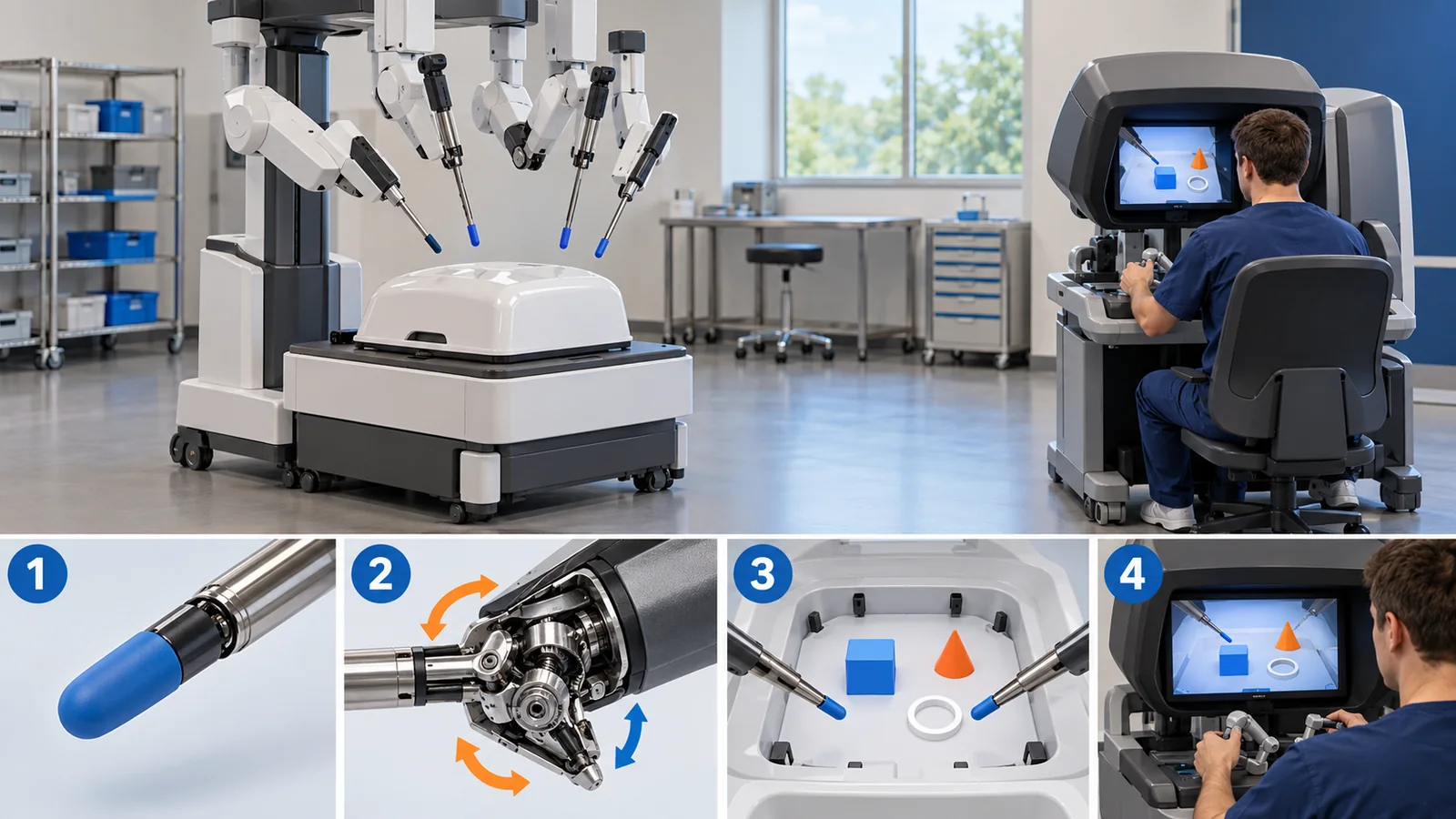
The da Vinci surgical robot is moved by a surgeon at a console, while robotic arms beside the patient move thin instruments. Intuitive Surgical’s revenue for the year to December 2025 was $10.06 billion, of which 84% was “recurring”: instruments and accessories, service and operating leases. That year da Vinci was used in about 3.15 million procedures, and about 11,106 systems were installed (company tallies and estimates). This article sets out what the company sells, which range of procedures the FDA and others have cleared (with dates), and where that differs from the company’s own claims, within what its Form 10-K and 10-Q and the U.S. FDA’s public databases say. It does not claim that any treatment or its safety is better. Products and clearances change quickly, so each status carries its check date (25 October 2026).
- Intuitive Surgical in 30 seconds, and where it stands in drones and robotics
- The logo and how the name is written
- Where the company sits in drones and robotics
- Scale
- Resources committed to robots
- What it has done so far
- What comes next
- What the company is aiming for in drones and robotics
- Map of partnerships in drones and robotics
- Technology, products and services
- The risks this company carries
- Glossary / References / Claim-to-source audit
1. Intuitive Surgical in 30 seconds, and where it stands in drones and robotics
USA1020 Kifer Road
specialist robotsSurgical robots used in operating rooms. The grouping is ours
Intuitive Surgical makes the da Vinci surgical robot. A surgeon works at a console, and robotic arms beside the patient move thin instruments. The robot does not decide the operation: it is a tool that turns the surgeon’s hand movements into fine movements of instruments (Form 10-K description) Sourced. The company also makes Ion, a thin robotic catheter used to take lung biopsies (tissue samples for diagnosis).
Two features stand out. First, 84% of revenue is “recurring” (instruments and accessories used in each procedure, service, and operating leases), so the business rests on systems being used again and again, not only on selling the machine Sourced. Second, the regulatory route is “clearance” (510(k)), not “approval”, and the FDA documents let us see, device by device, which range of procedures was cleared. This article does not claim that the treatment or its safety is better. The company’s aim of “better outcomes” and the scope the FDA cleared are different things.
This is a technology and business explainer, and it does not recommend any operation or treatment. FDA “clearance” is the result of showing substantial equivalence to a device already on the market (the 510(k) route); it does not guarantee a treatment effect. Choosing a procedure is a decision between a patient and the treating doctor.
2. The logo and how the name is written

A note on names: the company is Intuitive Surgical, Inc., also calling itself “Intuitive”. This article follows the U.S. parent’s filings and does not cover local subsidiaries in individual countries. da Vinci and Ion are the company’s trademarks for its robots; they are not people or separate companies. The joint venture in China, Intuitive Surgical-Fosun Medical Technology (Shanghai), is a separate legal entity formed with Shanghai Fosun Pharmaceutical (Fosun Pharma), and Intuitive holds the majority.
Source of the logo image: https://www.intuitive.com/assets/images/svg/isi-logo-black.svg
3. Where the company sits in drones and robotics
Companies in this field are easiest to understand by what they build and who buys it. Intuitive Surgical is in “industrial & specialist robots”: medical robots that work in hospital operating rooms. Hospitals buy them, and doctors and surgical teams use them.
4. Scale
Intuitive Surgical is almost entirely a surgical and diagnostic robot company, so the whole company falls within this field. Figures come from the Form 10-K and SEC’s XBRL data (US$ million) Sourced.
| Item (US$ million) | FY2023 | FY2024 | FY2025 |
|---|---|---|---|
| Revenue | 7,124.1 | 8,352.1 | 10,064.7 |
| of which instruments and accessories | 4,276.6 | 5,079.0 | 6,018.9 |
| of which service | 1,167.8 | 1,307.1 | 1,572.1 |
| of which operating leases (fixed or usage-based) | 500.5 | 654.2 | 874.3 |
| Recurring revenue as a share of revenue | 83% | 84% | 84% |
| Operating income | 1,766.8 | 2,348.9 | 2,945.5 |
| R&D expenses | 998.8 | 1,145.3 | 1,311.8 |
| Purchases of property, plant and equipment (capital expenditure) | 1,064.2 | 1,111.2 | 539.8 |
| Scale of activity | FY2024 (year end) | FY2025 (year end) | Jul to Sep 2026 (30 Sep) |
|---|---|---|---|
| da Vinci procedures (approx.) | 2,683,000 | 3,153,000 | 906,000 (797,000 a year earlier) |
| da Vinci installed base (cumulative, approx.) | 9,902 | 11,106 | 12,094 |
| da Vinci systems placed in the period | 1,526 | 1,721 | 546 |
| of which da Vinci 5 placed in the period | 362 | 870 | 315 |
| Ion installed base (cumulative, approx.) | 805 | 995 | 1,152 |
| Ion procedures (approx.) | 95,500 | 144,100 | 49,700 (37,900 a year earlier) |
Procedure counts and installed bases are the company’s tallies and estimates based on system logs; the Form 10-K says they involve estimates and judgment and are uncertain, and that procedure growth does not always match revenue growth Sourced. The recurring-revenue share is as in the Form 10-K table.
| Employees (31 December 2025) | Number |
|---|---|
| Total (29 countries) | 17,021 |
| Research and development | 2,288 |
| Manufacturing | 7,625 |
| Commercial and service | 4,837 |
| Administrative | 2,271 |
5. Resources committed to robots
We sorted four angles (people, money, outside relationships, research institutions) by whether the Form 10-K, 10-Q and public databases confirm them. “Not stated” is also a result.
| Angle | What we could confirm | Type |
|---|---|---|
| People | 17,021 employees. About 1,383 more in 2025. R&D 2,288 and manufacturing 7,625. Based in 29 countries | Sourced |
| Money | R&D of $1,311.8 million (FY2025). Purchases of property, plant and equipment of $539.8 million (against $1,111.2 million the year before). A breakdown of capital spending by site or product could not be confirmed in the Form 10-K | Sourced / not confirmed |
| Plants | Systems are made in Sunnyvale (California) and Peachtree Corners (Georgia) and at the joint venture’s plant in China. Instruments and accessories come from Sunnyvale and Mexicali in Mexico. Ion-related work is in Virginia, and endoscope-related work in Bulgaria and Germany | Sourced |
| Outside investments, acquisitions and joint ventures | A joint venture in China with Fosun Pharma (Intuitive holds the majority). On 1 March 2026 it bought the da Vinci and Ion distribution businesses in Italy, Spain, Portugal, Malta, San Marino and nearby territories for about $533.1 million in cash. Two venture funds, “Intuitive Ventures”, invest in early-stage companies (amounts not found in the Form 10-K) | Sourced / not confirmed |
| Joint development with companies | With Hillrom (now part of Baxter International), it developed “Integrated Table Motion”, which links the robot arms with an operating table | Sourced |
| Universities, institutions and public bodies | In Japan, university hospitals and surgical societies, with the company’s support, apply for reimbursement of procedures. Joint research with universities and public research funds (for example NIH or DARPA) are not stated in the Form 10-K and 10-Q we checked | Sourced / not confirmed |
Main robots and the scope of FDA and other clearances
Performance descriptions are the company’s. The scope of each clearance comes from the FDA clearance letters (510(k)) and the “Regulatory” section of the Form 10-K. An FDA “510(k) clearance” is a different route from “approval” (PMA): it confirms substantial equivalence to a device already marketed. Checked on 25 October 2026.
| Name (type) | Company description | Scope of clearance (with dates) | Stage | Source |
|---|---|---|---|---|
| da Vinci 5 (fifth-generation surgical system) | Force feedback instruments that let the surgeon sense force on tissue, new controllers, and more than 10,000 times the computing power of da Vinci Xi (company claim) | U.S. FDA (14 March 2024): adults, in urologic, general laparoscopic, gynecologic laparoscopic and general thoracoscopic procedures; cardiac and pediatric uses excluded. The force feedback needle driver is contraindicated in hysterectomy and myomectomy. U.S. FDA (database decision date 16 January 2026): selected thoracoscopically assisted cardiac procedures added (with non-force-feedback instruments). EU (July 2025): adult and pediatric abdominopelvic and thoracoscopic procedures, excluding force feedback. Japan (June 2025): all specialties except cardiac. South Korea (October 2024) | On the market (870 placed in 2025) | Refs. 1, 4, 5 |
| da Vinci SP (single-port system) | Three instruments and an endoscope come out of a single port. One arm | U.S. FDA: April 2023 selected prostate procedures; July 2024 thoracoscopic procedures; December 2024 colorectal; May 2025 transanal local excision; December 2025 cholecystectomy, inguinal hernia repair, appendectomy and nipple-sparing mastectomy. EU (January 2024). Taiwan (August 2024) | On the market | Ref. 1 |
| da Vinci X and Xi (fourth generation) | The generation before da Vinci 5, still widely used | Multiple indications in many countries (see the “Regulatory” section of the Form 10-K). The FDA database lists decisions dated 1 April 2025 and 11 June 2025 for the X and Xi | On the market | Refs. 1, 8 |
| Ion (bronchoscopy robot) | A thin catheter reaches lesions in the outer lung to take tissue; shape-sensing guides the path (company description) | U.S. FDA (2019): first indication is minimally invasive lung biopsy. October 2025: software update adding AI. April 2024: uses per catheter raised from 5 to 8 (EU followed in February 2025). China NMPA (March 2024) | On the market (195 placed in 2025) | Refs. 1, 8 |
| Intuitive Endoluminal GI System (IG1000) | A robotic system that controls an endoscope for the esophagus, stomach and duodenum | U.S. FDA (510(k) K253702; database decision date 7 August 2026): robotic-assisted control of the robotic GI endoscope for observation, diagnosis and endoscopic treatment of the esophagus, stomach and duodenum. The reference device is a FUJIFILM endoscope | Cleared. Launch timing and units not confirmed | Ref. 6 |
Prices of each model, national reimbursement rates, clinical trial results, names of hospitals, and the launch timing of IG1000 are not stated in the sources we checked Not yet confirmed. For Japan we stay within what the Form 10-K says and have not checked Japanese device approval numbers.
6. What it has done so far
| When | Event | Meaning |
|---|---|---|
| 1999 | Launched the first da Vinci | Company statement |
| 2000 | FDA cleared use in general laparoscopic surgery | The first U.S. clearance; later extended to urology, gynecology, thoracic, head and neck and more |
| 2019 | FDA cleared Ion (first indication: lung biopsy) | Extended from surgery into diagnosis |
| June to August 2023 | China’s NMPA approved a local version of da Vinci Xi; the joint venture gained a manufacturing licence | Manufacturing and sales set-up in China |
| 14 March 2024 | FDA cleared da Vinci 5 (510(k) K232610) | The first U.S. clearance of the fifth generation |
| 2025 | da Vinci 5 cleared in Europe and Japan. 870 da Vinci 5 systems placed in the year | Roll-out outside the U.S. begins |
| January 2026 | FDA cleared da Vinci 5 for selected thoracoscopically assisted cardiac procedures | Indications extended into cardiac surgery |
| 1 March 2026 | Acquired distribution businesses in southern Europe (about $533.1 million) | Wider direct selling |
| 7 August 2026 | FDA cleared IG1000 for the upper digestive tract (database decision date) | Into robotic endoscopy |
| October 2026 | Agreed to settle an antitrust class action over instrument repair and replacement for a one-time $450 million plus injunctive relief (subject to court approval; no admission of liability) | Progress of a lawsuit. Court proceedings are not complete |
7. What comes next
In its earnings release of 20 October 2026 the company gave an outlook for 2026. The outlook is the company’s expectation, not accomplished fact Not yet confirmed.
Unit targets for the overseas roll-out of da Vinci 5, sales plans for IG1000, launch timing of new products and medium-term revenue targets are not stated in the sources we checked Not yet confirmed. The “vision” passages (such as less invasive care) are statements of purpose, not numerical targets.
8. What the company is aiming for in drones and robotics
This section includes points the company does not state directly. They are inferences read from primary sources, shown with their basis.
| What we read | Primary source basis | Type |
|---|---|---|
| The centre of revenue is income that comes from systems being used, not the sale of the machine | Form 10-K: recurring revenue (instruments and accessories, service, operating leases) is 84% of revenue. Operating leases are fixed-payment or usage-based | Sourced |
| Growth is driven by widening the range of procedures (indications) one step at a time | Form 10-K and FDA letters: da Vinci SP added procedures from 2023 in steps; da Vinci 5 moved into cardiac. The FDA database holds 198 decisions for the company | Inference |
| It is extending robots beyond surgery into diagnosis and endoscopy | Clearances for Ion (lung biopsy, 2019) and IG1000 (upper digestive tract, 2026) | Inference |
| It is moving toward owning sales and service itself | The March 2026 acquisition of southern European distributors; China via a joint venture; most other overseas markets use distributors | Inference |
| Parts sourcing and tariffs are a key management issue | In 2025, tariffs and other trade measures raised cost of revenues by about $63.0 million. The report names China’s export controls on rare earths, including magnets, as a sourcing risk | Sourced |
Setting out the FDA clearance history of da Vinci SP shows a new type of procedure roughly every six months: April 2023 (part of prostate), July 2024 (thoracoscopic), December 2024 (colorectal), May 2025 (transanal) and December 2025 (gallbladder, hernia, appendix and part of breast) (Form 10-K) Sourced. From this we read that the company uses applications to the FDA to widen what the same system may be used for as a way to grow, and not only new machines Inference. Which procedures are added also depends on clinical need and surgeon demand, so how much each addition contributes to revenue could not be confirmed Not yet confirmed.
9. Map of partnerships in drones and robotics
The tie with Japanese university hospitals and societies comes from the Form 10-K’s description of the process for obtaining reimbursement; it is not a joint research contract Sourced. The Form 10-K also says that in many markets outside the U.S. it sells through distributors, and the names and terms of individual distributors are not stated Not yet confirmed.
10. Technology, products and services
A da Vinci system consists of a surgeon console, a patient-side cart (arms that hold instruments), a vision system (3D high-definition image) and surgical instruments (Form 10-K). The surgeon sits and operates, and hand movements are translated into small movements of the instruments Sourced.
| Category | Content (company description) | Plain explanation |
|---|---|---|
| da Vinci multi-port (X, Xi, 5) | Instruments and an endoscope go in through several small ports. About 70 types of instruments. Most can be reused up to a set number of times, and a memory chip inside each instrument records its use | Laparoscopic surgery: surgery through small holes using instruments and a camera |
| da Vinci SP (single-port) | Three instruments and an endoscope emerge from one port. A single arm supports all of them | Single-port: only one opening |
| Ion (bronchoscopy) | A very thin catheter reaches lesions in the outer lung and takes a biopsy. Shape-sensing tells it where it is | Biopsy: taking a little tissue for diagnosis |
| Intuitive Endoluminal GI (IG1000) | A robotic endoscope to observe and treat the esophagus, stomach and duodenum | Endoluminal: working through the inside of a tube such as the gut |
| Digital and learning tools | My Intuitive app, SimNow (VR simulator), Case Insights, Intuitive Hub (edge computer) | Tools that use surgical data for learning and review (company description) |
On China’s 2025 announcement of export controls on products containing rare earths, the Form 10-K says that “rare earth elements are critical to certain components” of its products, that China is a predominant producer, and that restrictions on rare earth exports, including magnets, could limit access to components used in many products Sourced. The motors that move robot joints generally use strong magnets (a general point), but the Form 10-K does not say which parts use which materials Not yet confirmed. Our explainer on permanent magnets and rare earths gives the background.
The other point is instrument life. Most instruments can be reused “up to a set number of times”, going through repeated cleaning and sterilisation. For Ion’s catheter instrument, the FDA cleared an increase in uses from five to eight in April 2024 (the EU in February 2025) Sourced. Surviving repeated cleaning and bending involves fatigue of metals, plastics and wires (damage from repeated stress) and resistance to cleaning agents (a general point). The company has not published the tests behind the higher use count Not yet confirmed. The FDA document for the force feedback instruments (K253986) says that clearance concerned design and cleaning-method changes, with the intended use unchanged.
11. The risks this company carries
| Risk | Content | Type |
|---|---|---|
| Competition | The Form 10-K names many competitors, including Johnson & Johnson, Medtronic, Medicaroid and several companies in China, Korea and the U.S., and calls the field highly competitive | Sourced |
| Reimbursement and hospital budgets | If hospitals cannot obtain reimbursement for procedures, adoption may slow | Sourced |
| Defects and recalls | The FDA recall database holds 277 records for the company, including entries such as da Vinci 5 tower parts logged in April 2026. Counts are by product and model, and severity and cause cannot be compared from them, so this article makes no judgement | Sourced |
| Tariffs and trade measures | In 2025, tariffs and other trade measures raised cost of revenues by about $63.0 million, and more is expected in 2026. Instruments are mainly made in Mexico and endoscopes in Germany; some materials are imported from China | Sourced |
| Rare earths and parts sourcing | Chinese export controls could affect parts supply and licences for exporting products. Some parts have a sole or single source | Sourced |
| Antitrust litigation | In October 2026 the company agreed to settle a class action over instrument repair and replacement for $450 million plus injunctive relief. Preliminary and final court approval are needed, and the company admits no liability | Sourced |
| Slower regulatory reviews | The company says review timelines in the U.S. and Europe have lengthened | Sourced |
| AI and cyber | Putting AI into products carries legal and regulatory risk; failures of or attacks on information systems are also listed | Sourced |
| Monetising new products | Sales and deployment of new products such as IG1000 are not yet confirmed | Not yet confirmed |
12. Glossary
- Surgical robot
- A machine that turns a doctor’s controls into fine instrument movements during surgery. The robot does not decide the operation.
- da Vinci
- The product name of Intuitive Surgical’s surgical robots.
- Minimally invasive surgery
- Surgery that aims for smaller wounds, with less burden on the patient.
- Laparoscopic surgery
- Surgery in which instruments and a camera go in through small holes in the abdomen.
- Biopsy
- A test that takes a little tissue for diagnosis.
- 510(k) (clearance)
- A U.S. FDA route that confirms substantial equivalence to a device already on the market. It is separate from approval (PMA).
- Indication (intended use)
- The range of operations or uses for which a device is cleared.
- Contraindication
- A condition under which a device must not be used.
- Force feedback
- A function that lets the surgeon feel the force applied by an instrument.
- Recurring revenue
- The company’s term: instruments and accessories, service and operating leases together.
- Operating lease
- A contract that lets a customer use a system for a fixed or usage-based payment.
- Installed base
- The cumulative number of systems placed in hospitals and in use.
- Form 10-K / 10-Q
- The annual and quarterly reports that U.S. listed companies file.
- openFDA
- An API through which the U.S. FDA publishes its databases.
- Joint venture
- A company that two or more firms set up together with shared investment.
13. References
- Intuitive Surgical Form 10-K for the fiscal year ended 31 December 2025 (filed with the U.S. SEC on 3 February 2026). Business, products, list of regulatory clearances, results, procedures, installed base, employees, manufacturing sites, risk factors. https://www.sec.gov/Archives/edgar/data/1035267/000103526726000010/isrg-20251231.htm
- Intuitive Surgical Form 10-Q for the quarter ended 30 September 2026 (filed with the U.S. SEC on 21 October 2026). Third-quarter results, procedures, installed base, acquisition of distribution businesses, agreement to settle the antitrust class action. https://www.sec.gov/Archives/edgar/data/1035267/000103526726000071/isrg-20260930.htm
- Intuitive Surgical Third Quarter 2026 earnings release (Form 8-K, Exhibit 99.1, 20 October 2026). The 2026 outlook (company expectations). https://www.sec.gov/Archives/edgar/data/1035267/000103526726000067/q326ex-991earningsrelease.htm
- U.S. FDA 510(k) K232610: da Vinci Surgical System Model IS5000 (da Vinci 5). FDA clearance letter and indications for use (14 March 2024). https://www.accessdata.fda.gov/cdrh_docs/pdf23/K232610.pdf
- U.S. FDA 510(k) K251739: da Vinci Surgical System (IS5000). Clearance adding selected cardiac procedures to the indications. Decision date in the FDA database: 16 January 2026. https://www.accessdata.fda.gov/cdrh_docs/pdf25/K251739.pdf
- U.S. FDA 510(k) K253702: Intuitive Endoluminal Gastrointestinal System (IG1000), a new system for the upper digestive tract. Decision date in the FDA database: 7 August 2026. https://www.accessdata.fda.gov/cdrh_docs/pdf25/K253702.pdf
- U.S. FDA 510(k) K253986: da Vinci Force Feedback Instruments. Decision date in the FDA database: 11 March 2026. https://www.accessdata.fda.gov/cdrh_docs/pdf25/K253986.pdf
- U.S. FDA (openFDA) 510(k) database API (applicant Intuitive Surgical; newest decisions first; checked 25 October 2026). List of clearance numbers, decision dates and device names. https://api.fda.gov/device/510k.json?search=applicant:%22Intuitive+Surgical%22&limit=100&sort=decision_date:desc
- U.S. FDA (openFDA) Medical device recall database API (recalling firm Intuitive Surgical; newest first; checked 25 October 2026). https://api.fda.gov/device/recall.json?search=recalling_firm:%22Intuitive+Surgical%22&limit=8&sort=event_date_initiated:desc
- U.S. SEC EDGAR XBRL company facts API (CIK 0001035267). Check of annual revenue, operating income and R&D figures. https://data.sec.gov/api/xbrl/companyfacts/CIK0001035267.json
- Intuitive Surgical Official logo file (isi-logo-black.svg; source of the logo image; the company site blocks automated downloads, so it was retrieved in a browser and checked; checked 25 October 2026). https://www.intuitive.com/assets/images/svg/isi-logo-black.svg
14. Claim-to-source audit
| Claim in the text | Type | Source |
|---|---|---|
| Legal name, headquarters, listing, 17,021 employees and their split | Sourced | Reference 1 https://www.sec.gov/Archives/edgar/data/1035267/000103526726000010/isrg-20251231.htm |
| Revenue, operating income and R&D (FY2023 to FY2025) | Sourced | Reference 1, 10 https://www.sec.gov/Archives/edgar/data/1035267/000103526726000010/isrg-20251231.htm https://data.sec.gov/api/xbrl/companyfacts/CIK0001035267.json |
| Instruments and accessories, service, operating leases and the recurring revenue share (83 to 84%) | Sourced | Reference 1 https://www.sec.gov/Archives/edgar/data/1035267/000103526726000010/isrg-20251231.htm |
| Purchases of property, plant and equipment (capital expenditure) | Sourced | Reference 1 https://www.sec.gov/Archives/edgar/data/1035267/000103526726000010/isrg-20251231.htm |
| Procedures, installed base and placements (2024, 2025 and July to September 2026) | Sourced | Reference 1, 2 https://www.sec.gov/Archives/edgar/data/1035267/000103526726000010/isrg-20251231.htm https://www.sec.gov/Archives/edgar/data/1035267/000103526726000071/isrg-20260930.htm |
| Manufacturing sites, China joint venture, Hillrom co-development, Intuitive Ventures | Sourced | Reference 1 https://www.sec.gov/Archives/edgar/data/1035267/000103526726000010/isrg-20251231.htm |
| 1 March 2026 acquisition of distribution businesses (about $533.1 million) | Sourced | Reference 2 https://www.sec.gov/Archives/edgar/data/1035267/000103526726000071/isrg-20260930.htm |
| da Vinci 5 clearance (FDA 14 March 2024; cardiac in January 2026), indications and contraindication | Sourced | Reference 4, 5, 1 https://www.accessdata.fda.gov/cdrh_docs/pdf23/K232610.pdf https://www.accessdata.fda.gov/cdrh_docs/pdf25/K251739.pdf https://www.sec.gov/Archives/edgar/data/1035267/000103526726000010/isrg-20251231.htm |
| da Vinci 5 clearances in the EU, Japan and South Korea | Sourced | Reference 1 https://www.sec.gov/Archives/edgar/data/1035267/000103526726000010/isrg-20251231.htm |
| History of da Vinci SP clearances (April 2023 to December 2025) | Sourced | Reference 1 https://www.sec.gov/Archives/edgar/data/1035267/000103526726000010/isrg-20251231.htm |
| Ion clearance, AI software update, increase in uses from 5 to 8 | Sourced | Reference 1 https://www.sec.gov/Archives/edgar/data/1035267/000103526726000010/isrg-20251231.htm |
| FDA clearance of IG1000 (indication; decision date 7 August 2026) | Sourced | Reference 6, 8 https://www.accessdata.fda.gov/cdrh_docs/pdf25/K253702.pdf https://api.fda.gov/device/510k.json?search=applicant:%22Intuitive+Surgical%22&limit=100&sort=decision_date:desc |
| Force Feedback Instruments (K253986) clearance and what changed | Sourced | Reference 7 https://www.accessdata.fda.gov/cdrh_docs/pdf25/K253986.pdf |
| Records in the FDA recall database (277) | Sourced | Reference 9 https://api.fda.gov/device/recall.json?search=recalling_firm:%22Intuitive+Surgical%22&limit=8&sort=event_date_initiated:desc |
| Tariff cost increase (about $63.0 million in 2025); rare-earth export control statements | Sourced | Reference 1 https://www.sec.gov/Archives/edgar/data/1035267/000103526726000010/isrg-20251231.htm |
| Agreement to settle the antitrust class action ($450 million; court approval pending) | Sourced | Reference 2 https://www.sec.gov/Archives/edgar/data/1035267/000103526726000071/isrg-20260930.htm |
| 2026 outlook (procedure growth of 14 to 15% and others) | Not yet confirmed | Reference 3 The company’s expectation, not accomplished fact https://www.sec.gov/Archives/edgar/data/1035267/000103526726000067/q326ex-991earningsrelease.htm |
| Claims that the treatment or its safety is better | Not yet confirmed | This article does not make them. The company’s claims and the scope cleared by the FDA are different things |
| Prices, customer hospitals, IG1000 launch timing, clinical trial results | Not yet confirmed | Not stated in the sources checked. This article does not guess |
| Revenue is centred on recurring income from use | Sourced | Reference 1 Based on the Form 10-K table https://www.sec.gov/Archives/edgar/data/1035267/000103526726000010/isrg-20251231.htm |
| Reading: growth comes from widening the range of procedures step by step | Inference | Reference 1, 8 Our own reading of the FDA clearance history https://www.sec.gov/Archives/edgar/data/1035267/000103526726000010/isrg-20251231.htm https://api.fda.gov/device/510k.json?search=applicant:%22Intuitive+Surgical%22&limit=100&sort=decision_date:desc |
| Reading: extending beyond surgery into diagnosis and endoscopy | Inference | Reference 1, 6 Our own reading of the Ion and IG1000 clearances https://www.sec.gov/Archives/edgar/data/1035267/000103526726000010/isrg-20251231.htm https://www.accessdata.fda.gov/cdrh_docs/pdf25/K253702.pdf |
| Reading: moving toward owning sales and service | Inference | Reference 2, 1 Our own reading of the acquisition and sales-model statements https://www.sec.gov/Archives/edgar/data/1035267/000103526726000071/isrg-20260930.htm https://www.sec.gov/Archives/edgar/data/1035267/000103526726000010/isrg-20251231.htm |
| Company type (industrial & specialist robots) | Our calculation | Our own grouping. Company names are examples from this series |
Last updated 25 October 2026 / Troy Technical
All figures in this article come from documents Intuitive Surgical filed with the U.S. Securities and Exchange Commission and from the U.S. FDA’s public documents and databases. No research-firm estimates or press-based figures have been used. Descriptions of performance and benefit are the company’s claims and have not been independently verified. Passages marked “Inference” are our own reading of primary sources, not statements by the company. This article is not medical, investment or purchasing advice.