COMPANY PROFILE / DRONES AND ROBOTICS
Joby Aviation
– Reading the “final stage”: an electric air-taxi company building and operating before it holds a type certificate
Joby Aviation (United States) builds an electric aircraft (an eVTOL) that takes off and lands vertically with a pilot and four passengers, and aims to operate the air-taxi service itself. The company says it is in the fifth and last of five stages of FAA type certification. But those five stages are Joby’s own count, different from the five phases in the FAA’s own order. As of 25 October 2026 it holds no type certificate, and its revenue comes mainly from Blade, a passenger-brokerage business it acquired. Using only filings with the U.S. Securities and Exchange Commission, the FAA’s Federal Register notices and order, the U.S. Department of Transportation and company announcements, this article separates what is held from what is in progress or planned.
- Joby Aviation in 30 seconds, and where it sits in drones and robotics
- Logo and name
- Where this company sits in the drones and robotics world
- Company size
- Resources committed to robots and drones
- What it has done so far (reading the certification stages)
- Plans ahead
- What the company seems to be aiming for
- Partnership map
- Technology, products and services
- Risks the company faces
- Glossary / References / Claim-to-source audit
1. Joby Aviation in 30 seconds, and where it sits in drones and robotics
California333 Encinal Street. Factories in Marina (CA) and Dayton (Ohio)
four passengersFAA text: max takeoff weight 4,800 lb, six tilting electric engines
Joby Aviation builds an electric aircraft (an eVTOL, electric vertical take-off and landing aircraft) that takes off and lands vertically with a pilot and four passengers, and aims to run the air-taxi service itself (company description). Sourced
The company says it is working through the fifth and last of five stages of FAA type certification (the FAA’s finding that an aircraft design meets safety standards) Sourced. But those five stages are Joby’s own way of counting. FAA Order 8110.4C sets out a different five phases, and Joby’s stages 4 and 5 both fall inside FAA phase 4, “Implementation” (see the illustration; our grouping). As of 25 October 2026 the type certificate is not held.
Meanwhile, the company’s revenue comes mainly from Blade, a passenger-brokerage business it acquired (helicopter and similar services). Paid passenger flights in the eVTOL have not begun Sourced. This article separates what is held from what is in progress, using company and FAA official material.
On 10 September 2026 Joby began its first flights under the U.S. Department of Transportation’s eIPP (eVTOL Integration Pilot Program) in Texas. On 18 September a Cessna Caravan (a conventional light aircraft, not an eVTOL) carrying Joby’s autonomy software flew across the United States (company claim) Sourced.
On 8 August 2026 it agreed to buy the defense-technology company Resonant Sciences (through its parent, Strix Holdings) for a base price of US$500 million; closing needs regulatory and other approvals Not yet confirmed.
2. Logo and name

The logo is the company’s trademark. This article does not recreate it with generated images; it uses the logo image named in the official website’s organization data as img/joby_logo.png.
Notes on naming: the listed holding company is Joby Aviation, Inc.; the applicant for the aircraft’s type certificate (in FAA documents) is its subsidiary Joby Aero, Inc.
Official website: https://www.jobyaviation.com/3. Where this company sits in the drones and robotics world
It makes (1) a piloted electric air taxi (the company calls the model the “S4 Series”), (2) the air-taxi service that flies it, and (3) autonomy software for defense and other uses. It sees three routes to market: operate the aircraft itself, have partners operate them, or sell aircraft (10-K). See also our explainers on eVTOL aircraft and on drone regulation and airspace management.
The 10-K quotes an outside research firm’s estimate (Morgan Stanley) that the urban air-mobility market could reach US$1 trillion by 2040. This article does not use market-size estimates.
How the aircraft flies
4. Company size
| Measure (US$ million) | FY2023 | FY2024 | FY2025 |
|---|---|---|---|
| Revenue | 1.0 | 0.1 | 53.4 |
| Research and development | 367.0 | 477.2 | 581.1 |
| Net loss | 513.1 | 608.0 | 929.8 |
| Cash used in operating activities | 313.8 | 436.3 | 509.9 |
| Item | Figure | Date and source |
|---|---|---|
| Revenue, first half 2026 | US$62.9 million (of US$38.6 million in Q2, Blade was US$36.2 million) | 10-Q and shareholder letter |
| R&D, first half 2026 | US$372.1 million | 10-Q |
| Net loss, first half 2026 | US$355.4 million | 10-Q |
| Cash used in operations, first half 2026 | US$317.6 million | 10-Q |
| Cash plus short-term investments, 30 June 2026 | 636.1 + 1,634.0 = US$2,270.1 million | 10-Q; the sum is our calculation |
| Accumulated deficit, 30 June 2026 | US$3,141 million | 10-Q |
| Headcount, 31 January 2026 | 2,559 | 10-K |
| Full-year 2026 revenue outlook | US$115-125 million (company outlook) | Announced 5 August 2026. Not yet confirmed |
FY2025 revenue of US$53.4 million comes mainly from passenger services of Blade, acquired in August 2025, plus engineering services for third parties and rental income (10-Q). Of Q2 2026 revenue of US$38.6 million, Blade accounts for US$36.2 million, about 94% Our calculation. There is no revenue yet from passenger flights in the eVTOL Sourced.
5. Resources committed to robots and drones
| Resource | Details | Type |
|---|---|---|
| People and sites | 2,559 employees (31 January 2026). San Carlos (powertrain and electronics); Marina (assembly and test, with a new 226,000 sq ft building completed in 2025); Dayton (volume production: a 40,300 sq ft site in 2024 and a 728,000 sq ft site in January 2026) | Sourced |
| Money (R&D, funding) | R&D was US$581 million in FY2025 and US$372 million in the first half of 2026. In February 2026: net proceeds of US$576 million from a share offering and US$670 million from 0.75% convertible notes due 2032 (US$690 million principal). In January 2026, US$70 million from Delta’s warrant exercise. On 11 August 2026, a sales agreement for up to US$750 million of shares | Sourced |
| Outside investments, acquisitions, joint ventures | Toyota: about US$650 million invested by end-2025, US$250 million in May 2025, a further US$250 million conditional, and a manufacturing joint venture JTAMPC (Joby 49%) in June 2026. Acquisitions: Blade (August 2025, about US$92.4 million) and a signed agreement for Resonant Sciences (August 2026, not closed); earlier H2FLY, Xwing’s autonomy assets and Uber Elevate | Sourced |
| Universities, research and public bodies | U.S. Air Force Agility Prime (airworthiness approval in December 2020; aircraft delivered in 2023 and January 2025), NASA (noise measurement), the FAA (review), DOT’s eIPP, Dubai’s RTA. No university research ties are listed in the 10-K (not confirmed) | Sourced / not confirmed |
Status of the main products
Performance figures are company targets or company-stated values. Values described as targets have not been achieved on the real aircraft.
| Name | Type | Main specifications (company, FAA) | Use and track record (dated) | Regulatory scope | Stage |
|---|---|---|---|---|---|
| Joby eVTOL (JAS4-1 / S4 Series) | Piloted electric tilt-propeller aircraft | FAA text: maximum takeoff weight 4,800 lb, pilot plus four passengers, six tilting electric engines (five-blade), composite airframe and propellers. Company targets: top speed about 200 mph, range about 100 miles, takeoff and landing noise around 65 dBA | Five aircraft flying and twelve in production (5 August 2026, company). First conforming aircraft for type certification flew on 11 March 2026 | No type certificate. Special airworthiness certificates held (company). Operator side: Part 135 air-carrier certificate (2022) | In TIA type-certification testing. FAA pilots’ tests expected in late 2026 (Not yet confirmed) |
| Superpilot (autonomy software) | Autonomous flight system for existing aircraft | Fitted to a Cessna 208B. The company claims over 400 flights and 800 automated flight hours | Flew 3,199 miles across the U.S. in September 2026 (a safety pilot on board; remote supervision from up to 2,323 miles away) | Experimental operations. No type certificate confirmed | Demonstration |
| Blade (passenger brokerage) | Helicopter and similar passenger services | – | Q2 2026 revenue US$36.2 million (company) | Depends on partner operators’ approvals (details not confirmed) | On offer |
6. What it has done so far
| When | Event | Why it matters |
|---|---|---|
| 2009 | R&D begins (10-K: “since our inception in 2009”); the legal entity was incorporated in November 2016 | More than ten years of development |
| 2 Nov 2018 | Applies to the FAA for a type certificate (FAA) | The starting point; the application was extended and its basis updated to 14 June 2022 (FAA) |
| Dec 2020 | The company says the U.S. Air Force gave the first airworthiness approval for an eVTOL | Approval within a military test framework; separate from a civil type certificate |
| 2021 | Buys the Uber Elevate business; lists in August through a merger with a special-purpose acquisition company | Funds and operations software |
| 2022 | Receives a Part 135 air-carrier certificate; signs a revised G-1 certification basis in July | Part of the qualification to operate |
| 8 Mar 2024 | The FAA finalizes special-class airworthiness criteria for the JAS4-1 (effective 8 April 2024) | The yardstick for the type certificate is fixed |
| Feb and Dec 2024 | Receives a Part 145 repair-station certificate and a Part 141 flight-school certificate (company) | Maintenance and training qualifications |
| 21 Nov 2024 | Final rule and SFAR for powered-lift pilots and operations published (effective 21 January 2025) | The operating rules are set |
| 29 Aug 2025 | Buys Blade for about US$92.4 million | Secures passenger-operations experience and customers early |
| 9 Nov 2025 | First piloted point-to-point flight in the UAE (company) | A step towards deployment in Dubai |
| 9-11 Mar 2026 | Selected as a partner in eIPP projects (9th); first conforming aircraft flies (11th) | Rules and testing advance together |
| 29 Jun 2026 | Forms the manufacturing joint venture JTAMPC with Toyota | Building volume production |
| Aug 2026 | Shareholder letter (5th); agreement to buy Resonant Sciences (8th) | Defense expansion and a progress report |
| 10 and 18 Sep 2026 | First eIPP flights in Texas (10th); autonomous cross-country flight (18th) | First steps towards real operations before type certification |
Reading the type-certification stages
The word “stage” is used in three ways. (1) Joby’s five stages of type certification (certification basis, means of compliance, certification plans, testing, show and verify). (2) The 10-Q’s “stage 4 G-1” (the certification-basis document signed in July 2022). (3) The FAA order’s five phases. What the “stage 4” in (2) counts could not be confirmed in the 10-K, the 10-Q or the FAA order.
Also, the TIA (Type Inspection Authorization) is a permission the FAA issues after reviewing the applicant’s test results; it lets FAA personnel witness “for credit” tests (FAA order). In March 2026 Joby first flew an aircraft built for that testing Sourced.
7. Plans ahead
All of the above are the company’s plans and targets, not achieved facts Not yet confirmed. The company expects 2026 revenue of US$115-125 million and a fall in cash and short-term investments of US$385-415 million in the second half of 2026.
None of the following appears in the filings or official material Not yet confirmed.
The date of type certification and how many tests remain for the fifth stage / the date of the first passenger flight and fares / unit production cost and sale price / when the Resonant purchase will close (the long-stop date is 8 February 2027 and may be extended) / the timing of Toyota’s second investment / range and cruise speed actually achieved (only targets are given) / the start date of passenger operations in Dubai (the company says only “2026”).
8. What the company seems to be aiming for in robots and drones
This section includes points the company does not state directly. They are inferences from primary sources, written with their grounds.
| What can be read | Primary-source basis | Type |
|---|---|---|
| It is vertically integrating design, manufacturing and operation to capture the value itself | The 10-K names vertical integration as the business model, and the company has obtained operator certificates (Parts 135, 145, 141) and bought Blade | Sourced |
| The Blade purchase is also a way to gain passenger-operating experience before type certification | The 10-K says it provides “near-term operating experience and customer insights” | Sourced (company statement) |
| It treats eIPP as a chance to build a flight record and regulators’ trust before type certification | The shareholder letter calls it an early-operations opportunity, and the FAA Administrator says flight data will inform safe integration | Inference |
| It moves volume production towards a joint venture with Toyota to share the capital burden | The letter calls it a “more capital-efficient path”; Toyota holds the majority of the joint venture | Sourced (company statement) |
| It plans to separate defense from the civil air-taxi business | The Resonant announcement says that after closing Resonant becomes the dedicated defense business and the commercial side stays focused on the air taxi (not closed: Not yet confirmed) | Sourced (company plan) |
| It aims to extend autonomy to cargo, military use and, later, civil aircraft | The cross-country release cites freight, medical and defense uses; for civil aircraft the company says only that it “can inform future integration” | Inference |
The shareholder letter shows two progress bars for each stage, “Joby” and “FAA” (stage 4: Joby 83%, FAA 77%; stage 5: Joby 20%, FAA 10%; 31 July 2026) Sourced. This article reads the gap as the difference between the share of documents the company has submitted and the share the FAA has received (accepted) Inference.
The grounds: the party submitting and the party receiving are different, and for stages 1-3 the two bars match. But the company does not define this. The 10-Q of the same period says “about 75% of the fourth stage”, which also differs from the letter, so more than one way of measuring may be in use. All of these are the company’s tallies; none is independently verified or suitable for comparison with other firms.
9. Partnership map for drones and robotics
10. Technology, products and services
How the aircraft is designed for safety
| Item | What the company and the FAA say | How to read it |
|---|---|---|
| Propulsion | Each of six propellers is driven by two independent motors, each run by its own drive unit; power comes from four separate batteries (10-K) | Redundancy so that one failure does not stop everything (the company’s design approach) |
| Structure | Airframe and propellers are composite (FAA). Carbon-fibre prepreg is supplied by Toray under a long-term agreement (company, 2020) | Light, strong carbon-fibre layers set the limit on aircraft weight |
| Noise | About 65 dBA in the noisiest configuration (takeoff and landing); nearly silent overhead at 500 ft (company). The company says NASA work validated this | A company claim; measurement conditions could not be confirmed |
| Charging | Its own charging standard GEACS; the specification was opened to the industry in 2023 (company) | Aims at a shared charging interface |
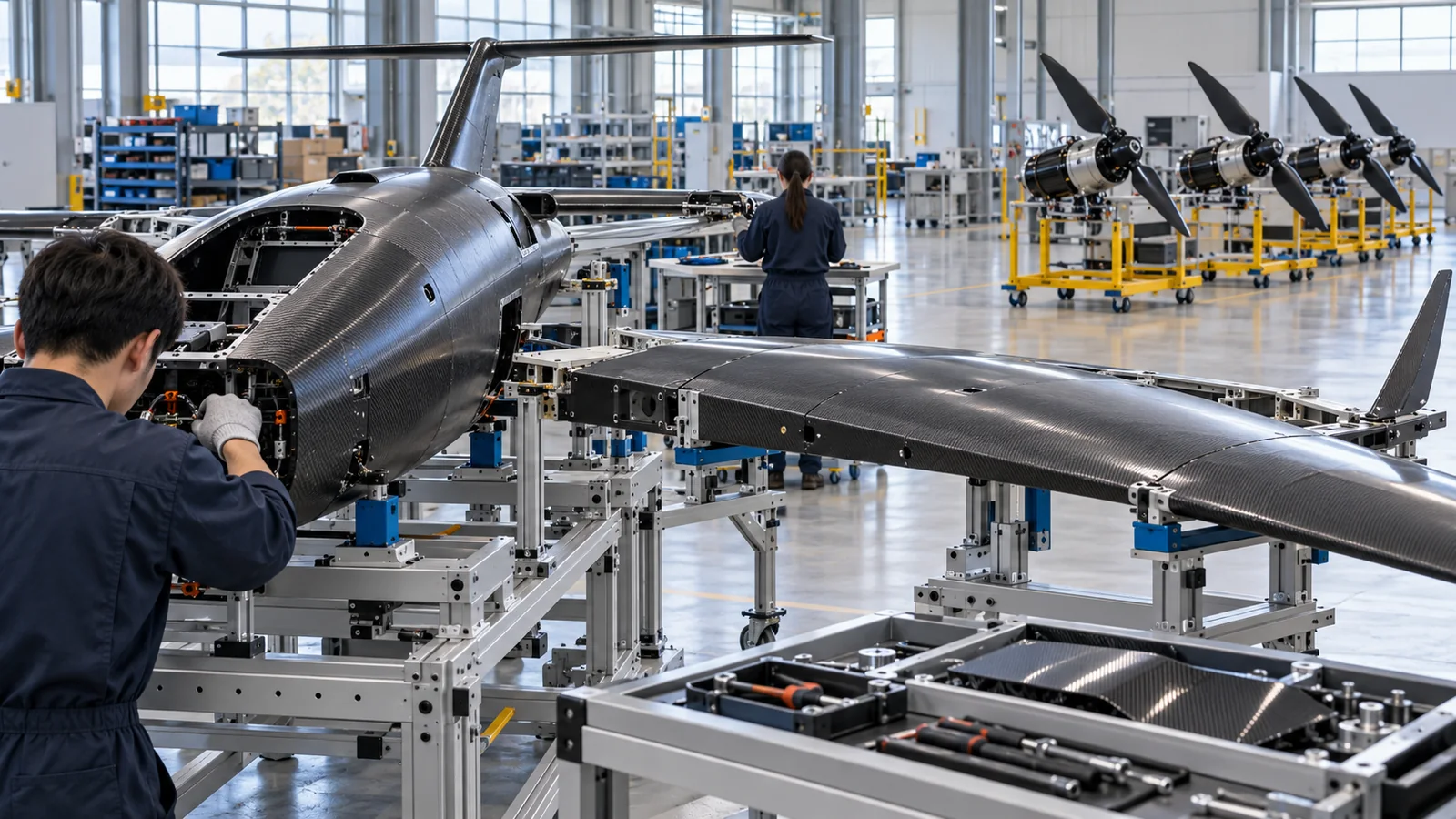
Joby’s airframe is a carbon-fibre composite (FAA). Carbon-fibre prepreg is carbon-fibre cloth pre-soaked in resin; layers are stacked and cured with heat into a panel that is light and strong. Toray is the supplier under a long-term agreement from 2020 (company announcement), and the company says it has started making propeller blades in Ohio. The 10-K also says carbon-fibre scrap is recycled into inputs for high-strength steel.
The other key is the batteries and motors. The aircraft carries four separate batteries and the motors are the company’s own design. Toyota signed a 2023 agreement to supply powertrain and actuation components, but payments to Toyota for parts and materials in the first half of 2026 were only US$1.3 million (10-Q), so large-scale component supply is still ahead. The battery chemistry (cathode and anode materials) and the type of magnets in the motors are not stated in the filings and could not be confirmed. See also our explainers on power sources for robots and drones, lithium-ion battery basics, and permanent magnets and rare earths.
11. Risks the company faces
| Risk | Details | Type |
|---|---|---|
| No type certificate yet | Not held; changes in rules or in what the FAA requires could push the schedule out (10-K). The company does not give a completion date for the fifth stage | Sourced |
| What the revenue is, and losses | Revenue is mainly Blade; there is no eVTOL passenger revenue. FY2025 net loss was US$930 million | Sourced |
| Production ramp-up | Pre-certification factory stage, with some single-source suppliers (10-K). Toyota’s second investment is conditional | Sourced |
| Dispute with a competitor | Joby sued Archer in November 2025 over alleged trade-secret misappropriation and related claims. Archer filed a patent complaint with the U.S. International Trade Commission in March 2026 (Joby’s 10-Q says 10 March, Archer’s says 9 March). The cases are pending; this article does not judge either side | Sourced |
| Integrating acquisitions | After Blade, an unclosed purchase of Resonant. Closing needs regulatory approvals; the long-stop date is 8 February 2027 (extendable) | Sourced / Not yet confirmed |
| Accidents and safety | The 10-K says accidents in the industry, even not involving its aircraft, could affect certification and demand | Sourced |
| eIPP is temporary | eIPP lets aircraft try limited operations before type certification; it is not a permanent approval | Inference |
12. Glossary
- eVTOL
- Electric vertical take-off and landing aircraft: takes off vertically like a helicopter and flies on wings like an airplane.
- Type certificate (TC)
- The FAA’s finding that an aircraft design meets safety standards. Separate from inspecting each individual aircraft.
- Production certificate (PC)
- Approval that an organization and its facilities can build aircraft that match the approved design.
- TIA (Type Inspection Authorization)
- An FAA permission, late in type certification, to carry out tests and inspections with FAA witnesses.
- Conforming aircraft
- A test aircraft built to the approved design and checked by the FAA.
- G-1
- The issue paper that fixes the certification basis, meaning which rules must be met.
- Means of compliance
- The agreed tests and analyses used to show that a safety rule is met.
- Powered-lift
- An aircraft that changes the direction of its propellers or similar to fly like both a helicopter and an airplane (an FAA category).
- Special class
- A way to type-certify an aircraft with no existing standards by writing airworthiness criteria for it.
- SFAR
- Special Federal Aviation Regulation. The powered-lift SFAR covers pilots and operations for ten years.
- Part 135
- The FAA rule set (14 CFR Part 135) for on-demand air-carrier operations.
- eIPP
- eVTOL Integration Pilot Program: a U.S. scheme letting aircraft try limited operations before type certification.
- VFR
- Visual flight rules: flying in weather where the pilot can see.
- dBA
- A noise unit weighted to how the human ear hears.
- Carbon-fibre prepreg
- Carbon-fibre cloth pre-soaked in resin; stacked and cured with heat.
- Joint venture (JV)
- A company two firms set up together. JTAMPC is Joby and Toyota’s manufacturing JV.
13. References
- Joby Aviation, Inc. – Form 10-K for the year ended 31 December 2025 (filed with the SEC on 27 February 2026). Business, the five stages of type certification, partners, certificates held, headcount, patents, financial figures, the Blade acquisition. https://www.sec.gov/Archives/edgar/data/1819848/000181984826000160/joby-20251231.htm
- Joby Aviation, Inc. – Form 10-Q for the quarter ended 30 June 2026 (filed 6 August 2026). First-half revenue, R&D, net loss and operating cash flow; cash; the February 2026 financing; Toyota-related transactions; the certification progress statement (about 75% of the fourth stage); the litigation with Archer. https://www.sec.gov/Archives/edgar/data/1819848/000181984826000435/joby-20260630.htm
- Joby Aviation, Inc. – Form 8-K (agreement of 29 June 2026, filed 30 June 2026). The Toyota manufacturing joint venture JTAMPC (Joby 49%, Toyota 51%), board composition, conditions for Toyota’s second investment. https://www.sec.gov/Archives/edgar/data/1819848/000181984826000378/joby-20260629.htm
- Joby Aviation, Inc. – Form 8-K (agreement of 8 August 2026, filed 11 August 2026). Agreement to buy Strix Holdings (parent of Resonant Sciences), US$500 million base price, closing conditions, a US$750 million at-the-market sales agreement. https://www.sec.gov/Archives/edgar/data/1819848/000162828026055505/joby-20260808.htm
- Joby Aviation, Inc. – Exhibit 99.1 to that 8-K: press release of 11 August 2026 announcing the Resonant Sciences acquisition and the plan to make it the dedicated defense business after closing. https://www.sec.gov/Archives/edgar/data/1819848/000162828026055505/exhibit991-8xk.htm
- Joby Aviation, Inc. – Q2 2026 shareholder letter (Exhibit 99.2 to the Form 8-K of 5 August 2026). Type-certification progress (as of 31 July 2026), five aircraft flying and twelve in production, eIPP, Virgin Atlantic, Atoms, Blade figures. https://www.sec.gov/Archives/edgar/data/1819848/000181984826000432/joby-8kx20260805xexx99_2.htm
- Joby Aviation, Inc. – Press release “Joby Reports Second Quarter 2026 Financial Results” (5 August 2026). Full-year 2026 revenue outlook (US$115-125 million) and the second-half cash-use outlook. https://www.jobyaviation.com/news/joby-reports-second-quarter-2026-financial-results
- Joby Aviation, Inc. – Press release “Joby’s first FAA-conforming aircraft takes flight” (11 March 2026). First flight of a TIA test aircraft; FAA pilots expected later in 2026; Dayton plans. https://www.jobyaviation.com/news/joby-s-first-faa-conforming-aircraft-takes-flight
- Joby Aviation, Inc. – Press release “Joby to Begin U.S. Operations in 2026 Under White House Air Taxi Program” (9 March 2026). The states in which Joby takes part in selected eIPP projects. https://www.jobyaviation.com/news/joby-to-begin-u-s-operations-in-2026-under-white-house-air-taxi-program
- Joby Aviation, Inc. – Press release “Joby Launches eIPP Flights in Texas” (10 September 2026). First eIPP flights (10-14 September), comments by the FAA Administrator and Transportation Secretary, and the statement that Joby is advancing through the fifth and final stage. https://www.jobyaviation.com/news/joby-launches-eipp-flights-in-texas
- Joby Aviation, Inc. – Press release “Joby Completes First-Ever Fully Autonomous Flight Across the United States” (18 September 2026). A Cessna Caravan with Joby’s autonomy system flew 3,199 miles; conditions of remote supervision. https://www.jobyaviation.com/news/joby-completes-first-ever-fully-autonomous-flight-across-the-united-states
- Joby Aviation, Inc. – Press release “Dubai Air Taxi Network Takes Flight” (17 November 2025). The first piloted point-to-point flight in the UAE (9 November), the six-year exclusive agreement with Dubai’s RTA, vertiport plans. https://www.jobyaviation.com/news/dubai-air-taxi-network-takes-flight-joby-completes-landmark-flight-and-announces-next-vertiport
- Joby Aviation, Inc. – Announcement “Toray Advanced Composites and Joby Aviation Finalize a Long-Term Supply Agreement” (7 December 2020). Long-term supply of carbon-fibre prepreg. https://www.jobyaviation.com/news/toray-advanced-composites-and-joby-aviation-finalize-a-long-term-supply-agreement
- Federal Aviation Administration (FAA) – Federal Register document 2024-04690, “Airworthiness Criteria: Special Class Airworthiness Criteria for the Joby Aero, Inc. Model JAS4-1 Powered-Lift” (89 FR 17230, published 8 March 2024, effective 8 April 2024). Description of the aircraft (maximum takeoff weight 4,800 lb, pilot plus four passengers, six tilting electric engines) and the application date (2 November 2018). https://www.federalregister.gov/documents/2024/03/08/2024-04690/airworthiness-criteria-special-class-airworthiness-criteria-for-the-joby-aero-inc-model-jas4-1
- Federal Aviation Administration (FAA) – Federal Register document 2024-24886, “Integration of Powered-Lift: Pilot Certification and Operations; Miscellaneous Amendments Related to Rotorcraft and Airplanes” (89 FR 92296, published 21 November 2024, effective 21 January 2025). Final rule and a ten-year Special Federal Aviation Regulation (SFAR) for powered-lift pilots and operations. https://www.federalregister.gov/documents/2024/11/21/2024-24886/integration-of-powered-lift-pilot-certification-and-operations-miscellaneous-amendments-related-to
- Federal Aviation Administration (FAA) – FAA Order 8110.4C, “Type Certification” (26 October 2005). The five phases of the type-certification process (conceptual design, requirements definition, compliance planning, implementation, post-certification activities), the role of the TIA, and special classes of aircraft. https://www.faa.gov/sites/faa.gov/files/2022-10/Order8110-4C.pdf
- U.S. Department of Transportation (DOT) – Announcement “Transportation Secretary Sean P. Duffy Unleashes Innovation, Taps Eight Programs to Test Next-Gen Aircraft in America’s Skies” (10 March 2026). Selection of eight eIPP proposals across 26 states. https://www.transportation.gov/briefing-room/driving-news-transportation-secretary-sean-p-duffy-unleashes-innovation-taps-eight
- Joby Aviation, Inc. – Company website (source of the name and logo image; the logo is the image named in the site’s organization data, https://www.jobyaviation.com/images/logo.png). https://www.jobyaviation.com/
14. Claim-to-source audit
| Claim in the text | Type | Source |
|---|---|---|
| Company name, headquarters, 2,559 employees, patents (over 330 issued or allowed, over 250 pending), manufacturing sites | Sourced | Reference 1 https://www.sec.gov/Archives/edgar/data/1819848/000181984826000160/joby-20251231.htm |
| Aircraft: maximum takeoff weight 4,800 lb, pilot plus four passengers, six tilting electric engines, composites, VFR, application date 2 November 2018 | Sourced | Reference 14 Official FAA document https://www.federalregister.gov/documents/2024/03/08/2024-04690/airworthiness-criteria-special-class-airworthiness-criteria-for-the-joby-aero-inc-model-jas4-1 |
| Top speed about 200 mph, range about 100 miles, noise around 65 dBA (company targets and claims) | Sourced | Reference 1 Company-stated targets; not achieved values https://www.sec.gov/Archives/edgar/data/1819848/000181984826000160/joby-20251231.htm |
| The five type-certification stages (company definition) and the split into “definition” (1-3) and “implementation” (4-5) | Sourced | Reference 1 Company definition https://www.sec.gov/Archives/edgar/data/1819848/000181984826000160/joby-20251231.htm |
| The five phases of FAA Order 8110.4C, the role of the TIA, and that powered-lift needs individual airworthiness standards | Sourced | Reference 16 https://www.faa.gov/sites/faa.gov/files/2022-10/Order8110-4C.pdf |
| Progress at 31 July 2026: stage 1 100%, stage 2 97%, stage 3 100%, stage 4 Joby 83% / FAA 77%, stage 5 20% / 10% | Sourced | Reference 6 Company tally https://www.sec.gov/Archives/edgar/data/1819848/000181984826000432/joby-8kx20260805xexx99_2.htm |
| The 10-Q’s “about 75% of the fourth stage”; the type certificate is not held (in progress) | Sourced | Reference 2 https://www.sec.gov/Archives/edgar/data/1819848/000181984826000435/joby-20260630.htm |
| First flight of a conforming aircraft (11 March 2026); FAA pilots’ tests expected in late 2026 | Sourced | Reference 8 The timing is a company plan https://www.jobyaviation.com/news/joby-s-first-faa-conforming-aircraft-takes-flight |
| When FAA pilots run tests, when the first passengers fly, when Dubai launches | Not yet confirmed | Reference 8, 6, 12 Company and RTA plans, not achieved facts https://www.jobyaviation.com/news/joby-s-first-faa-conforming-aircraft-takes-flight https://www.sec.gov/Archives/edgar/data/1819848/000181984826000432/joby-8kx20260805xexx99_2.htm https://www.jobyaviation.com/news/dubai-air-taxi-network-takes-flight-joby-completes-landmark-flight-and-announces-next-vertiport |
| Powered-lift final rule and SFAR (published 21 November 2024, effective 21 January 2025) | Sourced | Reference 15 https://www.federalregister.gov/documents/2024/11/21/2024-24886/integration-of-powered-lift-pilot-certification-and-operations-miscellaneous-amendments-related-to |
| Selection of eight eIPP proposals (9 March 2026) and the states Joby takes part in | Sourced | Reference 17, 9 The company release lists 10 states and the shareholder letter says 11 https://www.transportation.gov/briefing-room/driving-news-transportation-secretary-sean-p-duffy-unleashes-innovation-taps-eight https://www.jobyaviation.com/news/joby-to-begin-u-s-operations-in-2026-under-white-house-air-taxi-program |
| First eIPP flights in Texas (from 10 September 2026) | Sourced | Reference 10 https://www.jobyaviation.com/news/joby-launches-eipp-flights-in-texas |
| Autonomous U.S. crossing (3,199 miles, safety pilot on board, remote supervision) | Sourced | Reference 11 Company claim https://www.jobyaviation.com/news/joby-completes-first-ever-fully-autonomous-flight-across-the-united-states |
| Dubai: first piloted point-to-point flight in the UAE (9 November 2025), six-year exclusive agreement | Sourced | Reference 12 Company and RTA statements https://www.jobyaviation.com/news/dubai-air-taxi-network-takes-flight-joby-completes-landmark-flight-and-announces-next-vertiport |
| Revenue, R&D, net loss and operating cash flow (FY2023-FY2025) | Sourced | Reference 1 https://www.sec.gov/Archives/edgar/data/1819848/000181984826000160/joby-20251231.htm |
| First-half 2026 revenue, R&D, net loss and cash outflow; cash US$636.1 million plus investments US$1,634.0 million; accumulated deficit US$3,141 million | Sourced | Reference 2 https://www.sec.gov/Archives/edgar/data/1819848/000181984826000435/joby-20260630.htm |
| Cash plus investments of about US$2.27 billion; Blade about 94% of Q2 revenue | Our calculation | Reference 2, 6 Computed here from figures in the 10-Q and the shareholder letter https://www.sec.gov/Archives/edgar/data/1819848/000181984826000435/joby-20260630.htm https://www.sec.gov/Archives/edgar/data/1819848/000181984826000432/joby-8kx20260805xexx99_2.htm |
| 2026 revenue outlook of US$115-125 million; second-half cash decline of US$385-415 million | Not yet confirmed | Reference 7 Company outlook https://www.jobyaviation.com/news/joby-reports-second-quarter-2026-financial-results |
| February 2026 financing (share offering net US$576.3 million; convertible notes net US$669.7 million); Delta warrants US$70 million | Sourced | Reference 2 https://www.sec.gov/Archives/edgar/data/1819848/000181984826000435/joby-20260630.htm |
| US$750 million at-the-market agreement (11 August 2026); Resonant Sciences agreement (US$500 million base, conditions, 8 February 2027 long-stop date) | Sourced | Reference 4 https://www.sec.gov/Archives/edgar/data/1819848/000162828026055505/joby-20260808.htm |
| Plan to make Resonant the dedicated defense business after closing | Sourced | Reference 5 Company plan before closing https://www.sec.gov/Archives/edgar/data/1819848/000162828026055505/exhibit991-8xk.htm |
| Toyota: about US$650 million invested, US$250 million in May 2025, the JTAMPC joint venture (49/51), conditions for the second investment | Sourced | Reference 1, 3 https://www.sec.gov/Archives/edgar/data/1819848/000181984826000160/joby-20251231.htm https://www.sec.gov/Archives/edgar/data/1819848/000181984826000378/joby-20260629.htm |
| Payments to Toyota for parts and materials of US$1.3 million in the first half of 2026 | Sourced | Reference 2 https://www.sec.gov/Archives/edgar/data/1819848/000181984826000435/joby-20260630.htm |
| Blade acquired (29 August 2025, about US$92.4 million); Parts 135, 145 and 141; ties with Uber and Delta | Sourced | Reference 1 https://www.sec.gov/Archives/edgar/data/1819848/000181984826000160/joby-20251231.htm |
| Five aircraft flying, twelve in production; Virgin Atlantic; Atoms; Blade Q2 revenue US$36.2 million | Sourced | Reference 6 Company statements https://www.sec.gov/Archives/edgar/data/1819848/000181984826000432/joby-8kx20260805xexx99_2.htm |
| Long-term carbon-fibre prepreg supply agreement with Toray (December 2020) | Sourced | Reference 13 https://www.jobyaviation.com/news/toray-advanced-composites-and-joby-aviation-finalize-a-long-term-supply-agreement |
| Litigation with Archer (Joby’s suit, Archer’s ITC complaint, the date difference) | Sourced | Reference 2 As described in the 10-Q; neither side is assessed https://www.sec.gov/Archives/edgar/data/1819848/000181984826000435/joby-20260630.htm |
| Not using the market-size estimate quoted in the 10-K (Morgan Stanley) | Our calculation | Our policy in this article: no analyst estimates |
| The four company types; the grouping of the two “five-step” counts; the three meanings of “stage” | Our calculation | Our own grouping in this article |
| The reading that eIPP is a way to build a flight record and trust before type certification | Inference | Reference 6, 10 Our interpretation https://www.sec.gov/Archives/edgar/data/1819848/000181984826000432/joby-8kx20260805xexx99_2.htm https://www.jobyaviation.com/news/joby-launches-eipp-flights-in-texas |
| Reading the gap between the two progress numbers as submitted versus accepted | Inference | Reference 6, 2 The company gives no definition https://www.sec.gov/Archives/edgar/data/1819848/000181984826000432/joby-8kx20260805xexx99_2.htm https://www.sec.gov/Archives/edgar/data/1819848/000181984826000435/joby-20260630.htm |
| The reading that autonomy is meant to extend to cargo, military and later civil aircraft | Inference | Reference 11 Our interpretation https://www.jobyaviation.com/news/joby-completes-first-ever-fully-autonomous-flight-across-the-united-states |
| The risk that eIPP is not a permanent approval | Inference | Reference 17 Our interpretation https://www.transportation.gov/briefing-room/driving-news-transportation-secretary-sean-p-duffy-unleashes-innovation-taps-eight |
| What the “stage” in “stage 4 G-1” counts; battery chemistry and motor magnet type | Not yet confirmed | Not stated in the 10-K, the 10-Q or the FAA order; this article does not guess. https://www.sec.gov/Archives/edgar/data/1819848/000181984826000160/joby-20251231.htm |
Last updated: 25 October 2026 / Troy Technical
The figures in this article come from filings by Joby Aviation, Inc. with the U.S. Securities and Exchange Commission, official FAA and U.S. DOT documents, and company announcements. It uses no analyst estimates or press-only figures (the market-size estimate quoted in the 10-K is not used either). Items marked “Inference” are our interpretation of primary sources, not statements by the company. This article does not discuss share price, valuation or investment decisions, and is not legal advice.