COMPANY PROFILE / DRONES AND ROBOTICS
Skild AI
– A company that champions "one brain for any robot" and grows it with data from customer sites
Robot companies split broadly into those that build the body (arms, legs) and those that build the brain (AI). Skild AI is on the brain side. Its central idea is being "omni-bodied": one model that drives robots with different body shapes, such as quadrupeds, humanoids, tabletop arms and mobile manipulators. In 2026 it also bought a warehouse autonomous-mobile-robot business, a move to put its model into more customer sites. This article sorts out what it builds, with whom it works, and how far deployment has gone according to the company, using only its official blog and filings with the U.S. SEC as evidence.
- Skild AI in 30 seconds, and where it sits in drones and robotics
- Logo and naming
- Where the company sits in the field
- Scale of the company
- Resources behind its robot work (people, money, investments, acquisitions, university ties, model status)
- Track record so far
- Plans
- What the company seems to be aiming for
- Partnership map
- Technologies, products and services
- Risks the company faces
- Glossary / References / Claim-to-source audit
1. Skild AI in 30 seconds, and where it sits in drones and robotics
USA (California, Pennsylvania)Opened a base in Bengaluru, India, in February 2026
Secondary: Components & enabling softwareAlso bought a robot business (autonomous mobile robots) in March 2026
Series C $1.4BAnnounced July 2024 and January 2026
What sets Skild AI apart is that it puts "deploy, and train the model on the data from the field" at the center of its approach Sourced. Its blog post "The Hidden Pillar of Robotics" argues that demo videos alone cannot show real capability and that deployment is the pillar of both research and evaluation. Following that approach, the company is widening the places its model runs through two routes: integration into robot makers’ products (ABB, Universal Robots) and acquisition of a warehouse robot business. Throughout this article we keep company claims apart from facts that a third party can check, such as filings with the U.S. SEC.
2. Logo and naming

Naming note: the company name is Skild AI (spelled "Skild", not "Skill"). The image shown is the icon the company publishes on its official site (an S-shaped brand mark, icon.svg). The original file switches to white in a dark colour scheme, which would vanish on this article’s white background, so the copy used here omits only that rule (the shape itself is unchanged). We could not obtain a text logo (wordmark) from the official site. The Zebra Technologies warehouse robot business (formerly Fetch Robotics) is a separate operation that Skild AI bought in March 2026; we name it separately from the original company. The model names are Skild Brain and S1.
Official site: https://www.skild.ai/3. Where the company sits in the field
Skild AI’s main type is the far-left "Humanoids & physical AI", but it is not a company that builds and sells humanoid robots. Physical AI means AI that handles real objects, not only things on a screen. It builds the AI model that acts as a robot’s "brain" and aims to have other robot makers run it (the far-right "Components & enabling software" role). Since it bought Zebra’s warehouse robot business in March 2026, it also has some traits of "Industrial & specialist robots" Our calculation.
4. Scale of the company
Because it is privately held, Skild AI has no duty to disclose revenue or headcount. We separate the figures the company stated on its blog from the items we could not confirm Sourced.
| Item | Content | Type |
|---|---|---|
| Founded | 2023 (Series A post). It came out of stealth and went public on 9 July 2024 | Sourced |
| Bases | Teams in California and Pennsylvania; a Bengaluru base opened on 19 February 2026 | Sourced |
| Headcount | Not disclosed (no figure in official materials) | Sourced |
| Revenue (company’s account) | "From zero to about $30M in just a few months" in 2025 (Series C post). On 10 September 2026 it stated annual recurring revenue (ARR) above $100M, of which $50M had been recognized | Sourced (company claim) |
| Customers | More than 60 paying customers ten months after the first deployment (company’s account) | Sourced (company claim) |
| Revenue mix | About 10% mobility (of which autonomous mobile robots are 4%) and the remaining ~90% mainly manipulation tasks (company’s account) | Sourced (company claim) |
ARR (annual recurring revenue) is a metric the company defines; it is not audited revenue. Companies calculate it differently, for example by annualizing current monthly contracts, and the blog does not give its method. "$50M recognized" is also the company’s statement; audited financial statements are not public. This article records these only as company claims and makes no judgement on the value or prospects of the business. It also leaves out the company’s valuation, since that bears on investment decisions.
5. Resources behind its robot work
We sort four resource types (people, money, outside investments and acquisitions, and ties to universities or public bodies) by whether primary sources let us confirm them. "Not mentioned" is itself a finding.
| Resource | Content | Type |
|---|---|---|
| People | Bases in two U.S. states and India. It is recruiting robotics engineers, AI scientists and systems engineers (Bengaluru post). Headcount is not disclosed | Sourced |
| Money | Series A $300M (July 2024, led by Lightspeed, Coatue, SoftBank and Bezos Expeditions). Series C $1.4B (January 2026, led by SoftBank, with NVentures (NVIDIA), Macquarie Capital and Bezos Expeditions; LG, Schneider Electric, CommonSpirit, Salesforce Ventures and others joined). The company says the money goes to more data sources, core research and more deployments. R&D spending and capital expenditure are not disclosed | Sourced (company announcement) |
| Outside investments, acquisitions, joint ventures | Acquired Zebra Technologies’ robotics automation business (completed 27 March 2026, per Zebra’s 10-Q). Zebra received total consideration of $20M ($9M cash, a minority stake in Skild AI with a fair value of $9M, and $2M in escrow) | Sourced (SEC filing) |
| Universities, research institutes, public bodies | Carnegie Mellon University is named among the Series A participants (company announcement), and the company has a team in Pennsylvania. No research agreements and no participation in public-agency programs (NASA, DARPA, NSF and the like) are mentioned in official materials | Sourced (as an investor) / Not confirmed (research agreements) |
| Compute and training stack | The company says S1 was "built on NVIDIA AI infrastructure" and that it uses NVIDIA Isaac Lab and Isaac Sim for simulation and Cosmos for synthetic data | Sourced (company’s account) |
Status of the main models and products (checked 25 October 2026)
| Name | Kind | Main specifications (company’s account) | Use and operating record | Regulatory approval | Stage and date |
|---|---|---|---|---|---|
| Skild Brain | Robot foundation model | Two levels: a low-frequency high-level policy and a high-frequency low-level policy. Says it drives quadrupeds, humanoids, tabletop arms and mobile manipulators without being told the body shape in advance. Pre-trained on simulation and human video, then post-trained on field data | Says it is deployed in security, construction, delivery, data centers, warehouses and factory assembly (Series C post) | Not applicable (software; no approval mentioned) | Announced; 29 July 2025 (first technical post) |
| Vision-based locomotion | Humanoid walking model | From camera images and joint feedback, says it climbs stairs and steps over obstacles with no map | Outdoor tests in streets, parks and fire escapes (company videos) | Not applicable | Research release; 6 August 2025 |
| S1 | Robot foundation model (video prompt) | Executes a task from a demonstration video (in-context learning). Says it runs unseen tasks of up to about 10 minutes without updating weights. Success rates against pre-training scale are internal evaluations (Chapter 10) | The company says it is already at work with commercial partners. No third-party replication found | Not applicable | Announced; 18 August 2026 (first of a series of technical posts) |
| Physical Self-Play | Post-training research result | Learns soccer by playing against itself in simulation. After about 140 simulated years it was moved onto a humanoid robot for a match, the company says | Research stage; no deployment mentioned | Not applicable | Research release; 23 September 2026 |
| Warehouse autonomous mobile robots and orchestration | Robot products (acquired business) | Zebra’s robotics business (formerly Fetch Robotics) and Symmetry Fulfillment, which coordinates robots and workers. No numeric specifications in the company’s post | About 4% of revenue comes from autonomous mobile robots (company’s account) | Not confirmed | Acquisition completed 27 March 2026; announced 15 April 2026 |
| Assembly line for Foxconn | Deployment | On a production line for NVIDIA Blackwell systems, two arms place a busbar and a limit block and drive 16 screws (company video) | The March 2026 post says it "will ship"; the September 2026 post says it is deploying. No unit count or hours given | Not applicable | Deployment; as stated on 10 September 2026 (company claim) |
The figures in this table are results the company obtained on its own tasks and in its own settings, or the company’s own account. Conditions differ by row, so the numbers cannot be lined up to rank anything. For deployment and demonstration claims, whether the work was autonomous or remotely operated, the unit counts and operating hours, and any independent verification could not be confirmed on the official blog.
Skild AI’s blog says little about materials as such. But the idea of absorbing differences in the body (hardware) in the model bears on how materials and parts are chosen Sourced. The company built 100,000 different robots in simulation and trained the model on them, then showed it keeps working in tests such as shortening a leg to imitate damage or jamming a motor. In the blog’s example, a robot with a shortened leg changes its gait and starts walking after about 7 to 8 seconds. From a materials standpoint, one reading is that control software can absorb part of the change in the machine when parts wear or break. The Foxconn example, meanwhile, is the precise assembly of hard parts: a busbar (a conductive metal bar), a limit block and screws. That is the opposite in material character to the soft clothing in our Physical Intelligence profile.
How material choices affect performance cannot be confirmed from the company’s materials. The reading above is our own interpretation Not yet confirmed.
6. Track record so far
| When | What happened | Meaning |
|---|---|---|
| 2023 | Skild AI founded | Work on a robot foundation model begins |
| 9 Jul 2024 | Series A of $300M announced; leaves stealth | First large funding made public |
| 29 Jul 2025 | Skild Brain introduced (high-level and low-level policies) | The omni-bodied idea made public |
| 6 Aug 2025 | Vision-only stair-climbing locomotion model published | Humanoid walking outdoors |
| 24 Sep 2025 | A brain trained on 100,000 robots introduced | Explains how it works across different bodies |
| During 2025 | The company says revenue went from zero to about $30M in a few months (Series C post) | Start of deployments; company claim |
| 12 Jan 2026 | Method for learning a new task by watching human video announced (under 1 hour of robot data) | A response to scarce data |
| 14 Jan 2026 | Series C of $1.4B announced | Money to go into deployment and data |
| 19 Feb 2026 | Bengaluru base opened | First base outside the U.S. |
| 19 Mar 2026 | Partnerships with ABB Robotics and Universal Robots (including MiR), and an assembly-line example with NVIDIA and Foxconn | Aiming to spread through robot makers |
| 27 Mar 2026 | Sale of Zebra’s robotics automation business completed (Zebra’s 10-Q). Skild AI announced it on 15 April | A transaction a third party’s filing confirms |
| 18 Aug 2026 | S1 announced (video prompting) | Says a new task can be taught in minutes |
| 10 Sep 2026 | Announced ARR above $100M and more than 60 paying customers | Company claim; explains a deployment-first approach |
| 23 Sep 2026 | Post-training by self-play (soccer) announced | Research aimed at going beyond human data |
These dates are blog publication dates and the completion date of the transaction in Zebra’s filing. The blog’s content is the company’s own account, not independent third-party verification (only the fact of the Zebra sale is stated by a third party, in an SEC filing).
7. Plans
to the homeDescribed as factories, then hospitals and hotels, then homes
In its March 2026 post the company describes a catch-22, robots need data to improve but only capable robots can be sent out to gather it, and says it will solve it with a phased approach. It starts with semi-structured settings such as factories, moves to less structured ones such as hospitals and hotels, and finally reaches unstructured settings such as homes Not yet confirmed. The ABB and Universal Robots partnerships are described as aiming to integrate the Skild Brain into their robot portfolios; the blog does not say that a finished, integrated product has shipped Not yet confirmed. The Physical Self-Play post also says the next release will cover behaviour in larger teams Not yet confirmed.
None of the following appears in official materials Not yet confirmed.
How Skild Brain or S1 will be offered externally (API or license) and at what price / the launch date of integrated ABB or Universal Robots products / Foxconn’s unit count and hours / the timing of home use / specifications and unit counts of the business bought from Zebra / the method behind ARR. We do not use press-reported figures such as "how many by when".
8. What the company seems to be aiming for
This chapter includes points the company does not state directly. They are inferences that stay within what primary sources allow, given with their grounds.
| What can be read | Primary-source basis | Type |
|---|---|---|
| The goal is a common "brain" that drives a robot of any body | The official site and blog repeat "any robot, any task, one brain" and give quadruped, humanoid, tabletop-arm and mobile examples | Sourced (company’s account) |
| It wants its model to become a standard component in robot makers’ products | The stated purpose of the ABB Robotics, Universal Robots and MiR partnerships is integration into each maker’s portfolio | Inference |
| Buying the warehouse robot business is also a way to add customer sites and data | The Zebra post says it will accelerate the data flywheel and bring in more diverse data. Completion of the sale is confirmed in Zebra’s 10-Q | Inference (the acquisition itself is sourced) |
| It puts deployment results ahead of demo polish | The "Hidden Pillar" post says demo videos cannot show differences in success rate and makes deployment the pillar of evaluation | Sourced (company’s view) |
| S1 aims to cut the effort of adapting to change | The same post names the problem that every change in parts, layout or procedure needs new data and retraining, and presents S1 as the answer | Inference |
The reading that "it wants to be a standard component in robot makers’ products" rests on how the 19 March 2026 post is built. The company names ABB and Universal Robots, firms that already ship many robots, and says that embedding the Skild Brain’s shared intelligence layer in their portfolios lets automation spread without task-specific code Sourced. Its argument then is that the problem of robots needing data to improve while only capable robots can gather it is solved by large-scale deployment through those makers. From this we read that the company may make riding on other firms’ robots, not building and selling many robots itself, its main route. Yet buying Zebra’s business is a different route: owning a robot business. The balance between the two cannot be confirmed from official materials Not yet confirmed.
9. Partnership map
| Counterparty | Relationship (as stated in official materials) | Note |
|---|---|---|
| ABB Robotics | A partnership aiming to integrate the Skild Brain into its robot portfolio (19 March 2026). Its president said integration should help customers scale industrial automation faster | No shipped integrated product found; the stage is "aim" |
| Universal Robots (Teradyne Robotics), MiR | A partnership aiming to integrate into cobots and other portfolios. Universal Robots’ head (titled CEO in Skild AI’s post) said he wants to handle more variable tasks | No shipped integrated product found; the stage is "aim" |
| NVIDIA | Uses Isaac Lab, Isaac Sim and Cosmos in pre-training. S1 was built on NVIDIA AI infrastructure. NVIDIA’s investment arm (NVentures) took part in the Series C | Two relationships at once: supplier and investor |
| Foxconn | With NVIDIA, a deployment of two-armed assembly on a Blackwell-system production line | Company claim; no unit count or hours given |
| Mitsui & Co., Sumitomo Wiring Systems | A pilot of general-purpose robots in commercial kitchens with Mitsui & Co.; work toward automating wire-harness manufacturing with Sumitomo Wiring Systems (S1) | Neither is stated as deployed |
| Zebra Technologies | Sold its robotics automation business to Skild AI (completed 27 March 2026). Zebra received cash and a minority stake in Skild AI (10-Q) | A third party’s statement in an SEC filing |
10. Technologies, products and services
Skild AI’s "product" is the model that drives robots (Skild Brain, S1) and the applications built on it. The official site lists three applications: security and inspection robots, a mobile manipulation platform, and autonomous packing Sourced.
S1: teach a task by showing a video
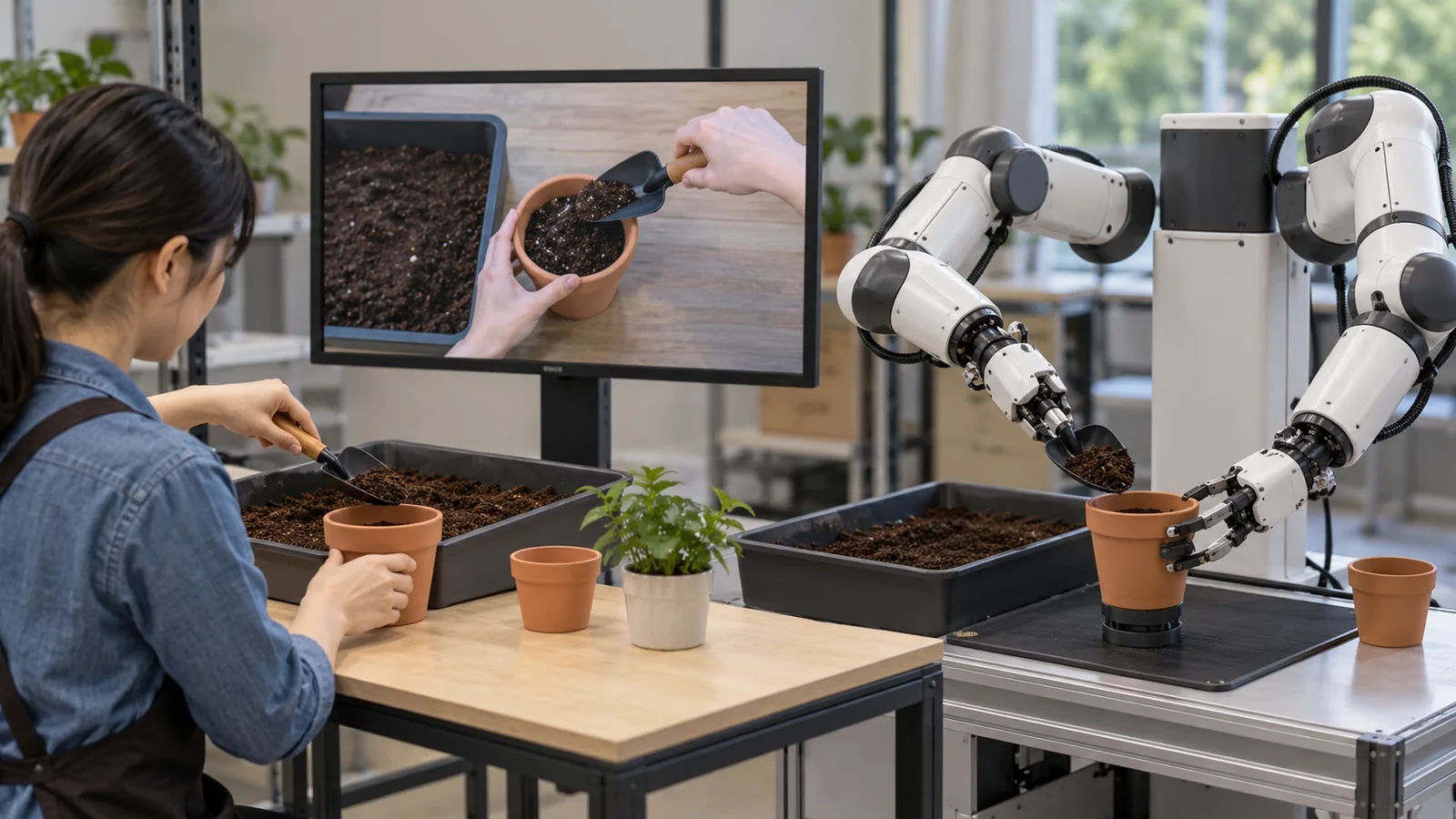
Conventional robot learning needed new data from teleoperation and a fresh round of tuning for every new task. The company says S1 takes a video of the task as the "prompt" (in-context learning) and executes a new task without updating its weights. It is similar to how a large language model follows a new format after being shown an example.
| Item | Company’s account | What to keep in mind |
|---|---|---|
| Unseen tasks (100k hours of pre-training) | 66% for video prompting, 9% for language prompting | Internal benchmark; long tasks of 4 to 8 minutes; no third-party replication found |
| Seen tasks (1k hours of pre-training) | 53% for language prompting, 43% for video prompting | The company itself notes the language side is higher with little data |
| With more pre-training | Video prompting reached about 96% on seen tasks, it says | No figure given for the comparison side |
| Cost of teaching a new task | One in-context video is worth roughly 380 post-training teleoperation demonstrations (collecting that many takes 50 to 100 hours) | An interpolated estimate; with 2,000 post-training demonstrations the company reports 86% |
| Plant repotting | 11 minutes from the demonstration to autonomous execution | One example from the company’s own experiment |
The S1 evaluation counts success with a person stepping in to continue after a failure (the post says the intervention was mostly used for the comparison side). The 66% on unseen tasks is also an average of cumulative per-step success, so it means part of the work was not achieved. The company itself writes in another post that a demo clip from a robot with 5%, 10% or 99% accuracy can look the same, and that demo videos alone do not show real capability. It also says that on a factory line both speed and accuracy count, and that a robot that is 99.9% accurate but ten times too slow is not deployable. Read S1’s numbers as a research milestone, not as an operating rate in the field.
11. Risks the company faces
| Risk | Content | Type |
|---|---|---|
| Evaluation and revenue are the company’s own account | S1’s success rates are internal benchmarks, and ARR and customer counts are company announcements. No audited financials or third-party verification are public | Sourced |
| Stage of integration and deployment | The ABB and Universal Robots partnerships are at the "aim to integrate" stage; Sumitomo Wiring Systems and Mitsui & Co. are described as working toward it or piloting. No shipped product is mentioned | Sourced |
| Integrating the acquired business | It must run Zebra’s warehouse robot business and embed its AI model at the same time. No specifications, unit counts or customer counts are given | Inference |
| Dependence on one compute platform | S1 was trained on NVIDIA AI infrastructure, and NVIDIA is also an investor (company’s statements). Changes in supply or price could affect training cost | Inference |
| Adapting to change in the field | The company itself names the problem that each change in parts, layout or procedure requires retraining. S1 is meant to solve it, but proof is still in progress | Sourced (company’s account) |
| Similar models exist elsewhere | Other companies also build robot foundation models (see our Physical Intelligence and NVIDIA profiles). This article does not rank them | Inference |
12. Glossary
- Omni-bodied
- The idea of one model driving robots with different body shapes (the company’s term).
- Robot foundation model
- An AI for robots trained in advance on large data and then adapted with little data.
- In-context learning (ICL)
- Doing a new task just by adding an example to the input, without changing the model’s weights. For S1 the example is a video.
- Pre-training / post-training
- A broad learning stage, and a stage that tunes the model to a target task.
- VLA
- Vision-language-action model: turns images and a language instruction directly into robot motion.
- Teleoperation
- A person operating a robot remotely and recording the motion as data.
- Simulation
- Trying out robot motion in huge numbers inside a virtual space on a computer.
- Self-play
- Learning by playing against earlier versions of oneself.
- ARR
- Annual recurring revenue: recurring contract revenue converted to a yearly figure, a metric each company defines; not audited revenue.
- OEM
- Original equipment manufacturer; here, a robot maker whose products carry another company’s technology.
- AMR
- Autonomous mobile robot: a wheeled robot that picks its own route to carry goods in places such as warehouses.
- Orchestration
- Software that coordinates and assigns work among many robots and people.
13. References
- Skild AI Official website (home page). The company’s thesis and three applications: security and inspection, mobile manipulation, autonomous packing. https://www.skild.ai/
- Skild AI Official blog index (12 posts, July 2024 to September 2026). https://www.skild.ai/blogs
- Skild AI Introducing S1: In-Context Learning for Robotics (18 August 2026). How S1 works, internal evaluation, evaluation conditions. https://www.skild.ai/blogs/s1
- Skild AI Physical Self-Play (23 September 2026). Post-training by self-play in soccer. https://www.skild.ai/blogs/physical-self-play
- Skild AI The Hidden Pillar of Robotics (10 September 2026). Annual recurring revenue above $100 million, customer count, deployment examples. https://www.skild.ai/blogs/skild-crosses-100m-arr
- Skild AI Skild AI Acquires Zebra Technologies’ Robotics Arm (15 April 2026). https://www.skild.ai/blogs/skild-zebra
- Skild AI The Reindustrial Revolution: Partnering with ABB Robotics, Universal Robots, and NVIDIA (19 March 2026). https://www.skild.ai/blogs/reindustrial-revolution
- Skild AI Skild AI Expands Global Footprint To Bengaluru (19 February 2026). https://www.skild.ai/blogs/bengaluru
- Skild AI Announcing Series C (14 January 2026). Amount raised, main investors, four sources of data. https://www.skild.ai/blogs/series-c
- Skild AI Learning by watching human videos (12 January 2026). https://www.skild.ai/blogs/learning-by-watching
- Skild AI The case for an omni-bodied robot brain (24 September 2025). https://www.skild.ai/blogs/omni-bodied
- Skild AI One Model, Any Scenario: End-to-end Locomotion from Vision (6 August 2025). https://www.skild.ai/blogs/one-policy-all-scenarios
- Skild AI Building the general-purpose robotic brain (29 July 2025). The two-level structure of Skild Brain. https://www.skild.ai/blogs/building-the-general-purpose-robotic-brain
- Skild AI Announcing our $300M Series A Funding (9 July 2024). https://www.skild.ai/blogs/announcing-our-300m-series-a
- Zebra Technologies Form 10-Q for the quarter ended 4 April 2026 (filed with the U.S. SEC on 12 May 2026). Sale of its robotics automation business to Skild AI (completed 27 March 2026) and the consideration received. https://www.sec.gov/Archives/edgar/data/877212/000162828026034109/zbra-20260404.htm
- Zebra Technologies Form 10-Q for the quarter ended 4 July 2026 (filed with the U.S. SEC on 4 August 2026). Net pre-tax gain on the same sale. https://www.sec.gov/Archives/edgar/data/877212/000162828026052550/zbra-20260704.htm
14. Claim-to-source audit
| Claim in the text | Type | Source |
|---|---|---|
| Founding (2023), leaving stealth and the Series A of $300M (9 July 2024), main investors | Sourced | Reference 14 https://www.skild.ai/blogs/announcing-our-300m-series-a |
| Series C of $1.4B (14 January 2026), main investors, four data sources, revenue of about $30M | Sourced | Reference 9 https://www.skild.ai/blogs/series-c |
| Bases (California, Pennsylvania, Bengaluru) | Sourced | Reference 8 https://www.skild.ai/blogs/bengaluru |
| ARR above $100M, $50M recognized, more than 60 paying customers, mobility 10% and AMRs 4% | Sourced | Reference 5 https://www.skild.ai/blogs/skild-crosses-100m-arr |
| Foxconn, Sumitomo Wiring Systems and Mitsui & Co. deployment, work and pilot statements | Sourced | Reference 5 https://www.skild.ai/blogs/skild-crosses-100m-arr Reference 7 https://www.skild.ai/blogs/reindustrial-revolution |
| Partnerships with ABB Robotics, Universal Robots and MiR; NVIDIA cooperation; Foxconn assembly example | Sourced | Reference 7 https://www.skild.ai/blogs/reindustrial-revolution |
| Acquisition of Zebra Technologies’ robotics business (announced 15 April 2026) | Sourced | Reference 6 https://www.skild.ai/blogs/skild-zebra |
| Completion of the Zebra sale (27 March 2026), breakdown of the $20M consideration, minority stake | Sourced | Reference 15 https://www.sec.gov/Archives/edgar/data/877212/000162828026034109/zbra-20260404.htm |
| Net pre-tax gain of $5M and total consideration of $20M (second-quarter 10-Q) | Sourced | Reference 16 https://www.sec.gov/Archives/edgar/data/877212/000162828026052550/zbra-20260704.htm |
| S1 announcement (18 August 2026), internal evaluation (66%, 9%, 43%, 53%, 96%), 380 demonstrations, 11-minute repotting | Sourced | Reference 3 https://www.skild.ai/blogs/s1 |
| Physical Self-Play (soccer, about 140 years, 23 September 2026) | Sourced | Reference 4 https://www.skild.ai/blogs/physical-self-play |
| Learning from human video (under 1 hour of robot data, 12 January 2026) | Sourced | Reference 10 https://www.skild.ai/blogs/learning-by-watching |
| Training on 100,000 robots; adaptation after leg shortening | Sourced | Reference 11 https://www.skild.ai/blogs/omni-bodied |
| Vision-based locomotion model (6 August 2025) | Sourced | Reference 12 https://www.skild.ai/blogs/one-policy-all-scenarios |
| Two-level structure of Skild Brain (29 July 2025) | Sourced | Reference 13 https://www.skild.ai/blogs/building-the-general-purpose-robotic-brain |
| The site’s three applications (security and inspection, mobile manipulation, autonomous packing) and the brand mark | Sourced | Reference 1 https://www.skild.ai/ |
| Headcount, R&D spending, ARR method, external offering and pricing | Not yet confirmed | Not in official materials; we do not estimate https://www.skild.ai/blogs |
| Launch date of integrated ABB or Universal Robots products, timing of home use, Foxconn unit count and hours | Not yet confirmed | Not in official materials https://www.skild.ai/blogs/skild-crosses-100m-arr |
| The phased rollout path: factories, then hospitals and hotels, then homes | Not yet confirmed | Reference 7 https://www.skild.ai/blogs/reindustrial-revolution |
| Research agreements or public-agency programs (not mentioned) | Not yet confirmed | Not in official materials; we do not assert that none exist https://www.skild.ai/blogs/announcing-our-300m-series-a |
| Four-type classification (main: Humanoids & physical AI; secondary: Components & enabling software) | Our calculation | Our own classification |
| The reading that it wants to be a standard component in robot makers’ products | Inference | Our own reading (basis: Reference 7 https://www.skild.ai/blogs/reindustrial-revolution) |
| The readings that the acquisition also adds sites and data, and that S1 aims to reduce the effort of adapting to change | Inference | Our own reading (basis: References 5 and 6 https://www.skild.ai/blogs/skild-zebra) |
| Risks of integrating the acquired business, dependence on one compute platform, and similar models elsewhere | Inference | Our own reading, based on Skild AI’s statements and other profiles in this series |
Last updated: 25 October 2026 / Troy Technical
This article rests on Skild AI’s official blog and on Zebra Technologies’ Form 10-Q filed with the U.S. SEC. We use no market-research estimates or press-reported figures. ARR, customer counts, success rates and deployment or demonstration claims are the company’s own statements, not independent verification (only the fact of the Zebra sale can be confirmed in an SEC filing). This is not investment advice and the company’s valuation is not discussed. Passages marked "Inference" are our own readings of primary sources and are not statements by the company.