COMPANY PROFILE / DRONES AND ROBOTICS
Skydio
A US drone company that sells aircraft, docks and operating software as one package, built around autonomous flight
Skydio designs and assembles in the United States drones that avoid obstacles and fly with little manual piloting (autonomous flight). Its use cases centre on first response by police and fire services, inspection of power lines and bridges, and checking indoor spaces, with an emphasis on leaving aircraft on site and running them remotely. This profile organises the products, results and plans that Skydio’s official spec pages and blog let us confirm, as “the company’s account”, and checks its regulatory position against FCC and FAA public documents. It does not cover defense or military details. Many of the numbers are the company’s own announcements, and we could not find independent verification. All items were checked on 25 October 2026.
- Skydio in 30 seconds, and where it stands in drones and robotics
- Logo and name
- Where the company sits in drones and robotics
- Company scale
- Resources put into drones and robotics
- What the company has done so far
- Plans going forward
- What the company appears to be aiming for in drones and robotics
- Partnership map for drones and robotics
- Technologies, products and services
- Risks the company faces
- Glossary
- References
- Claim-to-source audit
1. Skydio in 30 seconds, and where it stands in drones and robotics
(headquarters)Manufacturing in Hayward, California (official blog)
(primary type)Secondary: components and enabling software (autonomy software)
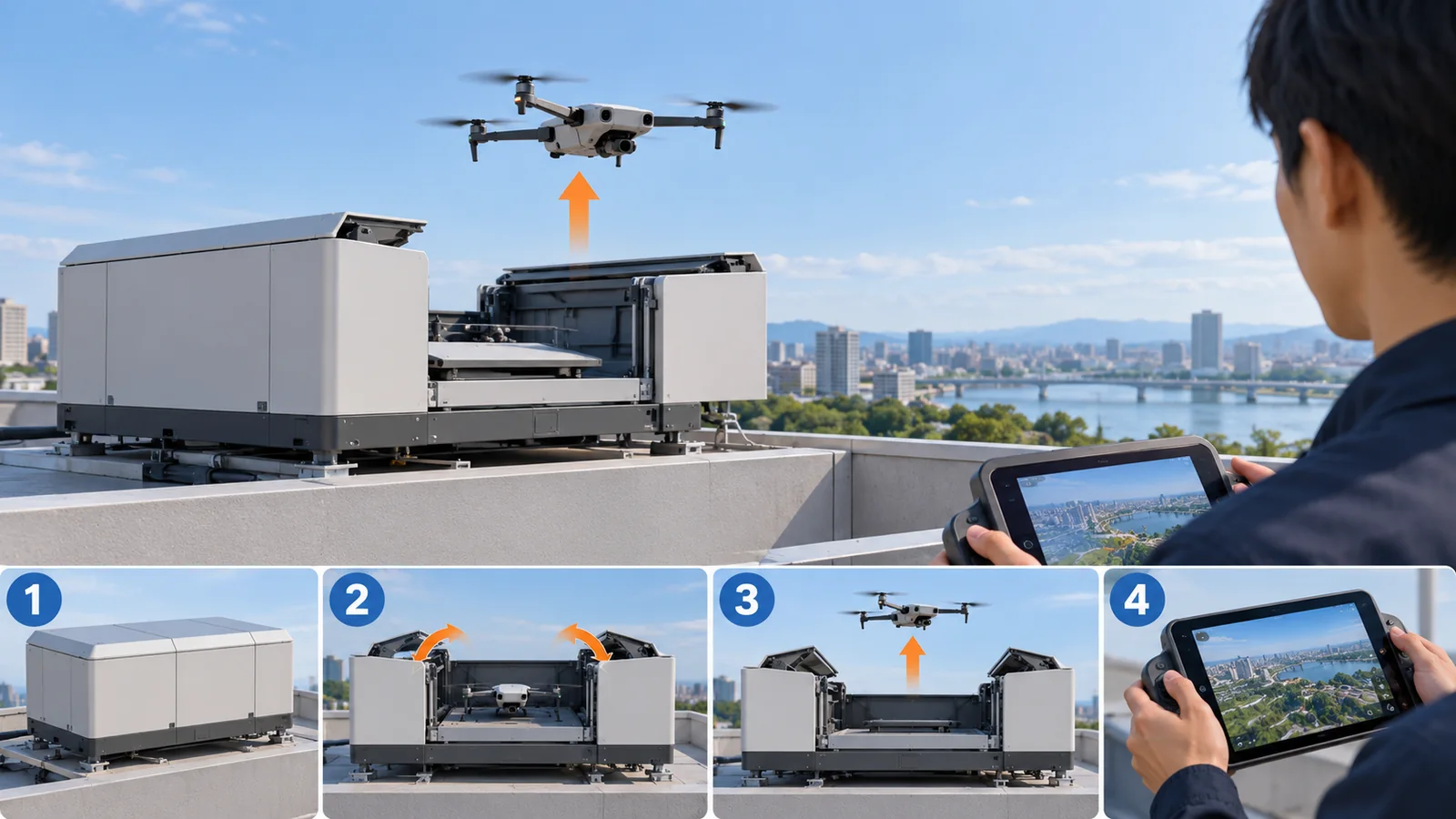
Dock for X10An outdoor aircraft, an indoor aircraft and a dock for remote operation
1,070 docksOfficial blog, August and July 2026. The company’s announcements; no independent check found
(company announcement)The FCC exempts aircraft on that list from its Covered List
Skydio is both an aircraft maker and a seller of “the system for running aircraft remotely from a fixed spot”. Its official blog says 1,070 docks were deployed as of July 2026, and that more than half of the roughly 2 million missions its customers fly each year (figure from September 2026) launch from a dock Sourced (company’s account). A dock is an outdoor box that stores, charges, launches and recovers a drone automatically. These figures are the company’s announcements; we found no third-party source showing how heavily each use case is flown. Note also that, in the US, whoever flies the aircraft needs FAA permission for beyond-visual-line-of-sight (BVLOS) flight and similar operations (Sections 7 and 11).
2. Logo and name

A note on the name: the company is Skydio. Its official page mentions Google’s Project Wing (a drone-delivery research project) in the founders’ background, but Wing and Skydio are separate companies. The logo is the one shown in the header of Skydio’s official site.
Official site: https://www.skydio.com/about3. Where the company sits in drones and robotics
Skydio sells aircraft that fly to businesses and public agencies such as police, fire departments, utilities and construction firms. Autonomous flight here means an aircraft flying itself to a set destination while avoiding obstacles. Skydio puts at its core the technology by which the aircraft’s cameras and onboard computers recognise their surroundings (related to our explainers on SLAM and on robot vision and recognition). The company presents it as a feature that the same autonomy software runs across its different aircraft. For that reason this profile treats “Drones & eVTOL” as the primary type and “Components & enabling software” as the secondary type.
4. Company scale
Skydio does not show revenue, profit or headcount on the official pages we checked. What we could confirm is a set of cumulative figures the company announced, and its leadership Sourced (company announcements).
| Item | Detail | Source and note |
|---|---|---|
| Founding and locations | 2014 / San Mateo, California (headquarters), Hayward (manufacturing) | Official page; official blog (23 July and 12 August 2026) |
| Units built | 65,000+ (as of 12 August 2026) | The company’s announcement. On 24 April 2026 it said it had shipped “more than 60,000” units to more than 3,800 customers |
| Docks | 1,070 deployed (6 July 2026) | The company’s announcement. Across three countries; “over 1,000 in the first year” |
| Leadership | CEO: Adam Bry (co-founder) / CTO: Abe Bachrach | Official page (About) |
| Headcount | Not disclosed | Not found |
| Revenue, profit, R&D | Not disclosed | Not found. Press-based figures not used |
Skydio’s blog calls itself “the largest US-based drone manufacturer” and says it “manufactures more dual-use drones than any company outside of China”, but it gives no comparison basis or statistics. We report this only as the company’s self-description and do not use it to rank anyone Not yet confirmed.
5. Resources put into drones and robotics
| Resource | Detail | Status |
|---|---|---|
| People | Total headcount and R&D staff are not published. In April 2026 the company said it expects, over five years, more than 2,000 new Skydio jobs and more than 3,000 additional jobs in the US supply chain (a plan) | Not disclosed (the plan is Not yet confirmed) |
| Money | A plan to invest US$3.5 billion in the United States over five years (manufacturing, R&D and supply chain, including more than US$1 billion to domestic suppliers). Past fundraising and R&D spending are not stated on the official pages we checked | Plan: Not yet confirmed; results not found |
| Outside investments, acquisitions, joint ventures, divestments | Not on the official pages we checked. A plan called “SkyForge” would invite suppliers to co-locate production next to Skydio | Not found (SkyForge is a plan) |
| Universities, research institutes, public bodies | The founders came from MIT (official page). No current joint research is stated on the pages we checked. In Japan it works through KDDI and NTT Docomo (Section 9) | Not found |
| Factory certification | The Hayward factory obtained ISO 14001:2015 (environmental management) from the Performance Review Institute (12 August 2026) | Sourced (company announcement) |
Next is a table of the main aircraft and products, as far as Skydio’s official spec pages and blog let us confirm. Figures are the company’s stated values, with conditions that differ by aircraft, so we do not rank the aircraft. Checked 25 October 2026.
| Name | Type | Main specifications (company’s stated value, with conditions) | Deployment record | Regulatory position (scope) | Stage |
|---|---|---|---|---|---|
| X10 | Outdoor (inspection, first response) | Weight 2.11 kg (Connect SL, including batteries). Maximum take-off weight 2.49 kg. Maximum flight time 40 min (the spec page footnote says “ideal lab conditions”); maximum hover time 35 min. Ingress protection IP55. Maximum gust handling 12.8 m/s. Operating temperature -20 to 45 degrees C | About 2 million missions a year across customers’ aircraft (company figure, September 2026) | Listed on the Blue UAS Cleared List (company announcement, 23 July 2026). The spec page states FAA and EASA Remote ID compliance | On sale |
| Dock for X10 | Dock (box for remote operation) | Weight 232 lb (about 105 kg, with base). Airborne in about 20 s. Launch and landing winds up to 12 m/s. Operating temperature -20 to 50 degrees C. Rain: up to 0.25 inch/h (light to moderate) for X10 operation; up to 4 inch/h (heavy) with the dock on standby | 1,070 deployed (company figure, 6 July 2026) | Listed on the Blue UAS Cleared List (company announcement) | On sale |
| R10 | Indoor (buildings, dark spaces) | Weight 785 g (including battery). Flight time 20 min. No water-resistance rating (the spec page says it is “not rated for sustained water exposure”) | Numbers and dates not found | Listed on the Blue UAS Cleared List (company announcement) | On sale |
| F10 Lightrunner / MegaDock | Fixed-wing aircraft and its dock | Company design targets: launch in seconds, top speed up to about 100 mph (about 160 km/h), 30-mile (about 48 km) flight radius; the MegaDock holds up to five aircraft | None (customer deliveries are planned for 2027) | Not obtained (not found in our checks) | Announced (plan) |
The F10 figures are design targets, not measured values (Not yet confirmed). Skydio also makes a defense-oriented version (X10D), which this profile does not cover.
Skydio’s X10 page says the airframe uses magnesium and carbon fibre, together with a graphite heat spreader (a material that spreads heat across a surface and carries it away) Sourced (company’s account). The aircraft’s computing chips (the spec page lists an NVIDIA Jetson Orin and a Qualcomm Snapdragon 865) give off heat that must be handled inside the airframe. The design reads as giving each material one job: magnesium for lightness, carbon fibre for stiffness and graphite as a path for heat. The battery is a lithium-ion polymer pack; the spec page gives 156.17 Wh and a weight of 707.5 g for the Rev 1 pack. From these we calculate about 221 Wh/kg for the whole pack Our calculation (156.17 Wh / 0.7075 kg; a figure for the whole pack, not the cell). The Rev 2 pack is 154 Wh and 685 g, or about 225 Wh/kg by the same method Our calculation. The thermal sensor is described on the official page as a Teledyne FLIR Boson+ (640 x 512 pixels, 12 µm pixel pitch). The sensing material (for example vanadium oxide) is not stated in the specifications we checked Not yet confirmed.
6. What the company has done so far
| When | What happened | Meaning and scope |
|---|---|---|
| 2009 | The founders meet in graduate school at MIT. They later work on Google’s Project Wing | Per the official About page |
| 2014 | Skydio founded | Official page |
| 2018 | Launches the R1, an autonomous drone for consumers | Official page. The company calls it a breakthrough |
| 2024 | The defense-oriented X10D is added to the Blue UAS Cleared List | Company announcement (this profile does not cover defense details) |
| 3 September 2025 | Dock for X10 becomes generally available in Japan. KDDI and NTT Docomo handle deployment, maintenance and support. The first customer site belongs to a KDDI customer, Ishikawa Prefecture | Company announcement. It describes Japan as the first country outside the US to deploy production docks |
| 22 December 2025 | The FCC adds foreign-produced UAS and UAS critical components to the Covered List | FCC document. It does not name Skydio (Section 11) |
| 7 January 2026 | The FCC exempts Blue UAS Cleared List aircraft and “domestic end products”, for a limited period | FCC document |
| 24 April 2026 | Announces a plan to invest US$3.5 billion in the US over five years | Company plan (Not yet confirmed) |
| 6 July 2026 | Says 1,070 docks are deployed (first year) | Company figure |
| 23 July 2026 | Announces that the X10, Dock for X10 and R10 have been added to the Blue UAS Cleared List (the X10D has been listed since 2024) | Company announcement. We could not retrieve the list itself (the Defense Department’s site did not allow automated access) |
| 12 August 2026 | The Hayward factory obtains ISO 14001:2015. Says 65,000+ units built | Company announcement |
| 24 September 2026 | Announces the fixed-wing F10 Lightrunner and the MegaDock (customer deliveries planned for 2027) | Company announcement and plan |
7. Plans going forward
planned for 2027The company’s schedule (announcement of 24 September 2026). Approval status not found
over five yearsCompany plan (24 April 2026). A new factory about five times the current floor space is planned
(finalisation not confirmed)Proposed 7 August 2025. We found no final rule in the Federal Register as of 25 October 2026
The FAA’s proposed rule (Part 108, 7 August 2025) sets out a framework that would allow beyond-visual-line-of-sight (BVLOS) flight by rule rather than by individual permission. Comments closed on 6 October 2025, the comment period was reopened on some topics on 28 January 2026, and a document of 10 February 2026 denied requests for an extension. We found no final rule in the Federal Register as of 25 October 2026 Not yet confirmed. Skydio’s DFR page (DFR = Drone as First Responder, drones that police and fire services send ahead to the scene) says remote flight requires a BVLOS permit and that its “Regulatory Services” team helps prepare the FAA paperwork (the company’s account).
The primary sources we checked do not mention the following Not yet confirmed.
Headcount / revenue, profit and R&D / past fundraising and investors / the planned FAA approval of the F10 / the scope of any FAA approval specific to Skydio (aircraft type or operating permission) / a document showing the FCC treatment of each individual aircraft.
8. What the company appears to be aiming for in drones and robotics
This section includes points the company has not stated itself. They are inferences from primary sources, each shown with its basis.
| What we read | Primary-source basis | Type |
|---|---|---|
| Skydio is aiming to earn from a remote-operation system including docks and software, not from aircraft alone | 1,070 docks; the statement that more than half of customer missions launch from a dock; the software family (DFR Command, Asset Command, Security Command and others); the MegaDock for the F10 | Inference |
| It makes US manufacture and security certification a competitive axis | The official statement “designed, assembled and supported in the USA”; the Blue UAS announcement; the US$3.5 billion domestic investment plan; the ISO 14001 announcement | Inference |
| It is widening the distance and places it can cover with an outdoor aircraft (X10), an indoor one (R10) and a fixed-wing one (F10) | The 24 September 2026 blog describes the three as one family running on a common autonomy engine | Sourced (company’s account) |
| Japan may be treated as its main market outside the US | Japan was the first country outside the US to deploy production docks, and KDDI and NTT Docomo handle deployment (September 2025) | Inference |
The FCC’s Covered List is a mechanism under which new models of foreign-produced aircraft and critical components get no equipment authorization, but there are time-limited exceptions for aircraft on the Blue UAS Cleared List and for “domestic end products” under US procurement rules Sourced. Skydio announced Blue UAS listing for its three main systems in July 2026, and on 7 October 2026 its blog explained, from its own standpoint, how NDAA compliance, Blue UAS and Green UAS differ Sourced (company’s account). Against this regulatory background, we read the company as making “made in America” and “government certification” central to how it sells Not yet confirmed. How the exceptions will be treated when their end date arrives (2027 or 2028) is not settled in FCC documents.
9. Partnership map for drones and robotics
10. Technologies, products and services
| Area | Products confirmed on official pages | What they do |
|---|---|---|
| Aircraft | X10 (outdoor), R10 (indoor), F10 Lightrunner (fixed-wing; planned for 2027) | Fly themselves around obstacles and film the scene. The company says the indoor model can also fly in the dark and without GPS |
| Docks | Dock for X10, MegaDock (for the F10; planned) | Leave the aircraft on site, with charging and launch/landing automated and run remotely |
| Operating software | DFR Command, Security Command, Asset Command and others | Management screens for first response, site security and equipment inspection. Linked to dispatch systems (CAD) and to Axon |
| Autonomy base | Skydio Autonomy, Pathfinder, Paraverse (a training environment) | Automatic route planning, recognition of surroundings and flight training. The company says Pathfinder has flown more than 600,000 miles on its own |
| Services | Regulatory Services, Success Services | Help with FAA permission paperwork, and with deployment and operation |
11. Risks the company faces
| Risk | Detail | Type |
|---|---|---|
| Exemption end dates and definitions can change | The FCC Covered List applies to aircraft “produced in a foreign country”, with time-limited exceptions for Blue UAS Cleared List aircraft and domestic end products. The end date is 1 January 2028, extended from 1 January 2027 in July 2026 (FCC DA 26-761) | Sourced |
| Effect of pending proposals | The FCC’s July 2026 “military-grade” import and sales ban proposal (DA 26-758) defines its scope by take-off weight, thermal imaging, LiDAR, docking stations and other features (a proposal). It applies to equipment on the Covered List, and whether an exception applies is a separate question. We do not judge how it would apply to Skydio’s aircraft | Not yet confirmed |
| Reliance on BVLOS permission | Remote operation needs the operator to hold BVLOS permission (the company’s account). The FAA’s Part 108 is still a proposal and we found no final rule | Sourced (company’s account) / Not yet confirmed |
| Figures cannot be verified | The 65,000 units, 1,070 docks and 2 million missions a year come only from the company, and we found no independent check | Sourced (company’s account) |
| Delivery of plans | F10 deliveries in 2027, the US$3.5 billion investment and the new factory are plans, not achievements. F10 approval status is also not found | Not yet confirmed |
| No published financials | Revenue, profit and fundraising could not be confirmed, so the feasibility of the plans cannot be judged from outside | Inference |
12. Glossary
- Autonomous flight
- A drone’s ability to fly itself to a destination while avoiding obstacles, without detailed manual piloting.
- DFR
- Drone as First Responder: police or fire services send a drone ahead to the scene after an emergency call.
- BVLOS
- Beyond visual line of sight: flying beyond what the pilot can see. In the US it needs a permit or a rule.
- Dock
- An outdoor box that stores, charges, launches and recovers a drone automatically.
- Blue UAS
- A list of unmanned aircraft cleared by a Department of Defense agency (DCMA), the Blue UAS Cleared List.
- NDAA compliance
- Meeting procurement requirements in US defense authorization acts, such as not using parts from certain countries or companies.
- Covered List
- The FCC’s list of equipment judged to pose a national security risk. Listed equipment cannot receive new equipment authorization.
- Domestic end product
- A product counted as made in the US under federal procurement rules (the Buy American standard).
- Remote ID
- A system by which a flying drone broadcasts identification information by radio.
- IP rating
- A dust-and-water-resistance rating written with two digits such as IP55. Higher digits mean stronger protection.
- ISO 14001
- An international standard for environmental management systems.
- CAD
- Computer-aided dispatch: the system police and fire services use to manage calls and dispatch.
13. References
- Skydio About Skydio (official). Founding year, founders, leadership, and the “designed, assembled and supported in the USA” statement. https://www.skydio.com/about
- Skydio Skydio X10 (official product page). Airframe features, structural materials, ingress protection, thermal sensor. https://www.skydio.com/x10
- Skydio Skydio X10 technical specifications (official). Weight, flight time and conditions, battery, ingress protection. https://www.skydio.com/x10/technical-specs
- Skydio Skydio R10 technical specifications (official). Weight and flight time. https://www.skydio.com/r10/technical-specs
- Skydio Skydio Dock for X10 technical specifications (official). Weight, operating temperature, launch time, wind and rain limits. https://www.skydio.com/dock/technical-specs
- Skydio Official blog, “All current Skydio drone solutions added to Blue UAS Cleared List” (23 July 2026; the company’s announcement). https://www.skydio.com/blog/skydio-blue-uas-cleared-list-2026
- Skydio Official blog, “Skydio Commits $3.5 Billion to Expand U.S. Manufacturing” (24 April 2026; a company plan). https://www.skydio.com/blog/skydio-commits-usd3-5-billion-to-expand-u-s-manufacturing-and-secure-american-drone-leadership
- Skydio Official blog, “1 Year, 1,000 Skydio Docks Deployed” (6 July 2026; the company’s figures). https://www.skydio.com/blog/1000-skydio-docks-deployed
- Skydio Official blog, “Skydio’s Hayward Facility Earns ISO 14001 Environmental Certification” (12 August 2026). https://www.skydio.com/blog/skydio-hayward-iso-14001-certification
- Skydio Official blog, “Skydio Extends Its Family of Flying Robots Platform With F10 Lightrunner and MegaDock” (24 September 2026; the company’s announcement and plans). https://www.skydio.com/blog/ascend-2026-f10-lightrunner-megadock-commands
- Skydio Official blog, “Skydio, KDDI Corporation, and NTT Docomo Accelerate Autonomous Operations in Japan” (3 September 2025). https://www.skydio.com/blog/skydio-x10-dock-available-japan
- Skydio Official blog, “A simple guide to understanding Blue UAS vs NDAA-compliant vs American-Made drone requirements” (7 October 2026; the company’s explanation). https://www.skydio.com/blog/a-simple-guide-to-understanding-blue-uas-vs-ndaa-compliant-vs-american-made-drone-requirements
- Skydio Drone as First Responder (DFR) solutions page (official). Axon integration and the note that remote flight needs a BVLOS permit. https://www.skydio.com/solutions/dfr
- Federal Communications Commission (FCC) Public Notice DA 25-1086 (22 December 2025). Adds foreign-produced UAS and UAS critical components to the Covered List. https://docs.fcc.gov/public/attachments/DA-25-1086A1.pdf
- Federal Communications Commission (FCC) Public Notice DA 26-22 (7 January 2026). Exempts Blue UAS Cleared List aircraft and domestic end products, for a limited period. https://docs.fcc.gov/public/attachments/DA-26-22A1.pdf
- Federal Communications Commission (FCC) Covered List FAQs: UAS and UAS Critical Components (updated 21 July 2026). https://www.fcc.gov/covered-list-faqs-uas-and-uas-critical-components
- Federal Communications Commission (FCC) List of Equipment and Services Covered By Section 2 of The Secure Networks Act (page showed “Updated October 23, 2026”). https://www.fcc.gov/supplychain/coveredlist
- Federal Communications Commission (FCC) Public Notice DA 26-758 (21 July 2026). Proposal to bar import and marketing of “military-grade” UAS (a proposal only). https://docs.fcc.gov/public/attachments/DA-26-758A1.pdf
- Federal Register (FAA) Normalizing Unmanned Aircraft Systems Beyond Visual Line of Sight Operations (proposed rule, 7 August 2025). https://www.federalregister.gov/documents/2025/08/07/2025-14992/normalizing-unmanned-aircraft-systems-beyond-visual-line-of-sight-operations
- Federal Register (FAA) Same proposed rule: reopening of the comment period and denial of an extension (document dated 10 February 2026). https://www.federalregister.gov/documents/2026/02/10/2026-02649/normalizing-unmanned-aircraft-systems-beyond-visual-line-of-sight-operations-reopening-of-comment
- Federal Register (FAA) Same proposed rule: reopening of the comment period (document dated 28 January 2026). https://www.federalregister.gov/documents/2026/01/28/2026-01644/normalizing-unmanned-aircraft-systems-beyond-visual-line-of-sight-operations-reopening-of-comment
- FCC Public Notice DA 26-761 (21 July 2026): extension of the Blue UAS and domestic-end-product exemptions to 1 January 2028. https://docs.fcc.gov/public/attachments/DA-26-761A1.pdf
14. Claim-to-source audit
| Claim in the text | Type | Source |
|---|---|---|
| Founded 2014; the founders’ background; the leadership; the statement “designed, assembled and supported in the USA” | Sourced (company’s account) | Reference 1 https://www.skydio.com/about |
| Headquarters in San Mateo; manufacturing in Hayward; ISO 14001:2015; 65,000+ units | Sourced (company announcement) | Reference 6 and 9 https://www.skydio.com/blog/skydio-blue-uas-cleared-list-2026https://www.skydio.com/blog/skydio-hayward-iso-14001-certification |
| X10 weight, flight time, battery, ingress protection, gust handling, temperature and processors | Sourced (company’s stated value) | Reference 3 https://www.skydio.com/x10/technical-specs |
| X10 structural materials (magnesium and carbon fibre, graphite heat spreader) and the thermal sensor (Teledyne FLIR Boson+) | Sourced (company’s account) | Reference 2 https://www.skydio.com/x10 |
| R10 weight, flight time and the water-resistance note | Sourced (company’s stated value) | Reference 4 https://www.skydio.com/r10/technical-specs |
| Dock weight, launch time, wind, temperature and rain limits | Sourced (company’s stated value) | Reference 5 https://www.skydio.com/dock/technical-specs |
| Announcement that the X10, Dock and R10 joined the Blue UAS Cleared List (23 July 2026); the X10D since 2024 | Sourced (company announcement) | Reference 6 https://www.skydio.com/blog/skydio-blue-uas-cleared-list-2026 |
| US$3.5 billion over five years, job estimates, SkyForge; 60,000+ shipped to 3,800+ customers (April 2026) | Not yet confirmed (plan); Sourced (company figure) | Reference 7 https://www.skydio.com/blog/skydio-commits-usd3-5-billion-to-expand-u-s-manufacturing-and-secure-american-drone-leadership |
| 1,070 docks (6 July 2026), three countries | Sourced (company figure) | Reference 8 https://www.skydio.com/blog/1000-skydio-docks-deployed |
| F10 Lightrunner and MegaDock; about 2 million missions a year; Pathfinder 600,000 miles; deliveries planned for 2027 | Sourced (company announcement) / Not yet confirmed | Reference 10 https://www.skydio.com/blog/ascend-2026-f10-lightrunner-megadock-commands |
| General availability of the Dock in Japan (KDDI, NTT Docomo, Ishikawa Prefecture) | Sourced (company announcement) | Reference 11 https://www.skydio.com/blog/skydio-x10-dock-available-japan |
| The company’s explanation of NDAA compliance, Blue UAS and Green UAS (7 October 2026) | Sourced (company’s account) | Reference 12 https://www.skydio.com/blog/a-simple-guide-to-understanding-blue-uas-vs-ndaa-compliant-vs-american-made-drone-requirements |
| Axon integration; the note that remote flight needs a BVLOS permit; Regulatory Services | Sourced (company’s account) | Reference 13 https://www.skydio.com/solutions/dfr |
| FCC addition to the Covered List (22 December 2025) and the definition of critical components | Sourced | Reference 14 https://docs.fcc.gov/public/attachments/DA-25-1086A1.pdf |
| The 7 January 2026 exceptions (Blue UAS, domestic end products) | Sourced | Reference 15 https://docs.fcc.gov/public/attachments/DA-26-22A1.pdf |
| New models cannot be authorized; authorized models can be imported, sold and used; the exemption end dates given | Sourced | Reference 16 https://www.fcc.gov/covered-list-faqs-uas-and-uas-critical-components |
| The Covered List’s own exemption end date (1 January 2028) and the Conditional Approvals list | Sourced | Reference 17 https://www.fcc.gov/supplychain/coveredlist |
| Extension of the exemption end date from 1 January 2027 to 1 January 2028 | Sourced | Reference 22 https://docs.fcc.gov/public/attachments/DA-26-761A1.pdf |
| The “military-grade” definition proposal and its status as a proposal (DA 26-758) | Sourced | Reference 18 https://docs.fcc.gov/public/attachments/DA-26-758A1.pdf |
| The FAA BVLOS proposed rule (7 August 2025; comments to 6 October 2025) | Sourced | Reference 19 https://www.federalregister.gov/documents/2025/08/07/2025-14992/normalizing-unmanned-aircraft-systems-beyond-visual-line-of-sight-operations |
| Reopening of the comment period and denial of an extension (28 January and 10 February 2026); no final rule found | Sourced / Not yet confirmed | Reference 20 and 21 https://www.federalregister.gov/documents/2026/02/10/2026-02649/normalizing-unmanned-aircraft-systems-beyond-visual-line-of-sight-operations-reopening-of-commenthttps://www.federalregister.gov/documents/2026/01/28/2026-01644/normalizing-unmanned-aircraft-systems-beyond-visual-line-of-sight-operations-reopening-of-comment |
| Pack-level battery energy (about 221 Wh/kg and about 225 Wh/kg) | Our calculation | Our calculation from the spec page’s Wh and weight https://www.skydio.com/x10/technical-specs |
| Headcount, revenue, R&D, fundraising, Skydio-specific FAA approvals, F10 approval | Not yet confirmed | Not stated in the materials we checked; not estimated https://www.skydio.com/about |
| The four-type classification and Skydio’s position | Our calculation | This article’s own classification; company names are examples from this series |
| Earning from a remote-operation system including docks and software | Inference | Our reading of the dock count and product family announcements https://www.skydio.com/blog/1000-skydio-docks-deployed |
| US manufacture and security certification as a competitive axis | Inference | Our reading of the official page, blog and FCC documents https://www.skydio.com/blog/skydio-blue-uas-cleared-list-2026 |
| Japan as a main market outside the US | Inference | Our reading of the Japan dock announcement https://www.skydio.com/blog/skydio-x10-dock-available-japan |
| Unpublished financials leave the feasibility of the plans unmeasurable from outside | Inference | Our own reading (no financials appear on the official pages) |
Last updated 25 October 2026 / Troy Technical
Product figures are the company’s stated values from Skydio’s official spec pages; because test conditions differ by aircraft, we do not compare them. Cumulative unit and deployment figures and plans are company announcements, and we found no independent verification. Statements on regulation rest on FCC public documents and the FAA’s proposed rule in the Federal Register. Defense and military details are not covered. No research-firm estimates or press-based figures have been used. Passages marked “Inference” are our reading of the primary sources and are not statements by the company or any authority. This article is not legal or investment advice.