


Key Findings
The study identifies lead compound 105B, a PROTAC designed to recruit the tissue-specific E3 ligase scaffolding protein MAGEA11 for the degradation of bromodomain and extra-terminal domain (BET) proteins. In osteosarcoma U2OS cells, 105B demonstrated a BRD4 DC50 of 0.130 nM and a Dmax of 78%. In KYSE180 esophageal squamous cell carcinoma cell lines, the compound showed a DC50 of 40 nM and a Dmax of 70%. Notably, no degradation was observed in non-cancerous HEK293T cells. Mechanistic analysis confirmed that 105B depends on MAGEA11 and HUWE1 expression, as well as the ubiquitin-proteasome system.
Technical Details
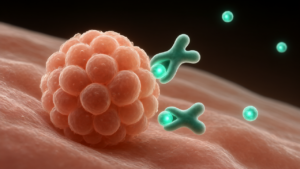
PROTACs are heterobifunctional molecules that link a ligand for a protein of interest (POI) to a ligand for an E3 ligase. This creates a ternary complex that allows the E3 ligase to transfer ubiquitin to the POI, leading to proteasome-mediated degradation. While most PROTACs utilize ubiquitously expressed E3 ligases like cereblon or von Hippel-Lindau (VHL), this design recruits MAGEA11. MAGEA11 binds to the E3 ligase HUWE1 to direct ubiquitination. The lead compound 105B successfully decreased levels of BET-regulated gene products RUNX2 and KRT14, though the authors note that further improvements are required to affect selective cytotoxicity.
Background & Context
BET proteins, including BRD4, are epigenetic readers that regulate gene transcription by binding to acetylated lysine residues on histones. Due to their role in tumorigenesis, they are primary targets for degradation, though their inhibition is often associated with dose-limiting toxicities. MAGEA11 is a cancer-testis antigen expressed in sperm and placental tissues in healthy individuals, but it is aberrantly expressed in various cancers, including non-small cell lung carcinoma, castration-resistant prostate carcinoma, osteosarcoma, and esophageal squamous cell carcinoma.
Significance & Outlook
By recruiting a tissue-specific E3 ligase rather than a ubiquitous one, this method increases the specificity of protein degradation. This reduces the risk of off-target effects in healthy tissues, similar to how VHL-based PROTACs targeting BCL-xL show limited degradation in platelet cells to reduce thrombocytopenia. This work establishes the feasibility of MAGEA11-recruiting degraders for cancer-restricted therapy.
Source: https://doi.org/10.1038/s44386-026-00081-2
Get our weekly technology intelligence — free
Receive an infographic that lets you judge at a glance whether each field’s analysis report is worth reading.
Subscribe Free — Weekly Tech Intelligence
By subscribing, you’ll receive Troy-Technical’s weekly technology intelligence newsletter.
- Your email and selected fields are used only to deliver the newsletter.
- We never share your information with third parties.
- You can unsubscribe anytime via the link in each email.
See our Privacy Policy for details.
Takes about a minute · Unsubscribe anytime