


Key Findings
IBM has demonstrated a multichannel quantum interconnect between two 120-qubit superconducting processors, achieving state-transfer fidelities of at least 98.86% across four links, with a peak fidelity of 99.29%. The researchers successfully performed controlled-Z gates between qubits on separate processors with an average fidelity of 94.75% and a maximum of 96.42%. Furthermore, the team generated entangled pairs across chips and extended entanglement to groups of four and six computing qubits, with statistically corrected fidelities of 91.70% and 90.87%, respectively.
Technical Details
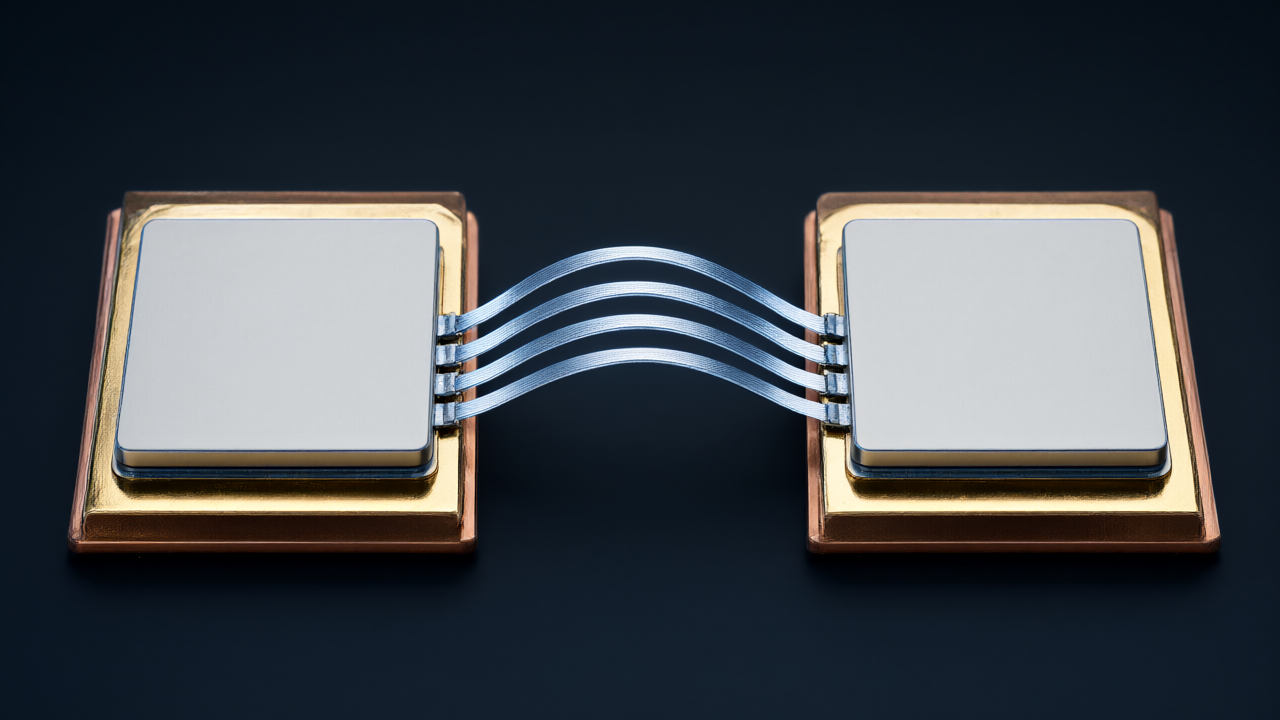
The experiment utilized two IBM Nighthawk R1 processors connected by four aluminum coaxial cables, each approximately 80 centimeters long. These cables functioned as superconducting microwave links within an ultracold environment. To facilitate the transfer of quantum information, the team used dedicated qubits at the cable ends and adjustable coupling devices. The cables were attached perpendicular to the processor surface to allow for higher connection density compared to previous parallel designs.
The researchers employed network benchmarking to isolate transfer errors from preparation and measurement errors. While state transfers were highly efficient, complete operations—which combined two state transfers, three local two-qubit gates, and single-qubit controls—showed lower fidelity due to the increased number of steps.
Background and Context
Scaling quantum computers is often limited by the physical constraints of a single chip. A modular approach divides workloads among multiple processors, but requires links that can preserve fragile quantum states and support entanglement. While previous experiments used smaller modules with single connections, this work represents the first demonstration of a multichannel interconnect between large superconducting processors.
Significance and Outlook
This modular architecture allows developers to expand computing capacity by linking separate chips. However, IBM notes that further improvements are required in qubit stability, magnetic shielding, and manufacturing before this approach can be fully scaled. Additionally, the current experiment only wired and measured a subset of the 240 total qubits to accelerate development.
Get our weekly technology intelligence — free
Receive an infographic that lets you judge at a glance whether each field’s analysis report is worth reading.
Subscribe Free — Weekly Tech Intelligence
By subscribing, you’ll receive Troy-Technical’s weekly technology intelligence newsletter.
- Your email and selected fields are used only to deliver the newsletter.
- We never share your information with third parties.
- You can unsubscribe anytime via the link in each email.
See our Privacy Policy for details.
Takes about a minute · Unsubscribe anytime