

Key Findings
A research team led by Professor Soon-moon Jung at the DGIST Graduate School of Engineering has implemented a power-free soft robot sensing technology. By applying a specialized “mechanoluminescence fiber,” the team enabled robots to emit intuitive light that reveals their movement trajectories without requiring batteries or complex electronic circuitry.
Technical Details
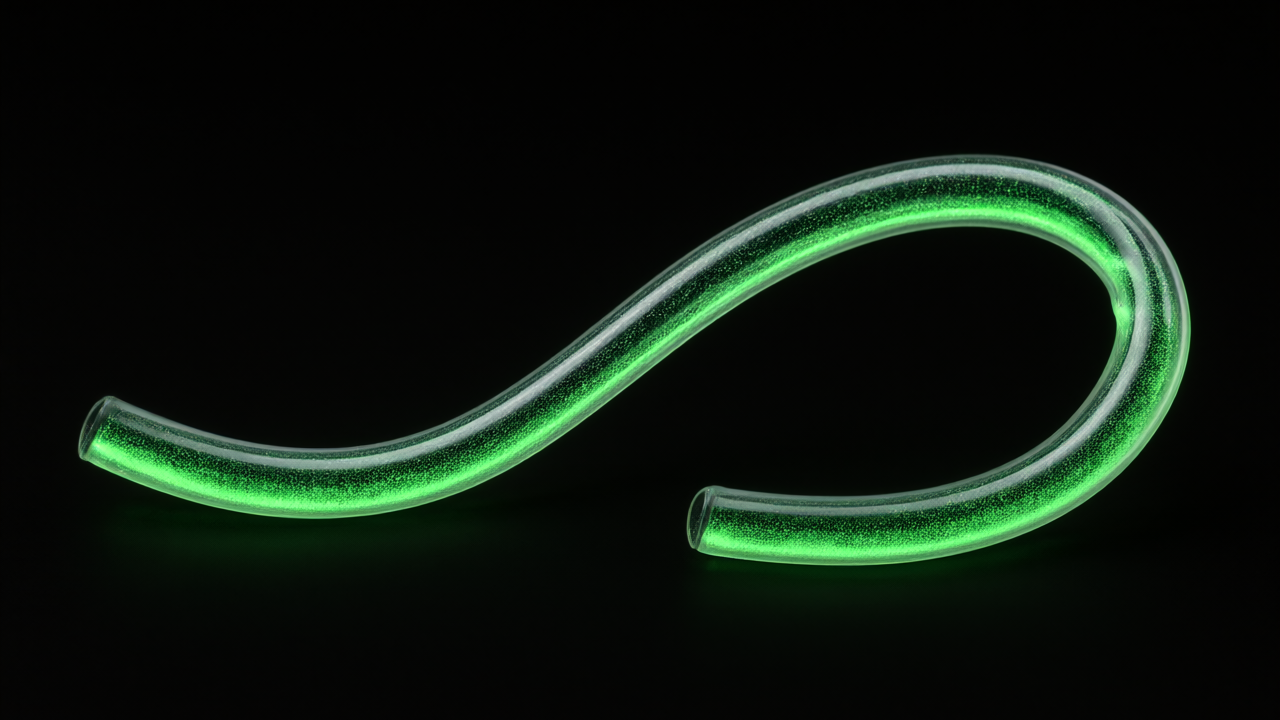
The technology utilizes the phenomenon of mechanoluminescence, where a material emits light when subjected to physical forces such as stretching, bending, or pressure. The researchers developed a “tube-type mechanoluminescence fiber” by mixing luminescence particles (zinc sulfide) with a flexible polymer material and filling it into an elastic silicone tube.
- Durability: The fibers can be stretched to more than 200% of their original length.
- Stability: The initial luminescence performance remains stable even after more than 1,000 cycles of stretching and releasing.
- Implementation: When the fiber is applied as a mesh over the surface of a soft robot, the areas undergoing deformation immediately emit green light.
Background & Context
Soft robots made from flexible materials like rubber or silicone are critical for next-generation applications in medical devices and disaster rescue due to their muscle-like movement. However, monitoring the minute movements of these robots typically requires rigid electronic sensors and wiring, which obstruct the inherent flexibility of the robot. This new fiber acts as a true power-free optical sensor, eliminating the need for external power sources or traditional sensors to verify bending and expansion.
Significance & Outlook
Professor Soon-moon Jung stated that this research provides a breakthrough for immediately identifying deformation states without hindering flexible movement. Future plans include improving luminescence performance and durability to expand the application of these flexible electronic elements to wearable devices and artificial skin for human-robot interaction. The study, supported by the Ministry of Science and ICT and the National Research Foundation of Korea, was published as the October cover story in the journal Small Structures.
Source: https://www.imaeil.com/page/view/2026110307594864132
Get our weekly technology intelligence — free
Receive an infographic that lets you judge at a glance whether each field’s analysis report is worth reading.
Subscribe Free — Weekly Tech Intelligence
By subscribing, you’ll receive Troy-Technical’s weekly technology intelligence newsletter.
- Your email and selected fields are used only to deliver the newsletter.
- We never share your information with third parties.
- You can unsubscribe anytime via the link in each email.
See our Privacy Policy for details.
Takes about a minute · Unsubscribe anytime