

Key Findings
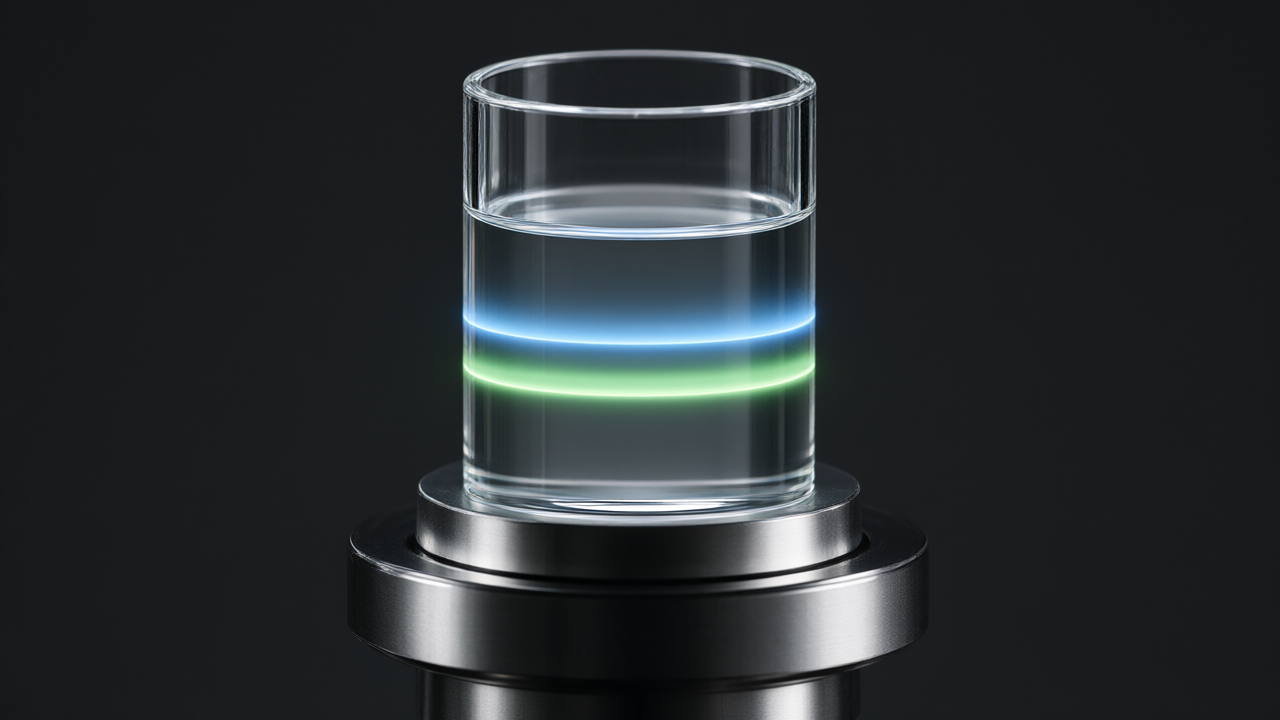
The research team at Regeneron Pharmaceuticals has established a high-resolution DGE-AUC workflow that distinguishes between two full AAV capsids in a dual-vector product. By utilizing rubidium chloride as the gradient-forming salt, the team achieved a resolution of approximately 1.5, significantly outperforming the 0.7 resolution provided by conventional cesium chloride. Final statistical optimization yielded a resolution of 1.63 ± 0.01, with relative standard deviations of 0.8 percent for 3′ Full and 1.1 percent for 5′ Full measurements.
Technical Details
The method separates capsids based on buoyant density rather than hydrodynamic behavior. Following a Quality by Design framework and Design of Experiments (DoE) using JMP Pro 17, the team identified the following optimized parameters:
- Salt: Rubidium chloride (selected over cesium chloride, rubidium bromide, and cesium formate).
- Rotor Speed: 37,300 rpm (speeds above 40,000 rpm caused leaks; lower speeds broadened peaks).
- Initial Salt Density: 1.3856 grams per milliliter (densities between 1.38 and 1.39 g/mL avoid boundary effects).
- AAV Load: An input concentration corresponding to an OD230 of 0.15, which provided the highest resolution of around 1.7.
Linearity was validated across an analytical range of 33 to 120 percent of the target load, using OD230 values of 0.049, 0.075, 0.12, 0.15, and 0.18.
Background & Context
AAV capsids are limited to packaging approximately 4.7 kilobases of genetic cargo. To deliver larger genes—such as those for hemophilia A or Duchenne muscular dystrophy—dual-AAV strategies split the transgene across two vectors. However, because these vectors often differ by only a few hundred nucleotides, they are nearly indistinguishable via standard PCR, ELISA, or sedimentation velocity AUC.
Significance & Outlook
This DGE-AUC method closes a critical analytical gap by providing a reproducible way to quantify individual vector species within a single formulation. The precision and resolution demonstrated make the technique suitable for routine drug product characterization in dual-AAV gene therapies.
Get our weekly technology intelligence — free
Receive an infographic that lets you judge at a glance whether each field’s analysis report is worth reading.
Subscribe Free — Weekly Tech Intelligence
By subscribing, you’ll receive Troy-Technical’s weekly technology intelligence newsletter.
- Your email and selected fields are used only to deliver the newsletter.
- We never share your information with third parties.
- You can unsubscribe anytime via the link in each email.
See our Privacy Policy for details.
Takes about a minute · Unsubscribe anytime