


Key Findings
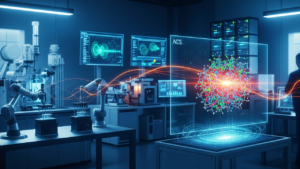
The SBL system enables AI to move beyond executing pre-defined workflows to autonomously expanding laboratory capabilities. In a primary validation experiment, the system synthesized cadmium sulfide quantum dots (CdS QDs), coordinating a liquid handling robot, a robotic arm, and optical detection equipment. The AI generated and verified a Python program consisting of 236 operation instructions to manage reagent preparation, liquid transfer, and measurement.
Technical Details
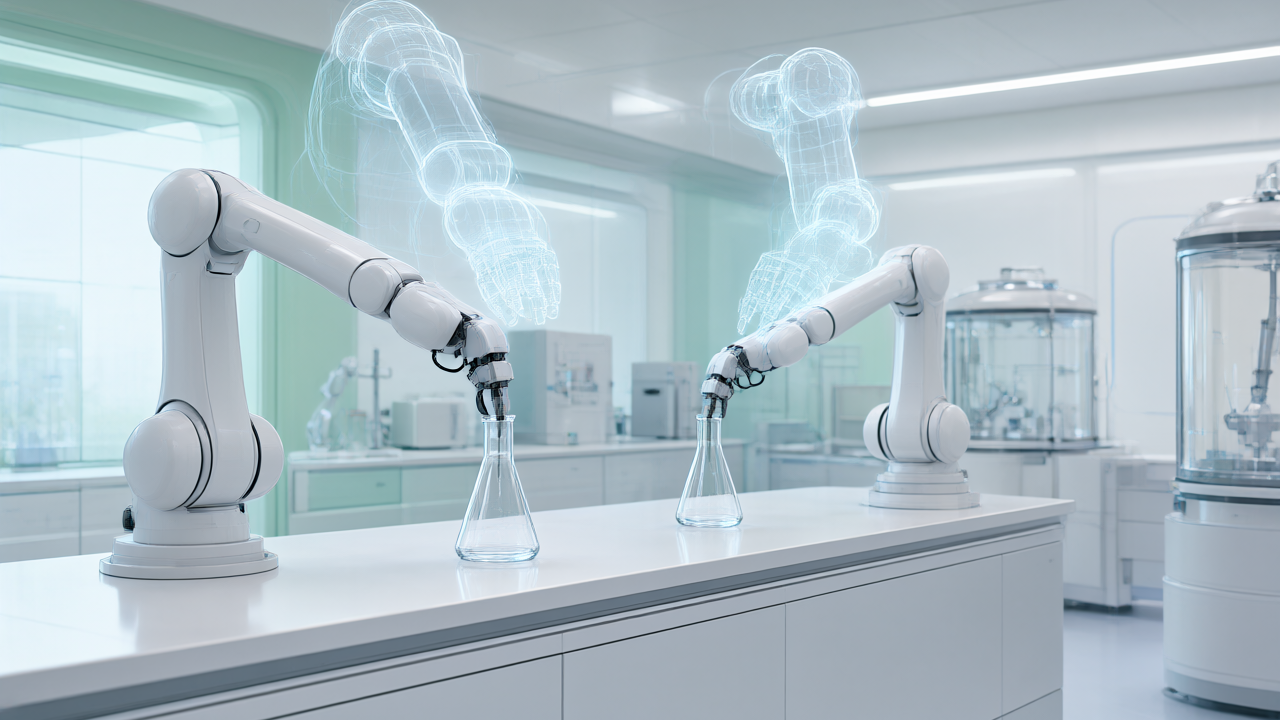
The architecture relies on a digital twin created via NVIDIA Isaac Sim, which maps the physical lab using photos, CAD models, and camera data to minimize discrepancies between virtual and real environments. Three specialized agents manage the process:
- Scientific Agent: Translates abstract research goals into concrete experimental steps based on literature and domain knowledge.
- Twin Agent: Converts scientific plans into device-specific instructions and develops new operational skills within the digital twin.
- Safety Agent: Simulates potential hazards, such as equipment collisions or reagent spills, to establish safety rules.
To handle high-precision tasks, such as HPLC plate loading requiring sub-millimeter accuracy, the system integrates vision, depth information, and force/torque sensor feedback to correct simulation errors in real-time.
Background & Context
Traditional Self-Driving Labs (SDL) are limited by the equipment and interfaces installed at the time of construction; adding new tools typically requires professional engineers to write new code. SBL aims to integrate the definition and expansion of these boundaries into the automation loop. The team, including researchers from the Vector Institute, Acceleration Consortium, CIFAR, and NVIDIA, previously developed computational agents like El Agente for quantum chemistry and MLIP simulations.
Significance & Outlook
The researchers envision “vertical expansion,” where robots move between different labs or floors in a building to schedule resources. Future goals include AI designing custom experimental equipment via 3D printing. While AI handles the execution, human scientists remain essential to provide “boundary conditions,” defining risk parameters and efficiency constraints to guide the AI’s search space.
Source: https://finance.sina.cn/tech/2026-11-08/detail-inixyrxk4290415.d.html?vt=4
Get our weekly technology intelligence — free
Receive an infographic that lets you judge at a glance whether each field’s analysis report is worth reading.
Subscribe Free — Weekly Tech Intelligence
By subscribing, you’ll receive Troy-Technical’s weekly technology intelligence newsletter.
- Your email and selected fields are used only to deliver the newsletter.
- We never share your information with third parties.
- You can unsubscribe anytime via the link in each email.
See our Privacy Policy for details.
Takes about a minute · Unsubscribe anytime