


Key Findings
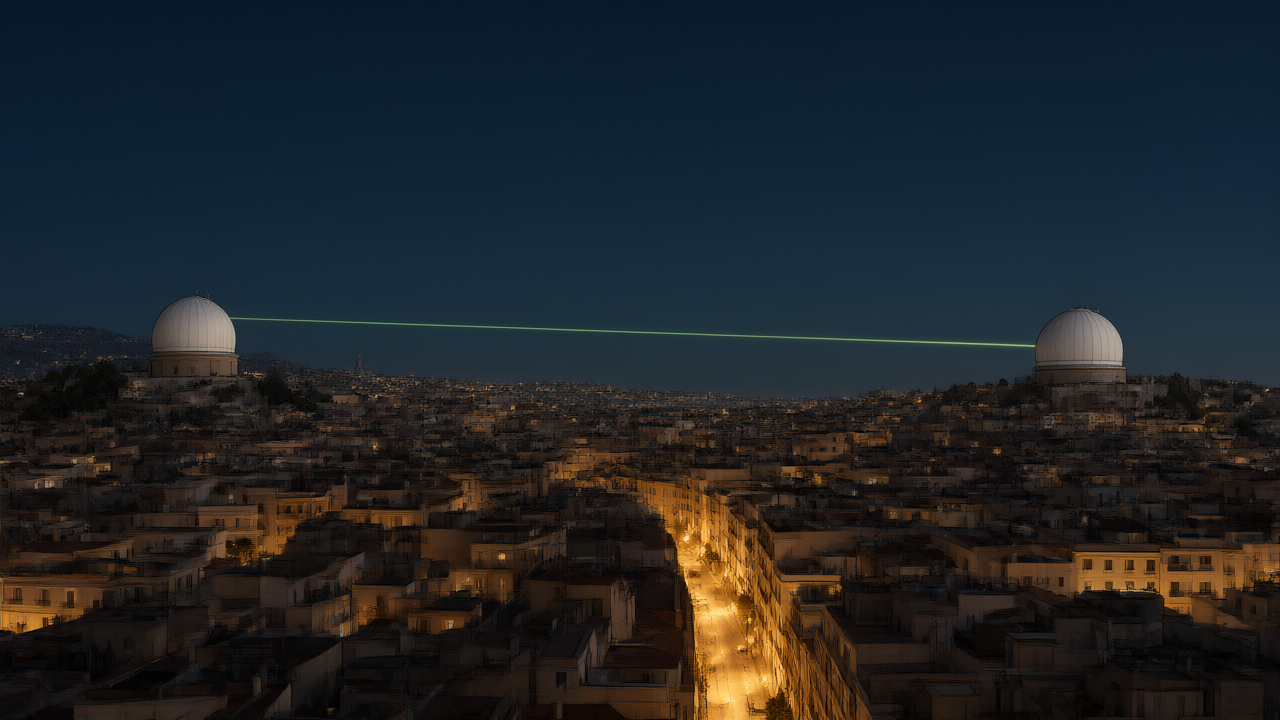
Researchers at ICFO-Institut de Ciències Fotòniques successfully implemented a free-space quantum key distribution (QKD) link covering 18.9 kilometers between Castelldefels and Barcelona. The system achieved a quantum bit error rate (QBER) of 1.31% and an attenuation of 19 dB. The team estimates an average finite-size secret key rate exceeding 11 kbit/s, demonstrating stable performance in a crowded urban environment where population densities range from 1,500 to 13,000 inhabitants per square kilometer.
Technical Details
The system operates at a wavelength of 785 nm and utilizes a decoy-state BB84 protocol with two decoy levels. Key technical specifications include:
- Hardware: Room-temperature single-photon detectors and a modular QKD transmitter.
- Infrastructure: A commercial research platform from Quantum Technology Laboratories GmbH (QTLabs), adapted for the 785-810 nm range.
- Synchronization: An independent, GPS-disciplined synchronization architecture.
- Optics: An aviation-compliant optical architecture designed to operate within the optical-emission restriction zone of Barcelona-El Prat Airport.
Notably, the receiver did not rely on adaptive optics, simplifying the overall architecture. Data collected over three months showed the system consistently operated with a QBER between 1% and 3% and attenuation between 16 and 22 dB.
Background & Context
The receiver node was hosted at the Collserola Tower, a major telecommunications hub in Barcelona, which provided direct fiber connectivity to critical infrastructure. This setup allowed the team to test the integration of a free-space link with existing fiber networks using trusted nodes.
Significance & Outlook
The modular design allows the quantum payload to connect to free-space optical terminals without requiring hardware modifications, facilitating the creation of hybrid quantum networks. By utilizing room-temperature detectors and avoiding complex adaptive optics, the system reduces costs and cooling requirements. Future research will focus on daytime performance, continuous unattended operation, and the correlation between residual pointing errors and QBER.
Source: https://quantumzeitgeist.com/icfo-ciencies-barcelona-quantum-key-exchange/
Get our weekly technology intelligence — free
Receive an infographic that lets you judge at a glance whether each field’s analysis report is worth reading.
Subscribe Free — Weekly Tech Intelligence
By subscribing, you’ll receive Troy-Technical’s weekly technology intelligence newsletter.
- Your email and selected fields are used only to deliver the newsletter.
- We never share your information with third parties.
- You can unsubscribe anytime via the link in each email.
See our Privacy Policy for details.
Takes about a minute · Unsubscribe anytime