


Key Findings
An international research team led by Associate Professor Cheng Jianfeng and Professor Li Hao of Tohoku University’s Advanced Institute for Materials Research (WPI-AIMR) has developed an integrated research system for discovering promising solid electrolytes. The framework integrates material databases, AI simulations, Large Language Models (LLMs), and automated experimentation to create a closed-loop discovery process. The findings were published in the latest issue of the journal Advanced Materials.
Technical Details
The proposed platform consists of four primary technical pillars:
- Material Database: A repository that records specific manufacturing conditions and the resulting experimental characteristics of materials to provide training data for AI.
- Machine Learning Models: Interatomic interaction models used to analyze lithium-ion movement and physical properties, aiming to predict material behavior over longer timeframes and more realistic structures than conventional calculation methods.
- LLM Integration: The use of LLMs to extract and structure data from fragmented sources, including research papers, tables, and figures, reducing the manual effort required for data organization.
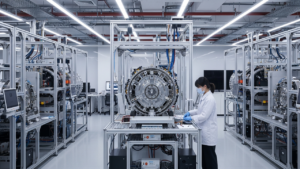
- Automated Experimentation: A closed-loop system where AI proposes candidate materials, physical models verify them, and automated experiments confirm performance. The resulting data is then fed back into the database to refine future AI suggestions.
Background & Context
Solid-state batteries replace the liquid electrolytes found in conventional lithium-ion batteries with solid electrolytes to reduce leakage and fire risks while increasing energy density. For a solid electrolyte to be viable, it must facilitate rapid lithium-ion transport while blocking electrons, maintain chemical stability at the electrode interface during charge/discharge cycles, and ensure mechanical strength and ease of manufacturing. The researchers noted that materials showing high ionic conductivity in laboratory settings often fail to maintain that performance and stability in actual battery applications.
Significance & Outlook
This shift from experience-based, repetitive experimentation to a data-driven systematic approach is expected to accelerate the development of materials for electric vehicles, portable electronics, and large-scale energy storage systems (ESS).
Source: https://www.bizwnews.com/news/articleView.html?idxno=151264
Get our weekly technology intelligence — free
Receive an infographic that lets you judge at a glance whether each field’s analysis report is worth reading.
Subscribe Free — Weekly Tech Intelligence
By subscribing, you’ll receive Troy-Technical’s weekly technology intelligence newsletter.
- Your email and selected fields are used only to deliver the newsletter.
- We never share your information with third parties.
- You can unsubscribe anytime via the link in each email.
See our Privacy Policy for details.
Takes about a minute · Unsubscribe anytime