


Key Findings
Researchers from the Cleveland Clinic Foundation, the RIKEN Center for Computational Science, and IBM Quantum have executed the largest heterogeneous quantum-classical (HQC) electronic-structure calculation to date. The simulation involved full solvated protein–ligand complexes exceeding 12,000 atoms. Compared to previous quantum-embedding benchmarks, this effort resulted in a greater than 40× increase in molecular size and an improvement in fragment energy accuracy of up to 210×.
Technical Details
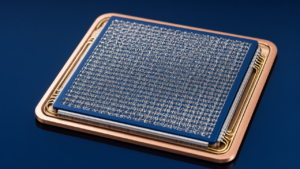
The hardware configuration paired two 156-qubit IBM Heron r2 processors with three leadership supercomputers. The team collected 3.0 billion measurement shots across 21,006 circuits. To manage the computational load, the researchers implemented the following:
- Embedded Wavefunction (EWF) Formalism: A localized approach that partitions macromolecules into spatially bounded atomic neighborhoods, reducing fragment construction costs from cubic O(M³) scaling to constant O(1) scaling per fragment.
- TrimSQD: An extension of sample-based quantum diagonalization used for heavy-atom fragments spanning 13 to 45 molecular orbitals. It iteratively filters and merges electronic configurations across distributed GPU subgroups before final subspace diagonalization.
- Workflow Automation: A Prefect-based controller orchestrated asynchronous job queues between the ROQUO supercomputer and IBM Quantum Runtime, processing 608 million measurement samples in 62.4 hours of wall-clock time.
Background & Context
Predicting drug binding requires solving the many-electron Schrödinger equation across thousands of atoms. Standard density functional theory approximations can misrank binding affinities, while full-system wavefunction methods often exceed classical memory limits. This project was supported by the U.S. National Science Foundation, the National Institutes of Health, Japan’s New Energy and Industrial Technology Development Organization (NEDO), and the MEXT Supercomputer Fugaku program.
Significance & Outlook
By bridging the gap between classical memory limits and quantum accuracy, this HQC approach allows for the simulation of significantly larger molecular systems. The integration of distributed GPU subgroups and quantum processors demonstrates a scalable pipeline for complex drug-binding simulations.
Get our weekly technology intelligence — free
Receive an infographic that lets you judge at a glance whether each field’s analysis report is worth reading.
Subscribe Free — Weekly Tech Intelligence
By subscribing, you’ll receive Troy-Technical’s weekly technology intelligence newsletter.
- Your email and selected fields are used only to deliver the newsletter.
- We never share your information with third parties.
- You can unsubscribe anytime via the link in each email.
See our Privacy Policy for details.
Takes about a minute · Unsubscribe anytime