


Key Findings
The optimized MXene–B₄C–polyimide nanocomposite achieves 100% attenuation of 50 MeV protons at a bulk thickness of 36 mm, a performance approximately fivefold higher than aerospace-grade aluminum. Simultaneously, the material provides 54.7 dB of electromagnetic interference (EMI) shielding across the X-band (8.2–12.4 GHz). These results are achieved with an areal mass reduction of approximately 81% relative to a 2.0 mm aluminum reference.
Technical Details
The material’s composition was guided by SRIM/TRIM simulations, which indicated that a boron-rich composition of 31 at% allows for the complete stopping of 50 MeV protons at 36 mm thickness, with electronic stopping as the dominant energy loss mechanism. The fabrication process utilizes solution casting and vacuum-assisted filtration to incorporate exfoliated MXene nanosheets and surface-functionalized B₄C nanoparticles (~ 45 nm).
- Composition: 20 wt% B₄C and 15 wt% MXene.
- Electrical Conductivity: 2.1 × 10⁴ S/m.
- Mechanical Properties: Retains flexibility down to a 2 mm bend radius.
- Environmental Durability: Performance is retained after 1,000 h of humidity exposure and 500 thermal cycles, aligned with RTCA DO-160G tests.
Background and Context
Flight-critical avionics at cruise altitudes are simultaneously threatened by atmospheric proton radiation and EMI. Traditional protection requires separate components: aluminum- or lead-based barriers for radiation and conductive copper-mesh shields for EMI. This fragmented approach increases the total mass, volume, and integration complexity of avionics enclosures.
Significance and Outlook
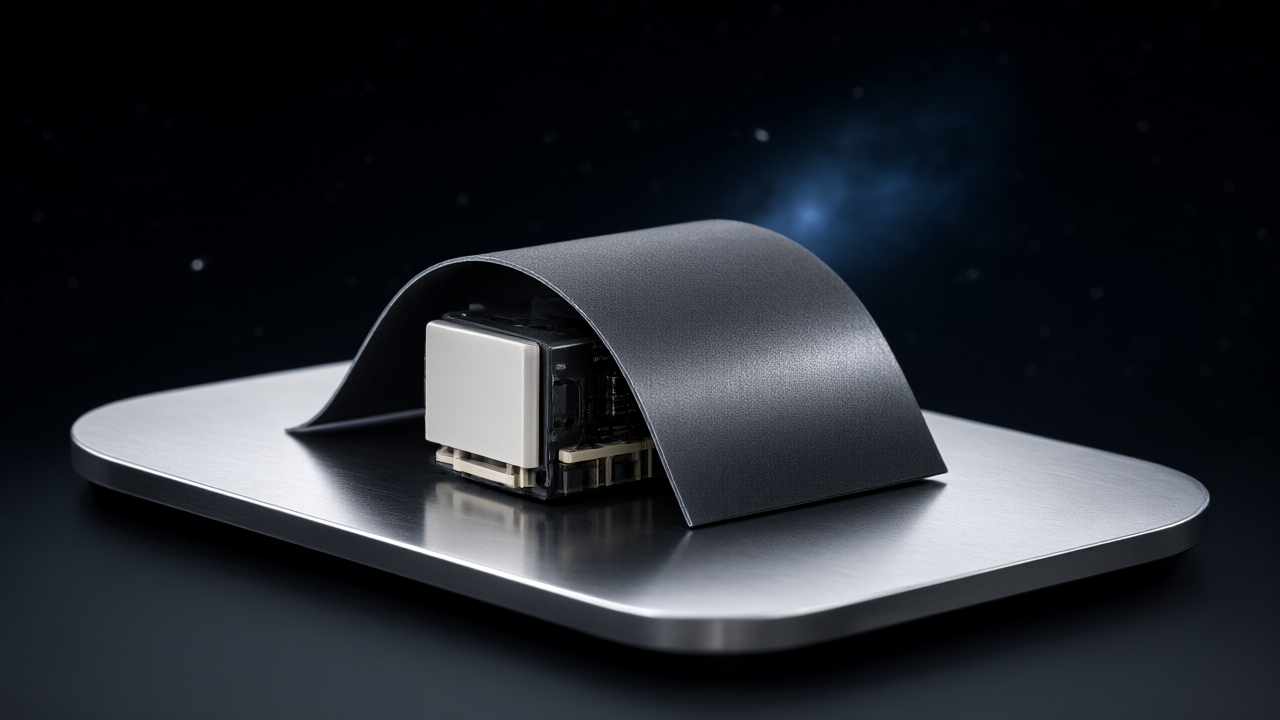
By integrating proton attenuation and EMI shielding into a single conformal material, this nanocomposite reduces the need for multiple heavy shielding layers. MCNP6.2 simulations project that this system can provide an eightfold reduction in processor radiation dose. The balance of mass efficiency, flexibility, and shielding effectiveness supports the development of lightweight, multifunctional protection for aerospace electronics.
Source: https://doi.org/10.21203/rs.3.rs-10946351/v1
Get our weekly technology intelligence — free
Receive an infographic that lets you judge at a glance whether each field’s analysis report is worth reading.
Subscribe Free — Weekly Tech Intelligence
By subscribing, you’ll receive Troy-Technical’s weekly technology intelligence newsletter.
- Your email and selected fields are used only to deliver the newsletter.
- We never share your information with third parties.
- You can unsubscribe anytime via the link in each email.
See our Privacy Policy for details.
Takes about a minute · Unsubscribe anytime